A Custom Clothing Store Paper Bags supplier comparison looks straightforward until the samples arrive. Two bags can share the same size, the same logo placement, and the same color on screen, yet one feels stiff and premium while the other creases early, drags at the handle, or opens up at the bottom seam. That gap is where most buying mistakes happen. A clothing bag is not just packaging. It is part of the store’s handoff, and customers notice more than buyers sometimes expect.
Apparel retailers have a narrow set of requirements that pull in different directions. The bag needs to carry folded shirts, hold a light knit without sagging, survive a walk to the car or subway, and still look clean enough to support the brand. That means comparing suppliers on structure, print quality, and consistency, not only on price. A quote that looks attractive can hide lighter paper, thinner reinforcement, or a handle construction that fails after a few uses. Those details matter because a bag that looks good but performs badly weakens the whole purchase moment.
How a custom clothing store paper bags supplier comparison works
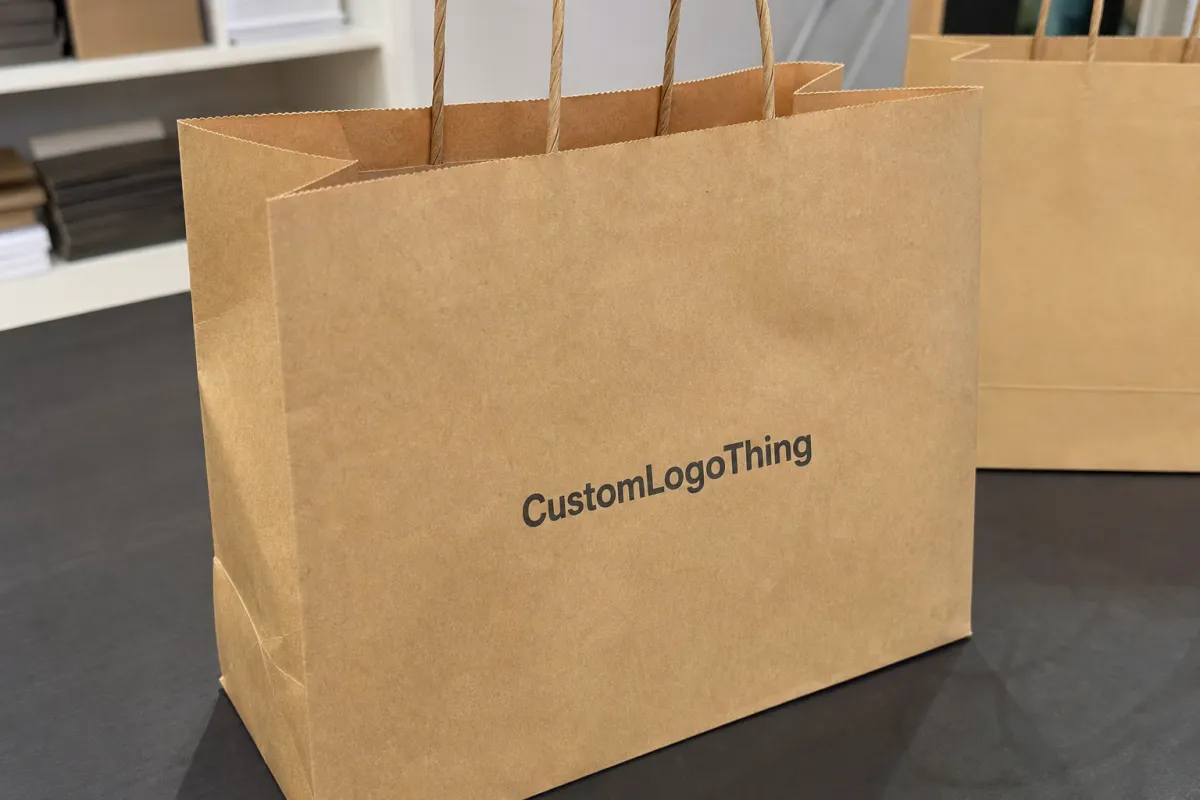
The best way to compare suppliers is to treat every quote as a specification exercise. A lot of variation hides inside seemingly small decisions: paper weight, bag construction, handle style, print method, finish, and freight terms. If the suppliers are not all pricing the exact same build, the comparison is basically noise. One may be quoting a 157 gsm board with twisted paper handles; another may be using 210 gsm board with rope handles and a reinforced top fold. Those are not equivalent bags, even if the mockups look nearly identical.
For clothing stores, the bag usually needs to do three jobs at once. It should protect the merchandise, present the brand cleanly, and feel durable in the customer’s hand. A boutique that sells minimalist basics may prefer a kraft bag with restrained print and paper handles. A premium label often wants a heavier stock, tighter print registration, and a more structured handle attachment. Neither style is universally better. The right choice depends on the product mix, the average basket size, and how much visual weight the store wants the bag to carry.
That is why the cheapest number on the page is rarely the strongest offer. If one supplier is lower by a few cents, ask what changed. Sometimes the paper is thinner. Sometimes the finish is downgraded. Sometimes the pricing excludes cartons, artwork cleanup, or inland freight. A proper comparison should cover total landed cost, not just the bag price before everything else is added.
Here is the practical lens I would use:
- Brand fit: Does the bag match the store’s positioning and product mix?
- Durability: Will it carry apparel without handle failure, bottom spread, or early scuffing?
- Quote clarity: Are setup, freight, and extras included or separated?
- Repeatability: Can the supplier match the first run on the second and third order?
If those four questions are answered well, the comparison becomes much easier. A retail bag is a visible part of the purchase, and the bag that leaves the store has to support the brand long after the register closes.
Paper stock, handles, and print finishes that change the bag
Paper stock sets the tone immediately. Kraft stock gives a more natural, less polished look and often reads as practical and honest. Coated stock is smoother and usually delivers sharper solids and cleaner logos. Matte finishes soften the appearance, while gloss can make printed areas pop, but also show fingerprints and rubbing more quickly. A buyer who says only “good quality paper” is leaving too much open to interpretation. Better to specify board weight, finish, and reinforcement in writing.
For clothing bags, paper weight often falls somewhere between 120 and 250 gsm, although the usable range depends on size, gusset depth, and what the bag needs to carry. A small bag for tees, socks, or accessories can work at the lighter end. Once the bag needs to handle sweaters, denim, or boxed items, the structure has to move up. At that point, a reinforced base insert and sturdier side gussets become less optional. A light bag can still look polished on the counter, but the real test is how it behaves once it is loaded and carried.
Handle construction changes the feel more than many buyers expect. Twisted paper handles are common because they are economical and neat. Flat paper handles are also cost-friendly and tend to sit comfortably in the hand. Rope handles feel more substantial and usually signal a higher-end retail position. Ribbon handles lean boutique and decorative, although they are not always the best choice for heavier apparel. The key is not choosing the fanciest option. The key is choosing a handle that fits the weight class of the bag and the store’s price point.
Print coverage can shift unit cost as much as the board itself. A one-color logo on kraft stock is usually the simplest route. Full-coverage graphics, dark solids, metallic inks, and edge-to-edge artwork require more setup attention and can increase waste during make-ready. Special finishes such as foil, spot UV, and soft-touch lamination can elevate the bag, but only if the brand actually needs them. A finish should solve a visual problem or reinforce positioning. If it only adds cost, it is usually the first thing to cut.
Buyers who care about fiber claims should ask for the documentation up front. If recycled content or responsible sourcing is being promoted, that claim should be backed by the relevant certification or chain-of-custody paperwork. The FSC certification and chain of custody framework is a useful reference point for that conversation. For broader packaging context, the Packaging Machinery Manufacturers Institute remains a solid technical resource.
A sample bag can look flawless flat on a table and still fail in use if the handle twists under load, the base bows outward, or the printed surface scuffs during a normal handoff at the register.
That is the real challenge in a supplier comparison. The bag has to look composed, but it also has to survive an ordinary retail day. Good packaging is usually the result of a dozen small decisions made correctly, not one dramatic feature.
Pricing, MOQ, and quote details that change unit cost
Price comparisons only become meaningful once the spec is locked. Bag dimensions, paper weight, gusset depth, handle style, print colors, finish, carton count, and shipping terms all move the final number. A plain kraft bag with one-color print might land around $0.24-$0.42 per unit at 5,000 pieces. A matte laminated bag with rope handles often climbs closer to $0.58-$1.10 per unit. Specialty finishes, heavier board, or complex artwork can push higher still. Smaller test runs of 500 to 1,000 pieces usually cost more per unit because the setup is spread over fewer bags.
MOQ is another place where quotes can look misleading. One supplier may advertise a lower unit price, but only at a larger commitment. Another may accept a smaller order and charge more per bag because the conversion work is still nearly the same. That is normal. What matters is whether the MOQ fits the store’s buying pattern. A boutique with seasonal artwork may need flexibility. A multi-location chain may care more about unit economics and can support a larger run if the artwork will stay in rotation.
| Supplier quote style | Typical MOQ | Usual unit price range | Common extra charges | Best fit |
|---|---|---|---|---|
| Simple kraft with one-color print | 1,000-3,000 | $0.24-$0.42 | Setup, freight, plate charges | Budget-conscious stores, test runs |
| Premium matte with rope handles | 2,000-5,000 | $0.58-$1.10 | Finish, handle upgrade, freight | Boutiques, higher-ticket apparel |
| High-coverage print with specialty finish | 5,000+ | $0.90-$1.80 | Artwork revisions, plates, finishing | Flagship branding, launch programs |
Look carefully at what the quote leaves out. Setup charges can range roughly from $35 to $120, depending on the print process and how much prepress work is required. Artwork fixes, carton labels, pallet prep, and inland freight may also sit outside the headline price. A quote that looks cheaper on the first line can become more expensive once the full bill is assembled.
For that reason, compare the full landed cost per usable bag. A bag that arrives with solid handle attachment, clean print, and the right hand feel is worth more than a slightly cheaper option that looks tired after one customer carry-out. The lowest price rarely wins once returns, reorders, and brand presentation are factored in.
Step-by-step guide to comparing supplier quotes and samples
Start with a single spec sheet. Put the dimensions, gusset width, paper stock, gsm, handle style, print colors, finish, quantity, and destination address in one place. If each supplier receives a different brief, the numbers will not line up cleanly. A strong custom clothing store paper bags supplier comparison depends on identical inputs. Otherwise the lowest quote may simply be the one built on the weakest assumptions.
Then ask for physical samples or, if the bag is highly customized, a close reference sample. A digital proof can confirm placement and color intent, but it will not tell you how the bag folds, whether the handle sits evenly, or how the surface reacts to normal handling. The sample should be checked with the kind of load the store will actually pack. Folded tees tell one story. A stack of denim or a boxed accessory tells another.
Several checks are worth doing every time. Inspect the handle bond, bottom insert, gusset shape, print registration, and edge finish. Look for crushing at the top fold, wrinkling near the side panels, and scuffing on dark solids. If the supplier says the bag can carry a certain weight, ask how that number was tested. A statement without a basis is not enough. For products that might face transit stress as well as store use, ISTA testing standards are a useful reference for understanding how packaging is measured under movement and vibration.
Proofing deserves its own review. Some suppliers provide a simple mockup, while others walk through a more detailed prepress check with bleed, safe zones, and Pantone targets. Either can work if the process is clear. The concern is ambiguity. If no one can explain how file changes are tracked, what color tolerance is acceptable, or who approves the final proof, that is a risk. That sort of gap usually appears later as a delay or a reprint.
A compact scorecard keeps the decision grounded. I would score each supplier on these five items:
- Quote clarity
- Sample quality
- Responsiveness
- Lead time accuracy
- Reorder consistency
Once the list narrows, ask about substitutions, tolerance ranges, and backup production capacity. Those questions matter more than they seem. A supplier that can explain how they keep paper tone and print density stable across runs is usually the safer choice. A vague answer at this stage tends to become a problem later.
Process and lead time from artwork approval to delivery
Lead time is not just transit. It starts with artwork review, moves through proof approval, then material sourcing, printing, converting, packing, and shipping. A supplier using stock paper and standard handles may move faster than one sourcing a special board or a custom handle color. For many custom Retail Paper Bags, a realistic production window is often 12-15 business days from proof approval, with freight added on top depending on the route and shipping method.
Rush orders are possible, but they tighten every tolerance. Less time means less room for corrections. If the file arrives with missing bleed, if the color reference is unclear, or if the bag structure has not been fully confirmed, the schedule can slip immediately. A good supplier breaks the timeline into stages: sample delivery, proof sign-off, production, packing, dispatch, and estimated arrival. That makes it easier to see where a delay can still be corrected instead of discovered too late.
Communication checkpoints matter more than many buyers assume. Confirm the artwork format, the final color reference, carton count, pallet needs if relevant, and shipping method before production starts. If the order has to arrive with tissue, labels, or inserts for a collection launch, line up those dates together. Split delivery windows create avoidable work at the store level and make the packaging program feel less coordinated.
Transparent process is often the quickest way to judge reliability. The supplier that can explain a production path clearly usually has fewer surprises hidden in the run. That does not make the order risk-free, but it does reduce the odds of a late scramble.
Common mistakes when comparing retail paper bag suppliers
The most common mistake is choosing on unit price alone. A cheaper bag can hide thinner paper, weaker handle bonding, or surprise freight that wipes out the saving. Another mistake is comparing quotes that are not actually identical. One supplier may quote a smaller size, fewer print colors, or a different finish, and the numbers look attractive only because the spec has been softened.
Skipping samples causes trouble quickly. A render can hide weak gussets, poor crease memory, or color drift on dark backgrounds. Clothing store bags need to feel dependable because the customer carries the bag through public space. If it feels flimsy, the brand feels flimsy too. That impression is hard to reverse, especially for higher-ticket apparel.
Artwork errors create another set of delays. Low-resolution files, missing bleed, and poor color references slow the process and often create unnecessary revisions. Packaging and visual discipline belong together. If the supplier has to chase basic corrections, the timeline stretches and the budget expands. A clean file package saves more than time; it protects the launch date.
Reorder consistency is easy to ignore on the first order and impossible to ignore on the second. Paper tone can drift. Handle color can shift. Print density can vary if the supplier does not control the process closely. A strong comparison should ask whether the supplier can repeat the same finish, the same color, and the same feel on later runs. A great first shipment means little if the next order arrives looking like a different product.
Expert tips and next steps for a cleaner shortlist
A weighted decision matrix is useful because it stops price from taking over the entire conversation. Give more weight to fit, durability, sample match, and communication than to unit price alone. For a clothing store, the bag sits in public view, often in photos, mirrors, and customer hands. Its appearance is part of the brand system, even if the bag gets thrown away later.
Ask for a written spec confirmation before payment. It should list paper weight, finish, handle type, print colors, carton count, and any agreed tolerances. That document becomes the reference point if something needs to be checked later. It also speeds up reorders, which matters when seasonal art changes quickly or opening dates are fixed.
If the budget is tight, compare one value option and one premium option side by side. Load both with folded apparel and carry them for a short distance. The differences usually show up fast in handle comfort, stiffness, sound, and visual presence. A few cents can separate two quotes. The customer experience can separate them much more sharply.
Before approving the order, confirm the delivery window, shipping method, and backup contact. If freight shifts or a file issue appears, you want a direct line to someone who can act. The best supplier is usually the one that gives the clearest answers, the most stable samples, and the most transparent total cost. Keep that checklist, and reuse it on the next bag run or the next Custom Packaging Products order.
That is the practical value of a custom clothing store paper bags supplier comparison: fewer surprises, tighter cost control, and packaging that supports the garments instead of fighting them.
What should I compare first in a custom clothing store paper bags supplier comparison?
Start with the spec sheet: size, paper weight, handle style, print coverage, and finish. Then compare sample quality and quote clarity so you are not judging mismatched versions of the same bag. Make sure each supplier is pricing the same quantity, freight method, and carton configuration.
How do I know if a paper bag quote is really competitive?
Check whether the quote includes setup fees, artwork changes, cartons, and freight. Compare the landed cost per usable bag, not only the headline unit price. Confirm that the paper stock, handle build, and finish are truly equivalent across suppliers.
What MOQ is typical for custom clothing store paper bags?
MOQ depends on bag size, print complexity, and the supplier’s conversion setup. Simple designs often allow lower minimums, while specialty finishes or custom handles usually require more volume. Ask whether the supplier can quote both a test run and a full production run so you can compare the economics.
How long should lead time be for custom retail paper bags?
Lead time usually includes proof approval, production, and shipping, so ask for each stage separately. Special paper, multiple colors, or rush freight can extend the schedule and raise cost. A reliable supplier should give you a realistic window, not a hopeful estimate.
What sample checks matter most for clothing store bags?
Inspect handle strength, bottom reinforcement, and how the bag folds when loaded with apparel. Check print alignment, color match, and whether the finish scuffs during normal handling. Compare the feel in hand, because retail packaging has to support the brand as well as the product.

