A plain T-shirt can read as a budget blank, a boutique basic, or a premium retail product before anyone reaches the hang tag. Often the difference is a small label at the neck or side seam. Custom clothing tag labels are tiny trims, but they expose weak planning fast: scratchy edges, unreadable care text, the wrong fold, poor color contrast, or a label that arrives after the sewing line is ready.
Good labels do more than carry a logo. They identify the maker, organize sizing, communicate care, support retail packaging, and make the product feel finished. From a packaging buyer’s view, they sit beside hang tags, belly bands, branded tissue, mailers, and Custom Printed Boxes. Small signals, yes. But small signals are how customers decide whether a brand has its details under control.
What Clothing Tag Labels Actually Do for a Garment
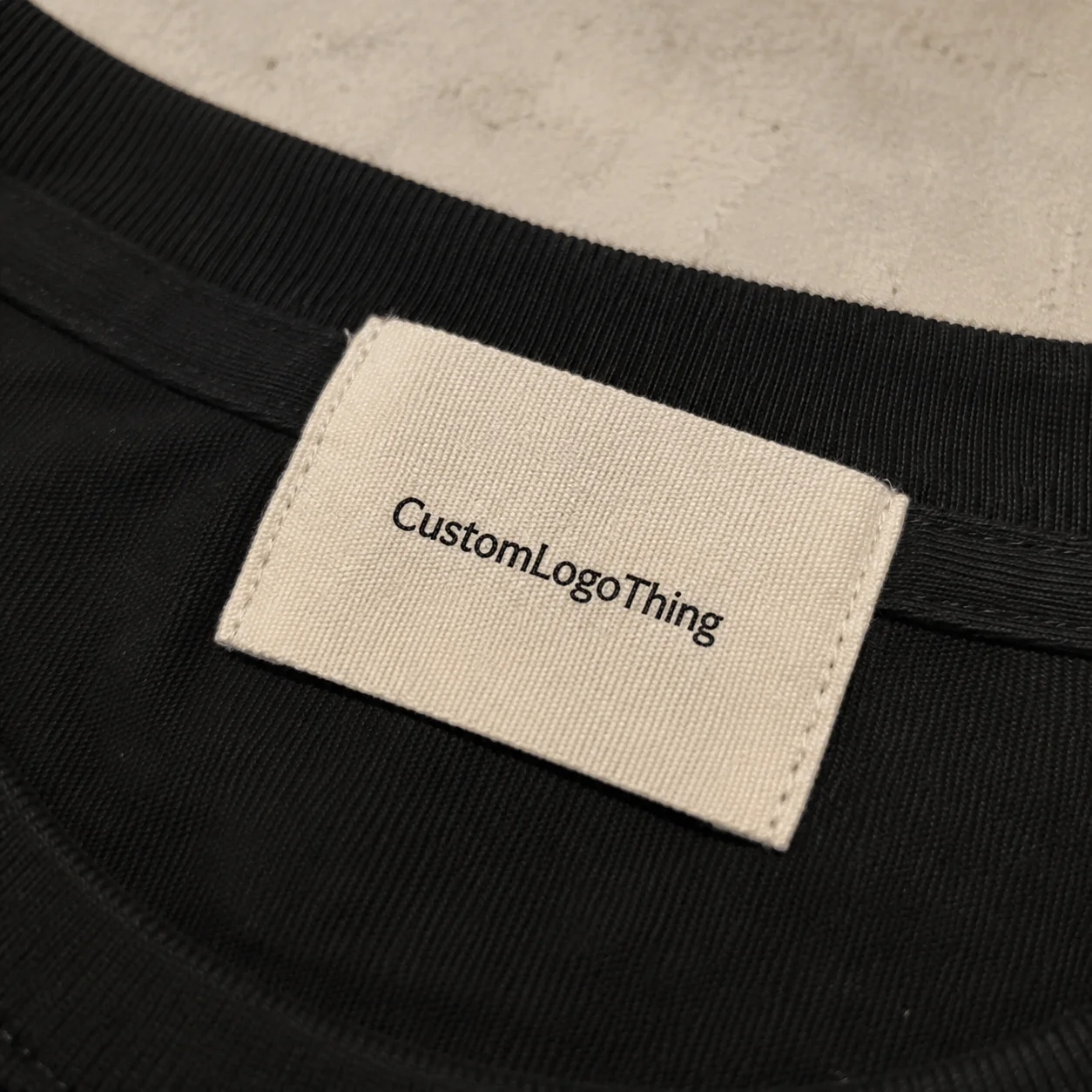
A clothing label usually has two jobs: branding and information. The brand label builds recognition and perceived value. The compliance or care label carries practical data such as size, fiber content, washing instructions, country of origin, RN numbers, importer details, safety warnings, and care symbols, depending on the product category and selling market.
Those jobs can share one layout, but cramming everything onto a 25 mm neck label rarely works. A clean woven logo label at the neck and a longer printed care label in the side seam usually gives a better balance of appearance, comfort, and readability. For a hoodie, denim jacket, or canvas tote, a thicker woven patch can look intentional. For lightweight activewear, a heat transfer mark may be better because the wearer does not feel a sewn-in tag.
Placement drives the specification. Neck labels need a soft hand, smooth edges, and a low profile. Waistband labels need abrasion resistance. Coat labels have more room, so care text can be larger. Sleeve patches need stronger contrast because they become part of the visible design rather than hidden product information.
Labels are one of the quickest ways to spot whether a garment was planned as a retail product or assembled late. They affect shelf appeal, product photos, unboxing, returns, resale listings, and the way a customer describes the garment to someone else. A sharp label will not rescue a poorly made shirt. A poor label can absolutely cheapen a well-made one.
Practical callout: If the label touches skin, judge it by feel first and artwork second. A beautiful label that irritates the neck will not stay in the garment for long.
How Label Materials, Weaves, and Prints Work
Most apparel labels fall into three production families: woven, printed, and heat transfer. Each has a different strength. The right choice depends on garment fabric, label purpose, artwork complexity, laundering conditions, and where the trim sits on the body.
Woven labels are made by interlacing polyester threads on narrow looms to form the logo, letters, and background. They are durable, washable, and strong for brand marks with clean contrast. Damask is the usual premium option because it holds fine detail and feels smoother than many lower-cost weaves. Satin has a glossy face and soft hand, though very small text may not remain as crisp. Taffeta is more economical and slightly crisper, which can be acceptable for outerwear, bags, or non-skin-contact use.
Printed labels use ink on cotton, polyester, satin, nylon, or similar tape. They suit care instructions, QR codes, multi-language text, fiber content, size runs, and artwork with many colors or gradients. If a side-seam label needs 12 wash symbols, importer information, and three language blocks, printing usually beats weaving. The questions to ask are direct: Will the ink survive the expected wash cycle? Does the tape stay soft? Will the print remain readable after abrasion?
Heat transfer labels are applied directly to the garment with heat and pressure. They are common for tagless T-shirts, performance apparel, and kidswear because they reduce irritation. They are not universal. Fabric content, stretch, dye migration, application temperature, dwell time, pressure, and wash cycle all matter. A transfer that performs well on a 100% cotton tee may fail on a high-stretch polyester-spandex blend.
| Label Type | Best Use | Typical Strength | Buyer Watch-Out |
|---|---|---|---|
| Damask woven | Premium brand labels, neck labels, patches | Fine detail, durable thread construction | Tiny lettering still needs minimum height, often 1.5-2 mm or larger |
| Printed satin or polyester | Care labels, size labels, multi-language content | Good for small text and changing information | Ink and tape must be matched to wash conditions |
| Heat transfer | Tagless neck marks, activewear, kidswear | Low profile and soft feel | Requires fabric compatibility and application testing |
| Woven patch | Outerwear, denim, beanies, bags | Strong visual branding | Can be too thick for lightweight knits |
Fold and edge choices matter more than many first-time buyers expect. A straight-cut label lies flat but may need edge control. End fold labels tuck the left and right edges under before sewing. Center fold and loop fold labels are common in neck seams and hems. Book fold, mitre fold, and Manhattan fold solve specific presentation and attachment needs. Each option changes the visible size, seam allowance, and how the label behaves inside the garment.
There are real production limits. Very tiny lettering, low-contrast thread colors, distressed logos, metallic yarns, thick coatings, and stretchy fabrics all need testing. A label has to survive sewing, steaming, folding, warehouse handling, and repeated washing. It also has to sit visually with the hang tag, mailer, and retail packaging rather than looking like a trim ordered from a different brand system.
Key Specs to Decide Before You Request Samples
Before asking for samples or pricing, define the label’s job. A small neck brand label may only need a logo and size. A side-seam care label may need enough width and length for fiber percentages, country of origin, washing symbols, importer details, and a lot code. Those are different constructions, even if both are called labels.
Start with finished size. Common brand labels might be around 25 x 50 mm, 30 x 60 mm, or 40 x 40 mm, though the best size depends on the garment and artwork. Care labels often run longer, sometimes 20-35 mm wide and 60-120 mm long, especially when multiple languages are required. Confirm whether dimensions refer to the finished visible label or the flat piece before folding. That single misunderstanding can throw off sewing allowance.
Artwork should be production-ready. Vector files such as AI, EPS, or editable PDF are preferred because edges scale cleanly. Pantone references, thread color targets, minimum text height, safe margins, and a simplified one-color logo version help prevent fuzzy output. If the logo has hairline strokes or distressed texture, ask whether a simplified label version should be created. Artwork that looks polished on a website header may not weave cleanly at 30 mm wide.
Comfort is a spec, not a finishing touch. T-shirts, kidswear, intimates, sleepwear, and activewear usually need softer materials and smoother edges. Outerwear, denim, caps, and bags can tolerate heavier woven labels or patches. If the label touches skin, request the softest compatible construction and test it after washing, not only when it is new.
Color and contrast need a practical eye. Dark text on a light ground or light text on a dark ground reads better after weaving, printing, and laundering. Tone-on-tone labels can look elegant on premium apparel, but they often sacrifice legibility. If the label carries compliance text, readability wins over subtle branding.
State durability requirements early. Hot laundering, sweat, dry cleaning, abrasion, outdoor use, chlorine exposure, and industrial washing can change the correct material and ink system. For paper-based hang tags and packaging, the Forest Stewardship Council is a useful reference for sourcing claims. Sewn textile labels need their own material documentation and performance testing.
- Artwork: vector logo, Pantone or thread references, simplified small-scale version.
- Construction: woven, printed, heat transfer, patch, or combined label system.
- Finish: straight cut, end fold, center fold, loop fold, book fold, mitre fold, or Manhattan fold.
- Packing format: rolls, cut pieces, folded pieces, transfer sheets, or sorted size bundles.
- Use condition: skin contact, hot wash, dry clean, outdoor abrasion, or industrial laundering.
Packing format affects the sewing floor. Labels on rolls may feed quickly for certain setups. Cut-and-folded labels can save handling time if the apparel factory is ready for that format. Heat transfers must be packed so operators can identify size, placement, and orientation without stopping to decode the sheet.
Process and Timeline from Artwork to Finished Labels
The path for custom labels is simple on paper: inquiry, artwork review, spec confirmation, digital proof, material selection, sample or strike-off, approval, bulk production, quality inspection, packing, and shipping. The trouble usually starts when one of those steps is skipped or treated as administrative.
During artwork review, the supplier checks logo complexity, color count, label size, fold type, seam allowance, text legibility, and production method. Sometimes woven is the right answer. Sometimes the artwork is so text-heavy that printing is cleaner and cheaper. A useful review flags those tradeoffs before sampling, not after the bulk run is packed.
A strike-off is a physical pre-production sample showing actual thread, print, cut, fold, backing, and hand feel. It is worth considering for premium garments, rebrands, first-time label orders, skin-contact labels, or any label carrying compliance text. Screen proofs are useful for layout. They cannot tell you whether a label is scratchy, too thick, too shiny, or hard to sew.
Timelines vary, but buyers should plan in working days. Digital proofing may take 1-3 business days after usable artwork arrives. A physical sample can add 5-10 business days depending on material and shipping. Bulk production may run roughly 7-15 business days for many straightforward woven or printed label orders after approval. Complex folds, specialty yarns, grouped care versions, or large quantities can take longer. Freight adds another layer.
Labels should be ordered before garment production reaches the sewing stage. Missing trims can hold up an entire apparel run even when fabric is cut, thread is ready, and operators are available. It is a common planning failure: the main fabric gets attention first, then a 30 mm label becomes the reason finished goods cannot move.
To reduce delays, provide final artwork early, approve proofs promptly, consolidate size runs where practical, confirm placement with the sewing factory, and avoid changing fiber content or care text after sampling. For shipping validation on larger packaging systems, groups such as ISTA provide testing frameworks for transport packaging. Garment label performance still needs garment-level sewing and wash checks.
Cost, MOQ, and Quote Factors Buyers Should Expect
Label pricing is driven by setup, material, size, color count, production method, finishing, quantity, sorting, and shipping. A quote needs more than a logo file. For accurate pricing on custom clothing tag labels, provide finished dimensions, fold style, material preference, quantity, deadline, destination, and artwork.
Woven label costs rise with finer damask construction, more thread colors, larger dimensions, metallic yarns, special folds, adhesive backing, iron-on backing, and edge finishing. Printed label costs depend on tape choice, ink system, color count, wash-fastness requirement, cutting, folding, roll format, and whether multiple sizes or care versions are grouped into one production run.
MOQ exists because setup takes time. Machines have to be loaded, artwork converted, thread or tape prepared, cutting and folding arranged, and packing checked. Even if the label is only 35 mm wide, the production setup is not tiny.
As a planning range, simple printed care labels and premium damask woven brand labels can land in very different cost brackets, and freight can distort small orders. A 500-piece order often carries a much higher unit cost than a 5,000-piece order because setup is spread across fewer labels. Larger runs usually reduce per-label cost, but they also require inventory discipline. Size, fiber content, origin details, and seasonal branding can change by style.
| Quote Factor | Typical Impact | Practical Buyer Detail |
|---|---|---|
| Quantity | Higher quantities usually lower unit cost | Ask for 1,000, 2,500, 5,000, and 10,000-piece price breaks if inventory allows |
| Label size | Larger labels use more material and loom or print time | Separate brand labels from care labels instead of overcrowding one piece |
| Color count | More colors can increase setup and production complexity | Use 1-3 strong colors for woven logos when possible |
| Fold and finish | Special folds add handling and quality checks | Confirm fold diagrams with the sewing factory before ordering |
| Backing | Adhesive, iron-on, or heat seal backing can add cost | Test backing on actual garment fabric before bulk use |
For a clean quote request, include label type, finished size, fold style, quantity, artwork file, color references, material preference, backing, packaging format, shipping destination, and required arrival date. If the same launch also needs hang tags, mailers, or Custom Packaging Products, discuss them together so color, finish, and brand hierarchy stay consistent across the retail presentation.
Common Mistakes That Make Apparel Labels Look Cheap
The most common mistake is shrinking a detailed logo too far. Fine lines, thin serif type, tiny icons, gradients, and distressed textures often lose clarity at label scale. A logo that is beautiful on a 100 mm hang tag may be unreadable on a 20 mm woven tab. Simplify early.
The second mistake is ignoring comfort. A stiff cut edge, scratchy yarn, heavy backing, or poor placement can make a customer cut the label out immediately. Once that happens, your brand mark is gone from the garment. If the label sits in the neck, test it on the actual garment and wash it before approval.
Poor contrast and overcrowding cause a different kind of damage. Care instructions squeezed into a tiny area may become useless after laundering, and a brand mark surrounded by legal text rarely feels premium. Give each label enough room to do its job. If needed, use a brand label, a size tab, and a separate care/content label rather than one overloaded piece.
Compliance shortcuts can create bigger trouble than appearance issues. Guessing care symbols, omitting fiber percentages, using unclear country-of-origin wording, or mixing importer text with branding without enough space may create retail, customs, or customer-service problems. Requirements depend on market and product category, so confirm legal text with qualified compliance guidance rather than treating it as decoration.
Sewing issues are another quiet cost. Labels without enough seam allowance slow operators down. Labels delivered in the wrong fold may need rework. Thick labels on lightweight knits can cause puckering. Heat transfers applied with the wrong temperature or pressure can crack, peel, or mark the fabric. These are not design problems on a screen; they are production problems on the floor.
Approving only a screen proof is risky for sensitive projects. Physical sampling is often worth it when softness, color, wash durability, or premium presentation matters. For a coordinated launch, check label samples beside hang tags, mailers, and retail packaging so the full system feels deliberate.
Next Steps for Choosing and Ordering the Right Label
Start with the label’s role, then choose the construction. Is it a visible brand feature, a quiet neck identifier, a size marker, a compliance label, or part of a broader product packaging system? Once that role is clear, it becomes easier to choose woven, printed, heat transfer, patch, or a combination.
A simple label matrix helps. Create one row for the brand label, one for the size label, one for the care/content label, and one for any hang tag or packaging tie-in. Add quantity, placement, finished size, fold, material, color, and deadline. It can take 20 minutes and prevent days of back-and-forth once production starts.
| Label Component | Information Needed | Common Placement | Best Production Fit |
|---|---|---|---|
| Brand label | Logo, brand name, optional size | Neck, hem, sleeve, exterior patch | Woven damask or printed satin |
| Size label | S, M, L, numeric size, or region sizing | Neck seam or side seam | Printed or small woven tab |
| Care/content label | Fiber content, origin, care symbols, importer text | Side seam or waistband | Printed polyester, satin, or nylon tape |
| Hang tag pairing | Price, barcode, story, QR code, sustainability note | Attached by string, pin, or loop | Custom Labels & Tags with coordinated paper stock |
Prepare a small spec packet before requesting pricing: logo file, finished label dimensions, color references, garment fabric, label location, fold style, quantity, launch date, and any required care or origin text. If the best construction is unclear, share garment photos and fabric content. A supplier can recommend a practical direction faster when they can see whether the garment is a heavyweight hoodie, ribbed tank, satin scarf, or stretch performance top.
Testing is simple and valuable. Sew the label into the real garment. Wash it. Check edge comfort. Photograph it for e-commerce. Confirm the sewing factory can apply it without slowing the line. If the garment uses Custom Printed Boxes, tissue, mailers, or other retail packaging, place all samples together and check whether color, finish, and tone belong to one brand system.
Before ordering custom clothing tag labels, confirm the artwork, label role, comfort requirement, compliance text, production timeline, and target unit cost. A label is a small trim with a large job: it should support the garment, protect the production schedule, and make the finished piece feel ready for a real customer.
FAQ
What are the best custom clothing tag labels for T-shirts?
Soft woven damask labels, printed satin labels, and heat transfer labels are common choices for T-shirts. For neck placement, prioritize softness, low-profile edges, and a label size that does not rub during wear. For side seams, printed care labels are often more practical because they handle fiber content, wash symbols, and origin text cleanly. If the shirt is lightweight or worn against sensitive skin, sew and wash a sample before approving bulk production.
How much do custom apparel labels usually cost?
Cost depends on label type, size, quantity, color count, fold style, backing, sampling, sorting, and shipping. Woven labels usually become more cost-efficient at higher quantities because setup is spread across more pieces. Printed care labels can be economical for text-heavy layouts, especially when multiple sizes or care versions are planned together. For a useful quote, ask for price breaks at several quantities instead of pricing only one run size.
What file format is best for custom clothing labels?
Vector files such as AI, EPS, or editable PDF are preferred because they scale cleanly and allow accurate production setup. High-resolution PNG or JPG files can help as visual references, but they are usually not ideal as the only production artwork. Include Pantone numbers, thread color references, or brand color standards if color consistency matters across labels, hang tags, and packaging.
How long does it take to produce custom garment labels?
Timeline depends on proof approval, sampling needs, material choice, order quantity, finishing, and shipping method. A digital proof may be quick, but a physical strike-off adds time and reduces risk for premium garments or first-time label orders. The safest planning habit is to order labels before garment sewing begins so missing trims do not delay final assembly.
Should I choose woven, printed, or heat transfer clothing labels?
Choose woven labels for durable brand marks and a premium sewn-in look. Choose printed labels for care instructions, fine text, multiple sizes, QR codes, or detailed compliance information. Choose heat transfer labels when a tagless feel is the priority, but confirm fabric compatibility, application settings, stretch behavior, and wash durability before using them in bulk.