Buyer Fit Snapshot
| Best fit | Custom Cmyk Labels for Packaging projects where brand print, material claims, artwork control, MOQ, and repeat-order consistency need to be specified before quoting. |
|---|---|
| Quote inputs | Share finished size, material target, print colors, finish, packing count, annual reorder estimate, ship-to region, and any compliance wording. |
| Proofing check | Approve dieline scale, logo placement, barcode or warning zones, color tolerance, closure strength, and carton packing before bulk production. |
| Main risk | Vague material claims, crowded artwork, missing packing details, or unclear freight terms can make a low unit price expensive after revisions. |
Fast answer: Custom Cmyk Labels for Packaging: Material, Adhesive, Artwork, and MOQ should be specified like a repeatable production item. The safest quote records material, print method, finish, artwork proof, packing count, and reorder notes in one written spec.
Production checks before approval
Compare the actual filled-product size with the drawing, then confirm tolerance on folds, seals, hang holes, label areas, and retail display edges. Reserve space for logos, QR codes, warning copy, and material claims before decorative graphics fill the panel.
Quote comparison points
Review material grade, print process, finish, sampling route, tooling charges, carton quantity, and freight assumptions side by side. A quote is only useful when the supplier can repeat the same color, closure quality, and packing count on the next order.
Custom CMYK Labels for Packaging: How to Get Color Right
A label can look vivid on a monitor and still land on shelf looking dull, muddy, or just slightly off. That mismatch is not usually a design failure. It is a translation problem. Screen light becomes ink, and ink behaves differently depending on stock, finish, press type, and even the shape of the container. That gap is exactly where custom cmyk labels for packaging matter most, because they give brands a controlled path from digital artwork to printed packaging without pretending color is some kind of magic trick.
Packaging teams run into that reality fast. One person approves a proof, another wants a copy change, a third asks for a seasonal version, and production still needs labels that read clearly on a bottle, pouch, carton, or jar. Custom cmyk labels for packaging sit right in the middle of that pressure. They are useful because they let brands move quickly while keeping the visual system intact, which is a lot harder than it sounds. I have seen launch calendars slip a full week over a single label revision, and honestly, that kind of delay is usually avoidable.
CMYK is a process, not a promise. Cyan, magenta, yellow, and black can reproduce a broad range of color, but they cannot perfectly duplicate every Pantone swatch or every painted package panel. The smarter question is narrower: how close does the color need to be, on what substrate, in what quantity, and with what timeline? That question usually tells you more than a glossy sales deck ever will. It also explains why custom cmyk labels for packaging are ideal for some programs and a poor fit for others.
What Are Custom CMYK Labels for Packaging?
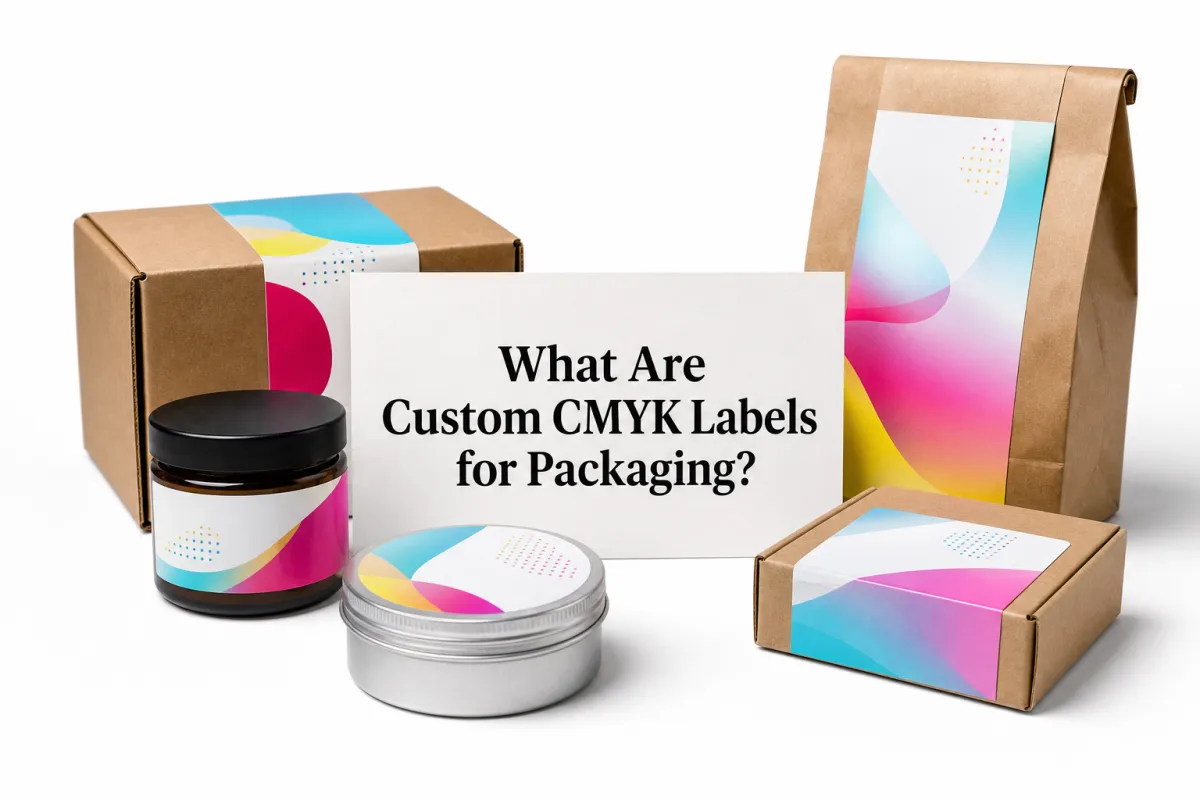
CMYK stands for cyan, magenta, yellow, and black. Those four inks are layered in small percentages to build images, text, gradients, and brand fields across the label. Put simply, custom cmyk labels for packaging are printed with process inks rather than a single pre-mixed spot color. The press creates the final appearance by combining those channels in varying amounts, much like many forms of digital printing and a fair amount of process-driven offset printing.
That approach fits brands that need speed and flexibility. Short-run launches, seasonal packaging, limited-edition retail packaging, test-market pouches, multi-flavor product lines, and products with frequently changing ingredient panels all benefit from that setup. In those cases, custom cmyk labels for packaging often make more sense than paying for a dedicated ink mix every time the copy changes by a few lines. They are especially useful when a label family needs to evolve across several SKUs without breaking visual continuity.
Substrate is the other half of the story. Ink does not behave the same way on every surface. Paper stock, BOPP film, clear film, adhesive type, and finish all shape the final result. A matte paper label absorbs light differently from a gloss polypropylene film. A clear label on a transparent bottle can let the container color show through, which changes how the artwork reads. The same file can look warmer, darker, sharper, or flatter depending on the stock. In practice, custom cmyk labels for packaging are a system of substrate, ink, finish, and application - not just a color file.
Custom cmyk labels for packaging also appeal to brands that want design flexibility without loading up inventory. A startup may need 500 labels for a scent test. A larger brand may need 10,000 labels across four SKUs with only modest copy changes. That flexibility is one of the main reasons buyers choose custom cmyk labels for packaging over more rigid print methods. It also helps when packaging needs to be refreshed before a full redesign cycle, which happens more often than teams like to admit.
CMYK does have limits, and those limits matter. Photographic detail, gradients, soft backgrounds, and most brand graphics print well. Exact color matching is a different question. If a brand relies on a precise red, a metallic-looking teal, or a deep blue that has to stay identical across Custom Printed Boxes, inserts, and labels, spot colors may still be the safer choice. Custom cmyk labels for packaging can look excellent, but they are not the best answer for every color-critical job.
That distinction matters in packaging sales because buyers often compare labels against cartons, sleeves, and other brand elements. A label can look polished on its own and still sit a little out of step next to a rigid carton printed by a different process. That is not a defect. It is a production reality. Once products hit a retail shelf beside competitors with tighter visual alignment, the difference becomes easier to see. For that reason, custom cmyk labels for packaging should be reviewed beside the rest of the package, not in isolation.
How Are Custom CMYK Labels for Packaging Printed?
The production flow usually starts with the file, not the press. A printer reviews dimensions, bleed, safe zones, image resolution, color setup, and the intended application before anything is manufactured. If the file is clean, custom cmyk labels for packaging move into proofing, then press setup, then printing, drying or curing, finishing, die-cutting, and final inspection. Skip one step too casually, and the result usually shows it. For custom cmyk labels for packaging, the proofing stage is where most avoidable problems surface.
From file to proof
Most suppliers begin with a digital proof. That proof is useful for layout, spelling, barcodes, copy fit, and dieline alignment. It is not a true substitute for the final printed label, because screens emit light while paper and film reflect it. A monitor can make a blue look brighter and a gray look cleaner than the printed label will ever appear in hand. For custom cmyk labels for packaging, a press proof or material proof gives a far more realistic expectation when color is critical. It is also the best way to judge how the labels behave on the chosen stock.
Good printers manage color with profiles, calibration, and press checks. They are not guessing. They are measuring. Process control keeps the cyan, magenta, yellow, and black values stable enough that repeat runs stay close to the approved target. With disciplined workflow, custom cmyk labels for packaging can be remarkably consistent across reorders, although that consistency still depends on the same substrate, the same press settings, and the same finishing method. That is why repeatability matters so much for larger product families.
Digital printing and flexographic printing
Many label jobs are produced on digital presses because they are efficient for shorter quantities and frequent artwork changes. Digital printing is often the more flexible choice when a brand wants fast revisions, multiple versions, or lower setup costs. Flexographic printing can be more economical for larger runs and repeat orders with stable artwork. Neither method is automatically better. The right answer depends on quantity, image complexity, and how often the label changes.
That difference matters for custom cmyk labels for packaging because press type influences both cost structure and repeatability. Digital presses can make proof-to-production transitions easier, while flexo can shine on larger volumes with consistent art. Some buyers compare the label process to offset printing because both can deliver strong detail, but labels usually require different handling since adhesives, liners, die-cutting, and roll orientation all enter the equation. For custom cmyk labels for packaging, the press choice affects both image behavior and operational fit.
Drying or curing follows print, and it affects color more than many buyers realize. Ink that is still settling can look slightly different from fully cured ink. Finishing comes next: gloss varnish, matte laminate, or soft-touch coating. After that, the label is die-cut, matrix-stripped, rewound, and inspected. If the label is intended for application on automated lines, roll direction and core size matter too. A small oversight there can create application headaches long after approval is signed off.
A label should not just look good in a PDF. It should survive the trip from file to press to shelf with its color logic intact.
One more practical point: custom cmyk labels for packaging are often only one part of the broader presentation system. Many brands pair them with Custom Packaging Products or coordinate them with Custom Labels & Tags so the bottle, box, and point-of-sale materials feel like one family. That coordination can make retail packaging read more polished without pushing the budget into premium embellishment territory.
For transport and durability questions, testing standards matter. Packaging teams often look at distribution and package-performance methods from groups like ISTA when they need to think beyond appearance and into shipping stress, abrasion, and handling. Labels are small, but they still live in the real world. That is especially true for custom cmyk labels for packaging that must hold up during long transit cycles.
Key Factors That Affect Color, Finish, and Readability
If two people order custom cmyk labels for packaging from the same file, they may still get a different visual result. That sounds frustrating until the variables are laid out. Substrate, finish, label size, adhesive, and the shape of the application surface all change how the ink appears. The file may be identical. The optics are not. For custom cmyk labels for packaging, that is the core reason material selection matters as much as design.
Substrate choice is usually the first major variable. Coated paper tends to give a softer, more absorbent look. BOPP film often produces sharper graphics and stronger moisture resistance, which is useful on personal care, beverage, or household product packaging. Clear film can make white type disappear if it is not backed correctly. Textured papers can add a premium feel, but they also reduce fine detail and can make small reverse type harder to read. Custom cmyk labels for packaging need substrate selection to be part of the color decision, not an afterthought.
Finish changes perceived color
Gloss finish usually makes colors look deeper and more saturated because it reflects light cleanly. Matte finish lowers glare and can make colors feel calmer or slightly muted. Soft-touch adds a premium tactile impression, but it also tends to reduce apparent contrast. That can work beautifully for luxury branded packaging and badly for tiny text fields. If a brand wants strong shelf visibility, the wrong finish can quietly drain energy from an otherwise sharp design. Custom cmyk labels for packaging should be evaluated under the same lighting where customers will see them.
Label size matters just as much. A 4-inch bottle label and a 1-inch seal label do not behave the same way. Smaller labels are more vulnerable to dot gain, ink spread, and finishing tolerances, which can affect hairline rules, thin fonts, and tiny barcodes. For custom cmyk labels for packaging, the practical rule is simple: the smaller the label, the more conservative the typography and linework should be.
Color complexity is another issue. Some hues are forgiving. Others are not. Deep blues can print heavy or dull. Bright oranges can drift toward red or brown depending on substrate and ink density. Metallic-looking effects usually need a special treatment rather than straight CMYK. If the brand’s signature tone is extremely exact, spot colors or embellishments may still be the better fit. Custom cmyk labels for packaging are versatile, but they are still bound by the four-color model.
Readability should never be traded away for style. Packaging design can be elegant and practical at the same time. Set body copy at a sensible size, keep barcode contrast high, and give ingredients or legal text room to breathe. A beautiful label that fails on the shelf because the UPC will not scan is a bad bargain, no matter how polished it looks in a presentation deck.
Comparison testing helps here. A label that looks balanced under office lighting may not look the same in a warehouse or under retail LEDs. That is why packaging teams should examine custom cmyk labels for packaging in the same lighting conditions where the product will actually be sold or stored. If the brand is pursuing sustainability credentials, it can also help to align material choices with recognized systems such as FSC-certified paper through the FSC network, though certification is only one piece of the larger packaging decision.
Visual consistency should be measured against the actual use case, not just against a computer file. In production terms, that means checking color swatches on the final material, reviewing under neutral light, and accepting that custom cmyk labels for packaging are judged in context. A label can be technically correct and still feel off next to a carton, shrink sleeve, or retail display piece.
Cost and Pricing for Custom CMYK Labels for Packaging
Pricing for custom cmyk labels for packaging depends on more than ink coverage. Quantity is the biggest lever, but it is not the only one. Material, finish, size, shape complexity, press method, adhesive, and turnaround speed all move the number. A buyer who compares two quotes without checking those inputs may assume one supplier is expensive when the real difference is simply that one spec is doing more work.
Short runs usually cost more per label because setup costs are spread over fewer pieces. Larger runs reduce unit cost, sometimes sharply. That is why custom cmyk labels for packaging can be attractive for launches and test markets, but the same approach may not be the cheapest choice for long production cycles if a brand already knows the artwork will remain stable for months. The business case for custom cmyk labels for packaging often depends on how often the design will change.
As a rough planning range, many simple custom cmyk labels for packaging may land around $0.18-$0.28 per unit at 5,000 pieces, depending on size, coverage, and finish. Smaller quantities can cost noticeably more. Premium film, complex die-cuts, white underprint, or lamination can push the number higher. That is not a quote; it is the kind of budget range that helps a buyer avoid sticker shock before final spec review.
| Option | Typical Color Control | Best Use Case | Relative Cost Impact |
|---|---|---|---|
| Custom CMYK labels for packaging | Strong for most process colors, gradients, and photos | Short runs, multi-SKU lines, frequent artwork changes | Lower setup cost, moderate unit cost |
| Spot-color labels | Very precise for specific brand tones | Exact logo matching, signature hues, repeat programs | Higher setup cost, can be efficient at scale |
| CMYK with special finishes | Good print color plus enhanced shelf impact | Retail packaging that needs a premium look | Higher than basic CMYK |
| CMYK on premium film or textured stock | Color varies more with substrate behavior | Durable labels or tactile packaging design | Moderate to high depending on material |
Hidden cost traps show up quickly. File corrections can add time and sometimes fees. A late artwork change may force reproofing. Rush schedules can compress production, but they rarely erase the laws of physics or the press queue. For custom cmyk labels for packaging, the cheapest quote on paper can become the expensive one if it triggers multiple revision rounds and a delayed launch. A second quote may look higher at first and still cost less in the end.
From a strategic point of view, the buyer should decide whether the label is being optimized for lowest unit price or strongest shelf impact. Those goals are not always the same. If the packaging needs to launch fast and test the market, custom cmyk labels for packaging often make strong sense. If the brand needs exact color alignment across Custom Printed Boxes, cartons, and inserts for a flagship line, a higher-investment option may be worth the extra spend.
A useful way to budget is to divide the label decision into three buckets: print, material, and production risk. Print covers the ink system and press type. Material covers paper or film and the finish. Production risk covers how much rework the design might need before approval. That framework turns custom cmyk labels for packaging into a clear business decision instead of a vague purchasing discussion.
Step-by-Step Process and Timeline for Ordering
The easiest label order is the one that arrives with enough information to avoid back-and-forth. For custom cmyk labels for packaging, the process usually begins with a brief: dimensions, quantity, substrate preference, finish, application method, and whether the label will be applied by hand or by machine. Leave out those basics, and production slows down before the art even reaches the press. Custom cmyk labels for packaging move faster when the technical inputs are clear from the start.
A realistic workflow starts with concept and ends with delivery, but the longest variable is often proof approval. Simple custom cmyk labels for packaging may move through the system quickly once the artwork is final. More complex jobs, especially those with multiple SKUs or very tight color expectations, can sit in revision while brand, marketing, and regulatory teams all comment at once. That delay is common. It is also expensive.
What a clean submission includes
- Final trim size and bleed dimensions
- Print-ready PDF with outlined fonts or packaged fonts if requested
- Images at print resolution, usually 300 dpi or better
- Barcode and ingredient text checked for accuracy
- Preferred stock, finish, and adhesive notes
- Any color reference or physical sample for comparison
That checklist may look basic, but it removes a lot of delay. A printer can quote custom cmyk labels for packaging faster and more accurately when they do not need to guess at the label size or the intended application. Even a short note like "label will be applied to a curved PET bottle" can change stock and adhesive recommendations. It can also change which finish is most practical for the job.
Typical turnaround varies. A straightforward label order may be completed in roughly 10-15 business days after proof approval, depending on volume and finishing. More complex custom cmyk labels for packaging can take longer, especially if they need specialty stock, multiple proof rounds, or a press proof. Rush jobs can compress part of the schedule, but they do not usually eliminate proofing or drying time.
Planning backward from the launch date helps. If a retail rollout depends on exact delivery windows, build in margin for revisions. The worst-case scenario is approving a label late, finding a copy issue, and then trying to fix it under a shipping deadline. That is how teams turn a manageable print order into a scramble with real operational costs.
One practical habit improves outcomes across the board: maintain a master file for custom cmyk labels for packaging. Keep the approved dieline, brand colors, safe text sizes, barcode placement rules, and export settings in one place. The next SKU launches faster, and the chances of accidental variation drop. That kind of discipline looks boring until it saves hours every quarter.
For companies already coordinating with broader product packaging programs, the label schedule should be aligned with carton and shipper timelines. If the labels are ready two weeks before the packaging boxes, storage and handling become simpler. If everything lands at once, the operations team has a better chance of keeping fulfillment smooth.
Common Mistakes When Ordering Custom CMYK Labels for Packaging
The most common mistake is treating the monitor like a proof. It is not. A calibrated screen helps, but it still does not replicate substrate absorption, press gain, or finish. Many first-time buyers are surprised when custom cmyk labels for packaging print a little darker, flatter, or less saturated than the artwork window suggested. That is normal. The fix is to proof against reality, not against a glowing rectangle.
Another trap is overdesigning tiny labels. Small type, thin rules, and crowded layouts can fall apart once the label is printed, cut, and applied to a curved or textured surface. If the package is small, keep the hierarchy simple. Legibility should outrank decorative ambition. Custom cmyk labels for packaging work best when the composition respects the physical size of the label.
Ignoring the substrate is also a classic error. A design that feels bright on coated paper may look subdued on clear film or slightly dirty on a matte texture. Transparent packaging can create its own color interactions, especially when the product itself has a tint. Before signing off custom cmyk labels for packaging, ask what the label will look like against the actual container and product fill.
Regulatory and operational copy gets overlooked far too often. Barcodes need contrast. Ingredient panels need readable type. Warning copy may need enough space to remain legible after application. A label that is visually strong but operationally weak creates risk later, and that risk is especially avoidable. If the packaging is intended for regulated retail categories, production review should include the practical requirements, not just the branding layer. Custom cmyk labels for packaging should pass both the visual test and the compliance test.
Changing artwork late is another expensive habit. Every revision after proof approval can trigger new checks, new timing, and sometimes new plates or file prep. For custom cmyk labels for packaging, the late-stage "small" tweak is rarely small. A font change can shift line breaks. A color adjustment can alter balance. A logo move can break the dieline margins. That is how one edit grows teeth.
The final mistake is ordering labels without thinking about their place in the larger packaging system. If the bottle, carton, and shipper all carry different visual cues, the brand can feel fragmented. Strong package branding usually comes from consistency across materials, not from overcomplicating one component. Labels should support the full presentation, whether that includes custom printed boxes, cartons, inserts, or secondary packaging elements.
If the job involves transit stress or e-commerce fulfillment, testing should be part of the conversation. Packaging organizations such as Packaging.org resources provide useful context around materials and supply-chain expectations. Even if the labels are small, they still need to survive handling, stacking, and shipping without becoming a weak link. That is one more reason custom cmyk labels for packaging deserve a production-minded review.
Expert Tips and Next Steps for Better Packaging Results
The best results usually come from a few disciplined habits, not from lucky guesses. Start by requesting a proof on the exact material you plan to use. A digital preview is helpful, but it should not be the final reference if color matters. For custom cmyk labels for packaging, the printed proof on the right stock is the closest thing to truth before production runs. If the proof looks wrong, custom cmyk labels for packaging should be adjusted before the full run begins.
Build a master spec sheet for future jobs. Include approved color references, safe text sizes, dieline notes, adhesive preferences, and finish choices. That sheet becomes the backbone for future custom cmyk labels for packaging, and it reduces the chance that each order starts from scratch. Brands with multiple SKUs often underestimate how much time this saves until the third or fourth revision cycle reveals the pattern.
Compare labels under different lighting conditions. Store light, warehouse light, and home light can all change how color feels. A cool white LED can make a warm cream look gray. A soft amber bulb can deepen reds and oranges. If your brand depends on subtle tone, custom cmyk labels for packaging should be checked where customers actually see them.
Ask for a tolerance conversation early. No reputable printer should promise impossible perfection on every substrate. What matters is defining acceptable variation before production begins. That discussion is especially useful for custom cmyk labels for packaging that need to sit beside other branded packaging components with slightly different print methods.
Think about the label in relation to the full product packaging system. The strongest packaging design is rarely isolated. It usually connects label, bottle, carton, and shipping presentation into one visual logic. If that means pairing labels with Custom Packaging Products for the outer pack or coordinating them with Custom Labels & Tags for line extensions, the result is often a cleaner brand story and fewer surprises at launch.
For materials and responsibility choices, keep an eye on standards and certifications that matter to your category. FSC paper can be relevant for paper-based programs, while testing and handling considerations may draw on recognized industry methods. Those details do not guarantee success on their own, but they do make custom cmyk labels for packaging easier to defend internally when procurement, marketing, and operations all want the numbers to line up.
So what should a buyer do next? Gather final dimensions. Choose a substrate and finish. Confirm the quantity. Prepare a print-ready file. Then request a quote or proof from a label supplier that understands both color and production realities. That sequence sounds simple, but it prevents most of the expensive mistakes that show up later.
Custom cmyk labels for packaging work best when the brand treats them as a production decision, not just a design decision. Get the file right, the material right, and the proof right, and the shelf result usually follows. Skip those checks, and even beautiful art can end up looking underpowered in the final package.
For brands balancing speed, flexibility, and visual consistency, custom cmyk labels for packaging remain one of the most practical tools in the packaging toolbox. They are not perfect for every color challenge, but they are often the most efficient answer when the job demands usable color, realistic timelines, and enough room to change without rebuilding the whole line.
FAQ
Are custom CMYK labels for packaging accurate enough for brand colors?
Yes for many brands, especially when the colors sit comfortably inside the CMYK gamut and the printer uses calibrated workflows. That is not true for every tone. Exact spot-matched hues, metallic effects, and ultra-specific brand colors usually need tighter control. If color is critical, ask for a proof on the final material and compare it to a physical brand reference under the same lighting. For custom cmyk labels for packaging, that final check is often the difference between close enough and truly on target.
What affects the price of custom CMYK labels for packaging the most?
Quantity matters most because setup costs are spread across more labels at higher volumes. Material, finish, label shape, and any added varnish or lamination also change pricing. Artwork revisions, rush timing, and special proofing requests can add avoidable cost. If you are comparing quotes for custom cmyk labels for packaging, make sure the spec sheet is identical before judging value.
How long does it take to produce custom CMYK labels for packaging?
Simple jobs can move quickly once artwork is approved, but proofing usually sets the pace. Complex shapes, specialty materials, and multiple revision rounds extend the timeline. The fastest way to stay on schedule is to submit final dimensions, print-ready files, and clear material preferences upfront. Custom cmyk labels for packaging tend to move fastest when approval is clean and complete.
What file type should I send for custom CMYK labels for packaging?
A print-ready PDF is usually the safest starting point because it preserves layout, fonts, and image placement. Include bleed, outlined fonts if needed, and images at print resolution to prevent production problems. If you are unsure, ask the printer for their preferred file checklist before exporting. For custom cmyk labels for packaging, a clean PDF reduces proofing time and lowers the chance of avoidable corrections.
When should I choose spot colors instead of custom CMYK labels for packaging?
Choose spot colors when exact brand matching matters more than flexibility or short-run efficiency. Spot colors can be better for logos, signature hues, and packaging that must match across multiple materials. CMYK is usually the better fit when you want lower setup cost, fast artwork changes, or lots of design variation. For custom cmyk labels for packaging, the right answer depends on whether precision or adaptability matters more.


