Buyer Fit Snapshot
| Best fit | Custom CMYK Printed Mailers projects where brand print, material claims, artwork control, MOQ, and repeat-order consistency need to be specified before quoting. |
|---|---|
| Quote inputs | Share finished size, material target, print colors, finish, packing count, annual reorder estimate, ship-to region, and any compliance wording. |
| Proofing check | Approve dieline scale, logo placement, barcode or warning zones, color tolerance, closure strength, and carton packing before bulk production. |
| Main risk | Vague material claims, crowded artwork, missing packing details, or unclear freight terms can make a low unit price expensive after revisions. |
Fast answer: Custom CMYK Printed Mailers: Cost, Color, and Impact should be specified like a repeatable production item. The safest quote records material, print method, finish, artwork proof, packing count, and reorder notes in one written spec.
Production checks before approval
Compare the actual filled-product size with the drawing, then confirm tolerance on folds, seals, hang holes, label areas, and retail display edges. Reserve space for logos, QR codes, warning copy, and material claims before decorative graphics fill the panel.
Quote comparison points
Review material grade, print process, finish, sampling route, tooling charges, carton quantity, and freight assumptions side by side. A quote is only useful when the supplier can repeat the same color, closure quality, and packing count on the next order.
A plain shipper can feel like a box of receipts. Custom CMYK Printed Mailers fix that mood fast. The parcel lands looking deliberate, branded, and worth opening before anyone has even touched the tape. For a subscription brand, a return kit, or a DTC launch, that first surface does more work than most teams want to admit.
I have watched a plain mailer do its job perfectly and still lose the customer on perception alone. The item arrived intact. Great. The packaging still looked like it had been picked by someone who hated nice things. That is the gap Custom CMYK Printed mailers close.
Color, material, and structure decide whether the pack reads as premium, practical, or just printed. That is why custom CMYK Printed Mailers deserve a hard look from anyone comparing branded packaging options, whether the alternative is a plain envelope, a flexible poly shipper, or a rigid carton.
Buyers usually do not struggle because they dislike color. They struggle because they have to turn brand intent into something that survives handling, fits shipping rules, and still looks right after transit. Once the production logic makes sense, custom CMYK printed mailers get easier to price, approve, and reorder. Funny how that works.
Custom CMYK Printed Mailers: What They Really Are
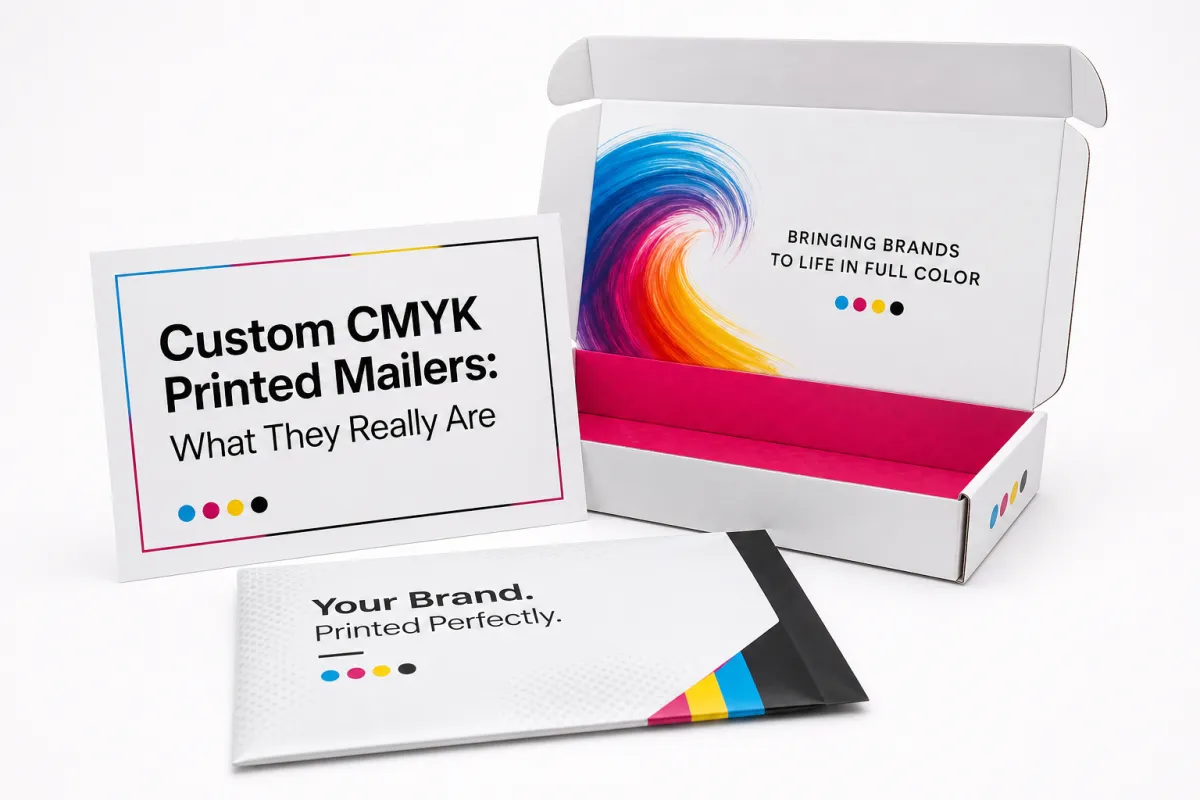
At the simplest level, custom CMYK printed mailers are shipping mailers printed in full color using the CMYK process: cyan, magenta, yellow, and black. Those four inks build the image in layers, which is why this format can handle gradients, photography, shadows, and multi-color branding far better than a one-color stamp or a basic logo mark. For packaging that depends on visual recognition, that matters a lot.
CMYK is the standard for full-color print because it is practical, not magical. A screen can show a neon accent, a deep violet, or a bright orange that looks perfect on glass. Ink does not behave like light. It sits on a surface, the stock absorbs or reflects it, and the final result shifts depending on the material underneath. That is the first lesson with custom CMYK printed mailers: design ambition has to meet print reality somewhere in the middle.
The gap between a printed mailer and a generic shipping envelope is bigger than decoration. A plain envelope usually does one job: move an item from A to B. A printed mailer can do three jobs at once. It can protect the contents, carry the brand, and set expectations before the customer opens the pack. That is why businesses use them for ecommerce shipments, subscription programs, influencer kits, and returns. The mailer is often the first physical touchpoint after checkout or signup, so it functions as branded packaging, not just a container.
Surface and structure change the experience too. A coated white paper mailer will show cleaner color and sharper imagery than a natural kraft surface. A heavier, stiffer board construction feels closer to retail packaging, while a lighter flexible mailer feels lean and utilitarian. Custom printed boxes and custom CMYK printed mailers solve different problems, but both shape how a brand feels in the hand.
One detail people miss: “full color” does not mean “every color imaginable.” A mailer can be full-color and still struggle with certain blues, fluorescents, and metallic effects. If a brand wants metallic gold, soft-touch drama, or a very specific spot color, that often pushes the project toward special inks or a different packaging design entirely. With custom CMYK printed mailers, the smarter move is to match the look to the process instead of asking the process to pretend it is a monitor.
Custom CMYK printed mailers also matter because they scale. The same artwork language can run on short digital tests, mid-volume production, or larger offset programs depending on the material and the supplier setup. That flexibility is one reason teams use them for launches, seasonal offers, and fast-moving product packaging programs.
How Custom CMYK Printed Mailers Work
The path from artwork to finished custom CMYK printed mailers starts long before ink hits the stock. First comes file setup: dieline, bleed, safe zones, logo placement, images, and legal copy. Then comes color separation, which breaks the design into the four process colors the press can print. If the file is sloppy here, production will expose it. Pretty mockups are excellent at hiding bad decisions.
Next comes proofing. That may be a digital proof, a press proof, or a sample made on the actual substrate. Proofing is where color shifts become obvious, especially on kraft paper or uncoated stock. White paper tends to keep brightness better; kraft warms and dulls certain tones. On custom CMYK printed mailers, that difference is not a defect. It is the material speaking up.
Registration matters too. If cyan, magenta, yellow, and black do not align, thin outlines blur, type softens, and small details look muddy. That is one reason production teams watch type size, line weight, and logo edges so closely. A digital rendering can look razor-sharp at 100 percent zoom, but production tolerances are physical, not virtual. Even a small misalignment can show up on a bright white pack.
There are two common print paths. Digital printing usually works better for short runs, variable artwork, quick proof cycles, and smaller budget tests. Offset printing usually makes more sense at higher volumes, especially when image quality and color consistency need to hold across a long run. Flexographic production can also play a role, especially for film-based mailers or simpler graphics at scale. The right choice depends on quantity, substrate, and artwork complexity.
Here is where the workflow gets less glamorous and more useful. After printing, the sheet or web gets converted into the finished mailer shape, then cut, folded, glued, sealed, packed, and labeled for freight. If the design includes tear strips, self-seal closures, or gussets, those features need to be planned early. A late structural change is usually what stretches timelines, not the ink itself. For custom CMYK printed mailers, converting is where a lot of hidden risk lives.
For brands shipping product packaging that needs to survive transit, testing is worth the effort. The International Safe Transit Association publishes test methods used across packaging; its standards help teams evaluate handling, vibration, drop behavior, and compression risks. The organization’s site is here: ISTA. A mailer does not need to pass a formal lab protocol every time, but it should still be judged like shipping packaging, not like a poster.
If the artwork includes dense coverage or photo-heavy imagery, small color corrections often happen during proof cycles. That is normal. A good supplier will explain where the tolerances are and which areas can be tightened. That conversation matters more than a polished sales deck because it tells you whether the supplier understands custom CMYK printed mailers as a production item, not just a branding exercise.
Key Factors That Shape Quality, Cost, and Pricing
The biggest driver of price is quantity. Small runs have higher unit costs because setup, proofing, and press prep get spread across fewer pieces. Larger runs lower the unit price, but they also raise the stakes if something is wrong. That is true for most packaging categories, yet custom CMYK printed mailers are especially sensitive because the print itself is part of the brand experience.
Material grade matters just as much. A lighter recycled paper mailer may cost less than a premium, high-bleed board construction, but it may also wrinkle more easily or show scuffs faster. Recycled content can be a selling point, and certification may matter for procurement teams that track sustainable packaging. If that is part of the brief, FSC documentation can help. The chain-of-custody resource is available at FSC. For some brands, that line on the spec sheet is not fluff. It is a requirement.
Print coverage changes the math. A low-coverage design with a small logo and lots of negative space usually costs less than a full-bleed design packed with images, gradients, and multiple panels of artwork. More ink means more press time, more quality checks, and more chances for visible variation. Ink-heavy custom CMYK printed mailers can absolutely be worth it, but they usually sit higher on the cost curve.
Finishing adds another layer. Gloss or matte coatings, soft-touch lamination, tear notches, reinforced seals, and specialty adhesives all affect pricing. So does size. A mailer that fits a standard dimension range usually costs less than a custom-sized piece because tooling, converting, and material yields are easier to control. Buyers often focus on print price alone, then get surprised by finishing and freight. The landed cost of custom CMYK printed mailers is the number that matters, not the quote line with ink on it.
To make that easier to compare, here is a simplified view of common options. These are not fixed market rates; they are realistic ranges that move with quantity, substrate, artwork, and shipping destination.
| Option | Best For | Typical Unit Range | Trade-Off |
|---|---|---|---|
| Digital printing on paper mailers | Short runs, launch tests, fast approvals | $0.30-$0.70 | Higher unit cost, lower setup burden |
| Offset printing on paper mailers | Mid-to-high volume color consistency | $0.18-$0.45 | Better economics at scale, more setup time |
| Flexographic printing on film mailers | Large-volume shipping programs | $0.12-$0.30 | Efficient for simpler art, less ideal for photo detail |
| Premium board construction with full coverage | Retail packaging feel, premium unboxing | $0.25-$0.60 | Better presentation, higher material cost |
Shipping can quietly distort the budget too. Flat-packed mailers are usually efficient, but dimensional weight, pallet build, and warehouse handling all affect the final cost. A buyer comparing custom CMYK printed mailers against plain shipping envelopes may find that the visible print difference is only part of the story. The real question is whether the packaging reduces damage, improves repeat purchase behavior, or lowers rework elsewhere in the fulfillment chain.
There is also a pricing mistake I see often: brands compare a paper mailer with a rigid carton without accounting for use case. A carton may be better for fragile items. A mailer may be better for apparel, flat goods, inserts, and lighter kits. The right comparison is not just cost per unit. It is cost per successful shipment. That is where custom CMYK printed mailers often make sense for branded packaging programs that need presentation and efficiency together.
Custom CMYK Printed Mailers: Process and Timeline
A realistic schedule starts with the quote request. If the supplier has clean specs, the first estimate may come back quickly. If the brief is vague, the quote will be slower because the vendor has to guess at size, structure, coverage, and packing method. Once the order is accepted, file review begins, followed by proofing, approval, production, finishing, and freight booking. For custom CMYK printed mailers, each step adds time, and each step can also save time if handled cleanly.
Standard jobs move faster when the artwork is print-ready and the dimensions are already confirmed. That part is simple. If the design is locked, the press schedule is open, and the supplier has substrate in stock, production can move in a fairly tight window. If the project needs new tooling, revised artwork, or an unfamiliar construction, the calendar stretches. That is why many buyers plan around a 12-15 business day window after proof approval for straightforward runs, then add freight on top. More complex custom CMYK printed mailers usually need extra buffer.
Delays usually come from boring causes. Missing dieline information. Late color changes. A different ship-to address after the run is already in motion. Incorrect quantity confirmation. None of that is dramatic, but each issue can knock the order off schedule. A fast campaign can turn into a scramble if the team treats packaging design like an afterthought instead of a production asset.
The cheapest mailer is usually the one that arrives on spec the first time.
That line sounds simple because it is. Every packaging buyer has seen the false economy of a rushed order that needs replacement. A slightly higher quote can be smarter if it comes with better proof control, more stable substrate sourcing, or clearer communication around press tolerance. That is especially true for custom CMYK printed mailers used in subscription drops or seasonal launches, where the timing window is narrow and the brand moment is public.
Planning also changes by campaign type. A rebrand may tolerate more proofing and more internal review. A flash sale may not. A subscription kit needs repeatability. A return mailer may need durable closure performance more than photo-heavy artwork. If the order supports branded packaging across multiple touchpoints, lock the specs early and write them down. That one habit can save a lot of pain during the next reorder.
Step-by-Step Guide to Ordering the Right Mailers
Start with the product itself. What is being mailed, how much protection does it need, and how should the package open? Apparel, flat insert kits, documents, and lightweight accessories all behave differently inside a mailer. A good packaging design begins with the contents, not the artwork. That is true for custom CMYK printed mailers and for custom printed boxes alike.
Second, choose dimensions based on fit and shipping efficiency. Too large, and the package looks loose or wastes postage. Too tight, and you may fight insertion, crease the product, or strain the closure. The right size usually leaves enough breathing room for the item, any inserts, and the sealing method. A dimension that works in a mockup but fails on the packing table is the wrong dimension.
Third, prepare artwork with production in mind. Confirm brand colors, type sizes, image resolution, bleed, and safe zones. If the design uses fine text, keep it large enough to stay readable after folding, sealing, and courier handling. If the layout includes barcodes or compliance marks, place them with enough separation so labels do not obscure them. This is where custom CMYK printed mailers turn into a packaging discipline, not just a design exercise.
Fourth, request a proof or sample. Read the sample like a packaging buyer, not like a designer. Check color, corner integrity, closure strength, surface scuffing, and any seam placement that could catch during transit. If you can, apply the same handling conditions the finished product will face. A mailer that looks fine on a desk may not survive a rough tote bin or a busy fulfillment line.
Fifth, document everything before the order is released. Quantity, size, material, print method, closure type, ship-to location, and any approved samples should all live in one place. That documentation turns the next reorder into a simple repeat instead of a fresh investigation. Brands that grow quickly often skip this step and then wonder why the second run looks a little different from the first.
If you are comparing broader packaging options, it helps to look at a full catalog rather than one SKU in isolation. The Custom Packaging Products page is a practical starting point for teams that want to compare mailers with other product packaging formats. If your program is already leaning toward flexible shipping formats, the Custom Poly Mailers option is worth checking alongside paper-based custom CMYK printed mailers so the decision is based on fit, not habit.
Here is the simplest ordering rule I know: if three people on the team would describe the job three different ways, the spec is not ready yet. Clean specs make better custom CMYK printed mailers, and better specs usually mean fewer revisions, fewer surprises, and fewer awkward phone calls after production starts.
Common Mistakes With Custom CMYK Printed Mailers
The most expensive mistake is approving a design on screen without understanding that monitor color and printed color are never identical. Screens emit light. Print reflects it. That difference can make a soft pastel look heavier, a gray look warmer, or a brand blue land a touch darker than the brand team expected. With custom CMYK printed mailers, this is not a theory issue. It is the most common reason a first run feels “off.”
Another frequent problem is visual clutter. Teams try to pack too much copy, too many logos, and too many decorative elements onto a format that already has seams, folds, and labels to contend with. The result can look crowded rather than premium. Clean package branding usually reads better from a distance and holds up better in real handling. That applies to branded packaging, retail packaging, and shipping packaging alike.
Low-resolution files create another kind of trouble. Thin fonts, small reverse type, and untested barcode placement can all fail in production, especially if the print method is digital and the design contains intricate detail. If the file needs to be enlarged or repaired at prepress, the finished result can lose sharpness. Designers sometimes assume the printer will fix everything. It will not. The press can only print what the file supports.
Structural mistakes can be just as costly. A mailer that is too small for inserts may force the item to bend. A mailer that is too flimsy may arrive scuffed or partially open. A closure system that looks fine in the mockup may fail after repeated handling. Custom CMYK printed mailers are often chosen for presentation, but they still have to behave like shipping packaging. If the structure is weak, the print cannot rescue it.
There is also a timing mistake: not leaving enough room for proof cycles. The first proof often reveals something useful. Maybe the white underlay needs adjustment. Maybe the kraft stock changes how dark the logo reads. Maybe the artwork needs more contrast around the seams. That is normal. Problems are rarely catastrophic if the team expects them and leaves room to correct them. Most packaging failures come from skipping a boring step, not from the print press itself.
Finally, people underthink the comparison set. A mailer is not just competing with a generic envelope. It may be competing with custom printed boxes, corrugated shippers, or even a plain unbranded pack that costs less but says less. The best choice is the one that fits the item, the budget, and the brand promise. Custom CMYK printed mailers are strong performers in that middle space, but only if the buyer keeps the whole job in view.
Expert Tips for Better Results and Smarter Reorders
Design for handling, not just for presentation. Leave enough breathing room around seams, folds, and tear strips so the graphics still look clean after the mailer has been packed, stacked, and shipped. A strong layout survives contact with real operations. That is where custom CMYK printed mailers prove their value.
Test a small batch before scaling up, especially if the artwork relies on rich blacks, photographic imagery, or very light brand colors. A sample run can expose issues that a PDF proof hides. It may also reveal whether the chosen stock feels right in the hand. Packaging design is partly visual, but it is also tactile. The customer notices both.
Build a one-page spec sheet for every recurring mailer. Include the approved dieline, final dimensions, substrate, closure type, ink coverage notes, proof version, and the date of approval. This is one of the simplest ways to keep package branding consistent across reorders. It is also a strong internal control for ecommerce teams that place packaging orders across different quarters or campaigns.
Ask the supplier direct questions before you place a repeat run. Who reviews proofs? What is the accepted color tolerance? What happens if the first production sample lands outside expectation? How are damaged cartons handled? A vendor who answers clearly is usually easier to work with than one who keeps everything vague. The goal is not to be difficult. The goal is to keep custom CMYK printed mailers predictable.
It also helps to separate the creative decision from the operational one. A gorgeous mailer is not useful if it slows packing or raises shipping costs beyond the value it creates. A simpler design may be better if the item is already premium, the insert is doing some of the storytelling, or the brand wants consistency across multiple product lines. The smartest packaging choices are often more restrained than the mood board suggests. Annoying, yes. True, also yes.
One more practical point: compare repeatability, not just first-run quality. A mailer that looks good once and drifts later is a headache. A mailer that stays stable over several reorders builds trust inside the team and among customers. That repeatable behavior is where custom CMYK printed mailers earn their keep, especially in programs that need dependable product packaging month after month.
Next Steps Before You Request Quotes
Before you ask for pricing, gather the information that actually changes the quote. Start with product dimensions, quantity, target ship date, delivery location, and the level of protection the mailer must provide. Then add brand color references, preferred material, and whether the artwork is already print-ready. The more precise the brief, the better the quote. That is true for custom CMYK printed mailers and for most custom packaging programs.
It helps to attach two assets: one print-ready file and one reference mockup. The file tells the supplier what exists today. The mockup tells the supplier what the brand wants the finished pack to feel like. Those two items reduce confusion, especially if several stakeholders are involved. If the team cannot answer whether the goal is premium retail packaging, efficient shipping packaging, or a hybrid of both, the quote will probably wobble.
Compare at least two vendors on more than price. Look at proof process, material options, turnaround window, communication style, and reorder support. A quote that is slightly higher may still be smarter if it includes better review steps or clearer accountability. That matters because custom CMYK printed mailers are not a one-time purchase for many brands; they are a recurring operational item.
Then write down your top three priorities. Maybe the priority order is color accuracy, speed, and cost. Maybe it is durability, sustainable sourcing, and consistent reorders. Maybe it is all about brand impact. The point is to force the trade-off conversation early. Packaging jobs go wrong when everybody assumes the same thing and nobody documents the decision.
If you keep those basics straight, the quoting process gets cleaner, the proof cycle gets shorter, and the final result is easier to reproduce. That is the real value of custom CMYK printed mailers: not just a better-looking shipment, but a repeatable packaging system that supports the brand without creating chaos for operations.
How much do custom CMYK printed mailers usually cost?
Pricing usually depends on size, quantity, material, print coverage, and finishing rather than one flat rate. Higher quantities often lower the unit price, but setup, proofing, and freight can still affect the total. For many programs, custom CMYK printed mailers sit somewhere in the rough range of $0.12 to $0.70 per unit depending on how simple or ink-heavy the job is.
How long do custom CMYK printed mailers take to produce?
Standard jobs move fastest when the artwork is print-ready and the dimensions are already confirmed. Proof approval, color corrections, and custom sizing are the most common reasons schedules stretch. A straightforward run may move through production in about 12-15 business days after approval, but custom CMYK printed mailers with special finishes or unusual structures usually need more time.
What file format works best for custom CMYK printed mailers?
Vector or high-resolution print files are best because they hold sharp text and clean edges at production scale. Include bleed, safe zones, and the correct dieline so critical elements do not fall near seams or cut lines. Ask the printer whether they prefer PDF, AI, or another format before sending final artwork for custom CMYK printed mailers.
Can custom CMYK printed mailers match brand colors exactly?
They can match closely, but screen color and printed color are not identical, so exact duplication is not guaranteed. Coated, uncoated, and kraft surfaces all influence how colors appear once printed. A proof or sample is the best way to confirm whether the final color is acceptable before a full run of custom CMYK printed mailers.
What should I check before ordering custom CMYK printed mailers?
Confirm the product dimensions, insert thickness, and required protection level first. Verify quantity, budget, turnaround time, and shipping destination before approving artwork. Review proof details like color, logo placement, closure strength, and barcode readability if labels will be applied. That confirmation step is often the difference between a tidy reorder and another round of corrections for custom CMYK printed mailers.
If you want the short version, here it is: lock the structure first, proof the color on the actual stock, and keep a written spec for every reorder. That is how custom CMYK printed mailers stay useful instead of becoming a recurring packaging headache.

