Buyer Fit Snapshot
| Best fit | Cmyk Printed Mailer Boxes Supplier projects where brand print, material claims, artwork control, MOQ, and repeat-order consistency need to be specified before quoting. |
|---|---|
| Quote inputs | Share finished size, material target, print colors, finish, packing count, annual reorder estimate, ship-to region, and any compliance wording. |
| Proofing check | Approve dieline scale, logo placement, barcode or warning zones, color tolerance, closure strength, and carton packing before bulk production. |
| Main risk | Vague material claims, crowded artwork, missing packing details, or unclear freight terms can make a low unit price expensive after revisions. |
Fast answer: Cmyk Printed Mailer Boxes Supplier: Film, Print, MOQ, and Carton Packing should be specified like a repeatable production item. The safest quote records material, print method, finish, artwork proof, packing count, and reorder notes in one written spec.
Production checks before approval
Compare the actual filled-product size with the drawing, then confirm tolerance on folds, seals, hang holes, label areas, and retail display edges. Reserve space for logos, QR codes, warning copy, and material claims before decorative graphics fill the panel.
Quote comparison points
Review material grade, print process, finish, sampling route, tooling charges, carton quantity, and freight assumptions side by side. A quote is only useful when the supplier can repeat the same color, closure quality, and packing count on the next order.
CMYK Printed Mailer Boxes Supplier: Smart Buying Guide
The wrong CMYK Printed Mailer boxes supplier can turn a sharp design into something flat, muddy, and weirdly cheap the second it leaves your screen. That is the irritating part. The artwork can be solid. The file can be clean. Then the substrate, proofing, or print method shows up uninvited and wrecks the result.
Mailer boxes are not just shipping containers. For DTC brands, subscription kits, and gift packaging, they are one of the first physical brand touchpoints a customer actually notices. A good cmyk Printed Mailer Boxes supplier understands that and knows how to turn a design file into a box that lands with the right color, the right structure, and the right cost.
If you are comparing options across Custom Packaging Products, the real job is not just getting a printed box. It is getting repeatable color, a realistic timeline, and a quote that does not keep changing every time somebody spots a missing detail.
Why CMYK Printed Mailer Boxes Supplier Quality Matters
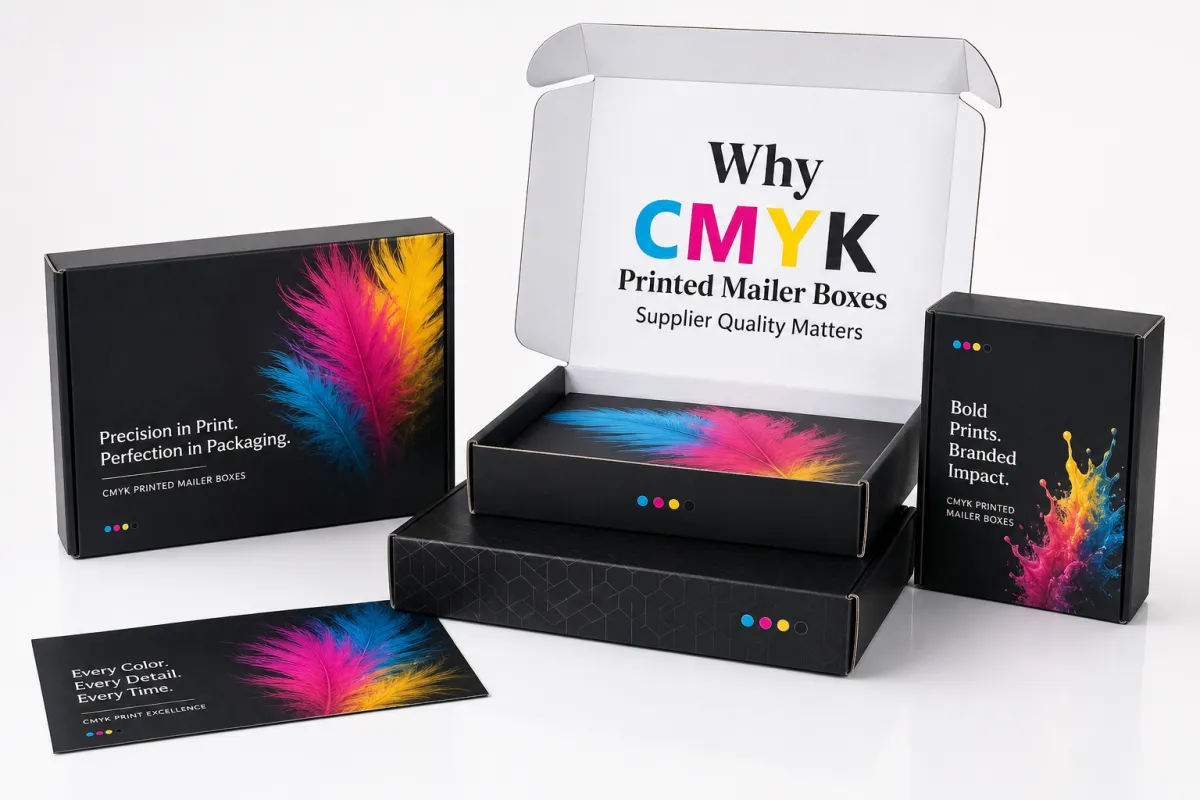
Here is the problem I see most often: a team approves a beautiful mockup on a bright monitor, then the finished box arrives and the red is muted, the black is soft, and the whole piece feels like it came from a different brand. That is usually not a design failure. It is a cmyk printed mailer boxes supplier problem, or more precisely, a supplier-selection problem that started before production ever began.
A mailer box has a strange amount of responsibility. It has to survive transit, open cleanly, hold its shape, and still look intentional when the customer lifts the lid. For DTC shipping, subscription packaging, and gift-ready packaging, the outer shell is part of the experience. If the print is off, the brand feels off. Pretty simple.
What does a cmyk printed mailer boxes supplier actually do? They take process-color artwork and print it directly onto corrugated or paperboard mailers, usually with digital printing, offset printing, or flexographic printing depending on the run size and the structure. The good ones know how the ink behaves on kraft, white board, and coated surfaces. The mediocre ones treat every board like a blank sheet of copy paper. That ends badly.
CMYK is excellent for full-color artwork, gradients, photo imagery, and layered brand graphics. It is not a spot color matching system. If your brand guide says a teal must hit one exact Pantone-style value every time, you need a different conversation with the supplier. A cmyk printed mailer boxes supplier can often get close, but close and exact are not the same thing. Packaging buyers learn that the hard way and then start reading proofs more carefully.
Think of the buying decision this way: do you want a box that looks good once, or do you want a box that reproduces consistently across reorders? The second option is what matters. A cmyk printed mailer boxes supplier should help you get predictable pricing, a real production schedule, and enough color discipline that your launch box and your reorder box do not feel like strangers.
I have watched brands spend days obsessing over a mockup and then approve a board stock they never tested. That is the kind of mistake that feels small in a meeting and expensive in freight. A supplier worth keeping around will slow you down just enough to avoid that mess.
Practical rule: if the box carries a premium product, photo-heavy artwork, or strong brand color, treat the supplier search like a production decision, not a shopping exercise.
How CMYK Printing Works on Mailer Boxes
CMYK stands for cyan, magenta, yellow, and black. Those four inks are layered in tiny dots to create the full image your eye sees. On paper, that sounds straightforward. In production, it gets more interesting, because the surface underneath changes everything. A cmyk printed mailer boxes supplier has to account for absorbency, coating, flute structure, and print method before the first sheet goes through the press.
Kraft board usually darkens colors and makes neutrals look warmer. White-coated board gives brighter color and better contrast. Uncoated paperboard can look softer but more muted. Corrugated mailers, especially E-flute or similar structures, also add texture, which means gradients and fine details need careful treatment. A cmyk printed mailer boxes supplier that skips this step will still print your art, but the result may not match the screen-based mockup your team approved in a meeting.
There are three common print methods to understand. Digital printing is best for lower quantities, faster sampling, and designs with a lot of variation or short runs. Offset printing usually gives excellent detail and stronger consistency at higher quantities, especially when the artwork is dense and the finish matters. Flexographic printing often makes sense for large corrugated runs where speed and unit economics matter more than ultra-fine detail. A good cmyk printed mailer boxes supplier will tell you Which One Fits your job instead of pretending one machine solves every problem on earth.
File prep matters more than most brands expect. Your artwork should be built on the supplier’s dieline, with bleed, safe zones, and fold-aware placement. Raster art should be high resolution at final size, usually around 300 dpi for most printed elements. Fonts should be outlined or embedded. Images should be converted to CMYK before approval, because RGB artwork often shifts when it hits the press. A cmyk printed mailer boxes supplier can sometimes fix minor issues, but they should not have to rescue a file that was never built for production.
The practical limit is color matching. If the brand wants a very specific spot color, the supplier may need a spot color ink, a hybrid print strategy, or a tolerance agreement. CMYK can do a lot, but it cannot magically become a dedicated spot color system. That is why serious packaging buyers ask for physical proofing, not just screen renders.
File checklist that saves time:
- Final dieline from the supplier
- Bleed around all edges, usually 0.125 in minimum
- Safe zone away from folds, seams, and cuts
- Artwork exported as print-ready PDF, AI, or EPS
- Images converted to CMYK at final size
- Fonts outlined or embedded
If you want to compare structures before you commit, it helps to review Custom Poly Mailers as well. They are not the same product, obviously, but they are useful as a reference point when a brand is deciding whether the application actually needs a rigid mailer box or something lighter.
Cost and Pricing Factors That Change the Quote
Pricing on a cmyk printed mailer boxes supplier quote is usually driven by six things: box size, board type, print coverage, finish, quantity, and destination. Change any one of those and the quote moves. Change three of them and the quote can look like it belongs to a different project.
Quantity is the biggest lever. A short run has higher setup pressure, more handling per unit, and less room to spread fixed costs. A larger run drops the unit price fast, which is why a cmyk printed mailer boxes supplier may quote a box at $1.80 each for 500 pieces and $0.55 to $0.95 each at 5,000 pieces, depending on the build. Those are not universal numbers, but they are normal enough to be useful.
Print coverage also matters. A simple single-color exterior is cheaper than full-bleed graphics on every panel. Heavy ink coverage, layered gradients, and detailed front-and-back printing take more press time and more attention during quality control. If the design needs gloss, matte lamination, aqueous coating, soft-touch film, or any other print finishing step, the quote will rise again. No surprise there. Finishing is labor and material, not magic.
Setup costs are where the first order usually feels expensive. Depending on the method, you may see charges for plates, dies, proofing, cutting tools, or color adjustment. A digital job often has lower setup and higher unit cost at small quantities. Offset printing can have more upfront setup, but the per-unit price gets attractive as quantity climbs. Flexographic printing sits in its own zone and usually rewards longer runs. A cmyk printed mailer boxes supplier should explain this in plain language instead of hiding it behind a quote sheet with three mysterious line items and zero context.
One more thing that gets ignored all the time: the quote is not the landed cost. A box that looks cheap on paper can become expensive once pallet fees, freight surcharges, and export packing show up. That is not a trick. It is just math wearing a bad suit.
| Print method | Best quantity range | Typical unit cost range | Main strengths | Watch-outs |
|---|---|---|---|---|
| Digital printing | 100-1,000 units | $1.20-$3.50 | Fast proofing, lower setup, good for short runs and revisions | Higher per-unit cost, some color variation on textured board |
| Offset printing | 1,000-10,000+ units | $0.45-$1.25 | Strong detail, efficient on repeat graphics, good consistency | More setup, less economical for tiny orders |
| Flexographic printing | 5,000+ units | $0.30-$0.90 | Efficient on large corrugated runs, durable production workflow | Less ideal for delicate gradients and very fine detail |
The board itself can swing the quote too. Kraft corrugated is often cheaper than white coated stock, but it can mute color. A premium white liner boosts brightness and usually costs more. If you need a stronger first impression, that extra cost may be worth it. If the box is mainly a transit shell, you may not need the premium upgrade. A cmyk printed mailer boxes supplier should help you decide based on use, not vanity.
Shipping is not a footnote. Freight can become a real line item if the cartons are bulky, the order is heavy, or the destination is awkward. Always ask whether the quote includes delivery, export packing, palletization, or residential surcharges. The cheapest per-unit quote is not always the cheapest landed cost. Anyone who has compared invoice totals knows that trick already.
A useful buying move is to ask whether a slightly higher MOQ lowers the overall launch cost enough to justify inventory. If the artwork is staying consistent for two product drops, a bigger run can save enough to offset storage. That is one of the few times where ordering more is actually the smarter financial move. Strange, but true.
The Process and Timeline From Artwork to Delivery
The order process with a cmyk printed mailer boxes supplier should not feel mysterious. The basic workflow is simple: quote request, spec confirmation, dieline review, artwork submission, proofing, production, finishing, and shipment. The issue is that one missing detail at any step can slow the whole thing down.
Delay usually starts with the files. Missing dieline files, artwork that does not match the actual box dimensions, or low-resolution images can stall proofing for days. Then there is color revision. Teams often want one more tweak after seeing the first proof, which is normal, but it means more back-and-forth and a later production slot. A cmyk printed mailer boxes supplier can move quickly, but only when the files are ready to behave.
Typical timelines vary by process and quantity. A short digital run may move from proof approval to shipment in roughly 7-12 business days, not counting transit. Offset printing often runs closer to 12-20 business days once approvals are locked. Flexographic production can be efficient at scale, but the prep and scheduling still matter. Sampling usually adds extra days before the main run even starts. If someone promises a complex custom box in a blink, they are either very lucky or not telling you the full story.
Before you approve anything, ask the supplier to confirm production slot, transit time, holiday shutdowns, and whether rush service actually exists. A cmyk printed mailer boxes supplier that understands scheduling will tell you if your launch lands inside a busy season, and whether that changes the realistic ship date. That kind of honesty is worth more than a flattering quote.
It also helps to send a clean checklist with the inquiry. One good file packet saves three email threads. Include quantity, dimensions, board type, finish, print coverage, shipping destination, and target delivery date. If the packaging is going to a fulfillment center, include carton pack counts and pallet preferences. The more specific you are, the less room there is for guesses.
A decent reference point for shipping durability is to ask whether the box structure aligns with common transit testing expectations such as ISTA packaging test standards. For broader packaging education and material context, the resources at The Packaging Association are also useful. That does not replace supplier testing, but it does keep the discussion grounded in actual packaging practice.
How to Choose the Right CMYK Printed Mailer Boxes Supplier
Price matters, but it should not be the only thing you compare. A cmyk printed mailer boxes supplier is worth paying attention to when they can show consistency, clear proofing, stable board quality, and decent reorder reliability. If a supplier looks inexpensive but cannot explain how they control color, you are not getting a bargain. You are getting suspense.
Start with the questions that expose real capability. What print process do you use for this size and quantity? How do you handle color approval? What tolerances do you work to? Do you have a physical sample from a similar structure? What happens if the first proof is off by more than the expected range? A cmyk printed mailer boxes supplier that answers quickly and directly is already separating itself from the one that sends three paragraphs and still avoids the question.
Ask for samples that match the actual box style, not generic packaging samples that happen to have a logo on them. A flat mailer sample is not the same as a self-locking corrugated mailer with folds, seams, and heavy panel artwork. Structure changes appearance. So does paper stock. If a supplier cannot show you something close to your actual build, they are asking you to trust a fantasy.
It also helps to standardize the spec sheet before you quote anything. Every supplier should be bidding on the same dimensions, finish, quantity, artwork coverage, and destination. Otherwise the lowest number is often just the one that omitted the most. That is how bad comparisons happen. That is also how procurement people end up with very long meetings.
Questions worth asking:
- What print method will you use for this run?
- Do you proof color digitally, physically, or both?
- What is your acceptable color tolerance?
- Can you repeat the same result on reorder?
- Are setup charges, shipping, and finishing included?
"If the sample is the only thing that looks good, the quote is hiding something."
Red flags are easy to spot once you know them. Vague lead times. No proofing process. Unrealistic color promises. Quotes that skip shipping or setup costs. A cmyk printed mailer boxes supplier who says every shade will match perfectly on every substrate is either new to packaging or hoping you are.
If you also need other branded packaging formats, it is smart to compare the supplier's broader range, including Custom Packaging Products and lighter shipping options such as Custom Poly Mailers. A supplier that understands multiple formats usually has a better grip on what a box is supposed to do, not just how it looks in a render.
Common Mistakes That Create Dull Color or Delays
The classic mistake is sending RGB artwork and hoping it will somehow print like the screen. It will not. RGB is a light-based system. CMYK is ink on board. That gap is why brand colors shift, shadows dull down, and gradients can pick up a slightly different tone than the design team expected. A cmyk printed mailer boxes supplier can manage the conversion, but the result is always better when the file starts in the right space.
Skipping proof review is another one. People get excited, approve too fast, and then notice after production that the logo sits too close to the fold or the inside pattern clashes with the outer panel. Once the run is underway, every correction costs time. Sometimes it costs money too. The whole point of proofing is to catch the stuff that looks small on a laptop and enormous on a box.
Dieline mistakes cause plenty of pain. Artwork placed too close to the cut line can get trimmed unevenly. Graphics that cross a fold without enough bleed can look crooked once the box is assembled. Seals, flaps, and lock tabs need extra attention because they are the first places where a clean mockup turns into a frustrating production reality. A cmyk printed mailer boxes supplier should warn you about these areas instead of pretending the box assembles by wishful thinking.
Quote comparisons go wrong when buyers compare apples to shipping crates. One quote may use thinner board, another may leave out finishing, and a third may ignore freight. Suddenly the "cheap" option is not cheap at all. A good comparison starts with matched specs: same size, same board, same print coverage, same finish, same destination. Anything less is theater.
Timing is the final trap. Brands order too late, then rush the job into a compressed window with fewer reviews and less room for correction. That is how you get a box that is technically delivered but not really ready. A cmyk printed mailer boxes supplier can sometimes rescue a rush project, but rush projects almost always cost more and leave less margin for quality control.
If the packaging needs to survive distribution rather than just sit on a shelf, ask about transit testing and fiber certification. FSC-certified board matters if the brand wants documented sourcing, and packaging teams often use EPA guidance on materials and waste reduction as a broader sustainability reference. That does not solve print quality, but it does keep the packaging conversation honest.
Expert Tips and Next Steps Before You Order
Before you request quotes, build one clean spec sheet. Include exact dimensions, quantity, board type, finish, print coverage, delivery location, and the target launch date. A cmyk printed mailer boxes supplier can work much faster when every supplier is reading the same brief. That sounds obvious, which is exactly why people forget to do it.
For any brand where color is critical, ask for a digital proof first and a physical sample if the texture, board tone, or structural fit matters. Digital proofs are fast and useful for layout. Physical samples are slower, but they tell the truth about ink on actual material. If the product is premium, skip the guesswork. A cmyk printed mailer boxes supplier should have no problem supporting that process.
Compare at least three suppliers using the same artwork and the same spec sheet. Do not let one quote include matte finishing and another omit it. Do not compare a 500-unit digital quote to a 5,000-unit offset quote and pretend the unit price tells the whole story. That is how people make bad buying decisions while congratulating themselves for being "efficient."
Build in time for revisions, proof approval, and shipping. If your launch date has no buffer, the packaging schedule will own you. Give yourself room for one color correction, one layout fix, and transit delays that nobody can predict with perfect accuracy. A cmyk printed mailer boxes supplier is not a miracle worker. They are a production partner, which is much more useful.
Here is the short version of what usually works best:
- Use CMYK for full-color graphics, gradients, and photo-heavy artwork.
- Use spot color only when a brand color must stay tightly controlled.
- Choose digital printing for short runs and quick revisions.
- Choose offset printing for stronger unit economics on larger runs.
- Choose flexographic printing when volume and corrugated efficiency matter most.
- Do not approve a proof until folds, seams, and print finishing are checked.
If you want repeatable results on reorder, that is the real finish line. A cmyk printed mailer boxes supplier that can reproduce the same color, the same fit, and the same packing performance six months later is worth far more than one that only delivers a pretty sample once. The difference between good packaging and annoying packaging is usually the ability to repeat the result. That is the whole job.
How do I compare cmyk printed mailer boxes supplier quotes fairly?
Use the same box size, board type, print coverage, finish, quantity, and delivery destination for every quote. Then check whether setup charges, proofs, shipping, and taxes are included. A cmyk printed mailer boxes supplier should also confirm color tolerance and reorder consistency, not just the first-run sample.
What file format should I send to a cmyk printed mailer boxes supplier?
Send print-ready vector artwork when possible, usually PDF, AI, or EPS with fonts outlined or embedded. Include the supplier’s dieline, bleed, and safe-zone requirements so nothing lands in a cut or fold area. Convert images to CMYK and keep raster art high resolution to avoid fuzzy or shifted color.
How long does a cmyk printed mailer boxes order usually take?
Timelines depend on quantity, print method, proofing speed, and shipping distance. Sampling or custom proof approval can add extra days before production even starts. Rush orders are sometimes possible, but they usually cost more and leave less room for revisions.
Why do cmyk printed mailer boxes sometimes look different from screen designs?
Screens use RGB light, while printing uses ink on board, so color always shifts a little. The board surface, coating, and ink coverage also change how bright or muted the final box looks. A proof helps catch major issues before the full run is produced.
Can a cmyk printed mailer boxes supplier match exact brand colors?
They can get close, but exact spot color matching is harder with process CMYK than with dedicated Pantone inks. If exact color is critical, ask for a tolerance range and a physical sample before approving production. Simple designs, darker tones, and standard substrates usually reproduce more consistently than complex gradients on uncoated board. A cmyk printed mailer boxes supplier that explains this clearly is usually the one you want.


