Buyer Fit Snapshot
| Best fit | Custom Compostable Labels With Logo projects where brand print, material claims, artwork control, MOQ, and repeat-order consistency need to be specified before quoting. |
|---|---|
| Quote inputs | Share finished size, material target, print colors, finish, packing count, annual reorder estimate, ship-to region, and any compliance wording. |
| Proofing check | Approve dieline scale, logo placement, barcode or warning zones, color tolerance, closure strength, and carton packing before bulk production. |
| Main risk | Vague material claims, crowded artwork, missing packing details, or unclear freight terms can make a low unit price expensive after revisions. |
Fast answer: Custom Compostable Labels With Logo: What Matters Most should be specified like a repeatable production item. The safest quote records material, print method, finish, artwork proof, packing count, and reorder notes in one written spec.
Production checks before approval
Compare the actual filled-product size with the drawing, then confirm tolerance on folds, seals, hang holes, label areas, and retail display edges. Reserve space for logos, QR codes, warning copy, and material claims before decorative graphics fill the panel.
Quote comparison points
Review material grade, print process, finish, sampling route, tooling charges, carton quantity, and freight assumptions side by side. A quote is only useful when the supplier can repeat the same color, closure quality, and packing count on the next order.
Custom Compostable Labels with Logo: What Matters Most
A compostable pouch can look finished and premium in a render, then buckle the minute it lands in a refrigerated warehouse. The label tightens, the corners lift, and the adhesive leaves a dull halo that never quite goes away. I have seen buyers approve a sample that looked beautiful on a desk and fail almost immediately once it met moisture, cold air, and handling. That kind of failure tells you far more about Custom Compostable Labels with logo than any polished spec sheet ever will.
Packaging teams usually want three things at the same time: sharp branding, dependable performance, and a sustainability claim that can stand up to scrutiny. The logo is rarely the hard part. The real work is making custom compostable labels with logo survive cold storage, humidity, shipping, and ordinary retail abuse while still breaking down the way the material claim says they should.
That balance sounds simple on paper. In practice, it is a lot more like tuning a system than picking a sticker. A label is never just a face stock with a nice-looking brand mark on top. It is a construction, and each layer has a job to do.
Custom Compostable Labels With Logo: What They Actually Are
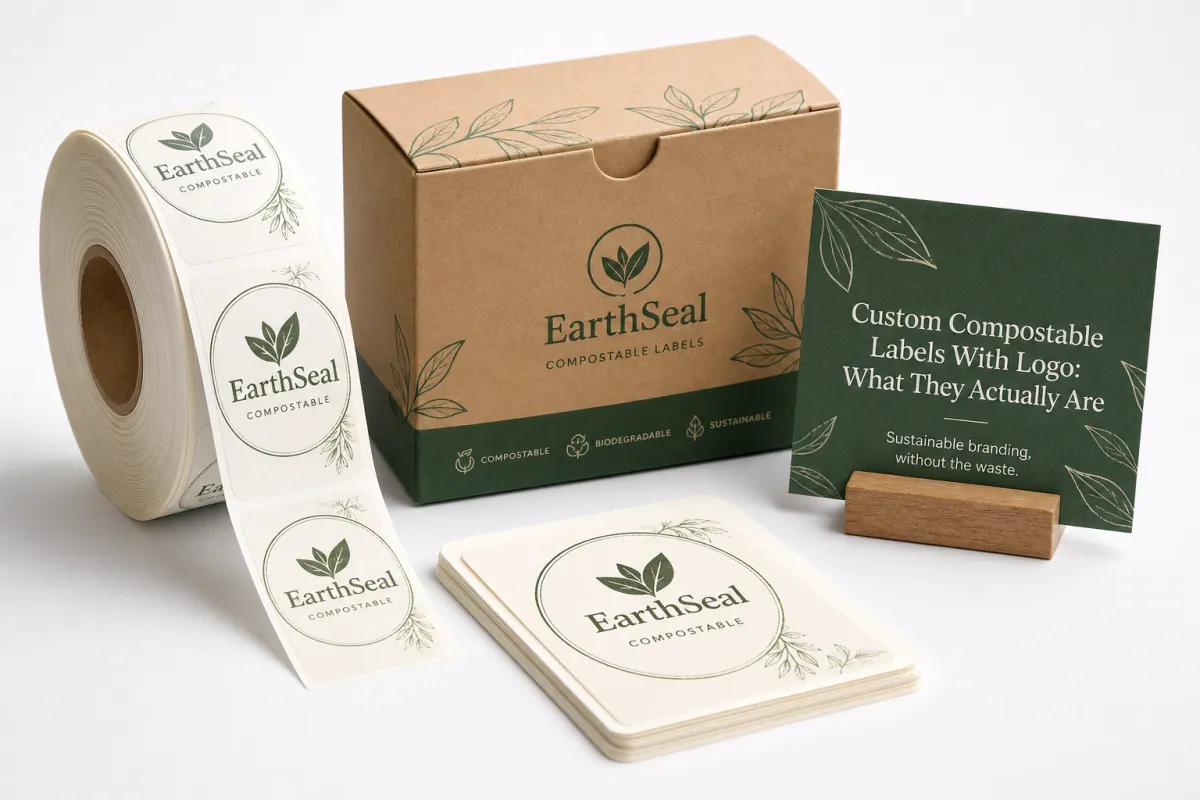
Custom compostable labels with logo are labels made from materials intended to break down under composting conditions, usually with inks and adhesives selected to support that end-of-life path. That means the label is not just a paper face wrapped in a green story. The face stock, adhesive, liner, and print system all need to work together under the relevant standard, such as ASTM D6400, EN 13432, or a similar certification route.
That detail matters because packaging gets judged as a complete system, not as separate material claims. A kraft-looking label on a pouch does not become compostable by appearance alone if the adhesive leaves residue or the liner sends the package into mixed waste. Buyers usually find that out after they test a few samples and realize the label that looked right in a mockup is not the same label that can actually pass in the real world.
From the branding side, custom compostable labels with logo still have a practical job to do. They identify the product, carry barcodes or regulatory copy when needed, and sit cleanly alongside the rest of the product packaging. The logo is usually the easiest element to place. What takes judgment is keeping edges sharp, colors readable, and registration steady on substrates that are often less forgiving than standard coated paper.
There is also a big difference between looking sustainable and being sustainable. A beige label on a plastic-free pouch can still be the wrong choice if the adhesive does not release properly in the composting stream or if the print layer adds unnecessary burden. That is why I tell buyers to ask for the full construction, not just the face material. If you are comparing options for Custom Labels & Tags, ask what every layer is made of before you decide based on the first attractive sample.
In practice, compostable label specs usually live in a narrower lane than standard retail labels. You are balancing eco-friendly packaging goals with shelf life, handling, and cost. That is not a flaw in the category. Packaging is full of tradeoffs, and the useful ones are the ones you can explain clearly to your team, your co-packer, and sometimes to a retailer who wants the short version by Friday afternoon.
A label claim is easy to print. A label that survives humidity, refrigeration, and a real composting spec is the part that takes money and judgment.
If your brand already uses cartons, pouches, or inserts, the label should feel like part of the same package branding system rather than a separate thought pasted on top. That matters even more when the line runs through Custom Packaging Products. Consistency is what makes the story feel planned instead of improvised.
How Custom Compostable Labels With Logo Work on Real Packaging
Custom compostable labels with logo only perform well as a system. The face stock, adhesive, ink, and liner all have to support the same end result. One weak layer can cause the label to miss compostability expectations, or simply fail on shelf before it gets anywhere near a composting facility. The most common mistake is treating those layers like separate purchase decisions. They are tied together from the start.
The face material can be compostable paper or a certified compostable film, depending on the finish, print behavior, and durability the package needs. The adhesive often decides whether the label succeeds. A label that behaves well in a dry stockroom may begin lifting on a refrigerated bottle, or leave residue on a molded fiber tray. That residue looks poor on retail packaging and raises questions when a sustainability claim is meant to feel credible.
Substrate choice changes the whole result. On glass, adhesion can be strong, yet condensation still creates problems. On paperboard, the issue is often fiber pull or a rough surface that prevents full contact. On compostable films or PLA-based pouches, a gentler adhesive may be needed to avoid distortion. On molded fiber, the texture can make standard assumptions break down quickly. One packaging format is never a stand-in for another.
Cold storage is where many buyers get a sharp lesson. Refrigeration at 34-40 F, freezer-adjacent handling, and repeated condensation cycles can expose a weak adhesive within a day or two. Grease and oils create the same problems on snack packaging, meal kits, and personal care products that migrate during transport. If the label needs to stay put through shipping, display, and consumer handling, those conditions matter more than a polished mockup.
That is also why custom compostable labels with logo are not the cheapest answer for every SKU. A short-run launch or a seasonal item may be a strong fit. A product that needs harsh durability, chemical resistance, or long-term exterior exposure may call for a different construction. Honest packaging work does not force one material choice across every category.
From a buyer's point of view, the smartest test is simple: apply the label to the real container, run it through the real cold chain, wipe it, condense it, stack it, and ship it. Then check edge lift, print smear, and residue. If you want a useful reference point for distribution stress, the ISTA packaging test standards are a solid place to start thinking about transport and handling instead of shelf appeal alone.
For brands trying to reduce carbon footprint across retail packaging, the label may be a small line item on paper, yet it still affects the whole sustainability story. A bad label can turn a careful design into a compliance headache. A good one disappears into the system, which is exactly what you want.
In one sampling round I worked through, the label looked fine until the product sat overnight in a cooler and the corners started to lift the next morning. Nothing dramatic, just enough curl to make the pack feel tired. That sort of thing is why I always push for a real product test, not just a material spec and a thumbs-up from a screen.
Custom Compostable Labels With Logo Pricing, MOQ, and Unit Cost
Custom compostable labels with logo are usually priced by a mix of material, construction, quantity, print coverage, and finishing. The blunt version is simple: the label stays inexpensive only when the spec stays simple. The moment you ask for a specialty adhesive, a custom die shape, multiple colors, or certification-heavy paperwork, the price moves up. That is normal manufacturing math, not a penalty.
For typical production runs, a few rough pricing bands show up often. A simple compostable label with limited colors and a standard shape might land around $0.08-$0.18 per unit at higher quantities, depending on size and material. A more specialized version with stronger certification requirements, heavier print coverage, or a difficult adhesive can move into the $0.18-$0.35 per unit range. Small runs can rise above that, especially if the order sits below the printer's efficient range. No one likes hearing that, but it is a realistic answer.
The main cost drivers are easy to list and easy to underestimate:
- Material type - compostable paper is often simpler than certified compostable film.
- Adhesive chemistry - performance adhesives cost more, especially for cold-chain or moisture-prone use.
- Print coverage - heavy ink coverage and multiple colors take more press time.
- Die-cut shape - circles are cheaper than custom outlines with tight tolerances.
- Roll format - core size, rewind direction, and label pitch affect setup.
- Documentation - certification data and technical sheets add review time and, sometimes, cost.
Minimum order quantities vary widely, yet the logic stays steady. Lower MOQ means higher unit cost because setup, plate making, and press time get spread across fewer labels. Larger orders improve unit economics, provided the artwork and product version stay stable. Nobody wants to order 50,000 labels and then discover the logo changed two weeks later. That is a very expensive kind of surprise.
Here is a practical way to compare the usual options for custom compostable labels with logo:
| Option | Best For | Typical Unit Cost | Tradeoff |
|---|---|---|---|
| Compostable paper label | Dry goods, paperboard, short shelf life | $0.08-$0.20 | Lower moisture resistance |
| Certified compostable film label | Flexible pouches, premium retail packaging | $0.12-$0.28 | Better durability, higher cost |
| Cold-chain optimized compostable label | Refrigerated food, condensation-prone packs | $0.18-$0.35 | More testing and tighter material selection |
| Custom die-cut, high-coverage print | Branded launches, seasonal SKUs | $0.15-$0.32 | Looks sharper, setup cost rises fast |
Hidden costs matter as much as the quoted number. Sample shipping, proof corrections, fit testing, and reorders caused by poor adhesion can cost more than the label itself. A cheap label that fails in the field becomes an invoice for a second label. That is why buyers should compare the total landed cost, not just the unit price on the quote.
If your brand already uses custom printed boxes and coordinated inserts, it makes sense to budget labels as part of the larger branded packaging system. The lowest price on paper can still become the most expensive mistake in the line if it breaks the visual system or triggers a rework.
Custom Compostable Labels With Logo: Process, Timeline, and Lead Time
Custom compostable labels with logo usually move through the same basic production flow: brief, material selection, artwork prep, proofing, sampling, production, and shipment. The sustainability side adds one more layer of review. That is the layer people rush past when a launch date gets tight, and the order starts drifting.
A realistic timeline for a straightforward order is often 10-15 business days from proof approval to shipment. If the artwork is complex, the die cut is custom, or the label construction needs documentation review, 12-20 business days is more realistic. Sampling can add another week or two depending on revisions. A supplier that promises everything in three days without asking about the product is not moving fast. That is optimism with a shipping label on it.
The longest part of the process is usually not the press run. It is the back-and-forth before production starts. The printer needs the right dieline, logo files, size targets, substrate details, and application method. Leave out the container material or storage conditions and you force guesswork into a technical decision. Guesswork is how a label looks fine on screen and useless in a freezer.
A good sample round is worth the time. A bad sample round teaches you everything before a full run becomes expensive. Test custom compostable labels with logo on actual products, not on a desk. Cold-chain stress, humidity, oil exposure, and handling pressure expose problems that a flat proof will never show.
One practical way to think about timing is this:
- 1-3 days for brief review and file prep if everything is clean.
- 2-5 days for proofing if the artwork is straightforward.
- 5-10 days for sample production and feedback if a test round is needed.
- 5-10 days for final production on standard label constructions.
- 2-7 days for domestic shipping, depending on volume and destination.
Delays usually show up in the same places: low-resolution logos, missing dielines, late size changes, unclear claims, and a launch team that keeps nudging the copy after production is already queued. The cheapest way to stay on schedule is boring accuracy. Not glamorous, but it works.
For brands that care about sustainability claims, it helps to review broader packaging guidance too. The EPA offers useful background on waste reduction and composting systems, which helps place a label inside a larger disposal pathway. That wider view matters because a label never acts alone; it sits on a package and enters a real waste stream.
Step-by-Step Guide to Ordering Custom Compostable Labels With Logo
If you want custom compostable labels with logo to perform well, the ordering process should feel a little technical. That is a good sign. Labels are not expensive enough to justify sloppy decisions, and a bad label can cause more damage than the savings were worth.
1. Define the package and the use case
Start with the basics: container material, product type, storage conditions, label size, application method, and quantity. A label for a dry snack pouch is not the same thing as a label for a refrigerated sauce jar or a molded fiber tray. Write down whether the package sees condensation, abrasion, oil, sunlight, or stacking pressure. Those details shape the material choice far more than any mood board does.
This is also the point to decide whether the label needs to coordinate with the rest of the product packaging system or simply identify the item. If the packaging line includes branded cartons, compostable pouches, or display sleeves, the label should fit the visual language of the whole set.
2. Define what compostable means for your brand
Industrial compostable and home compostable are not interchangeable, and not every supplier offers both. Ask which certification or claim the label construction supports, and ask for documentation. A vague answer is not enough. If a supplier cannot explain the claim in concrete terms, assume the answer is incomplete.
For many brands, the right question is not, "Can you make it compostable?" The better question is, "Can you prove the full construction matches the disposal claim we want to make?" That question clears out fluff very quickly.
3. Prepare artwork for the material, not for a fantasy render
Use vector files for the logo, keep fine lines honest, and avoid color choices that disappear on natural or uncoated stock. Dense blacks can look sharp on a screen and muddy in print. Thin sans-serif text can vanish on textured compostable paper. If you want a premium brand feel, simplify the logo treatment before adding extra effects. Clean art usually prints better and costs less.
The strongest designs for custom compostable labels with logo usually rely on restrained ink coverage, clear margins, and enough contrast to read at a glance. That sounds obvious. People still miss it constantly, and then wonder why the logo looks faint once it hits the actual substrate.
4. Ask for samples and test them hard
Request a sample that matches the intended construction as closely as possible. Then test it on the real container with the real product. Check adhesion after refrigeration, transit vibration, condensation, and normal staff handling. If your operations team wears gloves or handles products with damp hands, include that in the test. A desk test is not a field test.
For distribution-heavy brands, it helps to think about shipping and handling the way an auditor would. The right sample should survive the same abuse your products see before they reach the shelf. That is also where packaging standards and test thinking matter. If you want to cross-check your approach, ISTA is a useful reference point for transport and handling assumptions. The label should fit the journey, not just the design file.
5. Approve the final proof with a checklist
Before final approval, check quantity, finish, roll direction, core size, size tolerance, and any compliance language. Confirm that the logo is spelled right, the artwork is centered, and the claim is accurate. One wrong number in the order spec can force a reprint, and reprints are expensive because they are never just reprints. They are delays, wasted stock, and probably a tense email thread.
Once the proof is right, document the spec. Record the exact substrate, adhesive, size, and finish. That way future orders for custom compostable labels with logo stay consistent instead of drifting every time a new person places the reorder. A tidy spec sheet saves a lot of pain later, honestly.
Common Mistakes With Custom Compostable Labels With Logo
Custom compostable labels with logo fail for predictable reasons. The good news is that most of those reasons are avoidable. The bad news is that people keep repeating them, usually right before launch.
Mistake 1: choosing the face stock and forgetting the adhesive. The face material may be compostable, but the adhesive can still leave residue, fail in cold storage, or create a claim problem. Buyers get distracted by the front of the label because that is what they see. The adhesive is what the package feels.
Mistake 2: assuming one label works on every package. A compostable paper label that behaves beautifully on kraft paperboard may perform poorly on smooth glass or a flexible film pouch. Texture, curvature, and surface energy all change the result. Anyone who says otherwise is either selling you something or skipping the hard part.
Mistake 3: overdesigning the artwork. Heavy ink coverage, metallic effects, extra coatings, and decorative treatments can push the label away from the sustainability goal. They also raise cost. If you want the logo to feel premium, cleaner art usually beats cluttered art. Strong packaging design is disciplined, not crowded.
Mistake 4: skipping real-world testing. A sample sheet is not a shipping test. A label that sits neatly in a carton can still fail in humidity, under condensation, or after a truck ride. That is why custom compostable labels with logo should be tested on the actual product, in the actual chain, before a large order goes live.
Mistake 5: making sustainability claims too broad. If the label is industrial compostable but the package is not, say that plainly. If the adhesive has a different disposal profile than the face stock, get the language right. Bad claims do not age well, and they can damage trust faster than a print defect.
A lot of label problems are not technical problems. They are planning problems. The buyer wanted a green story, a premium feel, a fast turnaround, and the lowest possible price. You can sometimes get three of those. Four is usually fantasy.
One more point: if you are also sourcing custom printed boxes, inserts, or outer mailers, align the label spec with the rest of the system. A label that feels cheap beside premium branded packaging throws off the shelf presentation in a way customers notice immediately. Consistency matters because contradictions stand out faster than good intentions.
Expert Tips and Next Steps for Custom Compostable Labels With Logo
The strongest custom compostable labels with logo usually start with realistic constraints. Not flashy. Not overworked. Just matched to the package, the product, and the storage environment. That approach tends to save money and reduce surprises later.
Start with two or three material options. Do not lock yourself into the first sample unless it has already been tested on the real package. Compare a compostable paper option with a film-based option if your product needs more moisture resistance. The right answer depends on whether the package lives in dry retail, refrigerated storage, or a humid shipping lane. There is no one-size-fits-all answer, and anyone selling that idea is oversimplifying the problem.
Ask for documentation early. Get the technical data sheets, certification details, and adhesive notes before production starts. Review them against the sustainability claim you plan to make. A good supplier should be comfortable talking through the construction. That confidence is worth far more than polished sales language.
Keep the design honest. A simpler logo treatment, a restrained color palette, and cleaner typography usually print better on compostable stock. You do not need to bury the logo under effects to make it feel premium. In fact, the more natural the material, the more a clean design often stands out. That holds true for retail packaging, food labels, and much of eco-friendly packaging work.
Build a reorder file. Once the label passes testing, record the exact material, adhesive, size, print format, and winding direction. Save the approved artwork and the approved sample photos. Reorders should be boring. Boring is efficient.
For brands that want the whole package system to feel aligned, keep the label spec close to the rest of the packaging line. That means the same tone, the same level of finish, and the same discipline in claims. A compostable label should not look like it wandered in from a different project.
Custom compostable labels with logo are not a magic fix. They are a practical tool. Used well, they support brand identity, reduce waste, and keep the packaging story coherent. Used badly, they create residue, delays, and a sustainability claim that sounds better than it performs. Before you buy, test custom compostable labels with logo on the real package, in the real cold chain, with the real product. That is the only shortcut worth taking. If you get that part right, custom compostable labels with logo can look premium, do the job, and stay honest about how they should break down. That is the finish line worth aiming for, and it is the one that holds up once the packaging leaves the prototype table.
Are custom compostable labels with logo really compostable, or just compostable-looking?
They are only truly compostable if the face stock, adhesive, inks, and liner all meet the relevant compostability standard. Ask for certification or technical documentation instead of trusting a vague sustainability claim. If one component fails, the label may look eco-friendly but still not break down as intended, which defeats the point of custom compostable labels with logo.
What materials are best for custom compostable labels with logo?
The best material depends on the container and storage conditions, but compostable paper and certified compostable films are common choices. Cold storage, moisture, and grease usually push the decision toward more performance-focused options. Always match the material to the product, not just the brand aesthetic, especially if the label must support custom compostable labels with logo across a retail run.
How much do custom compostable labels with logo usually cost?
Cost depends on material, size, ink coverage, finish, and quantity. Small runs usually have a higher unit cost because setup is spread over fewer labels. Special adhesives, certification checks, and custom die-cuts also increase price, so custom compostable labels with logo are best priced as part of the full package spec, not as a one-line quote.
What is the typical turnaround for custom compostable labels with logo?
Turnaround depends on sampling, proof approval, and how complex the label construction is. Simple orders move faster; custom sizes and specialty materials take longer. The safest plan is to allow time for testing before production, not after, because custom compostable labels with logo usually deserve at least one real-world check before the press run.
Do custom compostable labels with logo stick to cold or oily containers?
Some do, but not all compostable adhesives handle condensation, refrigeration, or grease well. You should test the label on the actual package and product under real storage conditions. If the surface is difficult, adhesion performance matters as much as compostability, especially for custom compostable labels with logo used on food, beverage, or chilled retail packaging.

