Buyer Fit Snapshot
| Best fit | Custom Corrugated Cartons with Logo projects where brand print, material claims, artwork control, MOQ, and repeat-order consistency need to be specified before quoting. |
|---|---|
| Quote inputs | Share finished size, material target, print colors, finish, packing count, annual reorder estimate, ship-to region, and any compliance wording. |
| Proofing check | Approve dieline scale, logo placement, barcode or warning zones, color tolerance, closure strength, and carton packing before bulk production. |
| Main risk | Vague material claims, crowded artwork, missing packing details, or unclear freight terms can make a low unit price expensive after revisions. |
Fast answer: Custom Corrugated Cartons with Logo: Board, Finish, Dieline, and Unit Cost should be specified like a repeatable production item. The safest quote records material, print method, finish, artwork proof, packing count, and reorder notes in one written spec.
Production checks before approval
Compare the actual filled-product size with the drawing, then confirm tolerance on folds, seals, hang holes, label areas, and retail display edges. Reserve space for logos, QR codes, warning copy, and material claims before decorative graphics fill the panel.
Quote comparison points
Review material grade, print process, finish, sampling route, tooling charges, carton quantity, and freight assumptions side by side. A quote is only useful when the supplier can repeat the same color, closure quality, and packing count on the next order.
Custom Corrugated Cartons with Logo: Smart Packaging Guide Two identical orders can land on the same dock and still leave very different impressions. Put one into custom corrugated cartons with logo, and the package starts carrying brand meaning before the tape is even lifted; send the other in a plain brown shipper, and the product has to do all the talking on its own. That difference shows up in ecommerce, wholesale, subscription fulfillment, and retail supply chains where the outer carton is the first physical touchpoint a buyer sees. It also matters for sustainability, because custom corrugated cartons with logo stay in the recyclable fiber stream without relying on extra sleeves, decals, or decorative layers that add material without adding much functional value.
The most practical way to think about Custom Corrugated Cartons with logo is straightforward: they are not only shipping containers. They are protection, logistics, and brand presentation working together in a single package. That is why more teams treat custom corrugated cartons with logo as part of the product experience, not as an afterthought that gets solved at the end of procurement.
Custom corrugated cartons with logo: the unboxing detail customers notice first
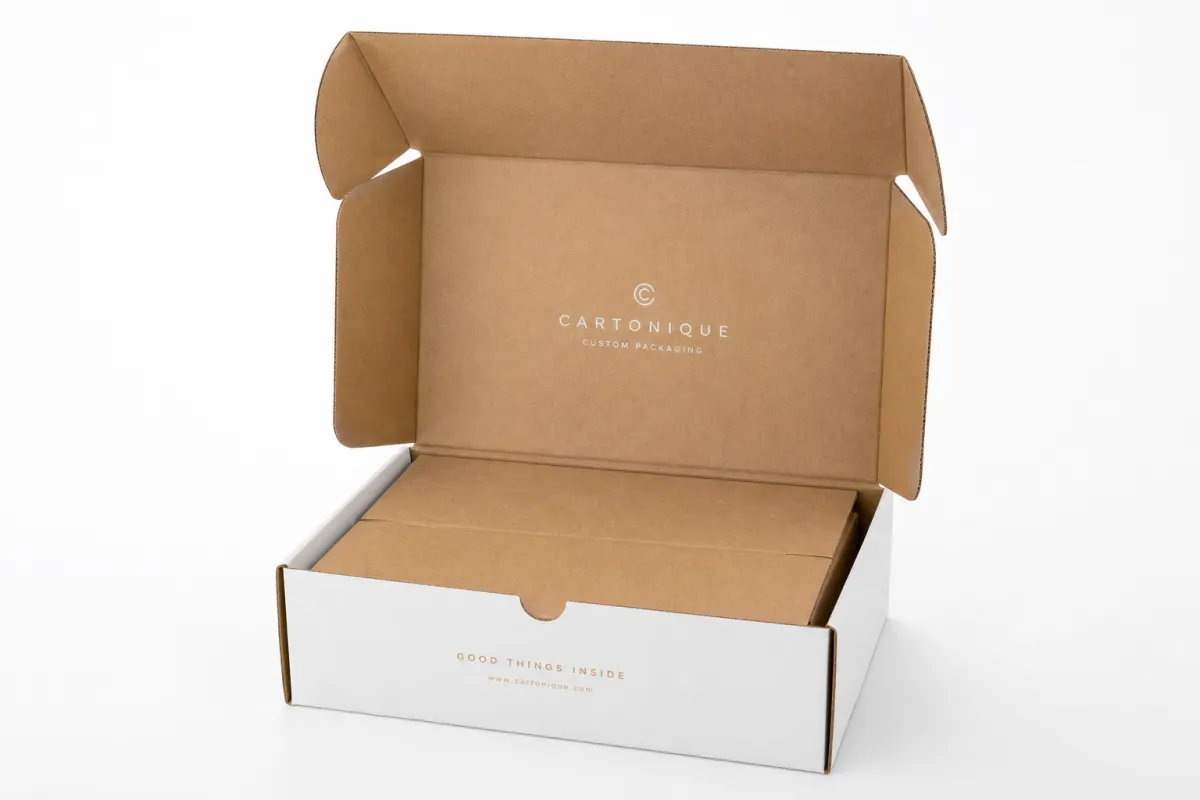
Open a delivery box and people form an opinion almost immediately. Sometimes the judgment starts before the product is visible. A clean, well-proportioned carton with a sharp logo tells the buyer that the brand paid attention to details, and custom corrugated cartons with logo make that signal early, quietly, and at scale. That kind of branding works because it frames the product instead of trying to overpower it.
For a packaging buyer, custom corrugated cartons with logo often become the first physical brand touchpoint after purchase. That is true whether the carton is moving through an ecommerce network, arriving at a distributor, or sitting in back-of-house storage before retail placement. A plain carton can absolutely do the job, but branded packaging gives the shipment a more deliberate feel. In real use, that sense of intention can lift perceived value even when the product inside has not changed at all.
The sustainability side is easy to miss if the conversation stays focused only on appearance. Corrugated board is widely collected for recycling in many markets, and the fiber structure itself is one reason it remains a standard material in modern packaging. The EPA recycling guidance keeps returning to material recovery and waste reduction, which is one reason custom corrugated cartons with logo fit so neatly for brands that want packaging to support both presentation and recovery. A logo printed directly on the carton usually adds far less waste than layered wraps, plastic labels, or decorative inserts that do not contribute much beyond visual noise.
That combination of protection, presentation, and logistics is the real value. Custom corrugated cartons with logo do several jobs at once. They protect the product during transit, they reinforce brand recognition at the doorstep, and they help a company control the look of shipping without moving into more expensive retail packaging formats. For many brands, that is the sweet spot: a carton That Ships Well, looks intentional, and remains practical in daily operations.
I have seen the same mistake repeated in plenty of packaging programs: treating the outer carton as generic infrastructure. It is not. Custom corrugated cartons with logo can be one of the most economical ways to make a shipment feel planned, and that matters because first impressions rarely come from the product alone. If anything, the outer box gets blamed or credited before the item has a chance to speak for itself.
How custom corrugated cartons with logo are designed and printed
Good results begin with the board itself. Corrugated packaging is built from linerboard and a fluted medium bonded together, and those layers shape everything from crush resistance to print clarity. A tighter flute, such as E-flute, often gives a smoother surface for finer logo detail. B-flute or C-flute structures can offer better stacking performance. Double-wall board is a different category altogether; it is heavier, stiffer, and better suited to shipments where compression strength matters more than a compact presentation.
When brands order custom corrugated cartons with logo, the print method matters just as much as the board spec. Flexographic printing is common for larger runs because it is efficient and handles simple spot colors and bold marks well. Digital printing works well for shorter runs, faster changeovers, or designs with more variation. Litho lamination, where a printed sheet is mounted to the corrugated structure, can create a more polished retail-facing surface, though it adds cost and process complexity. Spot-color branding is often the cleanest choice when the goal is sharp recognition without a busy layout.
Here is the part that gets skipped too often: logo placement has structural limits. A carton has panels, seams, folds, flaps, and closures, and each one changes where artwork can live. A logo placed too close to a fold can distort. A mark that lands across a seam can split. Custom corrugated cartons with logo work best when the artwork is designed around the dieline instead of being dropped on top of it afterward. That is why proofing matters so much. The difference between a clean carton and an awkward one is often a matter of a few millimeters.
File prep creates another set of avoidable problems when it is handled casually. Vector files such as AI, EPS, or PDF usually reproduce cleaner edges than low-resolution raster images. Bleed has to be built in. Safe zones matter. Text should still read clearly once the design wraps around a three-dimensional shape. If a brand insists on tiny copy, thin type, or a full-bleed field of ink, custom corrugated cartons with logo can still work, but the team needs a realistic sense of what the substrate can support. Nobody likes discovering after the first run that a typeface looked gorgeous on the monitor and kinda mushy on the finished box.
A simple design checklist usually looks like this:
- Confirm the box style before artwork begins, because mailer boxes, regular slotted cartons, and die-cut shippers behave differently.
- Lock dimensions so the logo lands where it should after folding and gluing.
- Choose a print method that matches quantity, image detail, and budget.
- Limit ink coverage if recyclability and material efficiency are part of the brief.
- Review proofs on a dieline rather than on a flat mockup only.
That last point carries more weight than it sounds like it should. Custom corrugated cartons with logo often look fine in a PDF proof, then feel crowded or off-center once they are folded. The carton itself changes the visual field. A careful proof process respects that reality and keeps the brand from paying to fix avoidable mistakes later.
One more practical note: fewer inks, right-sized formats, and recyclable coatings usually make life easier farther down the line. Custom corrugated cartons with logo can still look strong with restrained artwork. In fact, many of the best examples rely on less decoration, not more. Clean branding tends to read as confidence, not emptiness.
Cost, pricing, and MOQ for custom corrugated cartons with logo
Price is where expectations get tested. Custom corrugated cartons with logo are often more affordable than people assume at scale, but the numbers move quickly once size, board grade, print coverage, and order volume change. A small carton with a one-color logo has a very different cost profile from a large die-cut shipper with full-surface graphics. Strong pricing conversations start with the exact spec, not with a vague idea of a branded box.
The biggest cost drivers are predictable. Box dimensions matter because larger footprints use more board. Board grade matters because higher crush resistance costs more. Print coverage matters because more colors, more ink, and more setup work tend to push pricing up. Finishing choices also affect the final number. For custom corrugated cartons with logo, a simple one-color flexo print on standard single-wall board can stay relatively modest. A retail-style carton with rich graphics, a custom coating, or a litho-laminated exterior can climb quickly.
| Carton Type | Typical MOQ | Approx. Unit Cost at 5,000 Units | Best Use Case |
|---|---|---|---|
| Plain unprinted corrugated carton | Low to medium | $0.32-$0.58 | Basic shipping where appearance is secondary |
| One-color flexo logo carton | Medium | $0.38-$0.72 | Most custom corrugated cartons with logo for ecommerce and wholesale |
| Digital-printed short run carton | Lower quantities | $0.85-$2.10 | Launches, test runs, seasonal campaigns |
| Litho-laminated branded carton | Higher quantities | $1.20-$3.50 | Retail packaging or premium product presentation |
Those ranges are not universal, and that is the point. A compact carton made from lightweight board may land near the bottom of the range, while a large heavy-duty shipper with a more complex print spec can sit well above it. Custom corrugated cartons with logo also move in price depending on whether the design is one or two colors, whether the carton is standard or die-cut, and whether special tooling is required.
MOQ matters because setup cost gets spread across the run. If a printer has to prepare plates, dies, or specific press configurations, a very small order carries more overhead per unit. That is why custom corrugated cartons with logo often become much cheaper per box as volume rises. A 500-piece order can be dramatically more expensive on a per-unit basis than a 5,000-piece order, even when the carton spec stays exactly the same.
Buyers sometimes compare only the unit price and miss the hidden costs. Samples, freight, storage, and artwork revisions all affect the real total. Tooling can matter too, especially if a custom cut size or special print plate is needed. A carton that looks inexpensive on paper may become costly once the team pays for multiple proof rounds or rush shipping. In contrast, a slightly higher quote for custom corrugated cartons with logo can be better value if it cuts down on damage and rework.
There is also a tradeoff between board strength and savings. It is tempting to choose the lightest possible board. That choice can work if the product is light and the distribution path is gentle. It can fail badly if the carton has to survive stacking, courier handling, or humid storage. Under-specifying the board may save pennies per unit and cost much more in returns, replacements, and customer complaints. For custom corrugated cartons with logo, total cost of ownership matters more than the quote alone.
Compare quotes on the same assumptions. Same dimensions. Same board grade. Same print method. Same quantity. Without that discipline, two suppliers can look far apart while actually quoting different products. That is how packaging budgets get distorted, and it is one of the fastest ways to wind up with a “good” price that is not actually good at all.
Production process and timeline: from proof to delivery
The production workflow for custom corrugated cartons with logo is usually direct, but the details matter. A clean project moves through brief, quote, artwork review, dieline approval, proof or sample, production, quality check, and shipment. Each step creates a decision point. If the team moves slowly or changes the spec late, the schedule stretches. If the team stays disciplined, the timeline can feel surprisingly manageable.
- Brief and quote - Share product dimensions, weight, shipping method, branding goals, and target quantity.
- Artwork review - Confirm file format, color expectations, logo placement, and any print limitations.
- Dieline approval - Lock the exact structural layout before production work starts.
- Proof or sample - Check fit, folds, logo positioning, and carton strength.
- Production - Run the approved spec on the agreed board and print method.
- Inspection and shipment - Verify quality before the cartons leave the facility.
Lead times depend on print method and order size, but a practical planning window is often 8-15 business days after proof approval for standard runs. Digital short-run work can sometimes move faster. Custom tooling, special coatings, and higher-volume production may extend the schedule. Freight adds another variable, especially if the cartons move across long distances or arrive during seasonal congestion.
The biggest delays usually come from avoidable issues. Artwork that is not vector-ready can slow proofing. Dimensions that keep changing after quoting can force the spec to be redrawn. Approval cycles can stall if the marketing team, operations team, and procurement team each want one more revision. Custom corrugated cartons with logo do not have to be slow, but they do need decisions.
That is where a disciplined file process pays off. A logo may be simple, but if the carton layout is not final, the artwork is not final either. In a launch scenario, that matters a great deal because packaging often sits on the critical path alongside product inventory, freight bookings, and sales timing. A delay in custom corrugated cartons with logo can ripple into everything else.
If a shipment needs validation, shipping tests help reduce surprises. The ISTA standards are widely used to evaluate packaging performance under vibration, drop, and handling conditions, while ASTM methods are often referenced for compression and material performance. Those tests are not reserved for large enterprises. Even smaller brands can use them as a benchmark to compare custom corrugated cartons with logo against real transit stress.
A carton that fits once on a designer's screen is not ready. It has to survive a warehouse aisle, a truck linehaul, and the customer's hands.
That sentence sounds obvious, but it is where many programs go wrong. Custom corrugated cartons with logo should be approved under real conditions, not only in a polished proof. A carton that is easy to assemble, easy to stack, and easy to scan in the warehouse saves far more money than it costs to build correctly.
Key factors that determine strength, sustainability, and fit
Internal dimensions matter more than exterior measurements because product protection starts inside the box. If the carton is too loose, the item can shift and suffer abrasion or impact damage. If the carton is too tight, assembly gets harder and the board may deform under pressure. Custom corrugated cartons with logo should be built around the product's actual footprint, not around a rough estimate pulled from a spec sheet.
Board grade and flute profile shape both performance and appearance. A 32 ECT single-wall carton may be fine for lighter ecommerce loads. A 44 ECT or 200# Mullen spec can be more appropriate when the shipment is heavier or stacking pressure is more serious. For fragile products, temperature-sensitive goods, or items traveling through rough courier networks, a double-wall structure can reduce risk. Custom corrugated cartons with logo should match the transit conditions, not just the product weight in isolation.
Sustainability needs to be evaluated realistically. Recycled content, fiber sourcing, right-sizing, and print coverage all influence the footprint. A carton that is 10 percent smaller can cut board use and shipping inefficiency at the same time. FSC-certified material can help brands document responsible fiber sourcing. And because corrugated board is usually kept in the paper recycling stream, custom corrugated cartons with logo often fit neatly into a lower-waste model when the design stays simple.
Branding should support the package's job, not interfere with it. Heavy ink coverage, oversized graphics, and mixed-material coatings can complicate recyclability or alter performance. That does not mean a carton has to look plain. It means the packaging design should be intentional. Custom corrugated cartons with logo can look elegant with one or two colors, a strong mark, and a clean panel layout. In practice, restraint often reads as more premium than clutter.
Different product categories need different specs even when the logo stays the same. A subscription apparel box may prioritize presentation and easy opening. A parts shipper may prioritize crush strength and close tolerances. A food brand may need more caution around moisture and storage conditions. Custom corrugated cartons with logo are flexible enough to support all of those use cases, but the spec should still be tailored to the product and the route.
Here is a simple way to think about fit and performance:
- Lightweight, low-risk products can often use a lighter single-wall carton with modest print coverage.
- Medium-weight goods usually need better stacking strength and a more careful internal fit.
- Fragile or heavy items often require double-wall construction, stronger closures, or inserts.
- Retail-facing shippers may need cleaner print, tighter registration, and better surface quality.
That list stays simple because the physics stay simple. A better fit reduces movement. Better board reduces damage. Better branding improves recognition. Put those together and custom corrugated cartons with logo become a packaging system, not just a print project.
Common mistakes when ordering branded corrugated cartons
The first mistake is easy to spot: people start with artwork before the carton size is locked. A beautiful logo cannot fix a box that fits poorly. If the item moves around, the carton loses efficiency and the unboxing feels careless. Custom corrugated cartons with logo work best when structure comes first and graphics follow the structure, not the other way around.
The second mistake is underestimating shipping stress. An ecommerce brand may assume that one carton spec can handle every route, every carrier, and every destination. That assumption is risky. A shipper that performs well in local delivery might fail in a longer network with more vibration, more handling, and more stacking. Custom corrugated cartons with logo should be chosen with the real distribution path in mind.
Third, vague print instructions create avoidable defects. If the color target is not clear, the logo can drift. If the safe area is unclear, the mark can land too close to an edge. If the panel orientation is not spelled out, the brand may look upside down on a side panel or awkward across a seam. These are not major engineering failures, but they weaken the package branding. Custom corrugated cartons with logo deserve the same detail discipline as any other production asset.
There is also the low-price trap. A quote can look attractive until the carton reaches the warehouse and starts causing problems. If a box collapses in transit, needs manual rework, or requires extra inserts to keep the product safe, the savings disappear fast. I have seen brands chase the cheapest quote and end up with higher total spend. That is not because the supplier was bad. It is because the spec was underbuilt.
Skipping sample testing is another common miss. A printed proof is useful, but it does not tell the whole story. You need to see how the box folds, how the logo reads at arm's length, and how the finished carton behaves under load. Custom corrugated cartons with logo often reveal small fit or presentation issues only after the first sample is assembled. That is the sample's job: find the problem before the full run locks it in.
Some teams also forget that reorders need the same controls as the first run. If the original carton was approved carefully and the reorder is handled casually, the next batch can drift in color, registration, or material grade. Consistency is part of the value of custom corrugated cartons with logo. A clean repeat order protects that value.
The cheapest quote is not the cheapest outcome if the carton fails in the field.
That line deserves a place near the top of any packaging review. In corrugated packaging, the lowest unit price can become a very expensive decision once damage, complaints, and rework enter the picture.
Expert tips and next steps for smarter packaging decisions
Start with a spec sheet. That single document can save hours. Include product dimensions, product weight, shipping method, branding goals, and sustainability targets. If the carton needs to serve more than one channel, say so. If the item is fragile, say that too. Custom corrugated cartons with logo perform better when the brief is concrete.
Request both a structural sample and a printed sample. The first checks fit and build quality. The second checks the visual layer. Treat them as different tests. A carton can fold perfectly and still miss the mark visually. It can also print beautifully and fail in transit. Custom corrugated cartons with logo need both sides of the equation to work.
Compare quotes on identical assumptions. Same size. Same board grade. Same print coverage. Same quantity. Without that discipline, one quote may look lower simply because it leaves out a real requirement. That is especially true when suppliers are quoting different carton styles or different levels of finishing. Custom corrugated cartons with logo are easier to compare once the technical spec is pinned down.
Test the carton in the real world. Put it on a warehouse line. Stack it with actual product load. Run a mock delivery. Watch what happens when the carton is handled by someone who has never seen the brand. Then look at the unboxing from the customer's point of view. Product packaging is not only about the first look; it is also about the second, third, and tenth touchpoint in the supply chain.
A simple approval checklist helps keep reorders consistent:
- Verify the dieline before artwork is released.
- Confirm the carton dimensions against the actual product sample.
- Approve logo placement on all panels that matter.
- Check the color target against a physical proof if possible.
- Review the board grade for strength and shipping conditions.
- Document the final spec so reorders do not drift.
If a brand is still comparing packaging formats, the broader product range can help frame the decision. See Custom Packaging Products for a wider view of package styles, or review Custom Shipping Boxes if the main need is a transportation-first carton with branding built in. Those comparisons matter because custom corrugated cartons with logo are rarely chosen in isolation; they sit inside a larger packaging system.
Practical bottom line: custom corrugated cartons with logo work best when structure, print, and supply chain needs are decided together. If you get that sequence right, the carton does more than move a product. It protects margin, supports brand recall, and keeps the packing line simpler than a stack of add-on materials ever could.
For teams that want a cleaner procurement process, custom corrugated cartons with logo are often the smartest starting point because they sit at the intersection of brand and shipping. Get the spec right once, and the benefits show up in fewer damages, cleaner presentation, and a more consistent unboxing across every order. The trick is to lock the carton size, board grade, and print method before the artwork gets fancy, because that order of operations is what keeps the run predictable.
FAQ
What are custom corrugated cartons with logo usually made from?
Most custom corrugated cartons with logo are made from linerboard and a fluted corrugating medium bonded into a rigid board. Recycled fiber content is common in many grades, although the exact structure depends on product weight, stacking demands, and how far the carton has to travel.
How much do custom corrugated cartons with logo cost per unit?
Unit cost depends on size, board grade, print method, number of colors, and quantity. At higher volumes, custom corrugated cartons with logo often become much more economical per unit, but freight, tooling, samples, and revisions can change the total spend. That is why full quotes matter more than the sticker price.
How long does it take to produce custom corrugated cartons with logo?
Timing usually depends on proof approval, artwork readiness, order size, and whether the job needs custom tooling or special printing. Fast approvals and final dimensions can shorten lead time, while revisions and capacity constraints usually extend it for custom corrugated cartons with logo.
What logo file works best for custom corrugated cartons with logo?
Vector files such as AI, EPS, or PDF usually work best because they keep edges sharp when the artwork scales to carton size. Clean type, outlined fonts when needed, and a properly built dieline help reduce surprises during proofing and production of custom corrugated cartons with logo.
Are custom corrugated cartons with logo recyclable?
In many cases, yes, especially when the carton uses recyclable board and low-impact inks or coatings. Recyclability can be reduced by heavy lamination, excessive ink coverage, or mixed materials, so the sustainability choices made during design matter for custom corrugated cartons with logo.

