Buyer Fit Snapshot
| Best fit | Custom Corrugated Trays for Products projects where brand print, material claims, artwork control, MOQ, and repeat-order consistency need to be specified before quoting. |
|---|---|
| Quote inputs | Share finished size, material target, print colors, finish, packing count, annual reorder estimate, ship-to region, and any compliance wording. |
| Proofing check | Approve dieline scale, logo placement, barcode or warning zones, color tolerance, closure strength, and carton packing before bulk production. |
| Main risk | Vague material claims, crowded artwork, missing packing details, or unclear freight terms can make a low unit price expensive after revisions. |
Fast answer: Custom Corrugated Trays for Products: Material, Print, Proofing, and Reorder Risk should be specified like a repeatable production item. The safest quote records material, print method, finish, artwork proof, packing count, and reorder notes in one written spec.
Production checks before approval
Compare the actual filled-product size with the drawing, then confirm tolerance on folds, seals, hang holes, label areas, and retail display edges. Reserve space for logos, QR codes, warning copy, and material claims before decorative graphics fill the panel.
Quote comparison points
Review material grade, print process, finish, sampling route, tooling charges, carton quantity, and freight assumptions side by side. A quote is only useful when the supplier can repeat the same color, closure quality, and packing count on the next order.
Custom Corrugated Trays for Products: A Practical Guide
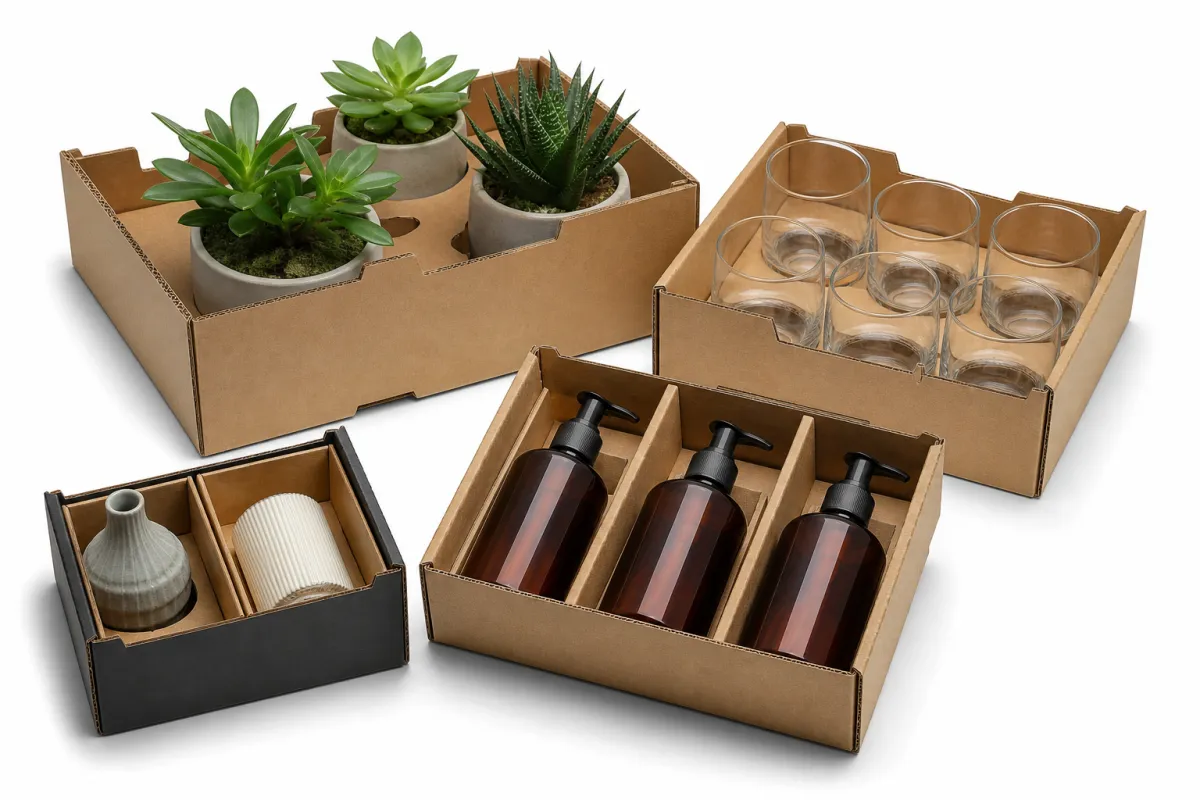
Custom Corrugated Trays for products solve a packaging problem that shows up everywhere from the warehouse floor to the customer’s doorstep: movement. Boxes move. Products slide. Fill materials settle. Shipping is basically a long series of tiny insults, and product movement is usually where the damage starts. A bottle shifts a little. A jar tilts. A kit knocks into itself a few times. That is enough. Custom corrugated trays for products matter because they stop that drift before it turns into broken goods and awkward returns.
From a buyer’s angle, the appeal is refreshingly practical. A tray can cut touchpoints, reduce void fill, and make packaging easier to standardize across multiple SKUs. It can also make retail packaging look more deliberate, which matters more than people admit. If the tray sits inside a shelf-ready display or becomes part of the unboxing moment, it is doing quiet brand work too. That is useful when packaging has to protect the product and still look like someone actually thought about it.
The middle ground matters. A plain carton protects the outside, but it does a mediocre job of organizing the inside. Foam cushions well, yet it can add cost, complicate recycling, and slow pack-out. Dividers separate items, but they do not always stop vertical movement or side-to-side creep. Custom Corrugated Trays for products land in the gap between those options and often win there because they can be tailored to one item, one family, or one kit.
I have seen plenty of packaging programs start with a carton and a hope. That usually ends the same way: damaged corners, loose parts, and someone in operations muttering that the tray “looked fine in the meeting.” It looked fine because the meeting did not involve vibration, humidity, or a tired person trying to pack 300 units before lunch.
What Custom Corrugated Trays for Products Actually Do
At the simplest level, custom corrugated trays for products are die-cut or formed support pieces made from corrugated board. They cradle a single product, separate multiple items, or keep a kit organized so each part lands in the same place every time. That repeatability is not glamorous. It is just useful. A tray that guides a bottle, carton, jar, or component into position keeps loading clean and predictable. Less fumbling. Fewer crooked packs. Fewer mistakes that get noticed too late.
They show up in retail-ready packs, e-commerce shippers, industrial kits, food and beverage programs, cosmetics, and fragile-goods packaging. Custom corrugated trays for products are common around glass jars, dropper bottles, candle sets, hardware assortments, small appliances, and refill packs. You will also see them under custom printed boxes when the outer carton handles the branding and the tray handles the stabilization. That split is pretty normal. It is also smart.
Here is the practical difference between a tray and a few adjacent formats:
- Trays support, separate, and position products with a shallow footprint.
- Inserts usually sit deeper in the carton and are better when each item needs more enclosure.
- Dividers split space into cells, but they do less to restrain vertical movement.
- Full cartons protect the outside, yet they often need internal help to stop product-to-product contact.
That is why custom corrugated trays for products often make the most sense when speed and stability both matter. They take fewer steps than loose fill and usually stack more cleanly than improvised packaging. They also help the line stay consistent. If a team packs 500 units a shift, shaving just a few seconds off each pack-out turns into real labor savings by the end of the month. That kind of math is not exciting, but it pays.
There is another benefit that gets brushed aside too quickly: presentation. Good product packaging does more than prevent damage. It tells the customer what belongs where. A clean tray can make a retail package feel organized instead of thrown together at the last minute. That matters in branded packaging, where the inside of the box still carries part of the brand story. People notice when the details are lazy. They notice when they are thoughtful too.
How Custom Corrugated Trays for Products Are Built Into a Packaging System
Custom corrugated trays for products should never be designed as a standalone object. They live inside a system that includes the outer carton, the product itself, the shipping environment, and the person packing the order. A tray can look perfect on a flat drawing and still fail in the real world if the operator has to wrestle the product into place, if the box gets stacked too high, or if the route includes rough handling and ugly temperature swings.
The board structure matters. Corrugated board is usually described by flute profile and construction. E-flute is thinner and often chosen for cleaner print and tighter retail fits. B-flute is a dependable general-purpose option. C-flute brings more cushioning and stacking strength. Single-wall construction works for lightweight to medium loads, while double-wall makes more sense when stacking pressure or heavier contents start to matter. For many custom corrugated trays for products, the right board is not the strongest one on paper. It is the one that fits the route, the weight, and the budget without overbuilding the job.
Design teams usually start by checking product dimensions, weight distribution, fragility, and how the pack gets handled from start to finish. A tray for a 4-ounce cosmetic jar is a very different animal from a tray for a 12-pound appliance accessory set. The first may care most about appearance and pack-out speed. The second may care more about edge crush, panel stiffness, and pallet stability. That is why packaging design is not a drawing exercise with a nice title. It is a usage exercise with consequences.
Common tray features include locking corners, finger cutouts, stacking lips, and vent or drain openings where moisture or airflow matters. Those details sound small until someone has to use them all day. A finger cutout keeps a worker from prying at the board. A stacking lip helps a display stay put on a shelf. Drain openings matter in food or produce applications, where condensation should go somewhere other than the product. Well-designed custom corrugated trays for products make those choices feel invisible because they work the first time.
For teams building to test protocols, industry benchmarks help. ISTA test methods define transit conditions, while structural checks such as ASTM D4169 or compression testing show where a design gets thin. Not every project needs a full test battery. Plenty of projects do need to be checked for rough handling, stack load, and pack-out speed before anyone approves production. Skipping that step is how people end up paying for the same mistake twice.
In my experience, the best packaging teams do not treat the tray as a pretty insert. They treat it like an operating part. That means checking how it behaves when the carton is half-empty, when the pallet is stacked high, and when the person packing is moving fast because the order queue is backed up. That is the real world. Not the drawing.
- Start with the product, not the carton.
- Map the handling path from pack line to customer.
- Select flute and board grade for the real load, not a guess.
- Prototype, test, revise, then release.
That sequence sounds obvious because it is. The part that gets people into trouble is ignoring one of the steps and hoping the tray will forgive them. It usually does not.
Key Design Factors That Affect Cost, Performance, and Presentation
Dimensions and tolerances come first. Even a few millimeters can decide whether custom corrugated trays for products hold an item securely or just surround it. That margin matters more than many buyers expect. Too loose, and the product shifts. Too tight, and operators slow down, crease the board at the folds, or reject the tray during pack-out. Good fit is not zero clearance. It is controlled clearance. There is a difference, and it is not subtle.
Product weight and stacking load come next. Two trays can share nearly the same footprint and still perform very differently. A tray for lightweight cosmetics may work well with 32 ECT board, while a heavier SKU family may need 44 ECT or a stronger flute combination. If the cases get palletized in tall stacks, that choice becomes even more important. A tray that looks fine on a table can crush under warehouse pressure. Packaging does not care about optimism.
Presentation is not decoration. Retail packaging, shelf-ready packs, and branded packaging often depend on whether the tray looks clean, consistent, and intentional. If the tray is visible to the customer, print coverage, color matching, and cut accuracy matter. Some brands want the tray to disappear. Others want the tray to support package branding with a tidy reveal, a printed message, or a deliberate product layout. Both choices are valid. They just require different decisions.
Sustainability is a design choice too. Right-sizing can reduce fiber use without sacrificing protection. Recycled content can lower demand for virgin material. FSC-certified board may matter for brand commitments or retailer requirements. If a tray replaces excess void fill or a more complicated insert system, the environmental result may actually improve even when the board weight rises a bit. The right comparison is system-level, not piece-level. Judging only the tray in isolation misses the point.
Honestly, one of the biggest mistakes in tray design is treating cost as a single number. Custom corrugated trays for products have cost drivers that interact. A slightly more expensive board may reduce damage enough to pay for itself. A simpler die may cut tooling cost and speed production. A cleaner tray geometry may improve pack line speed by 10% or more. That is not a fantasy number. It happens often enough to be worth planning around.
And yes, sometimes the cleanest answer is the least dramatic one. A tray that does the job without extra folds, unnecessary print, or weird little cutouts is usually the one that ages best. Fancy is not a substitute for fit. Never has been.
"If the tray saves one repack, one damaged return, and one awkward hand adjustment on the line, the piece price stops being the real metric."
That is the packaging math that actually matters. Not a neat quote in isolation. The real savings come from lower labor, lower damage, and less handling waste.
Custom Corrugated Trays for Products: Cost and Pricing Breakdown
Pricing usually starts with a prototype or sample fee, then moves to tooling, unit price, freight, and any secondary operations such as print, coating, scoring, or gluing. Custom corrugated trays for products are often quoted with a die charge if the format is die-cut. That charge can run from roughly $250 to $1,200 depending on size, complexity, and vendor. Sample runs may add another $150 to $500 if physical mockups or faster tooling are needed. No mystery there. Setup costs just like to show up early.
Unit cost depends heavily on volume. A tray that costs $0.42 at 1,000 pieces may drop to $0.18-$0.28 at 5,000 pieces and sometimes lower if the design is simple, the board is standard, and the print is light. The reverse is true too. A complex, heavily printed tray with moisture resistance or specialty coatings can sit closer to $0.35-$0.90 per unit depending on board grade and run size. Custom corrugated trays for products are a classic case where setup costs dominate at the beginning and fade as volume climbs. Those numbers are ballpark figures, not a quote from your supplier, so treat them that way.
Here is a practical comparison buyers can use when they are weighing tray options:
| Tray Option | Typical Board Spec | Best Use Case | Indicative Unit Cost at 5,000 | Notes |
|---|---|---|---|---|
| Light-duty die-cut tray | E-flute, single-wall, minimal print | Cosmetics, sample kits, lightweight retail packs | $0.16-$0.24 | Fast to pack, lower material cost, less stacking reserve |
| Balanced support tray | B-flute or E/B combo, moderate print | Most product packaging and shipper systems | $0.22-$0.38 | Often the best balance of protection and presentation |
| Heavy-duty tray | C-flute or double-wall, coating optional | Heavier kits, industrial goods, stacked pallet loads | $0.45-$0.90 | Higher board cost, stronger compression performance |
That table only tells part of the story. The hidden costs can be bigger than the tray price itself. Oversized outer cartons waste cubic space. Bad palletization raises freight cost. Extra void fill adds labor. A tray that takes 12 seconds too long to assemble becomes expensive over 50,000 packs. Anyone comparing custom corrugated trays for products to generic packaging should compare total landed cost, not just the tray invoice. Cheap on paper is not the same as cheap in the supply chain.
It also helps to think in terms of failure cost. If a tray prevents even a small percentage of damage, the savings can outrun a modest increase in unit price. For example, a 2% reduction in breakage on a 100,000-unit program may save far more than a tenth of a dollar per tray. That is why custom corrugated trays for products are often cheaper in the broad sense, even when they are not the lowest line item on the quote. The quote is only one slice of the bill.
For sustainability-minded buyers, the economics can improve in another way. EPA recycling guidance and FSC-certified board options can support corporate targets while still allowing the tray to use less material overall. If you want broader material and recovery context, the EPA’s recycling resources at EPA recycling guidance and the standards framework at FSC are useful references. They do not choose the design for you, but they help set the boundaries.
There is a simple budgeting framework that works well:
- Estimate annual volume by SKU family.
- Assign a realistic damage rate to the current pack.
- Estimate labor savings if pack-out is faster by even a few seconds.
- Compare shipping cube before and after the tray.
- Only then judge custom corrugated trays for products by piece price.
The mistake is buying the lowest number and calling it efficient. The better move is buying the tray that lowers the whole system cost.
A packaging manager who only looks at unit cost is usually seeing half the bill.
Step-by-Step Process and Timeline for Custom Corrugated Trays
The best projects begin with solid inputs. For custom corrugated trays for products, that means product samples, exact dimensions, weight, photos, any surface fragility issues, and the shipping environment. It also means knowing whether the tray must work inside a larger carton, on a retail shelf, or in a multipack display. A design team can solve a problem quickly if the problem is clearly defined. Vague requests just make expensive revisions later.
Design usually starts with concepts and structural options. One concept may favor low unit cost, another may favor faster pack-out, and a third may favor display quality. The team then checks board grades, flute direction, stacking orientation, and whether the tray needs locking tabs, corner supports, or finger access. For custom corrugated trays for products, a small geometry change early in the process can save a much larger correction after tooling. Tiny details have a habit of becoming big problems.
Sampling and testing should happen before the final order, not after. A good sample review includes fit checks, assembly checks, and a real pack-out trial with the people who will actually use the tray. If the tray is part of a shipping program, drop tests, vibration checks, and stack tests make sense. ISTA methods are useful here because they give the team a common language for transit abuse. A design that passes on-screen but falls apart on the line is not ready yet. It is just optimistic.
A realistic timeline for custom corrugated trays for products often looks like this:
- Discovery: 1-3 business days to gather specs, samples, and usage details.
- Concept and engineering: 2-5 business days for initial structural design.
- Sampling: 3-7 business days for mockups or prototype cuts.
- Revisions: 2-5 business days depending on fit changes.
- Production scheduling and manufacturing: often 7-15 business days after approval, depending on volume and factory load.
That timeline can move quickly if approvals are fast and the specification is clean. It can slow down if multiple departments weigh in late, if product dimensions are still fuzzy, or if the tray has to coordinate with custom printed boxes already in production. Speed is mostly a process issue. The artwork is rarely the main bottleneck. Decision-making is. That part tends to drag more than anyone wants to admit.
When teams know that, they usually assign one owner for the tray project and one backup reviewer. That keeps revisions from looping forever. It also reduces the chance that custom corrugated trays for products get stuck while marketing wants more branding, operations wants easier pack-out, and procurement wants a lower quote. All three concerns matter. The cleanest program makes room for all three without letting any one of them take over.
If the schedule is tight, the smartest move is not to skip testing. It is to simplify the spec. Fewer variables mean fewer delays. That may sound boring, but boring can be a very good sign in packaging development.
Common Mistakes When Ordering Custom Corrugated Trays for Products
One common mistake is designing to the CAD size of the product and ignoring handling reality. Vibration loosens fits. Temperature changes alter board stiffness. Humidity softens performance. A tray that is fine in a climate-controlled office can behave very differently in a hot truck or a damp warehouse. Custom corrugated trays for products need to be designed for the environment, not just the item dimensions. Otherwise the test looks good and the shipment looks worse.
The second mistake is choosing the cheapest board grade without checking crush resistance or edge strength. That is false economy. A lower-grade board can work for a light product on a short route, but it can fail under stack load or repeated handling. If the tray supports products in a multi-pack or lives inside a palletized shipper, the board choice matters more than many buyers assume. Custom corrugated trays for products deserve material selection, not just a price comparison. Packaging is not a race to the bottom. Or it should not be.
Usability is another place where projects go off the rails. A tray should not fit so tightly that operators have to wrestle with it. If packers need to twist, bend, or force the product into place, the line slows down and the board can tear at the score line. The right tray protects the product and respects the person packing it. That balance is what separates a competent design from an annoying one.
Overcomplication is the fourth mistake. Too many cutouts, too many folds, too many print requirements, and too many special finishes can add cost without improving performance. If the tray hides inside an outer carton, a full print program may be pointless. If the tray is visible, a simple one-color mark or a clear panel may be enough. The goal is not to make the tray fancy. The goal is to make it fit the job and not get in the way.
And then there is the most expensive mistake of all: skipping real-world testing. Drawings are useful. They are not proof. A tray that looks strong in a mockup can fail during repeated insertion, line vibration, or warehouse stacking. That is especially true for fragile items, liquids, and heavy multi-part kits. Custom corrugated trays for products should be tested with actual operators, actual products, and actual handling steps before anyone signs off on production. If the tray only works in theory, it does not work.
I have seen teams spend weeks polishing the drawing while never asking the packers to touch a sample. That is how you end up with a tray that is technically correct and operationally useless. Nice work, I guess.
Expert Tips for Better Tray Performance, Faster Pack-Out, and Lower Waste
Design for the worst credible case first. Heaviest load. Roughest route. Warmest warehouse. Slowest packer, if you are trying to avoid rework. Then tighten the design from there. A tray that survives the worst normal condition usually survives the average one without drama. This is one of the few places where conservative design actually saves money. Custom corrugated trays for products are cheap only when they do not trigger redesigns.
Standardize tray families where possible. If five SKUs share 80% of the same footprint, a common tray platform may reduce inventory complexity and simplify purchasing. That helps procurement, but it also helps operations because the line sees fewer changeovers. In some programs, one tray family can support several product packaging formats with only minor insert changes. That is a better outcome than rebuilding the tray for every SKU just because each team wants its own version.
Use pack-out trials with the people who touch the packaging every day. CAD can show dimensions, but it cannot show the awkward wrist angle that slows a packer down or the corner that catches during insertion. A 20-minute line trial can reveal problems that would otherwise cost weeks. For custom corrugated trays for products, that is often the fastest path to a cleaner design. Real people find real problems. Fancy renderings do not.
Compare total cost of ownership, not just the tray quote. That means looking at labor, damage, freight cube, customer returns, and how much secondary packaging the tray eliminates. If a tray lets you drop extra void fill, reduce repacks, and ship denser pallets, the economics may improve even when the board spec is stronger. If your team also uses Custom Packaging Products or needs Custom Shipping Boxes, it is worth checking how the tray and outer pack affect each other instead of buying each part separately. Packaging likes to hide costs in the seams.
One more practical tip: right-size the tray to the product footprint, then let the rest of the package carry the load. Oversized trays waste material and shipping volume. Overly generous cavities can make the product feel loose, which undercuts both protection and presentation. The best custom corrugated trays for products usually look almost boring on paper. In production, that is a compliment. Boring is often a sign that the design is doing its job.
Buyers sometimes ask whether the tray should be invisible or visible. The honest answer is that it depends on the brand promise. For high-end retail packaging, a visible tray can be part of the reveal. For industrial kits, invisibility may be better. Either way, package branding should support the job, not distract from it. The tray is there to help the product, not audition for attention.
And if a supplier tells you the tray is “universal,” be skeptical. Packaging loves that word right up until the first damaged shipment lands on someone’s desk.
What To Do Next Before You Order
Start with a short internal checklist. Product dimensions. Weight. Fragility. Pack quantity. Shipping method. Display requirements. This sounds basic, and it is. It is also where custom corrugated trays for products are usually won or lost. If the team cannot answer those questions with confidence, the tray spec will wobble too. Bad inputs produce bad packaging. That part never changes.
Then gather two or three physical samples, or at least exact measurements from production units rather than nominal drawings. Real samples matter because molded components, closures, and labels all change the fit. If the tray has to work with custom printed boxes or a retail sleeve, confirm those dimensions at the same time. This is the moment where precision saves money. A few millimeters here can prevent a tooling revision later. A tooling revision is expensive. Everyone knows that. People still cause them anyway.
Request a prototype and test it under real conditions. Check assembly time, fit, stackability, and damage resistance during handling and transit. If the tray is going into a shipper, simulate the shipping sequence. If it is going on shelf, simulate stocking and customer access. If it is going to be packed by hand, let the packing team try it before production. Custom corrugated trays for products should pass the hands test before they pass the purchase order test. That order matters.
Compare at least two options: one optimized for lowest unit cost and one optimized for performance. Then compare total cost of ownership across a realistic volume. That gives you a clearer picture than a single quote ever will. It also helps you decide whether the tray should be simple, printed, reinforced, or paired with another packaging component. In many cases, the best answer is not the cheapest tray. It is the tray that keeps the whole shipping system predictable. Predictable is good. Predictable keeps people from making late-night apologies.
If you follow that process, custom corrugated trays for products become a controlled purchase rather than a guess. That is the real goal: fewer surprises, fewer damaged units, and a packaging format that fits the product, the line, and the brand instead of forcing everyone else to adapt to it. The final move is simple: lock the sample, run the test, confirm the stack load, and only then approve production. That is how you keep the tray useful instead of merely promising to be.
What are custom corrugated trays for products used for?
They hold, separate, and stabilize products during packing, shipping, display, or storage. They are common for fragile items, multi-pack kits, retail-ready packs, and products that need organized presentation. In many programs, custom corrugated trays for products also cut assembly time because operators place items into a defined shape instead of arranging loose components by hand.
How do I know if custom corrugated trays for products are better than inserts?
Choose trays when the main job is support, organization, and faster pack-out rather than full enclosure. Use inserts when each item needs more cushioning or positioning inside a larger carton. If the product is light, visible, and handled repeatedly, custom corrugated trays for products often win because they are simpler to load and easier to standardize.
What affects the price of custom corrugated trays for products most?
Material grade, board thickness, tray size, print requirements, die complexity, and order volume have the biggest impact. Labor savings and damage reduction should also be factored into the real cost. A tray that costs a little more per unit can still be the cheaper choice if custom corrugated trays for products reduce rework, breakage, or freight cube.
How long does it take to develop custom corrugated trays for products?
A simple project can move from concept to sample quickly, but revisions, testing, and production scheduling can extend the timeline. Having product samples, dimensions, and approval contacts ready usually shortens the process. For many projects, the pace improves most when one person owns the decisions on custom corrugated trays for products.
Can custom corrugated trays for products be made sustainable?
Yes, they can use recycled content, be right-sized to reduce fiber use, and eliminate unnecessary filler material. The most sustainable option is often the one that protects the product with the least material and the fewest shipment failures. In practice, custom corrugated trays for products often improve sustainability simply by replacing wasteful overpacking with a more exact fit.

