Buyer Fit Snapshot
| Best fit | custom cosmetic boxes with logo branding for packaging buyers comparing material specs, print proof, MOQ, unit cost, freight, and repeat-order risk where brand print, material, artwork control, and repeat-order consistency matter. |
|---|---|
| Quote inputs | Share finished size, material target, print colors, finish, packing count, annual reorder estimate, and delivery region. |
| Proofing check | Approve dieline scale, logo placement, barcode or warning zones, color tolerance, and any recyclable or compostable wording before bulk production. |
| Main risk | Vague material claims, crowded artwork, or missing packing details can create delays even when the unit price looks attractive. |
Fast answer: Custom Cosmetic Boxes with Logo Branding: Dieline, Finish, Proof, and Buyer Review should be specified like a repeatable production item. The safest quote includes material, print method, finish, artwork proof, carton packing, and reorder notes in one written spec.
What to confirm before approving the packaging proof
Check the product dimensions against the actual filled item, not only the sales mockup. Ask for tolerance on folds, seals, hang holes, label areas, and retail display edges. If the package carries a logo, QR code, warning copy, or legal claim, reserve that space before decorative graphics fill the panel.
How to compare quotes without losing quality
Compare board or film grade, print process, finish, sampling route, tooling charges, carton quantity, and freight assumptions side by side. A lower quote is only useful if the supplier can repeat the same color, closure quality, and packing count on the next order.
Custom Cosmetic Boxes with Logo: Branding That Sells Before the Cap Comes Off
Custom cosmetic boxes with logo do a lot more than keep a product from getting banged up in transit. A tiny shift in board thickness, print quality, or closure style can make the same cream, serum, or lipstick feel premium on one shelf and weirdly cheap on another. Packaging is annoying like that. It is not just a container. It is protection, branding, and a sales pitch that starts before anyone touches the formula.
Beauty buyers judge fast. They are not sitting there admiring your structural engineering. They notice sharp type, a clean logo, and whether the carton feels solid in hand. A good box can lift perceived value almost instantly. A flimsy one can drag a strong formula down with it. Custom cosmetic boxes with logo help set the tone for price, position, and product quality in one shot.
Choosing a format gets easier when you stop staring at the logo alone. The real question is what custom cosmetic boxes with logo should say the second they hit a hand, a shelf, or a shipping lane. If the answer is fuzzy, the package will be fuzzy too. Packaging rarely hides confusion. It usually advertises it.
What Custom Cosmetic Boxes with Logo Actually Do
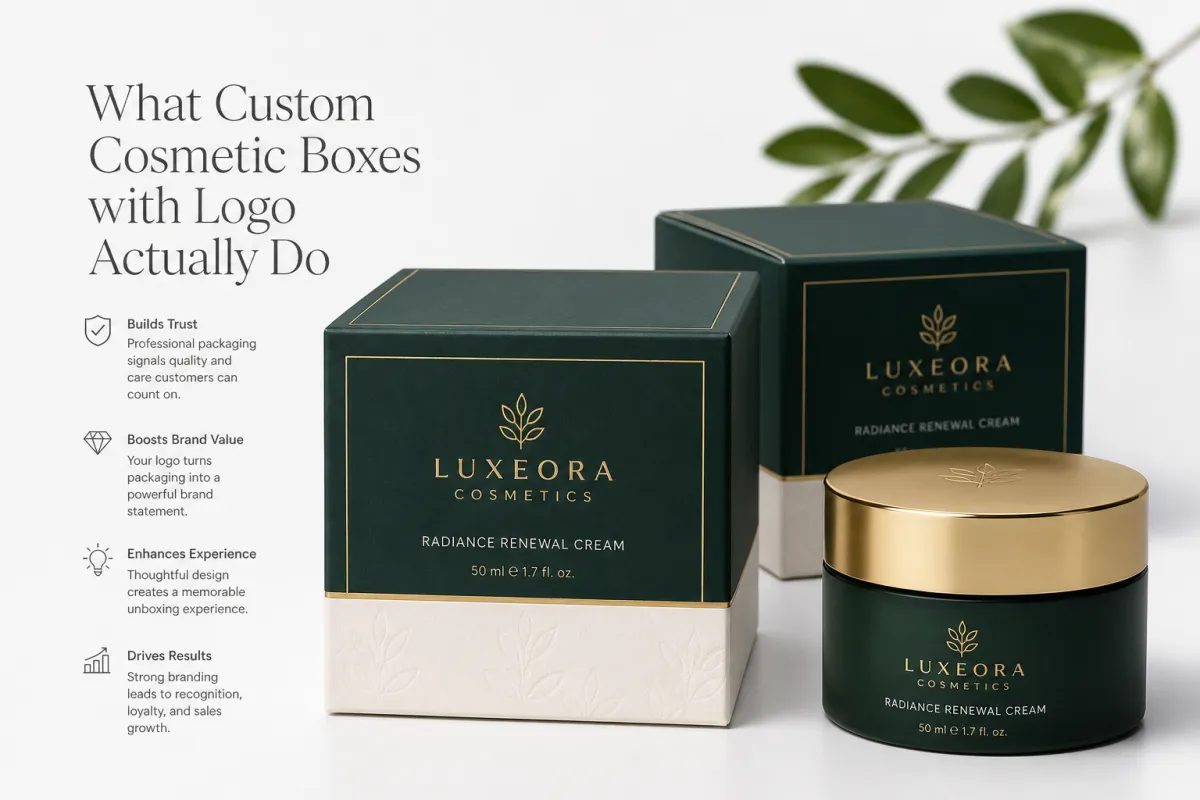
Custom cosmetic boxes with logo have three jobs, not one. They protect the product, present the product, and reinforce the brand from unboxing to display. A mascara carton and a serum carton do not need the same structure. A holiday gift set does not need the same treatment as a single lip color. The box has to fit the item, the channel, and the buying mood.
A lipstick carton usually needs to be compact, readable, and stackable. Skincare sets often need inserts, compartment spacing, and panel room for ingredients, claims, and barcodes. Giftable bundles tend to lean toward rigid board, drawer formats, or magnetic closures because the box itself becomes part of the purchase. That extra layer matters. Beauty is emotional, and packaging is part of the emotion.
The logo is not what makes custom cosmetic boxes with logo feel expensive. That sounds obvious, yet people still miss it. The board, the print registration, the spacing, and the way the closure lands matter more than the logo by itself. Put a logo on weak board and it still looks weak. Put it on a well-built carton and suddenly the whole thing feels deliberate.
Credibility in beauty gets decided early. A rigid carton with crisp print and a clean fold tells people the brand pays attention. Frayed edges, muddy color, or a crooked flap tell a different story. Nobody wants to feel that a product was packaged in a hurry, even if the formula is excellent. Custom cosmetic boxes with logo help prevent that first bad impression from happening.
From a buyer’s point of view, custom cosmetic boxes with logo should match the promise. A luxury serum, a clean beauty line, a dermatologist-inspired range, and a playful color cosmetics launch all need different visual cues. The box is not just showing a brand name. It is telling the customer what kind of experience to expect when they open the product.
I have sat through enough packaging reviews to know this part gets rushed more often than it should. Teams fall in love with a logo lockup and forget the rest of the carton. Then the box arrives and the whole thing feels off. Usually the logo was fine. The structure was not.
“The box has to feel like the formula deserves it.” That is usually the real test for custom cosmetic boxes with logo. When the structure, print, and finish line up, the product feels more credible without trying so hard.
If you are still shaping the offer, browse our Custom Packaging Products to compare carton styles, folding structures, and presentation options that can support custom cosmetic boxes with logo without overcomplicating the launch.
How Custom Cosmetic Boxes with Logo Move from Concept to Shelf
Most custom cosmetic boxes with logo follow a familiar path. The difference between a clean result and a messy one is usually how well each step gets handled. The process starts with a brief, then moves into a dieline, artwork placement, sample review, production, finishing, and packing. Skip one step or rush one approval, and the whole order can wobble later.
The brief needs specifics. A manufacturer needs exact product dimensions, the weight of the bottle or jar, whether the item ships through e-commerce or retail, and how much abuse the carton needs to survive in transit. Custom cosmetic boxes with logo for a direct-to-consumer serum ship differently from custom cosmetic boxes with logo for a prestige counter display. Same category. Very different requirements.
Artwork prep matters too. The logo should not be treated like a sticker tossed onto a template at the last minute. Good packaging design accounts for fold lines, panel hierarchy, flap behavior, and the face that actually sits toward the shopper. With custom cosmetic boxes with logo, the front panel is often the right spot, but not always. Sometimes the top or side panel does the job better, especially if the opening motion is part of the brand experience.
Proofing catches the expensive mistakes. Digital mockups help confirm layout, but they do not tell you how paperboard will feel in hand. Printed samples show color, finish, and logo scale more honestly. Structural samples show whether the product rattles, sits too high, or strains the tuck. Custom cosmetic boxes with logo benefit from all three when the order has any real complexity.
Poor planning burns money. If the die line gets approved before the artwork is ready, or the logo sits too close to a cut edge, the result can force a reprint. I have seen brands lose time not because the idea was weak, but because the fit data was sloppy. Custom cosmetic boxes with logo work best when product size, regulatory copy, and sales channel are locked before the art team starts polishing pixels.
Fragile formulas deserve transit testing. A lot of teams use methods aligned with ISTA packaging test standards to check drop behavior, vibration, and compression before full production. That is not overkill when you are shipping glass, pumps, or applicators inside custom cosmetic boxes with logo. It is just common sense with a better label.
Once the sample is approved, production and finishing begin. Foil, emboss, spot UV, matte or gloss lamination, and insert die-cutting all happen here, and each one affects timing. Custom cosmetic boxes with logo can look simple on screen while requiring several real steps to get the final feel right.
Key Design and Material Factors for Custom Cosmetic Boxes with Logo
The biggest design decisions behind custom cosmetic boxes with logo usually come down to board choice, print method, finish, and structure. Those four choices influence how the customer reads the box more than almost any decorative flourish. You can throw money at graphics all day. If the substrate is wrong, the box still feels off.
SBS paperboard is a common choice for custom cosmetic boxes with logo because it prints cleanly, holds sharp type, and works well for retail cartons that need a polished appearance. Kraft board suits a more natural, earthy story, especially for clean beauty or botanical skincare. Corrugated makes sense when protection matters more than shelf polish. Rigid board tends to fit gift sets and premium kits where the box is part of the value.
Finish matters just as much as stock. Matte lamination creates a calm, controlled surface and usually reads modern. Gloss pushes color harder and helps bright palettes show up under store lighting. Soft-touch adds a velvety feel people notice right away. Spot UV can pull the logo forward without covering the whole box in shine. With custom cosmetic boxes with logo, the finish should sharpen the brand story, not fight it.
Structure deserves the same blunt treatment. Tuck-end cartons are common for a reason. Sleeves add a useful second layer for set products. Rigid lid-and-base boxes create a more gift-like moment. Mailers work well for subscription beauty and e-commerce. Inserts matter when a glass bottle, palette, or applicator needs to stay centered and protected. Custom cosmetic boxes with logo should match the physical reality of the product, not just a mood board.
Print method affects logo clarity. Offset printing usually gives strong detail and color consistency on paperboard. Digital print can be useful for short runs, test markets, or variable artwork. Flexographic printing can fit certain corrugated applications. If your logo includes fine lines, tight kerning, or small text, the method matters. Custom cosmetic boxes with logo lose credibility fast when the logo prints fuzzy, washed out, or slightly shifted from panel to panel.
Sustainability needs honest language, not vague slogans. If a box is recyclable, say so only when the material and local recovery conditions support that claim. FSC-certified paperboard can help brands talk about responsible sourcing with real credibility, and the label means more when the packaging design stays efficient too. You can read more about responsible fiber sourcing through FSC. For custom cosmetic boxes with logo, honest material claims build more trust than a green box ever will.
The right material is not just about appearance. It has to fit the weight of the product, the fulfillment method, and the brand position. A luxury cream in a thin carton feels underbuilt. A simple cleanser in a heavy rigid box can feel overdone. Custom cosmetic boxes with logo work best when the box weight matches the product weight, visually and physically.
If you are comparing formats for several SKUs, review the whole family together. That is where our Custom Packaging Products can help you line up structures that share a visual system while still fitting different products cleanly.
One detail that gets missed a lot: tactile choices affect how people remember the brand. A soft-touch finish can make a serum carton feel calm and premium, while a crisp matte stock can make a color cosmetic line feel sharper and more editorial. Neither one is automatically better. The right answer depends on the product story. Pretty simple, really. Just not easy.
What Custom Cosmetic Boxes with Logo Cost and Why
Pricing for custom cosmetic boxes with logo comes down to a handful of inputs, and most of them are easy to understand once you look at the manufacturing process. Size, board type, print coverage, finishing, inserts, and quantity all affect the final number. A small carton with simple one-color print is a very different job from custom cosmetic boxes with logo that use rigid board, foil, embossing, and a die-cut insert.
Quantity drives a lot of the math. Lower runs usually carry a higher unit cost because setup, press time, cutting, and finishing get spread across fewer pieces. That does not make short runs a bad decision, especially for launches or seasonal packaging. It just means custom cosmetic boxes with logo usually reward volume. A 1,000-piece order and a 10,000-piece order can have very different unit economics even if the artwork never changes.
Brand image and budget pull against each other in a very real way. Premium custom cosmetic boxes with logo can raise perceived value enough to support a higher retail price or a stronger launch conversion rate. If the product is still being tested, a simpler structure may make more sense, with premium finishing saved for a hero SKU. Not every line needs foil on every panel. That would be a bad habit, not a strategy.
Here is a practical way to think about common options:
| Material / Style | Typical Use | Approx. Unit Range | What Drives the Cost |
|---|---|---|---|
| SBS paperboard carton | Retail skincare, lip color, single-item boxes | $0.18-$0.45 | Board caliper, color count, coating, quantity |
| Kraft paperboard carton | Natural beauty, clean-label, earthy branding | $0.20-$0.50 | Print coverage, white ink, finish complexity |
| Corrugated mailer | E-commerce shipping, subscription boxes | $0.65-$1.80 | Flute type, size, print coverage, structure |
| Rigid lid-and-base box | Gift sets, luxury launches, PR kits | $1.50-$4.50+ | Board wrap, magnet closures, inserts, specialty finish |
These ranges are not fixed quotes, because custom cosmetic boxes with logo vary by order size, artwork coverage, and finish selection. Still, they give a useful starting point. A brand that wants to protect margins may simplify structure before cutting print quality. A brand that depends on unboxing value may do the opposite and spend more on the packaging because the box is part of the product experience.
That choice matters most in beauty. If a customer keeps the box on a vanity or posts the unboxing moment, custom cosmetic boxes with logo can support organic marketing in a very direct way. If the carton is only a transit shell, a simpler build may be the smarter move. Pricing should follow function, not habit.
One more practical detail: inserts add cost, but they can cut damage claims. A molded or die-cut insert might add cents per unit, yet it can save real money if a glass bottle breaks, a pump cracks, or a compact shifts during transit. From a packaging buyer’s point of view, custom cosmetic boxes with logo are not just a line item; they are also a risk control tool.
Production Timeline for Custom Cosmetic Boxes with Logo
A realistic timeline for custom cosmetic boxes with logo starts with the quote and ends with delivery, but the middle is where delays usually show up. The first stage is artwork and structure review, where the dieline gets confirmed and the content gets checked for fit. Then comes proofing, sample approval, production, finishing, and packing. Each step depends on the one before it, which is why late changes get expensive quickly.
For a straightforward project, production can move fast once the proof is approved. More often, custom cosmetic boxes with logo take longer because someone wants to tweak logo size, adjust color, add regulatory copy, or change the insert. Those edits are normal. Every edit still affects layout, tooling, and schedule. A simple carton can sometimes move from approval to finished goods in roughly 12-15 business days, while more complex custom cosmetic boxes with logo may need several extra days for finishing and inspection.
Some steps can overlap. Artwork refinement can happen while sample planning is underway. Shipping can be arranged while production is running. Dieline approval, print proof sign-off, and sample acceptance still need to happen in sequence. That becomes even more true for custom cosmetic boxes with logo that use specialty finishes or need a tight fit around fragile items.
Rush orders do happen, but they narrow the field. You may get fewer finishing choices, less room for sampling, and a better chance that a small issue slips through because the deadline is breathing down everyone’s neck. That is not great for beauty packaging, where a slightly off color or a weak closure changes the customer’s reaction immediately. If the boxes need to land for a launch, trade show, or influencer drop, build in buffer time.
Shipping method should be confirmed early too. Air freight, sea freight, and domestic ground transit all affect how custom cosmetic boxes with logo should be packed and tested. A sample that looks perfect on a desk can still fail in a palletized shipment unless the master carton is built correctly. A little planning up front saves a lot of frustration later.
For launch calendars, the safest rule is simple: start earlier than you think. Custom cosmetic boxes with logo often take longer than the artwork team expects because proofing tends to surface questions that were invisible in the concept stage. If a product reveal depends on the box, the box should be treated like a launch asset, not a late-stage decoration.
Many teams also forget the final packing step. Counting, bundling, labeling, and arranging master cartons take time, especially when the order includes multiple SKUs or regional variants. The more carefully custom cosmetic boxes with logo are packed at the factory level, the fewer headaches the receiving team has later.
Common Mistakes That Hurt Custom Cosmetic Boxes with Logo
The most expensive mistake is usually not the big dramatic one. It is the small oversight repeated across thousands of boxes. With custom cosmetic boxes with logo, a logo placed too close to a fold line can disappear into the seam, a barcode can land where a flap interferes, or a legal line can become unreadable because the font was shrunk to save space.
Choosing a box that looks elegant but does not protect the product causes its own set of problems. Glass jars, dropper bottles, pumps, and applicators need internal support. If the box is too loose, the item can rattle, tilt, or crush corners during transit. Custom cosmetic boxes with logo should protect the formula first and impress the customer second. If they do both, great. That is the point.
Color management trips people up more often than they expect. Screen color can be a lousy predictor of printed color, especially for metallics, deep blacks, or delicate neutrals. A warm nude that looks clean in design software can print slightly pink or gray if the profile is off. With custom cosmetic boxes with logo, the logo may be technically placed correctly and still feel wrong if the color balance is off.
Too much decoration hurts performance too. I have seen cartons stuffed with gradients, claims, icons, pattern layers, and multiple finish treatments all fighting for attention. The result feels busy, not premium. For custom cosmetic boxes with logo, restraint usually reads as confidence. If every panel is shouting, the brand message gets blurred.
Regulatory copy creates problems when teams treat it like an afterthought. Ingredient space, country-specific language, batch coding, and barcode placement all need room. Ignore those details early and the design gets squeezed later, which usually wrecks the layout. Custom cosmetic boxes with logo should be designed with real compliance space, not imaginary space that only exists in a spreadsheet.
Shipping abuse gets underestimated all the time. A carton that survives a desktop mockup may still fail once it is stacked in a master carton, bounced across a truck, and handled by multiple warehouse teams. Testing with transit conditions in mind matters whether you are running custom cosmetic boxes with logo for retail, e-commerce, or a hybrid setup.
Some brands also design for a single launch and forget the line will grow. If every SKU uses a one-off layout, shade expansions become messy and expensive. A better approach is to create a packaging system that can stretch. That is where custom cosmetic boxes with logo become part of a long-term brand architecture instead of a one-off design exercise.
There is also the classic trap of approving artwork from a screen and calling it done. Screens lie. They are helpful, but they are not press sheets. I have seen a logo look perfectly centered in a PDF and then land a hair too low once the fold and glue zone show up. Tiny problem. Big irritation.
Expert Tips and Next Steps for Custom Cosmetic Boxes with Logo
My first recommendation is simple: review a sample before you approve a full production run. Even when the artwork looks perfect on screen, custom cosmetic boxes with logo can behave differently once the paper is folded, glued, and finished. A sample shows whether the logo feels balanced, whether the coating suits the brand, and whether the product sits properly inside the carton.
Second, design for the product family instead of only the current SKU. If you expect future shades, size changes, or bundle sets, it is easier to build one packaging system that can flex than to reinvent each carton from scratch. Custom cosmetic boxes with logo get stronger when they support a broader line architecture, because consistency helps shoppers recognize the brand faster.
Third, compare finishes with the same artwork. A matte surface can make a logo feel understated and upscale. Gloss can energize color and help the box read more vividly under retail lighting. Soft-touch can create a tactile cue people remember. The only honest way to compare custom cosmetic boxes with logo is to see the same design across different finishes before you commit.
Fourth, build a pre-production checklist. It should cover exact dimensions, closure style, logo placement, barcode location, ingredient copy, shipping format, and print expectations. That checklist sounds basic, but it is one of the best ways to keep custom cosmetic boxes with logo on track and avoid surprise revisions.
Fifth, think about the unboxing path. A lot of beauty buyers care about product packaging because opening the box is part of the brand story. If the lid opens awkwardly, if the insert grabs too tightly, or if the inside looks unfinished, the experience drops fast. Custom cosmetic boxes with logo should feel polished on the outside and organized on the inside.
From a practical buying standpoint, there are a few solid next steps:
- Gather exact product dimensions, weight, and fill type.
- Decide whether the box is for retail, e-commerce, gifting, or a mix of channels.
- Request sample options so you can compare board, finish, and structure.
- Review current artwork for logo placement, copy fit, and barcode space.
- Balance the launch budget against the role the box plays in sales and shipping.
If you are sorting through structure choices, our Custom Packaging Products page is a useful place to compare formats before you lock in custom cosmetic boxes with logo for a specific launch. It is usually easier to Choose the Right box by looking at the full set of options instead of starting from a single style and forcing the product to fit it.
One final note: good packaging is rarely accidental. The strongest custom cosmetic boxes with logo usually come from clear goals, careful sampling, and a realistic budget for materials and finishing. That is how the logo stops acting like decoration and starts doing actual brand work.
When you are ready to move, keep the conversation focused on dimensions, protection, shelf impact, and production timing. That is the language that leads to custom cosmetic boxes with logo that feel credible, protect the formula, and support the brand long after the first shipment leaves the dock.
The practical takeaway is pretty simple: do not start with decoration. Start with fit, shipping stress, and the customer’s first three seconds of contact. Get those right, and custom cosmetic boxes with logo stop being packaging in the generic sense and start acting like a sales tool that earns its keep.
FAQ
How do custom cosmetic boxes with logo help a beauty brand look more premium?
Custom cosmetic boxes with logo help create a consistent visual system across the shelf, shipping carton, and unboxing moment. Premium perception usually comes from details like paper quality, crisp printing, balanced proportions, and a structure that closes cleanly, not from the logo alone. When those details line up, the box makes the brand feel more trustworthy before the customer ever opens the product.
What is the best material for custom cosmetic boxes with logo?
SBS paperboard is often the best fit for retail cartons that need sharp print and a polished finish, especially for skincare and color cosmetics. Rigid board or corrugated can be a better choice when protection, gift value, or heavier products matter more. The best material for custom cosmetic boxes with logo depends on where the box will travel, how it will be displayed, and how much presentation value the brand needs.
How long does it take to produce custom cosmetic boxes with logo?
Timing depends on artwork approval, sampling, finishing complexity, and order size. A simple run can move faster, while custom cosmetic boxes with logo that use special structures, inserts, or specialty finishes usually add more time. If the boxes are tied to a launch or seasonal retail deadline, it is smart to build in extra buffer for proofing and any last-minute revisions.
What affects the price of custom cosmetic boxes with logo the most?
Box size, material, print coverage, finish selection, and quantity are usually the biggest price drivers. Custom inserts, multi-step finishing, and short-run orders can increase the unit cost significantly. In many cases, custom cosmetic boxes with logo become more economical as volume rises, because setup and press time are spread across more units.
How can I avoid mistakes when ordering custom cosmetic boxes with logo?
Send exact product measurements and confirm how the item will sit inside the box. Review a sample, check logo placement, and make sure regulatory text and barcodes fit before production. The most reliable custom cosmetic boxes with logo usually come from early planning, clear artwork files, and a sample review that checks both appearance and fit.


