Buyer Fit Snapshot
| Best fit | Custom Crinkle Paper Void Fill projects where brand print, material claims, artwork control, MOQ, and repeat-order consistency need to be specified before quoting. |
|---|---|
| Quote inputs | Share finished size, material target, print colors, finish, packing count, annual reorder estimate, ship-to region, and any compliance wording. |
| Proofing check | Approve dieline scale, logo placement, barcode or warning zones, color tolerance, closure strength, and carton packing before bulk production. |
| Main risk | Vague material claims, crowded artwork, missing packing details, or unclear freight terms can make a low unit price expensive after revisions. |
Fast answer: Custom Crinkle Paper Void Fill: Material, Print, Proofing, and Reorder Risk should be specified like a repeatable production item. The safest quote records material, print method, finish, artwork proof, packing count, and reorder notes in one written spec.
Production checks before approval
Compare the actual filled-product size with the drawing, then confirm tolerance on folds, seals, hang holes, label areas, and retail display edges. Reserve space for logos, QR codes, warning copy, and material claims before decorative graphics fill the panel.
Quote comparison points
Review material grade, print process, finish, sampling route, tooling charges, carton quantity, and freight assumptions side by side. A quote is only useful when the supplier can repeat the same color, closure quality, and packing count on the next order.
Custom Crinkle Paper Void Fill: Smart Packaging Guide
A box can look full and still let the product smack the side wall. That is usually where custom crinkle Paper Void Fill earns its keep. I have seen this mistake a lot in product packaging: the carton is roomy, the item slides, and the first scuff happens before the customer even opens the lid. A fancy box does not help much if the product arrives looking tired.
This is not about tossing paper into empty space and calling it finished. Used well, custom crinkle paper void fill keeps the product centered, improves retail packaging presentation, and makes the unboxing feel deliberate instead of thrown together at 4:45 p.m. It can also speed up pack-out once the setup is dialed in. That part matters more than most teams admit when orders start stacking up.
For packaging buyers, the real question stays simple: which version of custom crinkle paper void fill protects the product, fits the brand, and keeps landed cost under control? The answer depends on product weight, box size, shipping method, and how much abuse the shipment is likely to take. No magic. Just tradeoffs.
What Is Custom Crinkle Paper Void Fill?
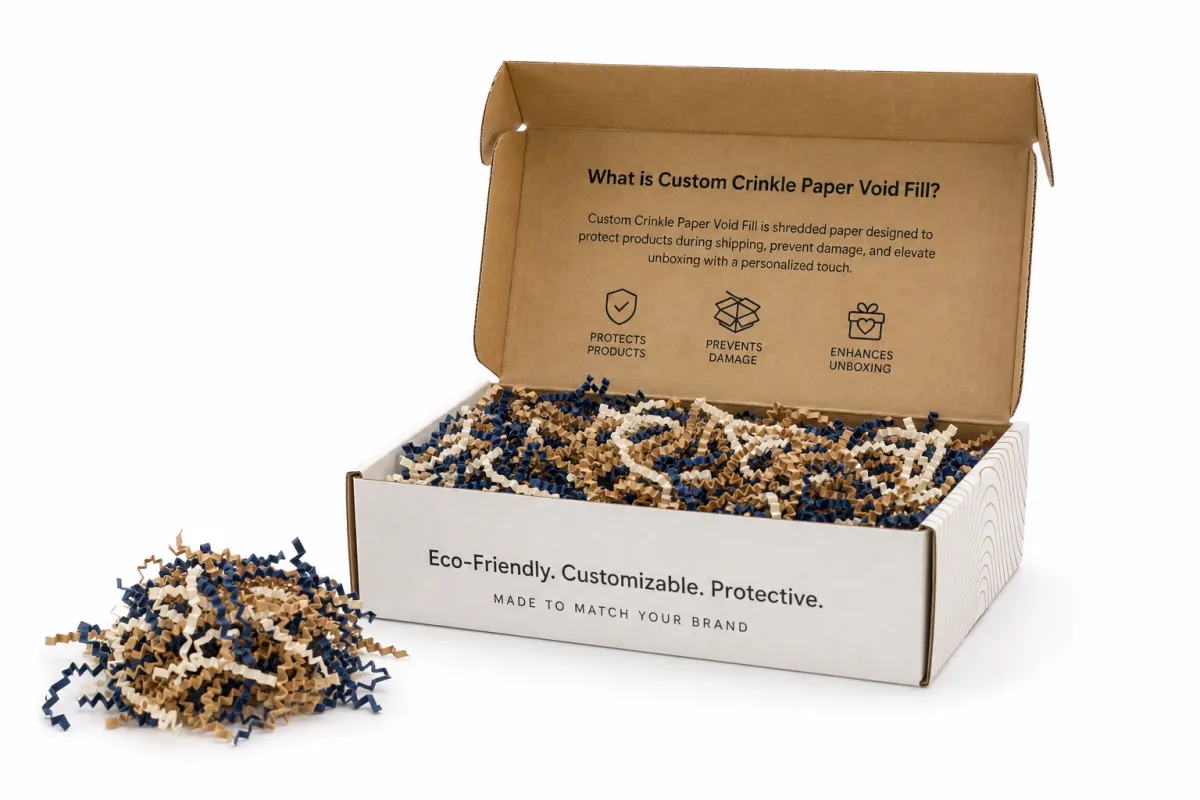
Custom crinkle paper void fill is the paper-based packing material placed around a product to stop movement inside a carton. Plain version: it fills the dead space that would otherwise let the item slide, tilt, or rattle in transit. It can look decorative, sure, but the real job is protection. Pretty is a bonus, not the assignment.
There is a reason buyers keep coming back to custom crinkle paper void fill for gift boxes, subscription kits, cosmetics, candles, small electronics, and other lightweight goods. It does three jobs at once: cushions the item, anchors it in place, and gives the box a cleaner finish than a random pile of loose paper ever will.
That finish matters more than a lot of teams expect. Branded packaging is not just the logo on the carton. It is the whole package: outer box structure, internal color, product placement, tissue, and filler. When the fill matches the rest of the brand system, the box feels designed instead of patched together.
Loose tissue looks soft, but it flattens fast. Air pillows are efficient, but they rarely feel premium. Paper shred can be colorful, yet it often shifts around too much unless the pack-out is tuned carefully. Custom crinkle paper void fill sits in the middle: more structured than loose paper, more polished than air pillows, and easier to brand than plain kraft filler.
One common mistake is treating void fill like decoration only. That thinking runs backward. The first job of custom crinkle paper void fill is mechanical. The brand impression comes after that. If the item can move even a little inside the box, the filler is not doing enough, no matter how nice it looks on the packing bench.
From a packaging design standpoint, the goal is controlled fill volume. Enough spring and loft to protect the product. Not so much that the box looks stuffed or the item disappears under a pile of paper. The best custom crinkle paper void fill choices solve the shipping problem first and the visual problem right after.
In practice, the right spec usually comes down to four things: product weight, carton dimensions, desired presentation, and the amount of rough handling in transit. A lightweight soap bar in a 6 x 4 x 2 mailer does not need the same packing approach as a glass bottle in a rigid presentation box. That sounds obvious, yet people still try to force one filler spec across every SKU. It falls apart fast.
If you are building the rest of the box too, pair the filler decision with your Custom Packaging Products so the insert, outer carton, and internal presentation work together. That is where product packaging starts looking planned instead of improvised.
"If the product can rattle, the box is not packed. It is just hoping."
How Custom Crinkle Paper Void Fill Works in the Box
Custom crinkle paper void fill works because the paper has spring. The crinkled shape creates air pockets and resistance, so when a product settles into the carton, the filler pushes back just enough to hold position. That pressure keeps the item from drifting into the corners when the box gets dropped, tilted, or stacked.
The effect is simple, but the behavior changes depending on how the box is packed. A loose layer of custom crinkle paper void fill can soften the first impact for a fragile item. A denser pack can immobilize a heavier product so it does not slide around after the box leaves the warehouse. Same material. Different job.
Gift boxes, subscription kits, and retail packaging inserts often use this material because it gives the pack a finished look while still filling space efficiently. A customer opening a cosmetics box wants the bottle to sit centered, not buried. A candle box should feel stable in the hand, not hollow. A well-planned custom crinkle paper void fill layout handles both.
Color changes perception fast. Natural kraft reads earthy and plain. White feels cleaner and more premium. Black looks sharp, but it also shows dust and lint more easily. A matched brand color in custom crinkle paper void fill can make a modest box feel intentional. The wrong color can drag the whole package down in one glance.
Pack-out speed is the other piece people underestimate. Good custom crinkle paper void fill should dispense consistently, without exploding into fluff all over the bench. If the operator has to shake, compress, and fix every box by hand, the filler is charging you labor. That hidden cost gets ugly fast, especially in seasonal runs. I have watched it happen, and it is never pretty.
From a production view, the best material is the one that behaves the same way every time. A fulfillment team does not want to guess whether one bag will cover one box or three. They want repeatable volume per carton, predictable compression, and no awkward hand-fixing after the product is already in place.
If you want a quick field test, pack one sample box, shake it gently, then turn it sideways and tap it on a table from each corner. If the item shifts, the filler is too light or too sparse. If the box bulges before it closes, the pack-out is too dense. That kind of real-world check tells you more than a polished sample ever will.
For teams that care about supply discipline, standards matter too. Transit testing based on ISTA methods gives you a better read on performance than a pretty bench sample. See the ISTA site for packaging test context, then compare those results against your own warehouse handling and carrier route. Bench samples are fine. Shipping is the truth.
Key Factors That Affect Performance, Look, and Cost
The performance of custom crinkle paper void fill starts with density and loft. More volume usually means better cushioning and better product positioning, but there is a ceiling. Overpacking can make the box look sloppy, reduce closing clearance, and push material cost higher than it needs to be. You want enough spring, not a paper volcano.
Material quality changes the result too. Paper weight, cut width, crinkle depth, and surface finish all affect how well custom crinkle paper void fill rebounds after compression. Narrower cuts can nest tightly and look elegant in smaller boxes. Wider cuts create a bolder visual effect, which can work in large mailers but may feel too busy for minimal packaging design.
Branding choices sit on top of that. Custom color matching, printed accents, and special finishes can elevate custom crinkle paper void fill, but each one adds complexity. If the filler is part of a premium launch, the extra setup may be worth it. If you are filling a plain shipping carton, paying for color precision nobody will notice is money walking out the door.
Product shape matters just as much as aesthetics. A square soap bar, a glass dropper bottle, and an odd-shaped accessory all behave differently in the same box. Heavy items need a tighter pack-out. Tall items often need fill at the base and near the shoulder of the product. Fragile items may need a combination of filler and structural support. One spec does not fit every SKU line unless the products are nearly identical.
Sustainability enters the decision too. Buyers ask more questions about recycled content, recyclability, and paper sourcing, and that is fair. If your package branding claims a paper-based or recyclable fill, confirm the material path before print approval. FSC-certified paper can support that story, but the claim only works if the supply chain actually matches the language. Check FSC for certification context before you print the box insert with a bold sustainability claim.
Some teams forget disposal behavior. Paper does not automatically mean every local recycling system will accept it the same way. Clean, dry, single-material paper is usually the easiest route. Mixed coatings, heavy inks, or glue-heavy assemblies can complicate things. If the filler is meant to support a sustainability message, keep the construction simple enough for the claim to make sense.
From a cost standpoint, the biggest variables usually are fill volume, custom color, print setup, bag or bale format, and freight. A small shift in crinkle width can change how much material is needed per box. That is why sample testing should include actual pack-out weight, not just a visual approval.
Buyers comparing custom crinkle paper void fill with other internal packaging materials should look beyond the price tag. The lowest-cost option per pound is not automatically the best option per box. If it takes more labor to fluff, or if it causes damage because it does not hold the product still, the cheap material gets expensive in a hurry.
Custom Crinkle Paper Void Fill Cost and Pricing Basics
Custom crinkle paper void fill pricing usually comes from five pieces: base material, custom color or print, setup, packaging format, and freight. That is the boring answer, but it is the real one. The quote on screen is rarely the whole story. Landed cost is what matters.
For a practical buying range, standard unprinted paper filler might land around $0.08-$0.18 per packed box at moderate volume, depending on how much fill each carton needs. Custom dyed or branded custom crinkle paper void fill can move into the $0.14-$0.30 per box range once you add special handling, tighter specs, or higher fill volumes. Those numbers shift fast with order size and freight class, so treat them as a starting point, not a promise from the packaging gods.
Setup fees are where low-volume orders get hit. Small custom runs often carry a few hundred dollars in setup, and more complex color matching or printed work can push that higher. For many buyers, the setup on custom crinkle paper void fill is the part that stings, because it gets spread across fewer cartons. A 2,000-box order and a 20,000-box order do not behave the same. Shocking, I know.
Here is a clean way to compare options before you place a purchase order.
| Option | Best Use | Typical Cost Impact | What You Get |
|---|---|---|---|
| Natural kraft crinkle | General shipping, everyday retail packaging | Lowest base cost, often around $0.08-$0.14 per box | Simple look, solid void fill, easy to source |
| Custom color crinkle | Branded packaging, seasonal campaigns, gift boxes | Often $0.12-$0.22 per box plus setup | Better package branding and a more finished unboxing |
| Printed branded filler | Premium product packaging and launch kits | Usually the highest option after setup, often $0.16-$0.30 per box | Stronger visual identity and tighter brand consistency |
| Air pillows | Lightweight shipping with low visual requirements | Low material cost, but sometimes higher handling time | Fast void filling, very light, less premium look |
That table is the short version. The longer version is this: custom crinkle paper void fill should be priced by the job it performs, not just the weight in the carton. If a filler takes more time to pack, increases product protection, and improves presentation, that may justify a higher unit price. If it only looks nice and still lets the product move, it is wasting money.
Freight matters too. Lightweight filler can still cost more than expected if it ships in bulky cartons with poor cube efficiency. On smaller orders, shipping can swing the landed price enough to erase the advantage of a cheaper material. That is why a quote should include carton count, pallet count, and estimated freight zone before anyone compares suppliers.
If you are sourcing custom crinkle paper void fill alongside boxes, inserts, or other structural components, keep the comparison consistent. Compare cost by box, by packed unit, or by labor minute. If one option saves two cents but adds four seconds of hand work, it is not saving anything. Pair filler decisions with your Custom Packaging Products quote so the math reflects the whole package, not just one line item.
One more pricing note: custom matching can be worth it for larger programs, but it is often overkill for short runs. If the order is temporary, a standard color close to the brand palette may be the smarter move. Close enough is not a slogan anyone hangs on the wall, but in packaging economics it often beats paying a premium for a shade that exists mostly to satisfy a spreadsheet.
Step-by-Step: Ordering and Timeline for Custom Crinkle Paper Void Fill
The ordering process for custom crinkle paper void fill starts with measurements, not color chips. Record the inner dimensions of the box, the product weight, and the amount of empty space left after the product is placed in the carton. If the box is 10 x 8 x 4 and the item only fills half the height, you need enough filler to lock it down without crushing the presentation.
Next, define the spec. Choose color, cut style, fill density, and target pack volume before requesting samples. A vague brief leads to a vague sample, and vague samples waste time. A tight spec for custom crinkle paper void fill helps suppliers quote accurately and lets your team compare samples on equal terms.
After that, ask for samples in the actual box, not just on a desk. A pretty handful of filler can look great in the office and fail the minute it goes into a real mailer. Test the box closed, shake it gently, and see whether the product stays centered. If you are shipping fragile goods, run a simple drop test from a low bench height and inspect the corners, edges, and product surface.
Here is a timeline that usually makes sense for a custom run:
- Day 1-2: Measure boxes, confirm product weight, and request samples.
- Day 3-7: Review sample colors and pack-out behavior for custom crinkle paper void fill.
- Day 8-10: Approve the final spec, including fill volume and packaging format.
- Day 11-15: Production for simpler custom work, longer if color matching or print is involved.
- After production: Freight transit, then receiving, QA, and release to fulfillment.
That schedule is not sacred, but it is realistic enough to plan around. Simple sample approval can move quickly. More detailed custom crinkle paper void fill programs, especially ones tied to seasonal launches or branded packaging rollouts, usually need more lead time once artwork, color, and volume are locked.
Before you release the order, confirm five things: carton size, target fill volume, approval sample, order quantity, and delivery window. This is also the point where a lot of teams forget to check the packing method. Loose fill, pre-fluffed bagged fill, and bulk baled fill all affect labor differently. The right answer depends on whether the line is hand-packed, semi-automated, or built for batch fulfillment.
If the packaging program includes a broader launch, align the filler decision with the rest of the box build. A cleaner custom crinkle paper void fill spec often works better when the outer carton, insert, and product arrangement are all designed together. That is why a combined packaging design review saves so much pain later. It is much easier to set the internal structure before the warehouse starts packing orders by the thousand.
For larger projects, ask for one sample that prioritizes presentation and another that prioritizes protection. Those two versions of custom crinkle paper void fill usually show the tradeoff clearly. One looks prettier. The other holds the product better. A good spec usually lands somewhere between the two, not at either extreme. Nobody gets bonus points for choosing the prettiest failure mode.
Common Mistakes With Custom Crinkle Paper Void Fill
The first mistake is underfilling. A box can look busy and still let the product move. That happens when the filler sits around the item instead of anchoring it. With custom crinkle paper void fill, the goal is not to decorate empty space. The goal is to stop the product from shifting enough to cause scuffs, dents, or broken seals.
The second mistake is overfilling for the sake of looks. Too much filler can make the box feel bloated, hide the product, and slow down fulfillment. It can also create a weird reveal where the customer spends twenty seconds digging through paper before finding the actual item. That is not premium. That is clutter wearing a nicer shirt.
The third mistake is choosing color before performance. A bold shade of custom crinkle paper void fill may look great in a render, but if it fails the shake test, the pretty color is irrelevant. Protection first. Color second. That order is not glamorous, but it keeps the product from arriving damaged.
The fourth mistake is trying to use one filler spec across a whole line of different products. A candle box, a serum bottle, and a ceramic mug do not want the same treatment. Weight, shape, and center of gravity change everything. If the cartons vary, the custom crinkle paper void fill spec should vary too, even if only slightly.
The fifth mistake is skipping real handling tests. Desk samples do not tell you how the filler behaves after a pallet moves, a truck shakes it for eight hours, or a delivery driver drops the parcel at a bad angle. Run drop tests, shake tests, and corner impact checks before you approve the final spec. If the product survives your roughest realistic test, you have a shot at surviving the actual shipping route.
Another common miss is forgetting about labor. Some fillers are cheap on paper and slow in the warehouse. Others cost a little more but pack faster and cleaner. A good custom crinkle paper void fill choice should protect the product and keep the packing line moving. If it creates extra hand work, it can quietly eat into margin. That is the kind of cost people only notice after the seasonal spike has already chewed through the schedule.
And yes, the rest of the box matters. If the outer carton is too large, no filler fully fixes that. If the product ships in a flimsy mailer, custom crinkle paper void fill can help, but it cannot perform miracles. Packaging systems work as systems. Annoying concept, but true.
Expert Tips and Next Steps for Better Custom Crinkle Paper Void Fill
The simplest way to improve custom crinkle paper void fill is to standardize around the top box sizes first. Pick the three cartons that move the most volume, then lock in a pack-out formula for each one. That keeps operations simple and makes it easier to compare damage rates, labor time, and material use across the line.
Track how much filler each box consumes. Not guessed. Measured. Use ounces, grams, or a fill-volume standard that your team can repeat. Once you have that data, you can see whether a tighter fill reduces breakage or just wastes paper. Good packaging buyers like proof. Guessing is how margins get mysteriously thinner.
If brand presentation matters, ask for the exact color and fill weight you plan to buy. Close matches can help early mockups, but they are not enough for final approval. A warmer kraft tone, a duller white, or a slightly different crinkle depth can change the visual effect more than people expect. In branded packaging, small differences are still differences.
For teams building custom printed boxes or a broader product packaging program, the filler should support the rest of the experience. A premium box with sloppy internal fill feels unfinished. A modest box with a clean, well-matched filler often feels more thoughtful than a flashy shell with no internal structure. Package branding is a full-system job, not a sticker contest.
Use route testing, not just product testing. The warehouse may handle the box one way, the carrier another, and the end customer a third way. Custom crinkle paper void fill should survive all three. If your package can handle a gentle shake, a short drop, and a rough delivery cycle, you are in better shape than most programs.
If you are still choosing between two options, compare them on these four points:
- Protection: Which version holds the product in place better?
- Presentation: Which one matches the look of the box and brand?
- Labor: Which one packs faster with fewer corrections?
- Landed cost: Which one stays reasonable after freight and setup?
My practical advice is to keep the first run simple. Measure your top three box sizes, request two sample versions of custom crinkle paper void fill, run a simple drop test, and lock the spec that protects best at the lowest landed cost. If that means choosing a less dramatic color for the first order, fine. The customer cares more about product condition than whether the filler matched the mood board perfectly.
Once the baseline is stable, then you can refine the color, adjust the fill volume, or move into a more branded version for seasonal campaigns. That is the smart sequence. Solve the shipping problem first, then polish the presentation. Custom crinkle paper void fill works best when it is treated like a real packaging component, not a last-minute decoration.
One more practical tip: document the final pack-out with photos and a short spec sheet. It sounds dull, but it saves time later when someone new joins the team and starts packing boxes differently. A five-minute reference sheet can prevent a month of “why do these look off?”
Is custom crinkle paper void fill better than air pillows?
Use custom crinkle paper void fill if presentation matters and you want a more premium paper-based unboxing feel. Use air pillows if ultra-low weight and fast void filling matter more than appearance. For fragile retail or gift packaging, crinkle paper usually wins because it looks better and stays in place more naturally.
How much custom crinkle paper void fill do I need per box?
Measure the empty space left after the product is placed in the carton, then test a loose fill and a tighter fill. Track usage by box size in ounces, grams, or pack-out volume so you can repeat the same result every time. If the product still shifts when you shake the box lightly, you need more fill or a denser pack-out method.
What drives custom crinkle paper void fill price the most?
Order size, custom color matching, print requirements, and packaging format usually affect pricing the most. Freight and carton count can change the landed cost a lot, especially on smaller orders. The cheapest quote is not always the cheapest choice if it causes rework, damage, or slower packing.
Can custom crinkle paper void fill be recycled?
Usually yes if it is clean, dry, and made from paper without mixed-material coatings that complicate recycling. Local rules matter, so check the destination market before making recycling claims on-pack. If sustainability is part of the brand message, confirm the recycled content and disposal path before you print anything.
How long does custom crinkle paper void fill take to produce?
Simple samples can move quickly, but production starts only after color, spec, and quantity are approved. Custom matching, special print, and larger volumes usually add extra lead time. Build time into the packaging schedule early so launch dates do not get wrecked by filler that arrives late.
If you are comparing options right now, keep the decision practical: pick the custom crinkle paper void fill spec that protects the product, supports the brand, and keeps the landed cost sane. That is the version that deserves a place in the box.

