A cuffed beanie can look like a throwaway promo item in a flimsy bag, then turn into a retail-ready product the moment the fold is clean, the tag lands in the right spot, and the barcode scans on the first pass. That is the quiet power of Custom Cuffed Beanies packaging and labeling. The hat is small. The signal is not. Buyers judge quality fast, and they often do it before they ever touch the knit.
The category looks simple until the details pile up. Packaging has to protect the product. Labeling has to carry brand identity, fiber content, care instructions, and retail data. Fulfillment still needs clear carton marks and accurate counts. Miss one layer and the whole presentation slips. Handle the system well and even a basic acrylic beanie can feel deliberate, premium, and ready to sit beside a higher-ticket SKU.
I have seen this play out on a winter merch run where the product itself was fine, but the fold was off by maybe half an inch and the hang tag twisted under the cuff. Nobody called the hat defective. They just called it cheap. That reaction is brutal, and also pretty normal. Packaging does not get a lot of credit when it works, but it gets noticed instantly when it does not.
Custom Cuffed Beanies Packaging and Labeling: What It Is
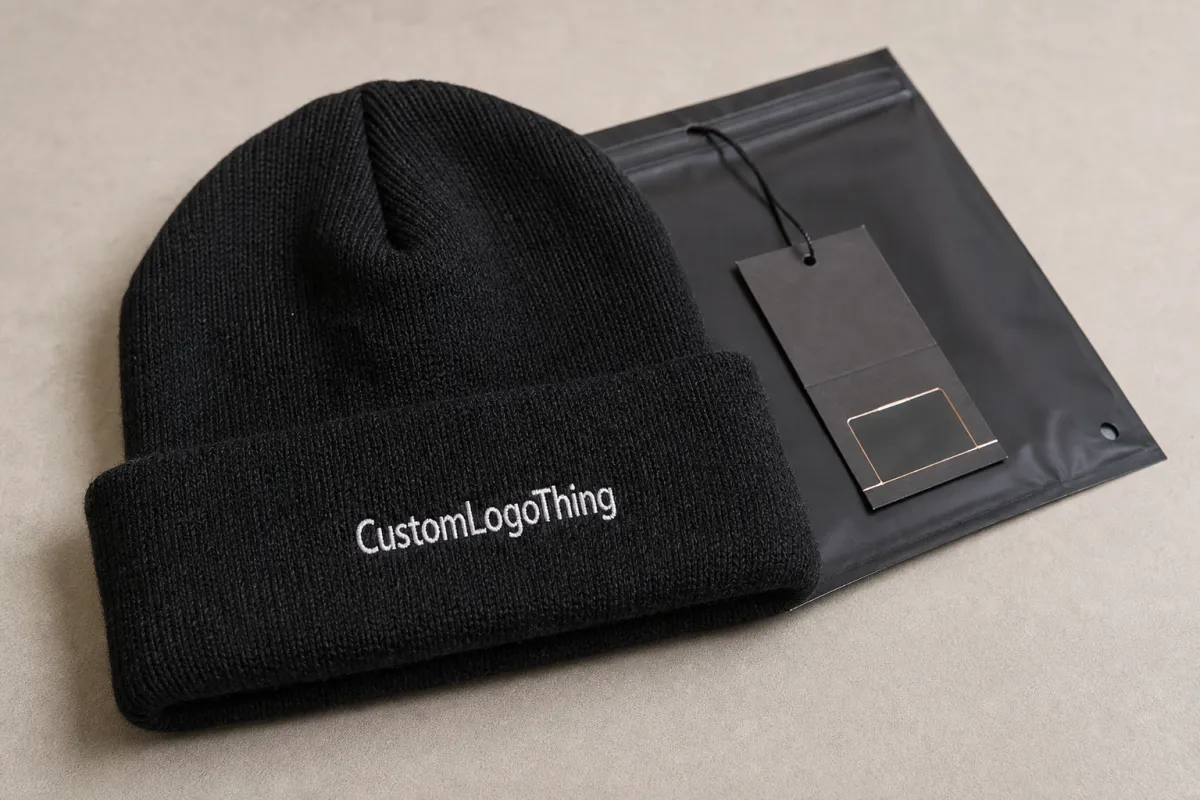
Custom cuffed beanies packaging and labeling includes every physical element around the product: the sewn-in label, the hang tag or sticker, the polybag or sleeve, and the carton markings used during shipping or retail receiving. Packaging protects and presents. Labeling informs. Mix those jobs together and you get clutter fast, which is how a small knit cap ends up carrying too much copy on too little surface area.
The cuff changes the math. A cuffed beanie gives you a visible branding zone that a standard beanie does not. That band can hold a woven label, a patch, a branded fold, or a tag placement that feels intentional rather than improvised. It also changes how the product sits in the pack. A folded cuff can tilt, bunch, or twist if the packout is careless. One sloppy fold and the hat looks off before the customer even opens the bag.
Most packaging programs for cuffed beanies break into five pieces:
- Permanent branding: sewn-in label, woven label, or interior print
- Retail messaging: hang tag, swing tag, size sticker, or belly band
- Compliance details: fiber content, care copy, country of origin, SKU, barcode
- Protection: polybag, tissue wrap, sleeve, or carton divider
- Fulfillment marks: case labels, carton counts, and scan-ready outer markings
That mix matters for apparel brands, merch drops, wholesale programs, promotional orders, and gift-ready retail sets. A giveaway beanie can stay minimal. A shelf program needs more discipline. A premium mailer needs a clean presentation that survives transit and still looks composed when the customer opens it. Wrinkled bags and crooked tags have a way of draining value out of the item before anyone has read the brand name.
Brands building a wider packaging system often start with Custom Packaging Products and Custom Labels & Tags because those categories turn vague branding ideas into actual production choices. The goal is not to add more materials. The goal is to Choose the Right material for the job and stop there.
How Custom Cuffed Beanies Packaging and Labeling Works
The clearest way to think about custom cuffed beanies packaging and labeling is as a stack. Layer one is the beanie itself. Layer two is the sewn-in label or permanent branding. Layer three is the hang tag, sticker, or sleeve. Layer four is the outer bag or carton. Each layer should have a defined purpose. If every layer tries to sell the brand, explain the product, and handle logistics, the pack becomes expensive noise.
A useful rule keeps the system from drifting. One element should sell. One should inform. One should handle compliance or shipping. That may mean a woven interior label for the permanent brand mark, a front-facing swing tag for the story or product name, and a barcode label on the bag or carton. The layout stays readable. Packing stays faster. Reorders stay easier because the job of each part is clear from the start.
Channel matters too. DTC brands usually want a tight fold, a compact outer bag, and packaging that arrives neat inside a mailer. Wholesale buyers tend to care more about carton labeling, case counts, and scan placement at receiving. Gift programs ask for a little theater: tissue, printed sleeves, or even Custom Printed Boxes if the margin supports it. That extra polish can make sense. It does not make sense when the item is a low-margin promo piece and every cent counts.
A few physical details cause more trouble than people expect if they are ignored:
- Cuff placement: front-facing cuffs look stronger on display, but the fold has to hold
- Tag string length: too short pulls the knit, too long looks careless
- Barcode placement: keep it flat, visible, and away from creases
- Pack density: compressed packs save space, while looser packs often look better on arrival
- Bag opacity: clear bags show the product, opaque bags hide wrinkles and color shifts
One decision sets the tone early: should the product feel premium, efficient, or compliance-first? The answer changes the packaging structure, the fold method, and the level of print investment. A beautiful tag that cannot scan is a bad trade. A sturdy pack that looks anonymous is also a bad trade. Shipping durability needs its own attention, especially if cartons will move through rough distribution. Many teams use ISTA standards as a reference point because real transit damage does not care how nice the mockup looked.
Process, Timeline, and Production Steps for Orders
The production flow for custom cuffed beanies packaging and labeling works best when approvals are locked down early. Start with SKU counts, color splits, and size breakdowns. Lock the packaging structure next. After that, move into artwork, proofing, material confirmation, and the final bill of materials. Only then should production and packout begin. Speed feels attractive right up until a barcode correction arrives after half the order is already packed.
Delays usually come from the same places. Artwork changes. Late barcode edits. Slow proof approvals. Material choices that looked elegant in a deck and turn out to be unavailable in the real world. Hang tag stock creates more trouble than people expect. Fancy paper sounds good until the supplier cannot source it on time. One unstable component can push the whole schedule back.
Lead time depends on how much of the pack is custom. A run with stock polybags and simple stickers can move in roughly 7-12 business days after proof approval. Add printed hang tags, special paper, or multiple SKUs and the window often stretches to 12-18 business days. Custom printed boxes, foil, embossing, and multi-piece retail kits can take longer still. None of that is mysterious. More parts mean more setup, more handwork, and more chances for something to stall.
Before anyone says yes, the production checklist should already be in hand:
- Final SKU list with colors, counts, and size breakdowns
- Print-ready art files with bleed and trim
- Pantone references or print targets for brand colors
- Barcode numbers and scan format confirmation
- Care copy, fiber content, and origin text
- Carton labeling requirements and pack counts
- Shipping method and delivery deadline
The list looks dull because it is supposed to. Paperwork keeps custom cuffed beanies packaging and labeling from turning into a rush-order mess with avoidable fees attached. Sustainability claims bring another layer of review, and paper sourcing sometimes matters as much as print quality. The FSC reference is useful if certified paper options are part of the brief.
Pack samples matter more than flat proofs. A paper proof checks copy, color, and layout. It does not show how the cuff sits, whether the tag hangs at a useful angle, or whether the barcode survives the fold without bending into a scan failure. A real sample reveals what the art file hides. That is especially true with knit goods, where a few millimeters can change the entire look.
Production teams that skip the sample step usually pay for it later. Sometimes the cost is extra labor. Sometimes it is a reprint. Sometimes it is only a few hours of hand-fixing, which sounds minor until you multiply it across hundreds of pieces. The work is boring, but the boring parts are what keep the order from wobbling.
Cost, Pricing, MOQ, and Quote Drivers
The cost of custom cuffed beanies packaging and labeling depends less on the hat and more on how many layers you put around it. Packaging type, print coverage, label count, finishing, packing labor, and SKU sorting all influence the final number. A stock polybag with a size sticker sits near the low end. A custom sleeve, branded insert card, hang tag, and carton label system moves the order into a different price class. That is not a surprise. It is the bill for additional steps.
The pricing ladder usually moves in a predictable pattern. Stock polybags and simple stickers are cheapest. Hang tags and belly bands sit in the middle. Custom boxes, sleeves, and gift kits raise unit cost quickly because setup and assembly become more intense. If the order needs sorting by color or size, labor climbs again. The packaging itself is rarely the biggest line item. Fulfillment is often the part that quietly eats margin.
| Setup | Typical Use | Typical Unit Cost at 1,000 pcs | Notes |
|---|---|---|---|
| Stock polybag + size sticker | Basic DTC or warehouse packing | $0.10-$0.22 | Fastest option; minimal presentation |
| Hang tag + polybag | Retail or merch drop | $0.18-$0.40 | Better branding; adds printing and stringing |
| Folded band + barcode + carton labels | Wholesale and store intake | $0.25-$0.55 | Cleaner shelf control; more packout labor |
| Custom printed box or sleeve | Gift sets and premium retail | $0.75-$2.25 | Stronger package branding; higher freight and setup |
MOQ changes the equation. Smaller runs usually carry a higher per-unit cost because setup fees and print prep are spread over fewer pieces. Once you move into 500 units and up, the unit price often improves. At 1,000 pieces or more, the price break becomes more visible, especially on printed components. Bigger is not always the right answer, though. A new retail program may be smarter at 250 or 500 pieces if the goal is testing rather than loading inventory.
Tiered pricing tells the real story. Request quotes at 250, 500, and 1,000 units so the break points are obvious. Ask which variable changes the number most: tag stock, finishing, labor, or the number of SKUs. A quote that hides those drivers is just a rounded number with a logo on it.
Clear briefs save time and money. Include product count, packaging tier, artwork status, insert needs, barcode requirements, and whether the supplier should provide components only or full packing. Vague inputs produce vague pricing. That is not a supplier flaw. It is how estimating works when the scope has gaps.
One more point that gets glossed over: freight can distort the budget more than the packaging itself. If the final pack is bulky, the carton count rises and so does the shipped cost. A project can look affordable on a unit-cost sheet and still run expensive once the boxes start moving. That is why experienced buyers look at landed cost, not just print cost.
Common Mistakes in Beanie Packaging and Labeling
The biggest mistake in custom cuffed beanies packaging and labeling is approving the design before seeing the actual folded product. A mockup can look balanced on screen and still sit awkwardly on the real beanie. The cuff is thicker than expected, the fold shifts, and the tag lands in the wrong place. Real knit goods have mass and shape. Screen comps pretend otherwise.
Another recurring problem is overloading a tiny hang tag. Brands try to fit story copy, SKU data, barcode, care instructions, sustainability language, and logo treatment into one small surface. The result feels cramped, not premium. Better packaging design uses hierarchy. Put the main message in front. Put the practical information where it can be read. Leave enough air for the product to breathe visually.
Barcode and compliance errors cause avoidable friction. A barcode sitting on a crease scans poorly. Small fiber-content text frustrates retail receivers. Missing country-of-origin copy creates back-and-forth that slows intake. If the beanies are headed into stores, treat barcode placement and legal copy as proof items, not as details to clean up later. That one habit saves time every time.
Fulfillment waste shows up in quieter ways. Buyers forget to add allowances for spoilage, misprints, and packing errors. They skip a packout check. They assume the garment will fit neatly into the chosen carton because the math looks fine. It is not a real plan until the folded product has been packed, scanned, weighed, and handled by someone who was not present for the design meeting. If the product is moving through distribution, some teams also compare the pack against ISTA or ASTM-style transit tests to see how the carton and insert structure hold up under abuse.
Too many finishing touches can also work against the product. More embellishment does not automatically mean better package branding. A clean tag, a disciplined fold, and one crisp label often outperform foil, embossing, and a sleeve stack that adds cost without improving the shelf read. Finishing should change buying behavior or reinforce price. If it does neither, it is decoration with a bill attached.
Expert Tips and Next Steps for Better Results
Better results from custom cuffed beanies packaging and labeling usually start with hierarchy. Give the hang tag one visual job. Give the barcode one practical job. Give the sewn-in label one permanent branding or compliance job. That split makes the pack easier to read and easier to assemble. It also keeps the design from turning into a tiny billboard where every message competes with every other message.
Channel-specific choices matter more than teams like to admit. DTC drops tend to perform better with compact polybags and branded packaging that keeps freight lean. Wholesale orders benefit from sturdy outer packs and carton labels that help receiving teams move quickly. Holiday sets and premium gift programs can justify inserts, sleeves, or custom printed boxes if the price point supports the added work. Packaging should match the sale, not the mood board.
Proofing deserves more scrutiny than it usually gets. Start with a flat mockup, then ask for a sample packed with the actual cuffed beanie if the order size justifies it. Check fold direction, tag position, barcode legibility, and whether the outer bag crushes the knit. A paper proof can tell you the logo is centered. It cannot tell you whether the product feels right in hand. That comes from a real sample under real conditions.
“The best beanie packouts are boring in the best way: clear fold, clear label, clear scan, no drama at receiving.”
Before requesting pricing, lock four things: SKU count, packaging tier, unit-cost ceiling, and approval timeline. Gather artwork, barcode data, and any care or fiber copy already known to be required. That trims the guesswork out of the quote. It also keeps custom cuffed beanies packaging and labeling from becoming a moving target once production is already underway.
If you want the shortest path to a clean result, make one decision first: basic product pack, retail-ready presentation, or premium gift format. That choice tells you how much print, labor, and protection the order actually needs. From there, define the fold, confirm barcode placement, and approve one packed sample before the full run starts. That sequence is not fancy, but it is the part that keeps the final order looking intentional instead of improvised.
FAQ
What does custom cuffed beanies packaging and labeling usually include?
Most setups include a sewn-in brand label, a hang tag or sticker, an outer polybag or wrap, and carton labels for shipping or retail intake. If the beanies are sold in stores, barcode placement, size identification, and care or fiber content details should also be built in so the product clears receiving without extra questions.
How much does custom cuffed beanies packaging and labeling cost per unit?
Simple stock packaging with basic labels costs far less than custom printed boxes or gift packaging, so the cheapest option usually has the fewest custom pieces. Unit price drops as MOQ rises, but setup, artwork revisions, and multiple SKUs can keep the first order expensive even when the per-piece price looks reasonable.
What MOQ should I expect for custom cuffed beanies packaging and labeling?
Small runs can begin in the low hundreds for stock components, while custom printed packaging usually becomes more efficient at 500 pieces and up. Tiered quotes at 250, 500, and 1,000 units make the break points visible and help you decide whether a larger order actually saves money.
How long does the process take for custom cuffed beanies packaging and labeling?
Simple stock-based runs can move quickly, while custom printed pieces, proofs, and multiple approvals add extra weeks. The slowest parts are usually artwork changes, missing barcode data, and waiting on packaging availability, not the beanie itself.
Do cuffed beanies need both sewn-in labels and hang tags?
Not always, but using both helps split the job: the sewn-in label handles compliance and permanent branding, while the hang tag handles shelf appeal and product details. If the product is sold direct-to-consumer and the packaging is minimal, one strong label plus one clean outer pack may be enough.

