Buyer Fit Snapshot
| Best fit | custom die cut boxes design pricing practices for packaging buyers comparing material specs, print proof, MOQ, unit cost, freight, and repeat-order risk where brand print, material, artwork control, and repeat-order consistency matter. |
|---|---|
| Quote inputs | Share finished size, material target, print colors, finish, packing count, annual reorder estimate, and delivery region. |
| Proofing check | Approve dieline scale, logo placement, barcode or warning zones, color tolerance, and any recyclable or compostable wording before bulk production. |
| Main risk | Vague material claims, crowded artwork, or missing packing details can create delays even when the unit price looks attractive. |
Fast answer: Custom Die Cut Boxes Design Pricing Practices: Cost, MOQ, Proof, and Reorder Checks should be specified like a repeatable production item. The safest quote includes material, print method, finish, artwork proof, carton packing, and reorder notes in one written spec.
What to confirm before approving the packaging proof
Check the product dimensions against the actual filled item, not only the sales mockup. Ask for tolerance on folds, seals, hang holes, label areas, and retail display edges. If the package carries a logo, QR code, warning copy, or legal claim, reserve that space before decorative graphics fill the panel.
How to compare quotes without losing quality
Compare board or film grade, print process, finish, sampling route, tooling charges, carton quantity, and freight assumptions side by side. A lower quote is only useful if the supplier can repeat the same color, closure quality, and packing count on the next order.
A bad box can hurt a good product faster than a weak label ever will. That is the whole point of Custom Die Cut Boxes: fit, protection, and presentation shape the customer’s first impression long before the product gets a chance to speak for itself. If the packaging feels sloppy, the brand does too. Packaging has a nasty habit of telling the truth.
Brands choose Custom Die Cut boxes because standard cartons are blunt tools. They can do the job in a basic way. They can also create dead space, extra filler, and awkward pack-out steps that slow everyone down. Odd shapes, fragile pieces, premium goods, gift sets, and products that need inserts all benefit from packaging that was built around the item instead of forced around it.
Buyers comparing Custom Packaging Products usually care about three things: whether the box fits, whether it protects, and whether it looks intentional. That is the real test. A box can be manufactured without much trouble. A box that fits cleanly, ships safely, and still looks like someone made actual decisions takes a little more thought.
What Do Custom Die Cut Boxes Actually Solve?
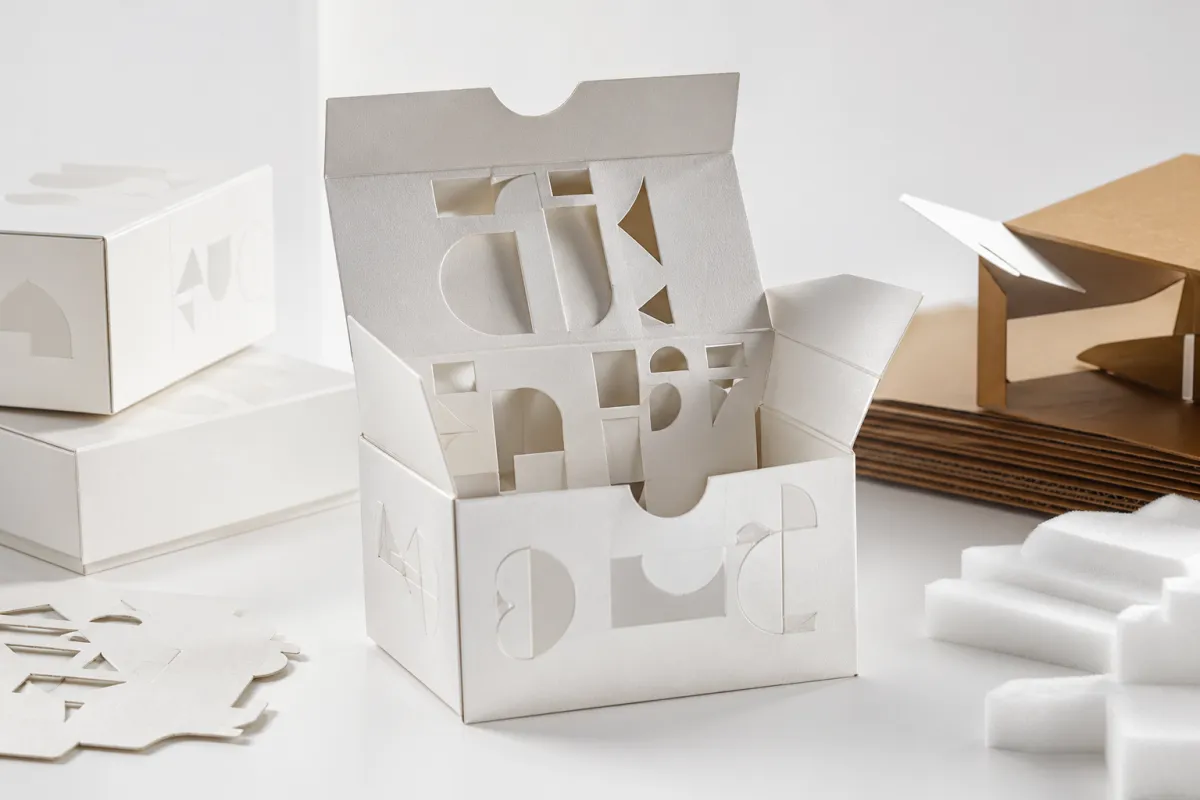
Custom Die Cut boxes solve a boring problem that burns money in a hundred small ways: products do not always fit standard packaging. A candle with a lid, a cosmetic set with inserts, a small electronics accessory, or a mixed gift kit can turn into a mess inside a generic carton. Empty space leads to filler. Filler leads to labor. Labor leads to cost. The trouble rarely shows up in one dramatic line item. It leaks out in little pieces.
These boxes start as flat sheets cut with a steel rule die, then fold into a shape made for one specific product. Cut lines, score lines, glue areas, and fold positions are all planned before production starts. That sounds technical, but the result is simple. The box opens the right way, closes the right way, and holds the item without improvisation. That is what separates branded packaging from a plain carton with a logo printed on top.
Custom Die Cut Boxes show up everywhere because they do several jobs at once. They protect the product. They present the product. They can speed up assembly on the packing line. A box that folds cleanly saves seconds per unit. A few seconds does not sound like much until it repeats a few thousand times. Then the savings stop being theoretical.
The buyer advantage looks like this:
- Tighter fit, so the product does not bang around inside the carton.
- Less filler, which reduces waste and keeps the package cleaner.
- Stronger shelf presence, especially for retail packaging that needs a consistent front panel.
- Fewer damage claims, since the carton matches the item instead of fighting it.
- Faster packing, because the structure helps the team instead of slowing them down.
Custom Die Cut boxes are not a cure-all. They shine when the product is premium, fragile, odd-shaped, or shipped often. They become expensive theater when the item is simple and already fits a standard mailer or folding carton. I see this mistake all the time. The packaging ends up more complex than the product deserves. Fancy is not the same thing as smart.
“The box has one job first: solve the shipping and presentation problem. If it misses that, the print finish is just expensive window dressing.”
That is the part people skip when they get excited about coatings and foils. Custom Die Cut boxes work best when the structure supports the product, the brand, and the shipping method at the same time. Miss one of those and the package tends to pay for it later.
How Custom Die Cut Boxes Are Made
Every set of Custom Die Cut boxes starts with a dieline. It is the flat blueprint for the box. The dieline marks the cut lines, score lines, folds, glue zones, and safe areas for artwork. A good dieline is not exciting. That is a compliment. It removes guesswork and tells the printer and die maker exactly where the sheet needs to be cut so the final shape comes out the same every time.
Once the dieline is approved, a custom die is built to match it. That tooling cuts each sheet with repeatable accuracy. If the dieline is wrong, the die will reproduce the error hundreds or thousands of times without apology. That is why structural samples matter. A sample shows whether the flap closes properly, whether the insert holds the item, and whether the corners behave the way the drawing promised. With custom die cut boxes, the first sample is usually where the expensive surprises show up. Better there than on the full run.
Material choice changes the result in a big way. Corrugated board gives more crush resistance and is common for shipping-focused packaging. Paperboard is lighter, smoother, and often a better fit for retail packaging or cosmetic presentation. Kraft stock creates a natural look and usually reads as less polished unless the brand handles it carefully. Each substrate cuts differently. Each one folds differently. Each one takes ink differently. Paper is kinda simple until you ask it to behave.
The production sequence usually looks like this:
- Confirm product dimensions and packaging goals.
- Create or adjust the dieline.
- Approve the structural sample.
- Prepare artwork with bleed and safe zones.
- Print, cut, score, and finish the board.
- Add coatings, inserts, patches, or glue where needed.
- Fold, pack, and ship the final order.
Finishing comes after the structure is locked. That includes printing, lamination, soft-touch coating, gloss coating, foil, embossing, window patches, or glue application. The order matters. A beautiful finish on a weak structure is still a weak box. A plain finish on a well-planned structure can look expensive because the shape feels deliberate. That is one reason custom die cut boxes often outperform more decorated packaging that has no structural thinking behind it.
For quality-minded brands, proofing is not optional. A solid production partner should provide a sample or proof so you can check the real fit before the full order runs. If you need a rough benchmark, standards such as ISTA testing methods help with transport and drop resistance, while EPA packaging guidance helps brands think about material reduction and waste. Those references do not replace common sense. They just keep the project honest.
The biggest production win is clarity. The more precisely you define the product and the use case, the easier it is to build custom die cut boxes that do the job cleanly. Ambiguity creates rework. Rework is where budgets start bleeding.
Custom Die Cut Boxes Pricing: What Drives Cost
Pricing for custom die cut boxes comes down to a few concrete variables, and none of them are mysterious once you look at production instead of sales copy. Size matters. Board type matters. Print coverage matters. Special finishes matter. Quantity matters. Tooling matters. If a new die has to be made, there is an upfront cost that gets spread across the order. That is why small runs feel expensive per box while larger runs start looking a lot healthier.
The tradeoff is simple. You pay more up front for custom tooling, then the unit price usually drops as quantity rises. A small order might land around $0.70-$1.80 per box depending on structure, board, and print complexity. Mid-volume runs often move into a more balanced range, maybe $0.25-$0.70 per unit. Larger runs can go lower if the design stays efficient and the finishing stays sensible. Exact pricing varies, obviously, but pretending every box costs the same is nonsense.
A practical comparison of common options for custom die cut boxes looks like this:
| Option | Typical Use | Cost Behavior | Strength | Best Fit |
|---|---|---|---|---|
| Kraft paperboard | Natural-looking retail or gift packaging | Usually lower finishing cost, moderate print limits | Good for light-to-medium products | Branding that wants a clean, earthy look |
| Folding carton | Cosmetics, supplements, small consumer goods | Often efficient at mid and higher quantities | Good print surface, lighter weight | Retail packaging with strong graphics |
| Corrugated board | Ecommerce, shipping, fragile items | Higher material cost, better damage control | Strong crush resistance | Products that need protection in transit |
| Premium finish build | Gift sets, luxury branded packaging | Higher setup and finishing cost | High shelf appeal | Projects where presentation justifies spend |
There are hidden costs people love to ignore until the quote lands. Inserts can add material and assembly time. Freight can bite if the box is bulky or the board is heavy. Color matching can add proofing rounds. Manual packing can add labor. If the order uses custom die cut boxes with multiple pieces or complex internal supports, the final number is rarely just a print quote. It is a production quote.
Save money where the customer will not notice the difference. Use a standard board if it is strong enough. Keep the footprint efficient. Skip cutouts, windows, foil, or embossing unless they actually help the product sell. A lot of branded packaging overspends on decoration and underspends on fit. That is backwards. The box should earn its budget by making the item easier to ship, easier to open, or easier to trust.
You can also control cost by being honest about quantity. Tiny runs make tooling harder to amortize. If you know the product will scale, ask for pricing at a few thresholds. A buyer who compares 500, 2,500, and 5,000 units usually gets a clear picture of where custom die cut boxes become efficient. That tends to matter more than obsessing over one quote.
For brands considering custom printed boxes and packaging formats, the real question is not “What is the cheapest box?” It is “What is the cheapest box that still protects the product and supports the brand?” Those are not the same thing, and mixing them up gets expensive fast.
Choosing the Right Size, Structure, and Finish
The best custom die cut boxes start with the product, not the artwork. Measure the item first. Add tolerance for inserts, protective padding, and any movement that could happen in transit. If a product is delicate, you do not want it kissing the walls of the carton. That is not snug. That is a damage claim waiting to happen. Good packaging design deals with the real shape, not the shape you wish the item had.
Structural style matters just as much as dimensions. A tuck-end box can work for lightweight retail packaging. A mailer-style box is often better for ecommerce because the lid closes securely and the structure feels complete when opened. A Tray and Sleeve can create a strong reveal for gifts or cosmetics. Auto-lock bottoms save assembly time on some runs. Each style solves a different problem, and forcing one shape to do everything usually creates compromise. Custom die cut boxes matter because the structure can be tuned to the use case instead of forcing the product to adapt to the carton.
Finish changes perception fast. Matte coatings tend to feel softer and more restrained. Gloss adds brightness and can make colors pop. Soft-touch film gives a velvet-like feel, though it adds cost and can show scuffs if handling is rough. Foil, embossing, and spot UV can raise perceived value, but only if the base design stays disciplined. Slapping three finishes onto a crowded layout does not make premium packaging. It makes a loud box.
One blunt rule holds up almost every time: smart structure beats loud graphics. A clean, well-sized box with sharp typography and a few deliberate print choices often beats a cluttered layout with too many things fighting for attention. That is especially true in retail packaging, where the customer has only a second or two to read the brand. With custom die cut boxes, the tactile shape is part of the message.
Sustainability and logistics get easier when the box is right-sized. Smaller dimensions reduce void fill, which lowers material waste and often improves shipping cost structure. Carriers use dimensional weight, and oversized cartons can get punished for being wasteful. A tighter fit is not just cleaner. It can be cheaper. FSC-certified board is worth considering when the brand story includes responsible sourcing, and FSC makes that claim easier to verify. Not every project needs every certification, but if sustainability is part of the pitch, the material choice should back it up.
From a packaging buyer’s point of view, the best finishes are the ones that match the product category. Cosmetics and gift sets often benefit from soft-touch, foil, or spot UV. Subscription kits may need only a strong print system and a neat opening experience. Electronics usually care more about inserts, stiffness, and transit protection than decorative effects. That is the tradeoff. Every finish should earn its place. If it does not help sell, protect, or clarify the brand, it is just overhead dressed up as taste.
Step-by-Step Process and Timeline
The easiest way to keep custom die cut boxes on schedule is to treat the process like a chain of decisions, not one giant purchase. Start with a brief. Define the product size, the quantity target, the shipping method, the print goals, and the finish budget. If those basics are fuzzy, the rest of the project wobbles. A packaging supplier can help. They cannot read minds, and the dieline does not forgive vague measurements.
A normal timeline starts with size confirmation and dieline setup. Then comes the structural sample. Then the artwork proof. Then production approval. Then manufacturing. Simple projects with standard materials move faster. Complex shapes, multiple inserts, or special finishes take more time. If the box requires new tooling, add that lead time early. If a revision shows up after proof approval, the clock resets in the annoying way everyone hates and nobody can dodge.
Delays usually come from the same places:
- Measurements were taken without accounting for inserts or product movement.
- Artwork was built before the dieline was final.
- Bleed and safe zones were ignored, so the print needed correction.
- Sample changes were requested late in the process.
- Approvals were stalled because too many people had to sign off on one box.
That last one happens all the time. Too many cooks, too many opinions, not enough packaging discipline. If the design team, sales team, and operations team all want to tweak the structure, the project drags. A buyer who wants custom die cut boxes made efficiently should lock one decision-maker early and let that person gather the other input before production starts. Consensus helps. Endless revision does not.
“Once the dieline and proof are locked, changes stop being creative. They become expensive.”
The buyer should prepare a few things early: product specs, quantity range, shipping destination, branding files, and any compliance needs for the channel. If the box will sit in retail, there may be barcode requirements or warning copy. If it ships directly to customers, transit standards matter more. If it needs to survive rough handling, look at testing methods such as ASTM D4169 or ISTA-style distribution checks. That does not mean every box needs a lab report. It means the packaging should be tested like it will actually be used, not like it lives in a spreadsheet.
One more practical note: approve the sample like it matters. Open it. Close it. Pack the real product into it. Check the edges, the fit, the flap alignment, the print placement, and the opening experience. If the team only looks at a flat mockup, they are not evaluating custom die cut boxes. They are evaluating a picture of packaging. Those are different things.
Common Mistakes That Waste Money and Time
The biggest mistake with custom die cut boxes is almost too obvious: people measure the product length and forget the depth, the insert space, and the closure tolerance. Then the box arrives and the item either rattles or jams. A carton that is two millimeters off can create a real problem if the product has a rigid lid, a fragile finish, or a display insert. Precision sounds boring until the box refuses to close.
Another mistake is overspending on decoration while underbuilding the structure. Fancy print cannot rescue a carton that crushes in transit or pops open too easily. It also cannot hide bad proportions. If the box footprint is awkward, the customer notices immediately. Good custom die cut boxes usually work because the structure makes the product feel stable and the graphics support that structure instead of fighting it.
Small quantities are another cost trap. Tooling and setup are harder to spread out when the run is tiny. That does not make small runs bad. It just means expectations need to match reality. If a brand wants highly customized packaging in low volume, the per-unit cost will show it. There is no hidden trick that makes fabrication free. Anyone claiming otherwise is selling hope, not packaging.
Skipping samples is also risky. A box can look right on screen and still fail in the hand. Score depth can feel off. Flaps can catch. Inserts can be too tight. Graphics can land across a fold in a way that looks accidental. When custom die cut boxes skip the sample stage, the final batch often becomes the sample at full scale. That is an expensive way to learn.
Artwork mistakes create their own mess. Ignore bleed, and white edges may show after trimming. Ignore safe zones, and your logo can get clipped by a fold. Ignore the dieline, and a panel can turn crooked the moment the carton is assembled. Packaging design is not just graphic design with a stronger opinion. It is layout tied to manufacturing. The fold line is not decoration. It is a boundary.
Brands also underestimate assembly time. A box that takes thirty seconds longer to build can create a labor problem fast. That matters for ecommerce, subscription fulfillment, and seasonal runs. Cleanly engineered custom die cut boxes reduce those hidden costs by making pack-out more predictable. That is real savings, even if it never appears in the first quote.
Expert Tips and Next Steps for a Better Run
Start with the shipping problem, not the mood board. That sounds a little rude, which is probably why it works. Decide what the box must survive first. Drop risk, stack pressure, shelf display, customer unboxing, warehouse handling, and return flow all shape the structure. Once those are clear, custom die cut boxes become easier to spec because the box has a job instead of a vibe.
Use a real sample with the real product and the real filler, if any. Test it under the actual shipping method. Lab assumptions do not pay replacement costs. A box that performs in a neat office test can still fail in a carrier network with vibration, compression, and corner abuse. Experienced buyers keep the testing practical for a reason. If the packaging has to survive transit, skepticism is healthy.
Keep the design efficient. Fewer gimmicks usually mean better fit, lower waste, and a cleaner result. A strong box does not need a dozen moving parts to feel premium. Good typography, a sane color system, and a well-sized structure usually do the heavy lifting. That is the sweet spot for branded packaging: the product feels considered without looking overworked.
Before placing the order, make a simple decision list:
- Exact product dimensions, including inserts and clearance.
- Quantity range, not just one ideal number.
- Budget ceiling for tooling, print, and finishing.
- Primary goal: retail display, shipping protection, or gift presentation.
- Target timeline and shipping destination.
- Any required certifications or material preferences, such as FSC.
That list sounds basic because it is. Basic is good. It keeps the project from drifting. If size or structure is still undecided, ask for a dieline first, then test the sample, then approve the final print. That order matters. It is a lot easier to adjust art than to fix a bad structural choice after production begins.
For brands building product packaging at scale, custom die cut boxes are usually the right move when the product needs precision, better presentation, or a more controlled shipping experience. They are not the cheapest path in every case, and they should not be treated like one. But when fit matters, structure matters, and the packaging needs to do more than exist, they are often the smartest buy. The takeaway is simple: define the product, lock the structure, test a real sample, and only then spend on the Finishes That Actually earn their keep.
Frequently Asked Questions
How much do custom die cut boxes usually cost per box?
Price depends on quantity, board type, print complexity, and whether new tooling is needed. Small runs cost more per unit because setup and die charges are spread over fewer boxes. Simple structures and standard materials are the fastest way to control cost without wrecking quality.
What is the difference between custom die cut boxes and standard boxes?
Custom die cut boxes are built to a specific shape and size, while standard boxes use fixed dimensions. Custom versions fit products better, reduce filler, and usually look more premium on arrival or on shelf. Standard boxes are cheaper and faster when the product shape is ordinary and presentation is not the main goal.
How long does it take to make custom die cut boxes?
Timeline depends on sample approval, tooling, print complexity, and order size. Simple jobs move faster; new structures, special finishes, and revisions add days or weeks. If speed matters, lock measurements and artwork early so the project does not sit in revision purgatory.
What artwork file do I need for custom die cut boxes?
A layered vector file is usually best, with the dieline separated from the artwork. Keep text inside safe zones and extend backgrounds with bleed so cuts and folds do not expose white edges. Ask for a proof on the exact dieline before production, because guesswork is how bad boxes happen.
Which products work best in custom die cut boxes?
Products with odd shapes, fragile parts, premium positioning, or retail display needs usually benefit the most. Cosmetics, electronics, candles, subscription kits, and gift items are common fits. If the item is basic and low-value, a simpler standard carton may be the smarter buy.

