Buyer Fit Snapshot
| Best fit | Custom Die Cut Boxes Wholesale Pricing projects where brand print, material claims, artwork control, MOQ, and repeat-order consistency need to be specified before quoting. |
|---|---|
| Quote inputs | Share finished size, material target, print colors, finish, packing count, annual reorder estimate, ship-to region, and any compliance wording. |
| Proofing check | Approve dieline scale, logo placement, barcode or warning zones, color tolerance, closure strength, and carton packing before bulk production. |
| Main risk | Vague material claims, crowded artwork, missing packing details, or unclear freight terms can make a low unit price expensive after revisions. |
Fast answer: Custom Die Cut Boxes Wholesale Pricing: Structure, Print Proof, Packing, and Reorder Risk should be specified like a repeatable production item. The safest quote records material, print method, finish, artwork proof, packing count, and reorder notes in one written spec.
Production checks before approval
Compare the actual filled-product size with the drawing, then confirm tolerance on folds, seals, hang holes, label areas, and retail display edges. Reserve space for logos, QR codes, warning copy, and material claims before decorative graphics fill the panel.
Quote comparison points
Review material grade, print process, finish, sampling route, tooling charges, carton quantity, and freight assumptions side by side. A quote is only useful when the supplier can repeat the same color, closure quality, and packing count on the next order.
Custom Die Cut boxes wholesale pricing is where packaging ideas stop living in a spreadsheet fantasy and start dealing with actual cost. Two boxes can look nearly identical in a mockup and still land miles apart in price once the board spec, cut pattern, print coverage, and finish are all on the table. That is not a bait-and-switch. That is packaging math doing what packaging math does.
If you are comparing quotes for branded packaging, the goal is not to find the cheapest piece of cardboard with a logo slapped on it. The goal is to get a unit price you can trust, a box That Holds Up in real shipping conditions, and a presentation that does not make your product look like it came from a garage sale. Low sticker price can turn into a very expensive mistake once reprints, returns, damage claims, and angry customers enter the chat.
For ecommerce brands, retail packaging teams, subscription businesses, and wholesale packaging programs, custom Die Cut Boxes wholesale pricing needs to answer three things clearly: per-unit cost, setup cost, and lead time from proof approval to delivery. That is the conversation that matters. Not vague promises. Not "we can probably do something." Just the numbers, the schedule, and the box specs.
What Affects Custom Die Cut Boxes Wholesale Pricing?
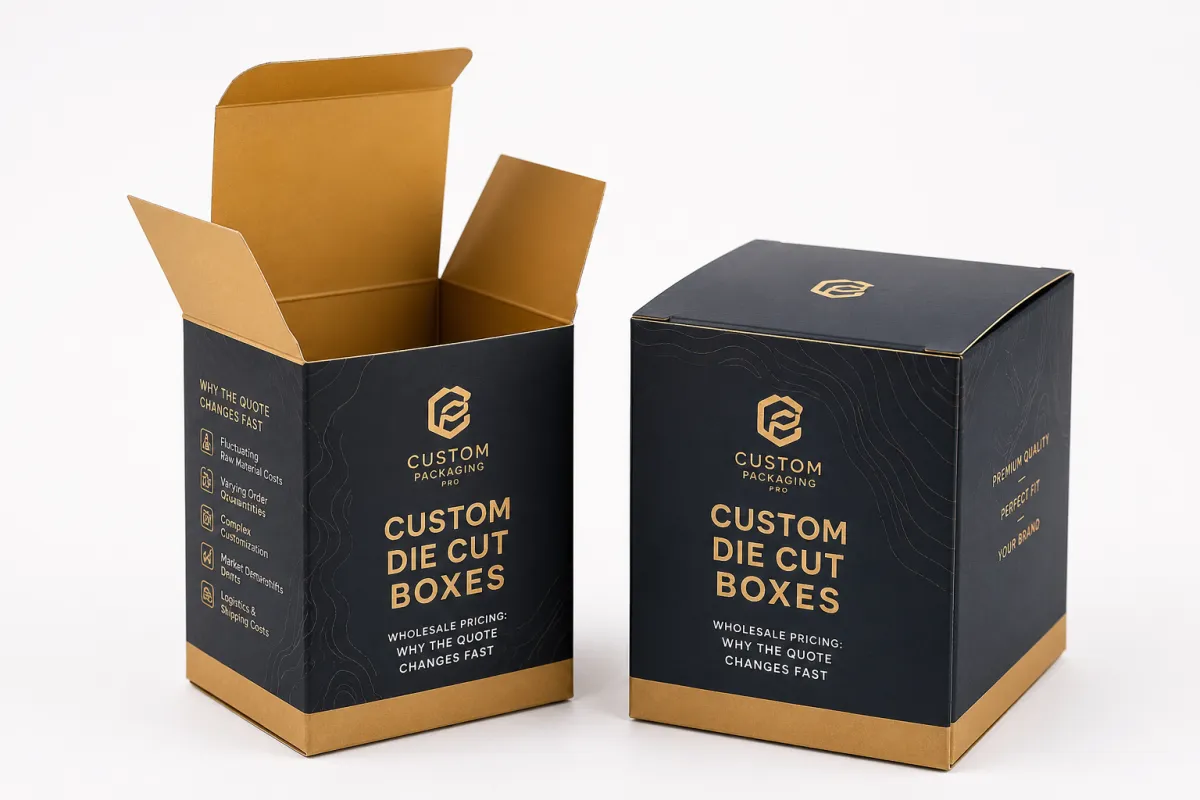
Custom Die Cut Boxes wholesale pricing changes fast because a quote is built from multiple parts, not one neat line item. A plain mailer with one-color print on standard corrugated board is one type of job. A display-ready package with inserts, coated print, and a locking structure that needs exact folds is something else entirely. Same family. Different cost profile.
The biggest mistake buyers make is assuming shape is the main pricing driver. It is not. Board grade, print coverage, structural complexity, and finishing usually matter more than the outline alone. A box with multiple cutouts, tabs, fold-in supports, and a tighter closure needs more setup and more attention on press. That means more labor, more tooling care, and usually a higher minimum.
Here is the real-world version: if one supplier quotes a mailer at $0.62 and another quotes a version that looks almost the same at $0.94, both may be right. The difference could be the board thickness, the coating, whether the artwork covers one panel or every surface, or whether the supplier included die setup in the quote instead of hiding it in a later line item. Custom Die Cut Boxes Wholesale pricing gets messy when the quote leaves out the parts that actually move cost.
For an ecommerce brand comparing a simple shipper to a display-ready die cut box with inserts, the tradeoff usually looks like this:
- Simple shipper: lower unit cost, quicker setup, fewer decoration options.
- Display-ready box: higher unit cost, stronger shelf presence, better unboxing, more branding value.
- Insert-ready format: tighter fit, less product movement, lower damage risk, more production detail.
That last point is where people get burned. A box that saves two cents but causes one damaged order in fifty is not a savings. It is a problem that arrives later with interest.
Custom die cut Boxes Wholesale Pricing should also be measured against margin, not ego. If the product sells through presentation, the box is part of the product experience. If the product ships in volume, the box has to stay inside a freight-friendly size and weight range. If it is oversized, freight climbs. If it is too light, the box may fail in transit. There is no magic "best price" without context.
Packaging truth: a quote that skips board grade, print Specs, and Setup details is not a quote. It is a guess with a letterhead.
That is why custom die cut Boxes Wholesale Pricing should be discussed with the product, the use case, and the shipping method in mind. A subscription box that ships monthly needs repeatability. A retail launch box may need more visual impact. A wholesale shipper may need stronger structure than decoration. Same category. Different priorities. Different pricing.
If you want a broader view of box styles and packaging formats, the Custom Packaging Products page is a useful starting point. If you are ordering at scale and need recurring purchasing terms, the Wholesale Programs page is where volume buying starts to become practical.
The cheapest quote is not automatically the best deal. I see buyers make that mistake constantly, then spend the next run fixing the mess the low quote created. Custom die cut boxes wholesale pricing should buy confidence, not surprises.
Product Details: What Custom Die Cut Boxes Actually Include
Custom die cut boxes wholesale pricing makes a lot more sense once you know what the product actually includes. A die cut box is not just "a box with a logo." It is a package built to a specific template, cut to fit, and folded to hold a product securely while doing a job in shipping, retail, or gifting.
Common styles include tuck-top mailers, sleeve boxes, foldable cartons, display boxes, and insert-ready packages. Some are built for ecommerce fulfillment. Some are built to sit on a shelf and sell the product visually. Some are built to do both, which sounds efficient until the price lands. Custom die cut boxes wholesale pricing rises when a box has to perform more than one role.
The customization lives in the details:
- Dimensions: exact length, width, height, and internal clearance.
- Openings and closures: tuck flaps, locking tabs, magnetic closures, or sleeve fit.
- Inserts: product cradles, dividers, or fitted inserts that hold items in place.
- Print placement: full wrap, spot panels, inside print, or both sides.
- Structural reinforcement: doubled walls, extra folds, or stronger locking geometry.
There is a difference between something that looks custom and something that is actually engineered. The first can photograph well and still fail in transit. The second usually costs more up front and saves money later because it cuts down on damage, packing labor, and rework. That is how custom die cut boxes wholesale pricing should be judged: by total outcome, not just sticker price.
For retail packaging, the finish matters almost as much as the structure. For ecommerce, the fit matters most. For gift packaging, the unboxing moment can justify a higher material spec. A cosmetics brand may want a crisp printed carton with a premium coating. A home goods seller may need a corrugated mailer with stronger corners and better crush resistance. Same packaging family, different business logic.
Another detail that matters is whether the packaging is custom printed boxes in a full production run or a hybrid setup where only certain panels carry branding. Full coverage print can look sharp, but it adds cost. Minimal branding can reduce the unit price, but it can also weaken the package if the box is supposed to do some of the selling.
Packaging professionals also look at the end use. If the box needs to fit automated packing lines, tolerances matter. If the box sits inside a shipping carton, outer dimensions matter more. If the package is going to be opened and displayed in store, the front panel and opening behavior matter more. Custom die cut boxes wholesale pricing is tied to how many of those jobs the box is expected to handle.
For practical planning, think of the product in four layers:
- Function: protect the product.
- Presentation: support branding and retail appeal.
- Production: fold cleanly, pack quickly, repeat reliably.
- Cost: stay inside the margin you can actually defend.
If the box misses layer one, everything else gets more expensive. If it misses layer two, you may lose the sale before the product gets opened. Custom die cut boxes wholesale pricing should reflect that balance instead of pretending it does not exist.
Specifications That Affect Pricing and Performance
Custom die cut boxes wholesale pricing depends heavily on the spec sheet. If the spec is vague, the quote will be vague. If the spec is sloppy, the box may be wrong. That is not me being dramatic. That is just packaging reality.
The first thing to lock in is the dimension set. External size matters for shipping cost, and internal size matters for product fit. A box that is off by a few millimeters can create a loose fit, crushed corners, or a closure that pops open under pressure. Tight tolerance jobs need more attention, more proofing, and sometimes a sample run. That raises cost, but it also lowers risk. Custom die cut boxes wholesale pricing should show that tradeoff clearly.
Next is the board or stock choice. Common options include corrugated board, paperboard, or heavier chipboard for rigid structures. Each one behaves differently. Corrugated board gives better crush resistance. Paperboard gives a cleaner retail look. Chipboard works well for premium presentation but can carry a higher price depending on the structure. A buyer chasing custom die cut boxes wholesale pricing should ask what the packaging actually needs to survive, not what looks nice in a mockup.
Print method matters too. A simple one-color run is usually far cheaper than full-bleed graphics. More ink coverage means more press time, more drying considerations, and more risk of registration issues. If the package uses rich flood coats, metallic accents, or multiple spot colors, the quote will move up. That is normal. Weak print coverage often looks weak anyway, so there is no award for pretending otherwise.
Finishes can push pricing quickly:
- Coatings: gloss, matte, aqueous, or soft-touch.
- Special effects: foil, embossing, debossing, spot UV.
- Structural options: window cutouts, magnetic closures, custom inserts.
- Extra precision: more complex dielines, tighter folds, nested components.
That is usually where the quote starts to drift upward. Not because suppliers are being difficult. Because each add-on creates more steps and more chances for waste. Custom die cut boxes wholesale pricing reacts to complexity. Always has.
Sustainability choices matter too. Buyers often ask for recycled stock, FSC sourcing, or lower-ink designs. Those can be smart choices, especially for branded packaging that needs to signal care without overbuilding the box. If sustainability is part of the brief, ask for certified sourcing through FSC and compare the pricing impact against standard stock. Sometimes the premium is modest. Sometimes it is not. That depends on availability, print coverage, and the exact board spec.
Packaging standards matter here too. If the box is shipping product that can fail in transit, testing against ISTA methods is a smart move. It is better to spend time on testing than to discover structural failure after the product is already in the wild. Custom die cut boxes wholesale pricing should not ignore distribution testing when the product is fragile, heavy, or oddly shaped.
One more spec worth calling out is fit tolerance. If you are using inserts, trays, or custom cradles, the product dimensions need to be accurate. A 2 mm error may not sound like much. In packaging terms, it can be the difference between a snug retail presentation and a box that rattles like loose change. That is where good packaging design pays for itself.
Here is the blunt version: if a supplier asks for your dimensions, product weight, print coverage, finish preference, and destination, they are not being nosy. They are doing the job properly. Custom die cut boxes wholesale pricing can only be honest when the inputs are honest.
Custom Die Cut Boxes Wholesale Pricing: MOQ, Volume Breaks, and Unit Cost
Custom die cut boxes wholesale pricing is usually ruled by one thing: quantity. The more units you order, the more the setup cost gets spread around, and the lower the per-box price tends to fall. That is true across most packaging categories, and die cut boxes are no exception.
The minimum order quantity, or MOQ, is not some random number pulled out of thin air. It exists because setup time, die preparation, press calibration, and production waste all have to be covered. A supplier cannot run a tiny batch at the same efficiency as a larger wholesale order. Custom die cut boxes wholesale pricing is built to protect production efficiency, not to annoy buyers for fun.
Here is a practical view of how volume usually behaves:
| Box Type | Typical Order Size | Typical Unit Range | Main Cost Drivers |
|---|---|---|---|
| Simple tuck-top mailer | 500 to 2,500 | $0.85 to $1.85 | Board grade, one- or two-color print, basic die setup |
| Retail carton with moderate print | 2,500 to 10,000 | $0.38 to $0.92 | Print coverage, coatings, folding complexity, fit tolerance |
| Display-ready box with insert | 5,000 to 20,000 | $0.62 to $1.45 | Insert tooling, special finishes, more detailed dieline |
| Heavy-duty custom shipper | 3,000 to 15,000 | $0.72 to $1.70 | Board strength, crush resistance, freight considerations |
Those numbers are working ranges, not a promise. Custom die cut boxes wholesale pricing can land outside them if the print is highly decorative, the structure is unusually complex, or the order includes extras like foam, molded pulp, or specialty coatings. Still, the table is a useful baseline for comparing quotes without guessing in the dark.
A lower quantity almost always means a higher unit price. That is the setup cost spreading itself across fewer boxes. If you need 1,000 units, expect the unit cost to sit higher than it would at 5,000 or 10,000. If you can move up to a better volume tier, the savings can be meaningful. That is why smart buyers ask for tiered quotes.
Ask for pricing at three levels if possible:
- Test run: enough to validate structure and market response.
- Core wholesale quantity: the number you expect to reorder regularly.
- Break-point quantity: the next tier where the unit price drops noticeably.
This is where custom die cut boxes wholesale pricing becomes a decision tool instead of a decoration. If the next tier saves enough per unit to cover storage or cash flow pressure, it may be the better move. If it does not, stay smaller and protect working capital. There is no prize for overbuying packaging.
Watch for hidden costs. They are the part of the quote that can quietly wreck a budget:
- Artwork changes: revision fees after proofing starts.
- New dielines: custom template work or tooling adjustments.
- Rush schedules: premium charges for tight delivery windows.
- Sample remakes: if the first proof needs correction.
- Freight variance: oversized boxes are not cheap to ship.
If you are comparing suppliers, ask whether the quote includes the die, the proof, the production run, and delivery to your destination. Otherwise custom die cut boxes wholesale pricing becomes a half-answer. Half-answers are how budgets get hurt.
Buyers often overlook freight because the unit price looks tidy. Then the shipment arrives, takes up more pallet space than expected, and the landed cost jumps. The smarter way is to compare landed cost per box, not just manufacturing cost per box. That is a better way to evaluate custom die cut boxes wholesale pricing with your margin intact.
Process and Timeline: From Quote to Delivery
Custom die cut boxes wholesale pricing is only useful if the process behind it is clear. A low number means very little if the supplier cannot explain proofing, lead time, or shipping assumptions. You need the full path from quote to delivery.
The process usually starts with a request that includes dimensions, quantity, product weight, artwork, finish preferences, and destination. Better input means better pricing. If the supplier has to guess, the quote will carry a buffer. That is not greed. That is risk management. Custom die cut boxes wholesale pricing rewards complete information.
After the quote comes the proof. That may include a dieline review, artwork placement check, and sometimes a physical sample or prototype if the job has tight fit requirements. If the box needs to hold a fragile product, a sample is not optional in my book. It is the cheapest insurance on the board. A sample lets you verify dimensions, closure behavior, insert fit, and print placement before the full run is cut.
Real packaging advice: if a 2 mm misfit would ruin the insert, do not approve a bulk run without checking a sample first.
Typical timing depends on complexity:
- Quote turnaround: often 1 to 2 business days for clear specs.
- Proofing: usually 1 to 3 business days, longer if artwork changes are needed.
- Sampling: about 3 to 10 business days depending on structure and finishing.
- Production: often 10 to 18 business days for standard wholesale jobs.
- Freight: a few days domestically, longer for larger or consolidated shipments.
Those timelines stretch if the job involves special coatings, inserts, or higher print precision. Material stock availability matters too. If a board grade is in short supply, even a simple order can stall. Seasonal demand can stretch the calendar as well. Custom die cut boxes wholesale pricing should always be paired with a realistic schedule, not an optimistic guess.
The easiest way to keep the job moving is to stay organized. Send clean artwork files. Confirm the product dimensions early. Respond to proofs quickly. If the supplier asks for an updated dieline or a measurement clarification, answer fast. Packaging delays often come from waiting on decisions, not from the press itself.
For brands with recurring programs, process consistency matters almost as much as price. If you are reordering monthly or quarterly, the real value is repeatability. The box should match the last run without drama. That is where a supplier with strong production control earns their keep. Custom die cut boxes wholesale pricing should include the value of not having to re-explain the same box every time you reorder.
There is also a simple truth about lead time: the more variables you add, the longer it takes. A plain corrugated mailer with basic branding moves faster than a foil-stamped insert box with a special die line. Nobody needs to pretend otherwise. The extra time is buying accuracy, not just waiting around.
That is why serious buyers ask for a schedule in writing. Not because people enjoy paperwork. Because a written schedule creates a shared expectation. When the production window is clear, custom die cut boxes wholesale pricing becomes part of a real buying plan instead of a hopeful estimate.
Why Choose Us for Wholesale Die Cut Packaging
Custom die cut boxes wholesale pricing makes more sense when the supplier understands structure and brand presentation. A packaging partner should not just quote a number and disappear. They should help you Choose the Right board, the right print coverage, and the right box style for the job.
Good wholesale support starts with consistency. If the dimensions stay consistent from run to run, your fulfillment team packs faster and your reorder risk drops. That matters more than most people admit. A box that is off by a little can create packing friction every single day. Custom die cut boxes wholesale pricing should buy consistency, not just cartons.
Direct wholesale pricing also keeps the math cleaner. Middlemen can be useful in some cases, but they also add markup, delay, and another layer of interpretation. For buyers trying to protect margin, clear pricing breakdowns are easier to manage. If the quote shows material, setup, print, and freight separately, you can compare suppliers with actual information instead of marketing fog.
At Custom Logo Things, the point is not to oversell the packaging. It is to match the box to the job. That may mean recommending a simpler structure to keep custom die cut boxes wholesale pricing under control. It may mean reducing print coverage so the brand still looks sharp without paying for extra ink. It may mean choosing a standard board thickness instead of a heavy custom build that adds cost without adding value.
That kind of advice saves money. More important, it saves bad decisions. Over-specifying packaging is a quiet budget leak. A box that looks premium but does not improve sales, reduce damage, or speed packing is just expensive cardboard with ambition.
Support also matters when the design needs adjustment. A good supplier will tell you if the die line is too complex for the target price, or if the insert geometry can be simplified without hurting fit. That kind of feedback is practical. It turns custom die cut boxes wholesale pricing into a design conversation instead of a guessing contest.
For buyers comparing formats, the right next step is often to review the range of Custom Packaging Products and identify the closest structural match before locking artwork. If the order is going to repeat, the Wholesale Programs page is also worth a look because volume buying should have clear rules, not surprises hidden in the fine print.
Good packaging support also keeps reorders sane. Once the original build is approved, the next run should be straightforward. Same specs. Same result. That is how branded packaging protects both customer experience and internal time.
And yes, quality control matters. Die cut boxes should be checked for cut accuracy, fold integrity, print registration, and closure fit. A box that misses one of those checks can still look fine in a product photo. It will not look fine in a warehouse. Custom die cut boxes wholesale pricing should reflect a supplier that knows the difference.
Next Steps for Accurate Custom Die Cut Boxes Wholesale Pricing
If you want accurate custom die cut boxes wholesale pricing, send complete specs. Not half a sentence. Not a screenshot with the product floating in a blank white void. Give the supplier the box dimensions, quantity, product weight, artwork files, finish preferences, and delivery location. That is the shortest path to a quote you can actually use.
Before requesting pricing, gather these details:
- Box size: external dimensions and target internal fit.
- Product details: weight, fragility, and any insert needs.
- Print needs: colors, full coverage, inside print, or minimal branding.
- Finish preferences: matte, gloss, soft-touch, foil, or none.
- Quantity tiers: at least three order sizes for comparison.
- Delivery destination: so freight is priced realistically.
Then ask for three quote tiers. That gives you a better view of unit cost movement and shows where the break-even point actually sits. A lot of buyers only ask for one number, then act surprised when they later discover a lower per-unit price at a higher volume. That is not a mystery. That is just sloppy quoting discipline. Custom die cut boxes wholesale pricing gets clearer when you compare tiers side by side.
If the box needs a precise fit, ask for a dieline review or sample first. If the package is shelf-ready, ask for a prototype. If the product is fragile, ask how the design would perform under distribution stress. These are not luxury questions. These are the questions that stop avoidable waste before it starts.
Here is the rule I would use: compare specs, not just sticker price. A lower quote on a weaker board with poor fit can cost more in the real world than a slightly higher quote on a better-made box. Custom die cut boxes wholesale pricing should be judged by performance, presentation, and landed cost together.
So the next move is simple. Send complete specs, request tiered pricing, review the dieline, and compare options on actual structure instead of wishful thinking. That is how buyers get control over custom die cut boxes wholesale pricing without getting trapped by the cheapest number on the page.
One last thing: if you are still deciding between two specs, choose the one that protects the product and keeps the packing line moving. Fancy is nice. Reliable pays the bills.
Frequently Asked Questions
What affects custom die cut boxes wholesale pricing the most?
Quantity, material grade, and print complexity usually have the biggest impact on unit price. New tooling, special finishes, and tight structural tolerances can raise setup costs fast. Shipping weight and box size also matter because oversized packaging costs more to move. If one quote looks mysteriously low, check whether it left out setup, proofing, or freight.
Is there usually a minimum order for wholesale die cut boxes?
Yes, most manufacturers set an MOQ to keep setup and production efficient. The MOQ depends on box style, print method, and whether the run needs custom tooling or inserts. Larger orders usually unlock better unit pricing, so it is worth asking for tiered quantity quotes. That is how you see where the real break point sits.
How can I lower my wholesale pricing without hurting quality?
Use standard dimensions where possible and keep the structure simple. Reduce unnecessary print coverage, coatings, or decorative finishes if they do not support the product. Order in a higher volume tier if your demand is stable, because unit cost usually drops. If a box only needs to protect the item, do not dress it up like it is headed to a gala.
How long does production usually take for custom die cut boxes?
Simple orders can move quickly once artwork and dielines are approved. Complex jobs with special finishes, inserts, or sampling usually need more time. Freight distance and seasonal demand can add extra lead time, so ask for a realistic schedule upfront. A rushed quote is not helpful if the boxes arrive after your launch.
Can I get a sample before placing a large wholesale order?
Yes, sample or prototype approval is common for custom packaging jobs. A sample helps confirm dimensions, print placement, and closure fit before full production. It is the cheapest way to avoid a bad run, which is apparently still a thing people try to skip. I would not gamble on a full order when a sample can tell you in one glance whether the box is actually going to work.

