Buyer Fit Snapshot
| Best fit | Custom Die Cut Boxes Recycled Board for Sustainable Brands projects where brand print, material claims, artwork control, MOQ, and repeat-order consistency need to be specified before quoting. |
|---|---|
| Quote inputs | Share finished size, material target, print colors, finish, packing count, annual reorder estimate, ship-to region, and any compliance wording. |
| Proofing check | Approve dieline scale, logo placement, barcode or warning zones, color tolerance, closure strength, and carton packing before bulk production. |
| Main risk | Vague material claims, crowded artwork, missing packing details, or unclear freight terms can make a low unit price expensive after revisions. |
Fast answer: Custom Die Cut Boxes Recycled Board for Sustainable Brands should be specified like a repeatable production item. The safest quote records material, print method, finish, artwork proof, packing count, and reorder notes in one written spec.
Production checks before approval
Compare the actual filled-product size with the drawing, then confirm tolerance on folds, seals, hang holes, label areas, and retail display edges. Reserve space for logos, QR codes, warning copy, and material claims before decorative graphics fill the panel.
Quote comparison points
Review material grade, print process, finish, sampling route, tooling charges, carton quantity, and freight assumptions side by side. A quote is only useful when the supplier can repeat the same color, closure quality, and packing count on the next order.
Custom Die Cut Boxes recycled board do more than signal a lower-impact packaging choice. Once the board grade, cut pattern, and print method are matched to the product, the carton starts doing real work: protecting the item, presenting it cleanly, and keeping the packaging budget from drifting out of control. For a buyer or brand manager, that balance matters because the box is never just a box. It affects the unboxing feel, packing speed, shipping reliability, and the way a customer reads the brand before they ever touch the product. If you need a starting point while comparing formats and structures, you can browse Custom Packaging Products.
A mistake I see a lot is assuming recycled board automatically means compromise. That is not how it plays out on press or in the packing room. Custom Die Cut boxes recycled board can print sharply, feel solid in the hand, and survive shipping if the structure is designed for the product instead of squeezed into a stock size that sort of works. Fit, compression resistance, assembly speed, and visual finish all have to line up. Recycled content matters, sure, but the carton still needs the right flute or caliper, predictable ink behavior, and enough structural discipline to hold up once it leaves the plant.
That is what makes Custom Die Cut boxes recycled board such a practical option for e-commerce, retail packaging, and hybrid programs that need to do both jobs. The box is built around a specific footprint, so void fill can drop, the product sits more securely, and the presentation feels intentional instead of improvised. Done well, the carton becomes part of the product experience instead of a disposable layer on the outside.
What Custom Die Cut Boxes Recycled Board Actually Solve
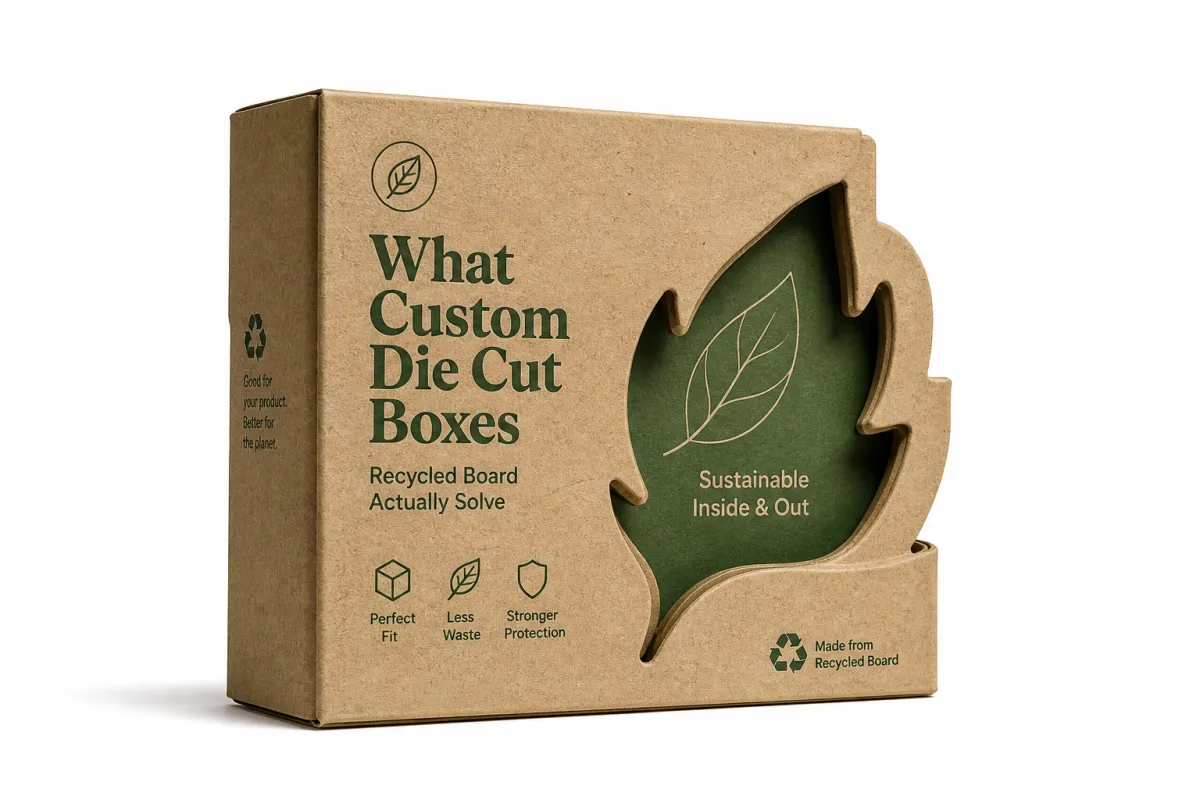
Custom die cut boxes recycled board solve a very plain packaging problem: how to protect a product without overbuilding the carton or hiding the brand behind excess material. Recycled board still has room to look premium when the cut is accurate, the folds close cleanly, and the artwork respects the surface instead of fighting it. Brands that want a more responsible look often find this approach gives them the cleanest path forward without jumping to a heavier rigid setup that may be unnecessary for the product.
From a buyer’s perspective, custom die cut boxes recycled board usually sit between a stock mailer and a more complex custom rigid package. That middle ground gives real control over size, structure, and presentation while keeping tooling and production time in a range most teams can manage. A fragrance sample, cosmetics kit, candle, small electronics accessory, or direct-to-consumer order can all benefit from a format that is cut for the product instead of padded out to fit whatever is already sitting on the shelf.
The decision is never only about recycled content. The box still has to fit the item, resist crushing, survive the route it will travel, and support the customer experience after opening. A carton that saves a little board but creates corner damage or slows packing is not a good trade, no matter how nice the spec sheet looks. Custom die cut boxes recycled board work best when the structure matches the use case, not when sustainability is treated like the only thing that matters.
Packaging structure also plays a larger role in retail presentation than many teams expect. A tray, sleeve, roll-end mailer, tuck-top carton, or insert can change how the item sits, how the opening feels, and how organized the interior looks the moment the customer lifts the lid. That is not cosmetic fluff. It shapes perceived quality immediately, which is part of package branding whether a team talks about it that way or not.
Practical rule: if the product shifts inside the carton, the carton is not finished. Recycled board can be the right material, the print can be excellent, and the system can still need a better fit or a better insert.
That is why custom die cut boxes recycled board should be treated as a packaging system rather than a single object. The carton, the insert, the closure, the artwork, and the shipping environment all influence one another. When those pieces are aligned, the result feels neat, efficient, and more polished than the material choice alone would suggest.
How Custom Die Cut Boxes Recycled Board Are Made
Custom die cut boxes recycled board start with the board itself, and that is where the material discussion gets concrete very quickly. Recycled board can mean corrugated board with recycled liner and medium, or folding carton stock with recycled fiber content, depending on the box style. For heavier product packaging, corrugated grades like E-flute or B-flute are common. For lighter retail packaging, recycled paperboard in the 18pt to 24pt range may be enough, although the right answer depends on product weight, filling method, and how much handling the box will see before it reaches the customer.
The die line comes next. A die line is the flat layout that tells the cutting and creasing equipment where to cut, score, slit, and remove waste. Careful die line work matters because folds need to land cleanly and locking tabs need the right clearance. On custom die cut boxes recycled board, the structure is what keeps the box from feeling flimsy, awkward, or imprecise. A score that is too heavy can crack the board. A cut that is too loose can make the closure sloppy. Small adjustments often change the whole feel of the finished piece.
Board grade, caliper, and compression strength are worth understanding in plain language. Board grade tells you the material’s intended performance. Caliper tells you how thick it is. Compression strength tells you how well it stands up when stacked or shipped. Two cartons can both use recycled board and still behave very differently because one uses a stronger flute profile or a heavier liner. That is one reason custom die cut boxes recycled board should never be chosen by recycled percentage alone.
Printing and finishing shape the final look just as much as the structure does. Flexographic print is common on corrugated. Litho-lam can deliver a sharper printed face. Digital print can help with shorter runs or variable artwork. Coatings matter too: aqueous coating, matte varnish, or an uncoated surface each change how much of the fiber character stays visible. Some brands want that natural texture because it supports the story. Others need a cleaner, brighter face for their graphics. Either path can work if the print method and substrate are chosen with intent.
Custom die cut boxes recycled board also move through cutting, creasing, folding, and gluing stages that require shop control. Windows, locking tabs, thumb cuts, and product retention features have to be engineered early. I have seen plenty of packaging concepts that looked elegant on a screen but turned awkward in production because a tab was too short, a fold moved the wrong way, or an insert fought the product instead of holding it. A proper structural spec avoids that kind of expensive rework, and it saves a lot of head-scratching later.
Buyers who want to validate shipping performance can lean on established references. Testing standards such as ISTA help when a box has to survive parcel networks, vibration, drops, and compression, while fiber chain-of-custody programs can look to FSC for certified material context. Those references do not choose the box for you, but they keep the conversation grounded in real performance instead of assumptions.
In practice, custom die cut boxes recycled board are built well when the manufacturer understands both the material and the end use. Too light, and the box flexes. Too heavy, and the customer pays for unnecessary material while the carton becomes harder to fold. The best result usually feels simple to assemble and strong enough to trust, which is kind of the whole point.
What Affects Pricing, Strength, and Print Quality
Custom die cut boxes recycled board can be cost-efficient, but the final unit price depends on a handful of variables that deserve attention before quotes go out. Board grade comes first. A lightweight folding carton costs less than a heavy corrugated shipper, though the lighter option may need more inserts or additional protection. Box size matters too, since larger sheets affect press setup, waste, and sometimes tooling costs.
Die complexity is another major cost driver. Straightforward shapes are faster to make and easier to assemble. Add thumb cuts, display windows, multi-point locking tabs, or unusual internal supports, and the tooling becomes more involved. That does not make custom features a problem. It just means custom die cut boxes recycled board should be designed with purpose. A feature that reduces labor or improves presentation can justify the extra tooling. A feature that only looks clever on the drawing board usually does not survive contact with the production floor.
Print coverage also affects price. Heavy ink coverage, multiple spot colors, special coatings, and white underlay on kraft-like surfaces can all raise the cost. Design choices and board choice interact here. Some brands want the recycled fiber to show through because it communicates restraint and material honesty. Others want a smoother, brighter face. Both approaches can work, but the print method and coating need to match the goal. If the artwork is busy or highly photographic, the substrate needs to support that without making the box look muddy.
Strength is its own conversation. A carton that holds a single lightweight item in a warehouse is not the same carton that survives a cross-country parcel network. Product weight, stack load, shipping distance, and moisture exposure all matter. If the carton will sit on pallets, the compression resistance has to be high enough to avoid crushing. If the product is fragile, corner integrity and internal restraint become even more important. Custom die cut boxes recycled board can perform well here, but the structure has to match the distribution conditions.
| Box option | Typical use | Typical board | Approximate unit cost at 5,000 pcs | Strength and print notes |
|---|---|---|---|---|
| Simple tuck-top carton | Light retail product, subscription item, accessory packaging | 18pt-24pt recycled paperboard | $0.28-$0.65 | Good for sharp graphics; limited compression unless reinforced |
| Roll-end mailer | E-commerce shipping, unboxing-focused branded packaging | E-flute or B-flute recycled corrugated | $0.55-$1.10 | Better crush resistance; print can be excellent with the right liner |
| Die cut tray with sleeve | Retail packaging, gift sets, presentation kits | 24pt board or lightweight corrugated | $0.70-$1.40 | Strong shelf presence; assembly time depends on nesting and insert design |
| Protective insert system | Fragile goods, cosmetics, glass, specialty product packaging | Custom recycled corrugated or paperboard | $0.15-$0.45 add-on | Reduces movement and returns; must be fit-tested with the final product |
Those ranges are planning numbers, not final quotes, but they help buyers think about total landed cost instead of only sheet price. A carton that saves a few cents but increases void fill, labor, or breakage is usually the wrong choice. I have seen custom die cut boxes recycled board lower overall cost because they cut down on secondary packaging and speed up packing. I have also seen them become more expensive than a stock carton because the artwork was too heavy and the structure was too intricate for the volume. Context decides the winner every time.
Print quality also depends on how well the design works with the substrate. Recycled fiber can show more texture than premium coated stock, which can be an advantage if the brand voice is earthy, modern, or minimal. When the brand wants a natural feel, the board character becomes part of the design. If photo reproduction needs to stay tight, the print process and coating have to compensate. Good custom die cut boxes recycled board work with the material instead of trying to hide it.
If you are comparing Custom Packaging Products, ask for a quote that includes board spec, print method, finishing, and assembly requirements. A low box price can hide a slow setup or a weak structure. A slightly higher price can be cheaper once labor and damage reduction are included. That kind of comparison helps branded packaging teams make better decisions without guessing.
Step-by-Step: From Spec Sheet to Production Timeline
Custom die cut boxes recycled board move faster when the first spec sheet is complete. The best place to start is the product itself: exact length, width, height, weight, fill method, whether it ships with an insert, and what the customer should see when the box opens. If the item arrives in a polybag, bottle, jar, molded tray, or multi-piece kit, that detail changes the structure immediately. A clean spec sheet saves a lot of back-and-forth, and it keeps the project from wandering.
The first production step is usually fit and structure development. A good packaging engineer translates the product footprint into a die line that leaves enough room for assembly without giving the item so much space that it rattles. That prototype should be checked with the real product rather than a drawing. Custom die cut boxes recycled board can look perfect in CAD and still miss the mark once a bottle cap, label seam, closure flap, or insert shoulder enters the picture. That is just how physical packaging behaves.
Sampling matters. I would rather see one clean sample round than rush into a full run and discover that the closure needs more friction or the product edge is scuffing the board surface. Fit testing belongs here. For shipping cartons, drop testing and compression checks can reveal weak corners, tab failures, or poor stack behavior early. For parcel programs, ISTA 3A or similar distribution methods can provide a useful reality check before thousands of units are ordered.
The artwork stage follows. Prepress reviews should confirm bleed, safe zones, barcode placement, and how colors behave on recycled stock. Dark solids may show more board character than expected. Light, restrained graphics can make the recycled texture look calm and intentional. Either way, color review needs to happen on the actual substrate because proofing on glossy paper does not tell the whole story for custom die cut boxes recycled board.
Here is a realistic timeline for many runs:
- Spec intake: 1-3 business days to confirm dimensions, product weight, and box style.
- Die line and structural concept: 2-5 business days for an initial layout.
- Prototype or sample: 3-10 business days depending on complexity and board availability.
- Artwork and proof approval: 2-7 business days if revisions are light.
- Tooling and prepress: 3-8 business days, longer for complex shapes.
- Production and finishing: often 5-12 business days for a standard run.
- Freight and delivery: depends on distance, carrier, and whether the job ships palletized.
That places many jobs around 12 to 25 business days from clean proof approval, though custom die cut boxes recycled board can take longer if the structure is new, the print setup is involved, or the board grade needs special sourcing. Timeline slips usually come from late changes. A different size, a new closure, or a color correction after approval adds time quickly, so it pays to get those decisions settled before the job starts.
The smoothest projects are the ones where the buyer gives clear priorities from the start. If sustainability leads, the design can stay straightforward and the board can stay honest. If shelf impact matters most, the print and opening experience deserve more attention. If shipping protection is the main concern, structure and inserts take the lead. Custom die cut boxes recycled board can support all three, but not all three equally without tradeoffs, so the priority order needs to be clear before production begins.
Common Mistakes with Custom Die Cut Boxes Recycled Board
One of the most common mistakes is choosing a box based only on recycled percentage. Custom die cut boxes recycled board should be judged by performance first and material claim second. A carton that sounds greener on paper but crushes in transit is not the better environmental choice once replacements, returns, and waste are counted. Strength, fit, and durability all shape the real footprint, and that part gets overlooked too often.
Over-design shows up a lot too. On a screen, a box with extra folds, internal bridges, hidden tabs, and fancy lock features can look smart. On the line, it can slow assembly, create weak fold points, and increase scrap. If the packaging team has to fight the carton to make it work, the structure is too complicated. Good custom die cut boxes recycled board usually feel almost boring in the best possible way: they open cleanly, fold predictably, and protect the product without fuss.
Undersizing can be just as damaging as overcomplication. When the carton is too tight, corners crush, surfaces scuff, and the product can press into printed walls or labels. That is especially risky with retail packaging for glass, cosmetics, or rigid containers. Leave no margin for tolerances, and returns will usually make the problem visible very quickly. Even a 1/16-inch adjustment can change how the box behaves, which is a tiny number with a big consequence.
What buyers notice late: the box was technically correct, but the fold memory was wrong, the product sat crooked, or the closure demanded too much force. Those small misses become expensive very fast.
Skipping sample approval is another frequent mistake. The urge to move quickly makes sense, especially when a launch date is close, but a sample often catches the problems that matter most: fit, print contrast, assembly speed, and how the recycled board reacts to scoring. Custom die cut boxes recycled board tend to reward that extra review because the natural surface and variable fiber structure can behave differently than a standard white board proof. The sample step is not extra fluff; it is the place where the expensive surprises usually show up.
Labor gets underestimated as well. A box that looks inexpensive per unit can become costly if it must be folded by hand in several steps, taped at the wrong moment, or packed with a fiddly insert. Total landed cost includes labor, damage, freight, and handling, not just the carton line on the quote. That is where many branded packaging programs lose money without realizing it. The budget line looks fine, but the warehouse team is doing extra work and nobody notices until the totals start creeping up.
Some teams try to make recycled board look like something it is not. Heavy graphics and glossy finishes can erase the material story that made the carton appealing in the first place. There is nothing wrong with a cleaner, natural presentation. For many custom die cut boxes recycled board, that restraint is exactly what makes the design feel more confident and more believable.
Expert Tips for Better Results and Smarter Budgeting
Start with the product, not the artwork. That advice sounds simple, but it prevents a lot of unnecessary revisions. Build the carton around the item’s real size, weight, and handling needs, then layer the graphic system on top of that. Custom die cut boxes recycled board perform best when structure and fill method are settled first, because the box can then support both protection and presentation without awkward compromises.
Use the recycled board surface as part of the design language. Minimal branding, strong typography, and a few well-placed color blocks often look more refined than full coverage. If the natural fiber tone suits the brand, let it show. That can reduce ink usage and still give the package a memorable presence. For many brands, that is where package branding feels more honest rather than less. You do not need to shout if the structure and print are doing their job.
Compare unit price, waste, and labor together. A carton that is 8 percent cheaper on paper may cost more once assembly time, inserts, and freight are added. I have seen buyers get the better outcome by selecting a slightly stronger box that cuts damage and removes the need for an inner shipper. Custom die cut boxes recycled board often win those comparisons because they can combine several functions in one structure instead of asking the operation to manage three separate packaging pieces.
Ask for two or three structural options whenever possible. One can prioritize price, one can prioritize protection, and one can prioritize presentation. Side-by-side comparison makes tradeoffs visible. If all three options use the same artwork but different board specs, the differences in strength and cost become much easier to evaluate. If you need a starting point for that kind of comparison, review Custom Packaging Products and ask which structures fit the product and fulfillment method best.
Request a production sample, a stack test, or a ship test before scaling up. For fragile items, even a small pilot run can reveal whether the closure tabs hold, whether the insert is pressing into the product, or whether the carton flexes under load. ISTA-style transit testing is not overkill for a lot of e-commerce work; it is cheap insurance. Custom die cut boxes recycled board can be highly dependable, but only if the structure is checked under real use conditions.
Use these quick budget checks before approving a run:
- Does the structure reduce void fill or secondary packaging?
- Does the board grade match the product weight and shipping method?
- Is the print method appropriate for the recycled surface?
- Will the carton assemble quickly on the line?
- Does the box feel premium without adding unnecessary material?
Those questions may sound basic, but they catch most expensive errors. Good custom die cut boxes recycled board rarely come from one dramatic choice. They come from a string of sensible decisions that stack up: the right board, the right score, the right print, the right insert, and the right amount of restraint. That is the part that separates a decent package from one that actually works in the real world.
Next Steps for Choosing the Right Box Program
If you are building a new box program, start with a short, honest checklist. Include product dimensions, product weight, shipping method, shelf or unboxing goals, print needs, target recycled content, and any special concerns such as moisture, fragility, or temperature swings. That single sheet can save days of back-and-forth when quoting custom die cut boxes recycled board.
Then ask for two or three structural options. One may be a simpler mailer-style box, another may be a tray-and-sleeve format, and a third may include an insert or reinforcement. Comparing them side by side makes the relationship between price, protection, and assembly time much easier to see. For many brands, that comparison is where the best decision becomes obvious. It takes the conversation out of theory and puts it back on the table, where it belongs.
Review your current packaging with a hard eye. Is it overbuilt? Is it underperforming? Does it support the brand, or does it simply get the job done? If the box is too loose, too heavy, or too expensive to assemble, recycled board may be the better path. If the current system is already efficient, the opportunity may sit in better artwork, less waste, or a cleaner die cut format.
From a practical point of view, custom die cut boxes recycled board work best when structure, artwork, and production plan all move in the same direction. That is the real lesson. Sustainability matters, but it does not live alone. Fit, strength, print behavior, and total landed cost sit in the same conversation, and the strongest packaging programs treat them that way.
If you are ready to refine your next carton, talk with a supplier who can walk through board grades, die line details, and production realities without overselling the idea. The right partner will help you choose custom die cut boxes recycled board that protect the product, respect the budget, and support the brand story at the same time. That is the kind of result worth building toward.
Frequently Asked Questions
Are custom die cut boxes recycled board strong enough for shipping?
Yes, when the board grade, flute style, and structure are matched to the product weight and transit conditions. Many custom die cut boxes recycled board perform very well in parcel and pallet environments, especially if the carton is fit-tested with the final product and closure method. For heavy, fragile, or moisture-sensitive items, it is wise to validate the design with samples or ship testing before scaling up.
Do custom die cut boxes recycled board cost more than standard cartons?
Not always. Pricing depends on die complexity, board spec, print coverage, quantity, and finishing requirements. A simple recycled board design can be very cost-effective, particularly if it reduces void fill or eliminates a secondary carton. More intricate shapes and short runs usually raise the unit price, so it helps to compare total packaging cost instead of only the box line item.
What recycled board grades work best for custom die cut boxes?
The best grade depends on the job. Corrugated recycled board is often chosen for strength and shipping protection, while lighter recycled paperboard can work well for retail packaging and sharp graphics. The right choice comes down to product weight, stacking needs, appearance goals, and how much handling the box will see before it reaches the customer.
How long does it take to produce custom die cut boxes recycled board?
Timelines vary with structural complexity, sampling, and board availability. Simple jobs can move quickly, while new die lines, print matching, and special recycled board sourcing can add days or even a couple of weeks. A clear spec sheet and fast proof approval usually shorten the schedule more than anything else.
Can custom die cut boxes recycled board still look premium?
Absolutely. Premium does not have to mean glossy or heavily coated. It can come from a clean structure, good typography, crisp folds, and artwork that respects the recycled surface. Many brands find that the natural fiber character gives the box a more authentic feel, especially when the design is restrained and purposeful.

