Why Custom Dovetail Drawer Boxes Change the Feel of a Cabinet
People judge cabinet quality with their hands first. A drawer that opens quietly, stays square, carries weight without twisting, and closes with a firm stop says more than a flawless face frame. The difference is tactile. Users may not know the species, slide brand, or joinery method, but they notice drag, wobble, and hollow-sounding construction immediately.
Custom dovetail drawer boxes are made-to-size drawer components built with interlocking dovetail joinery. They are usually made from solid wood, plywood, or engineered hardwood panels, then specified around a real cabinet opening or a production drawer schedule. Width, depth, height, bottom recess, side thickness, finish, and slide compatibility all have to be decided before the box is cut.
That is what separates them from generic bins pulled from inventory. A stock box may be fine for a simple replacement if the cabinet and slide system cooperate. A custom box is different: it is sized for the job, machined for the hardware, and built to match the material and finish expectations of the project.
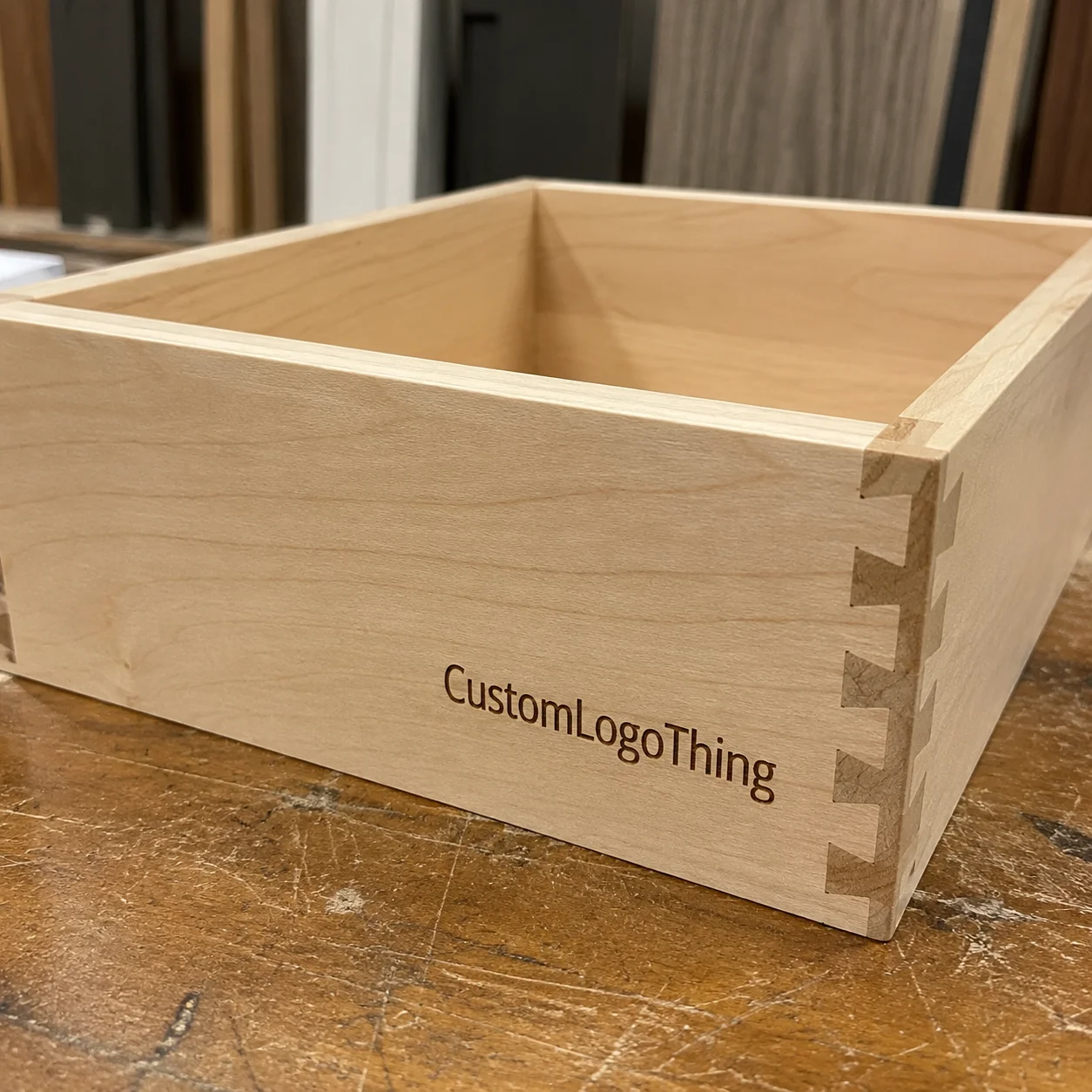
The dovetail joint works on two levels. Structurally, the angled pins and tails resist pull-apart force, especially at the front corners where daily stress is highest. Visually, the joint gives the drawer side a finished, craft-built appearance. Buyers often read that corner as a quality signal before they ask about load rating or bottom thickness.
These boxes show up in kitchens, vanities, closets, hospitality millwork, office built-ins, retail fixtures, and replacement drawer programs. In commercial storage, they may support samples, printed materials, parts, and display components behind Custom Packaging Products or branded packaging kits. A weak drawer in that setting becomes irritating quickly because it is handled by multiple people, not one careful homeowner.
A drawer box is not always a complete drawer system. Slides, drawer fronts, pulls, dividers, inserts, locking devices, scoop fronts, finish, and installation hardware may be quoted separately. That is normal. It also means the buyer has to define the box correctly instead of assuming the supplier will infer every detail from a cabinet opening.
The practical goal is not merely “make it fit.” The goal is fewer field adjustments, fewer callbacks, and drawers that keep their shape under daily load. Joinery matters, but so do slide clearance, material stability, finish choice, labeling, packing, and the accuracy of the schedule sent to production.
How Dovetail Joinery Works in a Made-to-Size Drawer Box
Dovetail construction is simple once the corner is pictured. One board is cut with tails, the mating board is cut with pins, and the two profiles slide together. The shape itself resists straight pull-out force. Glue still matters. So does the accuracy of the cutter setup. But the geometry gives the corner a mechanical advantage that a plain butt joint does not have.
Drawer boxes most often use visible side joinery. A through dovetail shows the joint profile across the full thickness of both boards. A half-blind dovetail hides one face of the joint, which can be useful where the front needs a cleaner look or where a separate applied drawer front covers the box. For custom dovetail drawer boxes, the visible side pattern is often part of the reason buyers choose the construction in the first place.
Production follows a tight sequence. Material is selected, then parts are ripped and crosscut. Dovetail profiles are machined on routers, shapers, or CNC equipment. Grooves are cut for the bottom panel. The box is glued, assembled, clamped or pressed, checked for square, sanded, and inspected before finishing or packing.
The bottom panel deserves more attention than it usually gets. Better drawer boxes capture the bottom in grooves on the sides, front, and back so the panel is supported around the perimeter. That is different from fastening a thin bottom only at the lower edge. On wide pantry drawers, file drawers, or deep utility drawers, the bottom construction can decide whether the drawer still feels solid after months of use.
Slide rating and box construction need to match. A slide rated for 100 pounds does not make a flimsy box into a 100-pound drawer. Load rating assumes the box, fasteners, bottom panel, and cabinet structure can handle the same demand. For files, pantry storage, shop fixtures, and commercial drawers, 3/8 inch or 1/2 inch captured bottoms are often more appropriate than a thin panel.
Dovetail boxes are not the only valid option. Stapled, doweled, or butt-jointed drawer boxes can work in light-duty cabinetry, temporary fixtures, budget projects, and situations where replacement cost matters more than long service life. Dovetails make sense when strength, appearance, and repeated use justify the added machining and labor.
Precision is the quiet part. A beautiful joint still causes trouble if the box is out of square by 1/8 inch, too wide for the slide clearance, or built with inconsistent side thickness. Good joinery earns its keep only when the entire box is held to the required tolerance.
Shop-floor rule: never approve a drawer box only because the corner looks good. Check square, width, depth, bottom recess, side thickness, and slide requirements before calling the specification complete.
Key Specs to Confirm Before You Request a Drawer Box Quote
A clean quote starts with clean information. For custom dovetail drawer boxes, the essential dimensions are outside width, outside depth, finished side height, quantity, and bottom recess. State whether those numbers are box-only dimensions or were derived from cabinet openings. One sentence can prevent a costly misunderstanding.
Slides should be confirmed before the order is released. Side-mount slides often need a set clearance, commonly around 1/2 inch per side, but the slide manufacturer’s data sheet should control. Undermount soft-close slides may require a specific box width deduction, depth, rear notch, locking device hole, and bottom recess. Heavy-duty slides may need thicker sides, stronger bottoms, or more careful fastener placement.
Material choice changes durability, weight, appearance, lead time, and price. Maple is common for premium drawer interiors because it machines cleanly and takes a clear finish well. Birch plywood is stable and cost-efficient when the exposed edge treatment is acceptable. Walnut and oak give a stronger furniture look, but they raise the unit cost and may require tighter finish expectations. Prefinished plywood and UV-coated panels save finishing time and give installers a ready-to-use interior surface.
- Side thickness: 1/2 inch is common for smaller drawers; 5/8 inch or 3/4 inch may be better for large or demanding boxes.
- Bottom thickness: 1/4 inch can work for small drawers; 3/8 inch or 1/2 inch is safer for wide storage, files, and pantry use.
- Finish: options may include raw sanded, clear coat, UV prefinished, sealed edges, color match, or ready-to-install components.
- Labeling: room, elevation, cabinet number, and drawer position help crews sort similar boxes quickly on site.
Buyers who also manage Custom Printed Boxes, package branding, or product packaging programs already know the pattern. A quote is only as accurate as the specification. A vague drawer request creates the same production risk as sending packaging files without dielines, material callouts, finish notes, or packing requirements.
Tolerance language belongs early in the conversation. Ask how the supplier checks square, what dimensional tolerance they quote for width and depth, and how they handle boxes that need notching or drilling for a specific slide model. A practical tolerance might be plus or minus 1/32 inch on critical dimensions, but that depends on material, equipment, process control, and supplier capability.
Also ask how moisture content and panel movement are managed. Solid wood sides move more than plywood. Seasonal movement may not matter much on a small drawer, but it can affect wide boxes, tight reveals, and high-end inset cabinetry. No supplier can remove wood movement from physics; the point is to choose materials and clearances that respect it.
| Specification Area | Typical Options | Why It Matters |
|---|---|---|
| Material | Maple, birch, oak, walnut, prefinished plywood | Controls appearance, weight, machining quality, stability, and budget |
| Side Thickness | 1/2 inch, 5/8 inch, 3/4 inch | Affects strength, interior capacity, slide compatibility, and cost |
| Bottom Panel | 1/4 inch, 3/8 inch, 1/2 inch captured panel | Supports load and helps prevent sag in wide or deep drawers |
| Slide System | Side-mount, undermount, soft-close, heavy-duty | Determines clearances, notches, holes, and setback details |
| Finish | Raw, clear coated, UV-coated, sealed edges | Improves cleanability, stain resistance, and installation readiness |
Cost, Pricing, and Unit Cost Drivers for Dovetail Drawer Boxes
Pricing is usually driven by size, material species, side thickness, bottom type, finish, machining details, quantity, packaging method, and freight. A small maple drawer with clear finish and undermount notching can cost more than a larger unfinished plywood box if the labor and machining requirements are heavier.
As a broad planning range, simple unfinished plywood or maple drawer boxes may land around $35 to $75 each in moderate quantities. Larger hardwood, finished, or heavily machined boxes may run $80 to $180 or more per unit. Very small replacement orders can price higher because setup, programming, material handling, sanding, inspection, and packing do not shrink in proportion to box size.
Quantity helps, but only when the order is organized. If 80 boxes share the same material, side thickness, finish, and slide machining, setup time can be spread across the batch. If those 80 boxes are split across five species, three bottom thicknesses, and several slide systems, production behaves more like several small jobs with separate checks.
Cost adders often hide in the details. Undermount slide notching, scoop fronts, radius corners, custom branding, pre-drilled holes, dividers, file rails, knife-block inserts, spice inserts, and individual carton packing all add value. They also add time. In packaging terms, it is similar to adding inserts, partitions, special labels, or spot finishes to Custom Printed Boxes; each feature must be specified, produced, checked, and packed.
Minimum order quantity is not always a hard wall. Some suppliers accept mixed-size projects, especially for cabinet shops and replacement programs. Others price most efficiently when batches share material, thickness, and finishing requirements. If you need two specialty boxes, expect setup-heavy pricing. If you need 40 or 400, spend the time on a proper drawer schedule.
A drawer schedule beats loose notes every time. Include room, cabinet number, width, depth, height, quantity, material, finish, slide type, notches, holes, and special comments. Clean information reduces back-and-forth, helps production hit the first ship date, and lets the manufacturer quote without padding for uncertainty.
Freight should not be treated as an afterthought. Finished drawer boxes are bulky, easy to scuff, and awkward to rework once damaged. Bulk pallet packing may be economical for a cabinet shop with staging space. Individually cartoned boxes may cost more, but they can protect finishes and simplify distribution on multi-unit jobs.
Process and Timeline From Measurement to Ready-to-Install Boxes
The ordering process should feel methodical, not improvised. Collect cabinet opening information first. Confirm the slide system. Build the drawer schedule. Review material and finish options. Approve drawings, a cut list, or a sample. Then release the job to production. Skipping one step usually shows up later as a fit issue, a delay, or an uncomfortable phone call.
Lead time depends on order complexity, shop capacity, material availability, finish cure time, sample approval, and packing requirements. A small unfinished order in a common material might move in 7 to 12 business days after approval. A larger finished order with mixed dimensions, special machining, or staged delivery may need 3 to 6 weeks. Those are planning ranges, not guarantees, because production calendars and material supply can shift quickly.
A pilot box is cheap insurance on tight projects. Order or approve one sample when the project involves new slides, unusual clearances, high-value cabinetry, or a large multi-room rollout. Install it with the exact slide hardware, check the front alignment, test the closing action, and load it with realistic weight before releasing the full batch.
The approval checkpoint should cover dimensions, quantities, material, side height, drawer depth, bottom construction, front and back orientation, bottom recess, notching, drilling, finish, and labeling. If the box is for an undermount soft-close slide, provide the slide brand and model. “Undermount ready” is not precise enough. Similar slide systems can require different rear notches or locking device hole locations.
Production steps are straightforward and unforgiving. Parts are cut. Dovetails are machined. Bottom grooves are routed. Boxes are glued and assembled. Square is checked. Surfaces are sanded. Finish is applied if specified. Quality control reviews the order, labels are attached, and boxes are packed for shipment or pickup.
Quality control should include more than a quick glance at the joint. Practical checks include outside width and depth, diagonal measurement for square, side height, bottom recess, notch location, hole location, visible glue squeeze-out, finish coverage, sharp edges, and label accuracy. On repeat orders, checking the first piece and a few pieces through the run helps catch drift before the whole batch is packed.
Standards can frame expectations even when they do not directly govern a cabinet drawer. For shipping validation, ISTA procedures are useful references for packaged-product testing, especially if finished drawer boxes are traveling long distance. For responsible wood sourcing, many buyers ask about FSC chain-of-custody options, though availability depends on the material and supplier.
Turnaround delays usually come from incomplete hardware information, late finish decisions, missing approvals, or field conditions that were never documented. Changing the slide after boxes are machined can turn a clean production order into rework, scrap, or a full reorder.
Common Mistakes That Cause Fit Problems or Installation Delays
The most common fit mistake is measuring only the cabinet opening and forgetting the slide manufacturer’s required clearance. Side-mount slides, undermount slides, rear brackets, inset fronts, face-frame obstructions, and appliance clearances all affect the final drawer box size. The opening is only the starting point.
Another expensive mistake is mixing inside and outside dimensions. One person measures the desired storage space. Another assumes the numbers are outside box dimensions. Production builds exactly what was written. On a 5/8 inch side box, that confusion can create a 1-1/4 inch width error before anyone opens the carton.
Do not assume all soft-close slides share the same setback, notch, and hole pattern. They do not. Even within the same general category, one undermount system may require a different rear notch depth or locking device location than another. The safest instruction includes the exact brand, model, length, and any manufacturer template requirement.
Overbuilding creates its own problem. Thicker sides and bottoms can improve load capacity, but they also reduce interior storage space and may require different hardware. A 3/4 inch side can be excellent for a large commercial drawer. It may be unnecessary for a small vanity top drawer where capacity matters and loads are light.
Finish oversights usually appear after the drawer is in use. Raw sanded boxes may be acceptable inside dry, low-use cabinetry. Wet zones and high-use areas usually benefit from sealed surfaces. Clear coat or UV prefinished interiors reduce staining, swelling, odor absorption, and cleanup complaints. In many projects, finish costs less than a callback.
Labeling sounds minor until thirty similar boxes arrive at the same site. A label that says “Kitchen, base 12, top drawer” or “Unit 305, vanity, left stack, middle” can save hours. On multi-room and multi-unit work, labels are production information, not decoration.
Replacement work brings another layer of risk. Existing cabinets may be out of square, modified around plumbing, or built around discontinued hardware. Photograph unusual conditions before quoting. Face-frame lips, appliance handles, electrical boxes, sink traps, and uneven openings can all change the right drawer size.
Actionable Next Steps Before You Place the Order
Before ordering custom dovetail drawer boxes, slow down long enough to confirm the details that control fit. Start with the slide model. Record outside box dimensions. Choose material. Select side and bottom thickness. Specify finish. Assign every box to a cabinet location. That short checklist prevents most avoidable problems.
- Confirm the exact slide brand, model, length, load rating, and mounting style.
- Record outside width, outside depth, finished height, and bottom recess.
- Choose material, side thickness, bottom thickness, and finish.
- Identify notches, holes, scoop fronts, dividers, inserts, or special cutouts.
- Label each box by room, cabinet number, elevation, or installation sequence.
- Decide whether boxes should ship bulk packed, palletized, or individually cartoned.
A good drawer schedule can be simple. Build columns for room, cabinet number, width, depth, height, quantity, material, finish, slide type, notches, holes, and notes. If you already use spreadsheets for Custom Packaging Products, package branding, or branded packaging rollouts, use the same discipline here: one row per component, one clear specification per field, no loose assumptions.
Order or approve one sample when tolerances are tight, the project is large, or the specification is new. The sample should be installed with the real slide, real front condition, and realistic load. If it needs a small correction, make that adjustment before the rest of the order is cut.
Receiving plans deserve attention too. Bulk pallet packing works well for cabinet shops that sort and stage in-house. Labeled individual cartons may be better for multi-unit installation teams, retail fixture programs, or jobs where components move through several hands before installation. Protective packing is not glamorous. Damaged finished boxes cost time.
For brands that also need cartons, inserts, labels, or other product packaging around a fixture or retail display program, Custom Logo Things can support the broader packaging side through Custom Packaging Products. Drawer boxes and packaging are different products, but both reward the same habit: define the material, dimensions, finish, labeling, and handling requirements before production begins.
The strongest result comes from matching joinery, material, slides, finish, and measurements before the first part is machined. A drawer is touched every day. Every smooth close quietly confirms that the details were handled before production, not repaired after installation.
FAQ
What measurements are needed for custom dovetail drawer boxes?
Provide outside width, outside depth, finished height, quantity, material, side thickness, bottom thickness, finish preference, and the exact slide model. State whether the dimensions are box-only dimensions or based on a cabinet opening so the supplier can account for slide clearance correctly. Include notes for undermount notches, rear holes, scoop fronts, dividers, or special installation conditions.
Are dovetail drawer boxes stronger than stapled drawer boxes?
Dovetail joints are generally stronger against pull-apart forces because the interlocking pins and tails mechanically resist separation. Stapled or butt-jointed boxes can work in light-duty applications, but dovetail construction is preferred for higher-use cabinetry and premium interiors. Material quality, glue coverage, bottom support, and square assembly still matter as much as the joint style.
How much do made-to-size dovetail drawer boxes usually cost?
Cost depends on dimensions, wood species, panel thickness, finish, quantity, machining details, packaging, and freight. As a rough planning range, many made-to-size boxes fall between $35 and $180 each, with small specialty orders and premium materials moving higher. Unit cost often improves when the order is organized into a clear schedule with shared materials and repeatable specifications.
What is the usual lead time for custom drawer box production?
Lead time varies with order size, material availability, finish requirements, sample approval, and current production capacity. Simple unfinished boxes in common materials often move faster than mixed-spec, finished, or highly machined orders. Many small orders fall into a 7 to 12 business day planning window after approval, while larger or more complex jobs may need 3 to 6 weeks.
Can custom dovetail drawers be made for undermount soft-close slides?
Yes, but the drawer box must be sized and machined for the specific undermount slide system. Undermount slides may require rear notches, bottom recesses, locking device holes, and precise width and depth clearances. Always provide the slide brand and model rather than asking for a generic undermount-ready drawer box.