Buyer Fit Snapshot
| Best fit | Custom Drawer Style Boxes Wholesale projects where brand print, material claims, artwork control, MOQ, and repeat-order consistency need to be specified before quoting. |
|---|---|
| Quote inputs | Share finished size, material target, print colors, finish, packing count, annual reorder estimate, ship-to region, and any compliance wording. |
| Proofing check | Approve dieline scale, logo placement, barcode or warning zones, color tolerance, closure strength, and carton packing before bulk production. |
| Main risk | Vague material claims, crowded artwork, missing packing details, or unclear freight terms can make a low unit price expensive after revisions. |
Fast answer: Custom Drawer Style Boxes Wholesale: Pricing & Specs should be specified like a repeatable production item. The safest quote records material, print method, finish, artwork proof, packing count, and reorder notes in one written spec.
Production checks before approval
Compare the actual filled-product size with the drawing, then confirm tolerance on folds, seals, hang holes, label areas, and retail display edges. Reserve space for logos, QR codes, warning copy, and material claims before decorative graphics fill the panel.
Quote comparison points
Review material grade, print process, finish, sampling route, tooling charges, carton quantity, and freight assumptions side by side. A quote is only useful when the supplier can repeat the same color, closure quality, and packing count on the next order.
Custom Drawer Style Boxes wholesale shape perception before a customer ever lifts the lid, or rather, slides it open. That slow pull, the slight resistance, the moment of reveal: those details create a small pause that feels deliberate. Retail packaging does not always get that kind of pause, and yet a pause can do real selling. A box that opens like a drawer asks the buyer to slow down, and slowing down usually helps a higher-margin product feel worth a second look.
Brands that care about presentation, repeat pack-out, and a tidy shelf profile often settle on Custom Drawer Style Boxes wholesale for a reason. The structure works for gift sets, cosmetics, candles, jewelry, apparel accessories, and compact electronics because it protects the product while still feeling elevated. It also skips the drama of more complicated display packaging. A drawer box can look polished without acting precious or fragile.
At Custom Logo Things, the goal stays practical: match the structure to the product, the budget, and the reorder schedule. Strong packaging design does not need theatrical excess. It needs the right board, the right tolerance, and a finish that supports the brand without slowing the packing line or making warehouse handling awkward.
Why Custom Drawer Style Boxes Wholesale Work for Retail
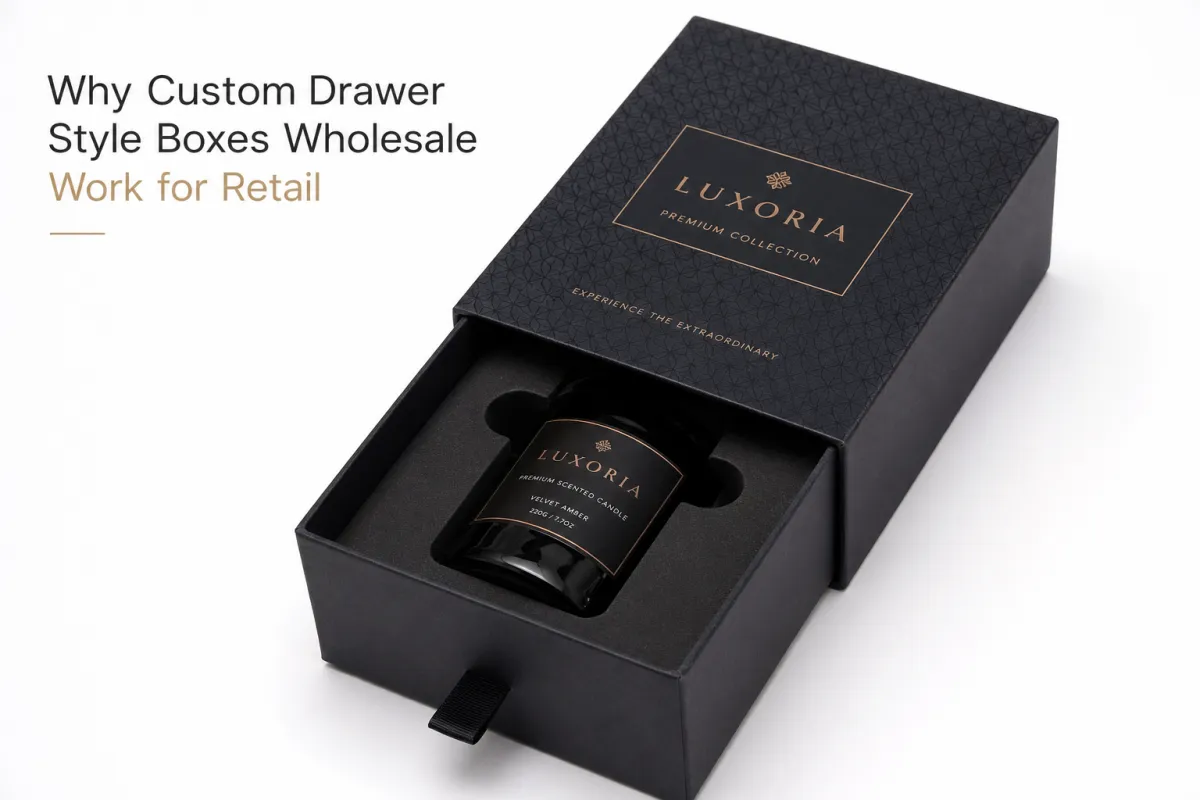
A drawer box changes the tempo of the reveal. That is the first reason custom drawer style boxes wholesale work so well in retail. A lift-off lid ends the story quickly; a sliding drawer makes the customer participate for a second or two longer. That small delay can make a product feel more considered before anyone has even seen what is inside. Packaging buyers know this instinctively. A slight pause often raises perceived value more effectively than louder graphics or more copy.
The format matters most for products where the package helps close the sale. Gift sets, skincare kits, watches, candles, premium chocolates, charging accessories, writing instruments, and compact apparel items all benefit from branded Packaging That Feels intentional on shelf and organized in hand. Custom drawer style boxes wholesale are especially effective when the item is small enough to sit securely in a tray but important enough to deserve a presentation that feels closer to a keepsake box than a shipping carton.
Function carries equal weight. The rigid outer sleeve gives the package structure, while the inner tray keeps the product centered and protected during shipping and repeated handling. That combination improves product packaging in a very concrete way. Less movement means fewer scuffs, fewer shifts, and a pack-out that warehouse teams can repeat without guesswork. I have watched buyers approve a beautiful prototype, only to reject the first production sample because the tray rubbed too hard against the sleeve. That kind of issue is boring on paper and annoying in real life, which is exactly why it matters.
The merchandising angle is strong, too. A drawer box keeps the graphics visible on the sleeve while the tray handles the hidden work. That leaves room for logo placement, seasonal copy, color blocking, or a restrained premium finish without drowning the design in clutter. For many buyers, custom drawer style boxes wholesale sit in the useful middle ground between basic folding cartons and luxury rigid cases that can outrun the product’s own price point.
Wholesale buying adds another advantage: the structure can travel across multiple campaigns. One footprint can accept different inserts, different colorways, or different SKU combinations while keeping the core style intact. That helps with package branding because the visual language stays recognizable even as the contents change. It also simplifies internal planning when marketing, operations, and procurement need a format they can all repeat without reopening the same debate every quarter.
Custom drawer style boxes wholesale are not right for every product. Tall bottles, irregular shapes, or items that need one-step access may work better in a different carton style. Still, for compact products that need a premium presentation, the drawer format offers a rare blend of show value and handling control. That is why it appears so often in retail packaging programs where appearance and repeatability both matter.
A good drawer box changes the first impression in seconds. The product stops feeling incidental and starts feeling chosen. That small shift is often the line between ordinary packaging and packaging that earns trust.
If you are comparing structural options, review the finish and the pack-out path together. A matching sleeve and tray only help if the box still closes cleanly, slides smoothly, and fits the packing line. For more structural options, see our Custom Packaging Products and the broader Wholesale Programs available for repeat buyers.
What Makes Custom Drawer Style Boxes Wholesale a Smart Choice for Premium Products?
Custom drawer style boxes wholesale work because they combine theater and utility in one format. The box looks elevated on a shelf, but it also behaves like a practical piece of packaging. That matters for premium products, where the buying decision often depends on whether the package feels as intentional as the item inside. A polished sleeve, a controlled sliding motion, and a snug tray can all signal quality before the customer reads a single line of copy.
This is exactly where the format stands apart from ordinary folding cartons. A standard carton opens and ends the story. A drawer structure creates a sequence. That sequence can make the unboxing feel slower and more memorable, which is useful in categories like skincare, candles, jewelry, stationery, and specialty gifts. For brands building an emotional connection, custom drawer style boxes wholesale become a form of product presentation packaging rather than just a container.
The format also works well for product lines that need a consistent visual system across SKUs. One drawer size can support different printed sleeves, limited-edition colorways, or seasonal graphics without changing the core structure. That efficiency is one reason buyers compare custom drawer style boxes wholesale with other rigid drawer boxes and sliding drawer packaging options. The style can carry a premium look while staying efficient enough for repeat ordering.
There is another subtle advantage. Because the drawer and sleeve are separate pieces, the structure gives designers more room to control contrast. A plain outer shell can hide a vivid internal tray. A metallic sleeve can frame a quiet insert. That kind of tension gives packaging a bit of personality without making it feel overworked, and that is often what premium brands are chasing.
Custom Drawer Style Boxes Wholesale: Product Details
At a structural level, custom drawer style boxes wholesale usually include three core parts: an outer sleeve, an inner drawer tray, and a pull feature that helps the user open the box. The sleeve is the visible shell. The tray holds the product. The pull can be a ribbon tab, a finger notch, a thumb cut, or another opening detail chosen for the product weight and the target look.
The sleeve does more than cover the tray. It controls the first visual impression and helps the box hold its shape. A tighter sleeve gives a more snug premium look, while a slightly looser sleeve can make opening easier for customers who need frequent access. In wholesale production, that tolerance matters because a drawer that binds too tightly creates frustration, while a drawer that slides too freely can feel flimsy or unsafe. Nobody wants a box that behaves like it was built by guesswork.
Several common drawer box formats show up across wholesale orders. A full-sleeve design hides most of the tray and delivers a cleaner premium presentation. A partial-sleeve design leaves more of the tray visible, which can improve ease of opening and reduce material usage. Matchbox-style construction is often chosen for compact products where the opening experience should feel familiar and controlled. Each format can work well in custom drawer style boxes wholesale, but the right choice depends on size, print budget, and the customer experience you want to create.
Printing and finishing shape the final character of the box more than many buyers expect. Full-coverage graphics create strong shelf impact, especially for branded packaging that needs to stand apart from neutral competitors. Spot color work can keep the job cost in a manageable range. Foil stamping, embossing, and debossing add tactile depth, though they should be used where the design benefits from them rather than because they are available. Matte lamination gives a softer premium look. Gloss lamination sharpens contrast and can intensify color. Soft-touch coating feels refined in hand, though it usually increases cost and can wear differently depending on handling.
For buyers comparing options for the first time, a simple test helps. Ask three questions: does the box protect the product, does it support the brand story, and does it pack efficiently? If the answer is yes to all three, the structure is probably doing its job. If one point fails, the design needs adjustment before production starts. That matters even more for custom drawer style boxes wholesale, because the drawer action reveals fit issues that a standard folding carton can hide.
There are times when this style is the wrong tool. Very tall products can create a deep tray that becomes harder to slide. Highly irregular items can move inside the cavity unless the insert is carefully engineered. Products that require quick access, such as some medical or industrial items, may need a box that opens in one motion rather than a sliding format. In those cases, a different retail packaging format is the smarter choice.
For teams comparing Custom Printed Boxes, the drawer style often occupies a useful middle zone. It feels more refined than a basic carton, but it does not carry the same presentation cost as a heavy clamshell or a luxury rigid case. That makes custom drawer style boxes wholesale a practical option for brands that want premium cues without overbuilding the package.
Materials, Inserts, and Build Specifications
The material stack is where many drawer box projects succeed or fail. For custom drawer style boxes wholesale, the outer shell is often built on rigid greyboard or chipboard, then wrapped with printed paper for the outer finish. Common rigid board thicknesses sit in the 1.5 mm to 2.0 mm range, though the right thickness depends on box size, product weight, and the look you want on shelf. Smaller boxes can use lighter board and still feel substantial. Larger sets may need thicker board to keep corners sharp and reduce flex during transport.
Wrap paper matters just as much. A clean art paper wrap can reproduce fine graphics and bright color, while specialty stocks can add texture and a more tactile feel. Some buyers prefer coated paper for sharper print fidelity. Others choose an uncoated or lightly textured wrap for a softer brand look. From a packaging design standpoint, the wrap should match the brand voice as well as the print process. A luxury fragrance line, for example, usually needs a different finish than a tech accessory kit.
Inside the box, the insert should be designed around the product first and the presentation second. A paperboard insert works well for simple separation and keeps weight low. A die-cut insert gives a tighter fit for items with defined edges or multiple components. Foam can protect delicate products, though it adds a different feel and may not fit every sustainability goal. Molded pulp has become more attractive for brands that want cushioning in a more fiber-based format. For custom drawer style boxes wholesale, the insert choice affects both unit price and how quickly warehouse teams can pack the order.
Sizing deserves careful attention. Product length, width, and height are the obvious numbers, but drawer boxes also need clearance for the slide action. A box that measures perfectly on paper can still feel wrong if the tray rubs too tightly against the sleeve. Tolerance matters, especially when the product includes a ribbon pull or a foam insert that compresses slightly under load. It is usually better to confirm the final fit with a sample than to assume the box will behave correctly on the first run.
For production planning, the following details should be locked before approval:
- Board thickness for the sleeve and tray, usually matched to product weight and rigidity needs.
- Insert type such as paperboard, foam, molded pulp, or die-cut support.
- Pull feature including ribbon, notch, or thumb cut.
- Surface finish such as matte lamination, gloss lamination, soft-touch coating, foil, embossing, or debossing.
- Clearance allowance so the drawer slides without scraping.
- Carton pack plan for storage, shipping, and retail restocking.
That last point gets missed often. If the finished box is elegant but the master carton loads poorly, the real cost of ownership rises. Better carton pack efficiency means less freight waste, easier warehouse handling, and fewer crushed corners in transit. For brands selling through both retail packaging and e-commerce channels, that practical detail can matter as much as the visual finish.
There are compliance and sustainability angles to keep in view. If you need shipping validation, many packaging teams reference transport testing practices from ISTA transport testing standards. If your brand wants documented fiber sourcing, paper-based components can be specified with FSC-certified materials. Those choices do not solve every packaging problem, but they help when a buyer needs documentation as well as appearance.
For brands with a broader packaging line, treat drawer boxes as part of the full product packaging system rather than a one-off decoration. When the insert, wrap paper, outer sleeve, and shipping carton are planned together, the result is usually cleaner, more durable, and easier to reorder. That is where custom drawer style boxes wholesale become especially useful: the structure can stay standard while the surface details shift for each SKU or campaign.
Custom Drawer Style Boxes Wholesale Pricing and MOQ
Pricing for custom drawer style boxes wholesale depends on several variables at once. Size is the first one, because larger boxes consume more board and more wrap paper. Board thickness changes cost as well. Finishing methods, insert complexity, print coverage, and order quantity all affect the final number. A small drawer box with a single-color print and a basic insert can land in a very different cost band than a large, fully wrapped box with foil, embossing, and a custom die-cut insert.
MOQ sits in the same conversation. Fully Custom Drawer Boxes usually start higher than stock packaging because the structure requires custom cutting, assembly, and setup. In many programs, a practical entry point lands around 500 to 1,000 units, though standardized dimensions and simpler graphics can sometimes support a lower threshold. If you are comparing suppliers for custom drawer style boxes wholesale, ask about MOQ at the same moment you ask about price. That keeps the quote honest and avoids surprise limits later.
Buyers should also compare quotes by total landed cost, not only unit price. Some vendors include tooling, sample charges, or inserts in the quoted number. Others separate those costs. Freight can change the picture too, especially if the boxes ship flat in master cartons versus assembled in smaller inner packs. A lower box price is not automatically the better deal if freight, proofing, or insert fees push the final amount higher.
| Order Range | Typical Build | Approximate Unit Price | Notes |
|---|---|---|---|
| 500-1,000 pcs | Rigid sleeve, single-color print, basic paperboard insert | $1.25-$2.10 | Best for first runs, test launches, or simpler branded packaging |
| 1,000-3,000 pcs | Full printed wrap, matte or gloss finish, die-cut insert | $0.88-$1.65 | Common balance point for custom printed boxes with controlled cost |
| 3,000-5,000 pcs | Expanded coverage, upgraded finish, optional foil or embossing | $0.62-$1.20 | Better scale efficiency when the design is fixed and reorder-ready |
| 5,000+ pcs | Repeatable spec, streamlined insert, optimized production flow | $0.48-$0.95 | Usually strongest pricing for stable SKUs and ongoing retail programs |
Those ranges are reference points, not promises. A box with a deep insert, heavier board, and a soft-touch plus foil finish will price differently from a simple presentation sleeve. If a supplier quotes far below the market range, ask what has been removed. Sometimes it is board thickness. Sometimes it is print coverage. Sometimes it is insert quality. The lowest quote is not always the best value, especially when you need consistent custom drawer style boxes wholesale for a retail launch.
There are several ways to control cost without weakening the package. Standardize the footprint across multiple SKUs. Use one insert style wherever possible. Cut down the number of print passes. Keep special finishes selective instead of covering every panel. Plan reorders around the same dimensions so tooling and setup can be reused. In practice, those decisions can trim meaningful cost from repeat runs while preserving the look that supports package branding.
For buyers building a program rather than a one-time shipment, custom drawer style boxes wholesale become easier to manage once the core spec is locked. Wholesale programs work best when the choices are measured instead of trying to make every component special. The design should feel premium, but the structure should stay efficient enough for the next reorder.
Order Process and Timeline for Wholesale Buyers
The smoothest custom drawer style boxes wholesale projects start with complete information. A factory can price a box more accurately when it has product dimensions, quantity, artwork files, finish preferences, insert requirements, and the delivery location upfront. Missing details slow the process and usually create revisions later, which is exactly what Wholesale Buyers Want to avoid.
A practical workflow usually begins with a quote request, followed by structural review and a digital mockup. If the artwork is straightforward and the dimensions are standard, that mockup may be enough to move into approval. If the product is delicate, or if the fit needs to be exact, a sample or prototype is worth the extra time. For custom drawer style boxes wholesale, that sample stage is often the fastest way to prevent a drawer that binds, a tray that rattles, or an insert that does not hold the product firmly enough.
After approval, production usually follows a clear sequence: printing, surface finishing, die cutting, tray assembly, insert fitting, quality inspection, and carton packing. That order matters because each step affects the next one. A registration problem caught after lamination costs more than one found on proof. A tray fit issue caught during sampling is far easier to solve than one discovered during packing. Good wholesale packaging programs are built around finding mistakes early.
Realistic timelines depend on complexity. A simple drawer box with standard artwork and no complicated inserts may move through proof approval and production faster than a high-finish set with foil, embossing, and custom die-cut supports. As a practical planning range, many projects land around 12 to 18 business days from proof approval to finished cartons, though that can stretch if the structure is intricate or if production queues are full. Freight time sits on top of that, and it should be counted early so the boxes arrive before the product launch or replenishment date.
For teams who want tighter schedule control, these checkpoints help:
- Confirm the dieline before artwork is finalized.
- Approve a physical sample whenever the product has a fragile edge, unusual shape, or tight insert fit.
- Decide whether the boxes ship flat, nested, or fully assembled.
- Build freight time into the launch calendar instead of treating it as an afterthought.
That process sounds basic, but it prevents a lot of pain on repeat wholesale orders. Clear approval steps reduce back-and-forth, and that helps when marketing teams want a polished result without missing the launch window. A well-managed order for custom drawer style boxes wholesale should feel orderly, not improvised.
One other detail deserves attention: inspection. Buyers should ask how the supplier checks slide resistance, corner alignment, print registration, glue lines, and insert fit. Those checks tell you whether the product packaging will hold up after it leaves the factory. If the drawer opens too sharply, the sleeve bows, or the insert shifts during transit, the customer notices immediately. That kind of issue weakens the premium effect the box is supposed to create.
For that reason, many packaging teams reference established testing or material standards when they plan transport and sourcing. It does not mean every box needs a formal lab program, but it does mean the order should be built with real handling in mind. That is the practical side of custom drawer style boxes wholesale: the box should look good, but it should also survive the way warehouses, freight carriers, and retail staff actually treat packaging.
Why Choose Our Packaging for Repeat Wholesale Orders
Repeat orders reward discipline. When a buyer comes back for another run of custom drawer style boxes wholesale, the biggest value is consistency. The box should open the same way, close the same way, and hold the same shape from one production batch to the next. That consistency protects the brand on shelf and keeps operations from dealing with unexpected fit or print differences.
Quality control on drawer boxes should focus on a few specific points. Slide resistance needs to feel smooth but not sloppy. Corner alignment should stay square. Print registration should hold around edges and folds. Glue lines should be clean, not messy or overfilled. The insert should keep the product centered without making removal awkward. These checks are not flashy, but they separate a package that looks premium from one that only looks expensive on paper.
Communication matters just as much as machinery. Buyers need clear dielines, straightforward artwork feedback, and honest guidance on material choices. That is true whether the order is part of branded packaging for a retail launch or a larger sourcing plan that includes multiple stock keeping units. When the packaging supplier reduces uncertainty, the project moves faster and the risk of avoidable revision drops.
Here is where wholesale buyers often save the most time: they standardize the core structure and let the graphics shift around it. That can mean one drawer size with multiple printed sleeves, one insert style across a line of accessories, or a shared outer format across seasonal collections. The result is a cleaner operation and a more coherent package branding system. It also makes custom drawer style boxes wholesale easier to forecast because the spec stays familiar.
If you are managing multiple launches, repeatability becomes a hidden profit center. The same dimensions make it easier to reorder. The same finish helps maintain visual consistency across batches. The same insert cut keeps the pack-out process stable. Those advantages are simple, and they are exactly why many buyers return to custom drawer style boxes wholesale after they have proven the structure on a first run.
There is also a credibility angle. A customer can usually tell whether a box was designed with care or patched together late in the process. Clean edges, a smooth drawer pull, and a snug product fit signal that the brand paid attention. That is not hype. It is how physical packaging works. People judge quality by touch long before they read a spec sheet, and drawer boxes are especially good at making that judgment feel positive.
For buyers building a long-term packaging program, the best supplier relationship is the one that keeps the spec stable while still helping improve it when needed. Maybe the first run uses one insert material and the next run shifts to molded pulp. Maybe the finish changes from gloss to matte to better suit the category. The point is not to reinvent the box every time. The point is to make custom drawer style boxes wholesale dependable enough that the team can focus on product growth instead of packaging corrections.
Next Steps Before You Request a Quote
Before requesting pricing for custom drawer style boxes wholesale, gather the facts that actually move the quote. You will need product measurements, target quantity, desired finish, insert needs, and any retail or shipping constraints that could affect the structure. If the product has a fragile surface, a magnetic closure, multiple components, or a tight fit requirement, mention that early. Those details shape the recommendation as much as the artwork does.
It also helps to compare two or three structural options before you settle. A full-sleeve drawer, a partial-sleeve version, and a matchbox-style layout may all work on paper, but they will not perform the same way in real use. One may offer stronger presentation. Another may pack more efficiently. Another may reduce cost enough to free budget for a better finish. That is the kind of tradeoff a good wholesale buyer should evaluate before ordering custom drawer style boxes wholesale.
Send artwork files as early as possible, even if the design is still being refined. Confirm the dieline before final print approval. Ask for a sample or prototype if the product is delicate or if the insert must hold an unusual shape. Verify the delivery schedule against your launch plan, because freight delays have a way of turning a good packaging job into a rushed one if nobody accounted for shipping time.
A practical quote request usually answers these questions:
- What product will the box hold?
- What are the exact dimensions, including clearance for the drawer?
- How many units are needed now and on reorder?
- Do you need inserts, and if so, what kind?
- Which finish fits the brand and the budget?
- Where does the finished order need to ship?
That information lets the factory price the job accurately and recommend the right build instead of guessing. It also makes it easier to compare suppliers fairly, because you are evaluating the same spec across each quote. For a buyer who needs dependable custom printed boxes, that is far better than shopping on price alone.
From a packaging buyer’s point of view, the best results come from clear specifications, realistic timing, and a structure that fits the actual product instead of forcing the product into an attractive but impractical box. That is the real value of custom drawer style boxes wholesale. The format gives you premium presentation, repeatable pack-out, and a cleaner customer experience, as long as the material stack and dimensions are chosen with care.
If you are ready to move forward, gather your measurements, finish preference, insert needs, and quantity target, then request a quote for custom drawer style boxes wholesale. A complete brief makes it easier to price, sample, and produce a box that supports the product, the schedule, and the brand without unnecessary back-and-forth.
Frequently Asked Questions
What is the minimum order for custom drawer style boxes wholesale?
Minimums vary by box size, board thickness, print complexity, and whether inserts or specialty finishes are included. In many cases, standardized dimensions and simpler print setups can start lower than highly customized builds. Ask for MOQ at the same time you request pricing so you can compare the per-unit cost against the total order commitment for custom drawer style boxes wholesale.
Can custom drawer style boxes wholesale orders include inserts?
Yes, inserts are common for products that need to stay centered, separated, or protected during shipping and display. Popular options include paperboard inserts, die-cut supports, foam, and molded pulp, depending on product weight and presentation goals. The insert should be designed around the product first, then adjusted for easy removal and clean packing.
How long do custom drawer style boxes wholesale orders take to produce?
Timeline depends on approval speed, structural complexity, finishing method, and order quantity. A simple build with quick proof approval moves faster than a box that needs inserts, special coatings, or extra sampling. Build in freight time so the cartons arrive before the product launch or replenishment date.
Which finish is best for custom drawer style boxes wholesale without adding too much cost?
Matte lamination or a clean gloss finish often gives a polished look without pushing the price as high as more elaborate decoration. Soft-touch, foil, and embossing can add strong premium value, but they should be used selectively when the budget allows. The best choice depends on whether the goal is shelf impact, tactile feel, or a balance of both.
Are custom drawer style boxes wholesale recyclable?
Paper-based rigid boxes can often be recyclable, but the answer depends on the board type, laminations, adhesives, and any added inserts. If sustainability matters, confirm the exact material stack so you know whether the box and its components are recyclable in your market. Paperboard inserts and molded fiber options usually make it easier to keep the package in a more recyclable material family.
What should I check before approving a sample?
Open and close the drawer several times, check whether the tray rubs the sleeve, confirm the product sits centered, and look closely at corners, print alignment, and glue lines. If the box is meant for retail display, hold it at arm’s length too; weak registration often shows up there first. That quick inspection saves a lot of trouble later, and honestly, it is one of the simplest ways to avoid a bad run.
Final takeaway: if you want custom drawer style boxes wholesale to work as a selling tool rather than just a pretty shell, lock the dimensions, slide clearance, insert material, and finish before you approve artwork. That four-point check is usually enough to keep the box looking premium, packing efficiently, and behaving the same way on every reorder.

