Buyer Fit Snapshot
| Best fit | Custom Eco Jewelry Boxes projects where brand print, material claims, artwork control, MOQ, and repeat-order consistency need to be specified before quoting. |
|---|---|
| Quote inputs | Share finished size, material target, print colors, finish, packing count, annual reorder estimate, ship-to region, and any compliance wording. |
| Proofing check | Approve dieline scale, logo placement, barcode or warning zones, color tolerance, closure strength, and carton packing before bulk production. |
| Main risk | Vague material claims, crowded artwork, missing packing details, or unclear freight terms can make a low unit price expensive after revisions. |
Fast answer: Custom Eco Jewelry Boxes: Board, Finish, Dieline, and Unit Cost should be specified like a repeatable production item. The safest quote records material, print method, finish, artwork proof, packing count, and reorder notes in one written spec.
Production checks before approval
Compare the actual filled-product size with the drawing, then confirm tolerance on folds, seals, hang holes, label areas, and retail display edges. Reserve space for logos, QR codes, warning copy, and material claims before decorative graphics fill the panel.
Quote comparison points
Review material grade, print process, finish, sampling route, tooling charges, carton quantity, and freight assumptions side by side. A quote is only useful when the supplier can repeat the same color, closure quality, and packing count on the next order.
Many jewelry brands still spend more paper, plastic, and ink on the box than on the piece inside it. That imbalance is one reason custom eco jewelry boxes have moved from a niche preference to a practical packaging choice. In one run, the box has to protect a fragile product, carry brand identity, and signal a sustainability stance without turning into a lecture. Small package, big responsibility.
Strong custom eco jewelry boxes are not about stripping away every feature until the package feels bare. The better versions use the right board, the right insert, the right print method, and the right finish so the box still feels premium while avoiding wasteful layers. Buyers notice that balance quickly because the package has to look polished on a shelf, survive parcel handling, and still fit inside a lower-waste packaging strategy. That is a harder brief than it sounds.
For brands building thoughtful branded packaging, the box is often the first physical proof that the company pays attention. A loose closure, an oversized insert, or a mix of materials that complicates recycling can blur the message in seconds. The cleaner path is more disciplined: clear structure, honest material choices, and a design that protects the jewelry without overcomplicating the story.
Custom Eco Jewelry Boxes: What They Are and Why They Matter
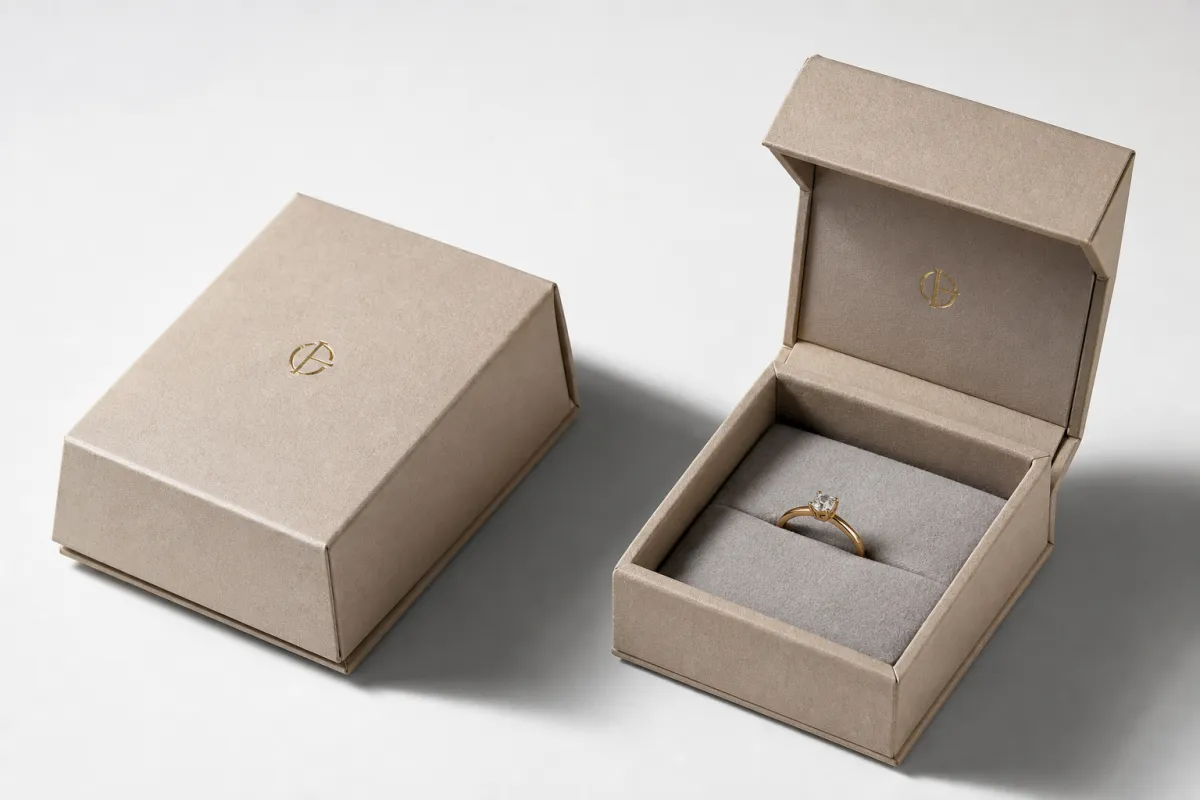
Custom eco jewelry boxes are branded packages made from recycled, recyclable, compostable, or responsibly sourced materials, sized to protect rings, earrings, necklaces, bracelets, and watches while cutting down on unnecessary waste. That sounds straightforward. The details decide whether the box deserves the eco label. A recycled paperboard carton with a well-fitted paper insert can perform beautifully. A box wrapped in mixed plastic film with a foam cradle may look refined, but it leaves the customer with a disposal puzzle.
Jewelry packaging is often larger than the item it carries. A pair of earrings can end up in a heavy rigid box with a bulky insert, a sleeve, tissue, and a closure system that feels more like ceremony than shipping. Custom eco jewelry boxes push back against that habit. They force a sharper question: what is the lightest, cleanest package that still protects the piece and feels worth opening?
That question matters because jewelry buyers read packaging fast. A ring box that opens cleanly, holds the ring centered, and uses FSC-certified paperboard or kraft paper can feel more intentional than a glossy package that tries too hard. In retail, the package is part of the product story. Handmade pieces, ethically sourced designs, and giftable collections all benefit from a box that speaks the same language.
There is a hard-edged reason to care too. Shipping damage, scuffed corners, and loose inserts cost money. Well-built custom eco jewelry boxes cut those losses by limiting movement inside the pack and resisting compression in transit. If the customer receives a clean box and an undamaged piece, the brand keeps both presentation and product intact. That matters for returns, reviews, and repeat orders.
Many buyers still treat "eco-friendly" as a synonym for thin or plain. That assumption misses the point. A sustainable box can still have crisp edges, a tight lid, a smooth opening action, and enough strength to survive distribution testing. If a package cannot protect the jewelry, it is not sustainable in any real sense because product loss and replacement waste wipe out the board savings. For that reason, custom eco jewelry boxes should be judged as a complete system, not as a material slogan.
As a working rule, good sustainable packaging needs to satisfy four conditions at once:
- It must protect the jewelry from crush, abrasion, and movement.
- It must present the brand clearly and consistently.
- It should use materials that are easy to recycle or responsibly sourced.
- It has to fit the production budget and the expected order volume.
That combination is why custom eco jewelry boxes have become a serious packaging design decision instead of a passing trend. Brands that want to build trust often find the box is the easiest place to prove the sustainability message is real. A buyer can feel the structure, see the material, and judge the finish in a few seconds.
For a wider view of structural and print options, many teams start by comparing the format against the rest of their product line in Custom Packaging Products. That keeps the jewelry box aligned with the full branded packaging system instead of leaving it as a one-off decision.
How Custom Eco Jewelry Boxes Work in Real Production
In production, custom eco jewelry boxes come together from a few core parts: the outer structure, the inner tray or insert, the print layer, and any surface finish. The box style usually gets chosen first because that choice drives cost and user experience. Rigid setup boxes create a premium feel and hold their shape well. Folding cartons are lighter, faster to ship, and usually better for higher volumes. Drawer styles add a deliberate reveal for gifting. Tuck-end cartons can work for simpler jewelry items, especially when the brand wants a compact form factor.
The right choice depends on the jewelry and the sales channel. A delicate necklace with a fine chain needs a cavity that prevents tangling and keeps the pendant centered. A ring needs a secure pocket that holds the band without pressing the stone against a hard edge. Earrings may need a slit, a card slot, or a molded recess. In all three cases, the insert does as much work as the outer box. Good custom eco jewelry boxes are built around that fit, not added to it later.
Fit tolerances matter more than many buyers expect. A box that is even a few millimeters too loose can let the jewelry shift during transit. Too tight, and the customer may damage the piece while opening it. I usually tell buyers to think in terms of controlled movement: the product should settle into the insert with light resistance, but it should not require force to remove. That matters even more for plated metals, polished stones, and delicate clasps, which scratch easily if the cavity is rough.
Material choice shapes the whole experience. Recycled paperboard works well for lighter cartons and inserts. Molded pulp gives structure without foam and can be a strong fit for nested trays or protective corners. Kraft board brings a natural visual tone that fits many sustainable brands. For premium rigid custom eco jewelry boxes, chipboard wrapped in paper or responsibly sourced paperboard can still feel substantial without plastic-heavy construction. The goal is not to make the box look green in an obvious way; the goal is to make it function like a thoughtful piece of product packaging.
Print and decoration should support the message rather than compete with it. Water-based inks and soy inks are common lower-impact choices. Reduced ink coverage often helps keep the package lighter and easier to recycle. Embossing and debossing can create a refined effect without adding extra layers. Blind emboss, in particular, can give package branding a tactile detail That Feels Premium without leaning on foil-heavy decoration. If foil is used, it should be used sparingly and only where it adds something real.
Many teams also choose to minimize lamination. A glossy plastic film can improve scuff resistance, but it can also make recycling harder. An aqueous coating or lightly varnished surface often gives enough protection for retail handling while staying closer to sustainability goals. That is one of the quieter strengths of custom eco jewelry boxes: they can look polished through structure and proportion rather than a stack of decorative layers.
A good eco box is not the lightest box. It is the box that protects the jewelry with the least waste and the fewest compromises.
Shipping-focused programs should test the package against real distribution conditions. Industry groups such as the ISTA publish test methods that simulate vibration, drop, and compression, and ASTM D4169 is often used to judge pack performance in transit. If the box is moving through parcel networks, a clean-looking mockup is not enough. Custom eco jewelry boxes should be checked under load, stacked, and dropped before the order gets approved. Otherwise you are basically guessing, and packaging rarely rewards guessing.
The best part is that one structure can often serve more than one channel. A well-built folding carton may work for retail display, e-commerce shipment, and gift presentation if the insert is tuned correctly. That gives brands more consistency across the line and reduces the need for separate packaging systems. In practice, that is where custom eco jewelry boxes start paying back the effort: fewer SKUs, cleaner assembly, and better alignment between brand, cost, and function.
Key Materials and Design Factors for Custom Eco Jewelry Boxes
The material conversation for custom eco jewelry boxes usually starts with paperboard, and that makes sense. Recycled paperboard and FSC-certified paperboard are widely available, familiar to converters, and suitable for many ring, earring, and pendant applications. FSC certification, tracked through the FSC system, gives brands a cleaner sourcing story when they need to show responsible fiber use. It does not make the box magical, but it does clarify the chain of custody behind the packaging.
Rigid board remains the go-to for a premium feel. Most rigid jewelry boxes use chipboard in the 1.5 mm to 2.5 mm range, then wrap or cover it with printed paper. That gives the package a solid hand feel and a precise opening action. Folding cartons often use paperboard in the 12 pt to 24 pt range, depending on product weight and the level of rigidity needed. For lighter earrings or slim chains, that is often enough. For heavier watches or gift sets, a sturdier build may be necessary. Custom eco jewelry boxes should match the weight of the jewelry, not the size of the marketing budget.
Insert design is where many programs either work well or get expensive quickly. A die-cut paper insert can hold a ring effectively if the slit width and depth are carefully controlled. Molded pulp trays are useful when the jewelry needs a formed cavity and the brand wants to avoid foam. Kraft cushions and folded fiber supports can work for necklaces, especially if the goal is to keep the chain flat and stop tangling. In some cases, a simple card insert with a slit is enough. The more custom the jewelry, the more likely the insert becomes the critical part of the package.
Surface texture does a lot of quiet work. Uncoated kraft gives an earthy, honest look. A matte paper wrap can feel refined without being glossy. Soft-touch finishes still exist in sustainable packaging, but they should be used carefully because not every soft-touch coating is equally easy to recycle. If a buyer wants the box to feel premium without leaning on plastic film, the better path is often a good substrate, crisp printing, and restrained use of spot details. That is one reason custom eco jewelry boxes can feel expensive even when the materials are simple: the quality comes from fit and finish, not just from shine.
Design factors also include logo placement and color contrast. Jewelry packaging often uses small canvases, so the logo has to be legible without taking over the front panel. A single-color mark, a debossed monogram, or a tight two-color layout can look stronger than a full flood of ink. Interior printing may be a nice touch, but it should not add so much coverage that the recycling story gets harder to explain. In many cases, less is more, especially if the product line already has a strong visual identity through the piece itself.
Durability still matters. Sustainable packaging has to handle shelf abrasion, storage humidity, and parcel compression. Jewelry boxes often sit in stock rooms for weeks, sometimes longer, before they are filled and shipped. If the paper wrap scuffs easily or the board warps with moisture, the brand ends up with inconsistent presentation. That is why custom eco jewelry boxes should be checked under real storage conditions, not only in a sample room. If a brand sells both retail and online, the box should survive handling in both environments.
For teams comparing options across the line, it helps to map the jewelry type, the channel, and the material into one decision grid. Some brands need a premium rigid box for signature pieces and a lighter carton for everyday items. Others want a single folding carton system across all products to simplify procurement. Either way, the box should follow the same package branding rules so the customer sees one family, not a random assortment of packaging design choices.
One more practical note: mixed-material structures can make recycling harder than many brands realize. A paperboard box with a large plastic window, a foam insert, and a laminated sleeve may look polished, but it does not behave like a straightforward paper-based package. If sustainability is part of the sales pitch, the materials should support that claim without asterisks. That is one of the clearest tests for custom eco jewelry boxes.
And here is the wrinkle that gets missed a lot: compostable only helps if the buyer actually has access to the right collection system. Industrial composting is not the same thing as a backyard bin, and the two get mixed up all the time. If a supplier uses that word, make them define the standard. Honest language beats vague green language every time.
Custom Eco Jewelry Boxes Process and Timeline
The production path for custom eco jewelry boxes usually starts with a brief, and the strongest briefs are specific. A supplier needs jewelry dimensions, item weight, target order quantity, the sales channel, and the brand goals before making a reliable recommendation. If the box is for a ring, the ring size matters. If the product is a necklace, chain length and clasp placement matter. If the item includes a stone or charm, the point of contact matters because that is where scuffing tends to happen.
After the brief, the supplier usually proposes a structure and a material set. That is the right moment to compare a rigid box with a folding carton, or a molded insert with a paperboard insert. The sample stage matters because jewelry packaging is unforgiving. A cavity that is 2 mm too shallow can lift the product. A slot that is too narrow can bend a chain. A lid that feels too tight can frustrate the customer. With custom eco jewelry boxes, those issues show up quickly once a sample is handled by real hands instead of viewed as a render.
Artwork setup comes next. This is usually where dielines are approved, logo placement is checked, and print coverage is reviewed against the chosen board. If the project uses a minimal palette, proofing is simpler. If it includes multiple printed panels, embossing, or a custom sleeve, the timeline can stretch. In most production runs, the order of work looks something like this:
- Product measurements and packaging brief
- Dieline or structure recommendation
- Artwork placement and proof review
- Sample or prototype approval
- Production scheduling and material purchase
- Printing, converting, and insert assembly
- Final inspection, packing, and shipment
Lead time depends on complexity. A simple recycled folding carton may move through the shop faster than a rigid box with a custom insert and multiple surface finishes. Tooling can affect timing too. If the box uses standard dimensions and off-the-shelf structures, production can often start sooner. If it needs special insert die-cuts, custom wraps, or special assembly steps, plan for a longer schedule. In many programs, the difference between a straightforward carton and a more elaborate custom eco jewelry boxes order can be a week or more, and sometimes longer if approvals drag.
From a buyer's point of view, the most useful question is not "How fast can you make it?" but "What step is most likely to slow it down?" The answer is often sampling, artwork revisions, or insert refinement. If the sample does not hold the jewelry properly, it is better to adjust the insert before full production. That extra round can save far more time than it costs because it prevents a bad run. The same is true for print proofing. A logo that sits too close to a fold or a closure tab may look fine on screen and wrong on board.
Quality checks should happen before the boxes leave the line. For custom eco jewelry boxes, I would want the supplier to inspect the board condition, the insert fit, the print alignment, and the closure action. If the package is going into retail and e-commerce at the same time, I would also ask for one more check on stacked compression and edge wear. Jewelry may be small, but the packaging still has to meet the same expectation of consistency that buyers have for larger Custom Printed Boxes.
Brands that order regularly often build a working calendar around production windows. That helps because jewelry launches, holiday gift sets, and promotional resets tend to cluster. If a packaging team knows the box needs sampling, revision, and final production, it can schedule around those steps instead of forcing last-minute approvals. That is one of the clearest ways to keep custom eco jewelry boxes from becoming a bottleneck.
Custom Eco Jewelry Boxes Cost, MOQ, and Pricing Drivers
Cost for custom eco jewelry boxes is shaped by structure, material, finish, insert design, and order quantity. Buyers often focus on the headline unit price, but that number only makes sense once setup, tooling, and labor are visible. A small change in closure style or insert complexity can move the price more than the print itself. If the quote is vague, ask for itemized components. That is the clearest way to compare apples to apples.
MOQ changes the unit economics quickly. Smaller runs carry more setup burden per box, which usually pushes the per-unit price higher. Once the order gets into a few thousand pieces, the price often drops because prepress, tooling, and machine setup are spread over more units. As a rough planning range, a simple folding carton for jewelry might land around $0.18 to $0.55 per unit at higher volumes, while a premium rigid box with an insert may sit closer to $0.90 to $2.40 or more depending on finish and assembly. Those are not fixed quotes, but they are realistic enough to help a buyer budget before requesting samples.
Here is a practical comparison that many teams use when evaluating custom eco jewelry boxes:
| Box Type | Typical Use | Approx. Unit Cost at Higher Volume | Sustainability Notes |
|---|---|---|---|
| Recycled folding carton | Earrings, slim pendants, lightweight pieces | $0.18-$0.55 | Often easiest to recycle if coatings stay light and materials stay paper-based |
| Rigid setup box | Rings, watches, gift sets, premium retail packaging | $0.90-$2.40 | Strong presentation; best when wraps, inserts, and finishes are kept disciplined |
| Drawer box with paper insert | Giftable jewelry collections and launch kits | $0.75-$2.10 | Good unboxing feel; watch material mix if sleeves or decorative wraps are added |
| Molded pulp tray system | Shipping-forward sets and lower-waste presentation | $0.30-$1.10 | Fiber-based inserts can reduce plastic content while keeping movement under control |
Those numbers shift with print coverage, tooling, and the number of components in the pack. A black flood coat, for example, can cost more than a single-color kraft look because it demands tighter control on ink coverage and scuff risk. A foil stamp can raise cost too, especially if the supplier needs special setup. On the other hand, simplifying the artwork and choosing a cleaner structure can lower the bill without making the package feel cheap. Some of the best custom eco jewelry boxes get their premium feel from restraint.
Assembly is another cost driver. If the box arrives flat and is easy to fold, labor stays lower. If each unit needs manual wrapping, insert placement, sleeve application, or specialty packing, labor rises quickly. That is why a smart packaging design can save money in places people do not always notice. A cleaner design may reduce the number of assembly steps, which helps keep branded packaging affordable over time.
The best value usually comes from the order that does three things well at once: it protects the jewelry, it presents the brand cleanly, and it avoids wasteful features. A box that prevents returns or damaged shipments can justify a higher unit cost much faster than a box that saves a few cents but creates customer complaints. For many brands, that is the real economics of custom eco jewelry boxes.
If a supplier offers several structures, ask them to quote each one with the same artwork assumptions. Then compare board thickness, insert material, print process, and packing method side by side. That makes it much easier to see whether the premium option is actually buying better performance or just adding decorative layers. A careful comparison like that is often more useful than the lowest number on the page.
For teams that want to explore broader packaging combinations, it can help to review Custom Packaging Products alongside the quote. That keeps the jewelry box decision connected to the rest of the product packaging line, which often reveals where standardization can save both money and time.
Common Mistakes to Avoid With Custom Eco Jewelry Boxes
The first mistake is choosing a package that looks eco-friendly but behaves badly in use. Mixed materials are usually the culprit. A paper box wrapped in heavy plastic film, paired with foam inserts and a plastic window, may look polished on day one, but it is not a clean sustainability story. Custom eco jewelry boxes should not make customers guess which part is recyclable and which part is not. If the package depends on a confusing mix of materials, the brand message gets weaker.
The second mistake is under-specifying the fit. Jewelry packaging is small, which makes people assume tolerances do not matter much. They do. A loose ring insert can let the ring rotate, which scratches the finish and makes the presentation look less precise. A necklace cavity that is too large can allow chain tangling. A pendant that sits off-center can make the whole package feel improvised. Good custom eco jewelry boxes are designed around the item geometry, not around a generic cavity size.
The third mistake is over-designing. It is easy to keep adding layers: a sleeve, a ribbon, a window, a foil logo, a soft-touch wrap, a foam pad, and a tissue insert. Each one may look appealing on its own. Put them together and they can weaken the sustainability message and push the cost beyond the value of the jewelry itself. For most brands, the smarter move is a simpler structure with better proportions and one or two meaningful details. That often produces a stronger result than a crowded package.
Sampling is another place where projects go wrong. Skipping the sample stage can be expensive, especially for delicate items. A lightweight chain may seem easy to package until it starts sliding around inside the insert. A narrow clasp may catch on a paper edge. A stone setting might rub the lid if the cavity height is not right. Custom eco jewelry boxes should be tested in the hand, not only viewed as a drawing. The difference between those two experiences is where many packaging problems show up.
There is also a trust issue around certifications and recycled content claims. If a supplier says the board is FSC-certified, ask how that is documented. If the box is described as recyclable, ask which parts are recyclable and whether any coatings or mixed inserts change that answer. If recycled content is part of the pitch, ask what percentage is actually in the board. Those questions are not nitpicking; they are how a buyer protects the brand from vague claims. EPA guidance on recycling systems can help teams sort out the difference between a claim and a practical disposal path.
One more common issue is forgetting the channel mix. A jewelry box that works beautifully on a boutique shelf may not survive parcel delivery without extra protection. A box designed only for shipping may feel too plain for premium retail display. Custom eco jewelry boxes should be judged against the real sales path: retail, gifting, e-commerce, or a combination of all three. If the box has to do more than one job, the design has to acknowledge that from the start.
For brands that sell both online and in store, I like to think in terms of failure points. Where can the box scuff? Where can the insert loosen? Where can the lid separate? If the answer is clear, the fix is usually clear too. Maybe the board needs a slightly thicker caliper. Maybe the insert needs a tighter die-cut. Maybe the print needs less coverage. Small corrections like that often do more for custom eco jewelry boxes than a complete redesign.
Expert Tips and Next Steps for Custom Eco Jewelry Boxes
Start with a packaging brief that gives the supplier real numbers. Send product dimensions, item weight, jewelry type, target quantity, brand colors, budget range, and delivery deadline. If the box is for a holiday gift set or a product launch, say so early. That helps the supplier recommend the right structure before the project gets locked into a poor path. In my experience, the best custom eco jewelry boxes come from clear input, not guesswork.
Ask for at least two structural options and two material options. Compare a recycled folding carton against a rigid setup box, or a paperboard insert against a molded pulp insert. That gives you a real view of how presentation, durability, and cost shift from one choice to the next. If the supplier can quote both, the decision gets easier. Many buyers are surprised by how close some options come in total cost once labor and assembly are included.
Always request a sample or prototype before full approval. Then test it the way a customer would:
- Open and close it several times to feel the closure strength.
- Shake it lightly to check for movement inside the insert.
- Inspect the jewelry for scuffs, bends, or rub marks.
- Drop-test the packed box from a realistic handling height if shipping is involved.
- Check the shelf look under store lighting and natural light.
If you need a formal performance benchmark for shipping, ask whether the pack should be evaluated against ISTA distribution methods or an ASTM-based procedure. That is especially useful for e-commerce. The point is not to make the packaging over-engineered; the point is to make sure the box survives the route it actually needs to travel. Custom eco jewelry boxes that pass a realistic test set are far more trustworthy than packaging that only looks good in a photo.
A simple decision matrix can keep the project grounded. Score each option on sustainability, presentation, protection, and price. Do not optimize only one column. A box that is ultra-low cost but damages product is not a savings. A box that looks beautiful but uses mixed materials and takes too long to assemble may not fit the business. The best choice usually lands in the middle, where the box does enough in each category without trying to do everything. That is where well-made custom eco jewelry boxes tend to live.
For teams building a broader packaging system, I also recommend reviewing the rest of the line so the jewelry package matches the brand's larger product packaging language. That can mean coordinating with shipping cartons, gift wrap, or display packaging so the customer sees one coherent story. If needed, explore the options in Custom Packaging Products and compare them against the jewelry box brief before final approval.
The strongest programs usually have one more thing in common: they respect the product. A ring, a pendant, or a watch is small, but the package still needs to protect the finish, hold the item in place, and make the moment of opening feel deliberate. That is the real job of custom eco jewelry boxes. Build around the item, the customer journey, and the brand story, and the packaging will support all three instead of competing with them.
Start the next round by locking three things first: fit, fiber, and function. If those are right, the print and finishing choices become much easier to judge, and the box stops being decoration with a lid. It becomes part of the product, which is exactly where it should be.
Frequently Asked Questions
What materials are best for custom eco jewelry boxes?
Recycled or FSC-certified paperboard is a strong starting point for most lightweight jewelry packaging. Molded pulp or fiber-based inserts work well when you want structure without plastic foam. Uncoated or lightly finished surfaces usually support recyclability better than heavy laminates, and they often fit the look of custom eco jewelry boxes naturally.
How do custom eco jewelry boxes stay premium without plastic?
Premium feel comes from structure, fit, and surface quality, not just glossy finishes. Tight insert design, clean edges, and restrained printing can make the box feel more intentional. Embossing, debossing, and texture can add value without relying on plastic-based decoration, which is one reason custom eco jewelry boxes can still feel upscale.
How much do custom eco jewelry boxes usually cost?
Price depends on box style, size, insert type, print coverage, and finish complexity. Smaller quantities usually cost more per unit because setup and tooling are spread across fewer boxes. A simpler structure with fewer coatings often lowers cost while still looking polished, especially for custom eco jewelry boxes built around paper-based materials.
How long does the custom eco jewelry boxes process take?
Timing usually includes briefing, sampling, approval, production, and shipping. Custom inserts or specialty finishing can extend the timeline, especially if tooling is needed. Supplying accurate dimensions and artwork early helps reduce avoidable delays, which is especially helpful on custom eco jewelry boxes orders with multiple components.
What should I send before requesting a quote for custom eco jewelry boxes?
Share product dimensions, jewelry type, target order quantity, and whether the box is for retail, gifting, or shipping. Include branding details like logo files, color goals, and any finish preferences. If you have a budget or deadline, send that too so the quote reflects realistic options for custom eco jewelry boxes.

