Buyer Fit Snapshot
| Best fit | custom electronics packaging boxes for packaging buyers comparing material specs, print proof, MOQ, unit cost, freight, and repeat-order risk where brand print, material, artwork control, and repeat-order consistency matter. |
|---|---|
| Quote inputs | Share finished size, material target, print colors, finish, packing count, annual reorder estimate, and delivery region. |
| Proofing check | Approve dieline scale, logo placement, barcode or warning zones, color tolerance, and any recyclable or compostable wording before bulk production. |
| Main risk | Vague material claims, crowded artwork, or missing packing details can create delays even when the unit price looks attractive. |
Fast answer: Custom Electronics Packaging Boxes: Design, Cost, Fit should be specified like a repeatable production item. The safest quote includes material, print method, finish, artwork proof, carton packing, and reorder notes in one written spec.
What to confirm before approving the packaging proof
Check the product dimensions against the actual filled item, not only the sales mockup. Ask for tolerance on folds, seals, hang holes, label areas, and retail display edges. If the package carries a logo, QR code, warning copy, or legal claim, reserve that space before decorative graphics fill the panel.
How to compare quotes without losing quality
Compare board or film grade, print process, finish, sampling route, tooling charges, carton quantity, and freight assumptions side by side. A lower quote is only useful if the supplier can repeat the same color, closure quality, and packing count on the next order.
Electronics rarely fail because they are naturally delicate. More often, they fail because custom electronics packaging boxes were treated like a shipping chore instead of part of the product itself. The device makes it through assembly, then gets hit with vibration, corner drops, compression, humidity changes, and rough unpacking. That is usually where the damage starts, and I’ve seen that pattern show up again and again in packaging reviews. A box built only to carry a SKU and a barcode is already asking for trouble.
custom electronics packaging boxes carry more responsibility than moving a product from one place to another. They manage shock, vibration, static, moisture, presentation, and the unboxing sequence as one connected system. That sounds demanding because it is. For a packaging buyer, the strongest solution is not always the most elaborate one; it is the one that lowers returns, keeps freight under control, and still feels purposeful in the hand.
A pair of headphones, a router, and a smart-home hub can share nearly the same outside dimensions and still need entirely different packaging inside. One product may need accessory separation, another may need anti-scratch restraint, and another may call for ESD-safe handling because a board is exposed. That is why custom electronics packaging boxes deserve the same attention as the device they hold. The aim is straightforward: define, price, and launch packaging that protects the product without paying for unnecessary layers.
Custom Electronics Packaging Boxes: Why They Matter
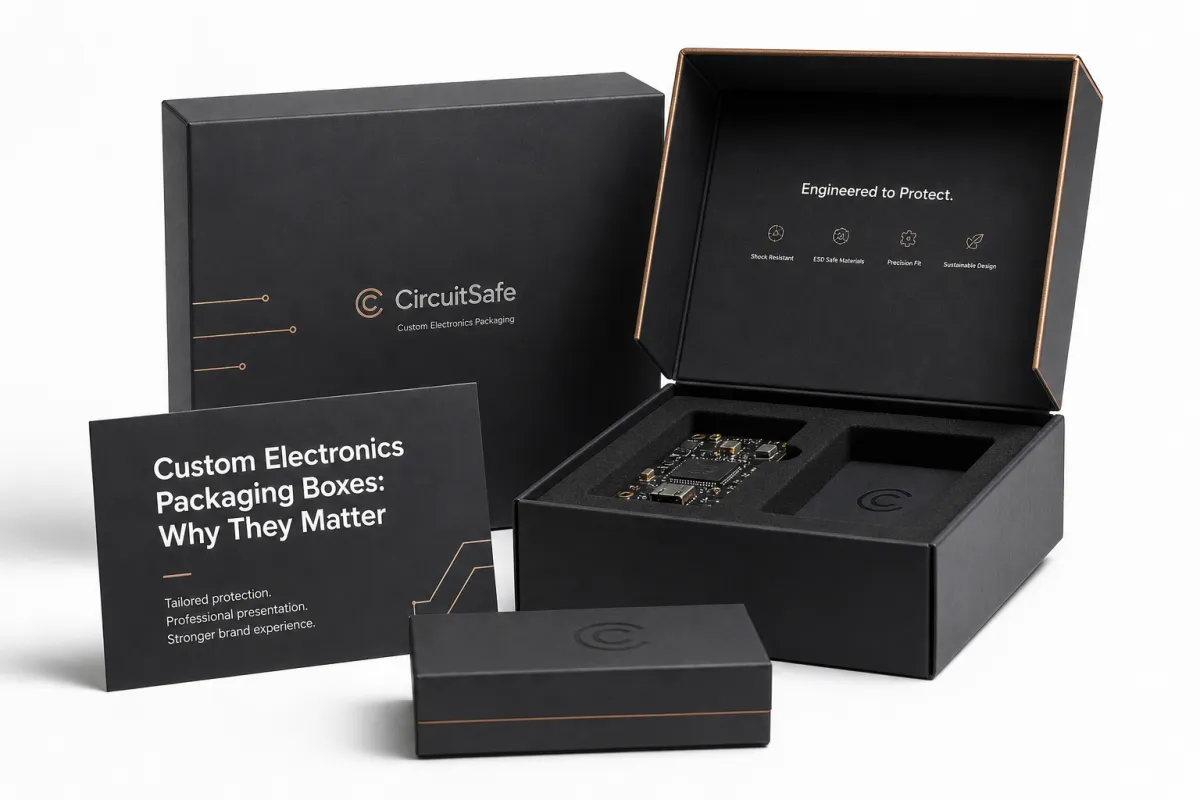
Many electronics arrive damaged for a reason that surprises teams the first time they see it: the packaging was built for shipping convenience rather than product behavior. A carton that looks fine on a shelf can still allow a charger to rattle loose, let a lens rub against a sleeve, or let a heavier item punch through a corner after a single drop. custom electronics packaging boxes are built to prevent those failures before they happen.
Think about damage in plain numbers. A 1% breakage rate on 20,000 units means 200 problems, and every one of those units can add replacement freight, support time, restocking work, and brand damage that is hard to chart but easy to feel. That is why custom electronics packaging boxes belong in the cost structure, not off to the side as a visual detail.
Generic cartons hold a product. Engineered packaging reduces failure risk. That difference matters more than many teams expect. A generic mailer can be the right answer for a cable or low-risk accessory, yet it is a poor choice for a tablet charger with sharp edges or a premium speaker with a glossy finish that scuffs easily. custom electronics packaging boxes match the structure to the product behavior instead of forcing the product to fit a generic shell.
Retail presentation matters too. Electronics buyers notice fit. They notice whether the device sits centered or floats in a cavity. They notice whether the insert holds accessories neatly or leaves them loose in a bag. Good branded packaging signals care before the device is even switched on. Bad packaging sends the opposite message.
A package that looks cheaper in a quote can become expensive after the first wave of returns. That is the sort of math that gets ignored until the damage report shows up.
That is why custom electronics packaging boxes need to be specified early. If the team waits until the artwork deadline, the choice usually becomes appearance or protection. A better path is to build both into the same brief and treat the box as part of the product experience from the start.
How Custom Electronics Packaging Boxes Are Built
Most custom electronics packaging boxes follow a layered structure. The outer box handles stacking, scuff resistance, and shipping stress. The inner insert keeps the device from moving. The cradle supports the product body. A separate compartment holds accessories, manuals, or power cords. A sleeve, tray, or lid then finishes the reveal. That stack can stay simple or become highly engineered, but the structure should always reflect the product's actual risk profile.
Form factor drives structure more than many teams expect. A slim wearable needs less vertical space, yet it may need tighter surface restraint so the finish does not wear. A power supply is heavier and needs stronger support at the base. A circuit board needs anti-static handling and a package path that keeps it from flexing during transit. custom electronics packaging boxes are built from the inside out.
Material choice is where the engineering becomes visible. Corrugated board is common for shipping strength, especially E-flute or B-flute when the pack needs more structure. Rigid Setup Boxes fit premium launches, giftable devices, and retail packaging that should feel elevated. Molded pulp offers recyclable protection with less plastic. Paperboard inserts work well for lighter items, while EVA foam or cross-linked foam can help with higher-risk products. Sensitive electronics may also call for anti-static materials or conductive layers.
Protection comes from a few simple mechanisms. Immobilization prevents movement. Cushioning absorbs impact. Surface treatments reduce abrasion. Static-safe materials lower risk for boards and chips. Moisture-resistant coatings or liners help when shipments move through humid routes or long storage cycles. custom electronics packaging boxes work best when those mechanisms are balanced instead of piled on blindly.
Graphics matter too, but they should never overwhelm the structure. Custom printed boxes can carry bold brand marks, product icons, setup instructions, and model-specific information. Package branding only helps if it does not interfere with venting, insert placement, or closure strength. Good packaging design makes the box feel intentional without making assembly harder or transit performance weaker.
For brands comparing structural options, the simplest way to think about it is this: the outer box is the body, the insert is the spine, and the finish is the handshake. All three need to work together. That is why custom electronics packaging boxes are not one material choice. They are a system.
Key Factors That Shape Performance and Cost
Weight, fragility, dimensions, and accessory count usually drive the biggest cost changes. Those four variables decide whether custom electronics packaging boxes can be built as a simple folding carton or need a stronger corrugated or rigid structure. A lightweight accessory kit may only need a printed carton with a fitted insert. A dense power brick or sensor hub may push the project toward heavier board, deeper reinforcement, and a more carefully designed closure.
Insert design is another major cost lever. Die-cut paperboard inserts are usually cheaper than molded pulp tooling for smaller runs, but molded pulp can become attractive if volume is high enough and the shape stays stable. Foam offers excellent restraint, yet it can increase freight costs and raise sustainability concerns. That tradeoff is real. The lowest material price does not always produce the lowest total package cost.
A packaging choice that saves a few cents per unit can cost far more if it raises returns by even a small fraction of a percent. If custom electronics packaging boxes reduce damage on a 10,000-unit run by just 50 units, the savings can outweigh a much larger material upgrade. The exact math depends on product value, labor, and replacement freight, but the pattern holds up.
Shipping method changes the equation too. Parcel shipping punishes corner crush and vibration. Freight shipments introduce pallet compression and stacking pressure. Retail distribution adds shelf handling, warehouse repacking, and display constraints. E-commerce packaging has to survive multiple touches, label application, and carrier sorting. A box that works in one channel can fail in another, so custom electronics packaging boxes should be tested against the actual route.
Sustainability is no longer a side topic. Many buyers now ask for recyclable board, FSC-certified paper sources, or reduced plastic content. If a device contains sensitive electronics, ESD-safe options still matter even when the outer structure is paper-based. For brands that want a credible material story, the Forest Stewardship Council and the U.S. EPA publish useful guidance on sourcing and recycling: FSC certification information and EPA recycling resources.
Pricing usually follows a few broad patterns. A simple folding carton can stay economical at scale. A rigid box raises the unit price but may reduce perceived risk for premium launches. Corrugated mailers tend to sit in the middle. Inserts, special finishes, and Custom Die Cuts add cost in small increments that become noticeable on larger runs. custom electronics packaging boxes should be priced as a complete system, not as a box with an afterthought insert.
| Structure | Typical Use | Approx. Unit Cost at 5,000 Pieces | Notes |
|---|---|---|---|
| Folding carton with paperboard insert | Light accessories, small devices | $0.22-$0.45 | Good for lower-weight items and simple retail packaging |
| Corrugated mailer with die-cut insert | DTC electronics, parcel shipping | $0.35-$0.80 | Stronger shipper profile; useful for mixed accessory kits |
| Rigid setup box with tray | Premium consumer electronics | $1.20-$3.50 | Better shelf feel and package branding; higher labor and material cost |
| Corrugated box with molded pulp insert | Heavier or sustainability-focused launches | $0.40-$1.10 | Strong protection and a cleaner recycling story |
The price spread above is wide for a reason. Print coverage, board grade, insert complexity, and order quantity can shift the quote more than the brand expects. A one-color logo on kraft board behaves very differently from full-bleed custom printed boxes with soft-touch lamination and foil accents. custom electronics packaging boxes should be quoted with every detail spelled out, or the comparison will mislead the team.
Testing standards matter here too. Many teams use ISTA protocols for transit simulation and refer to ASTM D4169 for broader distribution testing. If a pack has to survive parcel networks, those standards are useful filters, not marketing decoration. The point is not to impress a buyer with acronyms. The point is to prove the structure is ready before inventory is printed.
Custom Electronics Packaging Boxes: Step-by-Step Process and Timeline
The cleanest projects begin with a product audit. Measure the device, weigh it, list every accessory, and note fragile points such as buttons, lenses, screens, ports, or exposed boards. If the item shifts inside the box by more than a few millimeters, that movement needs to be designed out. That is the job of custom electronics packaging boxes, not a guess made during artwork review.
Next comes the structural concept. The packaging supplier drafts a dieline or a structural mock-up, often with a few options for insert style or opening method. At this point, the team should decide how the product is loaded, where the accessories sit, and what the customer sees first. That decision affects both presentation and assembly time. A good concept for custom electronics packaging boxes should be easy to describe in one sentence and easy to assemble on a line.
Prototype work usually moves faster than full production, but it still needs room for revision. A simple concept may go from brief to sample in a handful of business days if artwork and product data are ready. More complex structures can take longer because even a 2 mm fit change can alter the insert, closure, or packing sequence. This is often where timelines slip. It is rarely because the printer is slow. It is because the product and the box are not fully aligned yet.
Approval checkpoints are where a project either stays organized or loses a week. Teams should review dieline accuracy, insert fit, print proofing, finish samples, and assembly method before giving the go-ahead. If the company has multiple stakeholders, one person should own the final call. Otherwise, custom electronics packaging boxes get trapped in circular feedback: marketing wants more gloss, operations wants faster packing, and procurement wants a lower unit price.
Testing should happen before the order is locked. A sample pack can look polished on a desk and still fail in a real shipping scenario. The better approach is to test compression, drop behavior, and vibration with the product loaded exactly as it will ship. Many teams refer to ISTA testing guidance for this reason. If the unit needs anti-static support, verify that before bulk production, not after the first pallet arrives.
Timelines vary, but a typical path looks like this: 2-5 business days for concept and dieline work, another few days for sample building, then one or two rounds of adjustment, followed by proofing and production. Complex finishes or late artwork changes can stretch the schedule. custom electronics packaging boxes reward early decisions and punish last-minute redesigns.
One practical way to keep the process moving is to define what “good enough” means before sampling begins. Does the product need total immobilization, or is minor movement acceptable? Does the insert need to hold cables in fixed positions, or can they sit in a secondary pouch? Does the customer need a premium reveal, or is fast access more important? Those answers determine whether the final package is engineered for theater, efficiency, or both. Most of the time, it needs a little of each.
Common Mistakes That Raise Damage and Returns
The first mistake is designing only to exterior dimensions. A box can look correct from the outside and still leave the product loose inside, which invites corner crush, abrasion, and accessory scatter. With custom electronics packaging boxes, the internal geometry matters more than the measurements on a spreadsheet.
The second mistake is overusing foam or oversized inserts. Extra cushioning can improve protection, but it also adds material cost, bulk, and freight weight. It can make recycling harder too. Teams often reach for more padding because it feels safe, not because the product needs it. That habit can turn custom electronics packaging boxes into a cost problem rather than a protection solution.
The third mistake is skipping transit testing. A box can look polished in a conference room and still fail under drop, vibration, or compression. That is not theory. It happens when packaging design is judged by appearance alone. If the product ships through parcel carriers, test the actual lane. If it ships by freight, test stacking and pallet pressure. The box should survive the route it will actually travel.
Branding mistakes can be just as expensive. High-gloss finishes may scuff during warehouse handling. A confusing opening sequence can frustrate buyers and make accessory placement feel messy. Overdesigned interiors sometimes look impressive in mockups but slow down line assembly. Good package branding should clarify the experience, not complicate it. custom electronics packaging boxes have to carry the brand story and the protection logic at the same time.
Late-stage changes are another trap. A small tweak to the insert can alter tooling, print setup, carton sizing, and pallet counts. Suddenly the launch date moves because a 3 mm adjustment touched five other decisions. That is why custom electronics packaging boxes should be treated as part of the product plan, not a finishing task near the end.
Most packaging errors start with optimism. Teams assume the device is sturdy enough, the carrier will be gentle, or the customer will not care about the opening sequence. Reality is less forgiving. Electronics sell on emotion, but damage is mechanical. The box has to respect both.
Expert Tips for Better Fit, Branding, and Efficiency
Design from the product inward. That one habit solves a surprising number of problems. Start with the device, its accessories, its weak points, and its shipping path. Then choose the structure. If you build custom electronics packaging boxes from the shelf outward, you often end up with a beautiful package that is awkward to assemble and weak where it matters.
Use modular inserts when product families share a platform. If one model changes color or ships with a different cable, a modular tray can often absorb that difference without a full redesign. That lowers tooling churn and shortens future launches. For brands with multiple SKUs, modularity is one of the most practical ways to keep custom electronics packaging boxes under control.
Balance brand theater with engineering discipline. A strong unboxing moment is useful, but it should never depend on fragile folds, tiny tabs, or extra layers that slow the pack line. The best branded packaging feels intentional because the structure is clean, not because it is loaded with tricks. Good product packaging arrives intact and opens in a way that feels obvious once you see it.
If cost pressure is high, simplify where the customer will barely notice. Reduce print coverage instead of cutting the insert that prevents movement. Standardize board grades. Remove unnecessary sleeves. Choose one premium element and let the rest stay quiet. That is often a better path than making every surface expensive. custom electronics packaging boxes do not need ornate details to feel credible.
Small sample runs are worth the time. A run of 100 to 250 units can reveal fit issues, print inconsistencies, glue problems, and line bottlenecks before they become expensive. If the product is sensitive, one trial shipment can teach more than a week of debate. For custom electronics packaging boxes, a low-cost pilot often protects the budget that would otherwise be lost to rework.
Use clear handoff documents. Include product dimensions, weights, finish targets, accessory counts, loading sequence, and storage conditions. That document becomes the shared language between design, procurement, and production. It also reduces the chance that the final packaging design drifts away from the original intent.
What to Do Next: Sample, Test, and Launch
Start by measuring the product carefully and ranking the risks. Is it fragile? Heavy? Static-sensitive? Prone to cosmetic scuffing? Does it ship by parcel or freight? Those answers guide the structure before any quote is requested. If you are building custom electronics packaging boxes, the best first step is not artwork. It is product data.
Ask for a prototype or sample pack and test it the way the product will actually travel. Drop it. Stack it. Shake it. Load the accessories the same way every time. Open it with the same motion a customer or warehouse worker will use. That kind of practical testing exposes weak points fast. For electronics, the gap between a good idea and a usable pack is usually one round of real-world testing.
Compare at least two structure options before you commit. A corrugated mailer with a die-cut insert may beat a rigid box on freight and line speed. A rigid setup may win on shelf presence. A molded pulp hybrid may be the best compromise for sustainability and protection. Do not choose only on looks. custom electronics packaging boxes should be evaluated on protection, price, and presentation together.
Before launch, build a checklist that covers artwork approval, insert fit, packing instructions, line setup, and reorder triggers. If the packaging will be produced in a large run, confirm that the last sample truly matches the final spec. That final check saves a lot of pain later. If you need a starting point for structural planning, review Custom Packaging Products as part of the sourcing process.
custom electronics packaging boxes should be treated as part of the product itself, not a last-minute wrapper. That is the practical truth. The right pack lowers damage, supports brand perception, and keeps launch timing under control. The wrong one quietly taxes every order that follows. Get the fit, testing, and materials right, and custom electronics packaging boxes stop acting like a cost center and start acting like a control point.
The most useful next move is simple: lock the product measurements, define the shipping route, and sample one protective structure before you approve print. Do that, and the packaging decision gets a lot clearer, a lot faster, and a whole lot less expensive to fix later.
FAQs
What makes custom electronics packaging boxes different from standard boxes?
They are built around the product's exact weight, shape, fragility, and accessory count instead of a generic shipping size. Most include custom inserts, restraint features, or anti-static materials to reduce movement and impact. They can also improve presentation, which matters in retail packaging and direct-to-consumer launches.
How do I choose the right material for custom electronics packaging boxes?
Start with the risk profile. Heavy items usually need stronger corrugated structures, while premium or fragile devices may benefit from rigid box builds. Use anti-static or moisture-resistant options if the electronics are sensitive or the route is long. If sustainability matters, look at recyclable board or FSC-certified paper sources.
How much do custom electronics packaging boxes usually cost?
Pricing depends on dimensions, print coverage, insert complexity, material grade, and order quantity. Simple folding cartons are usually cheaper than rigid boxes with molded or die-cut inserts. The lowest quote is not always the lowest total cost once damage, returns, and replacement freight are included. These ranges are directional, not a substitute for an actual spec-based quote.
How long does it take to develop custom electronics packaging boxes?
A basic project can move from concept to sample quickly if the product specs and artwork are ready. More complex packs take longer because they need structural adjustments, proofing, and transit testing. Revisions usually add the most time, so early fit checks save the biggest delays.
What should I test before ordering custom electronics packaging boxes in bulk?
Test fit, drop resistance, compression strength, and whether accessories stay organized during movement. Check print quality, opening sequence, and whether the package can be assembled consistently on the line. If the device is sensitive, verify static control and moisture protection before approving production.

