Buyer Fit Snapshot
| Best fit | Custom Embossed Labels Wholesale for Premium Packaging projects where brand print, material claims, artwork control, MOQ, and repeat-order consistency need to be specified before quoting. |
|---|---|
| Quote inputs | Share finished size, material target, print colors, finish, packing count, annual reorder estimate, ship-to region, and any compliance wording. |
| Proofing check | Approve dieline scale, logo placement, barcode or warning zones, color tolerance, closure strength, and carton packing before bulk production. |
| Main risk | Vague material claims, crowded artwork, missing packing details, or unclear freight terms can make a low unit price expensive after revisions. |
Fast answer: Custom Embossed Labels Wholesale for Premium Packaging should be specified like a repeatable production item. The safest quote records material, print method, finish, artwork proof, packing count, and reorder notes in one written spec.
Production checks before approval
Compare the actual filled-product size with the drawing, then confirm tolerance on folds, seals, hang holes, label areas, and retail display edges. Reserve space for logos, QR codes, warning copy, and material claims before decorative graphics fill the panel.
Quote comparison points
Review material grade, print process, finish, sampling route, tooling charges, carton quantity, and freight assumptions side by side. A quote is only useful when the supplier can repeat the same color, closure quality, and packing count on the next order.
Custom embossed labels wholesale are one of the quickest ways to make plain packaging feel intentional. Texture gets noticed before copy does, and on a crowded shelf that tactile cue often does more work than another line of marketing text ever could. A raised mark catches the eye, then the hand. That sequence matters because buying decisions rarely happen in a straight line.
Embossing does not rescue a weak concept. It gives a strong one more presence. The right label structure can make a bottle, jar, carton, or tin look considered instead of generic. For brands building premium retail packaging, the effect is practical as much as visual: better shelf presence, stronger recall, and a more expensive first impression without rebuilding the entire container.
Buyers searching for custom embossed labels wholesale usually want two things at once: a premium finish and a production plan that does not create headaches later. Fair request. This guide breaks down what embossing is, what drives pricing, how wholesale minimums usually work, and how to specify labels that apply cleanly on real packaging, not just on a polished mockup.
Why Custom Embossed Labels Wholesale Stand Out on Shelf
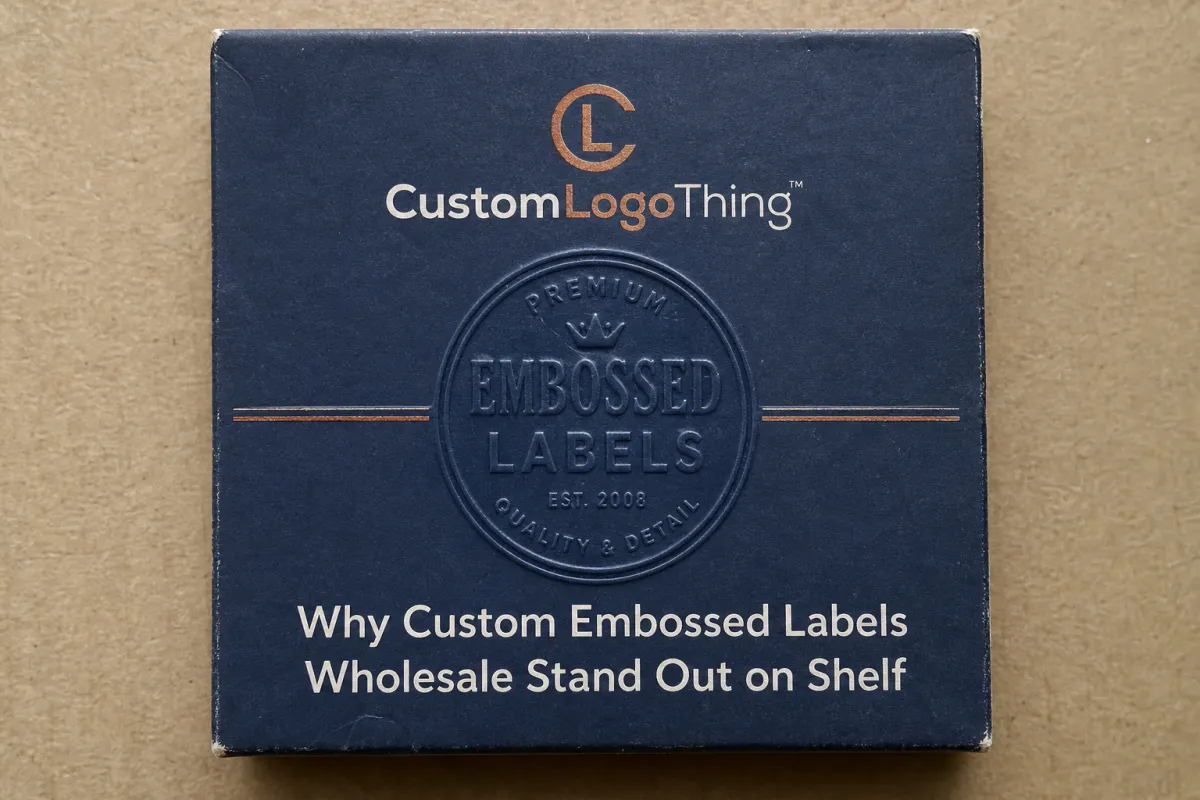
Most shoppers do not read packaging first. They touch it, glance at it, then decide whether it feels credible. A clean embossed label can outperform a louder printed design for that reason alone. Raised type, a pressed logo, or a textured border gives both the eye and the hand something to register immediately.
From a packaging buyer’s point of view, embossing adds perceived value without forcing a full redesign. A standard bottle label can feel more premium with the right texture. A plain folding carton can look more deliberate with a raised mark. Even a candle jar or a gourmet food jar can move up a shelf class with a well-planned emboss. That matters in branded packaging, where customers often judge quality before they try the product.
Beauty, spirits, candles, stationery, specialty food, and boutique retail packaging are strong fits. Those categories benefit from tactile detail because the package itself is part of the sales pitch. By contrast, a design that is already busy, heavily illustrated, or packed with copy can bury the effect. Texture needs breathing room. It is not a fix for clutter.
There is also a memory effect that buyers sometimes underestimate. A raised logo or symbol gives customers a physical cue to remember. That sounds subtle until you watch how people handle products in a store. A longer pause at the shelf often changes the outcome. In retail, pauses sell.
“If the label looks expensive but falls apart on application, it is not premium. It is expensive-looking waste.”
The strongest embossed labels are planned with the container and finish in mind. That is true whether the order is for product packaging, Custom Printed Boxes, or a coordinated launch across multiple SKUs. Texture, adhesive, material, and application method all need to work together. Miss that, and the result is usually a label that looks fine in a PDF and disappointing in a warehouse.
Product Details: What Counts as an Embossed Label
An embossed label is made by pressing selected areas of the stock with matched tooling so parts of the artwork rise above the surface. The effect may be subtle or pronounced. Some brands want a gentle press on a logo. Others want a more obvious relief that catches light and shadow. The best choice depends on the material, the artwork, and the way the label will be applied.
There are several common build styles, and they are not interchangeable:
- Blind emboss - raised texture without foil or ink contrast in the embossed area.
- Registered emboss - the emboss aligns with printed artwork so the raised detail supports the design.
- Foil emboss - foil and emboss are combined for a more reflective, luxury finish.
- Multi-layer labels - a more complex build using print, foil, texture, and sometimes lamination for depth.
Blind emboss is usually the most restrained option. It works well for minimal package branding where shape and shadow do the heavy lifting. Registered emboss is more common when the logo needs both color and physical dimension. Foil emboss costs more, but it creates stronger contrast on shelf. Multi-layer builds are for brands that want texture and visual richness, not just a raised mark.
Labels also come in different application formats. Roll labels are the usual choice for automated or semi-automated application lines. Sheet labels fit hand application, smaller runs, or teams labeling in-house. Custom die-cut shapes are useful for irregular bottles, cartons, tins, and jars, especially where the border needs to feel intentional rather than generic.
What the buyer is actually ordering is more than a printed sticker. A proper emboss job includes artwork prep, dieline confirmation, material choice, adhesive selection, print method, and tooling. If one piece is vague, the final result can drift fast.
For brands managing coordinated launches, embossed labels often sit beside other branded packaging pieces: Custom Printed Boxes, inserts, hang tags, sleeves, and secondary cartons. Consistency matters here. If the label feels luxe but the carton feels cheap, package branding starts to split into two stories. Customers notice the mismatch, even if they never say it out loud.
Common label build choices
Here is the short version buyers usually need:
- Paper stock for dry, indoor, or lower-cost applications where texture matters more than moisture resistance.
- Film stock for bottles, jars, and products exposed to moisture, refrigeration, or repeated handling.
- Pressure-sensitive labels for faster application and cleaner wholesale handling.
- Specialty finishes like soft-touch, matte, gloss, or metallic foil when shelf impact matters.
That combination sounds simple. It rarely is. The right build depends on how the label behaves after it leaves the press and enters the real world.
Specifications That Affect Finish, Durability, and Fit
This is the part many buyers rush. Bad move. A label can look excellent in a sample and still fail on the line if the size, adhesive, or stock is wrong. With embossed work, the smallest design or setup mistake tends to show up more clearly because the texture catches light and shadow.
The core specs to lock down are straightforward:
- Label size - exact width and height, not a rough estimate from a mockup.
- Corner radius - sharp corners can lift; rounded corners often hold better.
- Emboss depth - subtle, moderate, or strong relief depending on stock and detail.
- Stock thickness - paper and film behave differently under pressure.
- Adhesive strength - standard, high-tack, permanent, or removable.
- Finish - matte, gloss, soft-touch, uncoated, foil, or laminate.
Emboss depth matters more than most people expect. A raised area that is too shallow can disappear under certain finishes. Go too deep, and fine text can distort or crack the surface. For many labels, a modest emboss in the range of about 0.3 mm to 0.8 mm creates a premium feel without risking legibility. That range is not universal. Small logos, soft stocks, and film labels may need a lighter touch, and very fine line work often needs extra caution.
Durability depends less on the word “embossed” and more on the substrate and adhesive under it. A label on glass in a dry room behaves differently from a label on a plastic bottle that moves through refrigeration, condensation, and repeated handling. A paper label that looks rich on a carton may fail on a cold beverage bottle. A film label that performs well on a jar may be overkill on a shelf-stable cosmetic box. The structure has to match the use case, not the mood board.
For brands concerned with transit stress, it helps to check packaging against recognized testing standards. ISTA transit testing standards are a useful reference if your labels will travel through distribution, warehousing, and seasonal temperature swings. If the label also needs to support sustainability goals, FSC-certified paper is often worth considering for paper-based builds. Those credentials do not make a bad spec good, but they do make a responsible spec easier to defend.
Artwork matters just as much as material. Tiny type, thin lines, and busy details can turn muddy once the emboss is added. Safe zones should be generous. Logos need enough stroke weight to survive both print and pressure. Registration tolerance matters too, especially on foil emboss work where alignment between artwork and texture is unforgiving.
If the design includes custom printed boxes or other coordinated packaging pieces, keep the visual system simple enough to carry across formats. The same logo treatment, similar finish family, and coordinated color behavior make the whole package feel planned. That is package branding, not decoration for its own sake.
Custom Embossed Labels Wholesale Pricing, MOQ, and Quote Basics
Pricing for custom embossed labels wholesale is driven by a few predictable factors: material, size, emboss complexity, foil coverage, number of print colors, finishing steps, tooling, and order quantity. Remove one variable and the price usually changes. Add one and it often changes again. That is not a trick. It is production economics.
Tooling is one of the first cost items buyers should expect. A simple emboss die may be relatively modest, while a larger or more detailed tool costs more. In wholesale work, tooling is usually a one-time or low-frequency setup cost spread across the run. That is why small orders carry a higher unit price. The setup does not care how many labels you bought.
As a rough buying reference, many embossed label projects land in these ranges, depending on quantity and finish complexity:
| Label Type | Typical Setup Complexity | Rough Wholesale Impact at 5,000 Units | Best Use |
|---|---|---|---|
| Blind emboss | Lower | Often adds about $0.02-$0.06 per label | Minimal branding, subtle texture |
| Registered emboss | Medium | Often adds about $0.04-$0.10 per label | Logos that need both print and texture |
| Foil emboss | Higher | Often adds about $0.06-$0.15 per label | Luxury retail packaging, spirits, beauty |
| Multi-layer build | Highest | Can run $0.10-$0.25+ per label | Premium launches and high-visibility packaging |
Those are not promises. They are practical buying ranges. Size, coverage, shape, and material can move them in either direction. A small label with a lot of finishing can cost more than a larger one with a simpler build. A clean one-color design can still cost more if the emboss is tight and detailed.
MOQ usually follows the same logic. Many wholesale label runs start around 1,000 to 5,000 pieces, but that depends on the construction. Sheet labels can sometimes start lower. Roll labels often need a higher run to make setup worthwhile. If you are testing a new product, ask for the lowest quantity break and a second break above it. That shows where the unit cost starts to improve and whether the larger run is actually worth the storage space.
Here is the price trap most buyers miss: the cheapest line item is not always the cheapest job. A low quote with weak adhesive, poor registration, or a finish that cracks on application can cost more once reprints, delays, and packaging labor are added. A better quote is the one that fits the real use case and avoids hidden costs later.
Quote requests should include the basics in one clean brief:
- Exact label dimensions or dieline.
- Quantity and target reorder plan.
- Material preference: paper or film.
- Emboss style: blind, registered, foil, or layered.
- Application method: hand-applied or machine-applied.
- Exposure risk: moisture, refrigeration, abrasion, or shipping.
- Artwork status: final file, draft, or concept only.
Rush timing, last-minute artwork changes, and special adhesives can inflate cost quickly. If the spec is loose, the quote is not really a quote. It is a guess dressed up as one.
If you are comparing wholesale options across multiple categories, it also helps to think about the broader package stack. Labels are one part of the system, not the whole system. The same order may need matching inserts, cartons, or secondary presentation pieces from Custom Packaging Products, especially if you want the label finish to match the rest of the pack.
Process, Timeline, and Lead Time for Wholesale Orders
Embossed label production has more steps than a standard print job. That is normal. The workflow usually moves through brief intake, artwork review, dieline confirmation, proofing, tooling setup, sample approval, production, finishing, inspection, and shipping. If the job is organized, those steps feel boring. Boring production is usually accurate production.
A realistic lead time for custom embossed labels wholesale is often in the 12 to 20 business day range after proof approval, with more complex foil or multi-layer jobs taking longer. Some simpler runs can move faster. Some detailed jobs take much longer. The timeline depends on artwork quality, whether tooling already exists, and how quickly the buyer approves the proof. A one-day delay at the proof stage can create a chain reaction that reaches freight.
The fastest jobs usually share the same traits:
- Vector artwork is clean and complete.
- Dieline dimensions are confirmed before quoting.
- The stock choice is settled early.
- One person makes the final approval call.
- The label shape is simple enough to produce without unnecessary revisions.
The slow jobs usually share the opposite traits. Files are missing. Measurements are “close enough.” The emboss line is too fine for the stock. Two stakeholders want different finishes. Then everyone is surprised that the schedule slipped. The press was not the problem. The brief was.
If you need the labels for a launch date, seasonal reset, or coordinated retail packaging rollout, build in time for proofing. A label proof is not a formality. It is the checkpoint that catches scale issues, registration problems, and texture decisions that would be expensive to fix after production starts. A good proof can save a bad run.
For buyer planning, this is the practical sequence:
- Brief - define size, stock, quantity, and application method.
- Review - check artwork and clarify the emboss area.
- Proof - confirm the look before tooling is committed.
- Production - run the labels with the approved spec.
- Inspection - verify registration, finish, and adhesion.
- Delivery - ship with the timing your inventory actually needs.
That sequence is especially useful for brands handling multiple SKUs or multiple packaging formats at once. A good wholesale partner can keep the label and the broader package branding aligned across jars, bottles, cartons, and other branded packaging elements. That matters more than most people admit because inconsistency is usually what makes a line look less expensive than it should.
Why Choose Us for Custom Embossed Labels Wholesale
Some suppliers sell the idea of premium. We prefer to sell the result. That means direct answers about whether a design will emboss well, what material will hold up, and where the cost will land if you choose a certain finish. It also means saying no when a spec is fighting itself. Not every logo should be embossed. Not every stock should be pushed into a luxury treatment. Sometimes the smarter label is simpler, not fancier.
For wholesale buyers, the useful advantage is clarity. You want stable pricing, repeatable tooling, and production advice that reduces risk instead of adding jargon. That is especially true if the labels need to match other packaging assets like cartons, sleeves, or branded inserts. A clean production plan saves time across the whole project, not just on the label line.
Here is where a good wholesale program matters:
- Spec guidance - matching emboss style, adhesive, and stock to the real use case.
- Artwork checks - catching thin lines, small type, or registration risks before press time.
- Material options - paper, film, matte, gloss, soft-touch, and foil choices that fit the brief.
- Sample support - proofing or sample runs for detailed artwork and premium finishes.
- Wholesale consistency - keeping reorder quality steady across future runs.
That is useful whether you are launching a beauty line, a candle collection, a gourmet product, or a boutique retail item. The label has to look expensive, yes, but it also has to apply cleanly and survive normal handling. A premium finish that peels on day two is not premium. It is a refund waiting to happen.
If you are still building the package system, our Custom Labels & Tags page is a practical starting point for comparing formats. If you need broader sourcing support, Wholesale Programs are a better fit for planning repeat orders and coordinating production across a product line. For brands rolling out a larger family of items, that kind of structure matters.
We also pay attention to the problems buyers complain about later: labels that are hard to apply, finishes that scuff too easily, artwork that looked fine on screen but failed under texture, and adhesives chosen by guesswork. That may sound obvious. It is remarkable how often it gets ignored.
The goal is simple. Your labels should arrive ready to use, match the visual direction of the product packaging, and hold up in real handling conditions. If they do that, the wholesale order did its job.
Next Steps: Build the Right Spec Before You Request a Quote
The cleanest quote starts with a clean brief. Measure the final package, not the concept art. A mockup can hide fit problems that become very real once the label hits a bottle shoulder, a jar curve, or a carton flap. Exact dimensions save time. Guessing burns it.
Before you ask for pricing, gather the pieces below in one place:
- Final label size and shape.
- Estimated quantity and reorder expectation.
- Preferred surface: paper, film, or specialty stock.
- Emboss style and whether foil is part of the build.
- Application method and packaging surface.
- Exposure conditions like moisture, refrigeration, or abrasion.
- Artwork file status and any print constraints.
If the design is complex, ask for a sample or proof plan before full production. That is not hesitation. That is smart buying. Raised detail can change how a logo reads, especially on smaller labels or packaging with limited print space. A quick proof review is cheaper than reprinting a bad batch.
It also helps to compare two or three quantity breaks. A 1,000-piece price tells one story. A 5,000-piece price tells another. Sometimes the per-unit drop is enough to justify a larger run. Sometimes it is not. The point is to make the inventory decision with real numbers, not hope.
If you are coordinating the labels with other packaging elements, keep the system together. Matching paper tone, foil color, and finish level across labels, cartons, and presentation pieces makes the whole product line feel deliberate. That is how package branding holds together across the shelf and the unboxing moment.
For brands building a broader launch, it is smart to review labels alongside the rest of the pack instead of treating them as a separate purchase. A coordinated order across product packaging, retail packaging, and any companion Custom Packaging Products usually produces a better result than piecing everything together after the fact.
If you are ready to buy, keep the brief specific and realistic. Start with size, substrate, adhesive, emboss style, and application method. Those five choices shape almost everything else. Get them right, and custom embossed labels wholesale become easier to price, easier to produce, and far more likely to look like the premium packaging you intended in the first place.
What affects the price of custom embossed labels wholesale?
Material choice, emboss depth, foil coverage, label size, and quantity are the biggest cost drivers. Tooling and setup raise the first-order cost, while larger runs usually lower the unit price. Special adhesives, rush timing, and premium finishes can push the quote up fast, so the spec needs to be tight before pricing starts. If a vendor cannot explain those variables clearly, the quote is not ready yet.
What is the usual MOQ for embossed label wholesale orders?
MOQ depends on tooling, size, and whether the labels are roll-fed or sheeted. Smaller orders are possible, but the unit cost is usually higher because setup is spread across fewer labels. If you are testing a new product, ask for the lowest quantity break first and compare it to the next break before you scale. That comparison often shows whether the premium finish is still economical at launch volume.
How long does production take for custom embossed labels wholesale?
Lead time usually includes artwork review, proof approval, tooling, production, finishing, and shipping. Simple jobs move faster; detailed embossing or foil combinations take longer. Fast approval from the buyer is often the difference between a smooth schedule and a delayed shipment, so do not let the proof sit in someone’s inbox for three days. A clean approval path is one of the easiest ways to protect timing.
Can embossed labels work on bottles, jars, and cartons?
Yes, but the adhesive and stock need to match the surface and the use case. Glass, coated cartons, and plastic all behave differently, especially in cold or humid environments. Application method matters too, since roll labels and hand-applied labels do not always perform the same way on curved or textured packaging. The best choice is the one that survives the real environment, not just the sample table.
What artwork should I prepare for custom embossed labels wholesale?
Use vector files whenever possible and confirm the final dieline before production. Keep fine text and thin strokes conservative because embossing can exaggerate weak design elements. If the design uses foil or multiple finishes, separate the layers clearly so the proof stage stays clean and the job does not turn into a guessing contest. That is the cleanest way to order custom embossed labels wholesale without paying for avoidable revisions. A well-prepared file package usually saves more time than a rushed follow-up ever will.

