Buyer Fit Snapshot
| Best fit | Custom Fabric Pouches with Logo projects where brand print, material claims, artwork control, MOQ, and repeat-order consistency need to be specified before quoting. |
|---|---|
| Quote inputs | Share finished size, material target, print colors, finish, packing count, annual reorder estimate, ship-to region, and any compliance wording. |
| Proofing check | Approve dieline scale, logo placement, barcode or warning zones, color tolerance, closure strength, and carton packing before bulk production. |
| Main risk | Vague material claims, crowded artwork, missing packing details, or unclear freight terms can make a low unit price expensive after revisions. |
Fast answer: Custom Fabric Pouches with Logo: Film, Print, MOQ, and Carton Packing should be specified like a repeatable production item. The safest quote records material, print method, finish, artwork proof, packing count, and reorder notes in one written spec.
Production checks before approval
Compare the actual filled-product size with the drawing, then confirm tolerance on folds, seals, hang holes, label areas, and retail display edges. Reserve space for logos, QR codes, warning copy, and material claims before decorative graphics fill the panel.
Quote comparison points
Review material grade, print process, finish, sampling route, tooling charges, carton quantity, and freight assumptions side by side. A quote is only useful when the supplier can repeat the same color, closure quality, and packing count on the next order.
Custom fabric Pouches With Logo do something most packaging formats cannot pull off: they keep working after the product is gone. A customer may finish the candle, wear the jewelry, or unpack the accessory, and the pouch still hangs around in a drawer, travel kit, jewelry box, or retail display. That kind of long tail matters because every reuse gives the brand another quiet reminder without asking for another purchase. For a lot of companies, that is the real value of custom fabric pouches with logo. They are not just a finishing touch. They are a piece of branded packaging that can shape how the product feels, how the price is perceived, and whether the brand seems thoughtful or forgettable.
From a packaging buyer’s point of view, the decision is never only about looks. The pouch has to fit the item, survive shipping, support the unboxing moment, and stay inside budget. Sometimes it replaces a rigid carton. Sometimes it works alongside custom printed boxes or a broader retail packaging system. Sometimes it ends up doing all of that at once. The strongest results usually come from treating custom fabric pouches with logo as part of the full packaging plan, not as an extra that got added when the budget was almost done.
What Are Custom Fabric Pouches With Logo?
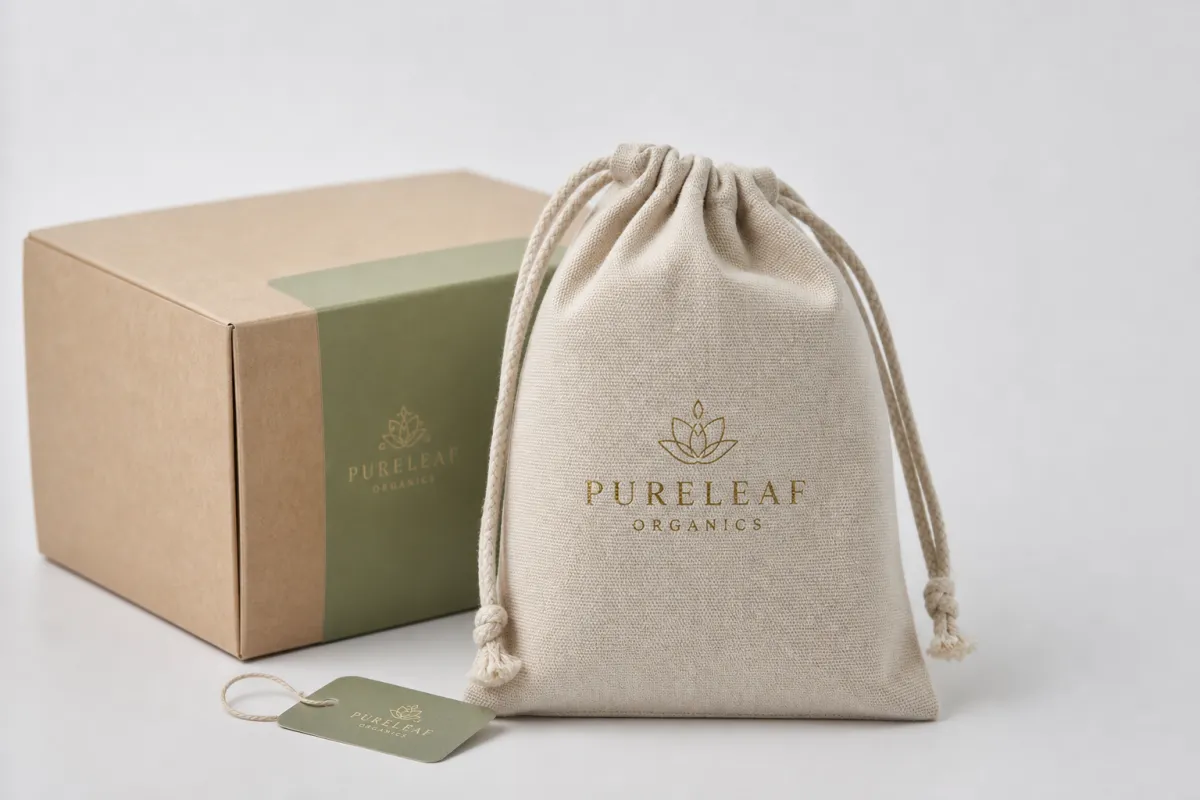
Custom fabric pouches with logo are soft packaging formats made from textile-like materials such as cotton, canvas, velvet, satin, nonwoven blends, jute, or recycled fibers. Brands customize them with embroidery, screen printing, heat transfer, woven labels, patches, or sewn-on tags. At the simplest level, they are reusable bags built to present, protect, and brand a product in one piece.
The appeal is easy to understand. A pouch feels less disposable than a carton, less rigid than a box, and usually more giftable than a plain insert. That matters for jewelry, cosmetics, candles, tech accessories, apparel add-ons, wedding favors, and premium retail items. In those categories, custom fabric pouches with logo can make a product feel considered before the item itself is even revealed. They also work well with package branding because the material itself becomes part of the brand story rather than just a container around it.
There is a practical side that buyers sometimes underestimate. A soft pouch can reduce visual bulk in a kit, protect surfaces from scratches, and make a product easier to carry or store. If the product will be handed out at an event, mailed in a larger parcel, or sold alongside other accessories, custom fabric pouches with logo often fit the job better than a more structured package. A rigid box can look impressive, but it is not always the best answer when space, reuse, or hand feel matter more. I have seen plenty of launches where a box looked polished on the mockup and then felt like overkill in real use.
The best pouch is the one that matches the object it holds. A delicate necklace needs different construction than a candle. A cable kit needs a different closure than a bridal favor. That sounds obvious, yet many packaging projects stumble right there: the pouch looks beautiful on screen, then behaves awkwardly in the hand. Good packaging design respects both the visual side and the physical side of the job.
A pouch should feel like part of the product experience, not a separate object that happens to share the logo.
That is the standard worth aiming for with custom fabric pouches with logo. They should support the product, reinforce the brand, and feel useful enough that customers keep them. If the pouch does those three things, it has earned its place.
How Custom Fabric Pouches With Logo Are Made
Most custom fabric pouches with logo follow a familiar production path, even when materials and decoration methods vary. The process usually starts with the product brief, then moves into sizing, fabric selection, artwork setup, sampling, production, finishing, and shipment. Clear steps at the beginning reduce the chance of rework later, which is where packaging schedules tend to get messy.
Here is the basic flow in practical terms:
- Measure the product and confirm the pouch needs. A jewelry pouch and a travel accessory pouch may both be small, but they are not interchangeable.
- Choose the fabric based on brand tone, durability, feel, and budget.
- Set the logo method such as embroidery, printing, or a woven label.
- Approve artwork and dimensions so placement, type size, and color are locked before production.
- Review a sample when possible, especially for delicate items or complex branding.
- Cut, sew, and finish the run once the spec is approved.
- Pack and ship with the final count, labeling, and carton setup the order needs.
The logo method matters more than many buyers expect. Embroidery creates texture and usually holds up well through repeated handling. Screen printing works well for simple graphics and clean lines, especially when the design uses one or two colors. Heat transfer can carry finer detail, though it needs to be tested carefully on fabric that stretches or wrinkles. Woven labels are often the quiet-luxury choice: less ink, more texture, and a premium look that suits brands that want the pouch to feel understated. For custom fabric pouches with logo, the decoration method should match the artwork, not just the mood board.
Construction changes the result too. A drawstring pouch feels casual and easy to open. A zipper pouch gives a more secure closure and works well for small accessories or travel kits. Flap closures, snaps, and tuck styles can increase perceived value, but they also raise sewing complexity and cost. The best option is rarely the fanciest one; it is the one that fits the product and the use case without adding unnecessary steps. A pouch that tries to do too much can kinda get in its own way.
Sampling is where many projects become real. A digital mockup can show placement and approximate color, but a physical sample reveals seam tension, logo scale, fabric drape, and how the product actually fits. That matters because custom fabric pouches with logo are tactile by nature. If the logo looks fine but the pouch opens awkwardly or the item sits crooked inside, the final impression weakens quickly. A sample catches those problems before they spread across a full run.
One more detail: the factory usually does a lot of the important work before production starts. Once fabric is cut and stitching begins, changes become expensive. Clear specs, a single approval trail, and measured sign-off steps make the whole job smoother. That is not glamorous, but it is how you avoid the kind of scramble that eats up time and budget.
Key Factors That Shape Cost and Pricing
Pricing for custom fabric pouches with logo is shaped by a handful of variables that interact with each other. Fabric type, pouch size, closure style, print method, stitching complexity, lining, inserts, and special trims all move the number. Order volume matters just as much. A clean design at 5,000 units can land at a very different unit price than the same design at 500 units, because setup and material procurement get spread out differently.
For a quick reference, here is a directional comparison that buyers often find useful when scoping custom fabric Pouches with Logo:
| Option | Typical Feel | Common Use | Rough Unit Price at Larger Volume |
|---|---|---|---|
| Cotton twill with print | Natural, clean, everyday | Apparel accessories, small gifts | $0.35-$0.90 |
| Canvas with embroidery | Sturdy, tactile, durable | Retail inserts, travel kits | $0.60-$1.50 |
| Velvet with woven label | Soft, premium, giftable | Jewelry, cosmetics, keepsakes | $0.85-$2.25 |
| Satin with printed logo | Smooth, reflective, elegant | Luxury samples, bridal favors | $0.75-$1.90 |
| Recycled nonwoven with print | Lightweight, economical | Promotional kits, event giveaways | $0.20-$0.55 |
Those ranges are directional, not promises. Geography, freight mode, ink coverage, seam count, and finishing standards all matter. A pouch with a simple one-color mark and a standard drawstring may be priced aggressively. Add lining, a custom zipper, edge piping, or a detailed embroidered crest, and the price climbs. That does not automatically mean the higher-cost pouch is a bad buy. It may simply be the right one for the product and brand position.
Why material choice changes the quote
Cotton and canvas usually sit in the middle of the value curve. They look familiar, they handle well, and they can support a wide range of products. Velvet and satin create a more giftable feel, which is why they often show up in jewelry and cosmetic programs. Nonwoven and recycled blends often work better when budget control is a priority or when the pouch is part of a promotional kit that needs to stay light. When buyers compare custom fabric pouches with logo, the fabric alone can explain much of the quote difference.
Minimum order quantities also deserve attention. Some simple programs can begin around 300 to 500 units if the supplier is using stock fabric and standard sizes. Fully custom dimensions, custom dye lots, or special decoration may push that to 1,000 units or more. The reason is not arbitrary. The supplier has to absorb setup, cutting, sewing, and decoration preparation before the first good unit ships. A lower MOQ can be useful, but it may come with a higher per-unit cost.
There is a hidden cost that deserves more attention than it usually gets: failure. The cheapest pouch can become the most expensive if it wrinkles badly, sheds fibers, tears at the seam, or ships out with inconsistent logo placement. That is especially true in retail packaging, where the customer sees the pouch as part of the brand promise. If the pouch looks off, the product can feel less valuable even when the item inside is strong.
It helps to think like a merchandiser. A pouch has to do three jobs at once: present the item, protect the item, and support the brand. Custom fabric pouches with logo that check only one of those boxes usually disappoint somewhere else. A lower unit price is useful, but only when the pouch still looks intentional and holds up to actual use.
For programs that also include cartons, labels, or inserts, it can be smart to compare pouch pricing against other branded packaging components. Our Custom Packaging Products page is a useful starting point if you are mapping the pouch against the rest of the kit. Sometimes a pouch replaces a box. Sometimes it sits inside a box. Sometimes it should be the hero piece on its own.
If sustainability is part of the brief, keep the claims specific. The EPA’s guidance on material recovery and waste reduction is a good reminder that durability and reuse matter more than vague green language. You can read more through the EPA sustainable materials guidance. For custom fabric pouches with logo, reuse is often the most credible sustainability story because the pouch stays in circulation.
Step-by-Step Guide to Ordering the Right Pouch
Buying custom fabric pouches with logo gets much easier once the order is built around the product instead of the other way around. The right sequence prevents waste, cuts revision cycles, and keeps suppliers from quoting different assumptions as if they were the same thing.
- Measure the product carefully. Use the exact item dimensions, then add room for closure, lining, and safe insertion. A pouch that is too tight will slow packing and create friction for the end user.
- Define the role of the pouch. Is it mainly protective, mainly decorative, or meant to do both? A pouch for a candle has different needs than a pouch for a silk scarf.
- Choose the branding method. Decide whether embroidery, print, woven labels, or patches best support the logo and the brand tone.
- Lock the color standard. If color consistency matters, ask for a Pantone reference or a controlled sample target.
- Confirm the closure. Drawstring, zipper, flap, snap, and open-top styles each change usability and cost.
- Request quotes with identical specs. If one supplier is quoting a lined pouch and another is quoting an unlined version, the numbers will mislead you.
- Approve a sample. For custom fabric pouches with logo, this is often the difference between a clean launch and a painful correction.
That sample should be tested against the actual product, not just judged in the hand. Put the item in and out several times. Check whether the logo stays centered once the pouch is filled. Make sure the fabric creases the way you expect. If the pouch is part of a gift set or product packaging bundle, place it into the whole pack-out and see whether it still feels right. A pouch that looks good alone can feel awkward inside a full kit.
It also helps to build a short decision file before contacting suppliers. Include dimensions, fabric preference, closure style, target quantity, logo file format, finish expectations, and a rough budget range. That may sound basic, but it saves time. Suppliers can quote faster, compare more accurately, and recommend trade-offs that make sense. Custom fabric pouches with logo are easier to source when the buyer has already done the measuring and the thinking.
For brands that buy packaging regularly, it is worth keeping pouch specs in the same family as the rest of the branded packaging system. If your campaign also uses custom printed boxes, sleeves, inserts, or tissue, make sure the pouch color and logo treatment sit comfortably alongside those pieces. Consistency is not about matching everything perfectly. It is about making the pieces feel like they belong to the same brand family.
One useful rule: ask for at least two quotes using the same exact spec sheet. If the suppliers are truly comparing the same pouch, the differences will tell you something useful. If the quotes look wildly different, that usually means the assumptions are different too.
Process Timeline: From Sample to Delivery
Custom fabric pouches with logo rarely move in a single straight line. The timeline usually passes through brief, artwork setup, sampling, revisions, production, quality checks, and freight. A simple order can move faster than a complex one, but even a basic pouch still has more steps than a stock bag off the shelf.
A practical timeline often looks like this:
- Brief and quote: 1-3 business days if the specs are clear.
- Artwork setup: 1-3 business days for a straightforward logo.
- Sample production: 5-10 business days, sometimes longer for premium fabrics.
- Sample review and revisions: 2-7 business days depending on feedback speed.
- Mass production: often 10-20 business days for standard runs.
- Freight or delivery: varies by mode and region; air is faster, ocean is slower.
Those numbers move quickly when a project is well organized. They stretch when the dimensions are unclear, the artwork keeps changing, or the buyer wants to see a different seam, trim, or closure after the first sample. The biggest schedule killers are usually not dramatic manufacturing problems. They are small decision delays. One missing measurement can hold up the whole run.
Complexity changes timing too. A single-color logo on cotton is usually faster than a fully lined velvet pouch with a woven label and custom cord. A pouch that uses standard fabric and a basic drawstring can often move through production with less friction than one that needs specialty trim or multiple decoration steps. Custom fabric pouches with logo become slower the moment the design stops being simple.
Rush orders are possible in some situations, but they deserve caution. Faster schedules often leave less room for error, fewer finish options, and tighter production windows. They may also increase cost by 10% to 20% or more, depending on the work involved. The question is not whether rush production exists. The real question is whether the result will still meet the brand standard when it arrives.
If the pouch is traveling inside a larger shipment, test the full system. The outer carton, protective fill, and pouch should work together. For packages that need distribution testing, ISTA procedures are often the reference point buyers use for transit performance. That does not mean every pouch needs a formal lab program, but it does mean the pack-out should be judged under realistic handling conditions, not only on a desk.
Buffer time matters more than most launch calendars allow. Give yourself extra room if the pouches are part of a seasonal promotion, a product drop, a wedding order, or an event kit. The pouch may be a small line item on the quote, but it can become the bottleneck if approvals lag. Custom fabric pouches with logo should arrive before the campaign needs them, not the day after.
Common Mistakes to Avoid With Logo Pouches
The most expensive mistake is usually not a pricing mistake. It is a fit mistake. A pouch that is too small, too loose, or shaped badly for the product will create friction every time it is used. That frustration shows up in packing labor, customer handling, and the visual result. Before comparing custom fabric pouches with logo, define the product the pouch has to hold and the experience it has to support.
Another common problem is overcomplicating the logo. Thin strokes, tiny text, and too many colors can blur on soft materials. Embroidery can make fine detail look muddied. Printing can lose clarity when the fabric texture is too open or too nubby. A strong logo on fabric is usually simpler than the same logo on a flat paper surface. That is one reason package branding often works better when the artwork is tuned for the medium instead of copied unchanged from a screen file.
Buyers also get tripped up by the lowest quote. A lower unit price may hide weaker stitching, inconsistent sizing, loose thread finish, or poor color control. In retail packaging, those differences matter because customers touch the pouch before they judge the product. A bargain pouch that looks cheap can drag down an otherwise strong item. With custom fabric pouches with logo, cheap often announces itself quickly.
If the logo is the only thing that feels premium, the pouch has already failed its job.
Timeline errors create a different kind of pain. Late artwork approval, skipped samples, and unrealistic shipping assumptions can all push delivery past the launch date. That is particularly risky for event kits, subscription boxes, and seasonal retail programs, where packaging is tied to a fixed send date. A pouch delay may look minor on a spreadsheet, but it can stop the rest of the campaign from moving.
There is also a bigger systems mistake: evaluating the pouch in isolation. A good pouch should work with labels, inserts, cartons, and any outer packaging. If your program includes custom printed boxes, the pouch should feel like one member of the set, not a random add-on from a different brand. The same logic applies to unboxing flow. The sequence matters. What customers see first should set up what they see next.
One last trap is treating the pouch as reusable only in theory. If the stitching is weak or the closure is awkward, customers will not keep using it. Reusability comes from construction as much as from material choice. For custom fabric pouches with logo, a pouch that survives repeated handling is more valuable than one that simply looks nice on day one.
Expert Tips and Next Steps
Think like a merchandiser, not just a buyer. The best custom fabric pouches with logo balance feel, function, shipping efficiency, and brand recognition in a single package. They should be pleasant to open, easy to store, durable enough to reuse, and simple enough to produce without constant revisions. That balance is where the real value lives.
Start by building a small decision kit before you speak with suppliers. Include the product dimensions, logo files, preferred fabric, rough quantity, closure preference, and a budget range. If the pouch will sit inside a larger retail packaging system, include those dimensions too. The more context the supplier sees, the better the quote and the fewer surprises later. That is especially true when custom fabric pouches with logo must coordinate with other branded packaging pieces.
Ask for two samples if the project matters. One should test fit. The other should test the look and feel against the actual product display or unboxing flow. A pouch can look refined on a screen and still feel too stiff, too shiny, or too shallow in the hand. Real-world handling is the only test that tells the full story.
Keep the branding honest. If you attach a hang tag or insert, consider whether FSC-certified paper makes sense for that component. If you want to talk about reuse or lower waste, be specific about what the pouch actually does. The EPA resource on sustainable materials is a useful reminder that durability, reuse, and material reduction are measurable behaviors, not slogans. That kind of clarity builds trust, and trust is worth more than a shiny claim that nobody can verify.
My practical advice is simple: measure the product, request samples, compare the quotes using the same spec, and test the pouch in the real packaging flow before you commit. If the fit, finish, and price all line up, custom fabric pouches with logo can become one of the most efficient branding tools in the mix. They are small, but they travel well. They feel intentional. And when they are made properly, custom fabric pouches with logo keep paying back the brand every time someone uses them again.
How much do custom fabric pouches with logo usually cost?
Price depends on fabric, size, closure, logo method, and quantity. For larger runs, simple custom fabric pouches with logo can land in the low cents to under a dollar per unit, while premium velvet, satin, or embroidered options usually cost more. The cleanest way to compare quotes is to give every supplier the same spec sheet, because one quote may include lining or upgraded stitching while another does not. If the numbers seem all over the place, the spec is usually the first thing to check.
What fabric works best for custom fabric pouches with logo?
Cotton and canvas are strong all-around choices when you want a natural look and dependable everyday use. Velvet and satin create a more giftable feel for jewelry, cosmetics, and luxury accessories. Recycled nonwoven fabrics work well when budget and weight matter most. The best fabric for custom fabric pouches with logo is the one that fits the product, the brand tone, and the shipping method. There is no single winner across every category, and that is fine.
How long does it take to produce custom fabric pouches with logo?
The timeline usually includes artwork setup, sampling, revisions, production, and freight, so it is longer than ordering a stock pouch. Simple custom fabric pouches with logo may move through the process faster, while lined constructions, specialty trims, or repeated artwork changes add time. Build in buffer time if the pouches are tied to a launch, event kit, or seasonal program. If the calendar is tight, the safest move is to lock the spec early and avoid late changes.
Can I use a full-color logo on custom fabric pouches with logo?
Yes, but the best method depends on the artwork and the fabric. Printing can handle more color variation than embroidery, while woven labels and patches can give a premium finish without heavy ink coverage. Fine lines, gradients, and tiny text may need simplification to stay readable. A physical sample is the best way to confirm the final look of custom fabric pouches with logo before mass production. On textured fabrics, what looks crisp on screen can soften a lot in production, so testing saves regret.
Are custom fabric pouches with logo reusable?
Most are designed for repeat use, which is one of the reasons they can keep promoting the brand after the original purchase. Reusability depends on fabric weight, seam strength, and closure style, so construction matters as much as appearance. If reuse is important, ask for reinforced seams and a fabric choice that can handle regular handling. That is where custom fabric pouches with logo often outperform more disposable packaging formats.

