Buyer Fit Snapshot
| Best fit | Custom Flat Handle Paper Bags projects where brand print, material claims, artwork control, MOQ, and repeat-order consistency need to be specified before quoting. |
|---|---|
| Quote inputs | Share finished size, material target, print colors, finish, packing count, annual reorder estimate, ship-to region, and any compliance wording. |
| Proofing check | Approve dieline scale, logo placement, barcode or warning zones, color tolerance, closure strength, and carton packing before bulk production. |
| Main risk | Vague material claims, crowded artwork, missing packing details, or unclear freight terms can make a low unit price expensive after revisions. |
Fast answer: Custom Flat Handle Paper Bags: Film, Print, MOQ, and Carton Packing should be specified like a repeatable production item. The safest quote records material, print method, finish, artwork proof, packing count, and reorder notes in one written spec.
Production checks before approval
Compare the actual filled-product size with the drawing, then confirm tolerance on folds, seals, hang holes, label areas, and retail display edges. Reserve space for logos, QR codes, warning copy, and material claims before decorative graphics fill the panel.
Quote comparison points
Review material grade, print process, finish, sampling route, tooling charges, carton quantity, and freight assumptions side by side. A quote is only useful when the supplier can repeat the same color, closure quality, and packing count on the next order.
Custom flat handle paper bags can look almost plain at first glance, yet the detail that usually decides whether they hold up in daily use is not the printed surface at all; it is the handle bond and the way that bond spreads stress across the top fold. That single construction choice changes how you spec the bag, how you compare quotes, and how confidently you use it in retail packaging, because a bag that splits at the handle has already failed the moment it leaves the counter.
Brands that want to reduce plastic and present a cleaner material story often find that custom flat handle paper bags do a lot with a relatively modest amount of material. The real question is not whether the bag is paper. The real question is which paper grade, handle build, print method, and order quantity fit the product without inflating cost or leaving the bag underbuilt for the load. That part can feel a little dry on paper, but it is exactly where good packaging decisions are made.
If you want to compare this format with other packaging styles, the Custom Packaging Products page is a helpful place to look at bags alongside Custom Printed Boxes and other product packaging used across retail, takeaway, and event programs.
A bag can look polished and still fail the first time it gets loaded with something heavier than expected. Handle construction tells you more than the artwork ever will.
What Are Custom Flat Handle Paper Bags?
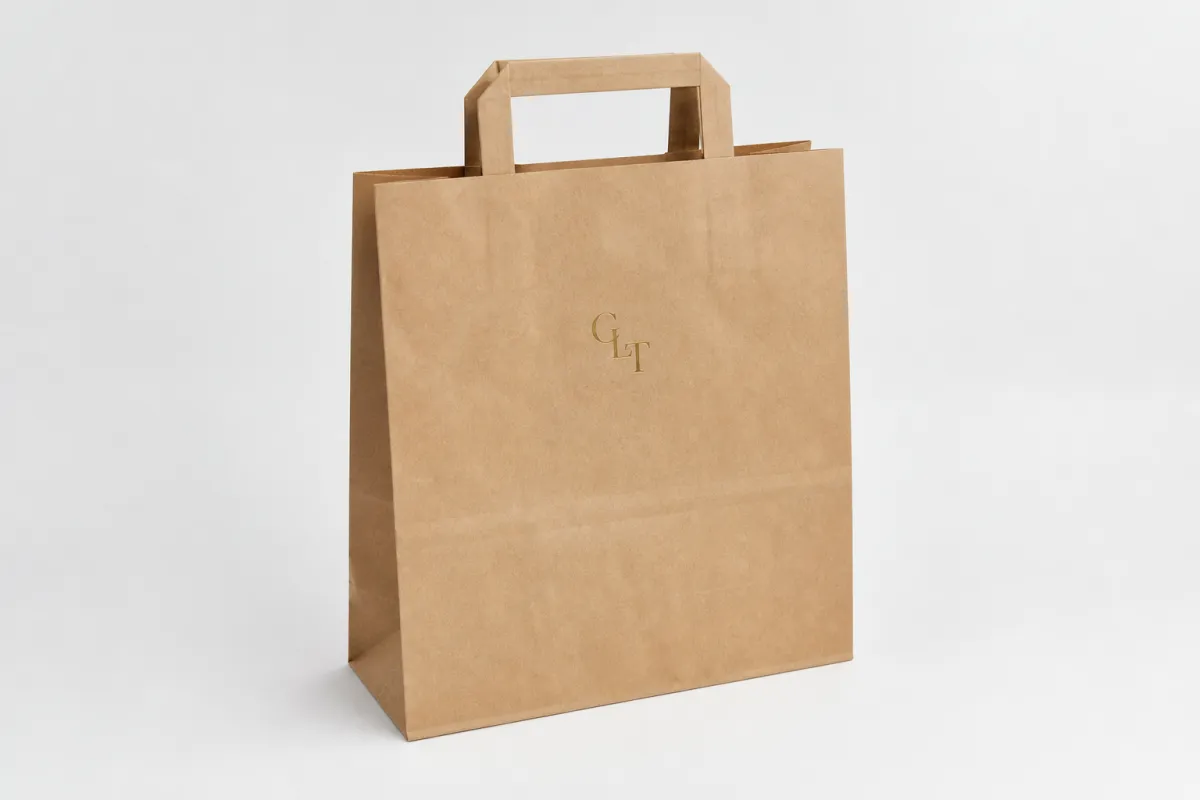
Custom flat handle paper bags are paper shopping bags with folded paper handles that lie flat against the body of the bag. The format shows up everywhere in retail, takeaway, events, and light-to-medium carry applications because it feels familiar in the hand, stores neatly in the back room, and gives a clear paper-based impression without asking the customer to think twice about what they are carrying.
The construction is simple enough to read at a glance. You have the main paper body, side gussets that create volume, a bottom panel that helps carry weight, adhesive points that hold the structure together, and a handle fold that spreads force across a wider contact area. That last part matters more than many buyers expect. Handle failure often shows up before the paper body gives out, especially when the load pulls unevenly or the top edge is too light.
Compared with twisted-handle bags, custom flat handle paper bags often come in at a slightly lower cost and stack more neatly in storage. Compared with rope-handle bags, they feel less premium in the hand, yet they can still look refined with the right print treatment and paper choice. That makes them a practical middle ground for brands that want a cleaner sustainability message without drifting into luxury pricing.
From a packaging design perspective, the surface area is useful. The front and back panels leave enough room for a logo, a short slogan, a QR code, or a simple recycled-content message. That is part of why custom flat handle paper bags work so well as branded packaging: they are visible, functional, and easy to understand at the point of sale.
I see a lot of buyers focus on appearance and underweight the structure. A 120gsm kraft bag with a weak handle bond may look fine in a rendering, while a 150gsm or 170gsm spec with proper reinforcement can perform better and reduce waste from damaged orders. In product packaging, that difference shows up fast at the counter.
For sustainability teams, the format has another practical advantage. Paper bags are easier to explain than many laminate-heavy alternatives, and that simplicity helps. If your brand needs to make a credible claim about waste reduction, a well-specified paper bag is much easier to defend than a complicated mixed-material carrier. If the paper is FSC-certified, that claim can support procurement language as long as the documentation is real and traceable. The certification framework is documented on the FSC website.
Still, “paper” does not automatically mean “recyclable everywhere.” Coatings, wet-strength additives, inks, and local collection rules all matter. For a general recycling baseline, the EPA recycling guidance is a useful reference point, though final recyclability always depends on the exact material spec and the local system receiving it.
In practical terms, custom flat handle paper bags occupy a very useful part of the market. They are simpler than premium rope-handle formats, more brandable than plain stock sacks, and usually easier to justify than bag styles that mix paper and plastic in ways customers can spot immediately.
How Custom Flat Handle Paper Bags Work in Real Use
Real-world performance is where custom flat handle paper bags either earn repeat orders or quietly get replaced. A bag does not spend most of its life in a lab. It gets tested by a cashier packing one more item than planned, by a customer carrying lunch with a bottle of water, or by a shopper putting sharp-edged cartons into a bag that was specified a little too lightly.
The load behavior comes down to balance. When contents sit centered and the product edges are smooth, the bag carries well. When a heavy item hangs toward one side, the handles feel the strain quickly. Wet packaging, condensation from chilled drinks, and overfilling at the top all raise the chance of seam stress. That is why the right paper weight matters, but the dimensions and fill pattern matter just as much.
A 120gsm kraft option may be perfectly fine for a light apparel purchase or a small gift set. Move into bakery boxes, multiple folded garments, or denser food items, and you may want 150gsm to 170gsm with a stronger top fold. That does not mean thicker is always better. Overspecifying the bag can raise cost without fixing the actual problem, especially if the issue is shape rather than weight.
The customer experience is another reason custom flat handle paper bags keep their place. They open quickly, stack neatly, and do not ask for a learning curve. A fast-moving cashier line benefits from packaging that can be grabbed, opened, and filled in seconds. The bag also sits flat in storage, which is a small operational advantage that often gets overlooked until the back room is crowded with awkward carrier inventory.
There is also a branding layer many teams underestimate. A well-printed bag can carry the same visual discipline as custom printed boxes, just in a different setting. Boxes usually do more work in shipping and unboxing. Bags do more work in public, where the logo is seen by staff, customers, and passersby. That turns the bag into a piece of mobile retail packaging. If the print is crisp and the proportions are right, it supports package branding without drawing attention to itself.
Practical use also depends on storage and replenishment. Because the format is straightforward, custom flat handle paper bags are usually easier to keep in a back room than more complex carriers. They ship in bundles or cases, count quickly, and slide into a standard packing workflow. For busy retailers, that predictability matters more than flashy extras.
A few behavior details are worth keeping in view:
- The top fold should feel firm, not flimsy, because it absorbs a lot of handle stress.
- Gusset depth needs to match the actual product footprint, not just the visual look of the bag.
- Flat handles work best when the bag is filled evenly and not stuffed beyond the top edge.
- Short-run print jobs can still look sharp when the artwork stays clean and ink coverage is controlled.
The real takeaway is straightforward: custom flat handle paper bags are not just containers. They are a daily-use piece of retail packaging that has to function in motion, not just in a presentation file. When the spec matches the load, they feel ordinary in the best possible way. No drama. No damage. Just a reliable handoff from brand to customer.
Custom Flat Handle Paper Bags Cost, MOQ, and Pricing
Pricing is where many buyers get surprised. Custom flat handle paper bags do not price like generic stock items because the cost is shaped by paper weight, dimensions, handle reinforcement, print complexity, finish, and quantity. Change even one of those variables and the quote can move more than expected.
The biggest driver is usually order quantity. Smaller runs carry more setup cost per unit because printing plates, prep time, converting labor, and spoilage allowance are spread across fewer pieces. Larger orders generally reduce the unit cost, though not always enough to justify inventory you will not use soon. That is the tradeoff, and it is one of the first things I ask buyers to think through before they start comparing prices.
Print coverage matters too. A simple one-color logo on kraft paper is usually much easier to price than full-coverage artwork with multiple shades, tight registration, or large solid ink areas. Ink-heavy layouts can increase spoilage risk, especially on porous stocks. If you want a cleaner quote, keep the artwork disciplined. The bag will often look better for it.
Here is a practical way to think about common cost bands for custom flat handle paper bags. These are broad market ranges, not fixed promises, but they are useful when comparing bids.
| Spec Type | Typical Paper | Common MOQ | Approx. Unit Cost at 5,000 pcs | Best Fit |
|---|---|---|---|---|
| Plain kraft, no print | 120gsm to 150gsm | 3,000 to 5,000 | $0.12 to $0.20 | Low-key retail packaging and takeout use |
| Single-color custom print | 120gsm to 150gsm | 5,000 to 10,000 | $0.18 to $0.28 | Simple branded packaging with clean logo placement |
| Two- or three-color print | 150gsm to 170gsm | 5,000 to 10,000 | $0.24 to $0.38 | Retail packaging that needs stronger shelf presence |
| Premium stock or specialty finish | 170gsm plus coating or treatment | 10,000+ | $0.32 to $0.55 | Higher-end package branding or gift presentation |
That table hides one important truth: the quote only helps if the spec is clear. If you ask for custom flat handle paper bags without giving dimensions, load target, print sides, and delivery location, you are going to receive a guess. A weak quote is often just a vague brief wearing a price tag.
For a cleaner comparison, send the same spec sheet to every supplier. Include the bag width, gusset, and height; the product weight range; whether the bag needs print inside or only outside; and whether you want kraft, white kraft, or a coated stock. If you are comparing bag programs with other Custom Packaging Products, that level of detail helps separate real price differences from sloppy assumptions.
Here is the short version of what pushes cost up or down:
- Paper weight: heavier stock usually costs more, though not in a straight line.
- Size: larger bags use more paper and more glue, which raises unit price.
- Handle reinforcement: stronger handle builds improve performance and can add a little cost.
- Artwork: more colors, larger ink coverage, and tighter alignment all add complexity.
- Finish: coating, matte treatment, or special surface work raises the quote.
- MOQ: lower quantities usually push the unit cost higher.
There is always a temptation to compare only the sticker price. I would not do that. A cheaper bag that fails in use can cost more through damaged goods, replacement orders, and a weaker customer impression. In that sense, custom flat handle paper bags are part of product packaging economics, not just procurement. The lowest quote is not always the best value. Sometimes it is the most expensive mistake you can make.
Production Process and Timeline for Custom Flat Handle Paper Bags
Production is a sequence, not a switch. Once a buyer understands that, custom flat handle paper bags become much easier to manage. A good job starts with the brief, moves through proofing and sampling, then enters production, finishing, packing, and freight coordination. If one stage slips, the rest usually follows.
Here is the typical flow I see in packaging work:
- Spec gathering: dimensions, paper choice, print details, and target weight are confirmed.
- Artwork prep: logos are cleaned up, color values are checked, and the layout is adapted to the bag panel.
- Digital proof: the supplier shows how the print will sit on the bag structure.
- Sampling or mockup: a physical sample or production-relevant proof is reviewed.
- Final approval: the buyer signs off on spec and artwork.
- Production: paper conversion, printing, handle attachment, and curing or drying happen.
- Packing and freight: bags are bundled, boxed, palletized, and shipped.
For a simple one-color order with standard sizing, the process often takes about 12 to 15 business days from proof approval to production completion, with freight added on top. If the job uses custom sizing, multiple print colors, or a special finish, 18 to 25 business days is a more realistic planning window. International shipping can add another week or more, depending on route and mode.
Where do delays usually happen? In the same few places. Missing artwork files are one. Late proof changes are another. Scope creep is a third. A buyer starts with one size, then decides the bag should be taller, wider, stronger, and printed on both sides. Each change sounds small. Together, they can reset the timetable.
That is why early planning matters for seasonal launches, store openings, trade shows, and promotional kits. Packaging often becomes the last item to arrive, even though it is the first thing the customer touches. If you are ordering custom flat handle paper bags for a campaign, treat the bag lead time as a launch dependency, not an afterthought.
Two scheduling habits help a great deal. First, approve final specs before artwork gets finalized. Second, lock quantity early so the supplier can plan production efficiently. If the order size changes after sampling, the job may need re-quoting or a new run plan. That is one of the most common reasons a timeline stretches without warning.
For larger programs, some teams also borrow transit-testing thinking from ISTA-style methods so finished packaging is not just visually correct but ready for distribution. Bags are not boxes, of course, but the logic is the same: packaging should arrive ready to use, not ready to be replaced. That mindset matters in retail packaging and branded packaging alike.
Common Mistakes When Ordering Custom Flat Handle Paper Bags
Most mistakes with custom flat handle paper bags are preventable. They come from rushing the brief, guessing on size, or treating the bag as decoration instead of a working carrier. The bill for those mistakes usually arrives later, in the form of reorders, damaged product, or artwork that looks rougher in print than it did on screen.
The first error is buying by appearance alone. A bag can look premium in a mockup and still be underbuilt for the load. If the paper weight is too light, the handles strain. If the top fold is too thin, the bond weakens. If the bottom panel is too small, the product rides awkwardly in the bag. None of that shows up in a PDF.
Size is the second trap. Buyers often underestimate gusset depth or bag height because they are focused on the logo. Then the packed item sits too tight, the top looks cramped, or the bag has to be overfilled to close. That is not just inconvenient. It can also make the bag more likely to tear at the seams.
Artwork mistakes cost more than people expect. Low-resolution logos blur at press, tiny type disappears, and heavy ink coverage can create a muddy look on kraft stock. If you want custom flat handle paper bags to support package branding, keep the artwork clean. One strong logo placement is usually better than a crowded design trying to say too much.
There are also sustainability missteps. Some buyers assume every paper bag is automatically recyclable. That is not true. Coatings, wet-strength treatments, adhesives, and local collection rules all affect the final outcome. Others ask for recycled content but never request documented proof. That is a quick way to create marketing language procurement cannot support.
If a fiber claim matters, ask for the documents. If a recycled-content claim matters, ask for proof of the exact stock. If the coating is part of the design, ask how it affects recycling. That is the difference between a good intention and an accountable spec. The same logic applies to any retail packaging or product packaging program that needs to stand up to internal review.
Late changes are the final costly mistake. A small tweak after proof approval can trigger new artwork checks, a revised sample, and a fresh production slot. With custom flat handle paper bags, one line change can ripple through the rest of the job. That is why the cleanest orders are the ones with fewer surprises.
Here is a simple buyer checklist that prevents a lot of trouble:
- Confirm the product weight and shape before choosing the paper weight.
- Measure the widest item, not just the tallest one.
- Approve artwork at actual size, not only on a screen.
- Ask how the bag behaves with moisture, grease, or temperature changes.
- Request written confirmation of recycled content, coating, and sourcing claims.
If that sounds basic, good. Most packaging problems are basic problems wearing a complicated mask. In my experience, the best-performing custom flat handle paper bags are the ones that were boring to specify and easy to repeat.
Expert Tips for Better Custom Flat Handle Paper Bags
There is a real difference between a bag that looks right and a bag that works right. The best custom flat handle paper bags do both, but the working part should come first. Start with payload, then choose paper weight, handle build, and print coverage around that reality. That order is much safer than designing from aesthetics alone.
My strongest practical advice is to test with the exact product mix you plan to ship or hand over. Do not test with a generic sample and assume the result will translate. A bag that handles folded apparel well may behave differently with boxed cosmetics, bakery items, or a mixed load with sharp corners. The load profile matters.
Use design restraint. One memorable logo placement and one short sustainability line often outperform busy artwork on custom flat handle paper bags. That is not because minimalism is trendy. It is because people see the bag while they are moving. The message has to land in a second or two. Clear branding beats clutter almost every time.
Paper weight should match real payloads, not guesswork. A light apparel bag and a lunch carrier may share a similar silhouette but not a similar stress pattern. If the top edge flexes too much, the handle bond becomes the story. If the bag feels stiff but bulky, you may have specified more material than the job needs. Either problem can hurt both margin and user experience.
Storage and fulfillment deserve attention too. The bag needs to fit the team’s back room space, the packing routine, and the speed of the counter. A well-designed bag that is awkward to store creates friction every day. That is why custom flat handle paper bags should be evaluated as part of the workflow, not as isolated SKUs.
One more tip: ask vendors how they handle inks and coatings. Water-based inks are often a better fit for sustainability messaging than heavier solvent-based systems, and recycled-content paper can be a smart fit when the intended use is light to medium. None of that should be treated as a blanket rule. It depends on the performance target, the print coverage, and the local recycling pathway. The questions are worth asking either way.
For brands with a broader packaging mix, it helps to think about the bag as one part of a system. A company may use custom printed boxes for shipping, rigid cartons for gift sets, and custom flat handle paper bags for front-of-house retail packaging. If those pieces share the same visual language, the brand feels organized. If they do not, the experience feels pieced together.
Two more expert-level checks can save money:
- Ask for a sample at target load: weight the bag with the real item, not just an approximation.
- Compare on the same spec sheet: if suppliers quote different dimensions or paper weights, the prices are not directly comparable.
Good packaging design is usually less about adding features and more about choosing the right ones. That is especially true here. The strongest custom flat handle paper bags are often the ones that balance cost, handling, and branding without trying to do too much.
Next Steps: Spec, Sample, and Scale Custom Flat Handle Paper Bags
If you are ready to move forward, treat custom flat handle paper bags like a specification project, not a shopping exercise. Start with the product weight, bag dimensions, print needs, and expected monthly volume. Those four inputs will shape an accurate quote far better than any vague request for “nice-looking bags.”
Next, request a sample set or a short pilot run. A physical sample tells you how the handles feel, whether the gusset depth works, whether the print reads clearly, and whether the bag looks right in the customer’s hand. That kind of testing is inexpensive compared with fixing a full production mistake.
Once samples arrive, compare at least two supplier proposals on the same spec sheet. That lets you isolate differences in material quality, MOQ, Lead Time, and finishing. If one supplier is much cheaper, find out why. Sometimes the answer is a thinner stock. Sometimes it is less disciplined production control. Either way, you need to know.
For teams that buy across multiple packaging lines, it also helps to map the bag against other formats such as custom printed boxes and broader branded packaging programs. The goal is not to make every item look identical. The goal is to make the experience feel consistent from shelf to handoff. That consistency is part of package branding, and customers notice it even if they do not say so out loud.
Finally, create a reorder plan. If the sample performs, lock the spec, confirm the production window, and set a reorder threshold before stock gets low. That keeps custom flat handle paper bags from becoming a rush purchase. Rush purchases are where margin tends to disappear, and nobody wants to explain that kind of surprise to finance.
Here is a practical decision path:
- Define the load, size, print, and monthly quantity.
- Request quotes on the exact same spec sheet.
- Review a physical sample under real use conditions.
- Confirm sourcing, coating, and recycling claims.
- Approve production and build in freight time.
- Scale custom flat handle paper bags with a reorder plan instead of starting from zero each time.
That is the simplest way to avoid waste and buy with confidence. Done well, custom flat handle paper bags are not just a cost line. They are a clean, practical piece of retail packaging that supports the product, the counter, and the brand at the same time.
Frequently Asked Questions
Are custom flat handle paper bags strong enough for retail products?
Yes, when the paper weight, handle bond, and bag size match the product load. Custom flat handle paper bags work best for light-to-medium retail items, takeaway orders, and gift packaging. For heavier contents, ask for reinforced specs and test the bag with the actual product mix before approving a full run.
What affects the price of custom flat handle paper bags the most?
Paper weight, size, print complexity, and order quantity are the main cost drivers. MOQ matters because setup costs are spread across fewer bags on smaller runs. Special finishes, custom sizing, and multi-color printing usually increase the quote, especially when the artwork uses large areas of ink.
How long does the production timeline usually take?
Simple orders move faster than fully custom jobs with multiple print colors or unique sizing. A typical timeline for custom flat handle paper bags is often 12 to 15 business days from proof approval for straightforward work, with more time needed for sampling, revisions, and freight. Seasonal launches should always include a buffer.
Can custom flat handle paper bags be recycled?
Often yes, but recyclability depends on coatings, inks, adhesives, and local recycling rules. Uncoated paper with water-based inks is usually easier to position as recyclable. Always confirm the full material spec instead of assuming all paper bags are treated the same by every collection system.
What should I send for an accurate quote on custom flat handle paper bags?
Send bag dimensions, target product weight, paper preference, print details, and order quantity. Include delivery location and timing so the supplier can price freight and schedule production correctly. If possible, provide artwork files and a sample reference to reduce revision cycles and keep the quote on target.

