Buyer Fit Snapshot
| Best fit | custom folding box pricing for packaging buyers comparing material specs, print proof, MOQ, unit cost, freight, and repeat-order risk where brand print, material, artwork control, and repeat-order consistency matter. |
|---|---|
| Quote inputs | Share finished size, material target, print colors, finish, packing count, annual reorder estimate, and delivery region. |
| Proofing check | Approve dieline scale, logo placement, barcode or warning zones, color tolerance, and any recyclable or compostable wording before bulk production. |
| Main risk | Vague material claims, crowded artwork, or missing packing details can create delays even when the unit price looks attractive. |
Fast answer: Custom Folding Box Pricing: What Actually Drives Cost should be specified like a repeatable production item. The safest quote includes material, print method, finish, artwork proof, carton packing, and reorder notes in one written spec.
What to confirm before approving the packaging proof
Check the product dimensions against the actual filled item, not only the sales mockup. Ask for tolerance on folds, seals, hang holes, label areas, and retail display edges. If the package carries a logo, QR code, warning copy, or legal claim, reserve that space before decorative graphics fill the panel.
How to compare quotes without losing quality
Compare board or film grade, print process, finish, sampling route, tooling charges, carton quantity, and freight assumptions side by side. A lower quote is only useful if the supplier can repeat the same color, closure quality, and packing count on the next order.
Custom Folding Box Pricing: What Actually Drives Cost
Custom folding box pricing looks neat right up until the quote lands and the details start doing the actual work. Two cartons can look almost identical in a mockup and still sit in very different price bands because one uses heavier board, another needs tighter tolerances on the dieline, and a third gets foil because somebody wanted the logo to pop. That part is normal. Packaging is not a pick-one-and-pray exercise, no matter how often people try to treat it like one.
From a buyer's point of view, custom folding box pricing is the full cost of designing, printing, finishing, converting, and shipping folding cartons built to your product specs. That is broader than most teams expect, but the bill is broader too. You are paying for file checks, press setup, die cutting, finishing, waste, folding, glue, freight, and a supplier who actually reads the brief instead of filling in the blanks with hope and a calculator. I have seen that kind of guesswork turn into real money pretty fast.
The upside is simple: custom folding box pricing stops feeling mysterious once you know which levers matter. The catch is that the biggest levers are usually the least glamorous ones. Dimensions. Quantity. Board grade. Print coverage. Handwork. If you are buying Custom Packaging Products for retail, ecommerce, or product packaging, there is usually room to trim waste without turning the carton into junk. You just need to stop paying for upgrades that do nothing for the product. Easy to say. Harder to do, but not complicated.
Why Custom Folding Box Pricing Looks Simple Until It Isn't
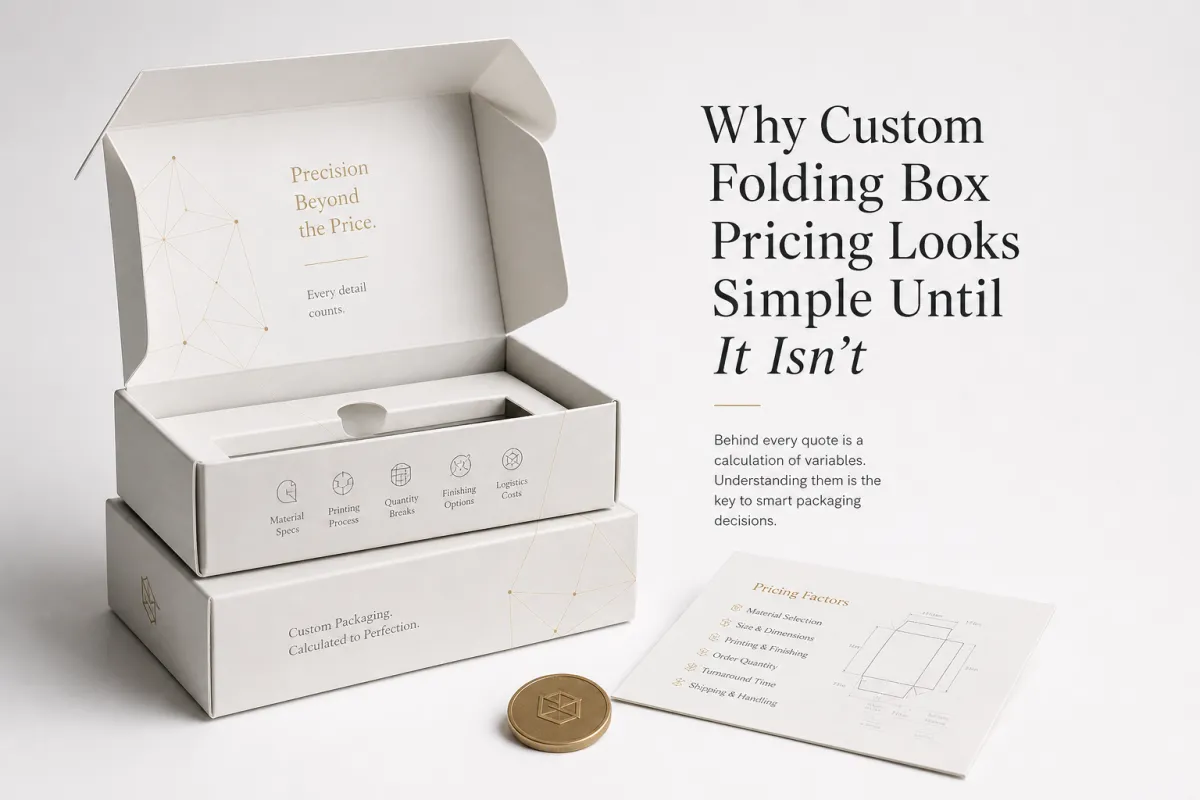
On paper, custom folding box pricing pretends to be simple: box size, quantity, unit price. Clean. Tempting. Wrong. That quote is carrying several jobs at once, and each job has its own cost. A small carton can still need an insert if the product is fragile. A plain print job can still jump if the brand wants soft-touch and foil. A flat-folding carton can still waste sheet space on press, and someone has to recover that waste somewhere.
Take a cosmetic serum carton and a candle carton. Both might be four-color tuck-end boxes. Both might look close enough on a screen. Then the spec sheet shows up. One needs a heavier SBS board because the product is dense and the fit has to be tight. The other needs a matte aqueous coating because retail handling will scuff anything too soft. One needs a crash-lock bottom. The other does not. The "same" box is suddenly not the same box at all.
Buyers also tend to leave out the parts that cost money but do not feel exciting during the first call. Tooling. Proofing. Freight. Minimum order quantities. Then the launch date moves, the artwork changes, or somebody decides the box should look more premium two days before approval. The quote changes because the job changed. That is not drama. That is production doing what production does.
A low quote only matters if the specs match. Different board, different finish, different quantity, different setup? Different price. Comparing those numbers without checking the details is how packaging budgets get chewed up.
If you want the short version, custom folding box pricing is the total cost of turning a product brief into a finished folding carton. Design support, prepress, print, die cutting, finishing, folding, and shipment all live inside that number. That is why one carton can land at $0.18 in one order and $1.20 in another. The market did not suddenly develop a mood. The specs did.
Retail packaging also has to do more than sit there and look presentable. It has to protect the product in transit, assemble cleanly, and show up on shelf without turning your line into a small disaster. If buyers focus only on the unit price, custom folding box pricing gets distorted fast. When they look at landed cost and how the carton behaves in the real world, the quote starts making sense.
How Custom Folding Box Pricing Is Calculated
Custom folding box pricing usually comes from a few familiar buckets. Some costs stay fixed no matter what. Others move with quantity. If you want a quote you can actually compare, split those buckets apart before you start vendor-shopping. One number without context is just marketing in a nicer font.
The main buckets are prepress or artwork setup, die cutting, printing, finishing, materials, conversion, and shipping. Suppliers may bundle those into a single line item, but the math underneath is still there. Prepress covers file checks and setup work. Die cutting covers the custom tool that makes the carton shape real. Printing covers ink, press time, and the number of passes. Finishing covers coating, foil, embossing, lamination, or varnish. Conversion covers folding, gluing, and any extra handwork.
Fixed costs hurt most on short runs. A setup fee of $150 spread across 500 boxes adds $0.30 before material or print even enters the chat. That same fee spread across 5,000 boxes drops to $0.03 per carton. That is why custom folding box pricing gets easier as quantity rises. The tradeoff is storage and cash tied up in inventory, which is why a bigger order is not always the smarter order.
Variable costs react to the spec sheet. Thicker board costs more. Heavier ink coverage slows the press. Foil stamping adds another step. Window patches, inserts, and specialty closures add labor or tooling, sometimes both. Minor details in an email are rarely minor in production. Packaging has a way of punishing optimism.
Suppliers usually build quotes from these inputs:
- Dimensions - length, width, depth, and whether the carton needs extra room for product insertion.
- Board grade - economy paperboard, SBS, CCNB, kraft, or specialty stock.
- Print method - digital, offset, flexographic, or a hybrid workflow.
- Color coverage - one-color, spot colors, or full-bleed CMYK.
- Finishing - matte, gloss, aqueous, soft-touch, foil, emboss, deboss, or varnish.
- Structural extras - inserts, windows, partitions, tear strips, locking tabs, and tamper features.
If you want a rough feel for how custom folding box pricing moves, the table below gives a realistic pattern. The exact numbers will vary by supplier, sheet size, region, and the mood of the production schedule, but the direction stays consistent.
| Example Spec | Typical Run Size | Approx. Unit Range | Why It Costs What It Costs |
|---|---|---|---|
| Simple one-color tuck box on standard board | 5,000 pieces | $0.14-$0.28 | Low setup complexity, efficient sheet usage, minimal finishing |
| Full-color CMYK carton with matte aqueous coating | 5,000 pieces | $0.22-$0.45 | More print coverage, coating step, and tighter press control |
| Premium carton with foil and emboss | 5,000 pieces | $0.40-$0.85 | Extra finishing passes, more labor, and tighter registration |
| Short-run carton with insert and special structure | 1,000 pieces | $0.75-$1.80 | Setup costs spread across fewer units plus added assembly work |
Those ranges are not a promise. They are a sanity check. If a quote lands far outside them, there is usually a reason. Sometimes the reason is legitimate, like a complex structure or a premium board. Sometimes the reason is simpler: the supplier quoted a different spec than the one you thought you asked for. That happens more than buyers like to admit.
Testing matters too, especially if the carton has to survive shipping abuse. If your packaging needs to hold up through repeated transit or rough handling, standards from ISTA help move the conversation from opinion to performance. If the brand wants responsibly sourced fiber, FSC certification can influence material choice and cost. Those standards do not make the quote cheaper. They make it defensible.
Key Cost Drivers Behind Custom Folding Box Pricing
Once the cost buckets are clear, the real question is which variables move custom folding box pricing the most. Quantity. Material. Size. Print complexity. Structure. They do not work alone either. They pile on each other, which is where budgets start to drift. The cheapest box on paper is rarely the cheapest box after damage, reorders, and handling problems show up.
Size matters, just not in the lazy "bigger box means bigger bill" way. Bigger cartons do use more board. That part is obvious. Less obvious is how awkward dimensions waste sheet space, reduce press efficiency, and create bad nesting on press layouts. A carton that is slightly smaller, or slightly more standard, can improve custom folding box pricing more than people expect. Sometimes a quarter inch saves more than a fancy finish ever will.
Material choice is another major lever. Economy paperboard is not SBS, CCNB, or kraft. SBS tends to print beautifully and gives a clean retail look, which is why it shows up so often in custom printed boxes. CCNB can be a practical choice for certain applications. Kraft gives a natural feel that fits some brands better than coated white stock. Specialty boards can elevate branded packaging, but they also move the price. The point is not to pick the cheapest board. The point is to pick the board that fits the job.
Print and finishing can swing custom folding box pricing quickly. A plain one-color carton is a very different production job from a full-bleed, soft-touch, foil-stamped piece. Heavy ink coverage asks more from the press. Spot UV, emboss, and deboss each add steps or tooling. If the box needs a polished retail feel, those finishes may earn their keep. If the carton lives inside a shipping case and never sees shelf life, that same finish may just be an expense wearing a nice suit.
Quantity changes unit cost more than almost anything else. Short runs carry setup, plates, proofs, and operator time. Larger runs spread that weight out, which drops the unit price. There is still a ceiling. Order far more than you can store or sell and the savings vanish into inventory risk. Good custom folding box pricing balances unit cost against cash flow and storage reality. The lowest unit price is not always the best buy.
Structural extras are where budgets quietly disappear. Windows, locks, inserts, partitions, tamper-evident features, hang tabs, and custom closures all add complexity. Some are absolutely worth it. A fragile product without an insert is asking for returns. A retail box without a window may not show the product well enough to move. Still, every extra piece adds material, labor, tooling, or all three.
Here is a practical way to look at the tradeoffs:
- If the product is protected by the carton alone, keep the structure simple and spend on board quality.
- If the box is part of shelf appeal, invest in print and finish before adding structural gimmicks.
- If the product is heavy or fragile, spend on insert design and testing instead of decorative noise.
- If the run is small, reduce complexity so custom folding box pricing does not get swallowed by setup costs.
The strongest quotes usually come from suppliers who understand packaging design, not just print mechanics. A good quoting team will tell you when a box shape is fighting the sheet size or when a finish is too much for the application. That kind of feedback is worth money because it improves both custom folding box pricing and the final carton.
There is another piece people ignore until it breaks something: handling in the real world. A carton that looks beautiful on a render but tears at the tuck flap, scuffs during packing, or crushes under pallet pressure is not good product packaging. It is a polished mistake. The quote should reflect actual use, not just the mood board.
Process and Timeline: From Brief to Delivered Boxes
Custom folding box pricing is not just a price conversation. It is a process conversation. Weak brief, fuzzy quote. Late artwork, messy schedule. Wrong dimensions, reworked dieline. Each misstep burns time, and time has a habit of turning into money. Packaging people see this all the time because paperboard does not care about your launch date.
The first step is the brief. Send the product dimensions, weight, fragility level, desired quantity, brand goals, and any shipping or display requirements. That sounds obvious, but incomplete briefs are still the main reason custom folding box pricing comes back with too many assumptions baked in. A supplier cannot quote accurately if they do not know whether the product needs a rigid insert, a retail-ready face panel, or a structure that survives parcel handling.
Then comes the dieline stage. The supplier maps the box shape before final artwork is locked. This is where a lot of packaging design mistakes get caught early. If the panels are too narrow for the copy, the seam lands in the wrong place, or the folds interfere with the logo, the dieline needs adjustment. A good dieline saves money because it prevents reprints and ugly surprises. It also makes custom folding box pricing more honest, since the box is being designed for production instead of fantasy.
Proofing follows. A digital proof is quick and useful for checking layout, text, and color placement. A physical sample takes longer, but it is worth asking for when structure, fit, or finish matters. If the carton has to protect a bottle, match a retail shelf plan, or include a specific insert, sample approval can save you from a painful production run. Nobody likes finding a fit issue after thousands of boxes are already printed.
Production lead time and shipping time are not the same thing. Buyers mix them up constantly. A supplier may quote 10-15 business days for print and finishing, then freight adds another week or two depending on method and destination. If a project is urgent, the fastest way to blow up custom folding box pricing is to compress the schedule after proof approval. Rush work usually adds fees because the plant has to reshuffle jobs, extend shifts, or pay for faster freight.
Here is a normal timeline for a straightforward carton run with clean artwork and no special structure:
- Brief review and quote: 1-3 business days if the specs are complete.
- Dieline and artwork prep: 2-5 business days, depending on revisions.
- Proofing and approval: 1-4 business days for digital proof, longer for samples.
- Production: often 10-15 business days after approval for standard runs.
- Freight: a few days for regional moves, longer for cross-country shipments.
That sequence is why custom folding box pricing and timing stay linked. One more revision may not sound expensive, but if it pushes the job into a busy production window, the cost can jump. More than once, the cheapest fix is stopping the artwork from changing every ten minutes.
Quality control matters too. Ask how the supplier checks color, die accuracy, and folding tolerance. Ask whether they use in-line inspection or manual checks. Ask how they manage scoring and glue alignment. Those details do more than protect the box. They protect the budget. A run that fails inspection is not just a delay. It is custom folding box pricing turning into waste.
Common Mistakes That Inflate Custom Folding Box Pricing
The fastest way to overpay is to compare quotes that are not actually the same. That is the classic custom folding box pricing mistake. One supplier quotes 1,000 units on lighter board with a basic coating. Another quotes 1,000 units on heavier board with full-coverage print and a specialty finish. The lower number looks great until you realize it is not the same box. That is not analysis. That is spreadsheet cosplay.
Changing artwork after approval is another budget killer. Every revision after proof sign-off can trigger more setup work, more proofing, or wasted production time. If the team keeps moving the logo, tweaking copy, or swapping colors late in the process, custom folding box pricing climbs for reasons that are completely avoidable. Once the files are in motion, packaging production stops being a creative sandbox.
Freight and warehousing are easy to ignore because they do not sit neatly inside the carton quote. That is a mistake. A box with a low unit cost but expensive freight, oversized cartons, or lousy pallet efficiency is not cheap. Neither is a box that has to be stored for months because someone chased a volume discount and ordered too many. Total cost matters. Without that view, custom folding box pricing turns into a low-number illusion.
Over-designing is another favorite trap. Fancy effects are fun. I am not against them. But every effect should have a job. If foil is not helping shelf appeal, if emboss is not reinforcing the brand, if a specialty coating is not protecting the print, then it is just money being burned in a prettier outfit. Same goes for unnecessary windows, oversized inserts, or structures that mainly exist to impress people during sampling.
There is also the habit of forgetting the box's actual job. Teams design for the unboxing moment and forget assembly speed, retail handling, and transit durability. That is how you end up with custom printed boxes that look fantastic on a render and fall apart on a packing table. From a packaging buyer's point of view, the cheapest box is the one that works the first time and keeps working.
Here are the mistakes I see most often when custom folding box pricing gets inflated:
- Spec drift - the quote changes because the brief keeps changing.
- Wrong size assumptions - the box is overbuilt for the product.
- Finish creep - small decorative upgrades pile up quickly.
- Unplanned inserts - no one budgeted for them early enough.
- Shipping blind spots - freight and storage were never modeled.
One practical way to avoid these mistakes is to ask the supplier to restate the spec in plain English before quoting. If they can summarize the carton, board, finish, quantity, and delivery method in one short paragraph, chances are the custom folding box pricing will be easier to trust. If they cannot, the quote is probably fuzzy too.
Sometimes the product itself is the problem. A tall narrow item, a fragile glass piece, or a product with awkward accessory packing needs can force a more complex carton. That does not mean the supplier is overcharging. It means the packaging has to do more work. Complexity costs money, even when it is necessary.
Expert Tips for Better Custom Folding Box Pricing
If you want better custom folding box pricing, stop asking first for "the cheapest option" and start asking for the smartest option. Those are not the same thing. The smartest option protects the product, supports the brand, and stays inside a range the business can live with. That usually means making a few practical tradeoffs instead of stacking every possible upgrade onto the same carton.
Use standard dimensions when you can. Even a small adjustment that fits a common sheet size can improve material efficiency and cut waste. If the product fits a cleaner, more standard carton, ask for that version. Custom dimensions are fine when they are necessary. They just need to earn their keep. This is one of the easiest ways to improve custom folding box pricing without touching print quality.
Ask for tiered quotes. Good suppliers should show price breaks by quantity, material, and finish. That lets you see where the real leverage lives. Maybe 2,000 pieces are too expensive, but 5,000 pieces fall into a much better band. Maybe switching from soft-touch to matte aqueous frees enough budget for an insert. Tiered quotes turn custom folding box pricing into a decision tool instead of a puzzle.
Build the box around the job. If the carton ships inside a master case and never touches a shelf, do not pay for premium retail effects just because they look nice. If the box sits in a store display, branding matters more and the extra finish may be worth it. Smart branded packaging is not about making the box fancy. It is about making it fit the sales channel.
Order earlier than you think you need to. Time helps custom folding box pricing in a boring but very real way. A calmer schedule means fewer rush fees, fewer last-minute changes, and better production planning. If you send a request on Monday and expect cartons by Friday, the math is not going to be kind. Early planning usually buys more options and a cleaner quote.
Ask for a packaging audit. A quick review can catch oversized dimensions, unnecessary inserts, or print specs that quietly inflate cost. In packaging design, small inefficiencies add up fast. A good audit can also flag changes that improve box performance without adding much cost, which is the kind of advice buyers should actually want.
If you are weighing options, use a simple decision lens:
- Does the change protect the product? If yes, it may be worth the cost.
- Does the change improve shelf appeal? If yes, compare it against the sales value it creates.
- Does the change reduce labor or damage? If yes, it can pay for itself.
- Does the change only make the box look prettier? If yes, be suspicious.
For teams buying at scale, the best custom folding box pricing conversations happen early, before artwork is locked and before the board choice gets treated like an afterthought. A good supplier will tell you whether a finish is overkill, whether the structure can be simplified, or whether the carton can be nested more efficiently on press. That kind of feedback is worth more than a polished quote PDF.
There is also a sustainability angle. FSC-certified board, less waste through smarter sizing, and less over-packaging can support both brand image and cost control. That does not make every green choice cheaper. It does push better decisions, and better decisions usually improve custom folding box pricing over time.
If you are looking at custom printed boxes for a retail launch, compare more than the unit cost. Look at how the carton prints, how it folds, how it ships, and how it sits next to competing products. That is the point where product packaging becomes part of package branding instead of just a container with a logo slapped on it.
What to Do Next Before You Request a Quote
Before you ask for custom folding box pricing, gather the basics. Product dimensions. Quantity. Material preference. Print coverage. Finish ideas. Delivery deadline. If the carton needs inserts, windows, or special closures, say so early. That one move cuts down the guesswork and usually shortens the back-and-forth. Clear input gets clearer pricing. Nothing mystical about it.
Decide what matters most before you shop around. Lowest unit cost? Faster turnaround? Premium Shelf Appeal? A workable mix of all three? If you do not know your priority, custom folding box pricing will pull you in circles because every supplier can optimize a different part of the problem. The cheapest quote may be cheap for a reason. The prettiest quote may be expensive for a reason. You need to know which reason matters.
Ask every vendor to quote the same spec sheet. Same board. Same dimensions. Same print coverage. Same finish. Same quantity. That is how you compare custom folding box pricing without guessing where the differences came from. If one supplier quietly changes the spec to make the number prettier, that is not a better quote. That is a different product.
If the carton protects something fragile, has a premium retail role, or includes structural extras, request one practical sample or mockup before you commit. A sample can expose fit problems, assembly problems, or color surprises that are hard to catch in a digital file. In packaging, a small sample often saves a large mistake. Cheap enough to sample. Painful enough to skip.
One rule matters more than the rest: use custom folding box pricing to Choose the Right box for the job, not the prettiest number on paper. The right carton protects the product, supports the brand, and stays within a cost range the business can live with. That is the whole point.
So here is the move: lock the spec sheet before you request quotes. Exact dimensions, board, finish, quantity, ship method, and any inserts or special features. Then compare only identical specs and ask for a sample if the product is fragile or the carton has to carry a retail role. That one habit usually does more for custom folding box pricing than chasing a cheaper supplier ever will.
Why does custom folding box pricing vary so much between suppliers?
Different suppliers may quote different materials, sheet sizes, print methods, or finishing levels even when the boxes look similar. Minimum order policies and setup charges can make one quote look lower on unit price while the total spend is actually higher. Compare the same specs, not just the headline number, or you are comparing apples to a carton with glitter on it.
What has the biggest impact on custom folding box pricing?
Quantity usually has the biggest effect on unit cost because setup costs get spread across more boxes. Material choice, box size, and print complexity are the next biggest levers. Special finishes and structural add-ons can move pricing faster than most buyers expect.
How can I lower custom folding box pricing without hurting quality?
Use a standard size if your product allows it, since custom dimensions can increase waste and tooling complexity. Simplify finishing or print coverage where customers will not notice the difference. Order earlier and ask for quantity tiers so you can see the price break before you commit.
How long does the custom folding box pricing process usually take?
A simple quote can come back quickly if the specs are clear and the artwork is ready. Sampling, proofing, and revisions are what usually extend the timeline. Production lead time and shipping time are separate, so ask for both before you promise a launch date.
What details should I send to get accurate custom folding box pricing?
Send product dimensions, quantity, material preference, print colors, finish ideas, and whether you need inserts or special structure. Include your target delivery date and where the boxes need to ship. The more complete the brief, the less back-and-forth and the fewer surprise charges later.

