Buyer Fit Snapshot
| Best fit | Custom Folding Carton Design Printing projects where brand print, material claims, artwork control, MOQ, and repeat-order consistency need to be specified before quoting. |
|---|---|
| Quote inputs | Share finished size, material target, print colors, finish, packing count, annual reorder estimate, ship-to region, and any compliance wording. |
| Proofing check | Approve dieline scale, logo placement, barcode or warning zones, color tolerance, closure strength, and carton packing before bulk production. |
| Main risk | Vague material claims, crowded artwork, missing packing details, or unclear freight terms can make a low unit price expensive after revisions. |
Fast answer: Custom Folding Carton Design Printing: What Matters should be specified like a repeatable production item. The safest quote records material, print method, finish, artwork proof, packing count, and reorder notes in one written spec.
Production checks before approval
Compare the actual filled-product size with the drawing, then confirm tolerance on folds, seals, hang holes, label areas, and retail display edges. Reserve space for logos, QR codes, warning copy, and material claims before decorative graphics fill the panel.
Quote comparison points
Review material grade, print process, finish, sampling route, tooling charges, carton quantity, and freight assumptions side by side. A quote is only useful when the supplier can repeat the same color, closure quality, and packing count on the next order.
A carton can look polished on a screen and still fail on press because one panel is 1 mm off or the glue flap is wrong. That is the real job of Custom Folding Carton design printing: turning packaging design into something that folds, glues, ships, and still looks good under retail lights.
People often treat Custom Folding Carton design printing like it is only an artwork task. It is not. It is a structure decision, a cost decision, a brand decision, and a production decision all at once. Miss any one of those, and the package gets expensive in the worst possible way: reprints, delays, and a product that lands looking like nobody checked the file.
For products that live on shelf, get handled in transit, or need to create trust quickly, the carton becomes the first sales pitch. That applies to retail packaging, subscription kits, cosmetics, supplements, and many forms of branded packaging. The box is not decoration. It is the part the buyer actually touches.
At Custom Logo Things, the most practical way to think about custom folding carton design printing is simple: structure first, print quality second, cost third, then timeline. That order saves a lot of pain, and honestly, it keeps everyone from making avoidable mistakes that seem small right up until the press run starts.
What Custom Folding Carton Design Printing Really Means
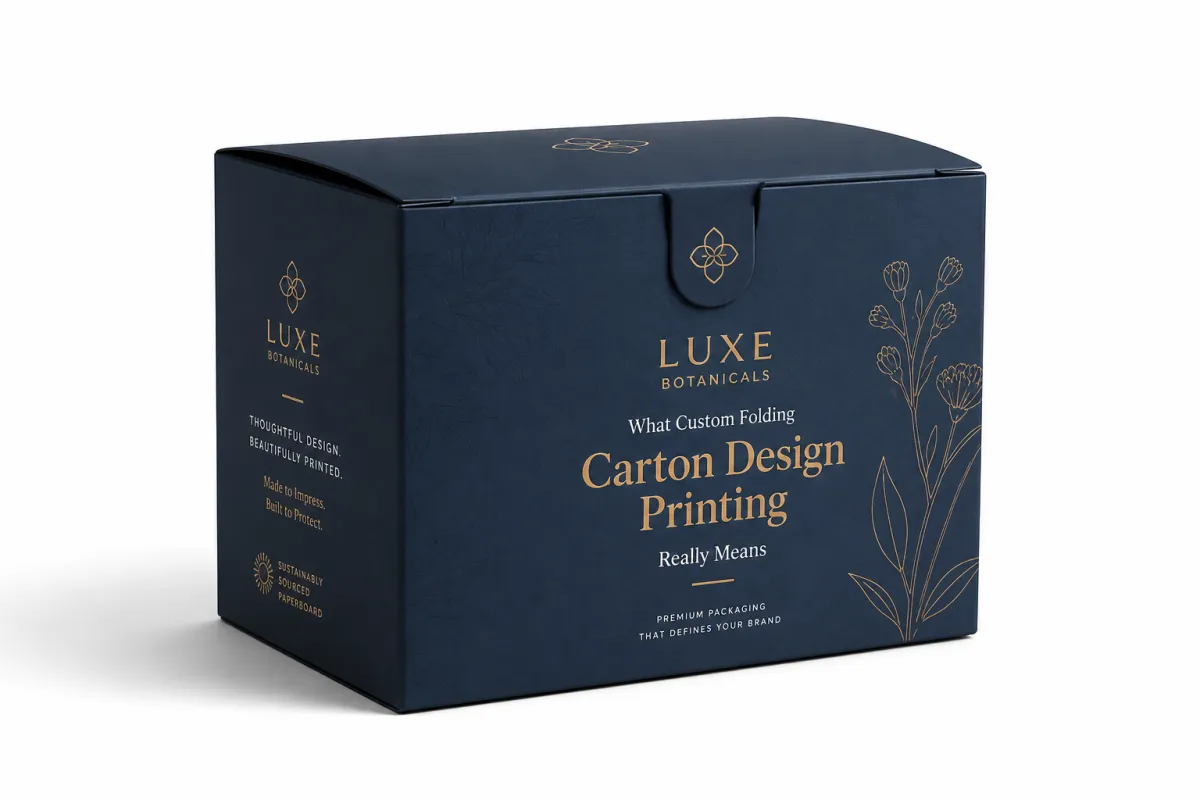
Custom folding carton design printing refers to paperboard packaging engineered to fold flat, ship efficiently, and present a product cleanly on shelf or in an unboxing moment. It is not the same thing as a corrugated shipper, and it is not a plain box you decorate later. A folding carton is usually made from paperboard such as SBS, C1S, C2S, or recycled board, then die-cut, scored, folded, and glued into its final shape.
That distinction matters because each format has a different job. A corrugated shipper is built for strength and transit abuse. A folding carton is built for presentation, information, and fit. A plain box may hold a product, but it rarely does much for package branding. Custom folding carton design printing sits in the middle: enough structure to protect, enough print surface to sell, and enough flexibility to work across multiple product categories.
Here is where buyers get tripped up. A carton can look premium in a mockup and still fail in production because the tuck flap is too short, the panel proportions are awkward, or the barcode lands too close to a fold. On a screen, everything looks neat. On press, the die, the board thickness, and the glue pattern start arguing with the artwork. I have seen clean-looking concepts turn into frustrating production fixes because nobody measured the real product early enough. That part is boring, but it matters more than the fancy render.
Custom folding carton design printing is also a tactile decision. The buyer feels board stiffness, sees ink density, notices whether the opening feels clean, and makes a judgment in seconds. In e-commerce, that same carton becomes part of the unboxing. In retail, it has to hold attention from a shelf distance of 3 to 6 feet, which is where simple hierarchy matters more than fancy effects.
From a packaging buyer’s point of view, the value is not just in the image. It is in how the carton performs under real conditions. The right structure, material, and finish make the product feel more credible. The wrong choices make even a good brand look rushed. That is why custom folding carton design printing is never only an art file exercise.
Think of the carton as the last silent salesperson in the chain. A strong one supports product packaging and makes the product feel worth the price. A weak one makes people notice packaging problems before they notice the product.
How Custom Folding Carton Design Printing Works
Custom folding carton design printing follows a predictable path, but the pace depends on how disciplined the inputs are. The workflow usually starts with product dimensions and ends with die-cutting, folding, gluing, and pack-out. If any step gets vague, the next step gets expensive.
- Measure the product. Record length, width, height, weight, opening direction, and any inserts or closures that affect fit.
- Build the dieline. The dieline maps scores, cuts, glue areas, and folds. This is the structural skeleton of the carton.
- Place the artwork. Graphics should follow the structure, not fight it. That includes bleed, safe zones, barcode placement, and panel hierarchy.
- Proof the file. A PDF proof checks layout. A digital mockup checks appearance. A printed sample checks reality.
- Run production. The press run, die-cutting, folding, and gluing happen after approval.
- Inspect and pack. Final checks catch warped board, weak glue, damaged corners, and print drift.
The structure and print design have to be solved together. If the carton opens from the top, the most important brand message should not be buried on a panel nobody sees. If the carton has a window, the window must not cut through important copy or a key image. That sounds obvious. It still gets missed.
Proofing is another place where custom folding carton design printing succeeds or falls apart. A PDF proof is useful for spelling, alignment, and layout. A digital mockup helps people visualize the finished piece. A printed sample is the first real check of color, board feel, and closure performance. If the carton is tight or premium, skipping the physical sample is a gamble that usually costs more later.
Typical timeline checkpoints
Simple jobs with a standard dieline, basic artwork, and no special finish can move quickly after approval. In practice, that may mean 7 to 12 business days for production once the proof is signed off. Custom structures, special coatings, foil, embossing, or new tooling push that out. A more realistic window is often 12 to 20 business days, and complex projects can run longer if revisions drag.
Delays usually come from three places: missing measurements, late artwork changes, and decision-making by committee. The last one is especially expensive. Three stakeholders can turn a two-day proof cycle into a two-week argument, and nobody really enjoys that.
For teams that need packaging support across multiple SKUs, it helps to review available Manufacturing Capabilities early. That is the easiest way to match structure, print method, and finishing options before anyone commits to a direction that will not scale.
Custom folding carton design printing also depends on print method. Offset printing is usually the better choice for larger runs and sharper color control. Digital printing makes more sense for shorter runs, test launches, and faster revisions. Neither one is magic. Each has a sweet spot, and pretending otherwise is how budgets get blown.
Custom Folding Carton Design Printing Costs and Price Drivers
Price is where custom folding carton design printing gets practical very quickly. A carton quote is usually shaped by board stock, size, print coverage, quantity, finish, and how much setup the job needs before the first good carton comes off the line. Anyone who says one price fits all is either guessing or selling you a headache.
The biggest cost drivers are usually easy to spot:
- Board stock: SBS, C1S, C2S, recycled board, or FSC-certified paperboard change both the look and the cost.
- Quantity: Setup costs hurt far more below 1,000 units. As volume rises, the unit price drops.
- Print method: Offset printing often wins on larger runs. Digital printing is usually better for smaller or changing runs.
- Color count and coverage: Heavy ink, solids, and full-bleed artwork increase press time and drying demands.
- Finish: Matte, gloss, soft-touch, foil, embossing, and spot UV all add labor or tooling.
- Structural complexity: Special folds, inserts, windows, and unusual closures add setup and die-cut risk.
For short runs, setup costs dominate the quote. A small batch of 500 cartons may carry a per-unit price that feels high because the plate, die, proofing, and press setup are being spread over very few pieces. At 5,000 or 10,000 pieces, the same setup gets diluted. That is why unit pricing drops hard once volume climbs.
Here is a rough buying view of common scenarios in custom folding carton design printing. These are broad ranges, not promises, because spec changes move the number fast, and regional labor or paper availability can shift them more than people expect.
| Run size | Common spec | Typical unit price | Typical setup/tooling | Best fit |
|---|---|---|---|---|
| 500 units | Standard board, 1-2 colors, no special finish | $0.85-$2.25 | $250-$900 | Tests, local launches, limited editions |
| 1,000 units | Full-color print, standard die-cut, basic fold | $0.45-$1.35 | $250-$1,100 | Early-stage product packaging and small retail runs |
| 5,000 units | Four-color process, matte or gloss coating | $0.18-$0.48 | $350-$1,500 | Established retail packaging and repeat orders |
| 10,000+ units | Higher coverage, premium finish, tighter specs | $0.12-$0.32 | $450-$2,500 | Broader distribution, stable SKU programs |
Special features change the math. Foil stamping often adds a separate tooling step. Embossing or debossing adds dies and registration control. Spot UV adds finish cost and can be sensitive to artwork density. If the carton uses multiple SKU versions, each version may add setup or version control cost. A clean quote should show those line items instead of hiding them.
The smartest rule in custom folding carton design printing is simple: spend on the feature customers will actually notice. If the brand sells on texture, a soft-touch finish can earn its keep. If the shelf story depends on color, put the money into ink control and better board. If the box will be opened and displayed, consider structural clarity before you throw money at foil just because the sample book looks shiny.
For sourcing, it also helps to know where the board comes from. FSC-certified paperboard can support sourcing goals without forcing the design into a compromise. If sustainability claims matter, reference the source directly through FSC-certified paperboard standards rather than guessing at what sounds responsible. Packaging people notice that difference. So do auditors.
One more practical point: quotes for custom folding carton design printing should be compared on the same basis. Ask for board grade, exact dimensions, print method, finish, and quantity. If those details are missing, two quotes are not actually comparable. They are just two different ways of hiding uncertainty.
For product lines that also need retail-ready SKUs or display packaging, review Custom Packaging Products before making a final spec. It is easier to align one carton family across a line than to redesign everything after the first quote comes back higher than expected.
Step-by-Step Custom Folding Carton Design Printing Process
Good custom folding carton design printing follows a disciplined sequence. Skip the sequence, and you usually pay for it in revisions, reproofs, or late-stage panic. The process is not glamorous, but it works.
1. Start with product specs
Measure the product as it will actually be packed, not as it looks on a spec sheet. Record dimensions, weight, fill method, shelf orientation, and any insert or closure detail. Include required copy, legal text, barcode dimensions, and any claims that must fit on the carton. If the product is a supplement, cosmetic, food item, or small electronic item, the on-pack information can take more space than the brand team expects.
2. Build the dieline first
The dieline is the backbone of custom folding carton design printing. Build it before you finalize the artwork so the design wraps the carton correctly. That means accounting for glue flaps, tuck ends, scoring, folds, and panel depth. A good dieline saves you from the classic mistake where a beautiful front panel gets sliced in half by the closure.
3. Design with hierarchy in mind
The front panel should say the one thing the buyer needs first. The side panels can carry supporting claims, ingredients, instructions, or compliance text. The back panel can handle the longer narrative. In retail packaging, the eye moves fast. If the visual hierarchy is confused, the carton becomes a cluttered poster instead of a product package.
Leave space for the barcode, batch code, and any traceability marks. Keep small type above a readable size, especially on textured board. On many cartons, 6 pt is the practical floor for dense legal copy, but 7 to 8 pt is safer if the board has a rougher surface. Thin strokes and low-contrast color are risky on anything but the smoothest stock.
4. Choose stock and finish for handling, not just mockups
Material choice changes how the carton behaves. A 14pt or 16pt board may be enough for a light cosmetic item, while a heavier product may need 18pt or 24pt board for better stiffness. A coated stock can hold sharp graphics better than an uncoated surface. Matte and soft-touch feel premium, but they also show scuffs differently than gloss. Custom folding carton design printing should be chosen for the hand feel and handling pattern, not just the render.
5. Approve proofs in the right order
First check the structure. Then check the artwork. Then check the sample. If the structure is wrong, the print proof does not matter yet. If the artwork is wrong, a perfect sample is still a problem. For premium jobs, ask for a printed mockup or short-run sample before the full run. That catches panel misalignment, closure friction, and color shifts before the whole batch is locked in.
6. Run production and inspect the output
During production, the cartons are printed, die-cut, folded, glued, and packed. A final inspection should check score quality, glue strength, corner integrity, print consistency, and how the carton closes with the product inside. If the closure pops open, if the glue flap shows through, or if the carton bows from ink load, that needs to be corrected before shipment.
“If the carton is supposed to sell the product, do not make it behave like a shipping box with a fancy photo on top.”
That line sounds blunt because it is. Custom folding carton design printing is most successful when the structure is doing real work and the branding is doing real work. One should not sabotage the other.
Common Mistakes in Custom Folding Carton Design Printing
The mistakes in custom folding carton design printing are usually not exotic. They are ordinary oversights that get expensive because they happen late. That is the annoying part. Most of them are preventable with a tighter checklist.
- Designing before confirming dimensions. Panels, folds, and closures need to be locked before the graphics are finalized.
- Using tiny type on the wrong stock. What reads fine on a monitor may disappear on textured board or low-contrast backgrounds.
- Ignoring glue flap space. If the artwork crowds the glue area, the carton can look clean in file form and messy in production.
- Forgetting barcode and compliance placement. That is the kind of mistake that gets noticed after the print run, which is exactly too late.
- Loading every finish into one carton. Foil, embossing, spot UV, and heavy solids can fight each other and make the design feel busy instead of premium.
- Skipping a real sample. Screens are helpful. They are not cardboard.
Another common problem is color expectation. A brand sees one render, expects one shade, and gets something else because the board absorbs ink differently than the monitor predicted. That happens all the time in custom folding carton design printing. The fix is not magical; it is better proofing, clearer board specs, and a sample before full production.
Heavy ink coverage also deserves attention. Large dark solids can increase drying time, make cartons warp, and raise waste on the press. If the carton has a full-black panel or deep color field, ask what that does to production speed and finish consistency. The quote should reflect that reality.
Another trap is assuming more finishes equal more value. They do not. A carton with one strong premium cue usually looks better than one with five competing tricks. In practice, one precise foil hit or one well-placed emboss often beats a design that tries to use everything in the sample book. The market is full of loud packaging. Good custom folding carton design printing is usually clearer than loud.
If the carton will travel through fulfillment or retail distribution, package testing matters too. For transit stress, ISTA test procedures are a useful reference point. They help you think about vibration, drop risk, and compression before the first customer does the testing for you.
One last mistake: buying the cheapest quote without checking the spec details. The low bid may have thinner board, less accurate print control, or a looser tolerance on the die-cut. That is not savings. That is deferred disappointment.
Expert Tips for Better Custom Folding Carton Design Printing
If you want custom folding carton design printing to come out right the first time, think like a packaging buyer, not a graphic designer in a vacuum. The carton has to survive handling, hold its shape, fit the product, and still tell the brand story fast. That is a lot to ask from a piece of paperboard, so the spec has to be sensible.
Tip 1: Match the board to the product weight and shipping stress first. A gorgeous carton that crushes in transit is a bad carton. For lighter items, a standard paperboard can be enough. For heavier or more fragile products, ask whether the board should be thicker, whether an insert is needed, or whether the carton needs support from the shipper.
Tip 2: Use one premium cue instead of five. In custom folding carton design printing, a focused finish usually looks more expensive than a crowded one. Matte board with a single foil logo can feel cleaner than a carton that mixes foil, emboss, spot UV, and full-coverage dark ink without a clear hierarchy.
Tip 3: Ask for the dieline, material spec, and line-item quote. If you cannot compare the same spec from vendor to vendor, the lowest number is meaningless. That is the part everyone hates to admit. It also saves money.
Tip 4: Request a printed sample when tolerances matter. This is especially useful for cartons with tight fits, unusual folds, window cutouts, or exact color expectations. The sample tells you more than a screen mockup ever will.
Tip 5: Keep an eye on ink coverage and drying. Large solids can slow output and create warp. That matters in custom folding carton design printing because a warped carton can stack badly, glue badly, and present badly. The design may look great in a PDF and still make production annoying. Those are not the same thing.
Tip 6: Use the carton to support the product story, not to repeat the same message ten times. Buyers are usually scanning for brand, variant, size, and trust signals. The carton should make those easy to find. If the shelf story is clear, the package does not need to shout.
For teams that need a better sense of what is possible across formats, browse the Custom Packaging Products catalog alongside the broader Manufacturing Capabilities. That combination helps you choose a carton style that matches the product instead of trying to force the product into a box that only exists in somebody’s imagination.
If sustainability is part of the brief, look at the board source and the end-of-life story early. Depending on the substrate and coatings, recycling behavior changes. If the carton needs a fiber certification, verify it up front. That is cleaner than writing vague eco language and hoping nobody checks.
One more practical observation: digital printing can be a smart choice for market tests, seasonal launches, and frequent artwork updates. Offset printing usually wins on larger, steadier runs where color control and per-unit economics matter more. Both are good tools. The right one depends on quantity, timing, and how often the artwork will change.
Next Steps for Smarter Custom Folding Carton Design Printing
The easiest way to improve custom folding carton design printing is to spec it like a production tool, not a mood board. Measure the product. Define the quantity range. Decide what the carton must do on shelf, in transit, and in the hand. Then build from there.
Before you request quotes, gather four things: exact product dimensions, target quantity, preferred finish level, and any compliance or barcode requirements. If you already know the box must feel premium, say what that means. Do you want texture? Color depth? A soft-touch surface? A foil accent? Specifics beat adjectives every time.
Then ask for at least one dieline, one material recommendation, and one apples-to-apples quote from each vendor. If someone refuses to quote the actual spec, that is a sign, and not a good one. Compare lead times too. A low quote is useless if it arrives after your launch window closes.
Build a prototype with the actual product inside. Check fit, closing strength, readability, barcode placement, and shelf impact under real lighting. A carton that looks good on a bright monitor and awful under retail LEDs is not finished. It is just untested.
If you are designing several SKUs, try to reuse a carton family where it makes sense. Shared structure can reduce tooling, simplify inventory, and keep the brand system cleaner. That is a far better use of budget than reinventing every size from scratch.
Custom folding carton design printing works best when structure, print, and cost all point in the same direction. Get those aligned, and the carton does its job without drama. Miss that alignment, and the first sign of trouble is usually a reprint invoice. Nobody enjoys that.
For brands building retail packaging that has to look polished and hold up in production, a careful spec is the difference between a box that sells and a box that just exists. That is why custom folding carton design printing deserves the same attention you give the product inside it.
The most useful takeaway is also the simplest: lock the product dimensions, choose the board and finish for how the carton will actually be handled, and approve a physical sample before you greenlight the full run. That one habit catches more expensive mistakes than any fancy checklist ever will.
What is custom folding carton design printing used for?
It is used for retail packaging, cosmetics, food, supplements, small electronics, and other products that need structure plus branding. It works best when the carton has to protect the product, sell the product, and carry required information on shelf.
How long does custom folding carton design printing usually take?
Simple projects can move quickly after artwork approval, while custom structures, special finishes, or new tooling add time. Plan extra time for dieline review, proofing, and any sample round if the fit or closure matters. If revisions stack up, the schedule can stretch pretty fast.
What affects custom folding carton design printing cost the most?
Quantity, board stock, carton size, and print method usually move the price more than anything else. Special finishes, tooling, and complex die-cuts can raise the quote fast, especially on low-volume jobs. Artwork coverage and the number of SKU versions can nudge pricing too.
Do I need a prototype before ordering custom folding carton design printing?
Yes, if the carton has a tight fit, a premium finish, or critical regulatory and barcode placement. A prototype catches bad panel dimensions, weak closures, and awkward artwork placement before you pay for the full run. It also shows whether the carton feels right in the hand, which screens cannot tell you.
Which finish is best for custom folding carton design printing?
The best finish depends on the brand story, handling requirements, and budget, not on what looks flashiest in a sample book. Matte, gloss, soft-touch, foil, embossing, and spot UV each have different costs and visual payoff, so pick one that supports the shelf message.

