Buyer Fit Snapshot
| Best fit | Custom Folding Carton MOQ Pricing projects where brand print, material claims, artwork control, MOQ, and repeat-order consistency need to be specified before quoting. |
|---|---|
| Quote inputs | Share finished size, material target, print colors, finish, packing count, annual reorder estimate, ship-to region, and any compliance wording. |
| Proofing check | Approve dieline scale, logo placement, barcode or warning zones, color tolerance, closure strength, and carton packing before bulk production. |
| Main risk | Vague material claims, crowded artwork, missing packing details, or unclear freight terms can make a low unit price expensive after revisions. |
Fast answer: Custom Folding Carton MOQ Pricing: Costs, Specs, Timing should be specified like a repeatable production item. The safest quote records material, print method, finish, artwork proof, packing count, and reorder notes in one written spec.
Production checks before approval
Compare the actual filled-product size with the drawing, then confirm tolerance on folds, seals, hang holes, label areas, and retail display edges. Reserve space for logos, QR codes, warning copy, and material claims before decorative graphics fill the panel.
Quote comparison points
Review material grade, print process, finish, sampling route, tooling charges, carton quantity, and freight assumptions side by side. A quote is only useful when the supplier can repeat the same color, closure quality, and packing count on the next order.
Custom Folding Carton MOQ pricing can look tidy on a quote sheet. Then a 2 mm size tweak, a soft-touch coating, or a window cut changes the whole math. Buyers learn that fast. custom folding carton MOQ pricing is rarely one number doing one job. It is setup, board yield, press efficiency, finishing, and the amount of product needed before the run stops making sense.
If you are comparing Custom Folding Carton MOQ pricing for a launch, a refill, or a shelf refresh, do not chase the lowest unit price like it means something on its own. It usually does not. The real question is what sits behind the number, what can be trimmed without weakening the box, and which specs deserve the spend. That is the difference between a quote that looks fine in email and one that survives production without drama.
Custom Folding Carton MOQ Pricing: Why Small Changes Matter
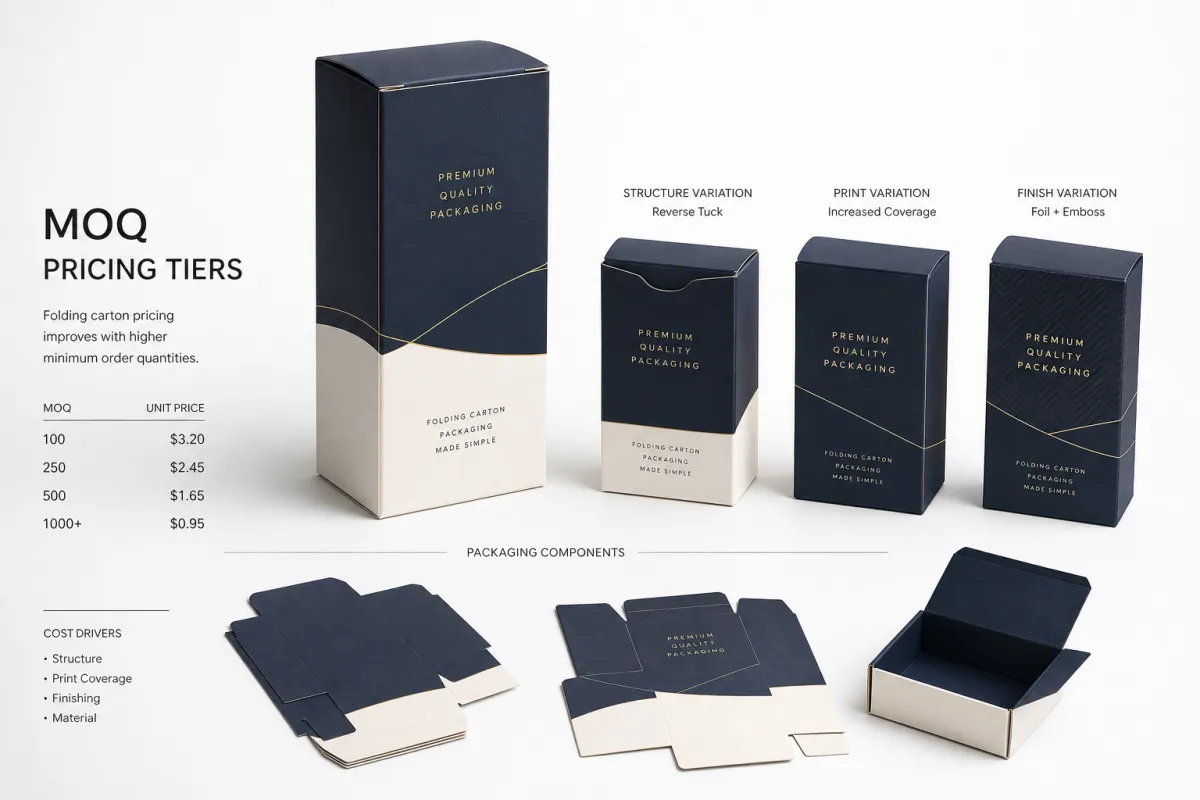
A brand usually starts with a simple request: “We need a carton. What is the price?” Then the real details show up. The product is 1.5 mm taller than expected. The insert has to keep it upright. The shelf panel needs a barcode, a claim, a legal line, and the logo block. Suddenly, custom folding carton MOQ pricing is not a generic quote anymore. It is a manufacturing puzzle with a deadline attached.
I have seen small packaging changes turn a clean estimate into a mess. Not because anyone was sloppy, but because folding carton production is unforgiving about details. A shift in finished size changes how many pieces fit on a press sheet. A move from aqueous coating to soft-touch lamination changes finishing time and waste. Add a window patch and the quote picks up extra labor, extra materials, and another setup step. custom folding carton MOQ pricing reflects those choices whether the buyer wants to think about them or not.
That is not a flaw in the process. It is what happens when a box has to do real work. The mistake is comparing per-carton numbers without checking what is inside them. One supplier may include prepress review, dieline checking, and shipping cartons. Another may bill tooling, proof samples, and freight on top. That is not a real comparison. That is a number on a page pretending to be a final answer.
For a useful buying decision, treat custom folding carton MOQ pricing as three questions:
- What minimum run keeps production efficient?
- What setup or tooling charges sit outside the unit price?
- Which design choices reduce waste without wrecking branding or shelf impact?
Lower MOQs almost always push the unit cost up. Fixed costs have fewer cartons to absorb them. Still, the gap is not always brutal. A better board choice or a smarter layout can narrow the spread enough to keep the project alive. That is why custom folding carton MOQ pricing belongs in both design and sourcing conversations, not just purchasing. If the carton is a launch vehicle, the structure and the budget need to be talking to each other from the start, not arguing later.
A carton quote is a production plan wearing a nicer shirt. If the plan is efficient, the price behaves. If the plan is fuzzy, the quote punishes everybody for it.
For readers comparing branded packaging options across multiple formats, our Custom Packaging Products page is a useful place to start, and the FAQ covers common order questions that come up before a formal quote is requested.
One more thing buyers often miss: custom folding carton MOQ pricing can shift fast while artwork is still changing. If the structure is locked but graphics keep moving, the estimate may still be usable, yet the final run price can change after prepress review. Clean quotes come from teams that know the dimensions, finish goals, and quantity target before asking for numbers.
What a Custom Folding Carton Includes
A folding carton is not just printed paperboard. It is a system. The substrate carries the product, the structure protects it, the print sells it, and the finish helps it survive handling without looking like a mailer that lost a fight. Once buyers understand those layers, custom folding carton MOQ pricing gets easier to read.
Start with the substrate. Common choices include SBS, C1S artboard, C2S board, and some recycled-content boards depending on the application. Thickness usually lands in the 14pt to 24pt range, though product weight, box size, and shelf goals matter more than the number alone. A light cosmetic item and a denser health or household product do not belong in the same structure, even if the artwork looks similar. That difference feeds directly into custom folding carton MOQ pricing.
Then comes structure. Reverse tuck cartons are popular because they are easy to make and efficient to fill. Straight tuck cartons often look cleaner at the opening edge. Auto-bottom or crash-lock styles speed up assembly and make sense when manual folding time would otherwise drive labor costs higher. Each style changes the price in different ways, which is why custom folding carton MOQ pricing cannot be judged from artwork alone.
Print and finish are the next layer. Some brands need a simple four-color exterior and nothing else. Others want spot colors, foil stamping, embossing, matte film, and a soft-touch feel. Those are not interchangeable upgrades. They affect make-ready time, waste allowance, and finishing labor. A buyer ordering premium custom printed boxes should expect a different price structure than someone ordering a plain one-color carton.
Internal features matter too. Inserts, partitions, glued tabs, and product supports can improve presentation and protection, but they also add time and material. Window cut-outs and acetate patches do the same. In retail packaging, those details often matter more than the artwork because they decide whether the product arrives intact and looks polished on the shelf.
The main point is simple: the carton is a stack of decisions, not a single SKU. When each layer is defined clearly, custom folding carton MOQ pricing gets more accurate and the production path gets less risky.
From a packaging design standpoint, the carton also has to do several jobs at once. It needs shelf presence, readable copy space, barcode placement, compliance text, and enough structure to support the product through handling. Strong packaging design and a clear product packaging brief usually produce better pricing conversations than vague creative direction. The more the function is defined, the less guesswork ends up in the quote.
Specifications That Shape the Carton
If there is one place where custom folding carton MOQ pricing changes quickly, it is the spec sheet. Dimensions, board grade, color count, coating, and structural complexity all push the number in different directions. A buyer who knows which specs matter can usually make better tradeoffs without weakening the package.
Finished dimensions come first because they determine sheet yield. A carton that fits cleanly across the press sheet wastes less board than one that leaves awkward gaps. That matters more than many people think. Two cartons with the same surface area can still produce different unit costs if one nests better in the imposed layout. For custom folding carton MOQ pricing, yield often outranks almost every other variable.
Board grade and caliper matter next. A 16pt SBS may be enough for a lightweight retail item, while a thicker board may be required for a heavier product or a box that needs a more substantial feel. If the product will travel through e-commerce or mixed freight, the carton may need extra stiffness to hold its shape. That can increase material cost, but it may reduce damage and rework later. Good buyers compare those costs together instead of treating them separately.
Print coverage is another major driver. A carton with one color and minimal ink coverage behaves very differently from one with full-bleed graphics, inside printing, and multiple spot colors. Add foil, embossing, or spot UV, and custom folding carton MOQ pricing starts to reflect more than materials. It reflects setup and finishing time too. If the design uses premium visual effects, the MOQ usually has to rise to keep the per-unit cost in a workable range.
Coating should never be an afterthought. Aqueous coating is common for protection and scuff resistance. Matte or gloss lamination creates a different feel and may be better for higher-end branded packaging. Soft-touch gives a distinctive tactile finish, but it also affects cost and sometimes recyclability discussions. If a brand is trying to align with FSC sourcing claims or broader sustainability messaging, the finish choice should be reviewed alongside the board choice. More on sourcing standards is available through FSC.
Compliance and panel space can also alter pricing. Nutrition panels, ingredient statements, warnings, regulatory copy, and barcode windows all consume real estate. When space is tight, the carton may need a larger format or a revised layout. That is one of the quiet drivers behind custom folding carton MOQ pricing: compliance design can be a cost issue, not just a legal one.
Here is a practical comparison of how spec choices usually influence MOQ and unit economics:
| Carton Option | Typical MOQ Range | Typical Unit Cost Trend | Best Fit |
|---|---|---|---|
| Simple reverse tuck, one-side print, aqueous coat | 2,500 to 5,000 | Lowest setup pressure; often about $0.18-$0.40 per unit depending on size | Launches, samples, light retail packaging |
| Straight tuck, full-color print, matte finish | 5,000 to 10,000 | Moderate unit cost; often about $0.14-$0.32 per unit | Consumer goods, branded packaging, shelf-ready product packaging |
| Auto-bottom with foil, embossing, or window patch | 10,000+ | Higher setup but better absorption at scale; often about $0.22-$0.55 per unit on smaller runs | Premium retail presentation, heavier products, custom printed boxes |
Those ranges are directional, not promises. The same artwork can land at very different numbers depending on board usage, waste, and how much finishing the run needs. That is why custom folding carton MOQ pricing should always be compared with equivalent specs, not just equivalent artwork.
For brands selling into shelf-based retail packaging, the finish should also be viewed through the lens of handling. A glossy surface may photograph well but show scuffs sooner. A matte board may feel more restrained but hide minor wear better. In practice, the right choice depends on whether the box has to stand out on a display tray, survive fulfillment, or do both. Sometimes the prettiest option is the one that looks great on a render and then gets chewed up in transit. That is not a win.
One useful benchmark for shipping and distribution is the testing framework from the International Safe Transit Association. If a carton has to move through parcel or retail distribution, checking ISTA test methods can prevent a cheap-looking package from turning expensive after damage claims start.
Custom Folding Carton MOQ Pricing Factors That Move the Quote
The quote actually takes shape here. custom folding carton MOQ pricing is usually built from fixed setup costs and variable production costs, then adjusted for waste, finishing, and handling. The math is ordinary. The outcome usually is not.
Setup costs are the first piece. Platemaking, die cutting, press make-ready, and prepress review all happen before a single sellable carton leaves the line. Those costs do not disappear just because the order is small. They get spread across fewer units. That is why lower quantities usually carry a higher unit price. For custom folding carton MOQ pricing, quantity is not just a volume metric; it is a cost absorber.
Press efficiency is the second piece. A larger run can often be imposed and printed more efficiently because the line is not stopping as often for setup or inspection. That lowers the cost per carton. If the artwork is simple and the board layout is efficient, the savings can be meaningful. If the artwork needs multiple passes, specialty ink, or unusual registration, the savings shrink quickly.
Waste allowance is the line item buyers tend to ignore until it shows up in the estimate. Every job needs a margin for spoilage, start-up sheets, and process control. Complex coatings, heavy coverage, or tight tolerances usually increase that allowance. It is one reason why custom folding carton MOQ pricing can look less attractive on small decorative runs than on plain utility cartons.
Finishing and assembly can move the number just as much as print. Die cutting, gluing, window patching, foil, embossing, and special folding sequences all add labor. If hand assembly is required, the cost profile changes again. Many buyers underestimate the gap between a carton that folds cleanly on a machine and one that needs extra manual intervention. The first can be priced like a manufacturing job. The second starts to feel like a labor project.
Packaging and freight for shipment are part of the real cost, even if they are not always built into the carton quote. A strong unit price can still lose the comparison if one supplier charges more for palletization, export cartons, or shipping. The smartest way to review custom folding carton MOQ pricing is to compare landed cost, not just the carton number.
To make that concrete, here is how two quotes can look similar and still end up in different places:
| Quote Element | Option A | Option B | Why It Matters |
|---|---|---|---|
| Unit price | Lower headline number | Higher headline number | The headline figure can hide extra fees elsewhere |
| Tooling / die / plate charges | Billed separately | Included | Changes the true project spend |
| Proofs | Extra cost | Included | Affects both budget and approval timing |
| Freight | Not included | Included to one location | Can erase a unit-price advantage |
| Total delivered cost | May end up higher | May end up lower | The real comparison for a buyer |
Custom folding carton MOQ pricing should always be measured against the purpose of the order. A brand validation run can tolerate a slightly higher unit cost if the MOQ is lower and the risk is smaller. A national retail launch usually needs the opposite: tighter cost control, more stable production, and fewer revisions. The right answer is not always the cheapest carton. It is the one that fits the launch plan.
Honestly, this is where packaging buyers can save money without wrecking presentation. Cut unnecessary print effects. Choose a board that is strong enough but not oversized. Simplify the carton style if the structure is doing more work than the product actually needs. Those moves do more than lower the number on a quote. They can improve the entire product packaging strategy.
For buyers who want to compare a broader range of formats, our Custom Packaging Products page shows how carton structure fits alongside other branded packaging options. The best quote is rarely the most ornate one. It is the one that makes production repeatable.
Process and Timeline: From Quote to Production
A solid quote process saves money. It also saves time. custom folding carton MOQ pricing is most reliable when the request includes exact dimensions, material expectations, artwork status, finish requirements, and a realistic launch date. A vague RFQ usually creates a vague estimate, and vague estimates do not help anyone make a purchase decision.
The workflow usually follows a predictable sequence: RFQ, specification review, estimate, proofing, sample approval, production, and shipment. Each stage has its own delay risk. The biggest issue is often not the press. It is the information that arrives before the press. If the dieline is missing or the art files are incomplete, the estimate can still be generated, but custom folding carton MOQ pricing will be less stable until the details are locked.
A good RFQ should include:
- Exact finished dimensions in inches or millimeters
- Board preference or minimum caliper target
- Print coverage, inside print, and special effects
- Target quantity range, not just one number
- Deadline, shipping destination, and whether proofs are required
That last detail matters more than many teams expect. A proof can be digital, hardcopy, or production-ready depending on the job. Each version affects timing and cost in a different way. If a carton has tight registration, unusual die lines, or legal text that must be checked carefully, a more complete proof stage is usually worth the extra step. It reduces risk before the full run starts, which is exactly where custom folding carton MOQ pricing can go sideways if errors are found late.
Standard production moves on a steady rhythm once approvals are complete. Rush work is possible in some cases, but only when material availability, press capacity, and customer approvals line up. If one of those pieces slips, the timeline slips too. That is why a buyer should treat “rush” as a constrained option, not a casual promise.
For distribution-sensitive jobs, ask whether the carton will be evaluated against shipping performance standards or customer requirements. The testing protocol may be as simple as internal drop testing, or it may follow an external framework such as ISTA or ASTM D4169. Either way, the right test method can keep a box from failing after it enters the channel. When the pack is tied to branded packaging and shelf image, failure gets expensive fast.
Most importantly, timeline and MOQ are connected. A higher MOQ may fit the press better, but if the launch date is tight and the artwork is still moving, the safer move may be a smaller first run with a cleaner structure. That is a practical tradeoff, not a compromise. Good custom folding carton MOQ pricing supports the launch plan instead of forcing the launch to serve the carton.
A useful internal reference point is our FAQ, where common lead-time and approval questions are grouped for faster review. If the order is part of a larger branded packaging rollout, those answers can help the team get aligned before the estimate request goes out.
Why Choose Us for Custom Folding Cartons
Buyers do not ask for a carton supplier because they want another name in a spreadsheet. They ask because they want fewer surprises. That is the standard we aim for. The value is not just making boxes. It is making custom folding carton MOQ pricing easier to understand, compare, and approve.
A strong carton partner should do three things well: understand print and structure, identify the real cost drivers, and flag issues before the order moves into production. That matters because packaging design decisions are often made under time pressure. A quick estimate can become expensive if the spec is wrong, the board is oversized, or the finish is more complicated than the product actually needs.
Here is the advantage of a manufacturer-led approach over a vague broker-led quote. The team closer to production can spot where the layout wastes sheet space, where a board upgrade is unnecessary, or where a finish is adding cost without improving retail packaging performance. That kind of feedback is practical. It is not sales theater. It is how custom folding carton MOQ pricing becomes a useful decision tool instead of a mystery number.
It also helps when the supplier can handle different launch stages. Some projects need a small validation run first. Others need a larger commercial order with consistent color and repeatable folding performance. A good packaging partner should be comfortable quoting both. If the project starts small, the spec can often be adjusted later to improve unit cost as the order scales. That flexibility matters in product packaging because the first run and the tenth run rarely serve the same business purpose.
There is also a trust issue. Buyers Need to Know whether the quote includes proofs, whether the board is FSC-certified, whether the finish choice matches the sustainability claims, and whether freight is bundled or separate. Those details are not extras. They are part of the economics. The better the disclosure, the easier it is to compare custom folding carton MOQ pricing across vendors without wasting time.
For brands that care about fiber sourcing or environmental statements, FSC documentation can be a meaningful requirement. For teams that need distribution validation, ISTA protocols can help define the test plan. Those are not decorative details; they are the kind of standards that separate a strong carton from a weak one. Buyers who ask about them early usually get better answers and fewer corrections later.
One last point: packaging buyers often want a single best number. Fair instinct. Wrong target, sometimes. A slightly higher unit price with a lower MOQ and a cleaner approval path can beat the cheapest quote. So can a more efficient carton style that costs less to produce and is easier to ship. custom folding carton MOQ pricing is most useful when it helps you choose between those options with clear eyes.
Next Steps to Get Accurate Pricing and MOQ
If you want a quote that can actually be used, start by gathering the details that move the number. Exact dimensions. Product weight. Desired board thickness. Finish preferences. Artwork status. Quantity range. Launch date. Those are the inputs that make custom folding carton MOQ pricing accurate the first time instead of revised three times.
It is also smart to request two or three scenarios instead of one. Ask for the target MOQ, a higher-volume option, and an alternate-spec version with simpler finish choices. That gives you a cleaner comparison between unit cost, total spend, and brand impact. In many cases, the alternate-spec quote reveals savings without forcing the design to look cheap. That is especially useful when the carton is doing both retail packaging and product packaging duties.
When budget pressure is real, the most effective adjustments are usually the most practical ones. Standard board instead of a specialty sheet. Fewer printed sides. No foil unless the brand really needs it. A carton size that nests efficiently. Those choices can soften custom folding carton MOQ pricing without turning the package into a compromise.
Before you approve anything, confirm whether the estimate includes:
- Prepress review and dieline checks
- Tooling, plates, and dies
- Proofs or samples
- Packaging for shipment and freight
- Any hand assembly or special finishing
If those items are not clear, the “cheapest” quote may become the most expensive one once the extras appear. That happens often enough that buyers should assume it can happen, then ask directly. Clear questions improve custom folding carton MOQ pricing more than aggressive negotiation does.
For teams that are still deciding between formats, our Custom Packaging Products page can help frame the broader selection, while the FAQ answers the recurring questions that usually slow down a first order. If you already know the structure you want, the next step is straightforward: send the specs, request matched quantity tiers, and use the custom folding carton MOQ pricing conversation to decide whether to optimize the design, adjust the quantity, or move forward with production.
custom folding carton moq pricing works best when it is treated as a procurement tool, not a guessing game. The buyers who get the strongest result are the ones who compare structure, board, finish, and quantity together, then choose the option that fits the launch rather than forcing the launch to fit the box.
What affects custom folding carton MOQ pricing the most?
The biggest drivers are carton size, board usage, print complexity, and setup costs spread across the order. Special finishes, inserts, and hand assembly usually raise the minimum quantity needed for a workable price. A quote can look lower at first glance but become more expensive once tooling, proofs, and freight are added. In practice, custom folding carton MOQ pricing rises fastest when the carton is large, decorative, and small in quantity.
Can I lower the MOQ without making custom folding carton pricing too high?
Yes, but usually by simplifying the spec instead of forcing the same design into a smaller run. Standard board, fewer finishes, and a more efficient carton size can reduce waste and soften the unit price increase. The best approach is often to compare a few quantity tiers before deciding on the final run size. That keeps custom folding carton MOQ pricing in a realistic range.
How do I compare custom folding carton quotes from different vendors?
Confirm that each quote uses the same dimensions, board grade, finish, and print method. Check whether tooling, prepress, proofs, and freight are included or billed separately. Compare delivered cost per carton, not just the headline unit price. If the specs are not aligned, custom folding carton MOQ pricing comparisons are not meaningful.
How long does custom folding carton production usually take?
The longest step is often proofing and approval, especially if the dieline or artwork is still changing. Once files are approved, standard production moves faster, but timing still depends on material availability and press capacity. Rush jobs may be possible, but they typically require simpler specs and quick customer approvals. That is why custom folding carton MOQ pricing and lead time should be reviewed together.
What should I send for the fastest custom folding carton quote?
Send exact dimensions, product details, estimated quantity, artwork files, and the finish you want. Include your target launch date and whether you need samples or production proofs. If you are unsure on specs, ask for options so the quote can show both MOQ and pricing impact. Clear input usually produces the most accurate custom folding carton MOQ pricing response.
Actionable takeaway: if you need a quote that is actually useful, send exact dimensions, board target, finish choice, quantity tiers, proof expectations, and freight destination in one shot. That is the fastest way to get accurate custom folding carton MOQ pricing and the cleanest path to a carton that fits the product instead of fighting it.

