Buyer Fit Snapshot
| Best fit | compare custom folding carton materials buyer review for packaging buyers comparing material specs, print proof, MOQ, unit cost, freight, and repeat-order risk where brand print, material, artwork control, and repeat-order consistency matter. |
|---|---|
| Quote inputs | Share finished size, material target, print colors, finish, packing count, annual reorder estimate, and delivery region. |
| Proofing check | Approve dieline scale, logo placement, barcode or warning zones, color tolerance, and any recyclable or compostable wording before bulk production. |
| Main risk | Vague material claims, crowded artwork, or missing packing details can create delays even when the unit price looks attractive. |
Fast answer: Compare Custom Folding Carton Materials Buyer Review: Dieline, Finish, Proof, and Buyer Review should be specified like a repeatable production item. The safest quote includes material, print method, finish, artwork proof, carton packing, and reorder notes in one written spec.
What to confirm before approving the packaging proof
Check the product dimensions against the actual filled item, not only the sales mockup. Ask for tolerance on folds, seals, hang holes, label areas, and retail display edges. If the package carries a logo, QR code, warning copy, or legal claim, reserve that space before decorative graphics fill the panel.
How to compare quotes without losing quality
Compare board or film grade, print process, finish, sampling route, tooling charges, carton quantity, and freight assumptions side by side. A lower quote is only useful if the supplier can repeat the same color, closure quality, and packing count on the next order.
Compare Custom Folding Carton Materials: Best Picks
If you compare Custom Folding Carton materials long enough, one thing becomes obvious fast: the board choice usually decides whether the carton survives the real world. Not the mockup. Not the pitch deck. The real world. Shipping, stacking, humidity, line speed, retail handling, and the occasional rough delivery driver all show up eventually. That is where pretty ideas get tested.
I have watched cartons look perfect in a proof and then crack on the first production run because the board was too brittle, the score was too tight, or the coating was wrong for the route to market. Not glamorous. Very common. That is why serious buyers compare custom folding carton materials against the product and the supply chain, not against a glossy sample sheet and a hopeful quote.
For custom printed boxes, the substrate shapes almost everything: print clarity, stiffness, fold memory, finishing behavior, and how the carton feels in hand. The best choice usually sits in the middle of three priorities: appearance, performance, and cost. A premium cosmetic carton, a warehouse vitamin box, and a kraft food shipper all need different answers. Same brief. Different board. Packaging loves that kind of contradiction.
Below, I break down the boards that show up most often in product packaging, where they work, and where buyers usually get burned. Short version: SBS gives the cleanest print surface, CRB and CCNB are the cost-conscious workhorses, kraft brings a natural look, and specialty boards step in when the product needs more protection or the distribution path gets ugly. The right pick depends on product weight, moisture or grease exposure, and the shelf story the brand needs to tell.
Quick Answer: Compare Custom Folding Carton Materials Fast
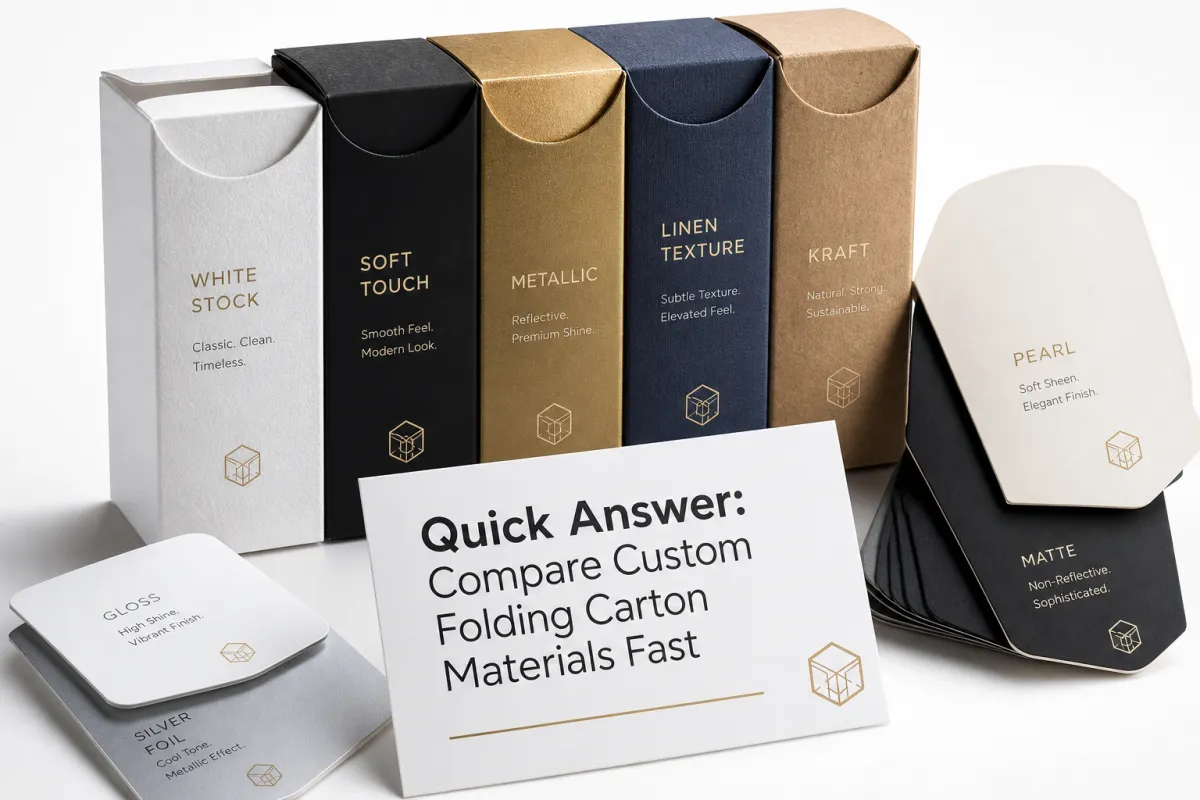
Compare custom folding carton materials by asking three blunt questions first: How heavy is the filled product? How much moisture, grease, or handling abuse will the carton face? What does the brand need the package to say the second it lands on shelf? Those three answers wipe out a lot of bad options before anyone starts debating foil, coatings, or lamination. That is a good thing. Fewer opinions. Fewer expensive mistakes.
If the goal is sharp color and premium shelf impact, SBS is usually the first board to inspect. If the goal is value and dependable print at scale, CRB or CCNB often fits better. If the brief calls for a natural, earthy look, kraft paper or unbleached stock can support that story without fake polish. For cold-chain products, heavier fills, or moisture-prone conditions, specialty structures with barrier coatings or higher caliper deserve a closer look.
I compare custom folding carton materials across four practical outcomes: stiffness, print surface, finishing behavior, and line performance. A board can look great on paper and still fight you during creasing or gluing. It can print beautifully and still scuff in transit. Packaging has a habit of exposing every weak assumption. Annoying, but useful.
Here is the fast verdict:
- SBS: best for premium cosmetics, supplements, and retail packaging that needs bright whites and fine detail.
- CRB / CCNB: best for cost-aware runs that still need respectable print quality and good stiffness.
- Kraft: best for natural branding, low-ink designs, and packaging that benefits from a visible paper texture.
- Specialty board: best for tougher distribution, heavier fills, or product protection needs that standard folding carton stock cannot handle well.
For buyers who compare custom folding carton materials with sustainability in mind, one more layer matters: a material can sound responsible and still fail the job. FSC-certified options can support sourcing goals, and you can learn more at FSC. Still, the board has to fit the application first. A carton that crushes, splits, or forces rework is a bad environmental outcome dressed up as a talking point.
The short answer: compare custom folding carton materials by matching the board to the job, not the branding deck. The best material is the one that balances appearance, run efficiency, and real-world performance without adding avoidable cost.
Top Options When You Compare Custom Folding Carton Materials
When teams compare custom folding carton materials, they usually start with the board family. Good instinct. The substrate affects coating choice, ink holdout, crease quality, and the way the finished carton feels in hand. A premium finish on the wrong board still looks tired. A simple finish on the right board can look more expensive than it is. Paperboard has that effect on people.
SBS, or solid bleached sulfate, is the premium pick in many branded packaging programs. It has a bright white face, solid rigidity for its weight, and reliable print reproduction for fine type, gradients, and dense solids. Cosmetics, wellness, medical retail items, and any package that depends on tight color control usually land here. If the carton needs to look clean, crisp, and upscale, SBS deserves a real review.
CRB and CCNB sit in the value-driven middle. They show up constantly in food, household, and mid-tier retail packaging because they offer decent stiffness at a lower board cost. The surface is less pristine than SBS, and the brightness is usually lower, but that does not make them weak choices. It just means the design has to respect the material. I have seen plenty of strong cartons built on recycled board because the artwork was designed for the board instead of against it.
Kraft paper and unbleached boards create a warmer, more natural feel. They work well for organic goods, artisan products, and brands that want a visual language with less polish and more honesty. Printing on kraft means accepting a darker base, which changes color behavior right away. White ink, strong contrast, and simpler layouts usually perform better than delicate pastel art. If the brand story depends on authenticity, kraft can carry it without trying too hard.
Specialty structures include barrier coatings, grease resistance, moisture control, and hybrid boards built for unusual distribution conditions. They are not always necessary, but they solve problems that standard folding carton stock cannot. A chilled product, a greasy food item, or a carton with a heavier fill weight may need that extra support. For teams that compare custom folding carton materials only by appearance, these boards can seem overbuilt. For anyone who has watched cartons fail in transit, they look like smart insurance.
Printability is not just about brightness. Surface behavior matters just as much. Ink laydown, gloss, matte, soft-touch, aqueous coatings, film lamination, and spot UV all react differently depending on the base board. Heavy solids on a porous board can dry well but lose depth. Soft matte on a smoother board can look premium and still scuff quickly if the carton rides through a rough distribution path.
Mechanical performance counts too. Stiffness, caliper, score quality, and crease memory can make or break the final carton. A board can carry attractive graphics and still refuse to hold a crisp fold after die cutting. That shows up later as split scores, misaligned tuck flaps, or glue joints that never sit flat. In practice, compare custom folding carton materials with printed, creased, and glued samples. Flat sheets tell half the story and leave out the annoying part.
One simple way to narrow the field is by use case:
- Premium retail shelf: SBS or another high-brightness board.
- Value-driven mass retail: CRB or CCNB.
- Natural or artisanal positioning: kraft or unbleached stock.
- Special handling or product protection: specialty or barrier board.
The better the match between material and job, the less money you burn trying to fix problems later. That is the real reason smart teams compare custom folding carton materials before artwork is finalized, not after production is already booked.
“The carton that looks a little less exciting on a render can be the one that behaves better on the line. That usually counts more.”
For practical packaging buyers, the goal is not to win a beauty contest on the spec sheet. The goal is to create custom printed boxes that protect the product, run cleanly, and support the brand without drama.
Detailed Reviews of Each Folding Carton Material
To compare custom folding carton materials honestly, you have to move past labels like “eco-friendly” or “premium” and look at how each board behaves in production. Surface smoothness, caliper, score quality, print holdout, and finished carton feel all matter. Those details shape packaging design decisions more than any sales pitch ever will.
SBS: Best for clean print and premium presentation
SBS is the board many designers reach for first because it handles high-end graphics so well. The white surface keeps brand colors vivid, and small text stays readable at tight sizes. If your carton carries skincare, dietary supplements, fragrance, or any product where visual polish matters, SBS usually performs very well. It also tends to pair nicely with soft-touch lamination and other premium finishes that signal value at shelf.
SBS is not the default answer to everything, though. It can cost more than recycled options, and the wrong coating can leave it vulnerable to scuffing in high-friction distribution. For products with lighter handling and strong shelf-facing needs, it stays one of the most dependable choices as you compare custom folding carton materials.
One technical detail people miss: SBS usually gives you better ink holdout, which helps fine type and dense solids stay crisp. That does not mean it is bulletproof. If the score is too deep or the fold pattern is crowded, even SBS can split at the crease. Clean design still matters.
CRB and CCNB: Practical workhorses for value programs
CRB and CCNB are used constantly for a reason. They give packaging teams a workable balance between cost and performance. Food, consumer goods, and light retail product packaging often land here because the board needs to be economical and still look presentable. These substrates may have a less brilliant white or a slightly duller surface, but they can still produce strong results if the design respects what they are.
Bold type, controlled ink coverage, and a finish matched to the material can make recycled board look far more refined than people expect. The mistake is asking a mid-tier board to impersonate an ultra-premium one. That is how disappointment starts. Compare custom folding carton materials against the print coverage and finish you actually plan to use, because the same board can look very different under a heavy solid versus a restrained, airy layout.
There is also a sourcing reality here. Recycled board availability can vary by region, mill, and grade, and some people talk about CRB and CCNB like they are interchangeable. They are not identical. The details shift depending on supplier and spec. If your supplier is using the terms loosely, ask for the exact construction, brightness target, and caliper range. Saves headaches later. A lot of them.
Kraft and unbleached boards: Natural, honest, and tactile
Kraft paper has a real advantage for brands that want a warm, straightforward look. The material carries part of the message before ink ever hits it. It says natural, earthy, and less processed without needing a speech. That works beautifully for organic snacks, handmade goods, wellness products, and brands that want a grounded visual identity.
The tradeoff is print behavior. Kraft has a darker base, so designers often need richer blacks, simpler color palettes, and white ink for stronger contrast. Fine details can still print well, but the art direction has to be deliberate. I would not use kraft for every premium project. For the right package, though, it can feel more believable than a heavily coated white board. It also pairs well with restrained branding and minimal embellishment.
There is a practical upside too: kraft can hide minor handling marks better than bright white stock. That matters on cartons that move through warehouses, pop-up shops, or direct-to-consumer fulfillment. It is not magic. It is just forgiving in a way glossy white stock usually is not.
Specialty and barrier boards: Built for tougher conditions
Specialty boards earn their keep in the parts of the market that do not forgive mistakes. If a carton has to resist grease, moisture, cold-chain condensation, or repeated stacking pressure, standard folding carton stock may not be enough. Barrier coatings and engineered structures help the package hold shape and protect the product where ordinary board would soften or stain.
These boards are especially useful for food packaging, chilled retail items, and products with heavier fill weights. They may cost more and require tighter coordination with the converter, but they solve real failures. That matters more than theoretical savings. I have seen teams compare custom folding carton materials on print appearance alone and miss the fact that a slightly higher-spec board would have reduced damage and complaint rates later.
Finishing gets underestimated too. Soft-touch laminate on SBS feels different from soft-touch on a recycled surface. Matte coating on kraft can emphasize fiber texture in a good way or make the carton feel dry and muted, depending on the artwork. Foil stamping, embossing, and spot varnish also react differently to each board family. That is why I always tell buyers to compare custom folding carton materials using the same finish specification whenever possible. Otherwise, they are not really comparing materials. They are comparing a pile of changing variables.
Sustainability-minded teams often assume recycled board is automatically the best answer. Not quite. Some recycled boards print beautifully and perform well. Some do not. Some natural boards are excellent for lower-ink branding. Some are not right for food safety or strong shelf graphics. The better approach is to compare custom folding carton materials on function first, then environmental messaging second. Both matter. They just do not always point to the same board.
One useful rule is simple: if the package must feel premium in hand, lean toward better surface quality. If the package must survive a harsher route, lean toward stronger structure. If the brand needs an earthy story, choose a board that tells that story honestly. That is how compare custom folding carton materials becomes a business decision instead of a guessing game.
Process and Timeline: From Spec Sheet to Sample
The process matters because the wrong sequence creates delays nobody budgeted for. Most buyers compare custom folding carton materials after the artwork already exists, but the best results usually start with the product itself: weight, dimensions, closure style, and any storage or transit concerns. Once those basics are clear, the board choice gets much easier to defend internally.
A typical sequence looks like this:
- Confirm product dimensions, fill weight, and any regulatory or food-contact needs.
- Choose two or three candidate boards and a target finish.
- Build or review the dieline so the carton structure fits the item correctly.
- Prepare artwork with the correct color expectations for the chosen stock.
- Approve a physical sample or prototype before production.
- Move into press setup, die cutting, folding, and gluing.
Where do schedules slip? Same places, every time. A client changes the carton depth after sample review. The dieline is built from an earlier product version. The finish changes late, which affects drying or lamination time. Or the team spends too long comparing custom folding carton materials without agreeing on the actual performance target. That last one is common, and expensive.
Material choice also changes lead time. Standard SBS, CRB, and CCNB options are often easier to source and faster to schedule, while specialty or barrier boards may need more procurement time and tighter minimum-order planning. If the box is tied to a launch date, do not assume every material is equally available. A standard recycled board may arrive quickly. A custom barrier stock may not.
For a normal custom run, a realistic timeline from spec approval to approved sample often lands in the 7-14 business day range, depending on complexity. Full production frequently adds another 10-20 business days, with finishing, freight, and special sourcing pushing that further. Highly finished cartons, unusual structures, or specialized coatings can stretch the plan again. Buyers who compare custom folding carton materials early tend to avoid the last-minute scramble that shows up once production is already booked and the launch date is fixed.
Testing matters too. A carton should be checked the way the customer will actually experience it. Crease it. Glue it. Fill it. Stack it. Move it through the same handling path it will see in distribution. If the program has shipping stress concerns, packaging teams often reference methods like ISTA protocols and load testing principles tied to standards such as ASTM D642. You do not need a lab for every project, but you do need a realistic test plan.
The best review is not just visual. It also looks at fold memory, panel squareness, glue bond, and whether the carton stays presentable after packout. That matters especially for retail packaging and subscription-style product packaging, where the end user sees the package long before the product gets opened. Good packaging is not only a graphic surface. It is also a little mechanical machine made of paperboard.
Here is a simple way to think about timing by material tier:
- Standard board programs: often the easiest to source and quickest to launch.
- Mid-tier recycled options: similar timing, but finish and proofing may need more attention.
- Specialty or barrier boards: longer procurement, more sample coordination, and less margin for late changes.
So when you compare custom folding carton materials, do not stop at board performance. Fold the timeline into the decision, because the fastest material is often the one that is already easy to source and easy to convert.
Price Comparison: What Each Material Really Costs
Price is where many teams get tripped up, because they compare custom folding carton materials by unit price alone. That number matters, but it is only one part of the real cost. The board, print coverage, finishing, tooling, setup waste, freight, and inventory handling all belong in the conversation. A low unit price can hide a more expensive total project if the carton causes spoilage, rework, or shipping problems.
For a practical baseline, here is how the tiers often behave on a custom Printed Folding Carton program for 5,000 units, assuming a straightforward die-cut shape and moderate print coverage:
| Material | Typical Use Case | Approx. Unit Cost | Strength / Print Balance | Best Fit |
|---|---|---|---|---|
| SBS | Premium retail, cosmetics, supplements | $0.18-$0.34 | Excellent print, strong presentation | High-visibility branded packaging |
| CRB / CCNB | Mass retail, food, household goods | $0.12-$0.24 | Good structure, moderate print | Value-focused product packaging |
| Kraft / unbleached | Natural brands, artisan goods | $0.14-$0.28 | Distinct look, moderate print constraints | Earthy package branding |
| Specialty / barrier | Moisture, grease, heavy fill, chilled goods | $0.22-$0.45+ | Highest protection, more engineering | Functional protection first |
Those ranges are not promises. They move with quantity, board availability, print coverage, finishing, and tooling complexity. A heavy flood of ink, a soft-touch laminate, or foil stamping can move the number faster than the base board choice. Short runs also carry setup inefficiency, which is why a ten-cent board difference may not mean much on a small order.
Here is the part many people miss: a more expensive board can lower total project cost. If it reduces rejects, speeds up packout, or avoids damaged cartons in shipping, the overall spend may improve. I have seen lower-cost options become more expensive once they required extra inspection, repacking, or replacement inventory. That is why compare custom folding carton materials with the full workflow in mind, not just the purchase order line.
There are also hidden costs in over-customization. Special coatings, multiple rounds of proofing, and late-stage artwork changes all add expense. So do storage decisions if you order too far ahead without confirming demand. Packaging design choices should support the business, not leave you with a shelf full of obsolete cartons.
From a buyer’s point of view, the real question is this: what does the carton cost per successful shipment, not just per printed piece? If one board protects the product better, presents better, and runs cleaner through the line, it may be the economical choice even if the unit price is higher. That is especially true for custom printed boxes used in retail packaging, where damaged appearance can hurt the brand long before the item is consumed.
When you compare custom folding carton materials, I suggest sorting the options into three buckets:
- Low-tier cost: best for simpler graphics, practical shipments, and tight budgets.
- Mid-tier cost: best for balanced programs that need respectable appearance and dependable conversion.
- Premium cost: best for shelf impact, tactile finishes, or more demanding performance targets.
There is no award for choosing the cheapest board if the carton looks tired or falls apart in transit. The best value is the one that keeps the product safe and the brand credible while still fitting the margin.
How to Choose the Right Material for Your Carton
The easiest way to compare custom folding carton materials is to build a short decision matrix around the product and the route it takes to market. Start with fill weight, fragility, moisture exposure, and compression load. Then factor in how much shelf visibility the carton has and whether the unboxing moment matters to the customer. Those inputs usually point to the right material faster than a broad brainstorming session ever will.
For heavier products, structure comes first. Stiffness, crease retention, and board memory matter more than a slightly brighter white. A carton that looks beautiful but buckles under load creates more risk than it solves. If the product is light but premium and heavily branded, surface quality can move to the top of the list. That is why compare custom folding carton materials differently for a skincare line than for a bulk vitamin bottle or a household item.
Moisture and grease exposure deserve special attention. A carton near cold-chain handling or oily contents needs more than a nice printed face. It needs a board and finish combination that can survive the environment. Barrier structures, coatings, and lamination choices become part of the package design instead of decorative extras. If the product will sit in a humid warehouse or ride through long distribution cycles, do not ignore that stress. That is kinda how cartons end up curling, staining, or softening before they even reach shelf.
Closure style and insert needs matter too. Tuck-end cartons, auto-bottom cartons, and cartons with internal supports behave differently under load. A glue area that seems minor can turn into a recurring production headache if the board surface or coating interferes with bond strength. As you compare custom folding carton materials, ask for sample builds using the real closure and any insert or tray the product needs. A flat sheet tells only part of the story.
Sustainability goals should be specific, not vague. FSC-certified fibers can support responsible sourcing. Recycled content can help. Still, if the carton fails in transit, the waste outcome gets worse, not better. That is why I recommend using environmental claims only after the functional fit is clear. Teams that compare custom folding carton materials with performance and sourcing goals in view usually end up with better packaging decisions than teams chasing a single talking point.
A practical sample test should include:
- Lighting check: review at least two samples under the same light source.
- Fit check: place the actual product inside, not a dummy weight.
- Handling check: open, close, stack, and move the carton several times.
- Finish check: inspect for scuffing, cracking, and glue-line issues.
- Line check: confirm the carton packs efficiently and consistently.
That last step corrects a lot of assumptions. A board that looks fine on a desk may slow down the packaging line. A small change in caliper can alter how the tuck flap behaves. A finish that looks elegant on screen can show fingerprints immediately. Once you compare custom folding carton materials in real conditions, the choice gets a lot clearer.
If you are building a new launch or refreshing existing package branding, keep the shortlist small: one premium board, one value board, and one sustainable or natural option. Then compare custom folding carton materials using the same dieline, the same artwork intent, and the same product weight. That is the cleanest test.
For teams that also need broader packaging support, it helps to review the available Custom Packaging Products alongside the carton material decision. The board choice, structure, and finish should work together as one system, not as three separate decisions made in isolation.
Our Recommendation and Next Steps
If you want the clearest path forward, start by compare custom folding carton materials in three lanes: a premium SBS option, a value-oriented CRB or CCNB option, and a sustainability-focused kraft or recycled option. That gives you a real comparison instead of a theoretical debate. From there, request physical samples, confirm caliper and fold performance, and test the carton with the actual filled product before you give final approval.
My recommendation is simple. Do not pick on looks alone, and do not pick on price alone. Compare custom folding carton materials against the job they need to do, then verify the choice in hand. If a board protects the product, supports the brand, and runs cleanly through production, it earns its place. If it only checks one of those boxes, keep looking.
Before release, make sure the buyer, designer, and operations team all agree on the final selection. The buyer needs margin and lead-time clarity. The designer needs surface behavior and print expectations. Operations needs a carton that folds, glues, stores, and ships without drama. That is the real checklist behind any successful custom printed boxes program.
If you are still narrowing the field, compare custom folding carton materials one last time under real handling conditions, not just a sales deck. Confirm lead times, ask for a sample build, and choose the board that protects the product while still making the brand look like it belongs on the shelf. That move usually saves the most time and money.
For buyers who need a dependable starting point, the best path is usually to compare custom folding carton materials with samples in hand, then move quickly once the right board is identified. A clean decision now prevents a lot of correction later, especially on retail packaging with fixed launch windows.
The actionable takeaway is straightforward: pick one premium board, one value board, and one protective or sustainable option, then run the same artwork and the actual filled product through all three. If the carton survives handling, holds its folds, prints cleanly, and fits the schedule, that is your answer. Everything else is noise.
How do I compare custom folding carton materials for a heavy product?
Start with stiffness, crease retention, and how the carton behaves once it is filled and stacked. If the board keeps its shape under load, that is usually the better choice even if the unit cost is a little higher. For heavier items, compare custom folding carton materials using the actual product weight, not a placeholder sample.
Which folding carton material prints best for premium retail packaging?
SBS usually gives the cleanest whites, sharpest detail, and most consistent premium finish. If brand color accuracy matters, request printed samples on the exact stock you plan to buy. That is the safest way to compare custom folding carton materials for high-end shelf presentation.
What is the most cost-effective board when I compare custom folding carton materials?
The lowest unit price is often CRB or CCNB, but real value depends on run efficiency, spoilage, and product protection. A cheap board can become expensive if it causes shipping damage or weak shelf appearance. So compare custom folding carton materials by total outcome, not just by quote.
How does material choice affect folding carton lead time?
Standard boards are usually easier to source, while specialty, recycled, or barrier boards may need more planning time. Finishes, proofs, and sample approvals often add more time than the board itself. Build that into the schedule early, and compare custom folding carton materials before the launch date becomes fixed.
Can I use eco-friendly materials without sacrificing print quality?
Yes, but the right balance depends on whether the recycled or natural board still supports the color, finish, and strength you need. Review samples under retail lighting, because some sustainable boards look great online but print differently in person. That is why it helps to compare custom folding carton materials with real samples, not renderings.

