Buyer Fit Snapshot
| Best fit | Custom Folding Carton MOQ projects where brand print, material claims, artwork control, MOQ, and repeat-order consistency need to be specified before quoting. |
|---|---|
| Quote inputs | Share finished size, material target, print colors, finish, packing count, annual reorder estimate, ship-to region, and any compliance wording. |
| Proofing check | Approve dieline scale, logo placement, barcode or warning zones, color tolerance, closure strength, and carton packing before bulk production. |
| Main risk | Vague material claims, crowded artwork, missing packing details, or unclear freight terms can make a low unit price expensive after revisions. |
Fast answer: Custom Folding Carton MOQ: Pricing, Specs, and Process should be specified like a repeatable production item. The safest quote records material, print method, finish, artwork proof, packing count, and reorder notes in one written spec.
Production checks before approval
Compare the actual filled-product size with the drawing, then confirm tolerance on folds, seals, hang holes, label areas, and retail display edges. Reserve space for logos, QR codes, warning copy, and material claims before decorative graphics fill the panel.
Quote comparison points
Review material grade, print process, finish, sampling route, tooling charges, carton quantity, and freight assumptions side by side. A quote is only useful when the supplier can repeat the same color, closure quality, and packing count on the next order.
Custom Folding Carton MOQ: Pricing, Specs, and Process
A Custom Folding Carton MOQ is where a packaging quote stops being theoretical and starts touching cash flow. That part gets glossed over way too often. The carton itself is usually not the expensive piece. Setup, waste, tooling, proofing, and the spec choices that looked harmless in a spreadsheet are what move the number. If you are planning a beauty launch, a supplement rollout, or a candle line, the right custom folding carton MOQ keeps the project moving. The wrong one fills your warehouse with regret and a lot of awkward inventory meetings.
I am keeping this practical on purpose. Buyers do not need packaging poetry. They need a usable custom folding carton MOQ, a real unit cost, and a timeline they can actually trust. I have seen teams approve a gorgeous spec, then panic when the first PO lands and the storage bill shows up right behind it. That is a very expensive way to learn a lesson.
Why custom folding carton MOQ changes your unit cost fast
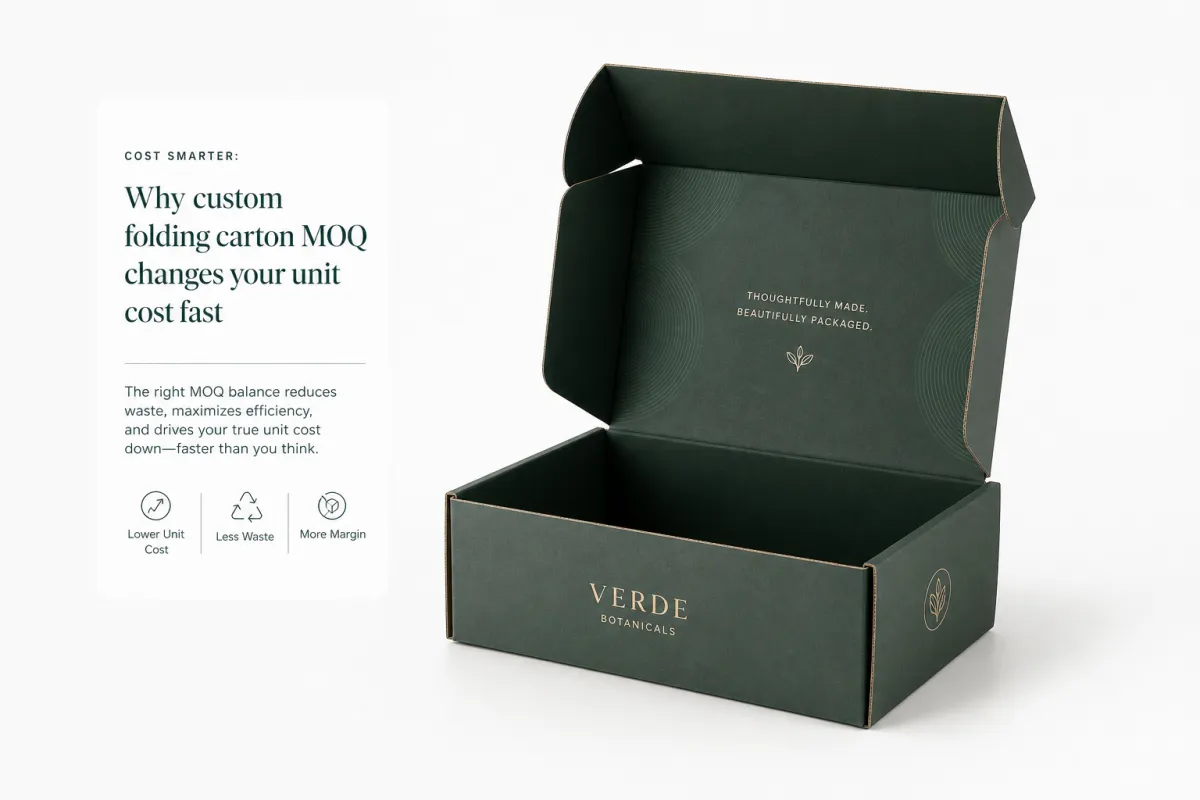
Here is the blunt version: a custom folding carton MOQ is not just about how many boxes you want. It is about how many boxes the production line can run efficiently once the press is set up, the die is loaded, the glue pattern is dialed in, and the board sheet is arranged with as little waste as possible. Every one of those steps carries fixed cost. Spread that cost over 500 cartons and the unit price looks one way. Spread it over 5,000 cartons and it looks very different. Same box. Different math. That is usually where the surprises start.
Most brands do not lose money on the carton itself. They lose money on setup, waste, and overcomplicated specs. A new die line has to be made. The press has to be calibrated. The printer needs enough sheet yield to avoid ugly waste ratios. If you ask for a custom size that forces a weak board layout, your custom folding carton MOQ goes up because the factory needs enough volume to make the run worth doing. Not because anyone is trying to be dramatic. Because the line is gonna need enough efficiency to function.
That matters most in launches with tight cash flow. A small beauty brand may only need 800 units for the first sell-through test. A supplement startup may want 1,200 cartons because the product is still being refined. A candle line might need just enough retail packaging to fill a few stores and a web order batch. In all three cases, the correct custom folding carton MOQ is not the cheapest unit price. It is the quantity that keeps the launch alive without burying the team in inventory.
Lower MOQ reduces storage risk and protects cash. Higher MOQ lowers the unit cost and improves print economics. That tradeoff is not glamorous, but it is the real buying decision. Anyone pretending otherwise is usually trying to sell you boxes, not solve the packaging problem.
Custom folding carton product details: what you actually get
A folding carton is secondary packaging made to hold, protect, and present a product without pretending to be the product. It ships flat, folds into shape, and gives you a clean retail face at a much lower cost than rigid boxes. For many brands, it is the default choice for retail packaging because it balances shelf impact, shipping efficiency, and production speed.
Where does it work best? Cosmetics. Supplements. Electronics accessories. Small food service items. Candles. Promotional kits. Any product that needs branded packaging, a neat unboxing moment, and enough structure to survive distribution can usually be built into a folding carton. The key is matching the carton to the product weight and the retail channel. A lightweight lip balm box has different requirements than a glass bottle carton or a kit with inserts. If those details get ignored, the spec gets messy fast.
Typical build details include the board type, caliper, coating, print method, closure style, and any internal support. Common boards are 14pt, 16pt, 18pt, and sometimes 24pt depending on the product load and the presentation goal. Coatings can be aqueous, matte, gloss, soft-touch, or film lamination. Print may be offset for color control, digital for short runs, or flexo on simpler jobs. Closure styles usually include straight tuck, reverse tuck, auto-lock bottom, or a display-ready carton for shelves and counter displays.
That structure is where packaging design turns into a buying decision instead of a mood board. A carton that looks great in renderings can still fail if the glue flap is too small, the insert is wrong, or the board buckles under weight. Good product packaging folds flat, stacks cleanly, and keeps the print face from scuffing during transit. Bad product packaging looks fine in a mockup and then shows up with crushed corners and a complaint email. Not exactly premium.
Practical rule: if the carton cannot hold the product securely while shipping flat, the structure is wrong, no matter how good the artwork looks.
Common carton structures
Straight tuck boxes are the workhorse. They are easy to produce, economical at moderate volume, and suitable for most lightweight retail items. Reverse tuck boxes are similar but can be better depending on direction of opening and shelf presentation. Auto-lock bottom cartons cost more, but they hold heavier products better and save time during packing. Display-ready cartons make sense for counter merchandising, though they usually raise the custom folding carton MOQ because the structure is more complex.
What buyers often overlook
The outside dimensions are only half the story. Internal clearance, insert space, product movement during shipping, and the finish all affect whether the box feels premium or just expensive. If the product rattles around, the carton is not doing its job. If the finish chips at the folds, the specification is too aggressive for the board. Good custom printed boxes are built from the inside out. A nice front panel does not save a bad structure.
Specs that drive the custom folding carton MOQ
The fastest way to move a custom folding carton MOQ is to change the specification. Some changes are harmless. Some are budget killers. The main drivers are finished dimensions, panel count, board caliper, print coverage, and finishing complexity. If the carton needs a new die line, a tighter sheet layout, or more press passes, the MOQ usually rises with it.
Custom sizing sounds simple until it hits the sheet. A carton that nests efficiently on press can run at a lower minimum because waste stays low. A carton with unusual proportions may leave too much empty space on the sheet, which means more board consumed per finished box. That waste shows up in the quote. So does the extra setup labor. This is why the same custom folding carton MOQ can look very different for two products that appear similar on the outside.
Print coverage matters too. A box with one or two spot colors is easier to run than a full-bleed design with heavy ink coverage on both sides. Add foil stamping, embossing, debossing, spot UV, window patching, or soft-touch lamination, and the job gets more expensive to set up and slower to finish. A simple finish can keep the run within a lower custom folding carton MOQ. A stacked list of special effects tends to push it upward.
Then there is compliance. Supplement cartons often need ingredient panels, warning statements, barcode placement, net contents, and sometimes language-specific copy. Cosmetic packaging may need ingredient and regulatory formatting. Food-related packaging can trigger additional review. These are not decorative details. They affect proofing time, version control, and whether the final art can be approved without a rework cycle. A clean file with accurate copy does more for your custom folding carton MOQ than most brands realize.
Structure also matters more than artwork in many cases. If the box has to support a heavier bottle, survive e-commerce handling, or protect a brittle item, the board and closure style take priority. A pretty carton that collapses in transit is not branding. It is waste.
- Finished size: bigger cartons use more board and often raise the minimum.
- Board caliper: thicker board can increase cost and change folding behavior.
- Print coverage: full bleeds, dark solids, and white ink increase complexity.
- Finishes: foil, embossing, UV, and soft-touch add setup and handling steps.
- Compliance copy: more text and more versions usually mean longer approval cycles.
- Insert needs: paperboard, molded, or custom dividers can change the carton spec fast.
If you are comparing options, the easiest way to see how the custom folding carton MOQ shifts is to compare simple and complex builds side by side. The numbers below are directional, not a fixed price list. Specs, quantity, board choice, and market conditions all move the quote.
| MOQ tier | Typical unit cost range | Best fit | Watch-outs |
|---|---|---|---|
| 500 units | $0.25-$0.55 | Pilot launches, samples for retail, seasonal tests | Higher setup share, fewer finish options, tighter file approval |
| 1,000 units | $0.18-$0.35 | First commercial run, small brand reorders | Still sensitive to specialty finishes and multiple SKUs |
| 5,000 units | $0.09-$0.18 | Established sell-through, e-commerce plus retail demand | Storage space, cash tied up, color consistency across the run |
| 10,000 units | $0.05-$0.12 | Steady velocity, national distribution, repeat programs | Warehousing, forecast risk, freight and pallet planning |
The smarter question is not, "What is the lowest custom folding carton MOQ you can give me?" The smarter question is, "What spec changes let me reduce the MOQ without hurting the brand or the unit economics?" That is a packaging buyer's question. It saves time and usually gets a better answer. It also tells you who actually understands the tradeoff and who is just reading off a rate card.
For sustainability claims, ask for FSC-certified board if that matters to your line, and make sure the claim language is accurate. If you need transport durability checks, review ISTA testing methods and basic distribution requirements before approving the final structure. For material reduction and recycling guidance, the EPA's waste resources are a useful reference point, especially if your product packaging is part of a larger sustainability story.
Common mistakes that push the MOQ up
Most MOQ problems are self-inflicted. Not always. But most of the time, yes.
The biggest one is asking for premium finishing before the structure is stable. Foil, soft-touch, embossing, and special coatings can look great in a concept deck. They do not help if the box is too small, the scores crack, or the product shifts inside the carton. Fix the fit first.
Another mistake is sending artwork before the measurements are confirmed. Teams sometimes design to the old box, then try to squeeze the same layout into a new format. That is how you end up paying for revisions, proof delays, and a higher custom folding carton MOQ than the product really needs. A few minutes spent validating the dieline can save a week of chaos.
Multi-SKU programs cause trouble too. If every scent, flavor, or shade has its own version, proofing gets slower and color management gets harder. That does not always increase the MOQ directly, but it raises the cost of managing the run and can make the quote look worse. Clean version control matters more than teams want to admit.
I also see buyers ignore the channel. A carton for shelf retail is not the same as a carton for Amazon or subscription fulfillment. E-commerce adds compression, drop risk, and longer handling. That may mean stronger board, tighter closures, or a different insert. If the channel is not defined, the spec usually drifts, and the MOQ follows it upward.
None of that is mysterious. It is just the part of packaging nobody wants to do after lunch.
Custom folding carton MOQ pricing: what moves the number
Every custom folding carton MOQ quote follows the same basic formula. You have fixed setup costs, plus variable material and production costs. The fixed part includes die making, press setup, prepress checks, and sometimes plate or tooling charges. The variable part includes board, ink, coating, finishing, folding, packing, and freight. Once the setup cost is spread over more units, the unit price drops. That is the whole game.
But the unit price only falls so far before other costs start creeping back in. Large runs may lower the carton price, yet they can create storage pain, cash strain, and forecast risk. A quote that looks unbeatable on paper can still be the wrong decision if the product is only moving 300 units a month. This is where unit cost and inventory cost need to be viewed together. A cheaper carton is not cheaper if it sits in a warehouse for nine months. That is just delayed regret with a pallet label.
There are also hidden cost drivers people miss. White ink on dark board adds complexity. Multiple SKUs make color matching and proofing more annoying. Reorders can change if the first run used up an initial die set or special plate arrangement. Freight matters too, especially if the order is palletized and shipped long distance. The landed cost per finished unit tells the truth better than the base box price does.
From a packaging buyer's point of view, the best way to quote a custom folding carton MOQ is to ask for two or three quantity tiers. For example: 500, 1,000, and 5,000 units. That gives you a real comparison between inventory risk and per-box savings. If the jump from 1,000 to 5,000 only saves a few cents, the bigger run may not be worth the storage headache. If the savings are meaningful, then the larger MOQ can be a sensible buy.
Here is the practical buying logic I see all the time:
- Quote the carton.
- Add freight, packing, and any secondary handling.
- Divide by the number of sellable finished units.
- Compare that landed number against your target margin.
- Only then decide whether the custom folding carton MOQ is right.
That sounds basic because it is. Yet brands regularly skip this step and focus on the lowest-looking carton line item. Then the warehouse bills arrive. Funny how math shows up eventually.
Good rule: if the quote only looks good because the MOQ is high, ask what that means for storage, cash flow, and reorder timing before you approve it.
For a simple straight tuck box with standard board and one-sided print, a custom folding carton MOQ may start around 500 to 1,000 units. A more complex carton with foil, embossing, lamination, or a custom insert may need a higher floor to make the setup work. Digital printing can push the minimum lower on some jobs, but the per-unit cost usually rises faster than brands expect. That tradeoff is fine if you are testing a SKU. It is not fine if you are trying to support a national launch on the cheap.
Process and timeline for custom folding carton orders
The process is predictable if the buyer gives the right information up front. A custom folding carton MOQ order usually follows this path: quote, dieline review, artwork prep, prepress check, proof approval, production, finishing, packing, and ship. The delay usually comes from missing dimensions, unclear file setup, or a client who wants to "just see one more version" after approval should already have happened.
Start with the product itself. Send the finished dimensions, product weight, closure preference, and whether the carton needs an insert. Include the quantity range you are considering, not only the lowest number. A 500-piece quote and a 5,000-piece quote can lead to very different structures and pricing, so give the supplier room to show you the options. If you already have a sample box or a dieline, send that too. It makes the conversation more useful and a lot less vague.
Artwork should be vector-based where possible, with proper bleed, correct barcode placement, and print-safe text sizes. If your brand uses multiple SKUs, keep the versioning clean. Nothing wastes time like three files named final-final-v4. Prepress should catch color issues, overprint problems, and fold-line conflicts before the press starts. That is how you protect the custom folding carton MOQ from turning into a reprint.
Timeline depends on complexity. A simple run with standard board and basic print may move from proof approval to finished cartons in about 10 to 15 business days. A job with specialty finishes, inserts, or heavy proofing can take 15 to 25 business days, sometimes longer if approval drags. Add sample rounds and freight time if the cartons are going overseas or into a fulfillment center. The press is rarely the only schedule variable. The paperwork usually causes more trouble than the machine.
Good packaging teams use checks at each stage to reduce failure later. Dimensional verification keeps the box fit correct. Color proofs reduce surprises on brand colors. Glue tests protect carton integrity. Shipment planning keeps pallet counts sane. If the packaging is for retail distribution or fragile goods, extra transport testing may be smart. That is where organizations like ISTA matter, because carton performance is not just about looks; it is about surviving the journey.
If you need a broader view of formats before you request quotes, our Custom Packaging Products page shows the main packaging categories we work with. For general order questions, the FAQ covers common concerns without the usual sales fluff.
Most delays are preventable. The buyer sends clean specs. The supplier answers with a clear quote. Proofs get approved on time. The custom folding carton MOQ stays where it was supposed to stay. That is not glamorous, but it is how you get cartons that arrive usable instead of merely purchased.
Why choose us for custom folding carton MOQ projects
Custom Logo Things is built for buyers who want a straight answer on custom folding carton MOQ, not a foggy pitch. We focus on clear quotes, realistic minimums, and spec guidance that actually helps the budget. If a carton can be simplified without hurting the brand, we will say so. If a finish looks nice but adds unnecessary cost, we will say that too. Saves everyone time.
That matters because a good quote is more than a price. It is a packaging recommendation. An accurate custom folding carton MOQ should reflect the structure, board, print method, and finish level that fit the job. If the product is light and the run is short, there is no reason to pretend a heavy-duty spec is mandatory. If the carton needs to protect glass or survive shipping pressure, then yes, the structure should be upgraded properly.
Our support on dielines and spec review helps reduce rework before production starts. That is one of the easiest ways to control the MOQ. We look at whether the carton can be made on standard sheet sizes, whether the closure style is practical, and whether the artwork will print cleanly without turning the run into a headache. That approach supports better branded packaging because the box is designed around the actual product, not the fantasy version of it.
Quality checks matter too. Print consistency. Glue integrity. Fold accuracy. Carton fit. Shipment protection. Those are the checks buyers remember after the boxes arrive, not how pretty the quote email looked. We treat the relationship like a working production partnership, not a one-time spreadsheet exchange. Honest feedback is part of the job, even when it is mildly inconvenient.
If your team is still deciding between custom printed boxes, a basic retail carton, or a more premium presentation style, we can walk through the cost differences before you commit. That is usually where the real savings show up. Not in some magical discount. In removing unnecessary complexity from the spec.
Next steps for your custom folding carton MOQ order
If you want a clean custom folding carton MOQ quote, start with the basics: finished dimensions, product weight, target quantity, board preference, finish level, and the product's retail channel. If the box needs to live on a shelf, survive e-commerce, or support a subscription program, say that up front. Channel changes the spec, and the spec Changes the Quote.
Next, send artwork files, brand guidelines, and any compliance copy. The fewer missing pieces at the start, the faster the quote comes back in a usable form. A clean file package also helps us spot where the MOQ can be lowered. Sometimes the fix is as simple as moving from a custom coating to a standard aqueous finish or changing a special-size box to a more efficient format. That kind of adjustment can save real money without making the carton feel cheap.
Ask for two or three quantity tiers. That one move makes the buying decision much easier. You can compare the unit cost against inventory risk and see whether the savings are actually worth the extra cartons. For many brands, the right answer sits in the middle tier, not at the cheapest or the largest end.
Use this short checklist before you request quotes:
- Standard size if possible.
- Simple print coverage if the budget is tight.
- One finish instead of three.
- Realistic lead time, not wishful thinking.
- Clear quantity tiers for comparison.
If your goal is a lower custom folding carton MOQ, these are the levers that actually move it. Not vague "premium" language. Not unnecessary foil just because someone likes shiny things. A tighter spec, a cleaner file, and a realistic launch plan usually do more than anything else.
Use this custom folding carton MOQ checklist to request a quote that is actually comparable, then decide whether the best buying move is a smaller pilot run or a larger order that lowers the unit cost. Start with the product, not the packaging fantasy. That is how you keep the boxes useful instead of expensive theater.
FAQ
What is a typical custom folding carton MOQ?
It depends on size, board type, print method, and finishing, but many projects start around 500 to 1,000 units. Digital runs can go lower. More complex offset jobs usually need more volume before the custom folding carton MOQ makes financial sense. Regional converter capacity can also move the number, so there is no single universal floor.
Can I lower my custom folding carton MOQ by simplifying the design?
Yes. Standard dimensions, fewer inks, and no special finishes usually reduce the minimum order. Using a common board and a simple tuck style also helps keep the custom folding carton MOQ practical. Fancy is nice. Practical pays the bills, and it is a lot less annoying when the reorder lands.
How does custom folding carton MOQ affect unit price?
Higher MOQ usually lowers the per-box price because setup costs are spread across more units. The tradeoff is inventory risk, so the cheapest unit price is not always the smartest buying decision. A balanced custom folding carton MOQ often wins once storage and cash flow are included. I would rather see a clean landed-cost plan than a pretty low quote that breaks the budget later.
What do I need to request an accurate custom folding carton MOQ quote?
Send finished dimensions, quantity range, product weight, artwork files, board preference, and finishing requirements. If you have a dieline or sample box, include that too. The more complete the brief, the better the custom folding carton MOQ quote will be. Missing details usually mean slower answers and more back-and-forth.
How long does a custom folding carton MOQ order usually take?
Simple runs move faster; custom structures, specialty finishes, and detailed proofs take longer. Fast approvals help most. Delays usually come from missing files or late sign-off, not the press. A clean custom folding carton MOQ order can stay on schedule if the buyer keeps the approvals moving and does not keep changing the brief halfway through.
What is the biggest mistake brands make with folding carton quotes?
They compare unit price before they compare the whole landed cost. A quote that looks cheap can still be the expensive choice if the MOQ is too high, the carton needs extra handling, or the warehouse cost runs away with the savings. Look at the full picture first.

