Buyer Fit Snapshot
| Best fit | Custom Folding Mailers Wholesale projects where brand print, material claims, artwork control, MOQ, and repeat-order consistency need to be specified before quoting. |
|---|---|
| Quote inputs | Share finished size, material target, print colors, finish, packing count, annual reorder estimate, ship-to region, and any compliance wording. |
| Proofing check | Approve dieline scale, logo placement, barcode or warning zones, color tolerance, closure strength, and carton packing before bulk production. |
| Main risk | Vague material claims, crowded artwork, missing packing details, or unclear freight terms can make a low unit price expensive after revisions. |
Fast answer: Custom Folding Mailers Wholesale: Specs, Pricing, Process should be specified like a repeatable production item. The safest quote records material, print method, finish, artwork proof, packing count, and reorder notes in one written spec.
Production checks before approval
Compare the actual filled-product size with the drawing, then confirm tolerance on folds, seals, hang holes, label areas, and retail display edges. Reserve space for logos, QR codes, warning copy, and material claims before decorative graphics fill the panel.
Quote comparison points
Review material grade, print process, finish, sampling route, tooling charges, carton quantity, and freight assumptions side by side. A quote is only useful when the supplier can repeat the same color, closure quality, and packing count on the next order.
Custom Folding Mailers Wholesale: Specs, Pricing, Process
Ordering custom folding mailers wholesale makes sense for brands that want a clean, rigid presentation without jumping all the way to a heavier carton. The format stores flat, converts quickly on the packing table, and gives apparel, stationery, accessories, and curated kits a polished shell that holds its shape better than a soft mailer while often costing less to pack than a full box program.
For a packaging buyer, the real question is not just unit price. It is how the custom folding mailers wholesale choice affects warehouse space, labor, dimensional weight, and the unboxing moment. A mailer that folds accurately, locks cleanly, and prints sharply can reduce waste across the fulfillment path, which is why many teams compare it with padded envelopes, rigid mailers, and even Custom Packaging Products like custom printed boxes before they place an order.
I have seen more than one launch stall because the team focused on the print file first and the structure second. That order feels backwards on the production floor. If the package does not fit the product and the closure does not hold, pretty graphics only hide the problem for about five minutes.
Why Custom Folding Mailers Wholesale Make Sense
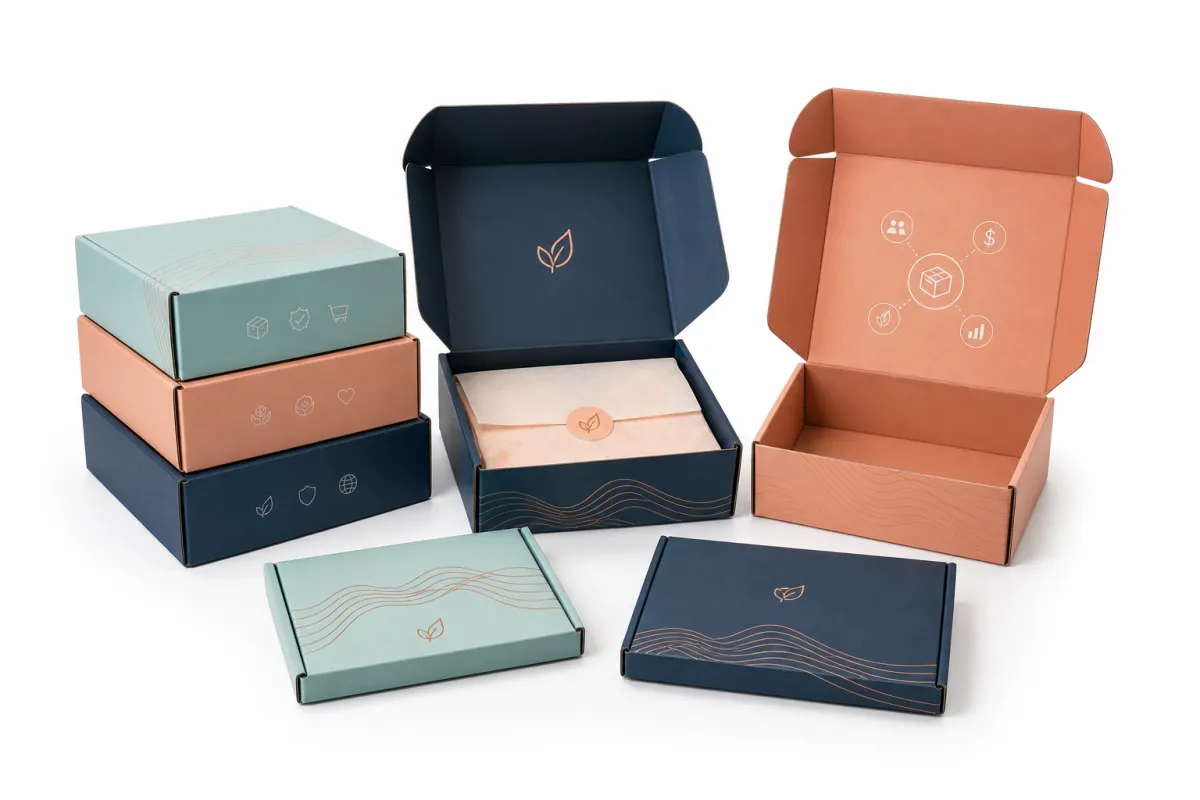
From a practical shipping standpoint, custom folding mailers wholesale solves a common problem: the product needs more shape and surface protection than a poly mailer gives, but not the full cost and footprint of a corrugated box. That middle ground matters. A folded board mailer arrives flat, takes up less receiving space, and is quick to assemble on the packing bench, which is exactly what busy fulfillment teams need during peak order weeks.
Buyers often compare custom folding mailers wholesale with padded envelopes and rigid boxes because those are the closest alternatives. Padded mailers are light and inexpensive, but they do not always deliver the crisp, branded presentation that premium apparel, notebooks, or gift sets call for. Boxes protect more, but they usually cost more to ship and store, especially when the item inside is thin and the extra air adds dimensional weight. A folding mailer can keep the parcel profile tight while still looking intentional.
That balance helps brands that sell T-shirts, socks, journals, trading cards, skincare sample kits, jewelry cards, small accessories, and subscription sets. In those categories, the surface of the package matters almost as much as the contents. A buyer opening a neatly printed mailer sees control, care, and consistency. That kind of branded packaging supports repeat purchases without pushing the parcel into a heavier shipping class.
"The best mailer is the one that protects the item, stores flat, and looks deliberate the moment it lands on the table."
Honestly, one of the most overlooked benefits of custom folding mailers wholesale is pack-out efficiency. If a shipper can grab a flat blank, fold it in one motion, and close it without tape or extra glue, the labor savings add up across thousands of orders. That is why the buying decision should account for total pack-out cost, not just the print quote. A slightly better board or a cleaner lock style can save time every single day.
There is also a brand story here. In retail packaging, the first physical touchpoint often sets the tone for the rest of the experience. A folding mailer with a strong print face, crisp fold lines, and a reliable closure can carry a simple message very well. For some programs, it even becomes a reusable shelf or storage piece after opening. That kind of utility supports package branding in a way that plain shipping materials never can.
For brands that are still building their fulfillment system, custom folding mailers wholesale can sit between a low-cost Custom Poly Mailers program and a full rigid box rollout. That makes it a smart stepping stone for teams that want better presentation now while keeping future options open as order volume grows.
A small but real advantage: flat storage is easier to live with than many teams expect. I have walked too many back rooms where bulky packaging ate into picking space and made reorders harder to count. Folding mailers kind of solve that problem without making the parcel feel cheap.
Product Details: How Custom Folding Mailers Are Built
A folding mailer starts as a scored flat sheet, usually die-cut from paperboard or heavier coated stock, with panels that fold into a secure shell. The structure typically includes locking tabs, tuck flaps, dust flaps, and precise score lines so the finished piece closes with minimal effort. Good engineering matters here, because a beautiful print design means very little if the mailer buckles at the corners or opens too easily during transit.
Most custom folding mailers wholesale programs use one of three common board families. SBS paperboard is popular for bright print reproduction and a smooth premium surface. Recycled board can be a strong choice for brands that want a natural look or a more earth-conscious paper story, although the surface may show texture more clearly. Coated stock can improve image sharpness and fingerprint resistance, which helps on mailers that handle a lot of shelf contact before shipment.
Internal dimensions matter more than many buyers expect. The product, any insert, tissue wrap, sleeve, or protective pouch should be measured together before the dieline is approved. A few millimeters can change how the closure performs. If the mailer is too tight, the lock tabs can distort. If it is too loose, the item can shift around, which hurts the presentation and increases edge wear in transit. If the closure is off by even a few millimeters, the pack line is gonna feel it.
Finishes shape the customer experience too. Matte finishes feel quieter and more editorial. Gloss can make color pop and improve scuff resistance on high-coverage artwork. Soft-touch laminate adds a premium hand feel, but it should be chosen carefully, because some brands prefer a crisper carton feel instead of a velvety surface. Uncoated stock can be ideal for natural, earthy, or eco-focused retail packaging, especially when the design uses strong typography and less ink coverage.
Not every structure needs the same feature set. Some custom folding mailers wholesale orders are built for influencer sends and PR kits, where visual surprise matters. Others are designed for subscription programs that must fold quickly and survive repeated handling in a warehouse. The right structure should always match the contents, not the other way around. That sounds simple, yet a surprising number of packaging problems come from forcing the wrong shape onto the wrong product.
For teams comparing performance standards, parcel simulation language can be helpful. Many packaging groups reference ISTA testing methods, such as ISTA procedures, to think more clearly about how a mailer may behave under vibration, drops, compression, and handling. The point is not to overbuild a thin product package, but to make sure the structure is realistic for the route it will travel.
That testing mindset matters because a mailer does not live a sheltered life after it leaves the warehouse. It gets stacked, sorted, tossed, pressed against other parcels, and sometimes handled more roughly than anyone planned for. A fold that works on the bench but fails after a few pressure points is a design problem, not a shipping problem.
Specifications That Affect Fit, Protection, and Branding
The spec sheet is where custom folding mailers wholesale projects are won or lost. A buyer may start with color and artwork, but the real decisions live in the details: inside length, inside width, inside depth, fold tolerances, board caliper, print coverage, and the way the mailer closes once the product is inside. Those numbers are not decoration. They decide whether the package feels refined or frustrating.
Board thickness is one of the first specs to review. In practice, thickness affects crush resistance, edge definition, and how substantial the mailer feels in the hand. A lighter board can work for low-risk items that simply need structure and branding. A thicker board can improve protection and perceived value, especially for product packaging that sits in a retail environment before it is shipped. The right choice depends on weight, route, and the impression you want to create.
Print coverage has a direct effect on pricing and on brand look. Full-bleed graphics, solid dark backgrounds, spot colors, and special white ink treatments on kraft or natural stock all require more control. If the artwork uses a lot of coverage, ask for a proof that shows how the fold lines, seams, and tuck areas will land. Nothing creates a weak first impression faster than a logo that disappears into a fold or a pattern that breaks awkwardly across a closure flap.
Die-cut details deserve attention too. Thumb notches make opening easier. Tear strips can create a more polished unboxing moment. Dust flaps help close up small gaps and improve edge protection. Window cutouts can show the product inside, but they must be placed carefully so the interior item does not look crooked or crowded. If the mailer includes an insert card or branded sleeve, that should be built into the dieline from the start, not added as an afterthought.
Shipping performance should be checked before production begins. Ask how many mailers fit in a carton, how the blanks stack on a pallet, and whether the finished form still holds up in parcel networks after repeated sorting. For larger programs, this is where custom folding mailers wholesale becomes a logistics conversation as much as a print conversation. Storage efficiency, carton count, and pack speed all affect the final landed cost.
For sourcing teams that track sustainability claims, fiber certification can matter. If the program needs certified paper, ask for FSC-aligned materials and supporting paperwork. The Forest Stewardship Council is a useful reference point for brands that want paper sourcing language they can stand behind. That matters especially for retail packaging programs where the carton or mailer is part of the sustainability message.
Brands that sell across channels often try to make one package do too much. That is rarely the best move. A mailer built for lightweight e-commerce orders may not be the right answer for a thick set, and a luxury finish may not be worth the added cost for a utility item. The most effective custom folding mailers wholesale spec is the one that fits the actual use case, not the imagined one.
There is a tradeoff that buyers sometimes want to gloss over: every extra feature adds friction somewhere. Special lamination, extra inside print, die-cut windows, and unusual locks can all be worth it, but only if the product and the channel justify them. Otherwise, you are paying for novelty, and novelty does not always pay you back.
Custom Folding Mailers Wholesale Pricing and MOQ
Price in custom folding mailers wholesale work is driven by a handful of predictable variables: board grade, print coverage, size, die complexity, finish, and order quantity. If the design uses multiple special effects, the price rises. If the order repeats the same size and artwork in higher volumes, the unit cost usually drops because setup and make-ready are spread across more pieces.
MOQ depends on how custom the structure is. A simple printed folding mailer may have a lower starting point than a fully custom size with special windows, tear strips, or inside print. Lower minimums can help a new product launch, but the per-unit price is usually higher. Buyers should ask for a price ladder at several quantities so they can see where the real break points sit.
| Option | Typical MOQ | Typical Unit Price | Best Fit | Notes |
|---|---|---|---|---|
| Plain kraft or recycled folding mailer | 1,000-3,000 | $0.30-$0.55 | Simple shipments, low print coverage | Good entry point for testing size and closure |
| 4-color printed SBS mailer | 3,000-5,000 | $0.65-$1.20 | Branded retail packaging and e-commerce | Strong balance of image quality and cost control |
| Soft-touch or premium finished mailer | 5,000+ | $1.10-$2.10 | Higher-end product packaging | Better tactile feel, higher finishing cost |
| Custom size with insert, window, or special lock | 5,000+ | $1.25-$2.50 | Kits, subscription boxes, retail sets | Extra tooling and tighter structural control required |
The ranges above are not fixed quotes, but they do reflect how custom folding mailers wholesale pricing often behaves in real sourcing conversations. A smaller run with heavy artwork can cost more per unit than a larger run with a simpler print spec. That is why it helps to request quotes at 1,000, 3,000, 5,000, and 10,000 pieces if the program has the volume to justify it.
For many brands, the best savings come from reducing structural complexity before cutting print costs. A cleaner dieline, one board choice, and one finish can outperform a flashy spec that adds labor without adding much value. If the mailer is part of a repeat shipment program, lock the structure early so inventory, reorders, and budget planning stay predictable. That is where custom folding mailers wholesale becomes easier to manage over time.
It also helps to think about the cost of errors. Oversized mailers can waste freight space. Undersized mailers can damage the product or slow the packing line. Weak closures can create returns or complaints. A quote that looks lower on paper may be more expensive once those issues show up. Good buyers compare total program cost, not just the line item on the PO.
For buyers who are tracking landed cost closely, the math should include more than paper and print. Labor per pack, damaged-product risk, freight efficiency, and reorder stability belong in the same conversation. That is not a glamorous spreadsheet, but it is the one that usually tells the truth.
Ordering Process and Production Timeline
A smooth custom folding mailers wholesale order usually follows the same sequence: request a quote, confirm dimensions, review the dieline, approve artwork, approve a sample or digital proof, move into production, then plan freight. Each stage sounds simple, but delays usually happen at the handoff points, especially if the product size was measured loosely or the artwork arrives before the structure is fully confirmed.
To speed up quoting, send the finished dimensions, product weight, quantity, print sides, finish preference, and ship-to location together. If the mailer must hold an insert, tissue, or wrapped item, include that too. The more the supplier understands the actual pack-out, the better the pricing and the fewer surprises later. A vague brief often creates a vague quote, and that is not a strong starting point for custom folding mailers wholesale planning.
- Spec review: confirm size, board, print coverage, finish, and any inserts or special closures.
- Dieline and artwork: map the folds, bleed, safe areas, and lock points before proofing.
- Proof approval: check color placement, panel alignment, and the way copy lands on fold lines.
- Sampling or test build: if needed, verify fit with the real product, not a guessed substitute.
- Production: once approved, the job moves into print, die-cut, fold, and pack.
- Freight planning: confirm carton count, pallet count, and delivery window before shipment leaves.
Lead time should be broken into separate parts. Proofing can take a few business days if the artwork is already clean. Manufacturing often runs in the range of 10-15 business days for standard specs, with more time needed for complex finishes or larger volumes. Freight then adds its own window, depending on location and service level. For time-sensitive launches, a buyer should always build in a buffer, because artwork revisions and sample changes can shift the schedule.
The most common delay is not press time. It is uncertainty. A customer changes the insert size after the dieline is approved, or the fold tab is not quite right, or the color needs another pass because the brand guide was not attached at the start. Strong custom folding mailers wholesale projects stay on schedule because the approval process is disciplined and the brief is complete.
If the mailer is tied to a launch, a seasonal drop, or a subscription start date, the smartest move is to approve the structure first and then finalize the artwork against that structure. That keeps the real production window visible and reduces last-minute risk. In practical terms, it is much easier to adjust art than to rebuild a mailer after tooling has already started.
From an operations standpoint, the cleanest projects are the ones where everyone agrees on the same source of truth early. One dieline, one size callout, one proof file, one sign-off trail. That sounds boring, but boring is nice when the order has to land on time.
Why Choose Us for Custom Folding Mailers Wholesale
What buyers usually need most is not a flashy promise. They need practical guidance that turns a product brief into a mailer that folds properly, prints cleanly, and ships with less drama. That is the value we focus on with custom folding mailers wholesale: helping translate size, product weight, route, and presentation goals into a structure that actually works on the bench and in transit.
Good packaging design is part engineering, part brand discipline. A folder that looks nice in a PDF can still fail if the board is too light, the closure is weak, or the fold sequence is awkward for the packing crew. We try to keep that reality front and center. The goal is not to over-spec every project. The goal is to Choose the Right level of structure so the packaging supports the product instead of fighting it.
Consistency matters even more in wholesale programs. Reorders should feel the same, stack the same, and close the same. If the first lot works and the second lot does something different, the entire fulfillment process becomes harder. That is why repeat custom folding mailers wholesale orders benefit from stable artwork files, approved dielines, and a clear production spec that does not drift from run to run.
There is also a bigger brand system to think about. Many teams use folding mailers alongside custom printed boxes, sleeves, and protective shipping formats to build a complete package branding story across channels. For buyers managing that mix, the difference between good and great often comes down to whether each format feels like part of one family. Our Wholesale Programs are built around that kind of repeatability, and our Custom Packaging Products lineup gives brands room to Choose the Right structure for each item.
Communication matters just as much as the paper spec. Proofs, sample reviews, and production updates should be clear enough that a buyer can make decisions without guessing. If a change affects the fold, the print, or the ship date, that needs to be visible early. That is the kind of support that keeps custom folding mailers wholesale programs predictable, especially when launches are tied to inventory turns and fulfillment windows.
We also understand that not every order needs the highest-cost finish or the heaviest board. Sometimes the smartest move is a modest construction with sharp print and a dependable closure. Other times, the project justifies a premium surface or inside print because the package is part of the customer experience. The point is to match the spec to the actual business need, not to sell a one-size-fits-all answer.
In practice, that means telling the truth when a lower-cost option is the better fit. A glossy finish is not automatically better than matte. A thicker board is not automatically safer. A special cutout is not automatically more premium. The right answer depends on the item, the route, and the brand story you are trying to tell.
Next Steps for Custom Folding Mailers Wholesale Orders
If you are ready to move forward with custom folding mailers wholesale, start with a short checklist and keep the brief tight. The strongest orders usually begin with a few clear inputs and a real sample, not a vague idea.
- Confirm finished product dimensions with any insert, sleeve, tissue, or wrap included.
- Set the target quantity and ask for pricing at several volume levels.
- Choose the print coverage, finish, and any special features like a window or tear strip.
- Share a product photo or physical sample so fit can be checked against the real item.
- Request a dieline before artwork is finalized so the fold and closure are correct.
That last point saves time more often than buyers expect. A dieline lets the design team see where copy, logos, and background color will land after folding. It also makes it easier to judge whether the mailer will close without forcing the board, which is exactly where many early mistakes happen in custom folding mailers wholesale projects.
If you are comparing structure options, ask for a sample mailer or a comparable flat carton before you commit. A small physical test reveals more than a long email thread ever will. It shows how the board feels, whether the tabs lock cleanly, and how much effort it takes to assemble one piece on a busy packing line. That hands-on check is often the difference between a good guess and a confident buying decision.
Once the spec is set, the order should feel straightforward: review the proof, approve the sample or digital layout, and place the PO when the price, structure, and timing line up with your launch plan. The practical takeaway is simple: lock the size, board, finish, and proof order first, then build the artwork around that structure so your custom folding mailers wholesale program ships cleanly and reorders without avoidable surprises.
What products work best in custom folding mailers wholesale?
They work best for flat or low-profile items such as apparel, books, stationery, small accessories, and curated kits. They are a strong fit when presentation matters and the product needs light-to-moderate surface protection during parcel shipping. If the item is bulky or highly breakable, a corrugated solution may be more appropriate than a folding mailer.
How do I choose the right size for custom folding mailers wholesale?
Measure the finished product with any insert, sleeve, tissue, or wrap included, then add only the clearance needed for a clean fold. Check the closure area carefully so the mailer locks without buckling, bulging, or stressing the panels. When in doubt, request a sample or dieline review before committing to full production.
What is a typical MOQ for custom folding mailers wholesale?
MOQ depends on material, print method, and structural complexity, so plain runs and fully custom printed runs may have different thresholds. Higher volumes usually reduce unit cost because setup and tooling are spread across more pieces. It is smart to request pricing at several quantities so you can compare break points clearly.
How long does production take for custom folding mailers wholesale?
Timing usually includes proofing, sample approval if needed, manufacturing, and freight transit. Artwork delays or dieline revisions are the most common reasons schedules slip. A complete spec sheet at the start is the fastest way to keep the order on track.
Can custom folding mailers wholesale be printed inside and outside?
Yes, many programs support exterior branding plus interior print, messaging, or pattern work. Inside printing should be planned with fold lines and ink coverage in mind so the finished mailer still closes cleanly. Ask for a proof that shows both sides before approving production.

