Buyer Fit Snapshot
| Best fit | Custom Food Packaging Boxes with Window projects where brand print, material claims, artwork control, MOQ, and repeat-order consistency need to be specified before quoting. |
|---|---|
| Quote inputs | Share finished size, material target, print colors, finish, packing count, annual reorder estimate, ship-to region, and any compliance wording. |
| Proofing check | Approve dieline scale, logo placement, barcode or warning zones, color tolerance, closure strength, and carton packing before bulk production. |
| Main risk | Vague material claims, crowded artwork, missing packing details, or unclear freight terms can make a low unit price expensive after revisions. |
Fast answer: Custom Food Packaging Boxes with Window: Quote Scope, Sample Proof, MOQ, and Lead Time should be specified like a repeatable production item. The safest quote records material, print method, finish, artwork proof, packing count, and reorder notes in one written spec.
Production checks before approval
Compare the actual filled-product size with the drawing, then confirm tolerance on folds, seals, hang holes, label areas, and retail display edges. Reserve space for logos, QR codes, warning copy, and material claims before decorative graphics fill the panel.
Quote comparison points
Review material grade, print process, finish, sampling route, tooling charges, carton quantity, and freight assumptions side by side. A quote is only useful when the supplier can repeat the same color, closure quality, and packing count on the next order.
Custom Food Packaging Boxes with window do something packaging often promises but rarely delivers cleanly: they let the food speak for itself before anyone opens the carton. A shopper can see the glaze on a pastry, the crumb on a loaf, the layered color in a dessert cup, or the neatness of a sandwich assortment in one glance. That visual proof matters on a retail shelf, in a bakery case, and even at checkout, because the product starts earning trust the moment light hits the package.
That visibility is not just decoration. It is a working sales tool that can improve shelf appeal for cookies, pastries, sandwiches, desserts, and gift assortments while the rest of the box keeps doing the less glamorous job of protecting shape and structure. Once a window enters the picture, the board, the film, the coating, and the placement all matter more than they do on a closed carton. A plain box can get away with average decisions. Custom Food Packaging Boxes with window cannot.
What Custom Food Packaging Boxes With Window Are
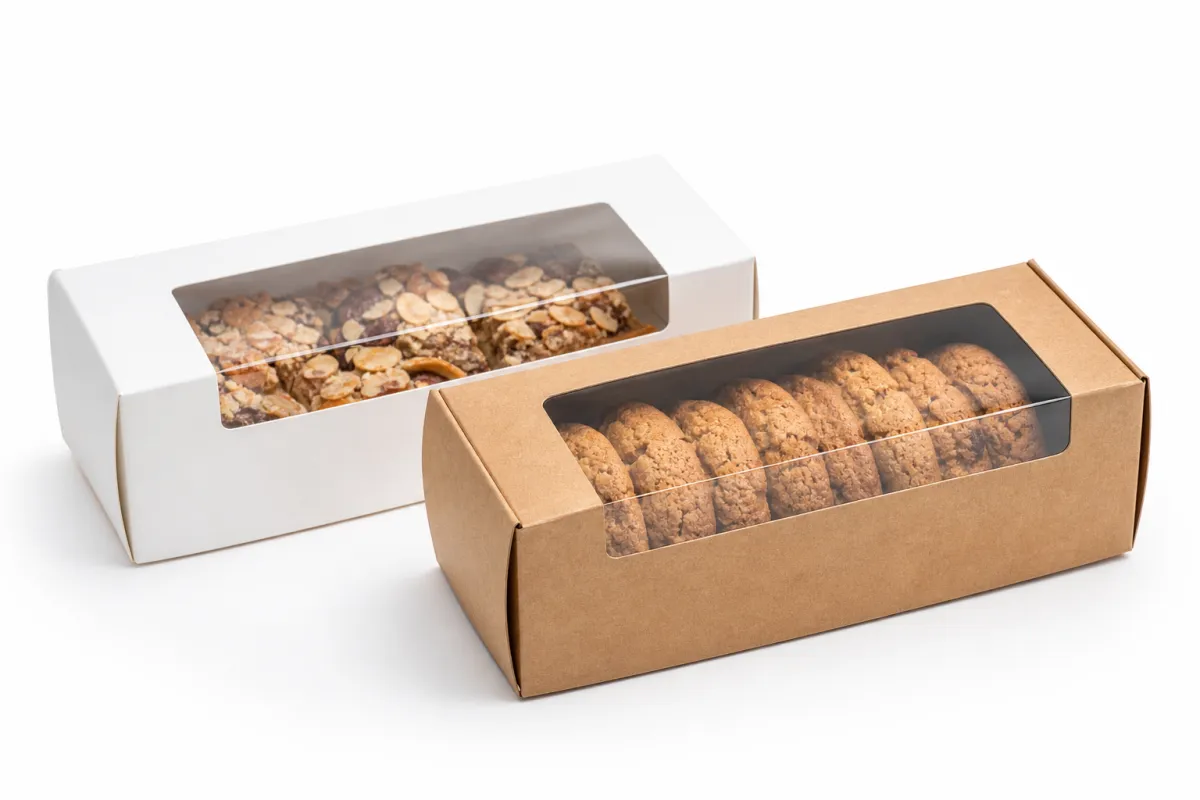
At the simplest level, custom food packaging boxes with window are food-grade cartons with a cutout and a clear panel that reveals part of the product while the structure still supports handling, stacking, and shipping. The opening might be a small display window or a broad viewing area, but the purpose stays the same: keep the food visible, keep it protected, and keep the package easy to trust.
That sounds straightforward until the real product enters the room. A bakery buyer wants the crust, frosting, or filling to look fresh. A deli brand wants the ingredients to stay tidy and readable. A confectionery line wants texture and portion size to feel generous without exposing brittle edges or messy corners. Custom food packaging boxes with window turn packaging design into a preview rather than a guess.
They work especially well for bakeries, dessert shops, deli items, bakery gift assortments, and retail packaging that needs a premium look without hiding the product. Seasonal branding also benefits from the format, because the window gives the food space to do the selling while the artwork carries the logo, color palette, and product story. The right balance can make a simple carton feel considered instead of cluttered.
There is a catch, though, and it matters. Custom food packaging boxes with window change how a carton behaves in the real world. A window that is too large can weaken the panel area. A film that is poorly chosen can fog, stain, or pick up grease. A fragile item can shift and turn a neat display into something that looks a little sad by the time it reaches the shelf. Buying decisions should start with the food itself, not the graphics.
A window does not rescue weak product packaging. It only frames what is already there.
From a packaging buyer's point of view, the real question is not whether a window is attractive. It is what should be visible first, what should stay hidden, and how the structure needs to behave once the box is filled. That is the point where custom food packaging boxes with window start doing useful work instead of just looking polished in a mockup.
- Best fit: products with strong color, texture, layering, or portion size that sell visually.
- Less ideal: greasy, frosted, loose, or highly irregular items unless you add inserts or liners.
- Practical rule: if the product looks better in person than in a photo, custom food packaging boxes with window usually help.
I have seen a lot of good food lose shelf appeal because the box hid the wrong thing. The reverse happens too. A carefully placed window can make a modest product look crisp, fresh, and worth the ask. That is kinda the point of the format.
How Custom Food Packaging Boxes With Window Work On Shelf
Shelf behavior is the whole game. Custom food packaging boxes with window reduce the guesswork that slows buying decisions, and less guesswork usually means a cleaner path to checkout. If a shopper can see the filling, glaze, crumb, or portion size in one glance, the box feels more honest and the product feels easier to choose.
The structure may look simple from the outside, yet each layer has a job. Board stock provides rigidity. The die-cut opening defines the display area. Clear film keeps the food visible. Adhesive secures the panel. Folding style keeps the carton square enough to stack and handle. Good custom food packaging boxes with window stay true after packing, transport, and shelf placement, not just in a proof image.
Window placement matters more than most teams expect. A centered window that frames the best-looking feature can make the box feel premium with almost no extra effort. A cutout that lands across a seam, a dull section, or a lopsided item can lower perceived value immediately. Custom food packaging boxes with window should frame the strongest part of the food, not simply expose whatever happens to sit in the middle.
There are practical limits. Very greasy items can stain the board. Frosted products can fog the film. Delicate pastries may move in transit and arrive looking bruised instead of fresh. In those cases, custom food packaging boxes with window often need inserts, liners, or a partial opening rather than a broad reveal. A smaller display area can solve more problems than a bigger one.
One rule I keep coming back to is simple: if the product sells on appearance, aroma, or color, the window should show the strongest visual feature. If the main value is texture and freshness, custom food packaging boxes with window still work, but the carton has to protect first and promote second. A pretty box does not matter if the croissant collapses before lunch.
For brands thinking about package branding as a retail tool, the window should support the decision rather than fight it. Brand mark, product name, and legal copy need room around the opening so the design reads quickly from a few feet away. That distance is what matters in real retail packaging, where shoppers glance first and read later.
There is also a practical retail detail that gets overlooked. A window can reveal whether the product has shifted, collapsed, or smeared during handling. That can help or hurt. If the pack-out is sloppy, the window makes the problem visible. If the pack-out is disciplined, it becomes proof that the brand pays attention to the small stuff.
Materials, Liners, And Window Film That Keep Food Safe
Material choice decides whether custom food packaging boxes with window feel clean and premium or look greasy and careless. The most common board options are kraft for a natural tone, SBS for crisp print quality, and coated stocks when grease resistance needs more attention. Each one behaves differently under ink, folding pressure, and food-contact demands, so the right choice depends on the item, the shelf environment, and the brand tone.
Kraft is a strong fit when the brand wants a rustic or artisan feel. It hides small scuffs better than many glossy boards and works well for baked goods, takeout-style presentation, and packaging that is meant to feel grounded rather than formal. SBS gives sharper print, brighter color, and cleaner white space, which helps branded packaging that needs a polished retail presence and tight image reproduction.
The window film matters just as much as the board. PET is common because it is clear, stable, and easy to view through. PLA gets attention for sustainability claims, yet the buyer still needs to confirm whether the intended storage conditions and end-of-life claims line up with the actual material standard. For compostable claims, ask for the test basis and the specific certification path, not a vague promise and a cheerful hand wave.
For responsible fiber sourcing, ask whether the paperboard is FSC-certified and whether the supplier can provide chain-of-custody documentation. The FSC system is widely used for paper and board sourcing, and it helps buyers support documented material choices. You can review the standard at FSC.
Liners and barriers are not optional in many food runs. Grease-resistant coatings, inner wraps, and inserts help keep oil, sauce, butter, or moisture from reaching the carton wall. If the food is fragile, a tray insert can stop movement and keep custom food packaging boxes with window looking neat on arrival instead of crushed and disappointing.
Do not get distracted by pretty finishes alone. Soft-touch lamination, foil, and heavy spot gloss can look excellent in a render, but they also increase cost and can scuff during packing or transport. Some coatings make custom food packaging boxes with window harder to recycle, and some films fog faster in chilled storage. Attractive is not the same as suitable.
Use this buying checklist before you approve anything:
- Food safety: confirm that inks stay outside the food zone and that the materials are appropriate for direct or indirect food contact.
- Seal quality: ask how the window is attached and whether the panel stays tight under stacking pressure.
- Storage: check ambient, chilled, or frozen handling before choosing film and board.
- Durability: ask for scuff, grease, and moisture resistance details in plain language.
If you want a more technical view of shipment stress, testing references from the ISTA framework are worth asking about. Transit failure is not really a design issue. It is a packaging issue that was allowed to stay hidden until the box was already moving through the chain.
On the production side, I always tell buyers to ask for the exact board caliper and film gauge, not just a material nickname. Two quotes can both say "kraft" or "PET" and still describe very different builds. That tiny detail can change how the carton folds, how it prints, and how it holds up under a loaded case pack.
Cost And Pricing For Custom Food Packaging Boxes With Window
Price is where custom food packaging boxes with window stop being a visual idea and become a purchase decision. The main cost drivers are board type, window size, film choice, print coverage, special finishes, and order volume. A simple white carton with a small clear opening is not the same job as a premium retail box with full-color art and a large display panel.
The window is not a tiny add-on. It introduces die-cutting, film insertion, adhesive work, and often more inspection during assembly. That is why custom food packaging boxes with window usually cost more than a plain folding carton, even if the opening looks small on paper. Labor has a way of appearing in the quote whether anyone invited it or not.
Here is a practical pricing snapshot for common production runs of about 5,000 units. These ranges move with dimensions, finishing, and press setup, but they are still useful for planning budget, margin, and package branding decisions before a quote request goes out.
| Box Build | Best Use | Typical Unit Price | Notes |
|---|---|---|---|
| 16pt kraft board, small window, simple one-color print | Bread, cookies, bakery carryout, low-frills retail packaging | $0.18-$0.28 | Good value, fewer finishes, strong on basic branding |
| 18pt SBS, full-color print, PET window, matte lamination | Desserts, pastry assortments, premium shelf displays | $0.24-$0.42 | Better print clarity and a cleaner premium look |
| Premium board, larger window, soft-touch, foil, inserts | Gift packs, holiday assortments, upscale custom printed boxes | $0.38-$0.70 | Looks expensive because it is expensive |
| Short-run digital sample or small MOQ | Test launches, flavor trials, seasonal product packaging | $0.65-$1.20 | Fast for testing, not ideal for margin-heavy scale |
These are planning ranges, not fixed quotes. Board thickness, print side coverage, foil complexity, glue pattern, and whether the supplier hand-assembles sample packs can move the number pretty quickly. If a quote looks strangely low, check what was left out. If a quote looks strangely high, check whether you are paying for finishes that do not actually help the food sell.
The expensive mistakes are easy to spot once the quote lands. Oversized windows weaken the box and add film cost without improving sales. Extra coating layers can make custom food packaging boxes with window feel nicer without making them perform better. A giant opening can even make the product appear smaller if the board frame is too thin. That is not a theory. It is a shelf problem buyers run into all the time.
If you are comparing quotes, compare the same dimensions, the same board, the same window style, the same print coverage, and the same quantity. Anything less is not a fair comparison; it is a stack of different jobs wearing the same label. That is how a low quote becomes a high invoice once the add-ons show up one by one.
For most brands, the smartest move is to decide the minimum look that still supports sales. A clean kraft carton with a modest window can work beautifully for a local bakery. A premium dessert line may justify more finish work. Custom food packaging boxes with window should protect margin as much as they protect muffins.
If the package is going to live in a freezer case or ride in warm delivery, ask about condensation behavior before you fall in love with a finish. That one detail can save a lot of rework, and it is easy to miss if everyone is focused on the artwork alone.
Step-By-Step Process For Custom Food Packaging Boxes With Window
A clean order starts with product facts, not artwork. Measure the food, weigh it, note whether it sheds grease or moisture, and decide how much of the item should be visible. Custom food packaging boxes with window perform better when the sizing and opening come from the actual product instead of a guess made from a flat design file.
- Define the product. Measure the item at its widest points, including toppings, garnish, and any tray or liner.
- Choose the structure. Tuck end, auto-lock bottom, sleeve, tray, or window carton all behave differently in filling and stacking.
- Place the window. Frame the most appealing area and keep enough board around it for strength.
- Set the print plan. Put brand marks, product name, and required copy where the folded carton will still read clearly.
- Review a sample. Test the box with the actual product inside before approving the full run.
The structure choice matters more than many teams expect. A tuck end can be perfectly fine for light bakery items, while an auto-lock bottom gives more support for heavier food packaging boxes. A sleeve can work well for layered dessert presentation. A tray-and-lid setup can give custom food packaging boxes with window a more premium shelf presence, but it also adds material, cost, and assembly time.
Artwork review should not feel rushed. Folds, glue seams, and the window edge all eat into print real estate. If you ignore that, package branding can look clean on screen and awkward on shelf. Keep the logo readable, keep the product name visible, and keep the legal text away from the areas that fold, tuck, or get covered by the display opening.
Sampling is where careful buyers save money. Ask for a prototype and put the real food in it. Check whether the box closes, whether the window stays clear, and whether the product moves during handling. If the item ships any distance, ask for transit testing aligned to an ISTA profile so the box has to survive more than a careful handoff in the office.
Timeline is another place where expectations often drift. A straightforward run often needs 12-18 business days after proof approval, and more complex custom food packaging boxes with window can take longer because sampling, revisions, finishes, and production all stack up. If you need a launch date, lock the dimensions and artwork early. Late revisions are expensive because they are late.
For many buyers, it helps to start with a base structure from Custom Packaging Products and then build the window style around the food. That is usually faster than inventing a new carton from scratch, and faster usually means fewer mistakes.
One more thing from the production floor: if the package is going to be hand-filled, test how the window area behaves after twenty or thirty quick closures. A box that looks fine in a single sample can start to bow, wrinkle, or open too easily once real packing speed enters the picture. I have watched that happen more than once.
Common Mistakes That Make Window Boxes Look Cheap Or Fail
The bad examples are often easy to spot from across a room. The failures are more subtle. Custom food packaging boxes with window can look polished in a mockup and still fail in real use because the product shifts, the window fogs, or the carton crushes under stack pressure. Packaging has a talent for exposing hopeful assumptions.
- Window too large: the carton loses structure, the product may look smaller, and the board frame can feel weak.
- Wrong film choice: moisture, grease, or cold storage can cloud the display or stain the board.
- Weak print hierarchy: the design competes with the product instead of supporting it.
- No prototype: you do not find out about shifting, buckling, or fogging until the order is already underway.
- Ignored storage conditions: ambient, chilled, and frozen handling each put different stress on the packaging.
One common mistake is assuming a bigger opening automatically sells better. That is not always true. If the product is irregular or messy, a huge cutout can expose the least appetizing angle instead of the best one. Custom food packaging boxes with window should reveal the part that feels fresh and inviting, not the part that looks like the baker ran out of time.
Another mistake is treating the carton like the window does not exist. Once the display opening is in place, the artwork has to be rebalanced around it. That is the difference between thoughtful packaging design and a box that looks like three drafts were merged without a final check.
Then there is the familiar screen trap. A digital mockup will not show grease soak, condensation, stack pressure, or the way the top flap behaves after the box is filled a dozen times. Custom food packaging boxes with window need physical testing. It is the boring part of the process, and it is also the part that prevents expensive surprises later.
A small manufacturing detail can save a lot of grief: ask how the window is bonded to the board. If the adhesive line is inconsistent, the panel can lift in shipping or haze around the edge. That kind of defect is easy to miss on a bright sample table and much harder to ignore once the cartons are in circulation.
Expert Tips And Next Steps For Custom Food Packaging Boxes With Window
Start with the product facts, the quantity, the storage environment, and the shelf goal. That sounds basic because it is basic. Custom food packaging boxes with window are easier to buy when the spec sheet is clear: size, board, film, finish, and whether the product needs to survive shipping or only a local retail handoff.
Ask for a sample with the real product inside. An empty box can flatter almost any concept. A filled box tells the truth. It shows whether the window frames the right area, whether the contents shift, and whether the closure holds. That is the moment where custom food packaging boxes with window either make sense or need another round of adjustments.
A good box is not the one that looks richest in a render. It is the one that holds the product, sells the product, and does not fall apart halfway through the day.
If you are deciding between two builds, compare a smaller window and a larger one side by side. The smaller opening usually gives more strength and less waste. The larger one gives more visual impact. There is no universal winner. The right choice depends on the food, the shelf distance, and how much premium you actually need to signal.
It also helps to request a pricing breakdown. Ask what the window, film, print, coating, and finishing each cost. That shows where the money is going and makes it easier to trim the wrong upgrade without stripping the box of its value. A lot of buyers discover they do not need the extra finish once they see the numbers in black and white.
If you are building out a wider line of product packaging, browse Custom Packaging Products and compare structures before you finalize the artwork. A strong base format often gives you better speed, better consistency, and less wasted budget than trying to force one fancy carton to do everything.
My practical advice is simple: shortlist your specs, request samples, and approve only when the custom food packaging boxes with window perform as well as they look. That is the point. A good window box should help the food sell, protect the product, and support the brand without making the order more complicated than it needs to be.
If you want the shortest path to a solid decision, use this order: confirm the product dimensions, choose the board and film for the real storage conditions, test a filled sample, and sign off only after the box still looks sharp after a short handling and transit check. That keeps the project grounded in how the packaging will actually live, not how it behaves on a screen.
FAQs
What products work best in custom food packaging boxes with window?
Bakery items usually lead the list: pastries, cookies, brownies, chocolates, sandwiches, and gift assortments all benefit from visible texture and color. Custom food packaging boxes with window also work well for products with clear layers or a clean finish that shoppers want to inspect before they buy.
Are custom food packaging boxes with window more expensive than plain boxes?
Usually yes, because the window adds die-cutting, film, and extra assembly steps. The price difference depends on window size, board choice, print coverage, and volume, but custom food packaging boxes with window tend to cost more than plain cartons with no display panel.
Do custom food packaging boxes with window keep food fresh?
No. The window is for visibility, not preservation. Freshness depends on the board, coatings, liners, closure style, and how the food is stored before sale. If the item needs protection from air or moisture, custom food packaging boxes with window should be paired with the right barrier materials.
How long does it take to produce custom food packaging boxes with window?
A realistic timeline includes quoting, dieline setup, artwork review, sampling, approval, and production. Straightforward runs can move in about 12-18 business days after proof approval, while more complex custom food packaging boxes with window often need more time because of finishing and sample revisions.
What should I ask before approving a custom food packaging box with window?
Ask what stock is being used, what the film is made of, and whether the materials are food-safe. Ask how the box behaves with your actual product, including grease, moisture, stacking, and shipping. If you get clear answers, a sample, and a clean quote, custom food packaging boxes with window are much easier to approve without surprises.
Before you approve a run, place the real food in a sample box, check it under the same conditions it will face in storage or transit, and make sure the visible area still sells the product without weakening the carton. That one step catches more problems than any render ever will.

