Buyer Fit Snapshot
| Best fit | custom food packaging boxes branding for packaging buyers comparing material specs, print proof, MOQ, unit cost, freight, and repeat-order risk where brand print, material, artwork control, and repeat-order consistency matter. |
|---|---|
| Quote inputs | Share finished size, material target, print colors, finish, packing count, annual reorder estimate, and delivery region. |
| Proofing check | Approve dieline scale, logo placement, barcode or warning zones, color tolerance, and any recyclable or compostable wording before bulk production. |
| Main risk | Vague material claims, crowded artwork, or missing packing details can create delays even when the unit price looks attractive. |
Fast answer: Custom Food Packaging Boxes Branding: Dieline, Finish, Proof, and Buyer Review should be specified like a repeatable production item. The safest quote includes material, print method, finish, artwork proof, carton packing, and reorder notes in one written spec.
What to confirm before approving the packaging proof
Check the product dimensions against the actual filled item, not only the sales mockup. Ask for tolerance on folds, seals, hang holes, label areas, and retail display edges. If the package carries a logo, QR code, warning copy, or legal claim, reserve that space before decorative graphics fill the panel.
How to compare quotes without losing quality
Compare board or film grade, print process, finish, sampling route, tooling charges, carton quantity, and freight assumptions side by side. A lower quote is only useful if the supplier can repeat the same color, closure quality, and packing count on the next order.
Custom Food Packaging Boxes Branding That Actually Sells
A box can win or lose a sale before anyone tastes the food. Custom Food Packaging Boxes branding is the difference between a package that looks shelf-ready and one that looks like it borrowed a shipping carton and hoped nobody would notice. If the packaging feels generic, flimsy, or visually overloaded, customers assume the product inside follows the same pattern.
Food buyers rarely give a package a long interview. They glance, judge whether it feels trustworthy, and move on. That means the box has to do real work: communicate flavor, quality, and brand identity in seconds while still protecting the food and fitting the price point. I have watched plenty of otherwise good products stall for no good reason except the box looked off. It happens more than brands like to admit.
Put simply, Custom Food Packaging Boxes branding is not just a logo on a carton. It is structure, print, color, materials, finish, compliance, and the opening experience all working together. One weak link throws the whole thing off. When those pieces line up, the product starts looking more expensive than it is, which is often exactly what a brand needs.
"A box has two jobs: protect the food and sell the food. If it only does one, it is not doing its job."
For brands comparing formats, it helps to look at the actual package, not only the artwork file. Our Custom Packaging Products page is a solid starting point if you want to compare structures before you commit to a dieline. Real examples can also be more useful than polished renderings, and the work shown in our Case Studies gives a clearer view of how brands handle tradeoffs in the real world.
Custom food packaging boxes branding: the shelf test nobody talks about
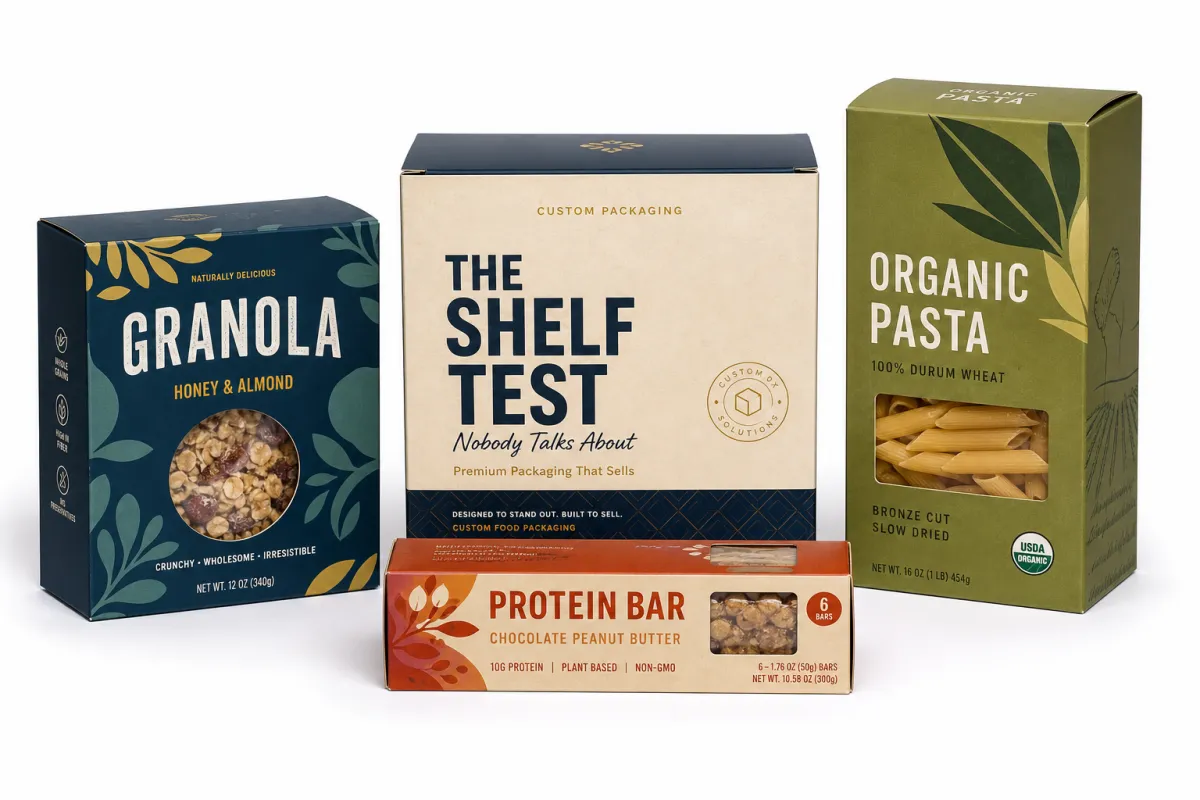
Most people treat branding as recognition. That is part of it, but not the whole story. The better test is whether the package looks like it belongs in the category, at the right price point, and in the right sales channel. custom food packaging boxes branding has to pass that test quickly, or the rest of the design work loses momentum.
Consider a bakery box, a frozen meal carton, and a premium snack sleeve. Each one needs a logo, though none of them needs the same visual language. A bakery box may lean warm, handcrafted, and easy to open. A frozen meal carton needs tighter hierarchy, clearer claims, and print that survives cold-chain handling. A snack sleeve can carry bolder graphics, but only if the message remains readable from a distance.
That is why custom food packaging boxes branding is not the same as generic packaging design. The box is not decoration. It is product packaging, retail packaging, and package branding at once. On a shelf, in a delivery photo, or stacked in a refrigerator case, the box has to do more than hold food. It has to build confidence.
Customers notice the details faster than brands expect. A plain kraft box can look premium if the typography is clean, the print coverage is restrained, and the board feels solid. A full-color carton can look cheap if the artwork is crowded, the finish is wrong, or the structure sags under its own weight. That is how custom food packaging boxes branding quietly decides whether a product feels artisanal, mass-market, or forgettable.
Why the first impression is so unforgiving
Food is one of the fastest visual decisions people make. They are not reading a long story. They are checking category, flavor, size, trust signals, and whether the box looks fresh. If the artwork is muddy or the structure looks weak, people assume the product is not worth the risk.
That becomes even more obvious in delivery apps and grab-and-go retail. A package does not get many second chances there. If the photo on screen looks flat or the physical box collapses after a single handoff, the brand has already lost the sale it was trying to protect.
What branding should communicate immediately
- Product type so the customer knows what they are buying in one glance.
- Flavor or variant so choosing feels simple instead of like a scavenger hunt.
- Quality level so the price feels justified.
- Trust signals like clean labeling, neat structure, and sensible material choices.
- Brand personality so the box feels like a deliberate part of the brand, not a random container.
That is the shelf test. Plain, unsentimental, and very real.
In practice, the best custom food packaging boxes branding looks simple because the difficult decisions happened early. The box size is correct. The artwork respects the folds. The colors still look good under store lighting. Nothing fights for attention unless it has earned that attention.
How custom food packaging boxes branding works from concept to shelf
custom food packaging boxes branding usually follows a more practical path than people expect. Good packaging does not begin with color. It begins with the product itself: what it is, how it travels, how it is displayed, and how much damage it can handle before it starts looking untrustworthy.
From there, the process usually moves through six stages: product positioning, box style selection, artwork layout, print method, sampling, and production. Skip one stage and the final box usually shows it.
Step 1: Define the product and sales channel
A premium dessert box for a boutique cafe does not need the same structure as a family meal pack sold through delivery apps. One might be opened at a table and photographed. The other may be stacked, shipped, cooled, reheated, and handled by several people before it is eaten. That changes everything about custom food packaging boxes branding.
Ask four blunt questions: Where is it sold? Who opens it? How far does it travel? What does the customer need to understand instantly? Those answers shape the box style and the brand message more than any mood board ever will.
Step 2: Choose the structure before the artwork
This is where a lot of brands get the sequence backward. They approve graphics on a flat mockup before they know whether the box is a tuck top, sleeve, mailer, folding carton, rigid box, or takeout format. Then the dieline appears and the design suddenly looks cramped. That result is entirely predictable.
A proper dieline shows folds, flaps, panels, safe zones, glue areas, and bleed. If the packaging design is not built around the dieline, the logo can land in a fold, the product photo can split across a seam, and the panel hierarchy can fall apart. custom food packaging boxes branding works best when the structure leads and the artwork follows.
Step 3: Build the visual system
The brand system should not stop at the front panel. Think about logo placement, typography, color blocking, flavor coding, side-panel messaging, and the back-panel copy that carries ingredients, instructions, or brand story. That is where custom printed boxes start to feel intentional rather than generic.
Good package branding usually relies on one dominant visual idea and a limited group of supporting elements. Too many icons, gradients, badges, and claims turn the box into a bulletin board. One clear brand mark, one main message, and one or two support points often do more than a crowded design ever will.
Step 4: Match print method and finish to the food
Offset printing, digital printing, flexographic printing, and specialty finishes all change the final result. So do matte, gloss, soft-touch, aqueous coating, foil, embossing, and window patches. A matte soft-touch carton can make a premium dessert feel expensive, while a glossy carton may work better for high-energy snack branding that needs more pop under retail lighting.
The finish should never be selected because it looks attractive in isolation. It should be chosen because it supports the product story, the handling conditions, and the budget. That is where custom food packaging boxes branding either stays disciplined or gets expensive for no useful reason.
Step 5: Sample before production
Never approve a food box only from a screen. A sample reveals the boring truths that renderings hide: panel size, closure strength, color shift, barcode readability, and whether the box actually feels sturdy enough to earn the price tag. A good sample also shows whether the inside print or unboxing experience adds value or just adds noise.
If the order is tied to a launch or seasonal rollout, a prototype is cheap insurance. It is easier to adjust a dieline than to explain to a warehouse why 8,000 boxes are a quarter inch too small. Ask me how fun that conversation is. It is not.
For brands comparing a few packaging shapes before committing, a short look at the available Custom Packaging Products can save a round of revisions later. Choosing the right format first is usually less painful than redesigning around the wrong one.
Step 6: Confirm the real-world use case
Branding on paper is one thing. Branding in a food truck, refrigerator case, shipping carton, or restaurant shelf is another. Your custom food packaging boxes branding should be checked in the environment where the box will actually live. Bright lights, moisture, grease, and handling all change how the package reads.
If you want a better sense of how those choices show up in production, the examples in our Case Studies are worth a look. Real packaging usually teaches more than a polished concept board.
Custom food packaging boxes branding cost, pricing, and MOQ
Money is where the conversation gets honest. custom food packaging boxes branding can be efficient, or it can become a small museum of unnecessary upgrades. Price depends on size, board grade, print coverage, finishing, die-cut complexity, and the quantity you order. Anyone saying otherwise is guessing or selling something with a very loose definition of value.
As a rough rule, lower quantities are useful for testing, but unit cost drops quickly as volume rises. That is not a secret. It is how setup, press time, and finishing costs behave. A 500-piece run can make sense for a pilot, while a 5,000-piece run usually gives better economics if the product is already validated.
| Box option | Typical MOQ | Approx. unit price | Best use case | Tradeoff |
|---|---|---|---|---|
| Kraft tuck box, one-color print | 1,000-5,000 | $0.18-$0.42 | Simple bakery items, dry snacks, clean minimal branding | Lower visual impact if the artwork is too sparse |
| Full-color SBS folding carton | 1,000-10,000 | $0.24-$0.65 | Retail shelves, flavor-coded product lines, promotional SKUs | Higher setup needs and more color management |
| Window box with PET patch | 3,000+ | $0.30-$0.80 | Pastries, confectionery, visible food presentation | Window placement must be precise and protective |
| Rigid gift box with insert | 500-2,000 | $1.20-$3.50 | Premium gift sets, corporate food gifts, specialty assortments | Cost climbs quickly with foil, embossing, and custom inserts |
| E-flute corrugated food box | 1,000-5,000 | $0.35-$0.95 | Delivery, heavier items, stackability, better crush resistance | Bulkier look if the structural proportions are poor |
Those numbers are ballparks, not promises. Print coverage, lamination, grease barriers, and specialty finishes can push the price up quickly. A single-color kraft box may look simple on paper, but if it performs well in transit and still feels good in hand, it can be the smartest spend in the whole line.
The cheapest quote often becomes the most expensive box. It arrives crushed, looks dull under retail lighting, or needs rework because the material cannot handle the food. Then you pay twice: once for the box and once for the fix. That is not savings. That is delayed regret.
For branding-heavy food lines, the smartest budgeting usually happens in layers. First, choose a structure that protects the product. Second, decide where the brand needs maximum visibility. Third, reserve the premium finishes for SKUs that justify them. That approach keeps custom food packaging boxes branding tied to actual sales rather than fantasy packaging.
Another useful comparison: a kraft mailer with restrained printing can be ideal for a local bakery subscription, while a laminated carton with foil accents might work better for a premium gift item sold at a higher margin. The box should match the margin. If it does not, the math gets ugly.
If the product also needs tags, inserts, or shelf labeling to support the package branding, our Custom Labels & Tags can fill the gap without forcing the box to carry every message itself.
Process and timeline: production steps, proofing, and lead time
custom food packaging boxes branding usually takes longer than a logo file and a few clicks. Good production has steps, and each one protects the final result from avoidable mistakes. The usual path is brief, dieline, artwork prep, proof, sample, approval, production, finishing, packing, and freight.
For a standard folding carton, a realistic timeline is often 12-15 business days from proof approval to production completion, with shipping added on top of that. More complex boxes with specialty finishes, inserts, or window patches can stretch to 20-30 business days. If the launch date matters, build buffer time. Otherwise the packaging arrives after the food, which is a remarkably expensive way to miss a launch.
Where delays usually happen
- Missing measurements that force dieline revisions.
- Late artwork changes after proofing has already started.
- Color corrections that need another review cycle.
- Special finish setup such as foil, embossing, or window patching.
- Approval bottlenecks when too many people want a final opinion at the same time.
Those delays are common because packaging sits at the intersection of design, compliance, operations, and marketing. Everyone has a comment. Not everyone shares the same deadline. That is why a clear owner for custom food packaging boxes branding matters more than another round of vague feedback.
How to keep the schedule under control
- Lock product dimensions before design begins.
- Approve the box style before any final artwork.
- Use vector files for logos and line art.
- Keep legal text, ingredient copy, and barcode data ready early.
- Limit revisions after sample approval unless the issue is structural or compliance-related.
Fast turnaround usually means fewer custom features, fewer revision cycles, and tighter artwork discipline. That is not a flaw. It is the tradeoff. If a brand needs a launch in two weeks, the package should be simple and the approval chain should be short. If a brand wants foil, embossing, internal print, and a custom insert, the schedule needs room to breathe.
For food boxes that will travel, it also helps to think beyond production and into transit performance. Organizations like ISTA focus on packaging test methods that help identify what happens during shipping and handling, which is useful if your boxes need to survive more than one gentle handoff.
Key factors that make custom food packaging boxes branding work
Good custom food packaging boxes branding is not a magic trick. It usually comes down to four things: clarity, structure, materials, and compliance. Miss any one of them and the package starts fighting itself.
Clarity beats decoration
The customer should know what the product is, what flavor it is, and why it is worth the money in just a few seconds. That means the front panel needs hierarchy. Not everything deserves equal size. If the logo is huge but the product type is tiny, the box may look stylish and still fail at selling.
Strong brand identity does not require clutter. A smart package often uses one focal point, a clear flavor code, and a restrained set of claims. That is enough to support custom food packaging boxes branding without turning the front panel into a parade of badges and slogans.
Structure has to earn its keep
If the box crushes, leaks, bows, or opens too easily, the branding will not save it. Structure matters because food packaging gets handled. It gets stacked, loaded, unpacked, refrigerated, shipped, and sometimes dropped by people who are already late. The best-looking box in the world is a bad investment if it fails at protection.
For heavier items, corrugated construction may be worth the extra bulk. For lighter retail items, a folding carton can be cleaner and cheaper. The right choice depends on how the product moves, not on what looks impressive in a design review. In other words, custom food packaging boxes branding should support the product, not compete with it.
Materials change perception fast
Material choice is one of the quickest ways to change how people judge the product. Kraft board can signal natural, rustic, or artisan depending on the print treatment. SBS and C1S boards can feel sharper and more retail-ready. Rigid board creates a premium unboxing experience, but it also adds cost, weight, and storage demands.
Surface finishes matter too. Matte can feel soft and refined. Gloss can make color pop more aggressively. Soft-touch feels premium but shows wear differently. Grease-resistant coatings help keep takeout and bakery boxes clean. Window cutouts help show the food, but the window placement has to be deliberate or the box starts looking cheap.
FSC-certified board can also matter for brands that want to speak clearly about responsible sourcing. If that is part of your brand promise, use FSC certified materials where appropriate and document it properly instead of hoping a green leaf icon will do the whole job.
Compliance should be part of the design, not an afterthought
Food boxes need room for ingredients, allergens, nutrition panels, handling instructions, and any required legal copy. If the design ignores that space, someone ends up shrinking the font or stacking text into a corner. That rarely ends well.
Food-contact rules are not decorative either. Materials and coatings should match the intended use, whether direct or indirect contact is involved. Check supplier specs and local requirements before final approval. Pretty packaging is useless if it fails compliance. A box that looks good but creates risk is not branding. It is a liability with a nice logo.
One more practical note: a box that is easy to open, reseal, or carry often earns more goodwill than a box that only looks expensive. Usability is part of the brand experience. People remember the package that made their life easier. They also remember the package that leaked sauce in the car. Nobody forgets that one.
Step-by-step guide to planning custom food packaging boxes branding
If you want custom food packaging boxes branding to work, the planning needs to be orderly. Not fancy. Orderly. Here is the sequence that usually saves the most time and the most money.
1. Write a product brief that actually says something
Start with the basics: product name, category, serving size, shelf life, storage condition, sales channel, and target customer. Add the pain points too. Does the item sweat in cold storage? Does the box need to resist grease? Will it be shipped flat or packed with product inside? Those details shape the box much more than the mood board does.
2. Choose the box style based on function first
Tuck top, sleeve, mailer, folding carton, rigid box, Tray and Sleeve, or takeout format each has its place. Pick based on protection, display, and handling. Then figure out how the brand can show up inside that structure. If the box cannot hold the food properly, the branding is not rescuing it.
3. Build the design hierarchy
Decide what belongs on the front panel, side panels, inside panels, and back panel. Put the logo where it helps, not where it dominates by default. Set one clear message for the front, then move supporting details into secondary zones. That is usually where custom food packaging boxes branding becomes easier to read and easier to approve.
4. Match copy to the customer journey
Some brands need a strong story. Others need a short ingredient callout and a clean flavor cue. Do not write a manifesto on a pastry box. On the other hand, do not leave a premium gift box looking empty and timid either. The text should reflect the category, the price point, and how much information the buyer actually wants.
5. Request a prototype and test it like a real buyer would
Print a sample or make a physical prototype. Then open it, stack it, photograph it, carry it, and see it under the lighting where it will actually be used. Check whether the colors still hold up. Check whether the logo is readable from a few feet away. Check whether the closure feels secure. This is where the practical side of custom food packaging boxes branding shows its teeth.
Also, if the product line needs custom identifiers, retail tags, or shelf-ready markers, compare them with the box design early. A small change in labeling can spare you a lot of formatting pain later.
6. Finalize files only after the sample is approved
Do not lock production art until the sample confirms the size, fit, finish, and print layout. Final files should reflect what was proven, not what the team hoped would work. The difference sounds small until you have 20,000 printed boxes sitting in a warehouse because one panel wrapped differently than expected.
If you are building a launch timeline, keep a fallback version ready in case a specialty finish or complicated structure threatens the schedule. That is not settling. That is planning like a person who has shipped packaging before.
Common mistakes in custom food packaging boxes branding and expert tips for next steps
The biggest mistakes are usually not dramatic. They are practical mistakes dressed up as design choices. custom food packaging boxes branding fails most often because someone tried to do too much, too late, with too little information.
Common mistakes to avoid
- Cramming too much onto the front panel so the product is hard to identify.
- Designing for a mockup instead of the real box, which leads to misplaced folds and dead space.
- Choosing weak materials that buckle, crush, or absorb moisture.
- Ignoring grease, condensation, or temperature changes that affect the finish.
- Chasing trends that do not fit the category, price point, or buyer expectation.
- Leaving compliance copy for the last minute and then forcing it into the design like a bad afterthought.
The trend trap deserves some direct language. A brand can copy a fashionable minimal box or a loud, playful carton and still miss the mark if the product is serious, premium, or retail-heavy. Packaging is not there to impress design people in a vacuum. It is there to sell the right product to the right buyer. That is a small distinction with a very large price tag.
Another common failure is treating the box as the only branding asset. It is not. The package should work with the rest of the system: website, menus, shelf labels, inserts, and supporting materials. If the brand needs extra on-pack communication, a coordinated system of box graphics and labels can keep the message clear without overcrowding the carton. That is one reason our Custom Labels & Tags line can be useful for food brands that need more structure around the package.
Here are the next steps I would recommend, in order:
- Define the product specs and sales channel in writing.
- Collect the exact box measurements and confirm the dieline.
- Shortlist two or three box styles that fit the use case.
- Request samples before you commit to full production.
- Align budget with MOQ so the unit cost makes sense.
- Reserve enough time for proofing, revision, and shipping.
That sequence keeps custom food packaging boxes branding practical. It also reduces the odds that someone signs off on a box because it looked nice in a PDF and then discovers it fails in a refrigerator case or delivery bag.
One more tip: keep a seasonal or limited-run version ready if your brand changes flavors often. A flexible system lets you swap copy, artwork, or color accents without rebuilding the whole package from scratch. That is a lot cleaner than redesigning every time the menu changes, and honestly, it saves everybody a headache.
If you want a clean way to judge whether the package is doing its job, use three questions. Can a customer identify the product fast? Does the box protect the food through normal handling? Does the design support the price? If the answer is yes to all three, your custom food packaging boxes branding is probably in good shape.
If one of those answers is no, fix that first. Not the foil. Not the emboss. The actual problem.
Custom food packaging boxes branding works best when it is treated like a business decision, not a decoration exercise. Build from the product outward, choose materials that match the food, keep the design readable, and give production enough time to do its job. That is the boring path. It is also the one that tends to sell.
Frequently asked questions
What makes custom food packaging boxes branding different from plain packaging?
Plain packaging holds the product. custom food packaging boxes branding does that plus the selling work. It communicates quality, flavor, and trust before the customer opens the box, and it has to do that without losing structural strength or food safety.
How much does custom food packaging boxes branding usually cost?
Cost depends on box size, board grade, print coverage, finishing, and quantity. Simple kraft or one-color boxes often start much lower than full-color cartons with foil, embossing, or specialty coatings. For many buyers, the real cost driver is not the print alone. It is the combination of setup, material choice, and MOQ.
What is the typical lead time for branded food boxes?
Typical lead time includes artwork prep, proofing, sampling, production, finishing, and shipping. Standard runs can move in roughly 12-15 business days after proof approval, while more complex custom food packaging boxes branding projects can take longer. If your launch date is fixed, build buffer time into the schedule.
What files do I need to start custom food packaging boxes branding?
You usually need your logo, brand colors, copy, product dimensions, and any legal or nutrition text that must appear on the box. A dieline from the supplier helps place artwork correctly, and vector files are best for sharp print output. If the file is blurry on screen, it will not magically sharpen on press.
How do I keep branded food boxes compliant and food-safe?
Use materials and coatings that are suitable for the intended contact type, leave enough space for labeling and allergens, and check local rules before final approval. Good custom food packaging boxes branding should look strong, but it also has to meet the practical requirements that keep the package legal, usable, and safe.

