Custom Frosted Zipper Bags for cosmetics brands are useful because they make small products look intentional without overcomplicating the package. The finish is soft, the presentation is controlled, and the reclosable format works well for minis, wipes, masks, bath salts, and tool sets.
For packaging teams, the value is practical. These bags sit between visibility and privacy, giving enough product display to inform the buyer while avoiding the harshness of a fully clear pouch. They also photograph well, resist fingerprints better than glossy film, and can support a premium feel without requiring a complex structure.
The useful questions are not abstract. How does it print on frosted film? What size actually fits the fill? What does the unit cost look like at your order quantity? Can the zipper survive repeated use? If the pouch cannot answer those questions, the design is not ready.
If you are comparing this format with other Custom Packaging Products, or trying to decide whether it fits your line, focus on what the pouch protects, how it presents the product, and whether the quote matches the way you actually buy.
Why frosted zipper bags are quietly outperforming clear pouches
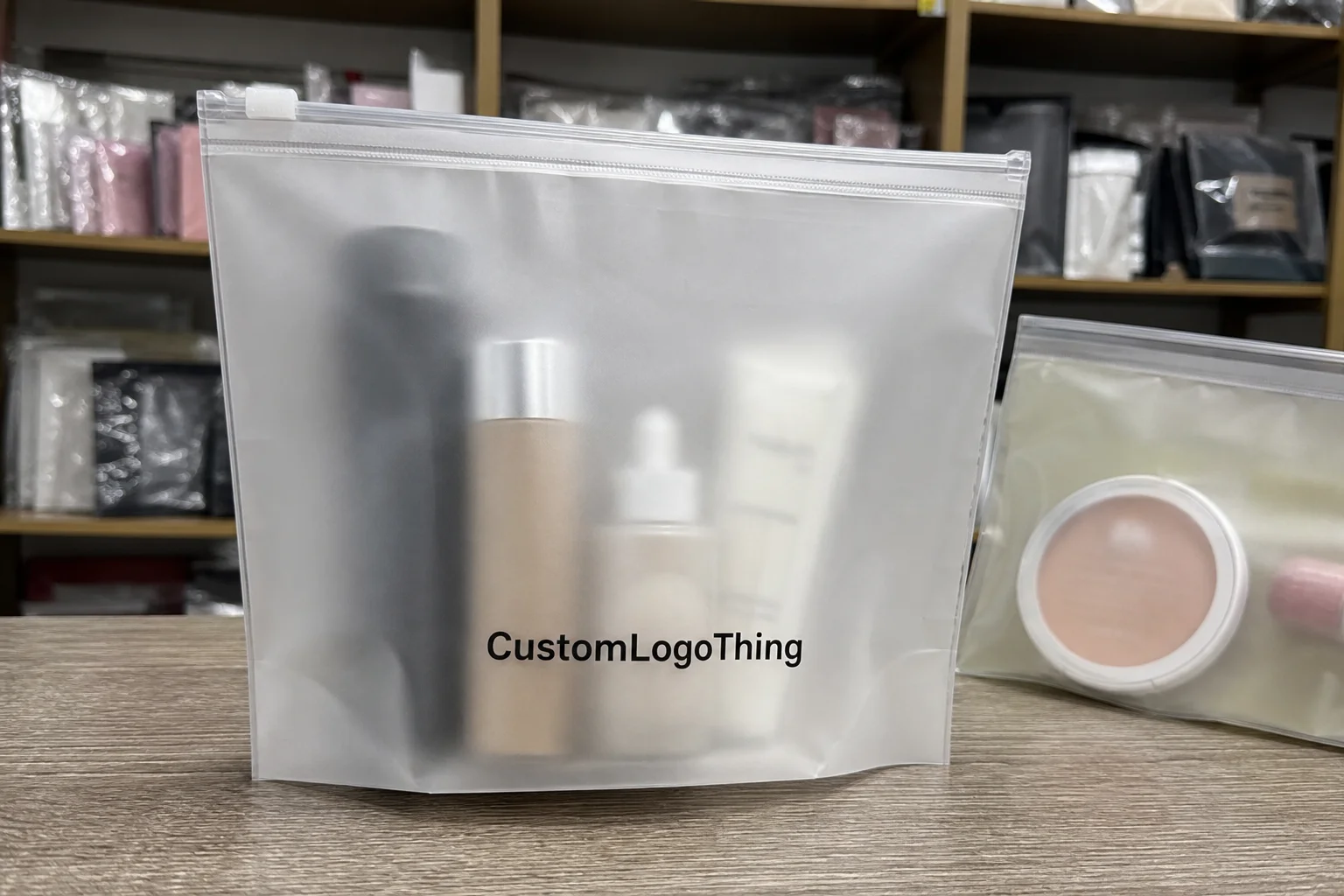
Clear pouches show everything. That can work for one-item kits, but it can also make mixed contents look busy or unplanned. Frosted film softens the view, so the package reads more like a designed object and less like a utility bag.
That matters in cosmetics, where presentation affects perceived value. Sample sets, travel sizes, sheet masks, grooming tools, and bundled kits usually need a package that feels clean and deliberate without heavy embellishment.
The matte surface has a second advantage: it hides fingerprints and light scuffs better than glossy material. For bags handled during packing, transit, and retail display, that helps the package stay presentable longer.
“A good pouch should support the product’s presentation, not compete with it.”
These bags are common in boutique launches, ecommerce shipments, subscription inserts, and event giveaways because they offer lightweight protection and a neat presentation. That said, product compatibility still matters. Oily, highly liquid, or chemically aggressive formulas may need testing before approval.
Photographically, frosted film reduces glare and makes mockups easier to light. That does not replace good art direction, but it does help the pouch read cleanly in thumbnails, catalogs, and social content.
How the zipper, seal, and frosted film work together
A pouch is a system. The film, frost level, zipper track, side seals, and optional details such as a tear notch or hang hole all influence the final result. If one part is underspecified, the package can feel less refined than the artwork suggests.
Barrier claims should be kept realistic. A zipper pouch can help with dust, moisture, and basic handling, but performance depends on film thickness, seal quality, and the product itself. Thicker material usually feels sturdier and resists puncture better. A better zipper improves reclosability. Neither detail turns the pouch into a high-barrier container unless it is designed and tested for that purpose.
For cosmetics, the user experience matters. A pouch that opens easily, closes cleanly, and survives repeated use reinforces trust. A pouch that splits at the seam or refuses to reseal does the opposite, even if the graphics look strong on screen.
Material structure also affects artwork. Common PE-based films are flexible and economical, while laminated structures can improve stiffness or barrier properties at a higher cost. On frosted surfaces, strong contrast, bold typography, and selective white ink usually work better than fine detail. If your primary packaging was built around custom printed boxes, the pouch artwork may need simplifying so it stays legible on matte, semi-translucent film.
Common build elements worth confirming early:
- Film gauge or thickness
- Zipper style and seal integrity
- Tear notch or hang hole options
- White underprint availability
- Moisture, dust, and leak expectations
Key specs that shape appearance, protection, and shelf appeal
Size is usually the first decision, and it causes more trouble than people expect. A pouch can look balanced in a digital proof and still fail once the real fill volume, insert card, and zipper headspace are added. Too snug, and the closure becomes awkward. Too loose, and the pouch looks underfilled.
Film thickness changes both feel and durability. Lighter gauges are often fine for sachets and low-risk samples. Heavier gauges feel more substantial, resist puncture better, and hold shape more reliably on display. That mix is what buyers usually call quality.
Zipper style matters more than many teams expect. A standard press-to-close zipper is often enough for minis, inserts, and dry products. Slider-style closures or smoother guided tracks can improve usability for repeat-open items, but they usually add cost and lead time.
Print specs deserve the same attention. On frosted material, bold logos generally work better than tiny decorative copy. White underprint can improve legibility and help color hold on translucent film. PMS matching is useful if your brand system depends on consistency, but film printing does not behave exactly like paperboard. If the pouch needs to coordinate with custom printed boxes or labels, the artwork may need to be simplified so it reads clearly on a matte, semi-translucent surface.
| Spec choice | Typical effect | Best use case | Buyer watch-out |
|---|---|---|---|
| Light film, simple zipper | Lower cost, softer feel | Samples, low-risk dry goods | Can feel flimsy if overfilled |
| Mid-gauge frosted PE | Balanced feel and appearance | Minis, retail bundles, wipes | Needs strong artwork contrast |
| Heavier or laminated structure | Better stiffness and perceived quality | Premium kits, repeat-use pouches | Higher cost and longer lead time |
Compatibility is the hidden spec that causes the most surprise. Oils, powders, botanicals, and fragranced formulas do not behave the same way inside packaging. A dry mask kit may be simple. A balm sample or a formula with migration risk may need more testing because the contents can soften the film or interfere with seal performance.
Custom frosted zipper bags for cosmetics brands: cost, MOQ, and quote basics
Pricing gets confusing when suppliers use similar language for different builds. One quote may cover a 10,000-piece run with simple one-color print. Another may be for 3,000 pieces, full-color artwork, white ink, and a heavier zipper. They are not comparable unless the specs match.
The main cost drivers are size, material, thickness, print colors, zipper type, and order quantity. More complex structures and more demanding artwork raise the unit price. Smaller runs almost always cost more per piece because setup costs are spread across fewer units.
As a rough budgeting range, simple branded runs can sometimes land around $0.18-$0.28 per unit at 5,000 pieces, while heavier film, special finishes, or more complex print builds can move higher. Smaller quantities can rise quickly, so the unit price matters less than the reasons behind it.
| Order style | Relative unit cost | Typical setup complexity | Best for |
|---|---|---|---|
| Stock pouch with logo print | Lowest | Low | Fast launches, tight budgets |
| Fully custom size and print | Medium | Moderate | Core retail packaging and brand consistency |
| Custom structure with special finish | Highest | Higher | Premium bundles, signature product lines |
MOQ follows the same pattern. Lower minimums usually mean fewer decoration options and a higher unit price. Higher minimums can improve pricing, but only if the inventory will move. For smaller brands, excess packaging is still cash tied up on a shelf.
At minimum, ask for setup fees, tooling if applicable, sampling charges, freight estimates, lead time, print method, and the exact specs included in the price. If those details are vague, the quote is not ready for serious comparison. A low unit price with unclear terms is often a poor decision in disguise.
For teams that want a broader view of how packaging decisions affect buying outcomes, our Case Studies page shows how format, finish, and structure influence the final packaging choice.
Production steps and timeline: from artwork to delivered cartons
The production path is usually predictable once the specs are locked. It starts with inquiry and specification confirmation, then moves into artwork prep, proofing, sampling if needed, production, inspection, and shipping.
Most delays happen at proofing. Files that work well on screen sometimes fail in print because they are too fine, too dark, or built for a different substrate. Missing compliance text and last-minute edits are another common slowdown. If the bag has regulatory copy, ingredient text, or usage instructions, that content needs to be finalized before printing starts.
For a straightforward order with approved artwork, timelines of 12-15 business days from proof approval are common. Sampling, structural changes, special inks, or higher order quantities can extend that schedule. Freight and customs can add more time again, so launch planning should include buffer.
Timeline pressure points:
- Artwork approval and file correction
- Sample confirmation
- Print method and color matching
- Production queue timing
- Freight and customs transit, if applicable
The teams that move fastest are usually the ones that document every approved spec: exact size, thickness, zipper style, print colors, finish, and final proof notes. That record keeps reorders clean and prevents the familiar problem of a “same” bag arriving with small but noticeable differences later.
Common mistakes cosmetics teams make when ordering
The first mistake is choosing a size from a mockup instead of a real fill test. A pouch may look proportionate on screen but become awkward once the product, insert, and zipper headspace are all inside.
The second mistake is over-designing the front panel. Frosted film already has character. If every inch is packed with artwork, the finish stops doing its job. Clean layouts and a single focal point usually work better than a crowded panel.
The third mistake is treating all closures as equal. Some zippers feel crisp and reliable, while others snag or wear quickly after repeated opening. That difference matters most for reusable bags.
The fourth mistake is ignoring storage and freight. Large pouch orders still occupy space and tie up working capital.
The fifth mistake is skipping product compatibility testing. Oils, powders, liquids, and fragranced formulas can all behave differently. A pouch that looks fine when empty may not hold up once filled, sealed, and shipped through temperature swings.
Expert tips for stronger branding and a cleaner buying decision
Use contrast with restraint. Let the frosted finish do part of the work. A bold logo, a readable product name, and one strong visual cue usually perform better than dense decorative detail.
Choose one primary message for the front and place ingredients, instructions, or compliance text on the back. That gives the front panel room to breathe and makes the system easier to repeat across multiple product lines.
Ask for a physical sample whenever possible. Screen images cannot show how stiff the pouch feels, how the zipper engages, or how translucent the frosted film really is under actual light.
Match pouch structure to the job. A sample pouch does not need the same build as a premium retail bundle. A subscription insert does not need the same print coverage as a flagship launch.
If your launch includes cartons, labels, or inserts, align the pouch with the rest of the system. That is where package branding becomes visible in a practical way.
Save the final approved spec sheet, artwork files, and proof notes in one place. Reorders move faster, errors drop, and there is less time wasted trying to reconstruct old decisions from scattered email threads.
Next steps: build a practical order brief and compare suppliers
The fastest way to move from concept to quote is to write a one-page brief before contacting suppliers. Include product type, fill size, target quantity, artwork requirements, material preference, budget range, and any compliance or testing concerns.
Then request pricing from at least three vendors using the same exact specs. That is the only fair comparison. If one supplier is cheaper but the MOQ is twice as high, or if another offers a stronger build with a slightly longer timeline, the best choice may not be obvious from unit price alone. Ask for sample photos or physical samples so you can judge zipper quality, print clarity, and the frosted surface before you commit.
Logistics belong in the decision too. Storage, shipping carton count, reorder timing, and launch schedule all affect whether the order makes sense. A pouch that looks ideal but arrives late is not ideal. A lower-cost option that cannot be reordered consistently is not much better.
Custom Frosted Zipper Bags for cosmetics brands can protect small products, support a clean shelf presentation, and improve the feel of a collection without requiring a complicated structure. The best orders are the ones where appearance, function, and repeatability all hold together.
FAQs
Are custom frosted zipper bags for cosmetics brands good for liquids?
They can work for some liquid products if the film, seal, and zipper are appropriate, but testing is essential. Check for leakage, seam stress, and compatibility with oils or solvents before placing a full order. For higher-risk formulas, ask whether a different structure or a barrier upgrade is more suitable.
What size should I choose for cosmetic sample pouches?
Choose the size based on the actual fill volume, not only the label dimensions or a product photo. Leave room for the zipper, headspace, and any inserts such as cards or applicators. A fit test with the real product is the safest way to confirm the final size.
How do I compare pricing for frosted cosmetic zipper bags?
Compare the same pouch size, material, thickness, print colors, and quantity across suppliers. Also check whether setup fees, tooling, sample costs, and shipping are included. A lower unit price can hide a higher total cost if the MOQ is too large or the build is weaker.
What artwork works best on a frosted pouch surface?
Bold logos, strong contrast, and simple layouts usually read best on frosted material. White ink or a white underlayer can help colors stand out and improve legibility. Dense details may lose clarity unless the print method and artwork are planned carefully.
How far in advance should I order custom frosted zipper bags for cosmetics brands?
Allow extra time for first-time orders because proofing, sampling, and approvals often add rounds to the process. Build in a buffer for production and freight, especially before a launch or seasonal push. If the order is urgent, confirm stock options and realistic turnaround before you commit.


