Buyer Fit Snapshot
| Best fit | Custom FSC Hang Tag Printing for Sustainable Brands projects where brand print, material claims, artwork control, MOQ, and repeat-order consistency need to be specified before quoting. |
|---|---|
| Quote inputs | Share finished size, material target, print colors, finish, packing count, annual reorder estimate, ship-to region, and any compliance wording. |
| Proofing check | Approve dieline scale, logo placement, barcode or warning zones, color tolerance, closure strength, and carton packing before bulk production. |
| Main risk | Vague material claims, crowded artwork, missing packing details, or unclear freight terms can make a low unit price expensive after revisions. |
Fast answer: Custom FSC Hang Tag Printing for Sustainable Brands should be specified like a repeatable production item. The safest quote records material, print method, finish, artwork proof, packing count, and reorder notes in one written spec.
Production checks before approval
Compare the actual filled-product size with the drawing, then confirm tolerance on folds, seals, hang holes, label areas, and retail display edges. Reserve space for logos, QR codes, warning copy, and material claims before decorative graphics fill the panel.
Quote comparison points
Review material grade, print process, finish, sampling route, tooling charges, carton quantity, and freight assumptions side by side. A quote is only useful when the supplier can repeat the same color, closure quality, and packing count on the next order.
The hang tag is often the first physical proof of brand quality, and custom fsc hang tag printing is where that proof can feel exact or feel improvised. The object is small. The implications are not. A tag touches materials, compliance, shelf presentation, and the story a buyer tells in front of the rack or display table.
That makes custom fsc hang tag printing more strategic than many teams assume. A good tag does more than hold a logo and a price. It can carry care instructions, reinforce package branding, support sustainable packaging claims, and signal that the brand has handled the paperwork with the same care as the design.
For brands focused on greener sourcing, the question is not simply whether a tag can be printed on FSC-certified stock. The sharper question is whether the brief is specific enough to prevent fuzzy claims, avoidable expense, and a finish that looks premium in a deck but awkward in production. The strongest custom fsc hang tag printing projects treat material choice, print method, finish, and verification as one system, not four separate decisions. That is the same discipline buyers bring to Custom Printed Boxes and retail packaging labels, and hang tags deserve the same standard.
Custom Logo Things works in that middle ground where creative intent meets production reality. That matters because a hang tag is not a billboard. It has to carry weight in a limited space, move through print and conversion without friction, and still fit the rest of the product packaging story. Done well, custom fsc hang tag printing becomes a small-format decision with a large effect on trust.
I have seen the same thing happen on press checks more than once: a tag that looked too plain in a PDF suddenly looked expensive once the paper texture caught the light. The reverse happens too. A glossy proof can flatter a design that the real stock just will not support. That gap is where a lot of budget gets burned, and it is why sample review matters so much.
What does custom fsc hang tag printing really mean?
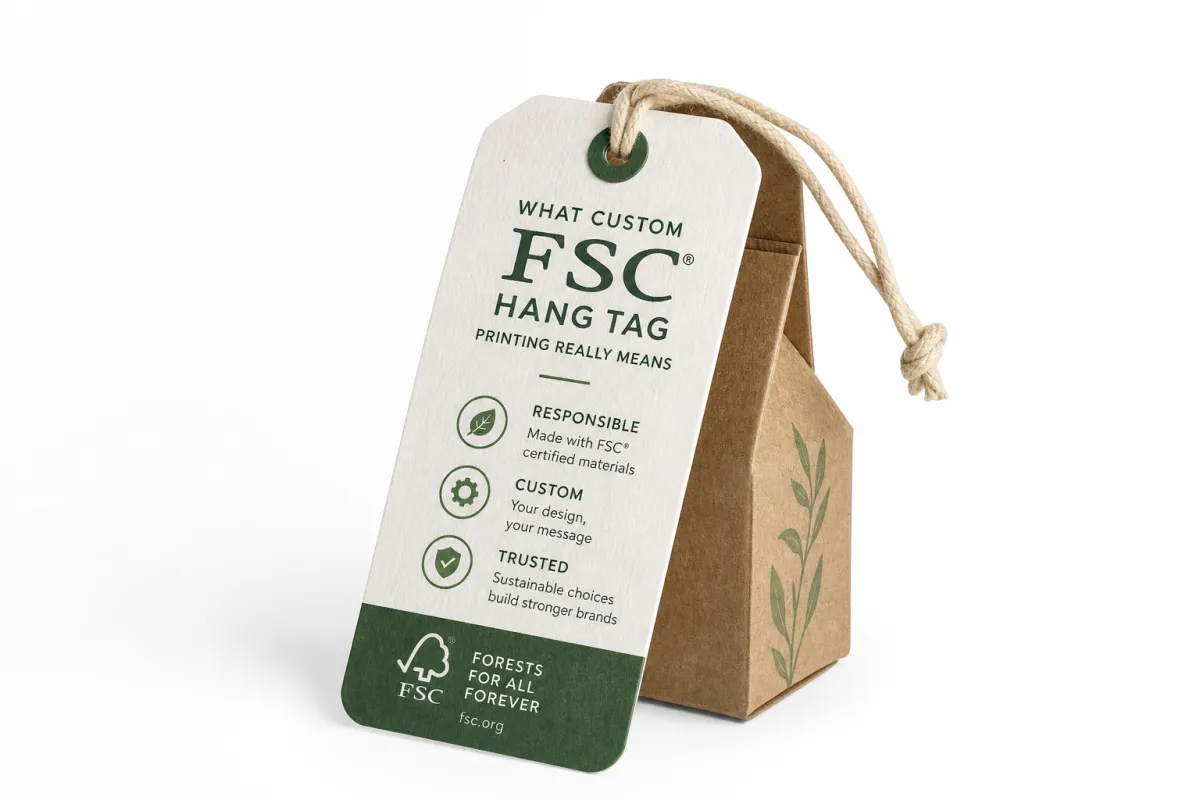
At its simplest, custom fsc hang tag printing means producing a branded tag on paper or board that comes from an FSC-certified supply chain and can be traced through a chain of custody system. The tag is customized for a product line, a seasonal launch, a retailer requirement, or a promotional campaign. The substrate, though, is the important part of the sustainability claim. That is where the paper comes from, and that is where buyers should begin.
FSC matters because it gives brands a clearer benchmark than vague language like "eco-friendly" or "earth-conscious." Those phrases can stretch to cover almost anything. FSC, by contrast, is a third-party framework tied to responsible forestry and traceability. For a packaging buyer, that reduces greenwashing risk and creates a paper trail that a retailer, auditor, or internal compliance team can actually review. More on the certification side is available directly through fsc.org.
There is also a commercial angle. A hang tag may carry the price, SKU, UPC, fiber content, care iconography, or a QR code that sends shoppers to product education. In apparel, cosmetics, gifts, and premium consumer goods, the tag is often the last place where a brand can add context without changing the main pack. That matters when the core package is already locked and the launch calendar is tight.
Many teams miss one point: custom fsc hang tag printing is not only about signaling sustainability. It is about making the signal believable. If a brand prints a recycled-looking tag with vague copy, no certificate reference, and a high-gloss finish that fights the "natural" message, the claim can feel decorative instead of verified. Buyers notice the mismatch fast. Retailers do too.
A strong FSC claim is not louder. It is cleaner. The material, the wording, and the documentation all need to point in the same direction.
From a packaging design point of view, the tag is a small canvas that can still do real work. It can support seasonal storytelling, add a short origin note, reinforce retail packaging consistency, or explain how the product should be disposed of after use. For brands that already invest in branded packaging, the tag can tighten the whole system so the box, label, insert, and hang tag feel related rather than assembled from separate moods.
That is why custom fsc hang tag printing sits at the intersection of identity and compliance. It is not decoration with a certificate attached. It is a production decision, a communication decision, and for many buyers, a credibility test.
How does custom fsc hang tag printing work from file to finish?
The workflow for custom fsc hang tag printing is simple on paper and messy in real life if one step slips. A clean project starts with the basics: tag size, shape, stock preference, quantity, attachment method, and the exact claim the brand wants to make. From there comes certification confirmation, artwork setup, proofing, printing, finishing, die-cutting, and packing.
The first decision is the format. A simple 2 x 3 inch rectangular tag may be the right answer for a fashion line, while a larger die-cut shape can make sense for a premium gift item or a cosmetics accessory. Smaller tags usually keep cost in check, but the real question is whether the layout can carry the information without crowding. In custom fsc hang tag printing, the tag size should follow the content, not the other way around.
Next comes the stock. Common options include FSC-certified 14pt, 16pt, or 18pt board, as well as heavier uncoated sheets for a more tactile feel. A 350gsm or 400gsm matte board is often a practical middle point for retail packaging use. If the tag needs a warmer, less manufactured look, an uncoated FSC sheet can work well. If it needs sharper contrast and cleaner image reproduction, coated stock may be the better fit. That choice also affects whether offset printing or digital printing is the more efficient route.
Chain-of-custody documentation is where the process becomes more than design. Before production starts, the buyer should ask for the relevant certificate details and make sure the project is covered. The FSC logo and wording need to match the actual certification status of the job, not just the paper name on a spec sheet. Paper can be FSC-certified even when the ink or a finish is conventional; the key is that the claim is accurate and the material is traceable.
Printing method matters too. Offset printing is usually a strong fit for larger quantities, rich solids, and tight color control. Digital printing tends to make more sense for shorter runs, variable data, or faster turnaround. Specialty techniques such as foil, embossing, debossing, and spot UV can elevate a tag visually, but they should be used with care when the sustainability brief is front and center. In many custom fsc hang tag printing projects, the simplest finish carries the most authority.
Common finishing choices
- Matte varnish for a soft, understated retail look.
- Gloss varnish for stronger color pop and higher contrast.
- Foil stamping when a premium accent is necessary and the brand can justify it.
- Embossing or debossing for tactile detail without adding much ink coverage.
- Spot UV for selective shine, usually used sparingly on sustainable packaging briefs.
- Hole drilling and stringing for assembly-ready tags that can move directly into packing.
One practical distinction prevents a lot of confusion: certification applies to the material and the chain of custody, not automatically to every visible element in the design. A printer can use FSC paper while still sourcing standard inks, adhesive dots, or string attachments. That does not invalidate the job, but it does mean the claim must be written carefully. A clear supplier conversation up front is cheaper than a compliance correction later.
For brands that want the tag to coordinate with the rest of the system, it helps to compare the tag plan against the broader packaging stack. If you are aligning labels, inserts, and outer cartons, the internal consistency matters as much as the individual item. See the broader Custom Labels & Tags range, our Manufacturing Capabilities, and related Custom Packaging Products if you are building a coordinated launch.
At the end of production, the finished tags should be counted, packed, and labeled in a way that matches the brand's receiving process. That seems minor until a buyer is opening cartons at 7 a.m. and trying to move product into stores the same day. Small details decide whether custom fsc hang tag printing feels smooth or punishing to the person handling the goods.
Custom FSC hang tag printing costs: what really drives price
Pricing for custom fsc hang tag printing is rarely driven by one number. It is usually a stack of smaller decisions, and each one nudges the final quote. The clearest drivers are paper stock, tag size, color count, finishing complexity, quantity, turnaround time, and whether the job needs stringing, kitting, or individual bagging.
Quantity is the biggest driver. Low-volume digital runs often have a higher unit cost because setup is spread across fewer pieces. Larger offset runs usually lower the per-unit price once the press is running and the impression count rises. That is why a buyer asking for 500 tags and a buyer asking for 10,000 tags are not comparing the same product. They are comparing two different economic shapes inside custom fsc hang tag printing.
Finish can change the quote faster than teams expect. Premium effects become expensive once they are layered together. A custom die shape, two foil colors, embossing, and a spot UV window may all look great on a proof. In production, those choices add makeready time, more conversion steps, and more risk. If the tag is carrying a sustainability story, the cheapest path is not always the right one, but the most elaborate path is often unnecessary.
For a useful comparison, here is a practical pricing view. These are broad ranges, not fixed quotes, but they reflect how custom fsc hang tag printing usually behaves in the market.
| Run type | Best for | Typical setup | Approx. unit cost | Notes |
|---|---|---|---|---|
| Digital printing | Short runs, fast launches, variable data | Low setup, flexible artwork changes | $0.18-$0.55 each on smaller orders | Best when speed matters more than press economies |
| Offset printing | Mid to large runs, precise color, dense coverage | Higher setup, better at scale | $0.06-$0.22 each on larger orders | Usually the best fit for repeatable retail programs |
| Specialty finishing | Premium branding, tactile detail, high shelf impact | Extra passes, conversion steps, tighter tolerances | $0.25-$0.75 each depending on complexity | Costs climb quickly when foil, embossing, and die-cut shapes combine |
The most useful pricing request is a line-item quote. Ask the supplier to separate substrate, print, finishing, assembly, and fulfillment. That makes it easier to see where the money goes and where the trade-offs live. A brand may choose to upgrade the stock while dropping a second foil color, or simplify the shape while adding better variable data. In custom fsc hang tag printing, small shifts can move the economics more than most people think.
There is also value beyond the unit cost. A tag that clarifies fiber content, care instructions, or end-of-life guidance can reduce customer service questions. A tag that supports stronger shelf appeal can protect margin by improving conversion. That is why a serious buyer should compare cost against output, not just against paper weight or decoration level.
If your team is budgeting for a product line, a practical starting point for a standard FSC hang tag might be $0.12-$0.28 per unit at moderate volume, depending on stock and finish. A more ornate version with foil, embossing, or custom cutting can move well above that. Those are normal swings in custom fsc hang tag printing. They are not red flags by themselves; they are signals that the spec needs to be tightened.
The truth is a little boring and a little useful: the best quote is usually the one that matches the exact job, not the one that looks cheapest on page one. A stripped-down spec that fits the launch is better than a fancy spec that forces compromises everywhere else. That is one reason experienced buyers keep a second version of the quote open while they decide what can be dropped without hurting the tag.
Step-by-step process and timeline for a custom fsc tag project
A strong custom fsc hang tag printing project has a visible sequence, and each step should have an owner. That sounds basic, but it prevents the late-stage confusion that often slows packaging programs. The cleanest projects begin with purpose: what does the tag need to do, and who needs to read it? After that, the format, stock, print method, and finish can be selected with intent rather than habit.
A realistic project flow looks like this:
- Define the use case - Is the tag for apparel, beauty, gifts, or general retail packaging?
- Set the size and shape - Match the layout to the content, not the other way around.
- Confirm FSC stock - Verify the paper grade and the chain-of-custody coverage.
- Prepare artwork - Include bleed, safe area, barcodes, legal copy, and the correct FSC wording.
- Review proofs - Check color, legibility, barcode scan quality, and claim language.
- Approve production - Lock the file before the press run starts.
- Finish and pack - Drill, string, count, bundle, and label for receiving.
Lead times vary with complexity. Simple digital custom fsc hang tag printing jobs can often turn around in 5-8 business days after proof approval if stock is available and the artwork is clean. A more typical offset job with standard finishing may need 10-15 business days. If the project includes foil, embossing, custom dies, or assembly, 15-25 business days is not unusual. The proofing stage often takes longer than the print stage, especially if compliance, brand, and procurement all have to sign off.
Where do delays usually happen? Not in the pressroom. They usually happen when files arrive late, the dieline is unclear, the certification request is vague, or someone changes the copy after approval. One late revision can ripple through prepress, plates, and finishing. That is why a disciplined briefing process matters so much in custom fsc hang tag printing.
Retail launches and seasonal drops deserve extra buffer time. If the tags need to arrive before the box run, the margin should be built into the schedule early. The same is true for product photography. A team that wants the tag visible in campaign images should have physical samples before the shoot, not after. That is a common blind spot in product packaging planning.
For brands with layered packaging programs, it can help to align tag timing with the rest of the supply chain. If the carton, insert, and tag all need to hit the same dock date, the project owner should treat the hang tag as part of the broader packaging schedule, not as a side order.
In practice, the best schedules include one extra checkpoint for sample approval. It is a small buffer, and it saves a lot of grief. I have seen a clean print job get delayed by a single barcode correction that should have been caught on page two of the proof. Nobody enjoys that scramble. Nobody.
Common mistakes that weaken FSC claims or waste budget
The biggest mistake in custom fsc hang tag printing is not choosing the wrong color or the wrong hole position. It is being vague. Vague claims, vague files, vague approvals, vague certification questions. Those soft failures lead to credibility problems and unnecessary cost.
Generic eco language is the first risk. A tag that says "sustainable," "green," or "planet-friendly" without a clear paper specification can sound polished while saying very little. In regulated or premium markets, that can create more skepticism than trust. A stronger approach is to name the material, keep the claim precise, and make sure the wording matches the documentation. That is the practical difference between marketing copy and verifiable custom fsc hang tag printing.
Artwork errors are another budget leak. Oversized bleed areas, tiny type near the cut edge, barcode quiet zones that are too small, and dielines that do not reflect the actual shape all raise the chance of a reproof or a reprint. A design that looks clean on screen can become expensive the moment the cutter hits it. For teams working across branded packaging and product packaging, this is where a disciplined prepress checklist saves money.
Common pitfalls to avoid
- Over-specifying the finish - Extra coatings and decorative layers can add cost without improving shopper response.
- Confusing paper certification with every component - FSC paper is not the same thing as a fully certified finished assembly.
- Ignoring color shift - Recycled and uncoated papers can mute saturation or shift neutrals.
- Approving too quickly - A rushed proof can miss barcode issues, copy errors, or compliance wording.
- Skipping the claim check - The exact FSC language should be confirmed before production, not after.
Over-specifying the tag is a surprisingly common problem. Teams sometimes add multiple specialty effects because the brand mood board looked thin without them. Each added process has a cost, and each added process can muddy the sustainability message. In many custom fsc hang tag printing projects, a well-chosen paper, one clean color system, and a single tactile detail beat a crowded stack of finishes.
Another mistake is ignoring the rest of the package system. If the tag feels natural but the carton is glossy and heavily inked, the story splits in half. A better approach is to coordinate the tag with the broader package branding, including inserts, labels, and Custom Printed Boxes where relevant. Consistency across those pieces tends to read as more deliberate and more premium.
Finally, teams sometimes forget that the proof is a legal and production document, not just a design preview. If there is a barcode, QR code, certification statement, or country-of-origin note, it needs the same attention as the logo. One missed digit can derail the launch more than a slightly imperfect color match.
For distribution-heavy programs, it can also help to think about the tag as part of a package that will be handled, shipped, stacked, and touched. If the item is moving through demanding channels, resources like ISTA test guidance can help teams think more carefully about how retail packaging and shipping conditions interact. The tag itself is not the shipper, but it still has to survive the trip from carton to customer.
Expert tips for better color, durability, and retail impact
The best custom fsc hang tag printing projects do not just check the sustainability box. They still sell the product. That means the visual hierarchy has to work. The product name, size, price, and brand mark should read instantly, while the FSC message supports the design instead of fighting it. If the sustainability note is louder than the product identity, the tag can feel preachy rather than premium.
Color management matters more on FSC stocks than many designers expect. Uncoated and recycled papers absorb ink differently from bright coated sheets, and that can change saturation, contrast, and neutral balance. A deep forest green may land as a softer olive. Black may read warmer. White space may feel more tactile but less crisp. A small proof run on the actual paper is the safest way to avoid surprises in custom fsc hang tag printing.
For apparel and soft goods, a matte or lightly textured FSC board often works well because it feels honest and tactile. For cosmetics or gift items, a smoother finish can help preserve fine detail. If the tag has to survive repeated handling, then durability becomes part of the brief. A simple protective varnish may be better than a complicated decorative build. The goal is not to make the tag indestructible; it is to keep the typography readable and the color credible through normal retail use.
Here are a few practical combinations that tend to work well:
- Apparel - 16pt to 18pt FSC board, matte finish, one or two ink colors, clean drill hole.
- Cosmetics - Smooth FSC cover stock, sharper color build, restrained foil or embossing if needed.
- Gift and lifestyle - Natural uncoated stock, strong typography, minimal surface treatment, premium stringing.
- Subscription or bundle items - Tags that double as care guides or unboxing storytelling pieces.
Durability is a bigger deal than teams often admit. If a tag will be touched often, stacked in cartons, or exposed to humidity during seasonal shipping, ask for the simplest finish that still protects the printed content. In many cases, a heavy coating is less useful than better stock selection and smarter layout. That practical thinking keeps custom fsc hang tag printing aligned with both presentation and performance.
There is also a storytelling opportunity. A tag can explain why the paper choice matters, how to recycle or compost the tag where local systems allow it, or how the product ties into a broader sustainability program. The trick is brevity. Two short lines done well are better than a long paragraph nobody reads. If the brand has a QR code, it can lead to a longer explanation without crowding the tag surface.
For teams coordinating multiple packaging items, consistency across the whole system creates practical alignment. The tag, carton, insert, and label should feel like they came from the same design logic. That matters especially in custom fsc hang tag printing, where the tag may be the smallest item in the set but the one most likely to be inspected by hand.
One more field-tested note: on rough FSC stocks, thin rules and pale gray type tend to disappear faster than most designers expect. I have watched a beautifully minimal layout lose legibility the second it moved off screen and into a store fixture. So keep contrast honest. Kinda boring, yes. Also far more useful.
Actionable next steps for your FSC hang tag project
If you are planning custom fsc hang tag printing, the fastest way to improve the result is to tighten the brief before asking for a quote. Start with the tag's job. Is it mainly for branding, compliance, pricing, or storytelling? The answer determines the size, the stock, and the amount of copy that belongs on the front and back.
A strong one-page brief should include the following:
- Tag size and shape - Include a rough sketch or dieline if you already have one.
- Paper preference - Note whether you want matte, uncoated, coated, or textured FSC stock.
- Quantity - Give a realistic estimate, not a guess, because scale changes pricing fast.
- Print method - Mention whether digital printing or offset printing is preferred, if known.
- Finish requirements - List only the effects that genuinely support the brand.
- Delivery date - Build in time for proofing, shipping, and internal approvals.
- Claim language - State the exact FSC wording or sustainability message you want to use.
It also helps to request two quote scenarios. One should be a value-focused version that uses a straightforward FSC stock, standard printing, and minimal finishing. The other should be a premium version that includes the upgrades you are considering. Seeing the spread between those two options is usually more useful than seeing one "best" quote, because it shows exactly where custom fsc hang tag printing gets expensive.
Before production starts, make sure design, compliance, procurement, and marketing all approve the same file. That sounds obvious, but it is where many projects wobble. A color tweak from design, a claim edit from compliance, and a finish change from marketing can each seem small on their own. Together, they can create delays or rework. One version of the truth keeps the job moving.
If your brand is building a larger packaging program, connect the tag work to the rest of the supply chain. That may mean coordinating with carton production, label fulfillment, or merchandising needs so the launch arrives as a single package story instead of a pile of disconnected parts. When all the pieces are aligned, custom fsc hang tag printing becomes a quiet but powerful detail: it supports trust, sharpens presentation, and helps the whole packaging system feel intentional.
The practical takeaway is simple: lock the stock, the exact FSC wording, and the finish limits before you approve artwork. That one move prevents the majority of rework, keeps the claim credible, and makes the rest of the job easier to quote, easier to print, and easier to receive.
That is the real upside. A small tag can carry a lot of weight when the claim is verified, the material feels right, and the design respects the buyer's time. Done well, custom fsc hang tag printing does not just decorate a product. It strengthens the brand behind it.
Frequently Asked Questions
How much does custom FSC hang tag printing usually cost?
Pricing depends on quantity, stock, size, number of colors, finishing, and whether stringing or kitting is included. Small runs usually have a higher unit cost because setup is spread across fewer tags, while larger runs reduce per-piece pricing. For custom fsc hang tag printing, ask for a line-item quote so you can compare substrate, printing, finishing, and fulfillment separately.
What files do I need for custom FSC hang tag printing?
Use print-ready artwork with the correct dieline, bleed, safe area, and resolution for the chosen print method. Include barcodes, legal copy, and FSC-related wording during the proof stage so nothing is added late. If the supplier needs certification details, request them before final approval rather than after production starts.
How long does custom FSC hang tag printing take?
Simple digital runs can move quickly, while larger offset jobs or specialty finishing usually need more lead time. Proofing and approvals often take longer than printing itself, especially when compliance or brand teams are involved. Build in buffer time for file revisions, stock availability, and shipping so the tags arrive before launch.
Can FSC hang tags still use premium finishes?
Yes, but every finish should earn its place because specialty effects can increase cost and complicate sustainability messaging. Matte, soft-touch, foil, embossing, and spot UV may all be possible depending on the stock and supplier capabilities. The best result is usually the one that supports the brand story without overpowering the material itself.
How do I verify an FSC claim on hang tags?
Ask the printer or converter for the relevant FSC certificate and confirm that the material and supplier are covered. Check that the wording on the tag matches the certification status of the project, not just the paper stock name. Keep documentation on file in case a retailer, auditor, or customer asks how the claim was validated. The safest move is to verify the claim, lock the wording, and archive the certificate before approval.

