Buyer Fit Snapshot
| Best fit | Custom Gable Boxes with Logo projects where brand print, material claims, artwork control, MOQ, and repeat-order consistency need to be specified before quoting. |
|---|---|
| Quote inputs | Share finished size, material target, print colors, finish, packing count, annual reorder estimate, ship-to region, and any compliance wording. |
| Proofing check | Approve dieline scale, logo placement, barcode or warning zones, color tolerance, closure strength, and carton packing before bulk production. |
| Main risk | Vague material claims, crowded artwork, missing packing details, or unclear freight terms can make a low unit price expensive after revisions. |
Fast answer: Custom Gable Boxes with Logo: Design, Cost, and Value should be specified like a repeatable production item. The safest quote records material, print method, finish, artwork proof, packing count, and reorder notes in one written spec.
Production checks before approval
Compare the actual filled-product size with the drawing, then confirm tolerance on folds, seals, hang holes, label areas, and retail display edges. Reserve space for logos, QR codes, warning copy, and material claims before decorative graphics fill the panel.
Quote comparison points
Review material grade, print process, finish, sampling route, tooling charges, carton quantity, and freight assumptions side by side. A quote is only useful when the supplier can repeat the same color, closure quality, and packing count on the next order.
Custom gable Boxes With Logo solve a packaging problem that gets overcomplicated fast. One handle-top carton can replace a gift bag, a takeaway box, and a branded presentation piece without turning the order into a production headache. That is why Custom Gable Boxes with logo keep showing up in food service, event kits, retail promotions, and holiday gifting. They carry well, open quickly, and put the brand in the customer's hand at the exact moment it matters.
From a packaging buyer's point of view, custom gable boxes with logo do three jobs at once. They protect the product, make handoff easier, and turn the package into a moving ad. The logo is not decoration for decoration's sake. It shifts the box from a plain container into branded packaging people actually notice, photograph, and remember. If the structure is right, the box feels easy to use. If the print is right, it feels deliberate instead of thrown together.
Brands keep coming back to this format for a reason. It works for bakery items, small apparel bundles, sample kits, cosmetics, party favors, and subscription inserts because the box is fast to assemble and simple to carry. It also gives package branding a lot of surface area for the money. That matters when the packaging has to do more than sit there looking polite. Below, I break down how custom gable boxes with logo are made, what pushes the price up, what slows production, and where design mistakes usually start.
What custom gable boxes with logo are and why they work
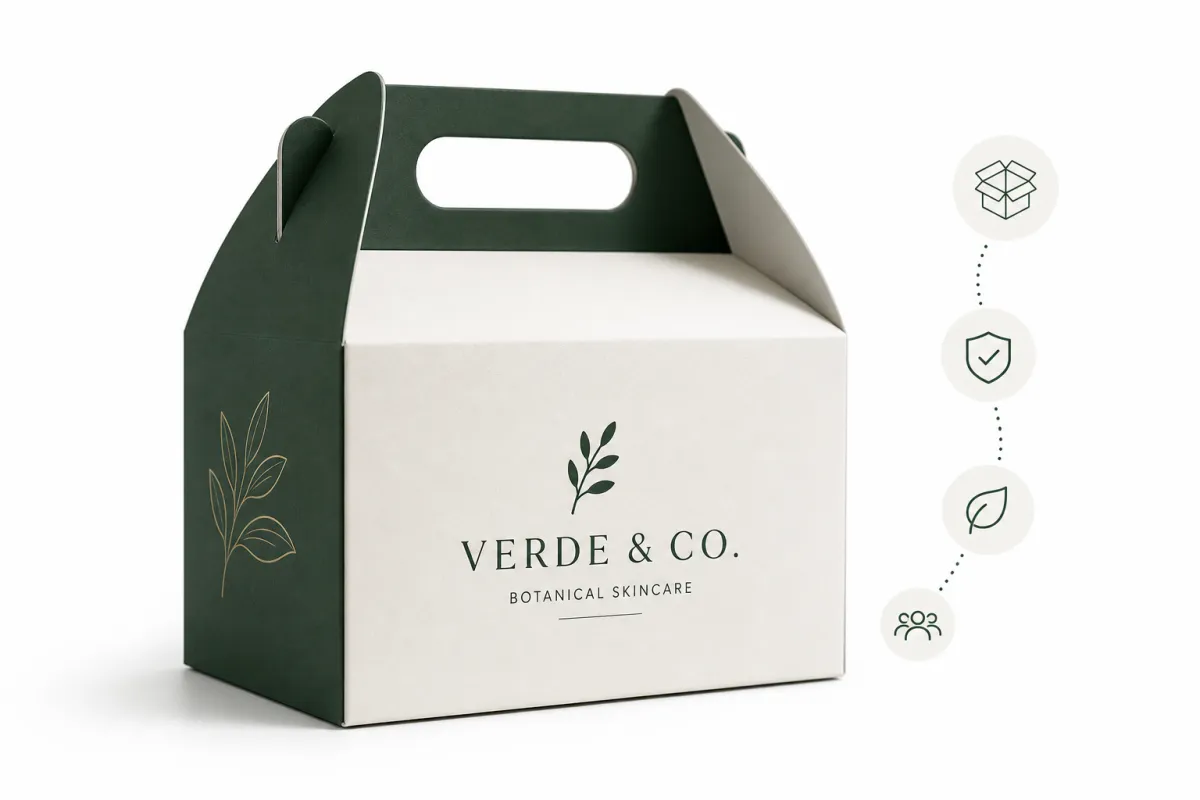
A gable box is a one-piece folding carton with side walls, a lockable bottom, and a top that folds into a built-in handle. The format is simple. That is the whole point. A team can assemble it quickly, the customer can carry it comfortably, and the front and side panels still give you room for custom printed artwork. For brands trying to balance speed and presentation, custom gable boxes with logo sit in a useful middle ground.
I think the real appeal is not just convenience. It is the way custom gable boxes with logo pull presentation and utility into the same object. A bakery can move a warm order from counter to customer without reaching for a separate bag. A boutique can send out an event set that already feels giftable. A promotional kit can look polished without a rigid outer shipper eating up budget. That saves time at the counter and improves the customer experience in the hand.
There is a branding advantage that gets overlooked. A logo on a gable panel does not just sit on a shelf; it travels. It is visible during pickup, at a conference table, in transit, and often again in photos or social posts. That makes custom gable boxes with logo a quiet but effective part of retail packaging strategy. They are not loud by default, but they can be memorable if the proportions, print placement, and colors are handled with discipline.
“A handle-top box can look simple and still do serious brand work, but only if the logo, structure, and size are all pulling in the same direction.”
Brands use custom gable boxes with logo for food, gifts, events, retail kits, and promotions because the format stays flexible. It can be economical in kraft board, more polished in SBS paperboard, or sturdier in corrugated stock. That flexibility matters when the same packaging has to work across seasons, channel shifts, and budget levels. It also means the format can scale from a small pilot order to a larger repeat run without changing the core structure or the way the box is assembled.
One more point: a logo changes the box's job description. Without print, the box is just a container. With a logo, it becomes a shelf marker, a takeaway cue, and a memory trigger. That is especially useful in crowded retail packaging environments where customers are comparing products in seconds. If the box is handled well, custom gable boxes with logo can carry more brand value than their material cost suggests.
How custom gable boxes with logo are built and printed
The structure usually starts with board selection, then moves to die-cutting, scoring, folding, and gluing. The handle is not a casual cutout. It needs enough board strength and reinforcement to hold weight without tearing during carry. For lighter items, a clean paperboard build may be enough. For heavier food portions, sample packs, or multi-piece kits, the wall strength and closure design deserve more attention. Custom gable boxes with logo work best when the engineering matches the load.
Material choice changes both performance and price. SBS paperboard gives a smooth surface and sharp print detail, which helps when the brand wants a premium look. Kraft board supports a natural, eco-forward style and often works well for simple two-color printing. Corrugated makes sense when shipping conditions are rougher or the contents are heavier. There is no universal winner here. The right board depends on what the box carries, how far it travels, and how much visual polish the brand expects from custom gable boxes with logo.
Printing method matters just as much. Digital printing is often the easiest fit for shorter runs because it avoids large plate costs and can support faster setup. Offset printing gives strong consistency on larger runs, especially when brand colors must stay tight across thousands of pieces. Flexographic printing is common in some corrugated applications where production efficiency matters more than ultra-fine detail. For custom gable boxes with logo, the best method depends on quantity, artwork complexity, and how exact the color match must be.
- Digital is often best for small to medium quantities and fast proof cycles.
- Offset suits larger runs and detailed graphics with consistent color control.
- Flexographic can work well on corrugated jobs that prioritize speed and volume.
- Special finishes such as foil, embossing, or spot UV raise the perceived value quickly.
Finishes change the way custom gable boxes with logo feel in the hand. Matte coatings usually read as softer and more restrained. Gloss can make color pop, though it does not suit every brand voice. Soft-touch lamination gives a velvet-like surface that feels premium, but it adds cost and can scuff if handled badly. Spot UV highlights a logo or pattern without coating the entire surface, and foil can turn a small panel into the focal point. Window cuts are another option when the product itself should be seen immediately.
Artwork placement needs planning because a gable box folds around itself. The front panel, side panels, and top handle do not behave like a flat sheet of paper. When the box is assembled, certain areas disappear into folds, locks, and overlap zones. That is why dielines matter. A design that looks balanced on a mockup can shift once it is scored and folded. Good packaging design starts with the actual panel sizes, not with a generic canvas.
If you want a technical reference point, standards and test methods help set expectations. For transit durability, parcel-style distribution testing often draws from ISTA test protocols. For fiber sourcing, many buyers ask about FSC certification and chain-of-custody documentation. Those details do not make the box prettier, but they do make the order easier to defend internally when procurement or sustainability starts asking questions.
Key factors that shape structure, branding, and shelf impact
Custom gable boxes with logo rise or fall on a few practical variables. Product weight is the first one. A light pastry box has very different needs from a bottle set or a stacked retail kit. Dimensions come next, because a box that is too loose wastes board and looks underfilled, while a box that is too tight can crush corners or distort the handle. Then there is use case: counter pickup, shipping, event gifting, or display use all change the packaging design brief.
Box size affects more than fit. It changes branding space, material usage, stacking behavior, and perceived value. A larger face panel gives your logo room to breathe, but it also increases board consumption and shipping volume. A smaller box can look refined and efficient, but only if the typography and logo placement stay legible. On custom gable boxes with logo, scale can make the difference between a package that feels premium and one that feels cramped.
Color strategy deserves more thought than many teams give it. High-contrast logos usually read well on kraft and white board, while muted palettes can disappear if the finish is too matte or the lighting is poor. A small logo often works better with generous white space than with extra graphic clutter. The same is true for typography. One strong line of copy can do more for package branding than a dozen tiny claims squeezed across a panel. For custom gable boxes with logo, restraint often prints better than ambition.
Structural details buyers should check
Some of the most expensive problems are invisible in the proof stage. Handle cutout strength is one of them. If the cut is too aggressive, the box can tear during carry or at the fold line. Tuck-lock reliability matters too, because a closure that pops open in transit creates a mess that no logo can hide. Inserts may be necessary if the contents slide around, particularly for cosmetics, glass, or mixed-item gift sets. In other words, custom gable boxes with logo should be judged as a system, not just as printed shells.
Compliance and usability matter as well. Food packaging may need grease resistance or food-safe barriers. Cosmetics may need product labeling areas that remain readable after coating. Retail packaging can require tamper awareness or clear presentation windows. If the box is used in direct food contact, confirm the correct material construction and any regulatory expectations before approval. The same box can look suitable on screen and still fail in practice if those basics are ignored.
There is also a transport question sitting behind every good packaging order. If the box will travel through parcel networks, ask whether a test plan based on ASTM or ISTA-style distribution checks makes sense. That is not overkill; it is insurance. A package that looks fine on a desk may fail after vibration, compression, or a drop sequence. Custom gable boxes with logo should earn their place by surviving the route they are actually going to travel.
For teams comparing format options, it helps to match the box to the job rather than forcing the job into the box. If the goal is fast carry-out and clear branding, gable is a smart choice. If the goal is high-end unboxing, a rigid carton may fit better. If the goal is light promotional distribution, custom gable boxes with logo often hit a sweet spot because they are easier to assemble than many custom printed boxes and still look polished enough to justify the spend.
Custom gable boxes with logo pricing: what drives cost
Pricing is shaped by a handful of levers, and most quotes make sense once those levers are visible. Material grade is a major one. A kraft gable with one-color print sits in a different price band than a coated SBS box with multiple print passes and a special finish. Quantity matters just as much, because setup costs get spread across more units as the run grows. With custom gable boxes with logo, the per-unit number often falls faster than buyers expect once the order passes a meaningful production threshold.
Print complexity changes the math. A logo-only box with one or two ink colors is generally cheaper than a fully wrapped graphic with gradients, photos, and layered legal copy. Finish selection also pushes the number upward. Soft-touch, foil stamping, embossing, and spot UV all add steps. Then there are structural extras: windows, inserts, custom dies, and unusual handle shapes. The quote may still look reasonable until these details are added one by one. That is why two orders for custom gable boxes with logo can look similar on paper and still land in very different price bands.
| Option | Typical build | Common quantity range | Approx. unit price | Best fit |
|---|---|---|---|---|
| Budget | Kraft or light paperboard, one-color logo, minimal finish | 500-2,000 | $0.75-$1.50 | Simple takeaway, seasonal promos, basic branded packaging |
| Mid-range | SBS or coated board, full-color print, matte or gloss coating | 1,000-5,000 | $1.25-$2.75 | Retail packaging, gifts, product kits, polished custom printed boxes |
| Premium | Heavier board, specialty finish, foil, window or insert options | 2,000-10,000 | $2.50-$5.50 | Presentation-focused launches, high-value gift sets, package branding campaigns |
Those numbers are directional, not universal. The exact Price for Custom gable boxes with logo depends on board thickness, print area, fold complexity, shipping destination, and proofing requirements. A small rush order with multiple revisions may cost more than a larger order with clean files and a stable structure. Buyers sometimes focus only on unit price, but total landed cost includes freight, storage, overrun tolerance, and the value of the box in the selling process.
That last part matters. A box is not just a supply line item. If custom gable boxes with logo help reduce bag costs, simplify handoff, improve repeat purchases, or support a higher retail price, the real value may be better than the quote suggests. On the other hand, a box that looks pretty but collapses in use is expensive at any price. I have seen teams save pennies per unit and lose far more in damaged perception. That is not a cute mistake. It is a budget leak.
For buyers comparing vendors, it helps to request apples-to-apples quotes. Ask for the same board, same size, same print count, same finish, and same pack-out assumptions. If you are comparing custom gable boxes with logo from more than one source, ask whether the quote includes die charges, plate charges, proofs, and shipping. A clean quote is easier to trust than one that hides half the real cost in separate line items. If you need a place to start, review the available Custom Packaging Products and build your request from the exact format you need.
Ordering custom gable boxes with logo: process and timeline
The best orders begin with a tight brief. The buyer sends product dimensions, target quantity, intended use, branding files, and any special requirements such as grease resistance, windowing, or inserts. After that comes the quote, then the dieline review, then artwork placement, then proof approval. For custom gable boxes with logo, the workflow feels simple if the inputs are clean. If the inputs are vague, the schedule starts to wobble immediately.
Most timelines have a few predictable stages. Artwork setup and proofing may take a day or two if files are ready. Production can take around 10-20 business days depending on quantity, print method, and finishes. Shipping adds another variable, especially if the boxes are moving across regions or if the order is too large for a single carton count. Shorter runs with digital printing are often faster, while larger offset or specialty jobs can take longer because setup is heavier. The biggest delay is usually not the press itself; it is waiting on a file fix, a color approval, or a structural change late in the process.
That is why launch planning matters. If the boxes support a seasonal menu, a trade-show kit, or a product release, the order should be backward planned from the real deadline, not from the day the quote is requested. Custom gable boxes with logo have little value if they arrive after the opening date. I would rather see a team order a smaller pilot run on time than chase a bigger order that misses the window and sits in storage.
What to send early
Send the product size, desired fill volume, and whether the contents will ship or just be handed off locally. Include the logo in vector format if possible, plus brand color references, copy that must appear on the panel, and any legal or compliance notes. It also helps to say whether the box needs to feel rustic, premium, playful, or corporate. Those cues help the packaging design team place the logo correctly and avoid the too-small, too-busy look that hurts custom gable boxes with logo more often than bad print quality does.
Sampling can save money if the order is strategic. A one-off sample or pilot run is worth it when the product is new, the box shape is unusual, or the contents are expensive. Test the fold, test the handle, and test the way the box sits on a table after assembly. If the carton flexes in your hands or the closure feels awkward, that will not improve once thousands of units are printed. Better to fix the problem before full production than after. Kind of obvious, sure, but people skip this and then act surprised.
For companies building a broader branded packaging program, ordering can also be staged. Start with one size, one finish, and one graphics system. Once the box performs well, expand the line to other sizes or seasonal artwork. That approach keeps custom gable boxes with logo consistent across channels while limiting early risk. It also makes it easier to compare performance across stores, menus, or campaigns without changing too many variables at once.
Common mistakes with custom gable boxes with logo
The first mistake is choosing the box for the photo instead of the product. A structure can look attractive and still fail under load. If the contents are heavy, the board needs to support the weight. If the item is fragile, the fit needs enough restraint to prevent shifting. Custom gable boxes with logo should never be chosen on appearance alone, because the handle, the closure, and the board strength all have to work together.
The second mistake is overloading a small panel with too much information. Logos, taglines, ingredients, legal copy, QR codes, and promotional claims can crowd one another out very quickly. On custom gable boxes with logo, the best-looking layouts usually leave more breathing room than clients expect. A strong logo with one supporting message can feel premium. A panel trying to say everything tends to feel desperate.
The third mistake is getting the size slightly wrong. A loose box can make the contents feel cheap, while a cramped box can deform during assembly. If the handle sits too high or too low relative to the fill, the package feels awkward in the hand. That is one reason sample testing matters. The box may measure correctly on paper and still feel off once it is picked up, carried, or stacked on a counter. Custom gable boxes with logo are judged as much by touch as by sight.
File and finish problems that cause avoidable rework
Low-resolution artwork is still common, even among experienced teams. A logo that looks fine on a screen can print soft or jagged if the source file is not right. Missing bleed, incorrect dieline alignment, and weak color expectations create another set of problems. Coatings also change appearance more than many people realize. A matte surface can darken colors slightly, while gloss can make them appear brighter. If your brand depends on exact color control, ask for a proof and not just a mockup.
There is also a cost trap on the buying side. Teams sometimes trim the spec too aggressively and end up with a box that no longer supports the product properly. That kind of saving is false economy. The box is the first physical interaction a customer has with the brand, and sometimes the only one before disposal. If custom gable boxes with logo are meant to represent quality, then the carton must protect the product and carry the identity well enough to justify its place in the customer journey.
A final mistake is assuming every supplier quotes the same thing. They do not. One vendor may include die charges. Another may quote without freight. Another may be using a different board grade entirely. Before you compare pricing, compare the spec. Only then does the unit price mean anything. Custom gable boxes with logo can look interchangeable in a spreadsheet while hiding major differences in construction, print method, and lead time.
Expert tips and next steps for a smarter order
Start with the product, not the box. Measure the item, add the space needed for insertion and removal, and decide whether the package will be carried, shipped, or displayed. Then choose the structure that fits the use case. That sequence sounds basic, but it saves more mistakes than most design tweaks ever will. Custom gable boxes with logo perform best when the dimensions came from the product reality rather than from a guess.
Ask for the dieline early. The moment a team can see the fold lines, glue areas, and safe print zones, the logo placement becomes easier to solve. That is especially useful for custom gable boxes with logo because the top handle and the panel folds can make a flat artwork file behave in unexpected ways. A good dieline also helps the design team avoid putting important text where it will disappear into a crease or wrap behind the fold.
Compare at least two or three quotes using the same spec sheet. This is where many buying conversations go sideways. People compare a kraft box against a coated box and wonder why the price differs. They compare a small run against a large run and call one supplier expensive. The spec has to stay constant if you want useful answers. Once that is done, the quote will tell you something real about the manufacturing path behind custom gable boxes with logo.
Test the sample under realistic light. A box can look perfect under a design-room lamp and flat under retail lighting. Try it in the place it will actually live: a counter, a shelf, a shipping bench, or an event table. Check the handle, the folds, the closure, and the way the logo reads from a few feet away. If the box does not read clearly at arm's length, the package branding is probably underperforming.
If you are building a lineup, not just a single order, think about consistency. Keep the color system, typography, and panel hierarchy stable so custom gable boxes with logo remain recognizable across sizes and seasons. That kind of discipline makes the packaging easier to reorder and easier for customers to recognize. It also lets the box work harder as a retail packaging asset, not just as a disposable container.
The cleanest next step is usually straightforward: measure the product, decide the use case, gather brand files, and request a proof. If you need a broader starting point, explore the Custom Packaging Products available for your category, then narrow the spec to the exact carton style you need. A good packaging plan removes surprises before production starts, and that is where custom gable boxes with logo tend to deliver the most value.
One practical rule I keep coming back to: if the box has to do real work, spend the time on structure first and decoration second. That order is why custom gable boxes with logo can be such a strong choice for branded packaging, and it is also why the best results usually look simple, not crowded. Get the fit right, keep the logo legible, and custom gable boxes with logo can carry more value than their footprint suggests.
Frequently Asked Questions
What materials are best for custom gable boxes with logo?
Kraft works well for rustic or eco-forward presentations and lighter products. SBS or coated paperboard is better when you want sharper print detail and a more polished finish. Corrugated is the safer choice for heavier contents or situations where the box needs more protection in transit. The right material for custom gable boxes with logo depends on both the product and the route the package will travel.
How long does it take to produce custom gable boxes with logo?
Timeline depends on quantity, print method, finishes, and how quickly proofs are approved. Smaller runs with digital printing can move faster, while larger offset jobs or specialty finishes often take longer. In many cases, the biggest schedule risk is artwork revision, not production itself. If the file is clean and the structure is settled, custom gable boxes with logo usually move through the process much more predictably.
What affects the price of custom gable boxes with logo the most?
The biggest price drivers are size, board grade, print coverage, finish complexity, and order quantity. Add-ons such as windows, inserts, foil, or custom dies can push the quote higher. Short runs usually cost more per unit because setup is spread across fewer boxes. That is true for many custom printed boxes, and it is especially noticeable with custom gable boxes with logo because the handle and folding structure add more production detail than a flat carton.
Can I order a small quantity of custom gable boxes with logo?
Yes. Many suppliers support small quantities, especially with digital production. Smaller orders are useful for testing a design, trying a seasonal promotion, or validating a pilot launch before a larger purchase. The tradeoff is usually higher unit pricing. If the box is still being developed, a short run of custom gable boxes with logo is often the safer way to learn what works.
What artwork files should I send for a logo box order?
Vector files such as AI, EPS, or PDF are usually best because they keep the logo crisp at print size. High-resolution raster files can work for some simple layouts, but vectors are safer for brand marks and small text. It also helps to send brand colors, dieline notes, and any copy that must appear on the box. For custom gable boxes with logo, clean files reduce proof cycles and help the final result look more intentional.

