Buyer Fit Snapshot
| Best fit | Custom Gift Card Sleeves Printing projects where brand print, material claims, artwork control, MOQ, and repeat-order consistency need to be specified before quoting. |
|---|---|
| Quote inputs | Share finished size, material target, print colors, finish, packing count, annual reorder estimate, ship-to region, and any compliance wording. |
| Proofing check | Approve dieline scale, logo placement, barcode or warning zones, color tolerance, closure strength, and carton packing before bulk production. |
| Main risk | Vague material claims, crowded artwork, missing packing details, or unclear freight terms can make a low unit price expensive after revisions. |
Fast answer: Custom Gift Card Sleeves Printing: Design, Cost, Process should be specified like a repeatable production item. The safest quote records material, print method, finish, artwork proof, packing count, and reorder notes in one written spec.
Production checks before approval
Compare the actual filled-product size with the drawing, then confirm tolerance on folds, seals, hang holes, label areas, and retail display edges. Reserve space for logos, QR codes, warning copy, and material claims before decorative graphics fill the panel.
Quote comparison points
Review material grade, print process, finish, sampling route, tooling charges, carton quantity, and freight assumptions side by side. A quote is only useful when the supplier can repeat the same color, closure quality, and packing count on the next order.
Custom Gift Card sleeves printing often gets treated like a minor packaging line item, but the sleeve is usually the first thing a customer touches, and that first touch does a lot of quiet work. A plain gift card can still sell, sure, but custom gift card sleeves printing gives the offer a frame, adds perceived value, and makes the purchase feel intentional before the card is even revealed.
For packaging buyers, that first impression matters more than it may look on a spec sheet. A well-made sleeve turns a routine purchase into a branded moment, which is why custom gift card sleeves printing keeps showing up in restaurants, salons, hotels, boutique retail, and seasonal promotions where presentation carries real weight. I have seen more than one program go from “just a card” to something people actually wanted to give because the sleeve did the heavy lifting.
Custom Gift Card Sleeves Printing: Why the Sleeve Matters
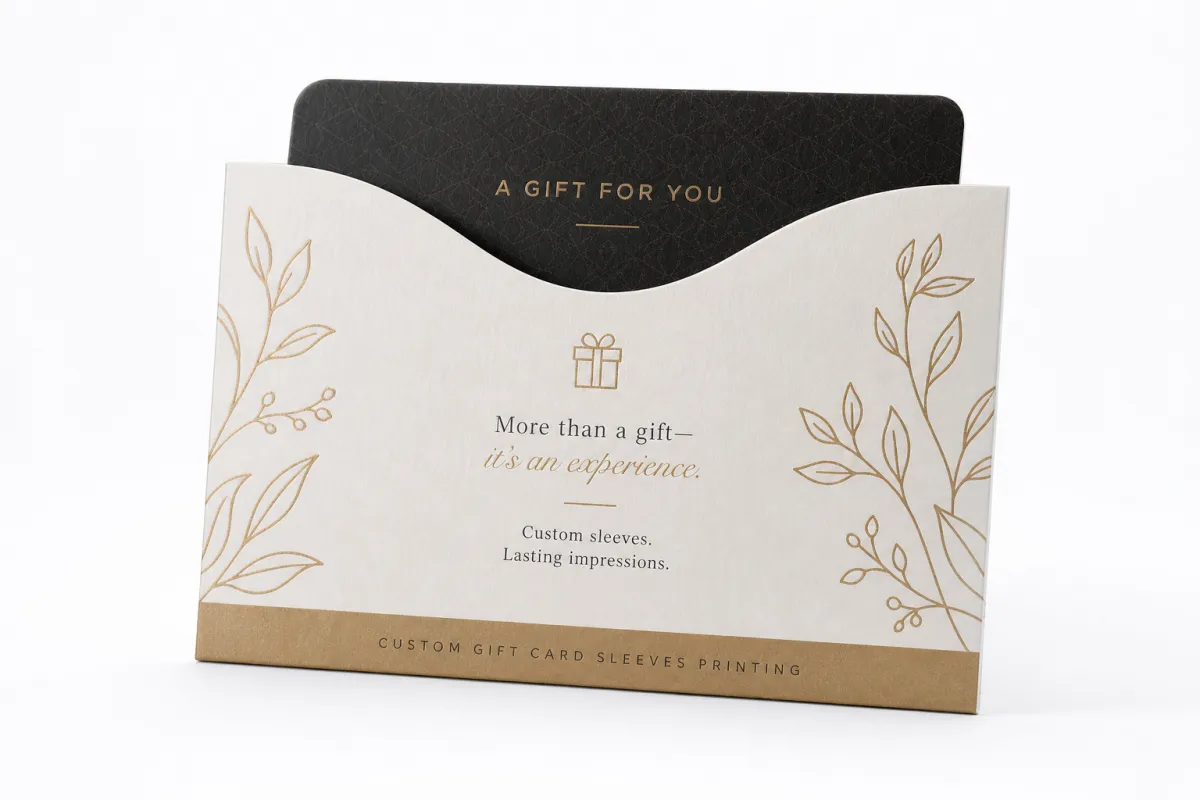
Watch a checkout counter for a minute and the pattern becomes clear. The card matters, but the sleeve is what gets handed over first, sits on the counter, and tells the customer whether the brand pays attention to details. That is the quiet value of custom gift card sleeves printing: it changes the order in which a person reads the gift. Before the amount is checked or the card is used, the brand has already spoken through the packaging.
That small shift has a bigger effect on impulse gifting than many teams expect. A clean branded sleeve feels ready to give, so the buyer does not have to imagine how to present it. The package already looks complete. In retail packaging, that kind of readiness removes friction. Custom gift card sleeves printing supports the sale by making the item feel finished, even when the product itself is only a card tucked inside a paper carrier.
A sleeve is not the same as an envelope. An envelope hides the card. A sleeve frames it. An envelope usually belongs to mailing or privacy. A sleeve is built for display, merchandising, and brand language. That is one reason custom gift card sleeves printing is so common for restaurants, spas, salons, resorts, museums, and boutiques where the gift card sits near the register or in a display tray and needs to look like part of the product mix rather than an afterthought.
One point buyers sometimes miss is how much a small paper component can affect perceived value. A gift card in a thin blank holder can feel like a last-minute add-on. The same card in a properly printed sleeve feels deliberate. In packaging terms, that is package branding doing real work. Custom gift card sleeves printing is not decoration for decoration's sake; it is a way to make a modest item feel worthy of being given, displayed, and remembered.
There is a practical side too. A sleeve can protect a card from scuffs, keep an insert aligned, and place barcode or redemption information where staff can find it quickly. That matters in busy retail settings where cards are handled often, set under bright lights, and picked up without much ceremony. Custom gift card sleeves printing helps the piece survive those moments while still looking polished enough to support the brand.
The strongest sleeves tend to be restrained. They carry the logo, the offer, maybe a short message, and then stop. The sleeve should feel like it belongs with the rest of the retail packaging, the custom printed boxes, and the broader product packaging system. That kind of consistency is what makes custom gift card sleeves printing useful instead of merely decorative.
"A sleeve does not need to be loud to feel premium. It needs to be clean, aligned, and honest about the brand behind it."
Thinking about the sleeve early makes the rest of the job easier. Once you understand how the piece behaves on a counter, in a gift bag, or inside a mailed kit, the decisions around stock, print method, finishing, and structure fall into place with much less guesswork. That is the real value of custom gift card sleeves printing: it turns a small carrier into a controlled part of the sales experience.
How Custom Gift Card Sleeves Printing Works
The process for custom gift card sleeves printing starts with structure, not artwork. A dieline defines panel sizes, folds, glue areas, tuck tabs, and any pocket that holds the card or a message insert. A good dieline saves money later because it cuts down on guesswork and keeps the finished piece from feeling cramped. The sleeve needs enough room for easy insertion, but not so much slack that the card shifts around inside.
Once the dieline is chosen or drawn, artwork is mapped onto each panel. That is where the packaging design work becomes real. The front panel, back panel, inside flap, and any wraparound section all need to feel deliberate. An open-end sleeve presents differently from a wrap style. A tuck tab has its own visual demands and should not fight with the logo or key messaging. Good custom gift card sleeves printing respects those folds instead of pretending they are invisible.
Artwork, folds, and structure
A sleeve may look simple in the hand and still be fairly technical in layout. Strong files account for bleed, safe margins, fold lines, barcode placement, and the direction the piece opens at point of sale. When custom gift card sleeves printing is handled well, graphics stay clear of the folds and trim. Logos remain centered. Copy stays legible. Any variable content, such as promo codes or holiday messaging, lands where a customer will actually see it.
Press-ready PDFs are usually the safest starting point. A PDF preserves vector artwork, trim marks, and bleed settings better than a loose image file. Fonts should be outlined or embedded. Images should be high resolution. If the sleeve includes a barcode or QR code, it needs enough contrast and quiet space around it to scan properly. Those details may feel small, but in custom gift card sleeves printing they decide whether the sleeve supports the sale or creates friction at the counter.
Digital printing and offset printing
Most buyers end up choosing between digital printing and offset printing. Digital printing works well for shorter runs, frequent artwork changes, and fast approvals because setup is lighter. Offset printing usually wins on larger quantities, tighter color control, and lower unit cost once the run is large enough to absorb the press setup. Custom gift card sleeves printing can work in either method, but the right choice depends on volume, color coverage, and the finishing needed afterward.
In practice, digital printing is a strong fit for a new brand, a seasonal promo, or artwork that changes every few months. Offset printing makes more sense for a steady evergreen sleeve used by a chain, a hotel group, or a retail program with predictable demand. Either way, the file still needs to be built with the fold in mind. Custom gift card sleeves printing is never just print and cut; structure matters as much as ink.
After printing, the sheets move to finishing. That may include lamination, spot UV, foil stamping, embossing, die cutting, stripping, folding, gluing, or simple scoring. The more steps involved, the more time and labor the project needs. For a sleeve, a clean score is especially important because paper that cracks at the fold can make the whole piece feel cheaper than the stock actually is. Good custom gift card sleeves printing gives the paper a controlled fold so the final item opens neatly and holds its shape.
Before release, most suppliers also check practical details like barcode placement, readable copy, and brand color consistency. That is where proofing earns its place. A screen mockup can look perfect, then shift once it is printed on real stock under real light. Solid custom gift card sleeves printing catches those issues early so the finished piece works in a store, not just on a monitor. A sleeve that looks good on a monitor can kinda fall apart once it is folded, handled, and stacked under retail lighting.
Custom Gift Card Sleeves Printing Cost, Pricing, and MOQ
Cost in custom gift card sleeves printing comes down to a handful of factors that stack up quickly: quantity, paper stock, print sides, ink coverage, finishing, die cutting, folding, and any special effect such as foil or embossing. A sleeve that prints one color on a simple coated stock is much easier to produce than a full-bleed, two-sided piece with soft-touch lamination and foil detail. More operations mean higher setup cost and more reliance on volume to spread those costs out.
The basic pattern is straightforward. Lower quantities carry a higher unit price because press setup and finishing do not shrink in proportion to the order. Larger quantities reduce the cost per sleeve, but they raise the upfront spend and the storage burden. That is why custom gift card sleeves printing needs to match the way the sleeve will be used. A one-off holiday campaign should not be priced like an evergreen chain program, and a trial run should not be planned like a national rollout.
Here is a practical way to think about it:
| Print Method | Best Fit | Typical MOQ | Indicative Unit Cost | Notes |
|---|---|---|---|---|
| Digital printing | Short runs, frequent changes, seasonal tests | 250-2,000 units | $0.45-$1.10 each | Good for speed and flexibility; setup is lighter, but the unit price is usually higher. |
| Offset printing | Steady programs, larger rollouts, tighter color control | 2,500-10,000+ units | $0.12-$0.40 each | Better economics at scale; plate and press setup make small runs less efficient. |
| Premium finish package | Upscale retail, hospitality, gift programs | 1,000-5,000 units | $0.30-$0.85 each | Foil, embossing, soft-touch, or spot UV adds labor and material cost. |
Those numbers are only a guide, and they shift based on supplier location, shipping, and current material pricing. Even so, they give a useful frame of reference when comparing quotes for custom gift card sleeves printing. If one estimate comes in far below the others, it is worth checking whether the supplier quoted the same stock, finish, fold style, and finished size.
MOQ is another place where buyers get surprised. Some suppliers set minimums based on press setup, while others set them because finishing labor becomes inefficient below a certain sheet count. For simple sleeves, MOQ may be only a few hundred pieces. For more elaborate programs with custom dies, hot foil, or multi-step folding, the floor can be much higher. Custom gift card sleeves printing is one of those jobs where a small structure change can alter the buying model.
Seasonal sleeves deserve their own planning note. If the artwork is tied to holidays, a menu refresh, a grand opening, or a short-lived promotion, overordering can turn into dead inventory. If the sleeve is evergreen and the brand wants to keep it in circulation for months, a larger run can make sense even if storage needs to be arranged. That balancing act is part of smart custom gift card sleeves printing, not a side issue.
If you are comparing sleeve work with other branded packaging, it helps to view it alongside broader programs such as Manufacturing Capabilities or adjacent Custom Packaging Products. That wider view makes it easier to decide whether the sleeve should be produced as a standalone item or folded into a larger retail packaging order.
For responsible sourcing, many brands also ask whether the paper is traceable through recognized systems such as FSC. That question matters if the sleeve is part of a public sustainability claim or if the retail program needs documented chain-of-custody support. On the shipping side, if sleeves are packed into larger kits or shipped long distance, it makes sense to review distribution expectations against ISTA test methods so the outer packaging protects the finished pieces in transit.
Materials, Finishes, and Design Choices That Change the Result
The material you choose for custom gift card sleeves printing changes more than the look. It changes stiffness, fold behavior, scuff resistance, writing feel, and how the sleeve sits in the hand. Coated text stock is common when a brand wants bright color and crisp graphics. Uncoated stock feels more tactile and understated, which fits hospitality, artisanal retail, or any brand that wants the sleeve to feel paper-forward rather than glossy. Cover stock and premium board can push the piece toward a more substantial presentation, especially when the sleeve holds a higher-value gift card.
Most sleeves fall somewhere between 10pt and 16pt, depending on the design and how the piece will be handled. A thinner stock folds more easily and can work well for high-volume mailers or multi-card inserts. A heavier stock feels firmer on the counter and often gives the sleeve more presence. The right choice for custom gift card sleeves printing depends on whether the sleeve will be tucked into a bag, displayed in a holder, or handed over by staff as a standalone gift package.
Finish is not just decoration
Finish choices can turn the same artwork into very different experiences. Matte lamination reduces glare and gives a calm, controlled look. Gloss boosts saturation and makes color pop, especially under retail lighting. Soft-touch adds a velvety feel that many buyers associate with Premium Product Packaging, though it can show scuffs if the sleeve is handled heavily. Foil stamping creates bright highlights. Embossing adds physical depth. Spot UV can draw attention to a logo or mark without covering the whole design in shine. In custom gift card sleeves printing, finish should be chosen for handling as much as for appearance.
Not every finish belongs on every sleeve. If the piece sits near a register and gets touched repeatedly, a finish that hides fingerprints and abrasion is usually smarter than one that only looks dramatic in a sample light. If the sleeve is part of a high-end holiday set, foil can work well, but only if the layout leaves enough breathing room for the metallic element to stand out. The best custom gift card sleeves printing result is the one where the finish supports the message instead of competing with it.
Layout details that matter more than people think
Color contrast deserves close attention. Small sleeves do not forgive muddy type or low-contrast logos. A dark background may look elegant on screen, then swallow fine text once printed if the file is not managed carefully. Safe margins matter too. So do bleed settings. If the sleeve includes a message line such as "Happy Holidays" or "Thank You," it should not sit too close to the cut edge where trimming variation could make it feel awkward. Those are the details that separate steady custom gift card sleeves printing from rushed artwork.
The same thinking applies to content. A sleeve is not a brochure. It does not need paragraphs. Most of the time, it needs a logo, a short message, a clean callout, and maybe one small directional cue for staff or scanning. Too much copy makes the piece feel busy. Too little structure makes it feel generic. The right balance in custom gift card sleeves printing is a layout that reads in a second or two and still feels branded when held at arm's length.
For brands that already use broader retail packaging systems, the sleeve should match the visual language of the rest of the line. If the business already relies on custom printed boxes, a matching sleeve helps the whole package branding program feel consistent. Customers often judge the whole offer by the weakest visible piece. If the sleeve looks polished, the gift tends to feel more deliberate. That is why custom gift card sleeves printing should be treated as part of the packaging system, not a detached print job.
Practical durability still matters. A sleeve that scuffs easily, cracks at the fold, or loses color at the edges will not hold up well in a retail environment. Good custom gift card sleeves printing balances visual impact with physical toughness so the piece can survive handling, transport, and point-of-sale display without looking tired before it reaches the customer.
Production Steps, Timeline, and Lead Time for Custom Gift Card Sleeves Printing
A realistic production timeline for custom gift card sleeves printing starts with quote approval and ends with packed, counted, and shipped product. The steps are straightforward, but each one can add time if decisions keep moving. First comes the spec sheet: finished size, quantity, stock, print sides, finish, and delivery location. Then artwork is submitted, checked against the dieline, and proofed. After the proof is approved, printing begins, followed by finishing, folding or gluing, quality checks, packing, and shipment.
Lead time depends heavily on the print method and the finish package. A simple digital sleeve with one or two colors may move through production in roughly 7-12 business days after proof approval. A more complex offset project with foil, embossing, or a custom die can stretch into the 12-20 business day range, sometimes longer if the schedule is full or the artwork needs revision. Custom gift card sleeves printing runs more smoothly when all of those decisions are locked before the first sheet reaches the press.
Where delays usually happen
Most delays do not happen on the press. They happen before press. File corrections, missing fonts, color changes, and late copy edits are the usual causes. A team approves a mockup, then someone notices a legal line is missing or a promo date has shifted, and the job slides back a day or three while the proof is rebuilt. In custom gift card sleeves printing, every revision costs time because the structure has to be rechecked, not just the artwork.
Another common delay comes from finish changes after the proof stage. A buyer sees soft-touch on one sample and decides to add foil, or decides to move the logo from the front panel to the flap. That sounds minor, but it can affect die cutting, registration, and finishing setup. The cleaner the handoff, the better the result. Seasoned buyers treat custom gift card sleeves printing like a production schedule, not a quick print request.
Seasonal demand matters too. Holiday gift programs, restaurant promotions, and event launches tend to crowd production calendars. If the sleeve is needed for a grand opening or a date-specific retail campaign, waiting until the last minute is a risky move. Material lead times may be manageable, but press slots and finishing queues are often the real bottleneck. Strong planning gives custom gift card sleeves printing enough room to move without stress.
There is also an operations question that gets overlooked: who receives the finished sleeves, and where? If the sleeves ship to a store network, a warehouse, or a fulfillment partner, the delivery plan should be confirmed early. Box counts, pallet requirements, and labeling all matter. A great print run can still create headaches if the packing list is unclear or the cartons are not broken down the way the receiving team expects. That is especially true when custom gift card sleeves printing is part of a wider branded packaging roll-out.
If the project is tied to a launch, a simple approval checklist helps keep everything on track:
- Confirm finished size and card dimensions.
- Approve quantity with a small buffer for waste or extras.
- Lock artwork, legal copy, and barcode placement.
- Choose stock and finish before proofing.
- Set delivery location and unpacking instructions.
That five-step habit sounds basic, and it is. Basic is good here. It removes most of the friction from custom gift card sleeves printing. Once the file is stable, the timeline becomes much easier to predict.
Common Mistakes in Custom Gift Card Sleeves Printing
The biggest mistake is assuming a small sleeve cannot go wrong. It can. A crowded layout, a weak proof, or the wrong stock can make the piece feel off. With custom gift card sleeves printing, tiny flaws become very visible because the format is small. There is nowhere for bad spacing or muddy color to hide.
Oversized copy is a classic example. If the message tries to say too much, the sleeve starts to look busy instead of premium. The customer should be able to read the brand name quickly and understand the offer without searching for the main point. In packaging design, restraint usually beats volume. Strong custom gift card sleeves printing makes the sleeve feel purposeful, not crowded.
Design and production errors to avoid
- Ignoring fold lines - important text can disappear or shift when the sleeve is scored and folded.
- Placing barcodes too close to edges - scanners need clean space, and trim variation can clip tight placement.
- Choosing finish only by sample shine - a finish that looks rich in a mockup may scuff badly in daily use.
- Ordering the wrong quantity - too few sleeves create rush reorders, while too many can sit unused after a short promo.
- Skipping proof review - one missed line or wrong Pantone note can trigger avoidable reprints.
Barcode placement deserves special mention because it is one of those details that feels minor until something fails at the counter. If the barcode is too close to a fold, distorted by texture, or printed in low contrast, the staff has to work around it. That slows the sale and weakens confidence in the sleeve. Solid custom gift card sleeves printing keeps scanning in mind from the start, not as a cleanup task at the end.
Another mistake is choosing a finish that looks expensive but does not fit the environment. A high-gloss sleeve may look sharp in a product photo, but under strong lights it can reflect glare and make small copy harder to read. A soft-touch finish can feel rich, yet if the sleeve is handled by dozens of customers, it may pick up marks faster than expected. Those tradeoffs matter in real retail packaging, and they are why custom gift card sleeves printing should be discussed with both design and operations in the room.
Overordering is its own trap. A seasonal sleeve with holiday artwork has a short window, and leftovers can become dead stock before the next campaign even starts. Underordering is the opposite problem. A business runs out halfway through a promotion and has to scramble for a second run that may not match the first because of a paper batch shift or schedule change. Good custom gift card sleeves printing plans for both demand and shelf life.
Rushing the proof is the final and most expensive mistake. A 15-minute review can save a week of rework. Check copy, colors, size, folds, and delivery labels. If the project is tied to a public launch, the print job should be treated like any other branded packaging asset: finish it once, finish it right, and keep the changes disciplined. That is the simplest way to keep custom gift card sleeves printing from turning into avoidable stress.
Expert Tips and Next Steps for Custom Gift Card Sleeves Printing
The cleanest way to manage custom gift card sleeves printing is to build one strong core design and let it flex across campaigns. A base sleeve can stay consistent while the color, seasonal message, or insert changes from one promotion to the next. That approach keeps package branding steady and makes reorders easier because the structure does not need to be rebuilt every time the artwork changes.
If color accuracy matters, ask for a printed proof or a material sample before approving a large run. Screen previews are useful, but they do not show how ink behaves on a specific stock under real lighting. For brands with strict visual standards, that step is worth the time. It reduces surprises and gives everyone a real reference point for custom gift card sleeves printing, especially when a logo must match other retail packaging pieces already in market.
Planning around the physical card helps too. Confirm the exact card size, the opening direction, and how the sleeve will be displayed at point of sale. A sleeve that looks great flat may be awkward to load if the opening faces the wrong direction for staff. That small operational detail can change the day-to-day experience in the store. Thoughtful custom gift card sleeves printing makes the work easier for the people who actually hand the piece over.
From a production standpoint, I would keep a short approval checklist on every job:
- Finished size and card dimensions
- Quantity with a small overage buffer
- Stock weight and surface finish
- Proof approval date
- Shipping destination and receiving contact
That checklist sounds simple because it is. Simplicity often protects a print program from chaos. The more consistent your inputs, the easier custom gift card sleeves printing becomes to quote, approve, and repeat. It also makes supplier comparison easier because everyone is quoting the same structure, not a different version of the same idea.
If you are building a broader branded packaging system, this is the right moment to think about what the sleeve needs to do beside the card itself. Should it match a box? Should it coordinate with a menu insert? Should it mirror the look of a loyalty kit or a holiday mailer? Those questions matter because the sleeve often sits inside a larger customer journey that may include custom printed boxes, inserts, ribbons, or other retail packaging components. Strong custom gift card sleeves printing should fit that system without pulling attention away from it.
My practical advice is direct: gather the dimensions, confirm the quantity, prepare clean artwork, compare a few quote options, and move ahead with a production plan that fits the calendar. That process gives you enough control to make smart choices without slowing the project to a crawl. If the sleeve is part of a launch, treat it as a branded asset rather than a support item, and custom gift card sleeves printing will do its job quietly and well.
FAQ
How much does custom gift card sleeves printing usually cost?
Cost depends on quantity, paper stock, print coverage, finishing, and whether a custom die or special effect is involved. Higher quantities usually lower the unit cost, while small runs work better for testing or seasonal campaigns. For many buyers, the most accurate quote comes from finished size, artwork complexity, and shipping destination, because those details change the setup and packing load more than people expect.
What is the typical turnaround for custom gift card sleeves printing?
Turnaround depends on proof approval, production method, finishing steps, and the current press schedule. Simple sleeves with standard finishes move faster than jobs with foil, embossing, or custom structural changes. The quickest results usually come when artwork is final and all specs are confirmed before the order starts, since every revision adds another round of checks.
What file format is best for custom gift card sleeves printing artwork?
Press-ready PDFs are usually the safest starting point because they preserve layout, bleed, and vector quality. Fonts should be outlined or embedded, and images should be high resolution for clean print reproduction. A dieline template helps keep fold lines, safe areas, and cut paths aligned correctly, which is especially useful on small sleeves where every millimeter matters.
Which materials work best for custom gift card sleeves printing?
Cover stock and premium text paper are common choices because they balance print quality, foldability, and durability. Coated stocks can make colors pop, while uncoated stocks often feel more tactile and understated. The best material depends on the brand look, handling needs, and whether the sleeve will be mailed, displayed, or inserted in packaging.
How do I choose the right quantity for a custom gift card sleeves printing order?
Start with the expected number of gift cards, then add a buffer for promotions, damaged packs, and future reorders. If the sleeve design is seasonal or campaign-specific, avoid overordering unless the artwork can stay relevant. For recurring programs, compare the unit cost of a larger run against storage space and cash flow, because those costs belong in the same decision.
If you want a sleeve that supports the sale instead of distracting from it, custom gift card sleeves printing is one of the simplest packaging upgrades you can make. The real takeaway is straightforward: lock the finished size, card dimensions, stock, and quantity before you design, then let the artwork fit the structure instead of forcing the structure to chase the artwork. Done that way, the sleeve adds polish, protects the card, and keeps the brand looking organized from the first touch to the final handoff.

