Custom Golf Ball Stickers: Design and Order Better
A golf ball is handled, inspected, pocketed, photographed, and passed around a foursome more often than many larger promotional items. That is why custom golf ball stickers can feel unexpectedly visible for something measured in fractions of an inch.
Small, though, does not mean simple. A sticker used on a golf ball or golf gift kit has to deal with curvature, dimples, moisture, bag friction, sunscreen, volunteer assembly, and the brutal honesty of close-up photos. Buyers are not just choosing a cute decal. They are choosing a material system: face stock, adhesive, print method, finish, cut shape, placement, packing format, and sometimes a broader branded packaging plan.
The best orders start with a plain question: what job is the sticker doing? Identification, sponsor recognition, personalization, retail labeling, gift presentation, or event photography? Each answer pushes the design and production specs in a different direction.
What Custom Golf Ball Stickers Are Really For
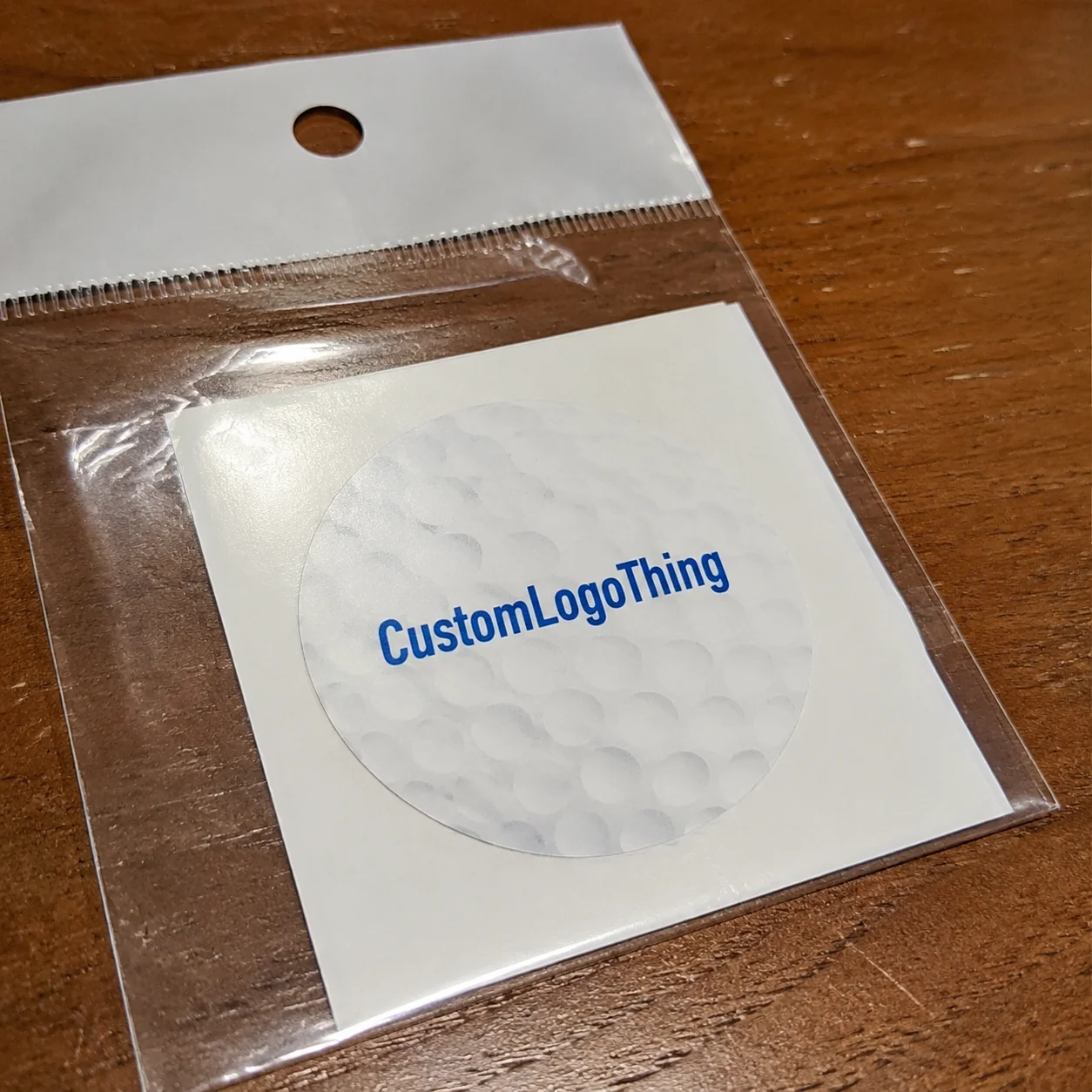
Custom golf ball stickers are small adhesive graphics sized for golf balls, sleeves, ball boxes, favor bags, display cards, hang tags, tournament handouts, retail samplers, or sponsor gifts. Some are applied directly to the ball. Others never touch the ball; they sit on packaging, insert cards, backing boards, or the outside of a sleeve.
That distinction matters more than it sounds. A direct-to-ball decal needs to be compact, flexible, and forgiving enough to sit on a curved, dimpled surface without looking bulky. A packaging label can be larger, more detailed, and easier to apply because it is usually going onto flat paperboard, kraft stock, plastic film, or a rigid gift box. From a buyer’s point of view, those are two different production problems wearing the same name.
Typical uses include charity tournaments, corporate golf days, bachelor parties, golf schools, pro shop promotions, influencer merch drops, sponsor packs, and premium member welcome kits. A sponsor logo on a ball sleeve has a different purpose from initials on a keepsake ball. A retail sampler label has a different job than a party favor seal.
Practical callout: treat the sticker as part of the whole presentation. If the ball, sleeve, insert card, mailer, and sponsor logo hierarchy do not agree with each other, the finished kit can look assembled from leftovers even when every component is printed cleanly.
This is the part buyers often underestimate. The sticker may be the smallest item in the project, yet it can control the first impression. A crooked label, fuzzy logo, or peeling edge makes a premium golf gift feel cheaper within seconds.
There is also a hierarchy issue. A golf ball has almost no room for nuance. It can carry a crest, initials, date, or sponsor mark. It cannot carry six logos, a QR code, a slogan, a URL, and a registration message without turning into visual static. The sleeve, backing card, or box can do the heavier communication work.
How Materials and Adhesives Behave on Golf Surfaces
Golf balls are awkward surfaces. They are curved, dimpled, touched repeatedly, rubbed against tees and pockets, dropped into bags, exposed to grass, sweat, dew, sunscreen, and sometimes cooler condensation. Ordinary paper labels are usually the weak link, especially for direct ball application or humid outdoor events.
Film materials tend to perform better. Vinyl is flexible, water resistant, and common for shaped decals. BOPP, short for biaxially oriented polypropylene, is thinner and often used for clean product labels where a slick, consistent finish matters. Clear films can look premium because the ball or package color shows through. Paper still has a place, mostly on boxes, favor bags, display cards, or short-term indoor uses.
| Material | Best Use | Typical Strength | Watch-Out |
|---|---|---|---|
| White vinyl film | Direct ball decals, event favors, sponsor marks | Flexible and moisture resistant | Can feel thicker than BOPP on very small labels |
| Clear BOPP film | Premium sleeves, boxes, subtle ball branding | Clean look with good print sharpness | May need white ink under logos for visibility |
| Coated paper | Favor bags, insert cards, sleeve seals | Cost-efficient for flat packaging | Weak around moisture and heavy handling |
| Specialty film | Metallic, holographic, or textured promotions | High visual impact for gifts | Higher cost and longer proofing cycle |
Adhesive choice deserves the same scrutiny as the face stock. A permanent adhesive suits keepsakes, sponsor packs, and labels that should stay put. Removable adhesive can help with temporary event marking or packaging that should not leave residue. Repositionable adhesive gives assembly teams a little forgiveness, though it may not grip as aggressively after repeated handling.
Finish changes perception. Matte hides fingerprints and reduces glare. Gloss photographs sharply and makes saturated colors pop. A laminate adds abrasion resistance, useful when stickers are packed on sheets, handled by volunteers, or slipped into gift bags with tees, markers, pencils, and divot tools.
Direct ball application has one unavoidable caveat: a sticker sits on top of a textured sphere. Even a well-made film decal will not behave like factory pad printing. It may be excellent for gifts, sponsor photos, registration tables, and casual play, but buyers should not expect it to become part of the ball surface.
For formal tournaments, check the rules before applying anything that could alter a ball’s surface, weight, texture, or identification markings. For casual rounds and keepsakes, decals are common. Competitive use is a different question.
Design Specs That Decide Whether the Sticker Looks Premium
Tiny graphics punish weak artwork. Fine lines vanish. Long taglines shrink into lint. QR codes that scan beautifully on a 3-inch label can fail at golf-ball scale. Low-contrast colors that looked tasteful on a laptop can look muddy against a white ball, ivory sleeve, or kraft gift box.
The strongest designs are usually simple: initials, monograms, short sponsor names, single-color logos, icons, dates, club crests, or compact marks readable from arm’s length. A 0.6-inch circular sticker has no patience for a full mission statement. Neither does the person assembling 500 tournament favors the night before check-in.
For file setup, vector artwork is preferred. AI, EPS, SVG, or production-ready PDF files generally give the cleanest edges. If raster artwork is the only option, use high-resolution files at final print size, typically 300 dpi or better. Fonts should be outlined. Linked images should be embedded. Brand colors should be identified with Pantone, CMYK, RGB, or a clear reference, depending on the print method.
Bleed and safe area matter even at miniature scale. A supplier may ask for 1/16 inch or more of bleed, depending on the cut method and sticker size. Fine borders near the edge can look uneven if the cut shifts slightly. That is not always bad production; sometimes it is a design asking the cut line to behave like a microscope.
Shape affects both appearance and cost. Circles and ovals feel natural on golf balls. Shields and crests suggest club heritage. Rounded rectangles work well on sleeves and favor boxes. Die-cut logos can look custom, but very intricate edges may lift, tear, or slow production. For packaging, a small label strip can sometimes deliver more usable brand space than a tiny ball decal.
Clear stock needs extra planning. If the sticker is printed on clear film and placed on a white ball, pale colors may disappear unless white ink is printed underneath. On darker packaging, the problem flips: black, navy, or deep green logos may lose detail without contrast. Ask to see a proof that shows the sticker on the intended surface, not floating on a white artboard.
There is also a packaging design question hiding in the artwork. If the sticker belongs to a sleeve, gift kit, event mailer, or retail sample, coordinate it with the box, insert card, and sponsor hierarchy. Custom Printed Boxes and labels should not compete for attention. One brand should lead. Supporting sponsors should support.
QR codes deserve a special warning. They need quiet space, contrast, and enough physical size to scan. On a ball, they are often a poor choice. On a sleeve, backing card, or insert, they can work well if tested with multiple phones before production.
Pricing, MOQ, and Unit Cost Factors Buyers Should Check
Sticker pricing is not mysterious, but vague requests produce bad quotes. The main drivers are size, quantity, material, adhesive, finish, cut complexity, color requirements, proofing, packing format, and whether the supplier is applying the stickers or only printing them.
MOQ, or minimum order quantity, exists because setup has a cost. Artwork review, print setup, cutting, waste allowance, quality checks, and packing take time even if the order is small. A 100-piece run may feel tiny to the buyer, but it still needs a proof, material setup, cutting file, and inspection.
As a planning range, simple paper or film packaging stickers can land around $0.08 to $0.20 per piece at several thousand units, depending on size and print coverage. Small vinyl decals for event use may sit closer to $0.12 to $0.35 per piece at moderate quantities. Specialty films, laminates, custom backing cards, variable versions, or application services can push costs higher. These are planning numbers, not guarantees; freight, rush work, artwork cleanup, and split shipping can change the final quote.
| Order Type | Typical Quantity | Likely Cost Drivers | Buyer Tip |
|---|---|---|---|
| Small party or bachelor event | 100-300 stickers | Setup cost, artwork cleanup, sheet format | Use a simple shape and one strong mark |
| Corporate golf day | 500-2,500 stickers | Logo approvals, finish, delivery deadline | Order extras for assembly mistakes |
| Sponsor tournament kit | 2,500-10,000 stickers | Multiple versions, kitting, packaging labels | Quote the full kit, not only the decal |
| Retail packaging program | 10,000+ stickers | Roll format, color control, QC documentation | Confirm application equipment and roll direction |
Add-ons matter. Rolls, kiss-cut sheets, individually cut decals, custom backing cards, sleeve labeling, ball application, kit packing, rush production, and split shipments all affect cost. A quote for 1,000 loose stickers is not the same as a quote for 1,000 branded ball kits packed into retail packaging and shipped to three event sites.
Roll format can be a hidden specification. If labels will be applied by machine or with a dispenser, roll direction, core size, outside wound versus inside wound, and gap spacing may matter. If volunteers are applying by hand, kiss-cut sheets may be faster and easier to distribute across several assembly tables.
If budget is tight, simplify. Choose a standard material. Reduce finishes. Avoid delicate die-cuts. Print multiple versions in efficient sheet layouts. Keep the design small and readable. For broader product packaging support, buyers often pair golf decals with Custom Labels & Tags so the ball, sleeve, and outer gift piece feel like one coordinated system.
Process and Timeline From Artwork to Finished Stickers
The usual path is simple on paper: inquiry, quote, artwork review, digital proof, approval, printing, cutting, finishing, quality control, packing, and shipping. The messy part is usually not printing. It is decision-making before the press ever runs.
Artwork review can become the hidden bottleneck. Low-resolution logos, missing fonts, unclear colors, competing sponsor approvals, and last-minute date changes can add days. If a tournament committee has five sponsors, one venue, and two internal approvers, build that into the schedule. A sticker supplier cannot responsibly print a logo that no one has approved.
A good proof should confirm size, shape, color, cut line, material, finish, quantity, sheet or roll format, and any packaging placement instructions. If the order includes application to sleeves, boxes, or kits, the proof should also clarify placement: front panel, side panel, seal location, centered on lid, or aligned with an insert card.
Many straightforward sticker orders can produce in roughly 5-10 business days after proof approval. More complex jobs involving specialty stocks, lamination, multiple versions, packaging, kitting, or direct application often need 10-20 business days. Shipping adds its own clock. So do sponsor approvals.
Quality control should not be treated as a vague promise. Useful checks include color review against the approved proof, cut registration, edge lifting, adhesive tack, sheet count or roll count, scuffing after handling, and legibility at actual size. For direct ball use, a simple sample application test can reveal whether the decal wants to wrinkle, bridge over dimples, or lift at the edge.
For tournament and corporate events, buffer time is cheap insurance. Weather dates shift. Sponsor lists change. Venue delivery windows can be stricter than expected. If volunteers are applying decals by hand, they may need an extra afternoon just to assemble ball sleeves, favor bags, or registration-table kits.
Here is the practical proofing trick: check the design at actual size. Not zoomed to 400% on a monitor. Print the proof at 100%, cut out the shape, and hold it near a real golf ball or sleeve. Tiny type is a notorious liar on screens.
For broader packaging programs, standards can also matter. If the finished kits are being shipped in cases, ISTA transit testing guidance from ISTA can help teams think through compression, vibration, and handling. If paperboard boxes or sleeves are part of the project, FSC-certified materials from the Forest Stewardship Council may be worth discussing for sustainability claims.
Common Ordering Mistakes That Create Reprints or Delays
The biggest mistake is treating a curved golf ball like a flat laptop, bottle, or notebook. A design that looks great at 2 inches wide may fail badly at 0.6 inch. On a dimpled sphere, large artwork has to bend, and stiff material may wrinkle or lift at the edge.
Another common miss is using generic paper stickers for outdoor events. Paper may be fine for an indoor favor card, but it is risky for humid check-in tables, gift bags stored in coolers, or packs that will be handled, transported, and photographed before play begins. Film stock usually earns its keep there.
File quality causes plenty of avoidable delays. Screenshots, social media profile images, compressed JPEGs, and copied logos from email signatures are not production artwork. They may look acceptable on a phone. Printed small, they can turn soft, jagged, or off-color. If a brand cares about consistency, supply the real logo file.
Sponsor overload is the political version of a print problem. Too many logos on one small sticker rarely make everyone happy. They make every logo smaller. A better strategy is often one hero mark on the ball and a more complete sponsor panel on the sleeve, backing card, or custom packaging insert.
Measurement mistakes are predictable. Buyers approve a digital mockup without testing the sticker against the physical item. The result: a decal that overwhelms the ball, blocks too many dimples, wraps awkwardly, or looks undersized on a box. Physical scale checks prevent a surprising number of reprints.
Proofing deserves respect. Check spelling, event date, sponsor order, cut lines, bleed, material, and delivery format. Will stickers arrive on rolls, sheets, or individually cut pieces? Are they kiss-cut for easy peeling? Is the backing split? Those details affect assembly speed. A volunteer team labeling 1,200 items will notice the difference.
Storage is another quiet failure point. Stickers should be kept flat, clean, and away from heat and heavy humidity before application. Adhesive products can curl, soften, or collect dust if they sit open in a clubhouse, car trunk, or loading area for too long.
What to Prepare Before Requesting a Quote
Before requesting a quote, gather the basics. You do not need to solve every production detail, but you should know the event date, delivery location, approximate quantity, intended surface, preferred sticker size, artwork file status, finish preference, and whether packaging is part of the order.
- Define the primary job: ball decoration, sleeve branding, favor personalization, sponsor recognition, retail labeling, or a photo-friendly giveaway.
- Confirm the surface: golf ball, paperboard sleeve, rigid box, poly bag, backing card, or mailer.
- Prepare artwork: vector logo if possible, high-resolution raster file if not, plus brand color references.
- Pick a finish direction: matte for soft glare control, gloss for sharper photos, clear film for a premium layered look.
- Choose the delivery format: roll labels, kiss-cut sheets, individual decals, backing cards, or applied stickers.
- Order overage: 5-10% extra is sensible for hand application, lost pieces, sponsor samples, and last-minute guest additions.
Two design versions often work better than one. Use a simplified mark for the ball and a more detailed label for the sleeve, bag, box, or insert card. That gives the smallest sticker a fighting chance while allowing the packaging to carry sponsor names, QR codes, event details, or retail information.
Ask direct supplier questions. Which material handles golf ball curvature best? Which finish resists handling? What file type is preferred? Is proofing included? Can the proof show actual size? What ship date is realistic after approval? If the project includes boxes, sleeves, or mailers, ask how the stickers coordinate with other Custom Packaging Products.
Also think beyond the decal. Golf gifts travel through registration tables, courier networks, hotel storage rooms, clubhouses, carts, and social posts. Package branding has to survive more than the first unboxing moment. The best custom golf ball stickers work as part of a small-format branding system, not as a last-minute decoration.
A final test is brutally simple: place the sticker, sleeve, and any insert card side by side. If the brand hierarchy is clear in three seconds, the system is probably working. If every element is shouting, the ball is not the problem. The plan is.
Frequently Asked Questions
Can custom golf ball decals be used during actual play?
They are best for casual rounds, event favors, giveaways, sponsor displays, and keepsakes unless the tournament or course rules specifically allow stickers on balls. For competitive play, confirm the rules before applying anything that could alter the ball surface, weight, texture, or identification markings.
What size should personalized golf ball stickers be?
Smaller is usually better because a golf ball is curved and dimpled. Simple logos, initials, icons, or short sponsor names reproduce more cleanly than large designs. Ask for a proof shown at actual size so readability can be judged before production begins.
Are vinyl golf ball stickers better than paper stickers?
Vinyl or film materials generally handle moisture, touch, and light abrasion better than paper. Paper can work well on packaging, favor bags, display cards, or short-term indoor uses, but it is usually not the best choice for direct ball application or damp outdoor events.
How much do custom golf ball labels cost?
Cost depends on quantity, size, material, finish, cut shape, artwork complexity, delivery timing, and whether the order includes packaging or application. The most accurate quote includes quantity, deadline, intended surface, artwork file, finish preference, and shipping location.
How long does it take to produce branded golf ball stickers?
Timeline depends on proof approval, material availability, order size, cutting complexity, finishing, and shipping method. Straightforward orders may move in about 5-10 business days after approval, while specialty materials, kitting, or packaging work can require more time. For event orders, build in extra time for sponsor approvals, assembly, and delivery.