Custom Grocery Bags That Make Checkout Faster and Cleaner
Most buyers treat custom grocery bags as a simple line item. That is usually where the trouble starts. At checkout, the bag is the last physical touchpoint in the store, and it has to do three jobs at once: move quickly, hold weight without failing, and carry a brand signal that feels organized rather than improvised. In branded packaging, that combination matters more than people expect because the bag is not only product packaging. It is also a piece of retail packaging that customers handle in the parking lot, at home, and sometimes for days after the sale.
From a packaging buyer’s point of view, the difference between a decent bag program and a frustrating one usually comes down to details that look minor on a spec sheet. Width, gusset depth, handle style, film gauge, print placement, and case pack all affect speed at the lane. A bag that looks fine in a quote can still slow down clerks, split at the seam, or feel awkward with a basket full of produce and cartons. That is why package branding should never be separated from utility. The best-looking bag is still a problem if it does not work under load.
If you are comparing options across stores, chains, or co-ops, it helps to think of bags the same way you would think about Custom Packaging Products for any high-volume operation: the spec has to fit the workflow, not the other way around. The right decision is operational first, visual second.
Why custom grocery bags matter at checkout
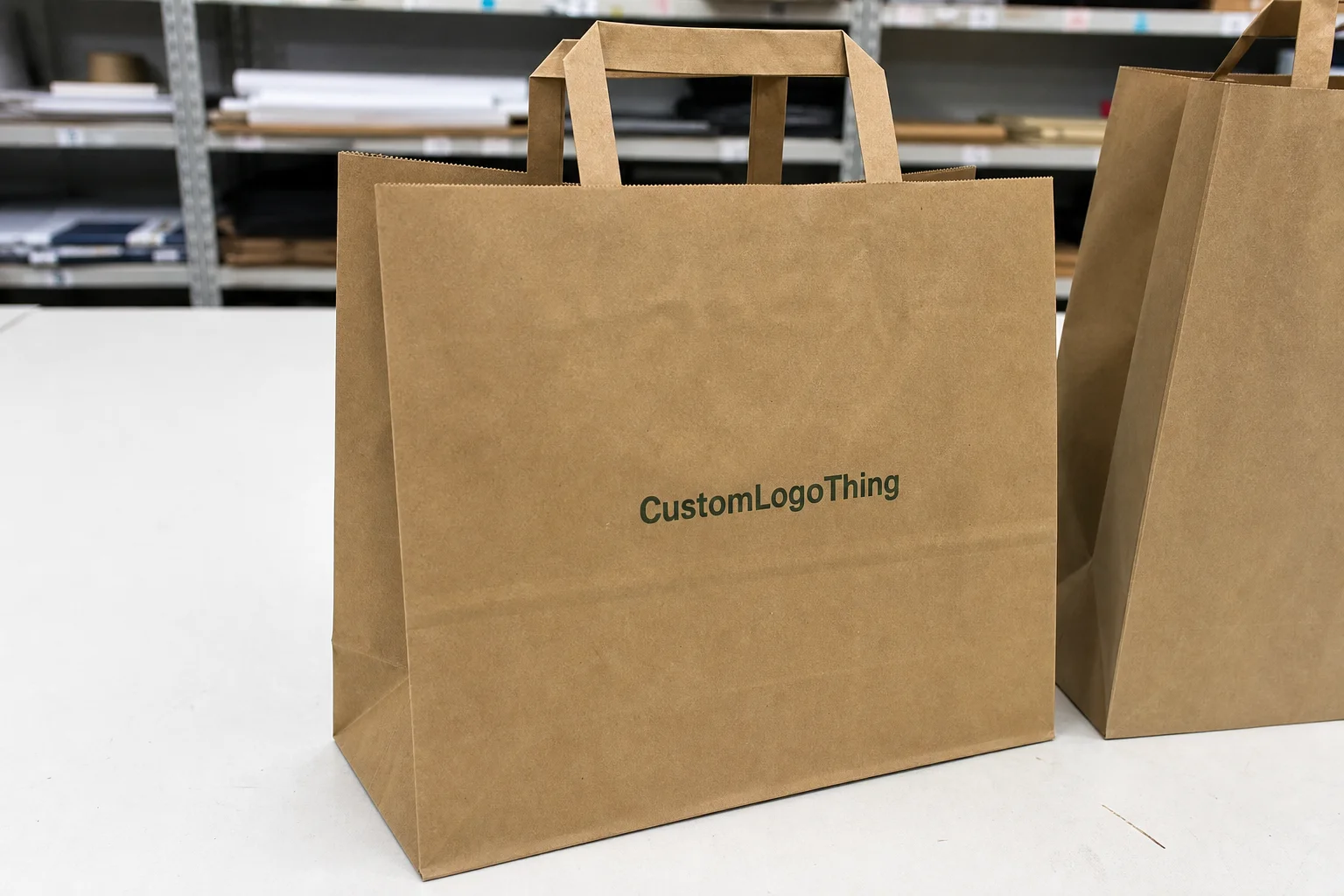
Checkout is a speed environment. Staff are moving quickly, customers are watching the lane, and every small delay gets magnified across hundreds or thousands of transactions. That is why custom grocery bags deserve more attention than they usually get. If the opening is too narrow, the handles are awkward, or the film clings in humid conditions, bagging slows down. If the bag tears, the customer remembers. If the logo is clear and the bag feels solid, the store looks more disciplined, even if nobody says it out loud.
The bag is also a brand surface with unusually broad exposure. A receipt is read once. A checkout bag is seen in motion, carried through a parking lot, placed in a kitchen, and often reused. That gives it a different kind of visibility than custom printed boxes or shelf-ready cartons. In practice, this means your packaging design needs to be simple enough to read at arm’s length and strong enough to survive the trip home. A cluttered bag may look busy in a proof; on the lane, it usually looks weaker.
Buyers sometimes focus too heavily on the visual and not enough on handling behavior. That is backward. A bag with the wrong dimensions can force staff to double-bag more often, which adds cost and wastes time. A bag with poor handle geometry can rub the hand or make it harder to carry a full load of heavy items. The result is friction at the exact point where the store wants the opposite.
There is also a hidden operational effect. When bagging is smooth, the checkout line feels cleaner and more controlled. That feeling matters in grocery because margin pressure is real and the customer experience is often judged in seconds. If your current program creates complaints, extra waste, or inconsistent presentation, the issue is not cosmetic. It is a workflow problem wearing a branding label.
Materials, gauges, and handle styles that hold up
For most grocery programs, material choice starts with the substrate and then narrows to gauge. High-density polyethylene remains common because it is lightweight, economical, and well suited to fast checkout environments. Low-density blends generally feel softer and have more stretch, which can help with comfort and load forgiveness. Recycled-content options are increasingly used in retail packaging programs that want a lower virgin-resin footprint, but the exact performance depends on the blend and the supplier’s process control.
Gauge matters because thicker is not automatically better. A 0.55 mil bag may be adequate for a small basket mix, while a 0.9 mil or 1.0 mil specification may make more sense for heavier loads, wider items, or stores that see a lot of repeat traffic. The smarter question is not, “What is the thickest bag we can buy?” It is, “What gauge reliably handles the average basket and the occasional heavy one without overpaying for material we do not need?” That is where real savings live.
Handle style changes the user experience fast. Die-cut handles can be quick to grab, but they need enough reinforcement and a clean cut. Loop handles often feel more comfortable for heavier loads and can improve carry comfort at the curb or in the parking lot. Patch reinforcement, if used, can make a noticeable difference in customer complaints because it spreads stress more evenly across the top edge. The right answer depends on who is carrying the bag and how far they usually walk.
Fit factors matter as much as the material itself. A bag with the wrong gusset width may stand poorly on the counter. A bag that is too deep can wrinkle and waste carton space. A bag that is too shallow can be a problem for stacked items, produce, and boxed goods. Case pack efficiency also matters because a spec that looks fine on paper can consume unnecessary storage space in the back room. That is a quiet cost, but it is a real one.
If your program includes paper options for certain stores or compliance reasons, ask for FSC-certified stock through the Forest Stewardship Council. For plastic programs, ask for technical data that includes dart impact or tensile references where applicable. A supplier who can discuss ASTM D1709 or ASTM D882 in plain language usually understands the film better than one who only says the bag is strong.
One more practical test: sample the bag with actual store items, not a generic weight number. Cartons, produce, and chilled goods behave differently inside the bag. Shape distribution matters. A ten-pound load of compact items is not the same as ten pounds spread across a few awkward cartons. Add a quick pull test on the handles and a seam check after loading. Those two checks catch more weak specs than a polished mockup ever will.
Print details that make the bag easier to trust
Print is not decoration first. It is a trust signal. The easiest bag to trust is the one with clear contrast, a readable mark, and no visual clutter around the functional zones. If the logo is buried too low, crowding the fold line or the gusset, the bag can look busy and poorly organized. That is a small design error, but in branded packaging small errors are expensive because they travel with every customer interaction.
For most grocery programs, a one-color or two-color print keeps the job clean and economical. It also tends to reproduce more consistently than full-coverage graphics, especially on thinner film. More colors can look attractive in proof, but they may increase setup complexity, registration risk, and scrap if the artwork is crowded. Buyers sometimes ask for a richer graphic because it feels more premium. That can work, but the bag still needs to function as retail packaging first.
Placement is critical. The print should not interfere with handles, score lines, perforations, or gusset folds. That sounds obvious, yet it is one of the most common reasons a proof comes back for revision. A design that leaves enough negative space usually looks better in motion because the eye can find the logo quickly. The same principle applies to shelf labels and custom printed boxes: if the viewer has to hunt for the brand, the brand has already lost some of its force.
There is a practical branding lesson here. A clean bag feels more reliable than a cluttered one, even if the resin and gauge are identical. People read visual order as operational order. That is why package branding on grocery bags should be restrained, legible, and consistent across store formats. If one location uses a dense graphic and another uses a simple mark, customers notice the mismatch even if they do not consciously analyze it.
Good file prep helps too. Vector logos, Pantone callouts where needed, and restrained line weights reduce production headaches. A bag print is not a poster. Fine detail can disappear once the film stretches or the press gains speed. Keep the art honest to the substrate, and the result usually looks better in the lane than the proof did on screen. A supplier’s prepress review should catch overprints, low-resolution art, and any critical elements that sit too close to the seal area.
Cost, pricing, and MOQ tradeoffs to compare before quoting
Price for custom grocery bags is driven by a handful of variables: size, gauge, resin choice, print coverage, number of colors, and quantity. Order volume matters because setup costs spread out as the run gets larger. Unit price usually falls with scale, but total spend can still rise if the bag is oversized, overprinted, or specified with more material than the store actually needs.
Minimum order quantity is where a lot of buyers get trapped. A low MOQ can be useful for a test rollout, but it often comes with higher unit pricing and less room to optimize freight or setup. A large MOQ can reduce unit cost, yet it also increases inventory risk and storage pressure. If a bag takes up too much back-room space or outlasts a format change, the “better” price is not better at all. It is just more expensive later.
| Spec type | Best fit | Typical unit range | Buyer note |
|---|---|---|---|
| Standard HDPE, one-color print | High-volume lanes with light to medium baskets | $0.03-$0.06 per bag at 5,000-10,000 units | Usually the lowest-cost starting point if dimensions are kept efficient |
| Heavier-gauge HDPE or LDPE blend | Stores with more refrigerated items, cartons, or heavier loads | $0.05-$0.09 per bag at 5,000-10,000 units | Added thickness can reduce failures and customer complaints |
| Recycled-content bag with simple branding | Programs that want a sustainability message without complex graphics | $0.06-$0.11 per bag at 5,000-10,000 units | Performance depends on the resin blend and process control |
| Paper carryout bag, FSC-certified stock | Co-ops, premium formats, or stores moving away from plastic | $0.10-$0.22 per bag at 5,000-10,000 units | Useful for certain brand positions, but storage and moisture resistance should be reviewed |
Those ranges are directional, not a promise. Freight, artwork complexity, and market resin conditions can shift them. A quote that looks cheaper on unit cost may still cost more once freight, proofing, or setup is added. This is where buyers should compare apples to apples: exact dimensions, exact gauge, print count, packaging format, and delivery terms. If one quote uses a smaller usable print area or a different case pack, the comparison is not real.
"The cheapest quote is often the one hiding the most compromises: thinner film, smaller print area, or freight that appears after the fact."
If you are building a broader packaging program, it helps to compare the bag spec against other custom packaging products you already buy. That keeps the conversation focused on conversion, labor, and total landed cost rather than just the first number on the page. For a grocery operation, that discipline usually pays off faster than chasing the lowest advertised price.
Production steps and lead time from artwork to delivery
The production path is straightforward, but there are several places where delay can creep in. It usually starts with artwork submission, followed by prepress review, proof approval, tooling or plate preparation, production, packing, and shipment. If files are incomplete, colors are unclear, or dimensions need to be rechecked, the schedule slows before the job even gets to the press.
Most delays are predictable. File problems are common. So are revisions to logo placement, changes to handle dimensions, and sample approvals that take longer than expected because multiple stakeholders want to weigh in. Freight can also add friction, especially if the destination is not close to the production point or if a store rollout is tied to a fixed opening date. The bag itself may be simple; the timeline around it rarely is.
For standard custom print work, a realistic window is often 12 to 18 business days from proof approval, plus shipping time. Simple rush jobs can move faster if the supplier has capacity and the spec is already dialed in, but it is a mistake to assume every project can be compressed. Custom grocery bags are not stock items. They need approval and setup. That time should be built into the plan from the start.
One of the smartest ways to shorten the schedule is to clean up the inputs. Send vector art. Confirm dimensions early. Decide on handle type before proofing starts. If possible, approve samples quickly and keep one person accountable for the final signoff. That sounds basic, but it removes a surprising amount of delay. The less back-and-forth in the early stage, the less the production calendar slips.
Ask for a clear preproduction checkpoint as well. A good supplier should confirm print size, color count, bag dimensions, case pack, carton labeling, and any special packing requirements before the run starts. That review is cheap compared with reworking a full order. If the supplier cannot explain where the tolerances sit, there is more risk than the quote suggests.
For buyers who want a more structured review of durability or distribution risk, the International Safe Transit Association offers package testing frameworks that can inform how you evaluate load performance and transit stress. Grocery bags are not shipping cartons, but the discipline is similar: if you test under realistic conditions, you learn more than a bench test or a sales pitch can tell you.
Common sizing and spec mistakes buyers make
The most common mistake is choosing a bag that looks right on paper but fails in use. A bag can be technically large enough and still be wrong if the gusset is too narrow for cartons, dairy, or stacked produce. Customers do not carry empty dimensions. They carry odd shapes. If the bag does not accommodate real basket mix, the checkout lane suffers and complaints follow.
Another frequent error is chasing a low price with a thin spec. A weak bag can create hidden costs that do not show up in the quote: replacement bags, more double-bagging, more staff time, and more customer dissatisfaction. That is not savings. It is deferred expense. In a high-volume environment, a failure rate of even a few bags per thousand can erase any apparent unit-price advantage.
Handle comfort gets ignored more often than it should. Staff may not complain immediately because they are trying to keep the line moving, but customers feel the difference on the way out. If the handle cuts into the hand or twists under load, the bag looks cheap even when the print is excellent. That is why ergonomics matter in product packaging and in package branding alike. The physical experience shapes the brand impression.
Storage and case pack are easy to overlook until the bags arrive. A spec that ships in awkward cartons or takes too much shelf space can create daily frustration in the back room. Buyers sometimes focus so much on retail presentation that they forget the person stocking the bags has to access them quickly, often in a crowded area with limited room. A practical spec should be easy to store, easy to grab, and easy to count.
Finally, some buyers do not test the bag with actual peak loads. That is the wrong test. If your store regularly sees bulk produce, bottled drinks, or frozen items, the sample should reflect that reality. Load the bag the way your customers do. Bend it. Carry it. Set it down. If the bag fails in a controlled test, it will fail faster in the wild.
Here is a simple spec-check list before you approve any order:
- Dimensions: verify width, gusset, and depth against real basket mix.
- Gauge: match thickness to average and peak load conditions.
- Handles: confirm comfort, reinforcement, and staff speed at the lane.
- Print area: keep artwork clear of folds, seams, and grip zones.
- Case pack: make sure storage and replenishment fit the store layout.
That checklist looks simple, but it catches most avoidable mistakes before they become expensive.
Next steps for a cleaner bag program
Start with a quick audit of the current program. How many bags fail per week? Where do complaints come from? What is the average basket mix? How much back-room space is available? Those answers turn a vague buying request into a usable spec. Without them, every quote is just a guess dressed up as a proposal.
Then build a short spec sheet. Include dimensions, gauge, handle style, print count, color expectations, case pack, target budget, and whether the order is meant for one store or a chain rollout. If sustainability is part of the brief, say so directly. The more specific the input, the less room there is for misinterpretation. That is true for bags, custom printed boxes, and every other branded packaging item that has to work at scale.
Ask for two or three quote scenarios, not just one. A baseline option, a heavier-duty option, and a lower-MOQ test option usually tell you more than a single number. Once you have those, compare them on total landed cost, not just unit price. Then request samples and test them with actual store items. That is the quickest way to find the spec that performs without wasting money.
From there, run a small pilot in one store or one lane mix. Watch checkout speed, durability, and customer reaction for a short period, then adjust if needed. A pilot reveals issues that a proof cannot: how the bag opens, how it carries, whether staff like it, and whether it fits the store’s actual rhythm. If the pilot goes well, roll out with confidence. If not, refine the spec before committing to a larger order.
custom grocery bags work best when they are treated as a small piece of operating equipment, not a generic print job. Choose the Right size, the right material, and the right print treatment, then match the order plan to your real usage. That approach keeps checkout faster, the lane cleaner, and the brand more credible with every bag that leaves the store.
FAQ
What size works best for branded grocery bags?
Pick the size from the average basket mix, not from what looks common in the market. Width and gusset depth should match the items customers buy most often, especially cartons, produce, and boxed goods. A bag that fits the real load is usually faster at checkout and more comfortable to carry.
How do I compare quotes for grocery bag printing?
Compare identical specs only: size, gauge, colors, material, packaging, freight terms, and lead time. Watch for setup fees, proofing charges, and MOQ differences that can make one quote appear cheaper than it really is. If two quotes are not built on the same spec, the comparison is not useful.
What material should I choose for heavy grocery loads?
Use a stronger construction and verify that the gauge supports the load you expect at peak checkout volume. Test with real store items, not just a generic weight number, because shape and load distribution matter more than a clean lab figure in many grocery settings.
How long do custom grocery bag orders usually take?
Lead time depends on artwork approval, tooling, production queue, and shipping distance. Clean files and fast approvals usually shorten the schedule more than small spec changes do. A typical custom run often needs more planning than stock bags, so it is better to build that time into the schedule early.
Can I order a low MOQ for grocery bags?
Yes, but lower MOQ often means a higher unit price and less room to optimize freight or setup costs. A low MOQ makes sense when you are testing a new spec, store format, or print design before a larger rollout. It is a good risk-control tool, not always the cheapest path.


