Buyer Fit Snapshot
| Best fit | boxes for retail replenishment compared for packaging buyers comparing material specs, print proof, MOQ, unit cost, freight, and repeat-order risk where brand print, material, artwork control, and repeat-order consistency matter. |
|---|---|
| Quote inputs | Share finished size, material target, print colors, finish, packing count, annual reorder estimate, and delivery region. |
| Proofing check | Approve dieline scale, logo placement, barcode or warning zones, color tolerance, and any recyclable or compostable wording before bulk production. |
| Main risk | Vague material claims, crowded artwork, or missing packing details can create delays even when the unit price looks attractive. |
Fast answer: Boxes for Retail Replenishment Compared: Dieline, Finish, Proof, and Buyer Review should be specified like a repeatable production item. The safest quote includes material, print method, finish, artwork proof, carton packing, and reorder notes in one written spec.
What to confirm before approving the packaging proof
Check the product dimensions against the actual filled item, not only the sales mockup. Ask for tolerance on folds, seals, hang holes, label areas, and retail display edges. If the package carries a logo, QR code, warning copy, or legal claim, reserve that space before decorative graphics fill the panel.
How to compare quotes without losing quality
Compare board or film grade, print process, finish, sampling route, tooling charges, carton quantity, and freight assumptions side by side. A lower quote is only useful if the supplier can repeat the same color, closure quality, and packing count on the next order.
Best Boxes for Retail Replenishment: Top Picks Compared
The best Boxes for Retail replenishment usually get chosen after somebody has already paid for a mistake. A carton that is only a little too large looks harmless on paper. In the warehouse, it chews up cube, demands more void fill, and pushes freight cost in the wrong direction. Then the store team gets stuck dealing with it, which is where the real bill starts to show. Funny how that works.
Pick the best boxes for retail replenishment poorly and the pain spreads fast. A loose carton lets product slide around. A box that is too tall stacks badly and throws off pallets. A carton that opens like a wrestling match slows down store labor and makes people get creative with knives. None of that shows up in a clean spec sheet, but it shows up everywhere else.
If you are sorting stock cartons, shelf-ready trays, mailers, or custom corrugated formats, the right answer depends on how the product actually moves. The best boxes for retail replenishment for cosmetics are not the same as the best boxes for retail replenishment for grocery replenishment moving mixed backroom stock every morning. Labor, breakage risk, pallet stability, and shelf speed all matter. Cheap alone is not a plan. It is a wish.
Below is a practical comparison for buyers who care about total landed cost, not just the first number in a quote email. I am looking at protection, pack speed, stack strength, shelf presentation, and how each structure handles repeated touches. If you need custom sizing or branded options, Custom Packaging Products is a sensible place to start once the carton type is clear.
Quick Answer: Best Boxes for Retail Replenishment
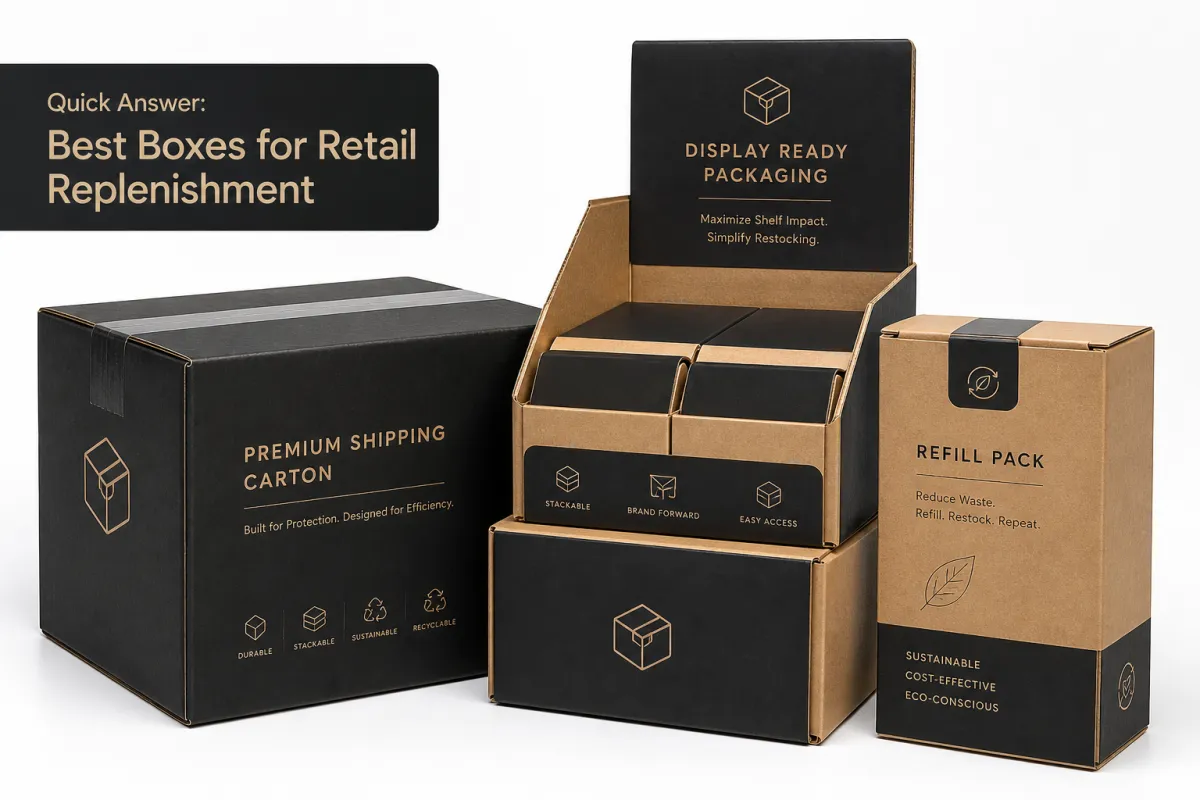
The short answer: the best boxes for retail replenishment are usually regular slotted cartons for general stock, die-cut Mailers for Smaller presentation-heavy items, and shelf-ready trays for fast store-facing restocks. That split keeps showing up because each structure solves a different bottleneck. Nothing fancy. Just different jobs.
Most replenishment problems are carton problems wearing an inventory badge. A box that is too loose rattles the product. A box that is too large burns cube and can crush under load. A box that opens badly creates labor friction on the sales floor. The best boxes for retail replenishment do three things at once: protect the product, move efficiently, and make the last person who touches them faster.
If I had to give one brutally practical rule, it would be this: pick the lightest box that still protects the product, stacks cleanly on pallets, and opens without drama at store level. If the carton needs more tape, more void fill, or more knife work than it saves in material, it is the wrong carton. The best boxes for retail replenishment are rarely flashy. They disappear into the workflow, and that is exactly why they work.
A carton should earn its keep twice: once in transit and once on the sales floor. If it only does one job well, it is probably costing more than it looks.
Three signals usually separate the winners from the rest. First, the box matches the product family instead of forcing a one-size-fits-all approach. Second, the structure holds up after more than one handling point, which matters in DC-to-store networks. Third, the box still makes sense after freight and labor are added back in. That is where the best boxes for retail replenishment pull away from generic stock solutions.
For a quick benchmark, many buyers start with 32 ECT to 44 ECT corrugated depending on load and stacking conditions, then validate against actual product weight and route conditions. If the contents are fragile or the shipment moves through rougher lanes, board grade and flute profile can matter more than the printed finish. That trade-off is the real story behind the best boxes for retail replenishment.
Top Boxes for Retail Replenishment Compared
People ask for the best boxes for retail replenishment as if one carton wins every category. It does not. The winner changes with the job. A carton that saves money on bulk apparel can be a terrible fit for cosmetics. A tray that speeds shelf loading can be useless for dense, heavy goods. The smarter move is to compare box types by function, not by habit.
The table below shows the main options I see used most often in retail replenishment, along with realistic pricing and the trade-offs that matter once the boxes leave the quote stage. These are not fantasy numbers. They are the kind of ranges buyers actually look at at moderate order volumes.
| Box type | Best use case | Typical spec | Estimated unit cost at 5,000 | Main advantage | Main drawback |
|---|---|---|---|---|---|
| Regular slotted carton | General replenishment, mixed SKUs, bulk backroom stock | 32 ECT to 44 ECT, kraft or C-flute | $0.24-$0.62 | Best balance of cost, stacking, and availability | Can slow store labor if top-opening is awkward |
| Shelf-ready tray | Fast facing, promo sets, high-velocity store restocks | Die-cut tray with tear-away front | $0.38-$0.95 | Speeds shelf placement and reduces repacking | Higher tooling and design sensitivity |
| Die-cut mailer | Small SKUs, presentation-sensitive items, direct ship | E-flute or B-flute mailer | $0.30-$0.88 | Fast assembly and clean presentation | Not ideal for heavier or mixed loads |
| Partitioned carton | Fragile bottles, glass, bundled assortments | Corrugated with inserts or dividers | $0.55-$1.25 | Controls movement and reduces breakage | More material and more pack steps |
| Telescoping box | Oversized or irregular items, layered protection | Two-piece corrugated structure | $0.48-$1.10 | Flexible for odd dimensions | More labor, more storage space, more pieces to manage |
Regular slotted cartons usually win on total economics because they are easy to source, easy to stack, and easy to standardize across multiple DCs. Shelf-ready trays win when store labor is the bottleneck. Die-cut mailers tend to win for small, cleanly branded items where presentation matters as much as protection. Partitioned cartons and telescoping boxes are more specialized, but they can be the best boxes for retail replenishment when breakage or fit issues are expensive.
One pattern keeps showing up. Standard cartons may look cheaper per unit, but they can become expensive if stores must cut them down, sort through mixed contents, or restock by hand from the top. That is why the best boxes for retail replenishment reduce touches. Every touch is a cost hiding in plain sight.
Another angle is pack density. If a carton leaves 15% void around the product, you pay for it in corrugated, freight cube, and stabilization material. If it is too snug, workers slow down because the packer has to force the fit. The best boxes for retail replenishment split the difference and leave just enough tolerance for real-world loading variation.
Detailed Reviews of the Best Boxes for Retail Replenishment
Testing the best boxes for retail replenishment means looking past the renderings and asking what happens after the carton is filled, lifted, stacked, scanned, opened, and handled again. I care about drop resistance, corner crush, tear behavior, and whether the structure still works after repeated touches. Pretty print is nice. A box that fails on the warehouse floor is not.
Regular slotted cartons
Regular slotted cartons are still the workhorse choice in the best boxes for retail replenishment conversation because they are cheap to run, familiar to packers, and stable under load. For standardized SKUs, they are hard to beat. The structure is predictable, the tooling is straightforward, and the box can be tuned with board grade and flute choice rather than reinventing the format.
In practice, I like them for mixed merchandise, seasonal stock, and palletized store replenishment where the store team is going to open the carton later anyway. A 32 ECT box can be enough for lighter items and short lanes, while 44 ECT or stronger may be the better fit for heavier contents or more stressful routes. The best boxes for retail replenishment do not overbuild every shipment, but they do account for the worst touch point, not the average one.
Where they fail is usually labor, not protection. If the box is taped heavily, cut in awkward places, or sized poorly for the contents, store staff will notice immediately. Procurement teams do not always see that problem on the spec sheet. That is one reason the best boxes for retail replenishment are often custom-sized even when the buyer starts with stock boxes.
Shelf-ready trays
Shelf-ready trays are the obvious choice when the store needs speed more than anything else. They are among the best boxes for retail replenishment for high-velocity goods because the front tears away cleanly, the products face forward, and the team can move from receiving to shelf in one motion. That labor savings can be real when a store is short-staffed or slammed.
The downside is that shelf-ready trays require more thoughtful design. If the tear line fails, the presentation is messy. If the tray is too shallow, product can tip. If the board is too light, the tray can warp before it reaches the aisle. The best boxes for retail replenishment in this category usually use a sturdy die-cut blank, a controlled tear feature, and dimensions matched tightly to the shelf depth.
From a buyer's point of view, shelf-ready packaging only pays when the store team actually uses it the way it was designed. If staff still repack items into bins or dump trays into baskets, the labor advantage disappears. That is why the best boxes for retail replenishment should be tested with real store teams, not just in a packaging lab.
Die-cut mailers
Die-cut mailers are excellent for small, lightweight, presentation-sensitive products. They close quickly, look clean, and can be a smart option when the replenishment flow overlaps with direct-to-consumer fulfillment. Among the best boxes for retail replenishment, they are the sleekest choice, but not the toughest.
I would not use a mailer for dense mixed stock unless the product set is very controlled. The box styles that shine in apparel, accessories, cosmetics, and small electronics often struggle once the load gets heavier or the shipment gets rougher. Mailers are one of the best boxes for retail replenishment when brand image matters and the SKU dimensions are disciplined, but they are not a universal answer.
They also behave differently depending on assembly method. Some designs fold in seconds and need little tape. Others need more careful creasing and tab engagement. A buyer should watch how the line behaves after the first 100 units, not just the first sample. That is where the best boxes for retail replenishment reveal whether they are genuinely efficient or merely attractive.
Partitioned cartons
Partitioned cartons are the serious option for fragile products and bundled assortments. If bottles rub against each other or glass is part of the mix, these cartons can be the best boxes for retail replenishment because the dividers control movement and reduce contact damage. The extra material is not there for decoration; it pays for itself when breakage claims are expensive.
The trade-off is pack time. Inserts take time to place, and the more cells you add, the slower the line tends to run. For some operations, that is acceptable because the damage savings are large. For others, the extra labor wipes out the benefit. The best boxes for retail replenishment in this category need a clear break-even calculation, not a vague feeling that more protection must be better.
If you need added protection, ask whether the divider should be corrugated, molded fiber, or paperboard, then test for real movement inside the box. A structure that looks secure in a sample can still allow micro-shift after vibration. The best boxes for retail replenishment should be judged by what happens after the route, not just at the pack station.
Telescoping boxes
Telescoping boxes solve a very specific problem: awkward size and layered protection. They can be the best boxes for retail replenishment for oversized items, irregular shapes, or products that need extra compression control. Because the top and bottom portions overlap, they offer flexible height coverage that a one-piece carton cannot always match.
They are not efficient for every operation. They take more storage room, more handling, and more time to assemble. If the product family is stable enough to use a standard RSC or tray, that is usually the cleaner choice. Telescoping structures become some of the best boxes for retail replenishment only when the size variation is real and persistent.
For buyers with broad SKU ranges, this format can rescue an otherwise messy packaging program. Just do not overuse it. A specialty carton should stay specialty. The best boxes for retail replenishment are often the simplest ones that match the load precisely.
For products that need a packaging spec tied to sustainability goals, it is worth checking whether the board can be sourced with FSC-certified fiber and whether the design actually reduces material use without hurting performance. The FSC standard is a useful reference point when sourcing matters alongside cost. For transport validation, many teams also look at the test methods and guidance published by ISTA, especially when the route includes multiple transfers or rougher handling.
Three practical observations keep coming up across box types. First, the first box choice is rarely the final box choice; buyers usually revise after a pilot. Second, the carton that works in a DC may fail at the store because the opening method is wrong. Third, the best boxes for retail replenishment are usually the ones that reduce judgment calls for the person loading, shipping, or stocking them. Fewer decisions. Fewer mistakes. Shocking, I know.
Retail Replenishment Box Pricing and Cost Comparison
Pricing for the best boxes for retail replenishment is never just unit cost. Board grade, print coverage, carton size, minimum order quantity, and freight all shift the real number. That is why two quotes that look close on paper can land very differently once you plug them into a production plan.
At modest volume, a plain stock carton might come in around $0.24 to $0.35 per unit, while a custom-sized RSC with light print can move into the $0.32 to $0.62 range depending on board and volume. Shelf-ready trays and mailers often sit a bit higher because the die-cutting and finishing add labor and tooling complexity. The best boxes for retail replenishment may cost more up front, but if they cut damage, void fill, or store labor, they can still be cheaper in practice.
Start with cube efficiency. A carton that is oversized by even 10% can increase shipping cost more than the box price itself, especially when pallets are built to height limits. If void fill is needed because the carton is loose, add that material and the labor to use it. Suddenly, the best boxes for retail replenishment are not the cheapest cartons. They are the cartons with the lowest total handling cost.
Here is the kind of cost model I recommend using internally:
- Box cost: unit price multiplied by annual volume.
- Freight cost: cube, pallet count, and shipping lane.
- Labor cost: pack speed, tape use, and store opening time.
- Damage cost: breakage, returns, rework, and shrink-related write-offs.
- Inventory cost: storage space, minimum order pressure, and lead-time buffer.
That list matters because the best boxes for retail replenishment often win by a small amount in each category rather than by one dramatic saving. A carton that packs 12 seconds faster per unit can outperform a cheaper option if it runs through thousands of units a month. A tray that reduces shelf labor by 15 seconds per face can matter more than a few cents of corrugated.
Custom boxes become especially attractive once dimensions are stable. If a stock carton leaves too much void, a custom die line can reduce material use, improve stacking, and lower freight cube. On larger runs, that design work can pay back quickly. If you need to compare options visually, Custom Packaging Products can help narrow down the structural formats before you request pricing.
There is also a procurement reality that gets missed often. Low minimum order quantities feel safer, but they can raise unit cost and leave you with a less efficient box for too long. Larger runs reduce per-unit expense, yet they increase inventory carrying risk if SKUs change often. The best boxes for retail replenishment are the ones that fit your reorder rhythm as much as your product dimensions.
How to Choose the Best Boxes for Retail Replenishment
The simplest way to choose the best boxes for retail replenishment is to start with the product, not the packaging catalog. Measure the actual product load, weight, and handling path before you choose a structure. A box that works for a single SKU in isolation may fail as soon as mixed packs, odd shapes, or faster handling are introduced.
Start with four questions. How heavy is the load? How fragile is the product? How often does the carton need to be opened at the store? How variable is the SKU mix? The answers usually point toward one of three outcomes: a regular slotted carton for protection and economy, a shelf-ready tray for speed, or a mailer-style carton for smaller branded goods. That is the logic behind the best boxes for retail replenishment.
From there, look at the process. Manual packing can tolerate a different box than a semi-automated line. A carton erector may favor certain scores and folds. Store staff may prefer a structure that tears open cleanly without tools. When the box is awkward, every step slows down. The best boxes for retail replenishment fit the machine, the worker, and the shelf, not just the product.
Fit first, then finish
One mistake I see a lot is choosing the print finish before the fit. That is backwards. Protection and dimensions come first. Branding matters, but not if the carton arrives crushed or the product sloshes around inside it. The best boxes for retail replenishment should be physically right before they are visually polished.
Match the carton to the handling points
If the box is touched at receiving, sorting, palletizing, transport, backroom storage, and shelf placement, each touch matters. More handling points favor stronger board, better stacking, and simpler opening features. Fewer handling points open the door to lighter and more presentation-focused structures. The best boxes for retail replenishment are the ones that survive the number of touches your network actually creates.
Test with real inventory
Sample packs can be misleading because they often use idealized product loads. Real inventory is messier. Labels vary, units are sometimes slightly oversized, and mixed loads shift differently than clean samples. Test the carton with actual product, actual inserts, and actual packers. The best boxes for retail replenishment should be proven with real conditions, not only a clean spec sheet.
A good validation sequence usually looks like this:
- Measure the product family and define acceptable dimensional tolerance.
- Order samples in two or three structural options.
- Run a short fit test with actual staff.
- Check stacking, opening, and reclosure behavior.
- Validate transit performance with a pilot route or ISTA-aligned test.
- Compare the landed cost, not just the quote.
Sustainability should be part of the decision, but after the performance basics are settled. Recycled content, FSC-certified fiber, right-sized design, and lighter board are all useful. They just should not be used to excuse a carton that causes damage or labor waste. The best boxes for retail replenishment often improve sustainability indirectly because they reduce wasted material and cut rework.
If a brand wants custom print, I would still keep the structural design conservative until the carton proves itself. Brand graphics can be added without making the box fragile. What cannot be added later is lost product, wasted freight space, or extra store labor. That is why the best boxes for retail replenishment often look humble and perform better than the flashier alternatives.
Retail Replenishment Process and Timeline
The process for sourcing the best boxes for retail replenishment usually starts with a sample, not a purchase order. That is the right order. You want to catch fit issues, stack issues, and opening problems before you lock in a production run. A carton that looks great in a drawing can behave very differently once the line starts filling it.
Typical lead time depends on whether you are buying stock or custom. A simple stock-box swap can move faster, while a custom carton often needs structural drawings, sample revisions, and approval time. In many programs, the first delivery arrives about 12 to 20 business days after proof approval for standard custom work, though larger runs or complex printing can extend that. The best boxes for retail replenishment are not just the right structure; they are also the right timeline.
Here is the rollout sequence I would trust:
- Sample: request two or three candidate structures.
- Test: pack real product and simulate store handling.
- Revise: adjust dimensions, scores, or closures.
- Pilot: run a small store or DC trial.
- Scale: move to full rollout once results are consistent.
That process sounds slow only until you compare it with the cost of a rushed change. Artwork approval, structural changes, seasonal demand spikes, and freight booking are the usual bottlenecks. A missed ship date can push the whole replenishment cycle backward. The best boxes for retail replenishment are the ones that arrive when stores actually need them, not when the design team finally signs off.
Another timeline issue is reorder cadence. If your replenishment rhythm is weekly, do not choose a box with a lead time that forces huge safety stock. If your product line changes every season, do not overcommit to a structure that is hard to revise. The best boxes for retail replenishment align with your velocity, your storage space, and your forecast accuracy.
For buyers who want branded packaging and structural consistency, a good next move is to compare a few carton styles against a standard spec sheet and order samples before full production. If custom print is part of the plan, Custom Packaging Products can help narrow the options once the product dimensions and store workflow are clear. That step alone can prevent a lot of expensive guessing.
Our Recommendation: Best Boxes for Retail Replenishment by Use Case
After comparing the main formats, my recommendation is straightforward. The best boxes for retail replenishment by use case are: regular slotted cartons for all-around stock movement, shelf-ready trays for fast store-facing replenishment, die-cut mailers for smaller branded goods, partitioned cartons for fragile assortments, and telescoping boxes for irregular or oversized items. There is no single carton that wins every category, and anyone promising one is probably hiding the labor math.
If you need the best all-around option, start with a regular slotted carton sized tightly to the product family. It is the safest starting point for mixed channels, and it usually gives the best balance of cost and performance. If the store team is the bottleneck, shelf-ready trays may be the real winner because they reduce opening time and improve shelf presentation. That is where the best boxes for retail replenishment stop being packaging and start becoming workflow tools.
For fragile goods, choose a partitioned format or a stronger corrugated build before you choose a prettier print. For small premium items, a die-cut mailer often makes sense because it packs fast and looks clean. For tight budgets, a stock RSC can still be one of the best boxes for retail replenishment if the dimensions are disciplined and the route is forgiving. Cheap and efficient are not the same thing, but they can overlap if the spec is honest.
Here is the practical next-step list I would use inside a buying team:
- Audit the top replenishment SKUs by size, weight, and breakage history.
- Measure the current carton and compare it to the product footprint.
- Request samples in at least two structural styles.
- Run a store-level test with actual staff and actual stock.
- Compare quote, freight cube, labor time, and damage rate together.
If the current box is oversized, awkward to open, or expensive to ship, changing it can be one of the fastest packaging wins available. That is why I keep coming back to the same point: the best boxes for retail replenishment are not just the strongest or the cheapest. They are the boxes that lower the total cost of getting product from the DC to the shelf with the fewest surprises.
If custom branding matters, choose the carton family first, then tune the dimensions and print after the structure proves itself. That is the durable move. Test real product, compare actual handling costs, and buy the best boxes for retail replenishment for your specific channel mix rather than for a theoretical average that does not exist.
Frequently Asked Questions
What are the best boxes for retail replenishment of mixed SKUs?
Regular slotted cartons usually work best when stores receive a mix of item sizes and weights in one shipment. Use partitions or inserts when mixed SKUs can shift or rub during transit. Choose a carton size that packs tightly without forcing overfill, since loose voids slow down both shipping and store handling. In most mixed-SKU programs, the best boxes for retail replenishment are the ones that keep the load stable without adding unnecessary pack steps.
Are shelf-ready cartons better than standard boxes for store restocking?
Shelf-ready cartons are better when the store team needs to open a box quickly and place products directly on the shelf. Standard boxes are often better when the priority is transport protection and low purchase cost. The best choice depends on whether your pain point is backroom labor or in-transit damage. For many retailers, the best boxes for retail replenishment are shelf-ready only in high-velocity categories, not across the whole range.
How do I compare the cost of retail replenishment boxes?
Compare unit price, freight, and labor together instead of looking at box cost alone. Account for cube efficiency because oversized cartons can raise shipping cost even if the box itself is inexpensive. Include damage rate and rework time in the math, since those costs can outweigh small packaging savings. That is why the best boxes for retail replenishment often win on total landed cost rather than sticker price.
How long does it take to switch to a new replenishment box style?
A simple stock-box swap can be fast, while a custom carton usually needs samples, testing, and approval time. Build in time for pilot runs so you can confirm fit, stacking, and store usability before a full rollout. Lead time is usually driven by design changes, order size, and how quickly samples are approved. If the schedule is tight, the best boxes for retail replenishment may be the closest proven structure you can source quickly.
What should I test before buying the best boxes for retail replenishment?
Test real products, not dummy loads, so weight distribution and fit reflect actual conditions. Check stacking strength, corner crush, and how the box opens at the store level. Measure packing speed, freight cube, and whether the carton still performs after repeated handling. Those tests reveal whether the best boxes for retail replenishment are truly better or just better looking.
The takeaway is simple: start with the product, not the carton catalog. Pick two or three structures, test them with real staff and real stock, and choose the box that lowers total handling cost across the DC, freight lane, and store floor. That is how you find the best boxes for retail replenishment without paying for guesswork later.