Buyer Fit Snapshot
| Best fit | Custom Hang Tags Bulk Order projects where brand print, material claims, artwork control, MOQ, and repeat-order consistency need to be specified before quoting. |
|---|---|
| Quote inputs | Share finished size, material target, print colors, finish, packing count, annual reorder estimate, ship-to region, and any compliance wording. |
| Proofing check | Approve dieline scale, logo placement, barcode or warning zones, color tolerance, closure strength, and carton packing before bulk production. |
| Main risk | Vague material claims, crowded artwork, missing packing details, or unclear freight terms can make a low unit price expensive after revisions. |
Fast answer: Custom Hang Tags Bulk Order: Specs, Pricing, and Lead Times should be specified like a repeatable production item. The safest quote records material, print method, finish, artwork proof, packing count, and reorder notes in one written spec.
Production checks before approval
Compare the actual filled-product size with the drawing, then confirm tolerance on folds, seals, hang holes, label areas, and retail display edges. Reserve space for logos, QR codes, warning copy, and material claims before decorative graphics fill the panel.
Quote comparison points
Review material grade, print process, finish, sampling route, tooling charges, carton quantity, and freight assumptions side by side. A quote is only useful when the supplier can repeat the same color, closure quality, and packing count on the next order.
For a Custom Hang Tags bulk order, the paper is usually only part of the bill. The price often moves because of the work around the paper: file cleanup, proof rounds, die cutting, finishing, freight, and the odd last-minute correction that nobody catches until the cartons are already staged. I have seen plenty of projects where the tag itself was inexpensive, but the churn around it made the job feel expensive. If the tag is part of the sale, the details deserve real attention.
Brands that treat hang tags as an afterthought often pay for that decision twice. The first hit shows up in production, and the second shows up later, when the launch slips or the retail packaging looks uneven across sizes, colors, and seasonal runs. A well planned Custom Hang Tags bulk order keeps the line visually steady, reduces waste, and gives you one approved spec to reuse instead of rebuilding the job from scratch every time.
Custom Logo Things works with brands that need tags to do actual work: carry pricing, support package branding, keep product packaging orderly, and still feel right on the shelf. That starts with choosing the right stock, the right finish, and the right run size before the order is placed. Not after. That part sounds obvious, but it is where a lot of projects get a little messy.
Why a custom hang tags bulk order beats piecemeal reorders
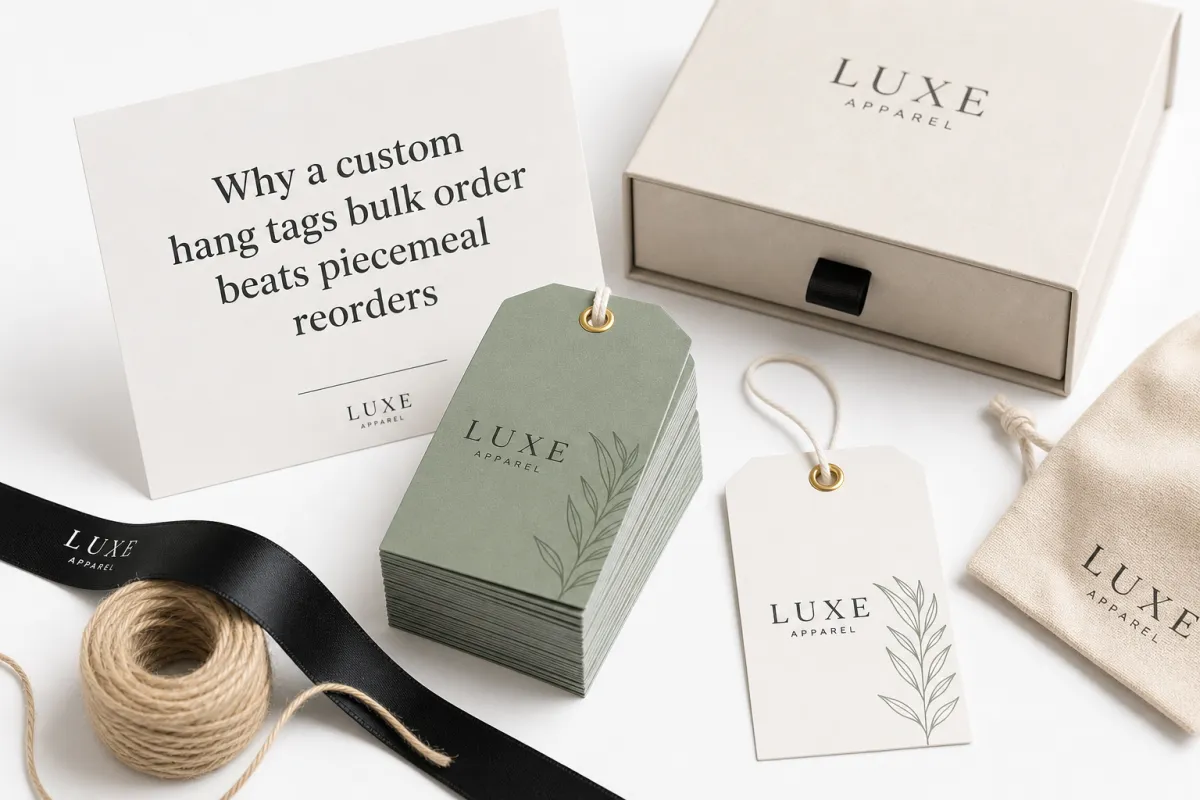
A piecemeal reorder can look cautious right up until the hidden costs show up. Small batches usually carry a higher unit price because setup time, short press runs, and extra handling get spread across fewer pieces. Then the next reorder comes from a different lot, the stock feels slightly different, and the brand starts drifting one tag at a time. That is how product packaging gets uneven without anyone noticing at first.
A Custom Hang Tags bulk order spreads setup costs across more units. Die cutting, art checks, plate creation, and finishing become easier to absorb per piece once the quantity rises. In practical terms, moving from 500 to 2,500 tags can cut unit cost sharply, while moving from 2,500 to 5,000 often trims it again, though the drop is never identical from one job to the next. Stock choice, print coverage, and finishing all shape the final number.
Bulk ordering also protects consistency. A brand launching several SKUs, one seasonal colorway, or a line of accessories that all need the same branded packaging benefits from one tag system that works across the family. Mixed reorders invite mismatched whites, slightly different trim sizes, and weaker shelf presence. Retail buyers notice that quickly. Consumers may not be able to name the issue, but they feel it.
Dead time matters too. A small reorder that lands late can stall fulfillment, delay packing, and hold up displays or retail packaging kits. That delay can cost more than the tags themselves. A Custom Hang Tags bulk order is less about volume than control when the launch window is tight. One approved spec. One production run. Fewer surprises. That's the whole point, really.
One mistake comes up often: ordering too few tags does not lower risk. It increases it. Extra freight, another proof round, and a second production slot that may not match the first run exactly all become part of the bill. That frustration hits hardest in fashion, gifts, and premium packaged goods, where the tag does more than hang. It becomes part of package branding and often gets noticed before the box does.
The lowest quote is not always the best value. The better tag is the one that does not need to be reprinted because the size was guessed instead of specified.
For brands that move quickly, a custom hang tags bulk order also makes inventory planning cleaner. Keep a steady reserve for core styles, then adjust only the details that vary, such as size, color code, or barcode. That is easier than chasing three tiny print runs and hoping every lot matches. Nobody needs that kind of guessing game, and honestly, it usually costs more than people think.
Custom hang tags bulk order product options that actually matter
Most buyers do not need every available upgrade. They need the right handful. A custom hang tags bulk order often starts with format: single-sided, double-sided, folded, shaped, or a multi-piece tag set. Single-sided tags work well for simple branding and pricing. Double-sided tags are a better fit when one side carries the logo and the other holds care instructions, story copy, or a barcode. Folded tags create more room without crowding the front.
Shaped tags help when the product needs stronger shelf personality. A rounded corner tag feels softer. A die-cut shape can support a fashion or gift brand that wants a more memorable display. Multi-piece tag sets make sense for premium products, especially when the brand wants a main tag plus an insert card, SKU card, or short story card. That approach shows up often in branded packaging and gift packaging, where the tag needs to do more than identify the item.
The most useful customization choices are usually the practical ones. Hole type matters because a clean 1/8-inch hole works for many apparel jobs, while a larger hole or reinforced hole is safer for thicker cord. Stringing options matter as well. Cotton cord feels natural. Elastic loop fasteners are quick. Satin ribbon looks elevated, though it can be more than low-margin goods need. Choose the option that fits the product, not just the mood board. A pretty sample that slows assembly is not pretty for long.
Finishes should support the design instead of burying it. Matte lamination keeps text readable and cuts glare. Gloss gives color more punch. Spot UV works when one detail should catch light without turning the whole tag into a billboard. Foil stamping adds impact, but too much foil starts to feel crowded quickly. Embossing and debossing create a tactile finish that suits premium retail packaging and higher-ticket products.
For category examples, think like this:
- Fashion - medium-sized double-sided tags with barcode space, size info, and a clean logo lockup.
- Jewelry - small shaped tags with a fine hole, light board, and room for SKU or metal details.
- Candles - tags that carry scent notes, burn warnings, and a brand story without crowding the front.
- Gifts - folded or multi-piece tags that support premium presentation and package branding.
- Premium packaged goods - heavier stock, foil or embossing, and a finish that matches the rest of the product packaging.
The best design is not the most decorated one. It is the one that makes the product easier to buy. A custom hang tags bulk order should help the shopper see the price, the promise, and the product category in two seconds or less. Anything beyond that has to earn its place. If it does not earn its place, cut it.
If the tag is supporting a wider branded packaging system, keep the look aligned with the rest of the line. A tag that feels disconnected from your Custom Packaging Products creates more work for the customer and less confidence in the brand. That is avoidable, and there is no reason to make the shopper do extra visual sorting.
One more practical point: a custom hang tags bulk order should not be overloaded with five different finishes just because they exist. Spot UV plus foil plus embossing plus a shaped die cut sounds exciting in a sales deck. On the production line, it can slow the job and raise waste. Keep the effects tight unless the margin can justify them. That is especially true on tighter retail programs, where every extra step has to pull its weight.
Materials, sizes, and specs for custom hang tags bulk order
Material choice changes the feel of the tag immediately. A custom hang tags bulk order can use kraft, coated paper, uncoated paper, premium card stock, recycled stock, or specialty paper, depending on the product and price point. Kraft works well for natural or handmade branding. Coated paper is cleaner for rich color. Uncoated paper gives a softer, less reflective look. Premium card stock is the safe middle ground for most retail jobs because it feels substantial without becoming wasteful.
Thickness matters more than some buyers expect. In common print terms, stock often falls in the 14pt to 24pt range. Apparel tags often sit around 16pt to 18pt. Premium goods may move up to 20pt or 24pt if the hanger system can support it. From a buyer’s point of view, thicker is not automatically better. If the tag hangs awkwardly or fights the garment, the material choice missed the mark.
Size matters just as much. Small tags around 1.5 x 2.5 inches fit jewelry or accessories. Mid-size tags around 2 x 3.5 inches are common for apparel and most retail packaging. Larger tags around 3 x 5 inches are useful when you need more storytelling, multiple languages, or a barcode area that stays readable. A custom hang tags bulk order should lock the dimension early because late size changes can shift the layout and alter print cost.
Several spec details need confirmation before quoting. Leave them vague and the quote will wobble. The better the spec sheet, the cleaner the price and the fewer corrections later.
- Print sides: single-sided or double-sided
- Color mode: full color, spot color, or a mix with Pantone targets
- Bleed: usually 0.125 inch on each side for trimmed art
- Hole diameter: often 1/8 inch, sometimes 3/16 inch for thicker cord
- Cord length: commonly 4 to 6 inches, depending on the product
- Finish: matte, gloss, soft-touch, foil, emboss, or spot UV
- Regulatory copy: fiber content, care instructions, safety text, or country of origin if needed
For sustainable stock options, some buyers ask for FSC-certified paper. That is a sensible request if the brand wants stronger sourcing claims and fewer questions from retail partners. If you need to verify material standards or sourcing language, the Forest Stewardship Council is the right place to start. It does not make a tag premium by itself, but it does make the claim clearer.
If the tag will be attached to goods that ship in larger packs, it helps to think about handling and transit during the spec review. The ISTA site is useful for understanding how packaging is tested for transport stress. Tags are small, yes. When they travel with product packaging or kit assembly, shipping conditions still matter because a crushed carton can bend more than just the box.
A custom hang tags bulk order should also include basic art file prep. Send artwork at 300 dpi or vector format, keep fonts outlined, and make sure the dieline is clear. If the tag has a hole near printed copy, leave enough safe space so nothing important disappears into the punch. That sounds obvious until a logo lands too close to the trim and the approved proof starts looking a little different from the finished piece.
Here is a simple pre-quote checklist that saves time and cuts back-and-forth:
- Exact dimensions, not "roughly business card size."
- Material preference with thickness if you know it.
- Print sides and color expectations.
- Hole size and placement.
- Finish choice, if any.
- Quantity by SKU, not just total quantity.
- Any compliance text, barcode needs, or care copy.
That last point matters. A custom hang tags bulk order can look simple until one SKU needs a barcode, another needs a warning line, and a third needs room for a price sticker. Plan for those details before production starts. It is much cheaper than rebuilding the layout after proof approval, and it usually saves everybody a small headache.
Custom hang tags bulk order pricing, MOQ, and unit cost
Pricing is where buyers usually focus first, and that makes sense. A custom hang tags bulk order has a few clear cost drivers: quantity, material, size, print complexity, finishing, packaging, and shipping. If any one of those changes, the quote changes with it. That is not a trick. It is just how print production works.
The MOQ question sometimes gets answered too loosely. Minimum order quantity depends on the stock, the finishing method, and whether the job needs a custom die cut. In many cases, bulk pricing starts at 250, 500, or 1,000 pieces, but the better unit cost usually shows up at a higher quantity. A 500-piece run works for testing. A 5,000-piece run is where the per-unit price often starts looking serious.
For a clean comparison, here is the kind of pricing spread many buyers see on a custom hang tags bulk order. Exact numbers depend on the art and finish, but these ranges are useful for planning.
| Quantity | Typical Stock | Unit Price Range | Best For | Notes |
|---|---|---|---|---|
| 250-500 | Standard card stock | $0.55-$1.20 | Sampling, limited runs, small launches | Setup costs have a big effect here. |
| 1,000 | Card stock or kraft | $0.28-$0.65 | Core SKUs, seasonal drops | Good balance of cost and flexibility. |
| 2,500 | Mid-weight premium board | $0.16-$0.38 | Retail-ready product lines | Often the first strong bulk break. |
| 5,000+ | Premium board or specialty stock | $0.09-$0.24 | Repeat programs, larger assortments | Best unit economics if the design is locked. |
Those numbers move quickly once you add foil, embossing, soft-touch lamination, or a shaped die cut. Specialty finishing can add roughly $0.03 to $0.25 per piece, depending on the process and the run size. Stringing is another small but real cost. If the tags arrive pre-attached, the labor savings can be worth it, especially for brands with lean fulfillment teams or a packaging line that is already busy enough.
A custom hang tags bulk order with simple full-color print on standard stock will almost always beat a decorated version on unit cost. That sounds obvious, yet buyers still compare quotes as if every tag should cost the same. It should not. A flat, uncoated, double-sided tag with one hole and no finish is not the same job as a foiled, embossed, shaped tag with ribbon stringing.
Another thing to watch is how the supplier handles proofs and revisions. Some quotes look low until you notice extra proof rounds, plate changes, or file cleanup are not included. A clean spec sheet cuts that mess down. It also speeds the quote. For a custom hang tags bulk order, speed and accuracy usually come from clarity, not from hoping the supplier reads your mind.
If you are comparing quote tiers, do not chase the lowest headline number only. Look at the total landed cost and the risk. A cheaper quote that needs a second approval, more freight, or a correction run is not cheaper. It is delayed pain. From a packaging buyer’s point of view, the best value is the one that lands on time and matches the approved proof.
One useful habit is to ask for at least two quantity tiers. For example, compare 1,000 against 2,500, or 2,500 against 5,000. That usually shows where the unit cost drops enough to justify a little extra inventory. In many categories, a custom hang tags bulk order pays off best when the brand buys a bit above immediate need and keeps a working reserve for reorders instead of doing emergency runs every other month.
If your supplier also supports Custom Labels & Tags and related retail items, you can sometimes consolidate similar jobs and save on setup. Not always, but often enough to ask. The same holds true if the brand uses the Wholesale Programs path for recurring launches. Repetition is where the savings tend to appear, and that is where print vendors get a little more efficient too.
Custom hang tags bulk order process, timeline, and production steps
A smooth custom hang tags bulk order usually follows the same path: inquiry, spec review, quote, artwork check, proof approval, production, finishing, packing, and shipping. The order is simple. The delays happen in the details. That is where timeline discipline matters more than enthusiasm.
Standard turnaround often lands around 10 to 15 business days after proof approval for straightforward jobs. Add foil, embossing, or custom shapes, and the schedule can stretch to 15 to 20 business days or more. Rush production may be possible for simpler tags, sometimes in 5 to 8 business days after approval, but that depends on the press schedule and the finish list. A custom hang tags bulk order with too many decorative steps is not a strong rush candidate. Physics still applies, and so does labor.
The biggest time sink is usually not the press itself. It is the back-and-forth before production starts. Unclear dimensions, missing logos, low-resolution artwork, and late revisions all eat lead time. If someone sends a rough idea and expects a finished proof an hour later, the clock is going to misbehave. Better to send the actual file set and the exact specs on day one.
Planning backward from the launch date is the best habit a buyer can build. Start with retail or inventory arrival, then subtract packing time, then transit, then production, then proof approval. That leaves a real ordering window. A custom hang tags bulk order should not be placed on wishful thinking. It should be scheduled like any other product packaging step, because once the launch date is moving, everything else starts to wobble.
Here is the usual production sequence in plain language:
- Specs review: confirm size, stock, finish, quantity, and hole details.
- Quote: price based on the exact job, not a guess.
- Artwork check: review layout, bleed, barcode legibility, and safe margins.
- Digital proof: approve the visual before anything goes to press.
- Production: print, cut, finish, and punch.
- Packing: count, bundle, and prepare for shipment.
- Delivery: arrive with enough buffer for assembly and launch.
For transit-sensitive programs, it helps to think beyond the tag itself. If the tags are part of broader retail packaging or bundled with custom printed boxes, the whole kit needs the same scheduling discipline. The tag should arrive when the rest of the materials arrive, not a week after the launch team starts improvising. That kind of mismatch creates avoidable labor, and it tends to snowball.
Rush fees can be worth paying when the alternative is missing a sell window, paying retail floor penalties, or holding labor while the team waits on printed materials. They are not worth paying just because a project sat on someone’s desk too long. There is a difference, and the invoice will remind you which one it was.
A custom hang tags bulk order also benefits from sample discipline. A digital proof is useful for layout, but a physical sample is better for feel, stock weight, and finish behavior. Screen color lies a little. Paper does not. If the tag will support a premium product, sample approval is cheap insurance and usually easier than explaining a color shift later.
Why choose us for custom hang tags bulk order
People do not shop for tags because they are emotionally attached to paper. They shop because a job needs to be done correctly. A custom hang tags bulk order should come with straight answers, predictable print quality, and delivery that matches the approved proof. That is the baseline. Anything less creates work for your team.
At Custom Logo Things, the useful part is not the sales pitch. It is the support around the order. Spec guidance matters when a buyer is choosing between kraft, coated, or premium stock. File checks matter when artwork is being prepared by a small internal team or a designer who has not built hang tags before. A clear quote matters because nobody wants surprise fees hiding in the last line.
Consistency matters too. A custom hang tags bulk order often has to match previous runs, future runs, and sometimes sibling items in the same line. That means color control, trim accuracy, and finish repeatability are not extras. They are the job. If the proof says one thing and the cartons deliver another, the supplier failed. Plain and simple.
Support for reorders is another real advantage. When a brand is moving through product packaging updates, the cleaner the reorder path, the less time gets wasted re-explaining specs. Keep the approved dimensions, hole placement, stock choice, and finishing notes on file. That makes future custom hang tags bulk order requests easier and less expensive to handle, which is handy when a line keeps growing in small steps.
Flexible material choices help as well. Some brands want recycled stock. Some want a soft-touch finish. Some need a tag that sits comfortably next to other branded packaging elements without looking heavy. Others need the tag to match a line of custom printed boxes. The supplier should know how to keep those details aligned instead of pretending every job fits one template. There is no prize for forcing everything into the same spec.
If you are building a broader merchandise program, it helps to treat tags as part of the system, not a side note. The same team that handles tags can often help coordinate related retail packaging items, which keeps the presentation cleaner. That does not mean every project has to be bundled. It means the brand has one place to keep the visual language steady.
For recurring buyers, custom hang tags bulk order production should feel boring in the best way. Same specs. Same proof logic. Same delivery expectation. The more boring it is, the fewer surprises you get. And honestly, boring print production is what good supply chains look like. It is not glamorous, but it works.
If you need a broader reference point for materials or support paths, our Custom Packaging Products range and Wholesale Programs page are useful starting points. If you need common answers fast, the FAQ page can cover the basics before you send a quote request. That saves time on both sides and keeps the first round of questions focused.
Next steps for your custom hang tags bulk order
The easiest way to keep a custom hang tags bulk order on track is to gather the essentials before you ask for pricing. Quantity, dimensions, material preference, print sides, finish, and deadline. If you have brand rules, send those too. The quote will be more accurate, and the proof will need less fixing.
Send the artwork in the cleanest format you have. Editable files are best. If not, high-resolution exports can still work if the text is readable and the colors are set honestly. A custom hang tags bulk order is not the place for fuzzy logos or a file named "final-final-use-this-one." Nobody trusts that file name, and they should not. I wish that was a joke, but it happens more often than it should.
Compare at least two quantity tiers before locking the job. That gives you a better view of where the unit cost improves. In many cases, the slightly larger run is the smarter buy if the tags support a steady product line. If the launch is short-lived, keep the order tighter. There is no virtue in sitting on dead inventory.
Approve a digital proof or a sample before production starts, especially for premium retail, seasonal drops, or multi-SKU launches. The cost of one correction is usually lower than the cost of a second print run. A custom hang tags bulk order should be treated like any other branded packaging investment: verify first, then run. That habit saves money and keeps the timeline from turning into a headache.
So the short version is this: spec it, quote it, approve it, schedule it. A clean custom hang tags bulk order does not happen by accident. It happens because the buyer made the right calls early, kept the design disciplined, and gave production a usable brief. Do that, and the tags stop being a problem and start doing what they were supposed to do from the beginning.
FAQ
What is the minimum quantity for a custom hang tags bulk order?
MOQ depends on the material, print method, and finishing, but bulk pricing usually starts once the run is large enough to spread setup costs. For many jobs, that means 250, 500, or 1,000 pieces. Ask for multiple tiers so you can see where the unit cost drops without buying more inventory than you can use.
How much do custom hang tags bulk order prices change by material?
Kraft and standard card stock are usually the most budget-friendly, while thicker premium board and specialty papers cost more. Finishes like foil, embossing, and spot UV add price because they create extra production steps. If you need a cleaner retail look, budget for the finish instead of pretending it is free.
How long does a custom hang tags bulk order usually take?
Standard production often lands in the 10 to 15 business day range after proof approval, but quantity and finishing can stretch that. The biggest variable is usually file readiness and how fast you approve the proof. Rush timelines are possible on simpler jobs, while complex die cuts and specialty finishes need more time.
Can I get a sample before placing a large custom hang tags bulk order?
Yes, and for premium retail work, that is the sensible move. Paper feel and print color are hard to judge on a screen. A sample or proof helps confirm size, hole placement, finish, and overall look before you commit to the full run.
What files do I need for a custom hang tags bulk order quote?
Send your logo, desired dimensions, quantity, material preference, and any copy that must appear on the tag. If you already have artwork, include editable files or high-resolution exports so the quote and proof are accurate from the start. The cleaner the file, the fewer delays you will have.

