Buyer Fit Snapshot
| Best fit | Custom Hang Tags with Custom Sizes projects where brand print, material claims, artwork control, MOQ, and repeat-order consistency need to be specified before quoting. |
|---|---|
| Quote inputs | Share finished size, material target, print colors, finish, packing count, annual reorder estimate, ship-to region, and any compliance wording. |
| Proofing check | Approve dieline scale, logo placement, barcode or warning zones, color tolerance, closure strength, and carton packing before bulk production. |
| Main risk | Vague material claims, crowded artwork, missing packing details, or unclear freight terms can make a low unit price expensive after revisions. |
Fast answer: Custom Hang Tags with Custom Sizes: Quote Scope, Sample Proof, MOQ, and Lead Time should be specified like a repeatable production item. The safest quote records material, print method, finish, artwork proof, packing count, and reorder notes in one written spec.
Production checks before approval
Compare the actual filled-product size with the drawing, then confirm tolerance on folds, seals, hang holes, label areas, and retail display edges. Reserve space for logos, QR codes, warning copy, and material claims before decorative graphics fill the panel.
Quote comparison points
Review material grade, print process, finish, sampling route, tooling charges, carton quantity, and freight assumptions side by side. A quote is only useful when the supplier can repeat the same color, closure quality, and packing count on the next order.
Custom Hang Tags with Custom Sizes: A Practical Guide
Custom Hang Tags with custom sizes do one thing better than most stock formats: they make the product feel considered before the customer even touches it. A tag that is a little too wide, or just a hair too tall, can throw off the balance of a garment, a pouch, or a boxed item. Get the proportions right, though, and the whole presentation feels settled, deliberate, and honestly a bit more expensive than the raw materials would suggest.
That difference is easy to miss on a screen and hard to miss in hand. Custom Hang Tags with custom sizes affect layout, readability, hole placement, finishing choices, and the way a product photographs for ecommerce or retail. For anyone managing packaging, the point is not perfection for its own sake. The point is to make the tag support the product without wasting paper, space, or money.
Apparel is the obvious use case, but the format reaches further than that. Accessories, gift items, subscription products, specialty retail goods, and branded kits all benefit from a tag that fits the design instead of forcing the design to fit a stock shape. Custom hang tags with custom sizes can carry logos, pricing, barcodes, care details, QR codes, and short brand messages, all while keeping the package system consistent.
Why custom hang tags with custom sizes stand out
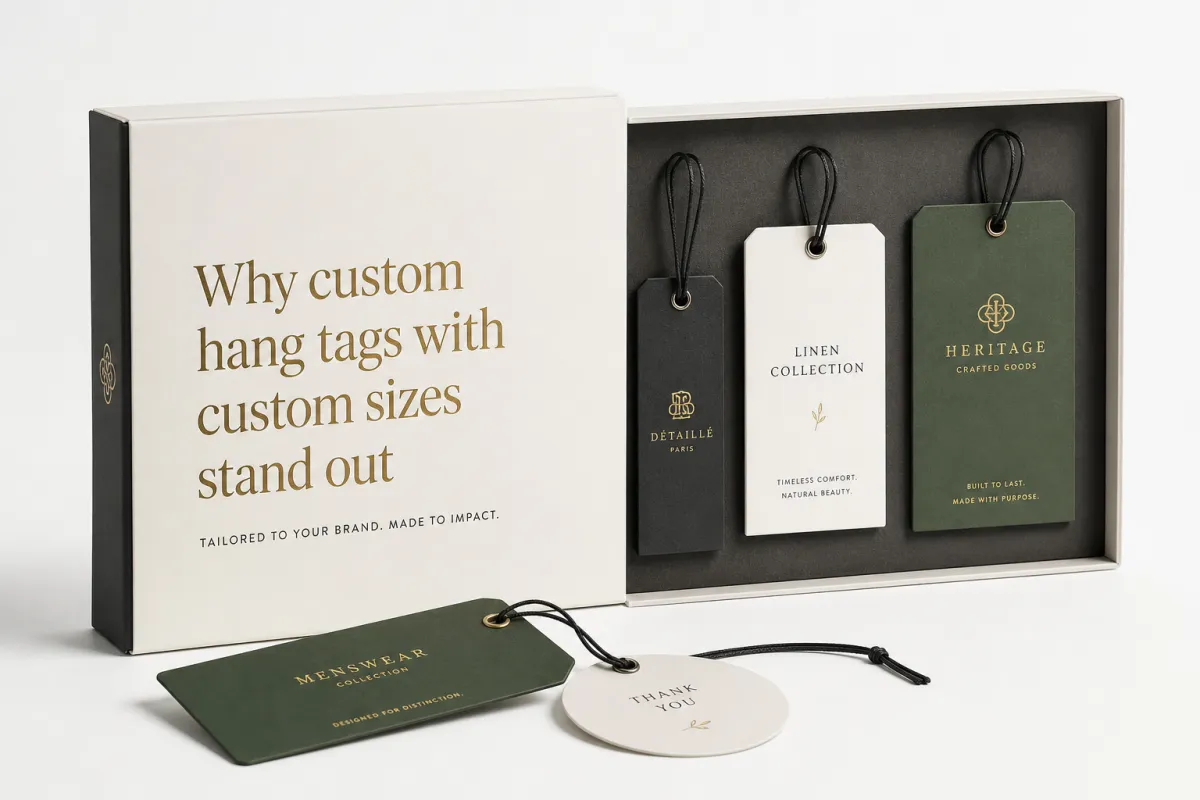
Standard tag sizes have a real advantage: they are easy to quote, easy to cut, and easy to reorder. That simplicity comes with a tradeoff. Standard sizes make your content behave according to the tag, not the other way around. Short copy leaves awkward blank space. Long copy pushes the layout into cramped territory. Custom hang tags with custom sizes solve that tension by matching the tag to the actual content and product.
In production terms, custom sizing means the flat finished size of the tag, plus the practical limits around it. Bleed, trim tolerance, safe area, hole placement, corner shape, and any fold all need to be accounted for before artwork is finalized. A tag that looks clean in a design file can still fail if the barcode sits too close to the edge or the hole cuts into the visual center. That is why custom hang tags with custom sizes are a manufacturing choice as much as a design choice.
These tags matter most in places where presentation does real selling work. Apparel leads the pack, yet jewelry cards, boutique packaging, luxury packaging, ecommerce inserts, and custom printed boxes all depend on the same discipline. Too large, and the tag overwhelms the item. Too small, and it looks like an afterthought. Either problem weakens the brand impression.
The tradeoff is straightforward. Standard sizes are fast and economical to set up. Custom hang tags with custom sizes usually give better proportion and better use of space, though they can add setup time and, on short runs, some extra cost. That is still a sensible investment when the tag needs to fit a specific brand tone, carry compliance information, or sit neatly beside the product without fighting for attention.
"A tag that is one-quarter inch too wide does not look slightly off. It looks like someone guessed."
That is the part people tend to overlook. Buyers do not measure the tag in their heads. They simply sense whether the product presentation feels organized. Custom hang tags with custom sizes help create that feeling, which is why they show up so often in retail packaging, premium product packaging, and polished branded packaging programs.
Thinking in systems helps. A tag often works with labels, cartons, inserts, and shipping presentation, so it makes sense to evaluate Custom Labels & Tags and broader Custom Packaging Products together rather than treating each piece as a separate decision.
Used well, custom hang tags with custom sizes make the entire item feel more deliberate. Used poorly, they become the thing people notice for the wrong reason. The margin for error is small, which is exactly why the sizing conversation deserves real attention.
How custom hang tags with custom sizes move from brief to delivery: process and timeline
The production path is familiar, but a few details can slow it down if they are not defined early. Custom hang tags with custom sizes usually move through the same sequence: brief, dieline, artwork setup, proofing, approval, print, finishing, inspection, and packing. The difference between a smooth run and a frustrating one is how clearly each step is specified.
Everything starts with the size brief. A useful brief includes the final dimensions, stock choice, print sides, finish, hole size and placement, attachment method, and quantity. If the tag needs to sit against a collar, a hang loop, a retail peg, or a folded garment, say so from the start. If it needs a barcode or variable data, that belongs in the brief too. Custom hang tags with custom sizes are far easier to quote accurately when the spec is complete instead of pieced together later.
Then comes the dieline. This is where the real shape gets locked in. Rounded corners, a custom silhouette, a perforated tear-off section, or a folded format all require a die line before artwork is finalized. Finishing choices can affect the layout as well. Foil, embossing, spot UV, soft-touch lamination, and thick board all change where text can safely sit and how the tag feels in hand.
Timeline usually follows complexity. Simple digital orders can often move in about 5-10 business days after proof approval. Once Custom Die Cutting, foil, embossing, multiple proof revisions, or hand stringing enter the job, the schedule stretches. That is not a problem by itself. It is just how production works.
If sustainability matters, bring it up early. FSC-certified paper is a strong choice for many custom hang tags with custom sizes, especially when the rest of the packaging is trying to support a cleaner brand story. For broader distribution and transit considerations, industry references like FSC and ISTA are useful markers, even when the tag itself is small.
The fastest way to move a project forward is to send the printer the information it actually needs. These details save time:
- Final dimensions in inches or millimeters.
- Exact quantity, not a range.
- Stock thickness or paper grade.
- Single-sided or double-sided print.
- Hole size, placement, and whether stringing is needed.
- Barcode or QR code requirements.
- Proof deadline and delivery deadline.
The biggest scheduling mistake is setting a launch date before the proof is approved. That is usually where delays begin, because any change after approval can trigger new setup, new trimming, or another proof round. Custom hang tags with custom sizes are manageable, yet they become less forgiving once the job leaves the screen and enters production.
One more practical point matters when the tag is part of a larger package system. If the job includes custom printed boxes or a retail kit, treat everything as one schedule rather than separate timelines. The box may be ready sooner, or the tag may need an extra finishing pass. If the launch depends on both pieces, plan around the slower one.
Custom hang tags with custom sizes: cost, pricing, MOQ, and quote factors
Pricing comes down to the spec. Custom hang tags with custom sizes can be economical on a clean digital run, or notably more expensive when the job calls for specialty finishes, thick board, or hand assembly. Size affects cost in more than one way. Larger tags use more material. Smaller tags can still cost more if they need tighter cutting tolerances or extra finishing precision.
Here are the main price drivers:
- Dimensions: larger surface area means more substrate and often more press time.
- Stock: 14pt artboard costs less than thick premium board or textured stock.
- Print sides: one side is cheaper than two, especially on short runs.
- Finish: matte coating is usually lighter on cost than foil, embossing, or soft-touch lamination.
- Die complexity: a simple rectangle is cheaper than a custom silhouette.
- Punching and stringing: these add labor, even when they seem minor.
- Proofing and revisions: extra rounds can add time and setup expense.
MOQ expectations vary by printer and process. For small, simple custom hang tags with custom sizes, runs may start around 250-500 units. Common commercial orders often sit at 1,000 units or more, and premium finishing can raise the practical minimum. That is not a sales trick. It is how setup spreads across the run.
| Option | Typical Use | Setup Complexity | Typical Unit Cost | Tradeoff |
|---|---|---|---|---|
| Standard rectangle | Basic apparel, promotional items | Low | $0.07-$0.18 at 1,000-5,000 pcs | Fast and efficient, but less distinctive |
| Simple custom size | Retail packaging, boutique goods, ecommerce inserts | Medium | $0.09-$0.28 at 500-5,000 pcs | Better fit and layout, slightly more setup |
| Complex die-cut or premium finish | Luxury packaging, high-end package branding | High | $0.25-$0.80+ depending on finish | Stronger shelf presence, longer lead time |
That table is a useful snapshot, not a universal price sheet. A short run of custom hang tags with custom sizes may cost more per piece than a larger standard order, but the better question is whether the tag prevents the design from looking cramped or unfinished. If it does, the higher unit price can still be the smarter choice.
Comparing quotes takes discipline. Ask for the same variables on every quote: same size, same stock, same print sides, same finish, same attachment method, same proofing expectations, and the same shipping terms. Anything less is not a comparison. It is a guessing contest with a spreadsheet attached.
Hidden costs deserve attention too. Rush fees, artwork changes, special packaging, split shipments, and barcode prep can move a low quote into a much higher total. That is especially true for custom hang tags with custom sizes, because custom cutting and setup can look inexpensive until the job is ready to run.
From a budgeting angle, it helps to leave room for corrections. If the first proof shows that the hole sits too close to the logo or the layout needs more breathing room, you will want the flexibility to adjust without scrambling the rest of the launch plan.
How to choose the right size for custom hang tags with custom sizes
Start with the content, not the mood board. If the tag only needs a logo and a short brand line, custom hang tags with custom sizes can stay compact. If the tag also needs care instructions, pricing, a barcode, a QR code, and legal text, the footprint grows quickly. Words take space. Barcodes take space. Quiet zones around barcodes take even more space.
The product itself comes next. Jewelry tags do not need the same proportions as apparel tags. Bags, scarves, beauty items, and premium stationery each ask for a different visual balance. A narrow tag on a slim product can look elegant. The same narrow tag on a bulky item can vanish. Good packaging design respects proportion instead of asking the product to compensate.
Production limits matter as well. Minimum font size has a limit. Hole clearance above the top edge needs breathing room. Safe margins around trim need to stay intact. If the layout includes a barcode, the quiet zone must remain clean and the contrast must be strong enough to scan consistently. Custom hang tags with custom sizes often fail for ordinary reasons: text too small, hole too low, or content too near the edge.
Sometimes shape matters more than size. A square tag can feel modern. Rounded corners can soften a bold layout. A shaped die cut can echo the product line. Size is one tool, not the only tool. If the brand is aiming for a refined look, a custom size alone may not be enough. Shape and finish matter too.
The method that saves the most time is simple: print a real-size mockup on plain paper, cut it out, and hold it against the product. Tape it on. Hang it. Step back. If it overwhelms the item, shrink it. If it feels timid, grow it. That five-minute check saves more money than most people expect, especially on custom hang tags with custom sizes ordered in volume.
For a stronger overall presentation, treat the tag as part of the full package system. The stock, finish, and typography should not fight the carton, label, or insert. If the line also uses branded packaging or a premium outer shipper, the tag should feel like it belongs to the same family. Consistency is what makes the whole program look thoughtful instead of patched together.
Step-by-step: ordering custom hang tags with custom sizes
Ordering goes faster when the process is treated like a spec exercise instead of a casual conversation. Custom hang tags with custom sizes move more cleanly when the printer gets one clear brief and one complete file package.
- Write the spec sheet. List dimensions, quantity, stock, finish, print sides, punch location, attachment method, and deadline. If the tag needs to coordinate with retail packaging or ecommerce inserts, include that too.
- Build the artwork on the dieline. Use the correct trim size, add bleed, and keep text inside the safe zone. Vector logos help. Low-resolution logos do not.
- Review the proof carefully. Check the exact cut size, hole position, color targets, barcode readability, and any finishing notes. On custom hang tags with custom sizes, a small shift can change the whole layout.
- Approve only after the details match. If the proof is wrong, fix it before approval. After approval, changes usually cost time and money.
- Inspect the first output. If you receive a sample or the full run, check trim consistency, punch alignment, color balance, and finish quality before the tags go into use.
That process sounds basic because it is basic. The problem is that people skip steps. They guess on size. They approve a proof with one thing still off. Then they wonder why the shipment does not match the expectation. Custom hang tags with custom sizes reward discipline and punish casual approvals. Printing has a way of doing that.
Before requesting quotes, gather the files and details a supplier will actually need. If you want to compare options on tag stock, finishes, or related product packaging pieces, the category pages for Custom Labels & Tags and Custom Packaging Products are a better starting point than trying to build a spec from memory.
If the job is for a premium line, do not treat the proof like a formality. Look at it the way a buyer would see it in a store. Is the tag too big for the product? Does the hole interrupt the brand mark? Does the finish make the piece feel higher end, or just shinier? Custom hang tags with custom sizes should answer those questions in a way that supports the sale.
One more practical move helps on repeat orders: keep a record of what worked. Save the dimensions, board, finish, punch placement, and actual turnaround. The next order will be cleaner, faster, and less stressful. That is how a decent tag program becomes a dependable one.
Common mistakes with custom hang tags with custom sizes
The first mistake is guessing. People eyeball the size on a screen and assume it will work in the hand. It rarely does. A product that looks fine next to a digital mockup can feel crowded or undersized once the tag is attached. Custom hang tags with custom sizes need physical context, not optimism.
Another common miss is designing right to the edge. No bleed. No safe area. No margin. That is how logos get clipped, fine print gets trimmed off, and barcodes lose scan quality. Print files need room to breathe because trim is never perfect down to the last pixel. Anyone who promises otherwise is selling fantasy with a glossy finish.
Material changes can catch buyers off guard too. Thick stock, foil, soft-touch coating, and lamination all affect how a tag cuts, folds, and punches. A layout that looks clean on uncoated board may shift once a finish is added. Custom hang tags with custom sizes work best when the finish is planned early, not added at the end because it sounded nice in the meeting.
Screen mockups can mislead. That is not a flaw in the software; it is just how screens work. A layout that feels balanced on a monitor may print as too small, too large, or too dense. This matters even more in package branding systems where the tag sits beside custom printed boxes, labels, or inserts. All of those pieces need to agree on proportion, or the line begins to look uneven.
Compliance gets overlooked too often. Barcode placement, UPC quiet zones, pricing rules, and required copy all need to be checked before the press run starts. If you work in retail packaging, there may also be internal brand rules about logotype size, product copy, or placement. The tag is not the place to discover those rules by accident.
Here is a clean way to avoid the usual mess:
- Measure the actual product, not the idea of the product.
- Mock up the tag at full size.
- Check barcode and text clearances.
- Confirm finish and stock before proof approval.
- Keep the same spec for every supplier quote.
If you do those five things, custom hang tags with custom sizes become much easier to manage. Skip them, and you will spend time fixing problems that were easy to predict from the start.
The worst mistakes are the avoidable ones. The tag was almost right. The hole was almost in the right place. The copy was almost readable. "Almost" is expensive in printing. Better to make the call early and make it deliberately.
Next steps for custom hang tags with custom sizes
The next move is simple: build a one-page spec sheet and use it to request quotes. Custom hang tags with custom sizes are easiest to buy when the vendor receives the same brief you would hand to an internal packaging team. That means dimensions, quantity, stock, finish, print sides, punch details, attachment method, barcode needs, and delivery date all in one place.
If the size is new, ask for a dieline and proof before committing to a full run. If the line is high value, begin with a short sample order so you can see how the tag behaves in the real world. That is especially smart for apparel, accessories, and luxury packaging, where the tag does real selling work and the margin for error is low.
Compare at least two or three suppliers using the same specs. Not rough ideas. Same specs. That is the only way to tell whether one quote is truly better or simply missing a finish, a punch, or freight. A low number without the details is just a tease.
If the tag feels too large, adjust in small increments rather than redesigning the whole thing. A quarter inch can be enough. Sometimes the layout just needs more air. Other times the hole needs to move, not the tag size. Custom hang tags with custom sizes give you that flexibility, which is exactly why they deserve the extra thought.
The strongest results happen when the tag, the product, and the budget all line up. Not one of them. All of them. That is the real job. Get custom hang tags with custom sizes right and they support the sale, reinforce the brand, and sit neatly inside the rest of the packaging system without becoming the center of attention.
My practical takeaway: lock the content first, print a full-size paper mockup, and only then settle the dieline and finish. That sequence catches the problems that screens hide, and it keeps custom hang tags with custom sizes from turning into a last-minute fix.
What are custom hang tags with custom sizes used for?
They let the tag fit the product instead of forcing the product to fit a generic label size. They are useful when you need room for branding, pricing, care instructions, QR codes, or barcodes, and they also help the product look more intentional on shelf or in photos.
How do I choose the right size for custom hang tags with custom sizes?
Start by listing everything the tag must carry, then size the layout around that content. Measure the actual product and hanger space, then leave room for safe margins and the punch hole. Mock it up at real scale before ordering, because eyeballing it on a screen is how people get burned.
Are custom hang tags with custom sizes more expensive than standard sizes?
Often yes, because custom cutting or setup can add cost, especially on small runs. Sometimes the total job cost is still worth it because the tag prints cleaner and wastes less space. The real comparison is unit cost plus setup, not just the sticker price on the first quote.
What is the typical turnaround for custom hang tags with custom sizes?
Simple orders can move in roughly 5-10 business days after proof approval. Specialty finishes, complex die cuts, or multiple revision rounds usually push the schedule longer, and shipping time matters too, so do not treat production time and delivery time as the same thing.
What do I need for a quote on custom hang tags with custom sizes?
Provide final dimensions, quantity, stock, finish, print sides, and hole or stringing details. Include artwork files, barcode requirements, and the delivery deadline so the quote is actually usable. The more exact the spec, the less back-and-forth you will get, and the easier it is to get custom hang tags with custom sizes that fit the product, the message, and the budget without drama.

