Custom Heart Stickers: Design, Order, and Price Tips
A heart shape does some work before anyone reads the copy. It signals care, gifting, appreciation, romance, celebration, handmade value, or seasonal warmth in a fraction of a second. That is why custom heart stickers keep turning up on tissue seals, bakery boxes, candle labels, florist wraps, subscription mailers, boutique shopping bags, nonprofit mailers, event favors, and thank-you inserts.
The shape is the easy part. The harder question is whether the sticker will stick to the right surface, survive handling, print cleanly at the chosen size, and arrive in a format your packing team can use without losing speed. A pretty proof does not guarantee a good label.
What Custom Heart Stickers Are Really Used For
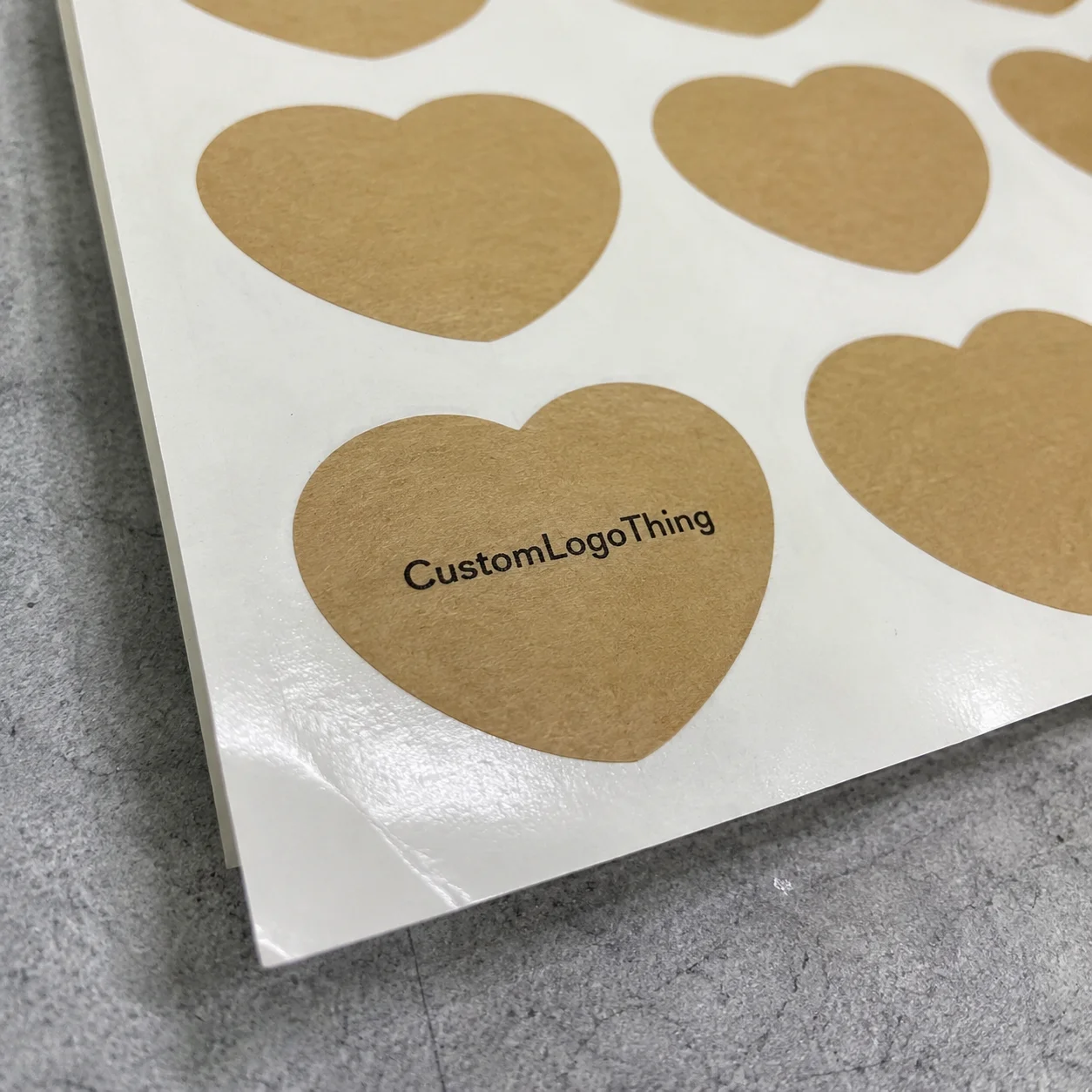
Heart stickers can be decorative, functional, or both. A 1.5-inch heart can close tissue paper inside a mailer. A 3-inch heart on a bakery box can carry a logo, flavor note, or seasonal message. On a paper shopping bag, the same shape can act as a branded closure and make an ordinary purchase feel more gift-ready.
Many buyers treat the heart as decoration. In actual packaging work, it often has a job: identifying a candle scent, sealing a glassine bag, marking a limited-edition flavor, dressing up plain corrugated, or adding a handwritten-style thank-you message without redesigning the main carton.
There are several formats worth separating before you request pricing. Heart-shaped stickers are cut to the outer heart shape. Heart artwork on standard shapes uses a circle, square, or rectangle as the sticker shape, which gives more layout room and may cost less. Kiss-cut heart decals stay on a backing sheet so the user peels away only the heart. Roll labels are wound on a core for quick hand application or dispenser use. Sheet stickers keep multiple pieces organized on flat sheets. Individually cut stickers are loose singles, usually better for giveaways, inserts, and resale packs.
The right choice depends less on the mood board and more on the job: surface type, moisture exposure, application speed, artwork detail, quantity, and how the package will be handled after labeling. A heart label going on cold kombucha bottles needs a different material than one sealing dry tissue inside Custom Printed Boxes.
How Heart-Shaped Sticker Production Steps Work
After a quote request and artwork submission, production usually starts with file review. A prepress team checks size, resolution, color mode, fonts, bleed, safe area, and the cut line. For small hearts, that review matters more than buyers expect. The top notch, curved shoulders, and bottom point leave less usable space than a circle or rectangle with the same outside measurement.
Vector files such as AI, EPS, or editable PDF are preferred because logos, text, and cut paths stay sharp. High-resolution raster files can work, usually at 300 dpi at final print size, but they are less forgiving when the artwork includes tiny type, thin outlines, soft edges, or detailed illustrations. A practical bleed allowance is often 0.0625 to 0.125 inch beyond the cut line, with essential text and logos kept another 0.0625 to 0.125 inch inside the trim area.
Production callout: A perfect-looking heart on screen can still print poorly if the border sits too close to the cut path. Small cut variation is normal in converting, so the design needs breathing room.
Digital printing is common for flexible quantities, short runs, seasonal artwork, and versioned designs. It avoids plates and can be efficient for orders of 250, 500, or 1,000 pieces. Flexographic roll label production tends to make more sense for larger runs, repeat orders, and machine application, especially when the order uses consistent materials, a defined roll unwind direction, and a larger total quantity.
Finishing changes both appearance and performance. Gloss laminate makes colors pop and adds scuff resistance. Matte laminate reduces glare and gives a quieter retail look. Soft-touch film feels velvety, though it can show oils from fingers more readily. Foil adds shine for gifting or premium packaging. Clear material with white ink can create a printed-on-glass effect for jars, candles, and PET bottles. Waterproof film with the right adhesive helps in bath, beverage, and refrigerated uses.
Then the stickers are cut, inspected, packed, and shipped. Die cutting cuts the full shape through the sticker and backing. Kiss cutting cuts the face stock while leaving the liner intact. The heart’s curves and center notch need clean geometry; rough paths can create tiny points that lift, tear, or look uneven during stripping and application.
Choosing Materials, Adhesives, and Finishes That Fit the Job
Material selection is where a cute sticker becomes reliable packaging, or a complaint waiting to happen. Paper stickers are cost-effective, easy to print, and excellent for dry indoor uses such as tissue seals, paper bags, note cards, and bakery boxes that will not see condensation. White BOPP is a film material with better moisture resistance, common on jars, bottles, cosmetics, and food packaging. Clear BOPP works well for a no-label look, especially when white ink sits under logos or pale colors.
Vinyl is thicker and more durable, often used for outdoor decals, laptops, water bottles, and giveaway stickers that need abrasion resistance. Textured stocks feel premium but can soften fine detail. Kraft paper creates handmade warmth, though ink prints darker on brown stock and may need extra contrast. Metallic films bring shine, but they can overpower small artwork if the design lacks structure.
| Material or Finish | Best Fit | Watch-Out | Typical Use Case |
|---|---|---|---|
| Paper with gloss or matte coating | Dry indoor packaging | Can wrinkle or stain with moisture or oil | Tissue seals, envelopes, bakery boxes |
| White BOPP film | Moisture-resistant product labels | Costs more than basic paper | Jars, bottles, beauty products |
| Clear BOPP with white ink | Printed-on appearance | Needs white backup under light colors | Glass candles, PET bottles, clear pouches |
| Kraft paper | Natural or handmade branding | Colors print muted | Coffee bags, soap wraps, florist packaging |
| Foil or metallic film | Gift and premium retail packaging | Fine type can lose clarity if overused | Holiday sets, luxury inserts, event favors |
Adhesive choice deserves the same attention as face stock. Permanent adhesive is the default for packaging seals and retail labels. Removable adhesive fits temporary promotions, price marking, and surfaces where residue would create a problem. Freezer-grade adhesive is made for cold storage and low-temperature application. Stronger adhesives may be needed for textured paper, curved jars, recycled corrugated, or compostable films with lower surface energy.
Surface compatibility should be tested whenever the package is unusual. Glass jars, PET bottles, coated folding cartons, tissue paper, bakery boxes, corrugated mailers, and paper shopping bags all behave differently. Compostable and recycled substrates can be especially unpredictable because coatings, fibers, and surface dust vary by batch. Standards from groups such as ISTA are useful for thinking about shipping stresses, while sourcing standards from FSC may matter if the broader packaging system uses certified paperboard.
Durability is not one trait. It is moisture, oil, refrigeration, abrasion, sunlight, shipping friction, and hand application all colliding with the same little label. Beauty brands should think about oils and wet hands. Beverage brands need condensation resistance. Food brands need storage temperature and possible grease exposure reviewed early. Retail teams need to know whether employees will apply 50 stickers a day or 500 an hour.
Custom Heart Sticker Pricing, MOQ, and Unit Cost Factors
Custom heart sticker pricing moves with size, material, adhesive, print coverage, finish, cut style, quantity, roll versus sheet format, and the number of artwork versions. A 1.5-inch paper heart on rolls is not the same production job as a 3-inch clear film heart with white ink, foil, laminate, and individual cutting.
As a broad planning range, simple digitally printed paper or film hearts may land around $0.08 to $0.35 per piece at a few thousand units, depending on size and finish. Short runs of 100 to 250 pieces can be much higher per sticker because proofing, setup, file handling, and packing time are spread across fewer pieces. Larger roll label orders may move below that range, especially when the design is simple and the material is common. Treat these as planning numbers, not a final quote.
Higher quantities usually lower unit cost. Setup, proofing, plate or die preparation, material waste, machine makeready, and operator time do not rise evenly with every sticker. If 500 pieces cost $0.42 each, 5,000 pieces might fall near $0.12 to $0.20 each for a similar specification. Specialty materials, foil, or individual cutting can hold the price above that range.
Minimum order quantity depends on the production route. Digital print may allow low quantities for testing, events, influencer mailers, or seasonal campaigns. Flexographic labels, foil stamping, specialty films, and custom dies often require higher minimums because the setup is more involved. Some suppliers use a minimum order value instead of a fixed sticker count.
Hidden costs usually come from complexity. Tiny cut details may require slower converting. Hairline borders can increase waste during quality checks. Foil, specialty film, white ink, individual cutting, expedited production, split shipments, oversized rolls, and multiple SKUs can all change the final number. If the order has five scent versions, ask whether they can be combined efficiently or quoted as separate runs.
For a cleaner quote, provide the sticker size, quantity, material preference, application surface, indoor or outdoor exposure, roll or sheet format, artwork files, deadline, and shipping location. If the sticker supports a larger branded packaging project, it also helps to share related components such as mailers, inserts, labels, or Custom Labels & Tags so the look stays consistent.
Design Choices That Make Heart Stickers Print Cleanly
The heart shape affects layout more than many designers expect. The top notch steals room from centered logos. The curved shoulders can crowd longer words. The narrow bottom point leaves almost no useful space for small text, QR codes, or legal copy. A design that fits comfortably inside a 2-inch circle may feel tight inside a 2-inch heart.
Keep essential artwork inside the safe area and let background color or pattern bleed beyond the cut line. Strong contrast helps, especially on small stickers viewed at arm’s length. Hairline borders can look elegant in a proof, but if the cut shifts even 1/32 inch, the border may look uneven. If you want a border, make it thick enough to tolerate normal converting variation or use an irregular border style that looks intentional.
Size decisions should start with the package. A 1-inch heart can work as an envelope closure. A 1.5- to 2-inch heart is common for tissue paper, small boxes, and hang tags. A 2.5- to 3.5-inch heart gives more room for logos, short phrases, and product messages on jars, candle boxes, bakery cartons, and retail bags. Larger decals can work for events or giveaways, but they may feel oversized on small product packaging.
Typography needs discipline. Short phrases print better: “Made with Love,” “Thank You,” “Fresh Baked,” or a two-word scent name. Heavier font weights usually hold better than thin scripts. If a brand mark already has detail, do not surround it with a long tagline, social handle, QR code, and border inside the same small heart. The sticker needs air.
Color planning matters too. Soft pastel hearts feel gentle and giftable. Red, pink, black, and white palettes read more seasonal or Valentine-specific. White ink on clear material is often needed so pale logos do not disappear on glass or dark product contents. Kraft stock mutes color. Metallic stock can shift color warmth. For close brand color matching, ask about Pantone references, digital tolerance, and whether a press proof or production sample is available.
Step-by-Step Guide to Ordering Heart Stickers
Start with the use case. Are the stickers sealing tissue, labeling a jar, closing an envelope, dressing up an event favor, going into a retail giveaway pack, or acting as a promotional insert? That answer controls the material, adhesive, size, and format more than the artwork does.
- Measure the application area. Check the exact spot on the box, bag, bottle, wrap, or mailer. Leave clearance around seams, barcodes, ingredients, handles, tear strips, and opening tabs.
- Choose the size. Print a paper mockup at actual scale and place it on the package. If the message feels small on paper, it will not improve after printing.
- Select the format. Rolls are efficient for fast hand application or label dispensers. Sheets are good for short runs and organized storage. Individually cut stickers are better for giveaways, resale, and unboxing inserts.
- Pick material and adhesive. Match paper, BOPP, vinyl, kraft, clear, or metallic stock to the surface and storage environment.
- Decide on finish. Gloss, matte, soft-touch, foil, or laminate should support the brand tone and durability need, not just the prettiest proof image.
- Review the proof carefully. Check spelling, size, cut line, bleed, color notes, quantity, roll unwind direction, core size if needed, and shipping details before approval.
Roll unwind direction deserves attention if labels will be machine-applied. There are eight common unwind orientations, and the wrong one can stop an automated labeling line. Even for hand application, roll direction can affect speed if the operator expects the point of the heart to face a specific way as it comes off the liner.
Order a sample or small test run if performance matters. Difficult surfaces include frosted glass, oily plastic, textured paper, cold containers, powder-coated tins, recycled corrugated, and compostable films. A 48-hour or one-week adhesion check on the real package can prevent an expensive full run from lifting at the edges.
Common Mistakes That Delay Orders or Hurt Results
The most common delays are ordinary: missing bleed, low-resolution logos, unclear cut lines, fonts that were not outlined, incomplete quote specs, or late changes after proof approval. One extra artwork revision can add a business day or two. A material change after proofing may require a fresh quote.
Another mistake is choosing material by appearance alone. A matte paper heart may look perfect on a screen, but it may not hold up on a chilled bottle or an oily bakery package. A clear film heart may look premium on glass, but the artwork may need white ink to remain readable. A kraft sticker may match handmade branding beautifully, yet small pastel text can nearly vanish on the brown base.
Size is the quiet troublemaker. Buyers often ask for heart stickers that are too small for the message they want to carry. Logos, taglines, QR codes, social handles, batch notes, and ingredient-related copy need space. Below 1.5 inches wide, every extra word becomes a tradeoff.
Ordering the lowest quantity can also backfire. If the sticker is part of recurring product packaging, a tiny order may lead to frequent reorders, rush fees, and slight batch differences. A slightly larger run can make sense when the design is stable and storage conditions are clean, dry, and temperature controlled.
Application problems are sometimes blamed on the sticker when the surface is the real issue. Dust, cold, dampness, oil, waxy coatings, and heavy paper texture can all cause edge lift. Apply labels at the recommended temperature, keep hands clean, and give pressure-sensitive adhesive firm contact across the full heart shape, especially at the notch and point.
Next Steps Before You Request a Sticker Quote
Before contacting a packaging supplier, gather the practical details. Define the use case, measure the surface, choose an approximate size, decide whether you want rolls, sheets, or individually cut pieces, estimate quantity, and note any moisture, refrigeration, oil, abrasion, or outdoor exposure. That information helps the supplier recommend a real production route instead of guessing.
- Use case: packaging seal, product label, envelope closure, event favor, retail sticker, or insert.
- Application surface: glass, PET, coated carton, corrugated mailer, tissue, kraft bag, pouch, or specialty substrate.
- Performance needs: dry indoor use, refrigeration, freezer storage, bathroom moisture, sunlight, or shipping friction.
- Artwork files: vector logo, editable PDF, outlined fonts, brand colors, and any finish references.
- Timing: proof deadline, event date, product launch date, packing date, and delivery location.
Vector artwork is best, but if you only have raster art, send the highest-resolution file available. Include brand color references if color consistency matters across cartons, bags, inserts, and Custom Packaging Products. If your sticker is part of a broader retail packaging system, ask whether the supplier can align finishes across labels, sleeves, boxes, and printed inserts.
Build cushion into the timeline. A straightforward digital sticker order may be produced in several business days after proof approval, while foil, specialty film, roll label production, or custom die work can take longer. Shipping transit, internal receiving, kitting, and packing schedules also count. The safest packaging launches leave room for one proof correction and one real-world adhesion test.
For custom heart stickers, the best quote starts with clear specs: size, quantity, material, adhesive need, finish, format, artwork, application surface, exposure conditions, deadline, and shipping location. Bring those details to the first conversation. You will get cleaner pricing, fewer revisions, and a sticker that looks good on the package and behaves properly in use.
Frequently Asked Questions
What size should custom heart-shaped stickers be for packaging?
For tissue seals and envelope closures, 1 to 1.5 inches often works well. Jars, bottles, bakery boxes, and retail bags may need 2 to 3.5 inches so the logo and message remain readable. Measure the exact application area first, then leave space around seams, barcodes, ingredients, handles, and opening tabs. If the design includes text, Request a Printed proof or sample because a heart shape has less usable space near the top notch and bottom point.
Are custom heart stickers waterproof?
They can be waterproof if produced on film materials such as BOPP or vinyl with the right ink system and laminate. Paper heart stickers are better for dry indoor packaging, gift wrap, and short-term use unless they receive a protective coating. For refrigerated, bath, beverage, or outdoor use, specify moisture exposure before quoting so the material and adhesive are matched correctly.
How long does it take to make personalized heart stickers?
Timeline depends on artwork readiness, proof approval, quantity, material availability, finishing, cutting complexity, and shipping method. Simple digitally printed stickers can move faster than specialty finishes such as foil, clear material with white ink, or large roll label runs. Build in time for proof review and possible artwork corrections, especially if the stickers are needed for a launch, event, or seasonal packaging run.
What affects the cost of custom heart label stickers?
Major cost drivers include size, quantity, material, adhesive, finish, roll or sheet format, cut complexity, and whether the order uses multiple artwork versions. Higher quantities usually reduce unit cost because setup and machine time are spread across more stickers. Specialty materials, foil, laminates, individual cutting, rush production, and split shipments can increase the final quote.
Can heart stickers be used on food packaging?
Yes, heart stickers are often used on bakery boxes, coffee bags, candy packaging, jars, and gift food sets, but the material should match the storage environment. For direct food contact, special food-safe requirements may apply, so most stickers are placed on the outside of packaging rather than touching food directly. For chilled, oily, or freezer applications, request a suitable film or freezer-grade adhesive and test it on the actual packaging before a full run.