Buyer Fit Snapshot
| Best fit | Custom Holographic Boxes with Logo projects where brand print, material claims, artwork control, MOQ, and repeat-order consistency need to be specified before quoting. |
|---|---|
| Quote inputs | Share finished size, material target, print colors, finish, packing count, annual reorder estimate, ship-to region, and any compliance wording. |
| Proofing check | Approve dieline scale, logo placement, barcode or warning zones, color tolerance, closure strength, and carton packing before bulk production. |
| Main risk | Vague material claims, crowded artwork, missing packing details, or unclear freight terms can make a low unit price expensive after revisions. |
Fast answer: Custom Holographic Boxes with Logo: Specs, Costs, Timing should be specified like a repeatable production item. The safest quote records material, print method, finish, artwork proof, packing count, and reorder notes in one written spec.
Production checks before approval
Compare the actual filled-product size with the drawing, then confirm tolerance on folds, seals, hang holes, label areas, and retail display edges. Reserve space for logos, QR codes, warning copy, and material claims before decorative graphics fill the panel.
Quote comparison points
Review material grade, print process, finish, sampling route, tooling charges, carton quantity, and freight assumptions side by side. A quote is only useful when the supplier can repeat the same color, closure quality, and packing count on the next order.
Custom Holographic Boxes with Logo: Specs, Costs, Timing
Custom holographic boxes with logo do not need to shout to get noticed. They catch light, shift color as the angle changes, and give a brand mark a surface that feels animated instead of flat. That little bit of movement can do a lot of selling before anyone lifts the lid, which is why you see this style on cosmetics, supplements, collectibles, tech accessories, and launch kits so often.
From a packaging buyer’s point of view, the appeal is pretty straightforward. A reflective finish helps branded packaging read faster, feel fresher, and make a stronger first impression in photos and on shelf. A plain carton still has its place, especially when the product is quiet and the budget is tight. But once the box has to create shelf pop, support social-friendly unboxing, or deliver a gift-ready feel, custom holographic boxes with logo start earning their keep quickly.
The tradeoff is that the finish changes nearly everything else about the package. Artwork, color selection, coating choices, and even the structure itself behave differently on holographic stock than they do on a standard white board. The real question is not whether custom holographic boxes with logo look appealing. They usually do. The better question is whether that look fits the product, the budget, and the timeline without turning production into a mess of revisions and surprises.
Custom holographic boxes with logo: why they pop
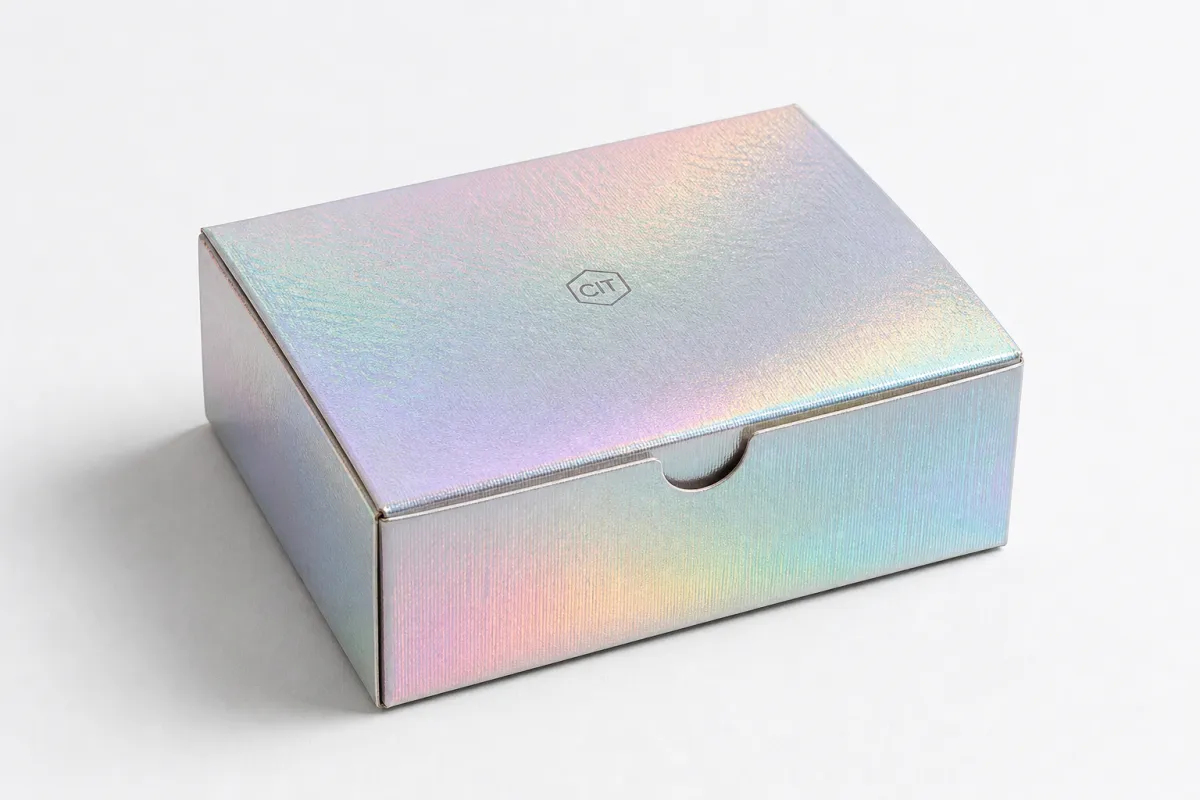
Custom holographic boxes with logo stand out because the surface does part of the visual work for you. The finish reflects light in shifting bands, so the package changes as a customer tilts it in their hands or passes it under store lighting. That movement is hard to ignore on retail shelves and even harder to ignore in product photography. For launch packaging and influencer mailers, that effect is often the whole reason the format gets chosen.
A lot of buyers compare board thickness first and visual impact second, which is backwards in many cases. A thicker carton without contrast can still disappear on shelf, while custom holographic boxes with logo can feel premium at a glance because the reflective finish creates energy and intent before anyone reads the copy. People often register “more expensive” from the surface treatment long before they notice the caliper or the inside construction.
These boxes fit categories that benefit from a little theater: cosmetics, skincare, supplements, premium phone accessories, trading cards, limited-edition merch, and seasonal retail packaging. If the item is purchased for gifting, display, or unboxing content, custom holographic boxes with logo can let the packaging do more of the marketing work. That does not mean every product needs shimmer. It means the finish should match the buying moment and the emotional tone of the product.
The reflective surface also creates a useful contrast effect. A simple logo can look sharper on holographic stock than an overloaded layout packed with small graphics and competing calls to action. Restraint tends to win here. One bold mark, a clear product name, and a clean structure usually read better than a busy composition trying to squeeze every idea onto the front panel.
I have seen projects stall because the design team fell in love with the effect and forgot the job of the box. The sample looked cool, sure, but the product name got lost and the hierarchy turned muddy. That is the kind of problem that sounds small in a meeting and looks expensive once boxes are stacked on a retail table.
"If the box has to earn attention in two seconds, custom holographic boxes with logo make sense. If the design needs people to stare for twenty seconds, the finish may be doing too much of the work."
The strongest projects use the finish with purpose. Full-coverage holographic surfaces create a louder, more futuristic feel. Selective accents create more control and keep the eye moving where the brand wants it. Either route can work. The weak versions are the ones chosen because they looked fun in a sample drawer, not because they support the packaging strategy.
If you are comparing packaging design options, begin with the job the box has to do. Shelf attention, gift appeal, social sharing, premium positioning, or all four will push the spec in different directions. Once that target is clear, custom holographic boxes with logo become a tool instead of decoration. That difference matters more than people usually expect.
How custom holographic boxes with logo are made
Custom holographic boxes with logo usually start with a base structure: a folding carton, rigid box, drawer box, sleeve, or mailer. The visual layer comes next. That layer can be holographic film, holographic paper, or a specialty laminate, depending on the construction. After that come print, cutting, folding, and any finish work such as spot UV or foil stamping.
The biggest technical choice is whether the design prints across the holographic surface or only on selected areas. Printing directly over the effect creates a stronger visual punch, but color accuracy becomes trickier because the reflective background changes the way the ink appears. White ink underprint helps bring control back into the design, especially for logos, type, and product names that need to stay readable at a glance.
Selective branding is often the wiser move. A full rainbow sheen can be dramatic, but it can also overwhelm small details and make the package feel noisy. For many custom holographic boxes with logo projects, the best result comes from leaving open space or using the holographic finish as an accent panel. That keeps the brand visible without turning the whole box into visual clutter.
A few finish combinations show up often. Matte lamination softens the shine and gives the box a more restrained look. Gloss raises the reflection and pushes the energy higher. Soft-touch adds a velvety hand feel, although it can calm the holographic effect a little. Spot UV is useful for highlighting the logo or product name, and foil stamping can give the mark a more polished presence. Embossing works well if the structure is rigid enough to hold the detail cleanly.
Custom Printed Boxes with holographic effects need tighter registration than many buyers expect. If the print is off by even a small amount, the edges start looking rough in a hurry. On a plain white carton, a minor shift may barely register. On a reflective surface, it shows immediately. That is why proofing discipline matters. The finish is already carrying a lot of visual weight, so the print has to be cleaner than average.
For buyers, the practical takeaway is simple: ask how the holographic effect is built, not just whether it exists. Film, paper, and laminate behave differently, and the answer affects cost, durability, and color control. If the supplier cannot explain that clearly, custom holographic boxes with logo are probably not the right place to improvise.
There is also a real-world production detail that gets missed a lot: the same design can feel totally different depending on press calibration and coating choice. A logo that looks crisp on one sample can feel muted on another if the underprint or varnish changes. That is why experienced teams keep one eye on the art and the other on the finishing stack.
Key factors that change the final result
The substrate matters more than most people realize. Paperboard cartons are flexible and cost-efficient, which makes them a common choice for custom holographic boxes with logo. Rigid chipboard boxes feel heavier and keep their shape better, so they suit premium kits and gift packaging. Corrugated mailers can carry the effect too, but the print and coating choices need to be adjusted for shipping durability and handling.
Artwork density is the next major lever. Bold logos, large type, and simple shapes usually perform better than tiny line art or dense gradients. The holographic finish already creates motion, so the design does not need to compete with it. A clean logo on a reflective surface often looks more expensive than a crowded layout trying to use every inch of space.
Color strategy is where many custom holographic boxes with logo projects go sideways. Dark inks usually create stronger contrast. Light or pastel palettes can disappear unless there is a white ink base or enough blocking under the print. If the brand palette depends on pale tones, ask for a controlled sample. Do not assume the final box will match the mockup on a backlit screen. That is how people end up disappointed for no useful reason.
Structure changes the mood too. A tuck-end carton feels different from a magnetic rigid box or a drawer-style package. Tuck-end cartons are efficient and practical. Magnetic boxes feel more gift-like. Drawer boxes create a reveal moment that works nicely for premium product packaging and retail packaging. The same holographic finish can read as playful, luxurious, or futuristic depending on the box form.
Handling issues deserve attention as well. Scuff resistance, fingerprint visibility, and shipping wear can make or break the final presentation. A finish that looks excellent under studio lights can still pick up scratches if it gets tossed around in fulfillment. If the package will travel through distribution, ask for abrasion-resistant coating or a stronger laminate. Custom holographic boxes with logo should look good after transit, not only on the proof sheet.
If the product needs to survive a rough route, ask for shipping testing aligned with ISTA methods. That is not overkill. It is the difference between a box that photographs well and a box that arrives looking like it lost a fight with the courier.
For buyers comparing options, a useful shortcut is to decide what matters most: shine, durability, or budget. You can push hard on two of those. Three is where the tradeoffs become painful. Custom holographic boxes with logo work best when the spec sheet is honest about what the box actually has to do.
One more thing that deserves a candid mention: not every holographic effect reads “premium.” Some finishes lean playful or even novelty-driven, which can be great for collectibles and limited drops, but wrong for skincare or higher-end electronics. The finish itself is not the problem. The mismatch is.
Custom holographic boxes with logo process and timeline
The cleanest custom holographic boxes with logo process starts with a brief that actually says something useful. Size, product weight, box style, finish preference, insert needs, and delivery date should all be on the table before quoting begins. If the supplier has to guess on those details, the timeline stretches and the price gets harder to trust. Fuzzy pricing is not a compliment.
A normal workflow looks like this: quote, dieline selection or custom dieline creation, artwork setup, proofing, sampling if needed, production, packing, and shipment. That sequence sounds boring because it should be boring. Packaging jobs go wrong when too many people treat the box like a mood board instead of a manufactured item with tolerances, lead times, and finishing limits.
For straightforward custom holographic boxes with logo, a digital proof can move quickly, often within 24 to 72 hours after files are ready. A physical sample may add several days, and custom structural samples can take longer. Once proof approval is locked, simple folding carton runs often take about 10 to 15 business days. Rigid boxes or jobs with multiple finishing passes usually need 15 to 25 business days, sometimes more if inserts or specialty coatings are involved.
Most delays come from the same places. Missing dielines. Low-resolution logos. Too many revisions after the first proof. Unclear finish decisions. Buyers often blame production speed, but the job is frequently waiting on a choice that should have been made earlier. If you want custom holographic boxes with logo faster, make the decisions sooner and keep the revisions tight.
Sampling deserves more respect than it gets. A digital proof shows layout, not the real shimmer, texture, or light response. A physical sample shows whether the logo reads clearly and whether the reflective effect feels balanced or overdone. If the order is large or the launch date matters, a sample is cheap insurance. It is far cheaper than finding out that the brand mark disappears into the surface after the full run is printed.
One useful shortcut is to keep artwork clean from the start. Vector logos, linked images at proper resolution, and final copy reduce back-and-forth. Another shortcut is to lock the finish early. If the team keeps bouncing between matte, gloss, spot UV, and foil, the schedule slides. That is not a supplier problem. That is a decision problem.
In practice, the most disciplined teams treat approval as a gate, not a suggestion. Once the dieline, art, and finish are signed off, they stop “just one more tweak” from creeping in. That discipline keeps the box moving and saves everyone from the kind of delay that looks tiny on a calendar and huge in shipping.
Cost, pricing, and MOQ
Cost for custom holographic boxes with logo depends on a few main levers: structure, board thickness, print coverage, finish complexity, insert needs, and order quantity. There is no honest way around that. A simple folding carton with holographic film is a different job from a rigid magnetic box with foam inserts, foil, and spot UV. If a supplier gives you one flat price without asking the spec questions, that number is more sales pitch than estimate.
For lower quantities, setup costs get spread across fewer boxes, which is why small runs look expensive per unit. That is normal. MOQ is not a punishment. It is just math. In many projects, folding cartons may start around 500 to 1,000 units, while rigid boxes often sit closer to 300 to 500 units because the build is more labor-heavy. Mailers usually land somewhere in the 500-unit range, though exact quantities depend on size and print method.
Here is a practical comparison of common options for custom holographic boxes with logo. The numbers are typical working ranges, not promises carved into stone, because finish coverage and freight can move them around.
| Box type | Common build | Best fit | Typical unit cost at 1,000 | Typical unit cost at 5,000 | Typical unit cost at 10,000 |
|---|---|---|---|---|---|
| Folding carton | 350gsm C1S board with holographic film or laminate | Cosmetics, supplements, retail packaging | $0.45-$0.85 | $0.22-$0.42 | $0.16-$0.30 |
| Rigid box | 1200-1500gsm chipboard wrapped with holographic paper | Gift sets, launch kits, premium product packaging | $2.10-$4.50 | $1.20-$2.60 | $0.95-$1.95 |
| Mailer box | E-flute or B-flute corrugated with printed holographic finish | E-commerce, influencer mailers, subscription drops | $1.05-$2.20 | $0.72-$1.45 | $0.58-$1.15 |
Those ranges move with print coverage. A full-wrap design costs more than a restrained accent layout. Extra inserts add more. Heavy ink coverage, custom windows, and specialty closures add more again. That is why the cheapest quote is often the least useful one. Buyers think they are saving money, then discover the lower price left out sampling, freight, or a finish they actually need.
There are a few hidden costs worth naming. Custom samples can cost money. Freight can surprise people. Storage matters if the boxes are delivered before the product is ready. Artwork fixes can add fees if files arrive in rough shape. Even the best custom holographic boxes with logo quote should be compared line by line, using the same spec sheet, the same quantity, and the same shipping assumptions. Otherwise you are comparing apples to glitter-covered oranges.
If you want a cleaner way to request quotes, use a simple spec sheet and keep it tight: box style, size, board or chipboard thickness, finish, print sides, insert type, quantity, delivery address, and target date. If you need ideas on structure, the Custom Packaging Products page is a better place to start than a dozen vague emails. It saves everyone time, which is rare enough to be appreciated.
For sustainability-minded buyers, ask whether the board carries FSC certification. The FSC system gives you a more credible paper sourcing story than vague “eco-friendly” claims ever will. If the finish uses heavy laminate, be honest about that too. Good package branding does not need greenwashing attached to it.
Another money-saving habit that works in real production: decide the finish before you request the final quote. Teams that bounce between three different coating ideas often burn days and get three different numbers. A clear choice, even if it is not the fanciest one, is usually cheaper than a half-finished idea. That part is kind of boring, but it works.
Common mistakes with custom holographic boxes with logo
The most common mistake with custom holographic boxes with logo is overdesigning the surface. Too many gradients, tiny type, and crowded callouts start fighting the effect instead of working with it. The holographic finish already brings visual energy. If the layout is equally loud, the box stops feeling premium and starts feeling confused. That is not a good look for branded packaging.
File-prep mistakes are the next headache. Low-resolution logos, missing bleed, incorrect dielines, and sloppy color handling can all create problems that show up late. Reflective packaging is less forgiving than people expect. A minor alignment issue on a matte carton can be tolerable. On custom holographic boxes with logo, that same issue looks sharper and more expensive. Prepress discipline matters here more than optimism.
Another error is finish mismatch. A delicate luxury product in a flimsy carton feels off. A shipping-heavy product in a fragile, overfinished box feels off in the other direction. Box style should fit the product’s actual use, not the mood board. Custom holographic boxes with logo can support premium positioning, but they should still be built like packaging, not props.
Approval mistakes cost real money. People sign off on a digital proof, assume the final box will look identical, and only realize later that the reflective intensity or cut lines change the read. That is why sample checking is worth the time. Hold the box under natural light and indoor light. The surface can look calmer in a meeting room and much louder under retail lighting. Same box. Different behavior.
There is also the cheapest-quote trap. A low price can hide weak board, poor lamination, or finishing that scuffs too easily. Then the boxes arrive and the cost of looking cheap lands right on the shelf. I would rather see a buyer spend a little more on a clean spec than save a few cents and lose the product’s perceived value. That trade is bad math.
If the packaging has to pass distribution testing, ask about ASTM D4169 or ship testing aligned to retail conditions. A box that looks excellent but fails in transit is not a win. It is just expensive debris with a logo on it. Custom holographic boxes with logo should still survive handling, stacking, and shipping wear.
One more thing: do not treat the finish as a substitute for good design. Strong package branding comes from the combination of structure, material, graphics, and finish. The holographic surface is only one part of the story. If the box needs rescuing by the effect, the design probably needs another pass.
Expert tips and next steps for custom holographic boxes with logo
Start with one clear goal. Shelf impact. Gift appeal. Social sharing. Premium positioning. Pick the main job first, because custom holographic boxes with logo behave differently depending on what you want them to do. A launch kit should not be designed like a retail carton. A subscription mailer should not be spec’d like a jewelry box. The smartest packaging design is specific.
Ask for two directions if you are unsure. One should use stronger holographic coverage. The other should use restrained accents. That comparison usually tells you more than ten opinions from people staring at the mockup on a laptop. In the real world, the calmer version often wins because it feels more controlled and easier to read.
Build a short spec sheet before you request quotes. Size, material, finish, logo placement, insert needs, quantity, and delivery date. Keep it simple. The cleaner the brief, the cleaner the pricing. If you need a starting point for structure or carton style, our Custom Packaging Products catalog is a useful reference for narrowing the box type before you start chasing finish ideas.
Check samples under different lighting. That sounds basic, because it is. Holographic packaging can feel subtle in daylight and very loud under LEDs. If the product will live mostly in retail packaging, check it in store-like light. If it ships directly to consumers, check it in ordinary room light too. Custom holographic boxes with logo should work in the places where customers actually see them.
Here is a practical approval checklist that saves headaches:
- Confirm the dieline is final before artwork starts.
- Keep logos vector-based and images at print resolution.
- Approve finish direction before the full run is scheduled.
- Ask for a physical sample if the launch date matters.
- Verify the box still reads clearly from arm’s length.
Most buyers do not need more decoration. They need better decisions. A clean spec, a controlled finish, and a clear visual hierarchy usually make custom holographic boxes with logo stronger than a pile of extra effects. The goal is not to show every trick the printer knows. The goal is to make the package work for the product.
For anyone planning a launch, I would start with two samples: one bold, one restrained. Put them under real light, hand them to people who do not already know the design, and see which one still reads cleanly after the first glance. That is the safest way I know to keep custom holographic boxes with logo exciting without turning them into expensive guesswork.
Are custom holographic boxes with logo recyclable?
It depends on the construction. Paperboard cartons are often easier to recycle than multi-layer laminated boxes or heavily coated structures. If the holographic effect comes from film, foil, or a plastic laminate, recyclability can drop quickly. If sustainability matters, ask for FSC-certified board, minimal coating, and inserts that separate cleanly from the carton.
What is the typical MOQ for custom holographic boxes with logo?
MOQ varies by structure and finish, but small runs usually carry a higher unit price because setup is spread across fewer boxes. Folding cartons often allow lower quantities than rigid boxes with specialty wrapping or custom inserts. For launch testing, tiered pricing is useful because it shows the cost jump between a pilot run and a fuller production order.
How long do custom holographic boxes with logo usually take to produce?
Lead time depends on artwork readiness, proof approval, material availability, and finish complexity. Straightforward folding carton runs can often move in 10 to 15 business days after approval. Rigid boxes, custom inserts, or extra finishing steps usually add time. The fastest way to avoid delays is to confirm the dieline early and send print-ready files.
What artwork works best for custom holographic boxes with logo?
Bold logos, strong contrast, and simple shapes usually read best because the reflective surface already adds visual movement. Tiny text, thin lines, and busy gradients can disappear or look uneven once the holographic effect is applied. If the brand needs more control, white ink, selective blocking, or partial holographic accents usually give better results than full-surface chaos.
How do I keep custom holographic boxes with logo from looking cheap?
Use a clean layout, the right board thickness, and a finish that matches the product instead of piling on every effect available. Avoid low-resolution artwork and awkward color choices, because reflective packaging makes those mistakes obvious. Order samples and inspect them under different lighting before approving the run. That one step saves more embarrassment than most people want to admit.
Custom holographic boxes with logo work best when the finish, structure, and artwork are chosen with a clear purpose. If the box needs shelf impact, gift appeal, or stronger package branding, the reflective surface can do real work. If you are building one, start with the structure, keep the artwork clean, sample at least two finish directions, and approve the run only after the proof matches what you want the customer to feel in hand.

