Buyer Fit Snapshot
| Best fit | Custom Jar Sleeves Branding projects where brand print, material claims, artwork control, MOQ, and repeat-order consistency need to be specified before quoting. |
|---|---|
| Quote inputs | Share finished size, material target, print colors, finish, packing count, annual reorder estimate, ship-to region, and any compliance wording. |
| Proofing check | Approve dieline scale, logo placement, barcode or warning zones, color tolerance, closure strength, and carton packing before bulk production. |
| Main risk | Vague material claims, crowded artwork, missing packing details, or unclear freight terms can make a low unit price expensive after revisions. |
Fast answer: Custom Jar Sleeves Branding: Retail Fit, Compliance Space, Print, and Cost should be specified like a repeatable production item. The safest quote records material, print method, finish, artwork proof, packing count, and reorder notes in one written spec.
Production checks before approval
Compare the actual filled-product size with the drawing, then confirm tolerance on folds, seals, hang holes, label areas, and retail display edges. Reserve space for logos, QR codes, warning copy, and material claims before decorative graphics fill the panel.
Quote comparison points
Review material grade, print process, finish, sampling route, tooling charges, carton quantity, and freight assumptions side by side. A quote is only useful when the supplier can repeat the same color, closure quality, and packing count on the next order.
Custom jar sleeves branding does more than make a container look dressed up. On a shelf full of jars that all want the same three seconds of attention, the sleeve has to work hard and fast. It needs to signal quality, sort the product from the crowd, and make the price feel justified. That is a tiny window for a big job, which is exactly why it matters.
From a packaging buyer's perspective, sleeves are practical. They give you more print space, a clearer brand read, and a faster route to launch than reworking the whole jar. Add the right material or finish, and custom jar sleeves branding can turn a stock container into Packaging That Feels intentional instead of like it got assembled in a hurry.
Custom Jar Sleeves Branding: What It Is and Why It Wins
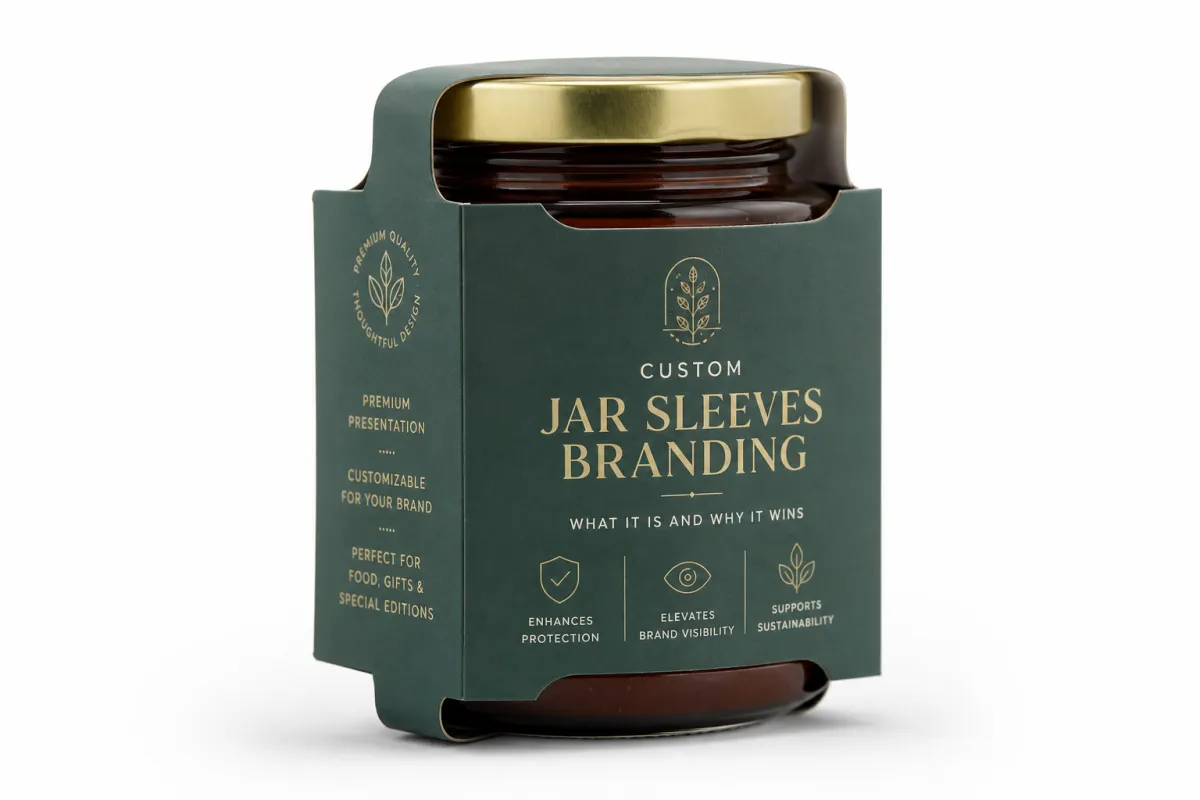
Custom jar sleeves branding means using a printed wrap, band, or sleeve around the jar instead of relying on a small front label alone. The sleeve can stay narrow and minimal, or it can cover most of the visible surface and become the main branding element. Either way, the jar gets more room for story, ingredients, legal copy, and visual personality without making the front look crowded.
The reason it works is pretty simple. Jars usually sit side by side, and most shoppers scan shape before they read copy. A sleeve changes the silhouette, adds color blocks, and creates a bigger visual hit. That makes custom jar sleeves branding a strong fit for premium spreads, bath products, herbs, supplements, candles, and other categories where retail packaging has to speak quickly.
It also gives brands room to react. Seasonal flavors, limited editions, and retailer-specific runs do not always justify a new mold or a permanent label system. Custom jar sleeves branding keeps the jar itself stable while the surface changes. That makes it useful for a small test launch and for a larger line that needs frequent updates without chaos.
Compared with standard labels, sleeves usually create a more confident block on shelf. A tiny label can tell part of the story, but a sleeve can carry the whole thing. For products fighting for attention in crowded aisles, that difference matters. It can be the gap between a jar that disappears and one that looks ready to sit beside Custom Printed Boxes and other elevated packaging.
There is another benefit that gets missed a lot: custom jar sleeves branding helps organize a line. One color family for jams, another for spice blends, another for limited runs. That kind of system makes the assortment easier to shop and easier to manage. Tiny labels can do the job, but they have less room to work.
A sleeve should earn its space twice: once in the aisle, and again when the customer opens the carton or gift set and the product still feels considered.
For brands building a broader packaging system, sleeves fit neatly beside Custom Labels & Tags, cartons, and inserts. Good packaging programs rarely hang on one piece alone. They work because the parts feel related, even when the jar carries most of the visual load.
How Custom Jar Sleeves Branding Works on the Shelf
Production starts with measurement, not artwork. The supplier needs jar height, body diameter, shoulder shape, closure style, and the visible panel area left once the jar is filled. If the fill level shifts across runs, that needs to be captured too. In custom jar sleeves branding, a few millimeters can decide whether the headline lands cleanly or gets lost behind a curve.
The next step is the dieline. That flat map shows folds, cuts, overlaps, and print-safe zones. A clean dieline is what turns custom jar sleeves branding from a concept into something that can actually be printed and assembled without guesswork. When the dieline is right, the artwork can follow the jar's shoulders and read naturally from the front, side, and quarter angle.
Then comes the material choice. Paperboard, coated paper, kraft, and specialty stocks all behave differently on a jar. A heavier board can feel more substantial in hand. A lighter stock may make more sense if the goal is speed and lower cost. For custom jar sleeves branding, the structure needs to match the jar's surface and the environment it lives in, whether that means dry shelf storage, refrigerated retail, or shipping through an e-commerce program.
There are several sleeve formats to consider:
- Wrap bands for simple branding, lower coverage, and faster production.
- Cardboard sleeves for a more premium look and a larger print area.
- Two-piece constructions for gift sets or products that need a more architectural feel.
- Shrink-style options when fit, tamper evidence, or a tighter profile matters.
Each format changes the shelf impression. A narrow band can feel clean and modern. A full sleeve can feel richer and more deliberate. That is why custom jar sleeves branding is never just a cosmetic choice. It is a structural decision tied to brand identity, handling, shipping, and how the product should be perceived in retail packaging.
Texture matters more than many teams expect. A matte stock can soften the look and suggest craft. Soft-touch coating can make a product feel more upscale in hand. Embossing, debossing, foil, and spot varnish all send cues shoppers notice fast, even if they cannot name the finish. In custom jar sleeves branding, those cues often do as much work as the logo.
For teams comparing approaches across a broader line, the smart move is to treat the sleeve as part of the full packaging family, not as an isolated item. If the jar sits next to pouches, cartons, or a display tray, custom jar sleeves branding should support the rest of the Custom Packaging Products program instead of fighting it. Consistency is where the system starts paying off.
Key Design Factors for Strong Jar Sleeves
Good custom jar sleeves branding starts with hierarchy. The shopper should catch the brand name, the product type, and the variant almost instantly. If those three things are competing, the sleeve is doing too much. Better custom jar sleeves branding gives the eye a clear path: brand first, product second, detail third.
Contrast is the fastest way to improve readability. Light text on a busy background may look polished on screen, but retail lighting can flatten it fast. The best packaging design treats contrast like a tool, not decoration. Strong custom jar sleeves branding uses dark-on-light or light-on-dark choices with intent, especially for products that sit beside ten almost identical competitors.
Size is another trap. A jar sleeve gives you more space than a front label, so it is tempting to fill every inch. That usually backfires. Shoppers do not need a wall of copy. They need enough information to know what is inside, why it matters, and whether the price makes sense. White space is not wasted space here. In custom jar sleeves branding, it often makes the product look more confident.
Material and finish need to match the real use case. A refrigerated jar faces condensation. A shipping-heavy SKU gets abrasion, box friction, and pallet movement. A spa or gift product needs a calmer surface and a more tactile feel. When custom jar sleeves branding ignores that reality, the sleeve can look great on day one and tired by day ten. Packaging teams see that mistake more often than they should.
I have seen teams fall in love with a finish on a render and then act surprised when the real jar turns into a scuffed mess in cold storage. Not exactly shocking, but here we are. The fix is usually straightforward: test the sleeve against the actual environment before anyone signs off on production.
Here is a useful checklist for design decisions:
- Keep the product name legible from arm's length.
- Use one clear accent color per variant family.
- Reserve premium finishes for the area shoppers touch or notice first.
- Leave enough space for legal text, barcode placement, and handling marks.
Sustainability claims need discipline. If the sleeve is supposed to be recyclable or low-impact, the structure, inks, and adhesive or assembly method have to support that claim. A recycled-content paperboard sleeve can be a smart move, but only if the rest of the system makes sense. FSC-certified paperboard, for example, can support sourcing transparency, and the chain-of-custody details should be verified through the organization itself at fsc.org. That is the difference between a marketing line and a credible claim.
Custom jar sleeves branding also benefits from small usability checks. If the sleeve has a tab, is it easy to open? If there is a fold, does it snag? If the jar is chilled, does the finish stay clean after condensation? Those are not glamorous questions. They are the ones that decide whether a sleeve just photographs well or actually performs in retail packaging.
For brands already using Case Studies to validate design choices, sleeves can be a good way to test packaging design language before it rolls across a full range. A single jar SKU can reveal a lot about color behavior, shelf contrast, and how the product reads beside other branded packaging in the same category.
Cost, Pricing, and Budget Drivers for Custom Jar Sleeves Branding
Pricing is shaped by a short list of variables, and none of them should surprise a serious buyer. Size, substrate, print method, finish, die-cut complexity, assembly, and order quantity all matter. Custom jar sleeves branding is one of those packaging categories where a tiny structure change can move the quote more than a new ink color would.
Short runs are where setup costs show up most clearly. If a supplier has to create a custom die, align specialty finishing, or build a more complex fold, those costs spread across fewer units. Larger quantities usually bring the per-unit cost down fast. That is why custom jar sleeves branding can feel expensive on a test run and much more manageable at scale.
To keep decisions grounded, ask for itemized quotes. Two vendors may give nearly the same total while using very different board weights, finishing steps, or tolerances. One may quote a simple digital run with minimal setup. Another may include a heavier stock, a tighter cut, and a soft-touch film. Without line-item detail, you are not comparing like with like. In custom jar sleeves branding, that is an easy way to misread value.
The table below gives a practical picture of how sleeve format often affects budget. These ranges are illustrative, not universal, but they match what many buyers see for mid-sized runs.
| Format | Best Use | Typical Unit Cost at 5,000 Pieces | Notes |
|---|---|---|---|
| Wrap band | Seasonal SKUs, simple flavor cues | $0.08-$0.16 | Lowest coverage, fastest route, fewer finishing steps |
| Cardboard sleeve | Premium shelf presence, gift-ready lines | $0.18-$0.35 | More material, better texture, stronger branding space |
| Two-piece sleeve | Higher-end sets, layered presentation | $0.24-$0.48 | More assembly time, more perceived craftsmanship |
| Shrink-style sleeve | Tighter fit, tamper evidence, irregular jars | $0.20-$0.42 | Needs careful application control and heat management |
Those figures move with coverage, materials, and quantity. A matte kraft sleeve will not price the same way as a heavy coated board with foil and embossing. Still, this kind of table is useful because it shows where custom jar sleeves branding is likely to be economical and where it starts behaving like a premium packaging upgrade.
There is a second budget question that often matters more than the unit price: what does the sleeve replace? If a brand can avoid a more expensive jar decoration step, or if it can delay a new mold while testing demand, the sleeve may save money elsewhere in the program. That is one reason buyers compare it against other product packaging tools, including cartons and Custom Labels & Tags.
It also helps to separate must-haves from nice-to-haves. A clean print job, accurate fit, and readable hierarchy are the essentials. Foil, embossing, specialty coatings, and complex insert structures may be worth it for a flagship SKU, but not every line needs them. The smartest custom jar sleeves branding plans keep spend aligned with the role the product plays in the assortment.
For teams building out a broader rollout, custom jar sleeves branding should fit into the same financial logic as the rest of the brand system. If a sleeve refresh pairs with an updated carton or display tray, the combined effect can be stronger than spending the full budget on one flashy finish. That is where package branding becomes measurable instead of decorative.
Custom Jar Sleeves Branding Process and Timeline
The best projects begin with a brief that is boring in the right ways. Measure the jar. Record the closure type. Note the fill range. List the product use case, target quantity, retail channel, and any regulatory or handling requirements. In custom jar sleeves branding, those inputs matter more than mood words. A detailed brief saves time later because the supplier can build a sleeve that fits the real jar instead of the ideal version in someone's head.
From there, the team creates the dieline and develops artwork to match the exact structure. This is the stage where a flat design becomes a wrapped one. It is also where many problems get caught early. If the barcode lands on a fold, if the logo wraps too far around the shoulder, or if the copy sits too close to a cut line, the proof should show it before production starts. Good custom jar sleeves branding depends on this step.
Proofing should include more than a screen review. A physical mockup, even a plain white sample, helps because it shows how the sleeve behaves on the real jar. Some products have a pronounced shoulder, others taper sharply, and some change appearance depending on fill level. A jar that looks generous at 95 percent full may look strangely empty at 80 percent. That is why custom jar sleeves branding needs a real-world fit check, not just a digital rendering.
A typical timeline often looks like this:
- Brief and measurement review: 1-2 business days.
- Dieline and artwork adjustment: 2-5 business days.
- Proof approval and corrections: 1-3 business days.
- Printing, finishing, and conversion: 7-15 business days.
- Shipping and receiving: varies by location and service level.
Simple runs can move faster than that. Specialty finishes, multiple SKUs, and tighter tolerances can stretch the schedule. If a brand is building a coordinated launch with custom printed boxes, secondary cartons, or retailer-specific artwork, the lead time should include a buffer for alignment across all components. That matters even more when the sleeve has to match a seasonal campaign or a time-sensitive retail packaging plan.
From a production management standpoint, it is smart to treat custom jar sleeves branding like a mini project instead of a throwaway print job. The file version needs to be locked, the dimensions signed off, and the product samples checked against the actual jar. The more SKUs involved, the more likely one jar size will slip by a fraction of an inch and cause a fit issue later.
Testing standards can matter here too. If the jar is going through shipping, look at ISTA-style drop and vibration testing. The International Safe Transit Association explains the purpose of transit testing and distribution simulation at ista.org. That matters because a sleeve that survives shelf handling may still scuff, shift, or split in a parcel network.
For brands that want a clean process, custom jar sleeves branding benefits from a launch checklist: jar measurement, artwork files, proof approval, sample verification, production window, and receiving date. That list sounds basic. It is also where projects stay on schedule instead of drifting.
Common Mistakes That Undercut Jar Sleeve Branding
The biggest mistake is designing for the flat file only. A sleeve that looks polished on a laptop can become awkward on a curved jar, especially if the strongest copy lands on a seam or around a shoulder. Custom jar sleeves branding needs artwork that respects the container, not just the canvas.
Another common error is choosing a stock that ignores the product environment. Condensation, cold storage, shipping abrasion, and handling by retail staff all change how a sleeve performs. A glossy finish may look rich in a controlled setting but reveal fingerprints or scuffs quickly. A lighter board may feel economical but curl, crush, or look tired before the product sells through. In custom jar sleeves branding, durability and image are tied together.
Overcrowding is just as damaging. Some brands try to explain the entire product on the sleeve, then wonder why shoppers cannot find the flavor or size. More copy does not always create more confidence. A lot of the time, it just creates noise. Strong custom jar sleeves branding leaves enough room for the eye to rest, which makes the product feel more premium and easier to read.
Fit errors are expensive because they are avoidable. A nominal jar dimension is not the same as the actual jar. Manufacturing tolerances, label thickness, closure variance, and fill level all affect the final result. When a supplier quotes from an idea of the jar rather than a physical sample, the outcome can drift. Good custom jar sleeves branding starts with the sample on the table, not a guess in a spreadsheet.
There are strategic mistakes too. One is treating the sleeve as a one-off decoration instead of part of the broader brand system. Another is stacking too many finishes into one design. Foil, embossing, high-contrast artwork, and multiple textures can fight each other. The result may look busy instead of premium. In packaging design, restraint often reads as confidence.
For e-commerce or subscription products, testing the sleeve through transit conditions is worth the effort. A quick pack-out trial can reveal scuffing, loose corners, or box friction long before a customer complaint does. If the product needs to survive long-distance shipping, align the sleeve work with the same discipline used for custom printed boxes and transit-ready packaging.
Another overlooked issue is the unboxing moment. A jar sleeve does not stop at the shelf. If the product ships inside a carton or sits in a gift set, it may be the first branded surface the buyer touches after opening the box. That is where custom jar sleeves branding can support the unboxing experience by making the product feel finished, not just packed.
Expert Tips and Next Steps for Custom Jar Sleeves Branding
Start with a shelf test. Put your jar beside two or three close competitors and step back. If the product does not block visually from three to five feet away, the design probably needs a stronger contrast system or a cleaner hierarchy. Custom jar sleeves branding is supposed to buy attention quickly, not slowly.
Then change one variable at a time. Swap the finish before you change the color system. Adjust the stock before you add foil. Increase sleeve coverage before you add more copy. That approach shows what actually drives perception. It is surprising how often a small material change does more than a full artwork overhaul in custom jar sleeves branding.
Use a pilot run whenever possible. Even a small production order can reveal whether the sleeve handles well, whether the color feels right in store lighting, and whether the product still reads clearly after a shipping cycle. If sales staff, retail buyers, or a small customer panel can handle the sample, their comments are usually more useful than another round of internal guessing. That is how custom jar sleeves branding becomes measurable instead of subjective.
It also helps to define the role of the sleeve in the wider portfolio. Is it a premium signal? A seasonal wrapper? A bridge to a new flavor family? A faster alternative to a full container refresh? The answer changes the design. A premium signal may justify a heavier board and tactile finish. A seasonal sleeve may need speed and cost discipline. Custom jar sleeves branding works best when the business purpose comes first.
If the materials are part of a sustainability story, document them carefully. Recycled content, FSC certification, and recyclable structures matter only when they can be substantiated. Strong sellers do not overclaim. They explain the system plainly and back it up with source documentation. That kind of clarity supports trust and keeps the message credible.
For supply chain teams, shipping discipline matters too. If the product must survive parcel handling, ask whether the sleeve needs extra edge strength or whether the jar should be nested inside another protective layer. E-commerce damage is expensive, and it can erase the value of strong branding in one bad transit event. A sleeve that looks elegant but fails in distribution is not finished packaging.
Here is a simple action list for brands planning the next move:
- Measure the jar and verify the closure height.
- Request a dieline and confirm the print-safe zones.
- Prepare artwork in the correct scale and color space.
- Decide the quantity, finish, and lead time target.
- Compare the sleeve against your wider Custom Packaging Products system.
That list looks ordinary for a reason. It is the foundation of a solid packaging refresh. Custom jar sleeves branding is not just about dressing up a container. It is about creating a better first read, better shelf presence, and a more coherent product story. If you already rely on branded packaging, a sleeve can sharpen the whole lineup without forcing a complete redesign.
When a brand gets the structure, color, and timing right, custom jar sleeves branding can do something very efficient: it makes the jar seem more expensive, more organized, and more intentional without turning the project into a full packaging overhaul. That is why so many teams keep coming back to it. It is a practical move, and in a crowded category, practical moves usually win.
If you want the short version, start with the jar in your hand, not the mockup on your screen. Measure it, test it in the real environment, and keep the sleeve's job narrow: attract attention, organize the line, and hold up in transit. Get those three right and custom jar sleeves branding stops being decoration. It becomes a tool.
FAQ
How is custom jar sleeves branding different from a standard label?
A standard label usually covers a smaller area and stays focused on core information, while a sleeve can carry more visual storytelling and stronger shelf presence. That extra space can help with flavor cues, brand hierarchy, and giftability. The tradeoff is that custom jar sleeves branding needs more planning around fit, material choice, and production method.
What materials work best for custom jar sleeves branding on glass or plastic jars?
Paperboard and coated paper are common choices when the goal is a premium look with strong print quality. If the jar will face refrigeration, moisture, or rough shipping, the material and structure may need to shift. The best choice depends on how the jar is used in real conditions, not just how it looks in a mockup.
How much does custom jar sleeves branding usually cost?
Price depends on size, quantity, substrate, finishing, and how complex the cut or structure is. Short runs usually cost more per piece because setup work is spread across fewer units. Ask for itemized quotes so you can compare stock, finishes, and production methods fairly.
How long does the custom jar sleeves branding process take?
A straightforward project may move from brief to proof to production in a few weeks. Specialty finishes, multiple jar sizes, or structural testing can add time. The schedule normally includes artwork prep, dieline approval, proofing, manufacturing, and shipping.
Can custom jar sleeves branding help small brands compete on shelf?
Yes. A sleeve can make a small line look more organized, more premium, and easier to shop quickly. It is especially useful for seasonal flavors, limited editions, and gift-focused products where the product needs to look polished without a full container redesign.


