Buyer Fit Snapshot
| Best fit | Custom Kraft Cartons for Retail projects where brand print, material claims, artwork control, MOQ, and repeat-order consistency need to be specified before quoting. |
|---|---|
| Quote inputs | Share finished size, material target, print colors, finish, packing count, annual reorder estimate, ship-to region, and any compliance wording. |
| Proofing check | Approve dieline scale, logo placement, barcode or warning zones, color tolerance, closure strength, and carton packing before bulk production. |
| Main risk | Vague material claims, crowded artwork, missing packing details, or unclear freight terms can make a low unit price expensive after revisions. |
Fast answer: Custom Kraft Cartons for Retail: Design, Cost, and Fit should be specified like a repeatable production item. The safest quote records material, print method, finish, artwork proof, packing count, and reorder notes in one written spec.
Production checks before approval
Compare the actual filled-product size with the drawing, then confirm tolerance on folds, seals, hang holes, label areas, and retail display edges. Reserve space for logos, QR codes, warning copy, and material claims before decorative graphics fill the panel.
Quote comparison points
Review material grade, print process, finish, sampling route, tooling charges, carton quantity, and freight assumptions side by side. A quote is only useful when the supplier can repeat the same color, closure quality, and packing count on the next order.
Custom Kraft Cartons for Retail: Design, Cost, and Fit starts with a simple truth: a brown carton can look expensive when the structure, print, and proportions are doing their jobs. Most packaging misses that point. Custom kraft cartons for retail do not win shelf space because they are kraft. They win because they are specific, tight, and built for the product instead of copied from a generic template.
Custom Kraft Cartons for Retail: What They Do
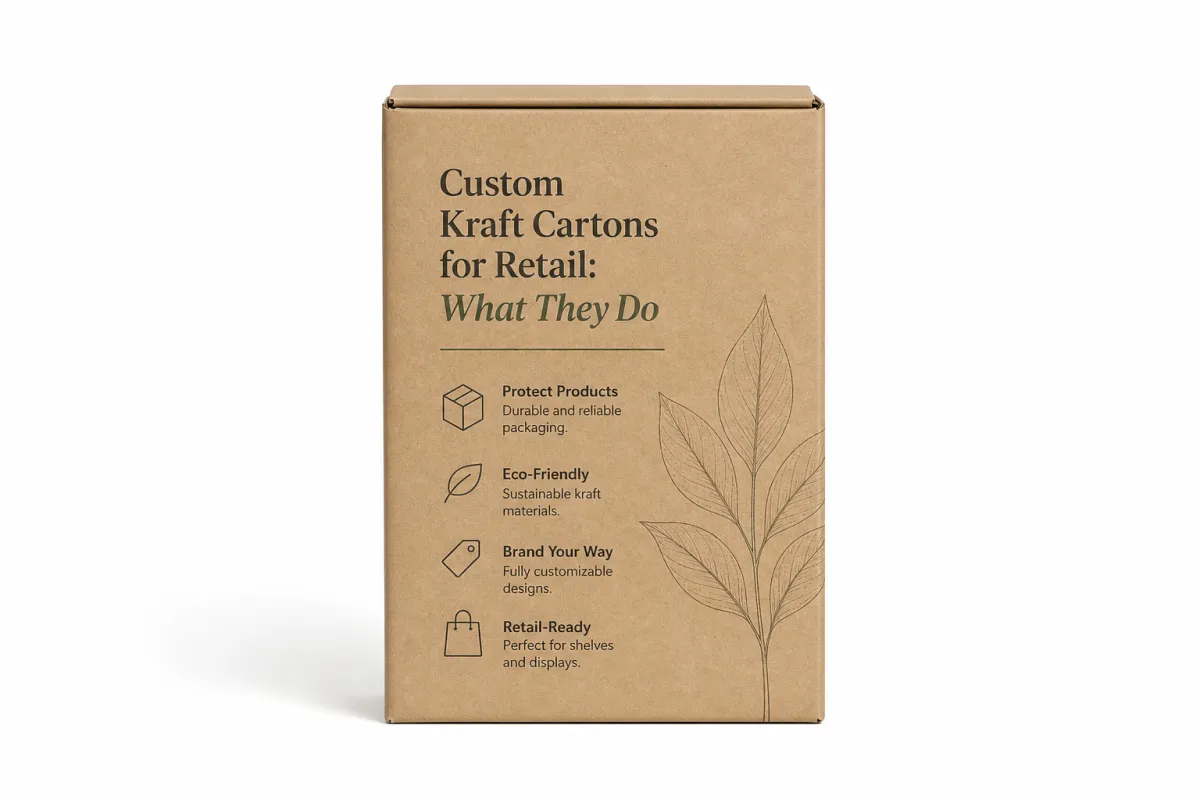
Custom Kraft Cartons for retail are not just a wrapper around the product. They are a selling surface, a protection layer, a logistics tool, and a brand signal all at once. That is a lot to ask from a box, which is why weak packaging shows up fast. It is generic. It is overworked. Or it looks good in a mockup and awkward on shelf.
In real retail use, Custom Kraft Cartons for retail can take several forms. Folding cartons work well for lightweight cosmetics, supplements, and small accessories. Rigid-style cartons suit brands that want a heavier, more substantial feel. Mailer hybrids bridge shipping and retail duties, which matters if the box goes direct to the customer and also lands in a store display. Sleeve-and-tray structures give a clean front face and a nicer opening moment, though they cost more than a simple tuck-end carton.
Kraft works because the look is honest. It suggests natural, practical, and less fussy. That fits beauty, wellness, food, apparel accessories, candles, and gift items without trying too hard. A kraft carton can signal ingredient focus, material integrity, or a quieter premium position without screaming for attention. Not every brand needs metallic ink and visual noise to feel expensive.
The gap between shipping packaging and retail packaging is wider than people think. A shipping box only has to survive transit. Custom kraft cartons for retail also have to face the customer, stack cleanly, open neatly, and communicate value in a few seconds. A carton that arrives intact but looks cheap on shelf still misses the mark. Retail does not give second chances for free.
If you are comparing options, it helps to browse a few formats before locking anything in. Our Custom Packaging Products page is a practical place to compare structures, and it beats guessing from a flat template. The right carton usually starts with product data, not artwork mood boards.
"A kraft carton looks premium when the proportions are disciplined. Sloppy structure makes even good printing look amateur."
Custom kraft cartons for retail set the tone before the customer even opens the box. If the carton feels intentional, the product gets a head start. If it feels flimsy or generic, the brand has to spend energy clawing that trust back.
How Custom Kraft Cartons for Retail Work
To understand custom kraft cartons for retail, break the box into parts. Substrate comes first. A 300-400gsm kraft folding stock works for many lightweight retail items. Heavier products may need 18pt to 24pt board, reinforced fold lines, or an inner insert. If the carton needs to survive warehouse handling, retail display, and customer opening, the construction has to support the whole path, not just one stage of it.
Structure matters next. Tuck-end cartons are common because they are economical and easy to run. Lock-bottom styles help with weight. Sleeve-and-tray designs add shelf presence. Mailer-style retail cartons help with ecommerce crossover. Custom kraft cartons for retail should be chosen by use case, not taste. Pretty is nice. Fit is better.
Printing changes everything on kraft. Uncoated kraft behaves very differently from coated kraft because the brown base absorbs ink and dulls certain colors. Soft pastels can go muddy. White type can vanish if the contrast is too weak. Black, dark green, deep blue, and restrained line art usually read better than a full-coverage rainbow. When a design team forgets that the substrate is not white, the result is predictable: an expensive-looking mockup that falls apart in production.
That is why custom kraft cartons for retail often look strongest with simple branding mechanics. Typography, a controlled logo lockup, one accent color, and generous negative space tend to beat busy graphics. Package branding on kraft is more about discipline than decoration. A front panel does not need to tell the brand’s entire life story. It needs to identify the product fast and make the customer feel the price is justified.
Retail performance also depends on handling. A carton should open without tearing, close without fighting the user, and sit properly on shelf or in tray display. If the top flap buckles or the side seams gape, the box loses credibility. Buyers notice those details. Store staff notice them too, especially when they are stocking dozens of units and do not want packaging that slows them down.
Testing matters. If the carton is going into distribution, it should be checked against relevant transport expectations, such as basic drop and vibration testing. ISTA has widely used test methods for transit simulation, and that is worth reviewing if your product will move through a rough supply chain. See the resources at ISTA for a baseline on distribution testing. For more general packaging references, the trade resources at packaging.org are also useful.
Sustainability claims need to match the actual build. Kraft can be recyclable, but only if the coatings, laminations, inks, and adhesives do not complicate recovery in a meaningful way. FSC-certified paper is a strong option if chain-of-custody matters. That does not make a carton automatically eco-friendly. It makes the material source clearer. There is a difference, and buyers know it.
Custom kraft cartons for retail work best when the structure supports the product, the print supports the brand, and the finish supports the channel. Simple formula. Not easy, but simple.
Key Factors That Shape Retail Performance
Product weight and fragility should drive the spec first. A lightweight lip balm does not need the same carton as a glass serum bottle or a boxed accessory set. Custom kraft cartons for retail need to match the load, the shape, and the way the item will be packed. That sounds basic because it is basic. Still, this is where a lot of packaging programs drift off course.
Shelf impact comes next. You usually get a few seconds, not a minute. The front panel needs to say what the product is, who it is for, and why it belongs at that price point. A strong hierarchy helps: brand name, product name, key benefit, then the necessary detail copy. If the box is cluttered, the shopper has to work too hard. Retail packaging should not ask the buyer to decode a puzzle.
Channel matters too. Boutique shops tend to like tactile, restrained, and more premium-feeling cartons. Mass retail often needs clearer category codes, stronger contrast, and more efficient pack-out. Subscription programs may prefer cartons that photograph well in unboxing content. Pop-up shops usually want quicker assembly and compact storage. Custom kraft cartons for retail should be tuned to the sales channel, because one size rarely fits all of them.
Material choice changes perception in a noticeable way. Natural kraft feels earthy and honest. Bleached kraft feels brighter and cleaner. A laminated kraft carton feels more polished, but it can also lose authenticity if the finish is too glossy or too slick. That tradeoff matters. The wrong finish can erase the charm people wanted from kraft in the first place.
Fit matters just as much. A carton that is even 2 to 3 mm too loose can let product rattle, especially if the item has headspace or a fragile closure. A carton that is too tight creates friction during packing and can make the customer struggle at opening. Good packaging design avoids both. The best custom kraft cartons for retail feel snug without being annoying.
Here is the practical test I use: if the box looks good from 3 feet away but feels awkward in the hand, it is not done. If the box packs quickly but looks generic on shelf, it is not done either. Retail packaging has to do both jobs. I have seen plenty of pretty boxes that did nothing for sell-through. Nice render, wrong answer.
For brands refining custom kraft cartons for retail, it can help to compare the final result against other custom printed boxes so the team can decide whether kraft is actually the right choice or just the most comfortable one. Comfort and correctness are not the same thing.
And yes, the finishing stack matters. A matte aqueous coating can protect print without wrecking the kraft look. Spot varnish can highlight the logo. Debossing can add quiet value if the budget allows it. Every added finish should earn its place. If the decoration does not improve shelf read or handling, it is just cost wearing a fancier jacket.
Custom Kraft Cartons for Retail Cost and Pricing Factors
Cost is where packaging decisions get honest fast. Custom kraft cartons for retail can be cost-effective, but only if the spec is controlled. Size, board thickness, print coverage, die complexity, inserts, coatings, and order quantity all affect the quote. That is not a sales trick. It is production.
Setup costs come first. Plates, tooling, and dielines can make a small run feel expensive because those charges are spread across fewer cartons. A run of 500 units may carry a per-unit cost that feels rude. A run of 5,000 or 10,000 units usually drops the unit price sharply. If you are budgeting custom kraft cartons for retail, ask for pricing at multiple quantities so you can see where the math improves. Guessing does not help anyone.
The material itself is only part of the story. A simple tuck-end carton in basic kraft board can be reasonable. Add window cuts, custom inserts, specialty coatings, or unusually large blank sizes, and the price climbs. Freight climbs too if the carton dimensions are inefficient. Sometimes a slightly smaller carton saves more money in shipping than it costs in redesign, which is the kind of boring detail that keeps margins alive.
Here is a practical way to think about the value stack. A low-cost carton is not automatically smart if it dents product protection or shelf appeal. A slightly more expensive carton can be the better buy if it reduces returns, speeds pack-out, or improves conversion on shelf. Custom kraft cartons for retail should be judged as part of product margin, not as a separate decoration line item. That is where teams make better choices.
| Option | Typical Use | Approx. Unit Cost at 5,000 | Setup Complexity | Notes |
|---|---|---|---|---|
| Simple tuck-end kraft carton | Lightweight beauty, wellness, accessories | $0.18-$0.32 | Low | Best for clean branding and fast production |
| Lock-bottom retail carton | Heavier items, jars, small gift sets | $0.24-$0.42 | Medium | Better load support and shelf stability |
| Sleeve-and-tray kraft package | Premium retail, gifting, display-led launches | $0.38-$0.75 | Medium to high | Stronger presentation, higher material and assembly cost |
| Mailer hybrid retail carton | Ecommerce crossover, direct-to-consumer, shelf reset | $0.45-$0.90 | High | Useful when one pack has to do two jobs |
These numbers are directional, not gospel. A small run can land well above those ranges. Heavy print coverage, narrow tolerances, and special finishing can push the price up fast. Still, the table gives a useful frame for custom kraft cartons for retail so the conversation stays grounded.
Hidden cost traps deserve attention. Custom inserts can add both material and assembly labor. Window cuts add tooling and can weaken the board if they are not sized correctly. Oversized blanks waste paper and freight space. Even a small change in board grade can affect the quote. If a supplier gives you one price and no breakdown, ask for a split between board, print, finish, tooling, and assembly. That is not being difficult. That is buying intelligently.
There is also a branding tradeoff. A highly decorated carton may look richer at first glance, but the whole point of kraft is often restraint. A cleaner design can be cheaper to produce and stronger on shelf. In many categories, custom kraft cartons for retail outperform more expensive-looking boxes because they feel honest and focused. Buyers do not always reward the most decorated package. Sometimes they reward the clearest one.
If you are still shaping the spec, compare a few versions side by side before placing the order. A small move from a complicated structure to a more efficient one can cut cost without hurting the product. That is the sweet spot. If you need to review broader packaging options, do that before locking the dieline. Changing the carton after print approval is the expensive route. Usually the funniest part is that nobody thinks they will be the one who does it.
Process and Timeline for Custom Kraft Cartons for Retail
The workflow for custom kraft cartons for retail is fairly predictable when the inputs are clear. It starts with a brief, then a structural spec, artwork prep, dieline approval, prototype, revisions, production, finishing, and shipping. The people who rush this usually pay for it later. The people who slow it down at the right points usually end up with a cleaner result.
A simple carton can move quickly. If the dimensions are locked, the structure is standard, and the print is modest, you may be looking at 10-15 business days after proof approval for production, depending on factory load and shipping method. Once you introduce structural development, inserts, foil, embossing, or special coatings, the timeline stretches. That is normal. Packaging does not care about wishful thinking.
The most common delays are not mysterious. Missing product dimensions. Vague print instructions. Late copy changes. Approval bottlenecks. Skipped sample reviews. If someone says the carton is "basically ready," that usually means the team has not looked closely enough. For custom kraft cartons for retail, the details that seem small on screen are the details that create problems in production.
Sampling is where you save yourself from expensive embarrassment. A physical sample catches fit issues, opening resistance, print contrast problems, and shelf-facing mistakes that a PDF cannot show. The mockup may look perfect on a monitor and still fail in real life because the logo sits too low, the closure is awkward, or the flap interferes with the product. I rarely trust only a digital proof for retail packaging. Screen approval is useful. It is not the finish line.
Use a handoff checklist before production starts. Confirm final dimensions. Confirm board grade. Confirm print method. Confirm color targets. Confirm the pack-out method and assembly direction. Confirm whether the carton is meant for hand packing or automated filling. Confirm shipping carton configuration too, because the retail carton does not live alone. Custom kraft cartons for retail work best when every stage has been considered, not just the front panel.
A useful rule: if the team cannot explain how the carton will be packed in under 30 seconds, the spec is still fuzzy. That sounds blunt because it is. Fuzzy specs create expensive boxes.
When a project is headed into testing, define what success looks like. A carton should pass basic compression logic, protect the contents in transit, and survive retail handling without scuffing badly or splitting at the seams. If the item is heavy or fragile, ask whether the carton should be tested against a recognized distribution standard like ISTA methods or a comparable internal test protocol. If the project includes recycled content or FSC claims, verify documentation before print. That is cleaner than backtracking after launch.
Custom kraft cartons for retail move faster when product data is clean, artwork is disciplined, and the sample stage is treated as a real decision point rather than a box-checking exercise.
Common Mistakes With Retail Kraft Cartons
The first mistake is choosing kraft only for the look. Custom kraft cartons for retail are not automatically strong, sustainable, or premium just because they are brown. If the carton crushes, scuffs, or opens badly, the brand loses credibility fast. A nice material cannot rescue bad structure. That is packaging reality, not opinion.
Overdesign causes trouble too. Too much ink coverage can fight the natural kraft base. Too many finish requests can drain budget while making the carton feel less authentic. Too much structure can create assembly pain without improving the customer experience. A good retail carton should feel intentional, not overworked. The more you add, the more careful you need to be.
Sizing mistakes are especially common. A loose carton lets the product move around, which is bad for fragile items and bad for shelf presentation. A tight carton slows the line and can damage corners during insertion. If the product has an insert, the insert and the outer carton should be designed together. That sounds obvious. It still gets missed all the time in custom kraft cartons for retail programs.
Print visibility is easy to underestimate on brown stock. Thin type can vanish. Low-contrast colors can flatten. Busy layouts can look muddy under retail lighting. A design that works on white paper may fail on kraft without adjustments. Strong typography and clear spacing matter more than decorative details. If the shopper cannot read the box quickly, the box is not doing its job.
Skipping real-world testing is the final expensive mistake. Stack tests, drop tests, and shelf mockups reveal what flat proofs cannot. Does the carton wobble? Does the product slide? Does the logo disappear when viewed at an angle? These are the practical questions. Custom kraft cartons for retail should answer them before the order is locked, not after the pallets arrive.
One more thing: if the carton will ship before it hits retail, do not assume one test covers everything. Transit stress and store handling stress are not identical. A package can survive the truck and still fail in the aisle. Retail packaging has a longer life cycle than people like to admit.
Expert Tips and Next Steps for Retail Packaging
Start with the product, not the artwork. Measure the item. Measure the insert if there is one. Measure the packed height, width, and depth with realistic tolerances. Then define the retail display goal. Only after that should the packaging design move into visuals. Custom kraft cartons for retail go much smoother when the structure is built around actual dimensions rather than optimistic guesses.
Use a simple front-panel hierarchy. Brand first if the brand has strong shelf equity. Product name second. Key benefit or flavor, scent, size, or variant third. Compliance copy where needed, but not taking over the front panel unless regulations require it. That order keeps the packaging readable. It also helps package branding feel deliberate instead of crowded.
For finishes, restraint usually wins. Keep the outside clean. Use contrast where the logo needs punch. Consider a soft-touch or matte coating only if it improves the tactile experience without hiding the kraft character. Do not pay for decoration that nobody will notice from a retail distance. That is just expensive noise on custom kraft cartons for retail.
A pre-production checklist should include the essentials: final dimensions, product weight, board grade, print method, color targets, assembly method, shipping configuration, and approval sign-off. If the carton uses recycled or FSC-certified stock, make sure the claim language is accurate. If the box needs to pass transit tests, define the standard upfront. If the carton needs hand assembly, make sure the labor budget reflects that. In other words, treat the carton like a production object, not a mood board.
It can also help to compare two material grades before committing. One version may use a slightly heavier board. Another may use a cleaner coating. The difference in cost is often small enough to justify testing both. Custom kraft cartons for retail are rarely won by one dramatic choice. They are usually won by a handful of small, correct choices adding up.
For brands evaluating custom kraft cartons for retail, I would suggest three next steps: request a prototype, ask for pricing at multiple quantity levels, and review the sample in a retail-like setting with real lighting. Put it next to the product. Put it next to a competitor. Check the read from 3 feet away. That is the real test, not the render. If you want to review broader options while you are at it, our Custom Packaging Products catalog can help your team compare structures without starting from zero.
Done well, custom kraft cartons for retail protect the product, improve shelf read, and keep cost under control without pretending to be something they are not. That honesty is part of the appeal. It is also why the best kraft cartons do not try too hard. They are built well, printed clearly, and fit the product without drama.
Are custom kraft cartons for retail strong enough for heavier products?
Yes, if the board grade and structure match the load. Heavier items usually need thicker stock, reinforced folds, lock-bottom construction, or an insert to stop movement. Always test with the actual product, not an empty carton. Custom kraft cartons for retail can handle more weight than people assume, but only when the spec is honest.
How much do custom kraft cartons for retail usually cost?
Price depends on size, board type, print coverage, quantity, and tooling. Small runs cost more per unit because setup charges are spread across fewer cartons. Ask for multiple quantity breaks so you can compare real per-unit savings. For many projects, custom kraft cartons for retail land somewhere in the $0.18-$0.90 range at scale, depending on structure and finishing.
What is the normal timeline for custom kraft cartons for retail?
Simple projects move faster than cartons that need structural development or inserts. Proofing and sampling usually take longer than people expect, and that is where most mistakes get caught. Delays usually come from artwork revisions, missing specs, or slow approval cycles. With clean inputs, custom kraft cartons for retail can move through production in roughly 10-15 business days after approval, though complex builds take longer.
Can custom kraft cartons for retail look premium without heavy printing?
Yes, and honestly, restraint usually looks better on kraft than clutter. Strong typography, smart spacing, and one or two bold brand elements can do more than a full-coverage design. Premium on kraft often comes from structure, print quality, and clean finishing, not noise. That is why custom kraft cartons for retail often outperform busier custom printed boxes.
What should I check before ordering custom kraft cartons for retail?
Confirm the product dimensions, weight, and how the carton will be packed. Check shelf visibility, opening behavior, and whether the carton protects the item in transit. Review a physical sample before committing to full production. If the sample fails, fix it before you buy thousands of custom kraft cartons for retail.
Custom kraft cartons for retail work best when they are treated like a product decision, not a decoration decision. Get the structure right. Keep the print readable. Price the carton against the margin. Test the sample. If those pieces are in place, the package can do real work on shelf instead of just occupying cardboard. The shortest path is usually the smartest one: lock the dimensions, order a sample, and check it under retail lighting before you approve the full run. That is the part that saves you from expensive regret later.

