Buyer Fit Snapshot
| Best fit | custom kraft display boxes sustainable packaging for packaging buyers comparing material specs, print proof, MOQ, unit cost, freight, and repeat-order risk where brand print, material, artwork control, and repeat-order consistency matter. |
|---|---|
| Quote inputs | Share finished size, material target, print colors, finish, packing count, annual reorder estimate, and delivery region. |
| Proofing check | Approve dieline scale, logo placement, barcode or warning zones, color tolerance, and any recyclable or compostable wording before bulk production. |
| Main risk | Vague material claims, crowded artwork, or missing packing details can create delays even when the unit price looks attractive. |
Fast answer: Custom Kraft Display Boxes Sustainable Packaging: Claims, Protection, MOQ, and Cost should be specified like a repeatable production item. The safest quote includes material, print method, finish, artwork proof, carton packing, and reorder notes in one written spec.
What to confirm before approving the packaging proof
Check the product dimensions against the actual filled item, not only the sales mockup. Ask for tolerance on folds, seals, hang holes, label areas, and retail display edges. If the package carries a logo, QR code, warning copy, or legal claim, reserve that space before decorative graphics fill the panel.
How to compare quotes without losing quality
Compare board or film grade, print process, finish, sampling route, tooling charges, carton quantity, and freight assumptions side by side. A lower quote is only useful if the supplier can repeat the same color, closure quality, and packing count on the next order.
Custom Kraft Display Boxes: Sustainable Packaging That Sells
A plain tray can outsell a flashy carton if it lands where shoppers actually reach. That is the logic behind custom kraft display boxes: they keep the product visible, stay readable at eye level, and avoid wasting precious shelf space on decoration that does not move inventory. At a checkout lane, on a countertop, or in a club-store aisle, a display box has a narrow window to earn its keep. Custom kraft display boxes are built for that exact moment.
These packs often get mixed up with shipper cartons, retail cartons, and shelf trays, then the quote arrives and the structure no longer makes sense. It should make sense. A display box is a merchandising tool first and a container second. Built well, custom kraft display boxes sharpen recognition, clean up presentation, and give package branding a natural material tone without trying too hard. Built poorly, they slump, hide the product, and turn store staff into reluctant box assemblers. Nobody enjoys that version.
This piece breaks down what the format is, how it performs in transit and on shelf, what shapes the price, and where teams usually make expensive mistakes. If you are specifying custom kraft display boxes for food, wellness, accessories, or small consumer goods, the details below can spare you time and a few headaches.
Custom kraft display boxes: why they win at eye level
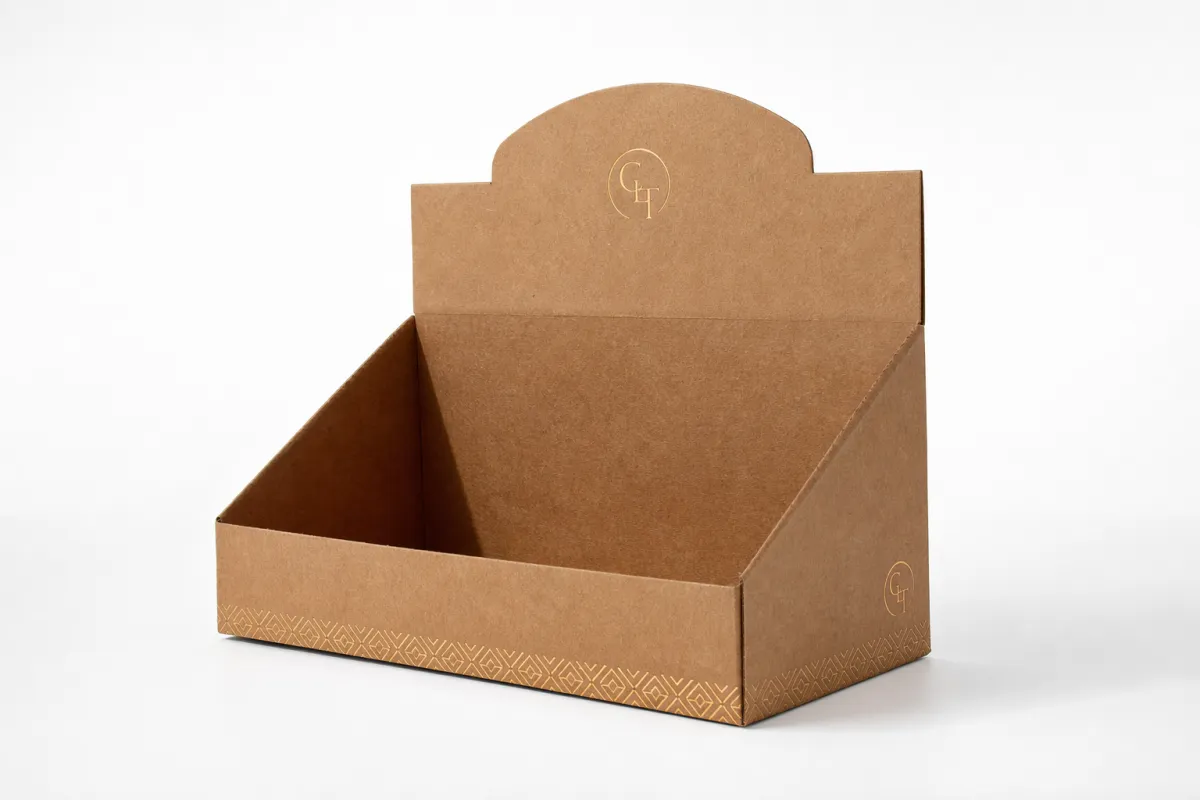
At shelf level, attractive is not enough. A display has to read quickly, hold its shape, and make the product feel easy to buy. That is why custom kraft display boxes perform so well in retail packaging. Kraft creates a warm, low-noise background that lets logos, product names, and short benefit statements stand out without shouting. It feels less manufactured than a glossy carton, which is exactly why many brands choose it for product packaging meant to feel natural, practical, or quietly premium.
Buyers notice the difference fast. A crowded design can look impressive on a screen and vanish in a store aisle. A clean kraft display tray, especially one with high contrast and a strong front lip, tends to do better because it tells the shopper what the item is without asking for extra effort. That is not magic. It is packaging design doing its job. Custom kraft display boxes work because they reduce visual friction.
The material itself sends a signal too. Kraft board carries an earthy, no-nonsense look that shoppers often connect with simpler ingredients, less waste, or a smaller brand with a clearer point of view. That does not make every kraft box sustainable by default. It does mean the surface supports the story. Brands that want packaging to feel honest instead of overproduced usually find custom kraft display boxes a practical starting point.
Picture a crowded checkout counter with candy, lip balms, tea sachets, or travel-size items lined up in a tidy tray. The shopper is moving fast. The retailer wants refill speed. The display cannot be fussy. Custom kraft display boxes fit that setting because they are quick to understand and usually simple to stock.
If a display needs a screwdriver, three tabs, and a patient employee to assemble it, the retail floor will not thank you.
One more point. The strongest custom kraft display boxes avoid trying to be the loudest thing on the shelf. They use restraint on purpose. A plain kraft base with one or two ink colors often beats a crowded full-bleed print because the product gets the attention. The box supports the sale instead of competing with it.
How custom kraft display boxes work on the shelf and in transit
Structure matters as much as appearance. Most custom kraft display boxes use a tray base, side walls, a front lip, and score lines that allow the box to pop into shape quickly. Some include tear-away fronts, perforated panels, or a removable header. Others use a gravity-fed design so product slides forward as pieces are removed. Each choice changes shelf performance and how much abuse the box can take during shipping.
A simple countertop tray usually starts flat. The packer folds the sides, locks the corners, loads the product, and ships it in a master carton or pre-filled, depending on the program. Speed is the point. Retail staff should not need ten minutes and a foldout manual to set up custom kraft display boxes. If the build takes too long, someone will assemble it incorrectly or skip it entirely. Both outcomes cost money.
Heavier products push the structure toward engineering, not decoration. Corrugated kraft, reinforced end walls, double-thick front lips, and tighter score placement can make a real difference. A tray that holds 12 light sachets is not the same thing as a display carrying 24 glass bottles or metal tins. Ask for the actual product weight, not the optimistic weight from a sales deck. Custom kraft display boxes need to survive the real load, not the ideal one.
The merchandising side matters just as much. Countertop displays usually need a compact footprint, a low front edge, and a face-out presentation. Floor displays need more stacking strength and a broader base. Gravity-fed trays need a slight angle and a product shape that can slide without catching. In each case, the goal stays the same: frame the product instead of hiding it behind cardboard. That is where custom kraft display boxes earn shelf space.
Transit introduces a second job. The display has to protect the product in the master shipper and still look clean after opening. That is why some buyers ask for pre-glued or partially assembled custom kraft display boxes, while others prefer flat-packed kits to reduce freight volume. The right choice depends on where the pain sits: warehouse labor, retail labor, or shipping cost.
For shipment testing, many teams use checks aligned with ISTA methods or related ASTM transport standards such as ASTM D4169. That sounds technical because it is technical. If the display ships loaded, it should be tested loaded. Pretty renders do not survive drop testing. Sometimes the real product does not either, which is exactly why physical samples matter.
Once the structure is dialed in, custom kraft display boxes can move from flat-packed shipping form to retail-ready presentation without a fight. That combination of speed, support, and clear presentation is why the format keeps showing up in Custom Printed Boxes programs across food, beauty, and small consumer goods.
Production steps and lead time for custom kraft display boxes
Production usually follows a predictable path, though any weak spec can stretch the schedule. For custom kraft display boxes, the process starts with product dimensions, weight, fill count, and the retail setting. A countertop tray for 24 lip balms is a different build from a club-store display holding 48 snack bars. If the supplier does not have those basics, the first proof is guessing dressed up as planning.
Box style selection and dieline creation come next. Sometimes an existing structure can be adapted. Other times the display has to be built from scratch. That is where lead time starts to move. New tooling, custom cut lines, unusual reinforcements, and insert work all add days. Revisions after the first proof add more. Custom kraft display boxes are not difficult because they are kraft. They become difficult when everyone assumes the structure is simple and then learns it is not.
After the dieline, the path usually runs through digital proofing and sample approval. If the display is structural, ask for a physical sample or at least a plain mockup before print. A polished PDF will not reveal whether the product sits too high, whether the front lip cuts into the logo, or whether the tray bows after loading. With custom kraft display boxes, that stage exposes the bad assumptions early enough to fix them.
Only after approval should the job move into printing, cutting, folding, gluing, and packing. A straightforward run on standard kraft board may move faster than a heavily printed build with special ink coverage or hand assembly. As a rough range, simple custom kraft display boxes can often land in about 10-15 business days after proof approval, while more complex builds may need 15-25 business days or more, especially if the supplier is producing samples, inserts, or multiple revisions.
Rush jobs can happen, but speed never comes free. Faster turnaround usually means a premium, less room for changes, and tighter communication from the buyer. If you need custom kraft display boxes for a fixed launch, start with the launch date and work backward from sample approval, production, and shipping. Waiting until artwork is "almost done" is a familiar way to end up late.
What should buyers send first? Start with this:
- Exact product dimensions and weight
- Fill count per display
- Whether the unit ships flat or pre-filled
- Retail location type: countertop, floor, club-store, or shelf tray
- Target launch date and receiving window
- Ship-to location and carton count
That set of details makes custom kraft display boxes much easier to quote correctly. It also keeps the packaging team from building a fantasy structure that looks good in a file and collapses in the aisle.
Custom kraft display boxes pricing: what changes the quote
Pricing is where a lot of buyers get tripped up. Two quotes can look similar on paper while one is a blank tray on thin board and the other is a fully printed, reinforced, pre-glued display with insert work. Those are not the same product. They are barely cousins. For custom kraft display boxes, the quote usually moves based on board thickness, print coverage, finishing, structural complexity, insert count, assembly method, and quantity.
Quantity has a bigger impact than most people expect. Lower MOQs carry more setup cost per box, which keeps unit pricing higher even when the design is simple. As volume rises, the per-unit number falls because tooling, plate setup, and handling get spread across more pieces. That is why a run of 500 custom kraft display boxes can cost materially more per unit than a run of 5,000, even with the same artwork and size.
Finishing changes the cost as well. A natural kraft surface with one or two spot colors is usually more economical than heavy ink coverage, soft-touch coatings, foil, or specialty laminations. If the box is meant to feel earthy and restrained, do not bury it under effects that fight the material. You are paying for a kraft look. Use it. Custom kraft display boxes do not need to wear a tuxedo to get noticed.
Here is a practical range table that helps separate low, mid, and premium builds. These are rough production estimates for custom runs and can shift based on board, print method, and packing assumptions. Shipping is extra unless noted.
| Build type | Typical quantity | Approx. unit price | Best for | Tradeoff |
|---|---|---|---|---|
| Basic uncoated kraft tray | 1,000-5,000 | $0.18-$0.42 | Light products, simple retail trays, test launches | Limited structure and modest print impact |
| Printed kraft display with reinforced lip | 1,000-5,000 | $0.35-$0.85 | Most branded packaging programs | Higher setup cost, better shelf presence |
| Heavy-duty custom display with inserts | 500-3,000 | $0.75-$1.80 | Heavier items, club-store loads, premium product packaging | More material, more assembly, more freight weight |
| Special finish or machine-glued build | 3,000+ | $0.60-$2.20 | High-volume retail packaging with stronger presentation needs | More complex production and tighter spec control |
Those numbers only help if you compare the same setup. Ask for the same size, the same board grade, the same print method, the same pack-out, and the same shipping assumptions. Otherwise you are comparing a bar stool to a bridge. Also ask whether the quote includes inserts, pre-gluing, or hand assembly. A lot of custom kraft display boxes look inexpensive until labor appears on the back end.
If sustainability claims matter, do not guess. Ask what the board is made from, whether it is FSC-certified, and whether any coating or adhesive affects recyclability. The FSC site explains certification basics clearly enough for buyers who need to verify chain-of-custody claims. For recycling guidance, the EPA recycling resources are a useful check. Custom kraft display boxes can stay low-impact if the material stack stays simple and honest.
Key factors that make custom kraft display boxes sell
The first job is fit. If the product sits crooked, too low, or too high, the display loses credibility quickly. That sounds obvious, yet a surprising number of custom kraft display boxes are designed around artwork first and product geometry second. Wrong order. The product needs the right angle, the right face height, and enough support to stay in place after a few grabs.
Contrast comes next. Kraft is naturally muted, which helps because it gives type and logos room to breathe. Black text, deep green, white, and restrained accent colors usually read well. Too many colors can muddy the shelf. A simple layout with one strong message often performs better than a crowded one. That is especially true for custom kraft display boxes in food, wellness, and specialty retail, where buyers are scanning quickly and do not want a design lecture.
Retail constraints matter too. Shelf depth, counter footprint, pack count, replenishment speed, and store rules all affect whether the display gets placed or rejected. A beautiful tray that is one inch too deep may never leave the back room. A display that takes too long to refill loses value after the first week. Custom kraft display boxes should be sized for the store, not for a mood board.
Durability cannot be treated as an afterthought. If the product is heavy, slippery, or top-heavy, the structure needs reinforcement. That might mean thicker kraft board, a corrugated base, a tighter locking mechanism, or a hidden insert. Good packaging does not brag about the reinforcement. It simply survives transit and stays upright on shelf. That is the assignment.
Sustainability should be real, not decorative. Use recyclable paper-based materials where possible. Keep coatings minimal. Skip unnecessary plastic windows or mixed-material add-ons that make recovery harder. If the box is part of a green claim, make sure the entire material stack supports the claim. Custom kraft display boxes are a strong fit here because the base material already signals lower impact, but signal and actual recovery are not the same thing.
There is a speed factor too. Retail staff like displays that are quick to build and easy to restock. That is not a luxury. It is the difference between a display staying on shelf and getting shoved aside. If your custom kraft display boxes can be assembled in under 30 seconds, you are in much better shape than if they require a mini engineering degree.
For brands balancing branded packaging, package branding, and operational reality, the winning formula is usually simple: the product must fit cleanly, the artwork must read fast, the tray must hold up, and the display must not create extra labor. That is how custom kraft display boxes earn repeat orders instead of one-time curiosity.
Common mistakes with custom kraft display boxes
The most common mistake is choosing a board that looks fine in a mockup but collapses once it carries real product weight. Paperboard strength is not a feeling. It is a spec. If the tray is holding multiple units, ask for a structure that matches the load. Custom kraft display boxes should be tested with the actual fill count, not a hopeful estimate.
Over-design is another trap. Too many graphics, too much ink, too much shine, or too many premium effects can fight the natural kraft look you were probably buying in the first place. A lot of custom kraft display boxes work best when the design is disciplined. One clear logo. One message. Maybe one accent color. That is enough more often than people want to admit.
Skipping a sample is a quick way to create avoidable pain. The first physical sample tells you whether the display opens correctly, whether the product sits well, and whether the shelf presence matches the plan. It also reveals whether retail staff will hate the build. That matters. A lot. Custom kraft display boxes that look perfect in a render can be awkward in real life, and awkward is another word for expensive.
Operational mistakes show up all the time. Bad pack instructions, confusing carton counts, unclear ship-to labels, and a display that takes too long to assemble all create friction. Even a strong design can fail if the back-end execution is messy. That is why the best custom kraft display boxes are built with warehouse and store teams in mind, not only the brand team.
Do not assume the retailer will accept your preferred format either. Some stores want flat-packed units. Some want pre-filled displays. Some care more about footprint than appearance. Ask before you commit. A display that cannot be placed is not innovative. It is dead on arrival.
Expert tips and next steps for custom kraft display boxes
Start with the product, not the art. Measure the item, confirm the fill count, define the display location, and decide whether the unit is for countertop, shelf, or floor use. Then ask for one or two structure options. That order saves time and avoids pointless revision rounds. Custom kraft display boxes are much easier to spec when the physical job is clear from the start.
If you can, test two versions. One should lean into the raw kraft look with minimal print. The other can carry a little more branding. Compare them on shelf, not in a file preview. Watch how fast they are to assemble, how well the product reads, and whether the tray stays neat after a few pulls. That kind of comparison tells you what will actually sell. Custom kraft display boxes are a retail tool, so test them like one.
Request a prototype or physical sample before you approve a full run, especially if the product is heavy, fragile, or oddly shaped. If the sample survives fill, handling, and a basic transit check, you are in a safer place. If it does not, fix the structure before you print thousands. That sounds obvious because it is obvious.
I have seen brands save more money from one good prototype than from a month of back-and-forth on artwork. The sample is where the real problems show up. The logo may sit too low, the front lip may cover the benefit copy, or the tray may feel sturdy on a desk and wobbly on a pallet. That kind of mismatch is common. Honest testing catches it before the first retail pallet leaves the dock.
Here is the practical next-step sequence I recommend:
- Collect dimensions, weight, and fill count.
- Decide on the retail environment and shelf footprint.
- Ask for two structure options and a sample timeline.
- Request an apples-to-apples quote with board, print, and labor included.
- Approve a prototype before a full production run.
- Run a small pilot if the product is new or the retailer is picky.
If you need more than one packaging direction, browse Custom Packaging Products to compare formats and see how a display tray stacks up against other product packaging options. You can also use that page to sanity-check whether a display is really the right vehicle or whether a different retail packaging structure would be simpler and cheaper.
One practical point tends to get overlooked: the cleaner the spec sheet, the faster the process. Good dimensions, clear artwork, realistic ship dates, and honest product weights make custom kraft display boxes much easier to produce. Bad specs create delays, extra samples, and awkward conversations nobody wants. Packaging is supposed to reduce friction, not create it.
For brands that want a natural look, workable structure, and stronger shelf readability, custom kraft display boxes remain one of the most practical choices in the display category. They are not flashy. That is the point. They are built to sit where shoppers reach, hold up in transit, and support the product without stealing the show. Get the structure, cost, and presentation right, and custom kraft display boxes do exactly what good retail packaging should do: sell the product, keep labor sane, and make the brand look like it knows what it is doing.
The clearest takeaway is simple: define the load, the shelf space, and the assembly method before you approve artwork. If those three pieces are right, custom kraft display boxes usually do the rest with very little drama. That is the kind of packaging decision that pays off on the sales floor, not just in a render.
Frequently asked questions
What affects custom kraft display boxes pricing the most?
Board thickness, print coverage, finishing, and structural complexity usually move the price more than small artwork edits. Quantity matters a great deal too: lower volumes carry more setup cost per unit, while larger runs usually bring the unit price down. Shipping, inserts, and any hand assembly should be included in the comparison so the quote does not mislead you.
What is the usual MOQ for custom kraft display boxes?
MOQ depends on the supplier and print method, but many custom runs begin in the low hundreds rather than a few dozen. Simple uncoated builds usually allow lower MOQs than highly printed or specialty-finished versions. If you need a smaller test run, ask for tiered pricing instead of assuming the first quote is the only option.
How long is the lead time for custom kraft display boxes?
Lead time usually includes dieline setup, proofing, sample approval, production, and shipping, so do not judge it by print time alone. Straightforward runs are faster; new structures, special printing, or revisions add days or weeks. If your launch date is fixed, share it early and ask which steps can be compressed without damaging quality.
Are custom kraft display boxes strong enough for heavier products?
Yes, if the board grade, structure, and reinforcement match the actual product weight and fill count. Ask for testing on loaded samples so the box is checked under real conditions, not just in a polished render. Heavier items may need inserts, thicker board, or a different display style to stay safe and upright.
Can custom kraft display boxes stay recyclable with printing and coatings?
Usually yes, if the build uses paper-based components and avoids unnecessary plastic-heavy finishes. Simple print coverage and minimal coating choices help preserve a cleaner recycling profile. If sustainability claims matter on the pack, confirm the full material stack before you print them on the box.

