Buyer Fit Snapshot
| Best fit | Custom Label Stickers for Boxes projects where brand print, material claims, artwork control, MOQ, and repeat-order consistency need to be specified before quoting. |
|---|---|
| Quote inputs | Share finished size, material target, print colors, finish, packing count, annual reorder estimate, ship-to region, and any compliance wording. |
| Proofing check | Approve dieline scale, logo placement, barcode or warning zones, color tolerance, closure strength, and carton packing before bulk production. |
| Main risk | Vague material claims, crowded artwork, missing packing details, or unclear freight terms can make a low unit price expensive after revisions. |
Fast answer: Custom Label Stickers for Boxes: Design, Cost, and Use should be specified like a repeatable production item. The safest quote records material, print method, finish, artwork proof, packing count, and reorder notes in one written spec.
Production checks before approval
Compare the actual filled-product size with the drawing, then confirm tolerance on folds, seals, hang holes, label areas, and retail display edges. Reserve space for logos, QR codes, warning copy, and material claims before decorative graphics fill the panel.
Quote comparison points
Review material grade, print process, finish, sampling route, tooling charges, carton quantity, and freight assumptions side by side. A quote is only useful when the supplier can repeat the same color, closure quality, and packing count on the next order.
Custom label Stickers for Boxes are often the first branded surface a customer touches. The carton lands on the doorstep before the product is visible, and that gives a label real jobs to do: identify the shipment, reinforce the logo, support product packaging, and turn plain corrugated into branded packaging without the expense of fully printed cartons.
That is why Custom Label Stickers for boxes show up on shipping cartons, mailers, retail packaging, subscription kits, and seasonal bundles. They solve a practical problem with a lot of moving parts. You want the box to feel deliberate, yet you do not want to be locked into expensive minimums or a slow artwork cycle. For many brands, custom label stickers for boxes sit in the useful space between blank packaging and custom printed boxes.
Used well, they improve brand recall, reduce packing mistakes, and make promotions easier to roll across multiple SKUs. Used poorly, they peel, tilt, and disappear into the background. The difference usually comes down to material choice, adhesive selection, and whether the design was built for the real box instead of a screen mockup.
What Custom Label Stickers for Boxes Really Change
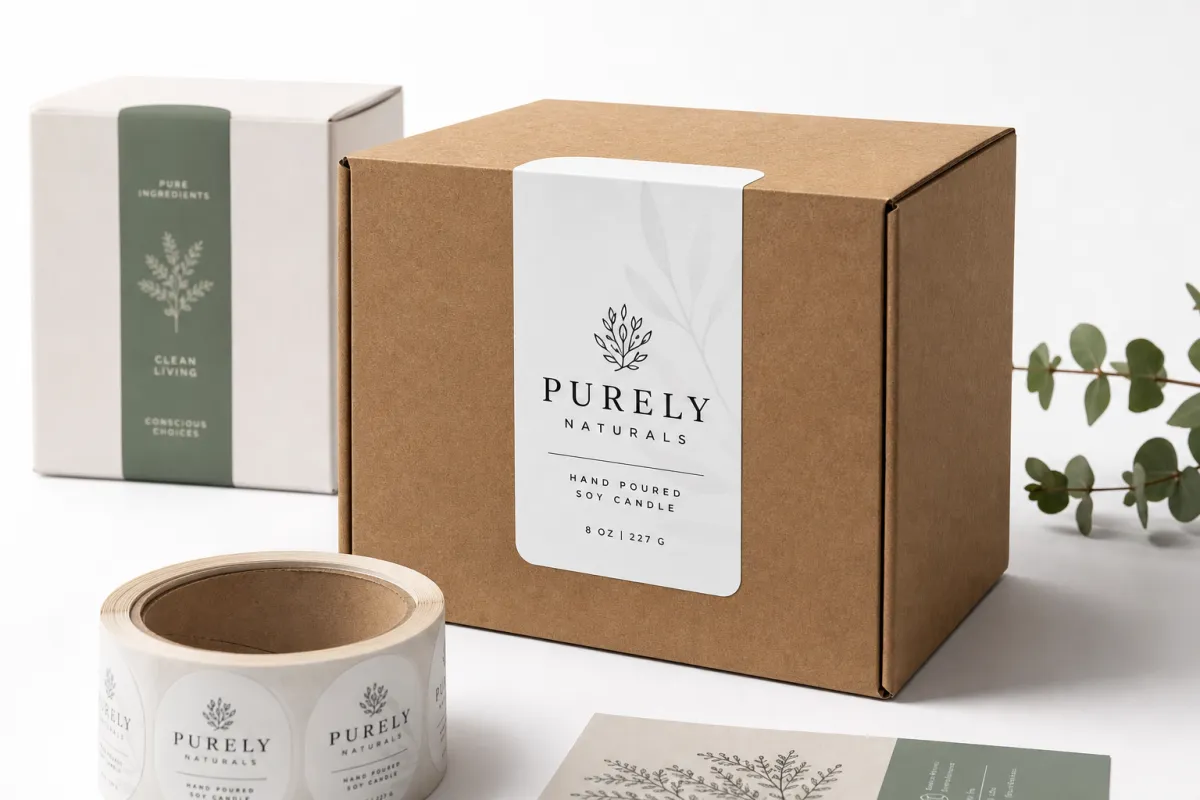
The biggest change custom label stickers for boxes make is perceptual. A plain kraft carton says, "We shipped something." A label says, "We planned this." That small shift matters because packaging design is not just visual; it is operational too. A single branded label can separate a new launch from a generic fulfillment run, especially when the outer shipper is the only part of the order a customer sees at the door or during pickup.
From a packaging buyer's point of view, custom label stickers for boxes also reduce friction. Campaign copy, seasonal art, QR codes, and compliance notes can change without reordering the whole carton. That flexibility is especially useful for short runs, regional campaigns, influencer kits, and multi-SKU product packaging, where printing a different carton for every variation would create waste and tie up cash in inventory.
There is a branding advantage too. Custom label stickers for boxes create a repeated visual cue across shipping boxes, mailers, inserts, and retail packaging. When customers see the same mark, color system, or message on the exterior box, the inner pouch, and the thank-you seal, the brand feels more organized. That is package branding at work: not louder, just more consistent.
One overlooked use is internal organization. Many teams use custom label stickers for boxes to separate kits, channels, warehouse zones, or promotional waves. That does not sound glamorous, yet it saves time. A fulfillment team that can identify the right box in one second is a team that ships faster and makes fewer mistakes.
The labels are also easy to scale up or down. A 500-piece test run for a new subscription box is a very different business case from a 50,000-piece national rollout. Labels make room for learning before a larger commitment. They let brands test copy, seasonal graphics, and callouts without redesigning the entire packaging line.
There is one real boundary to keep in mind: custom label stickers for boxes are not always the best choice when the design never changes and volume is high. In that case, custom printed boxes may win on unit economics and operational simplicity. The question is not whether labels are "better." It is whether they are better for the current run size, SKU mix, and brand cycle.
Brands building a packaging system rather than a one-off promotion often start here. If you need a broader packaging stack, it helps to compare labels with Custom Labels & Tags and the wider range of Custom Packaging Products so the outer box, insert, and shipping finish speak the same design language.
How Custom Label Stickers for Boxes Are Made and Applied
The production path for custom label stickers for boxes looks simple on paper and gets more sensitive in the details. It starts with artwork setup, moves through proofing, then material and adhesive selection, then print method, finishing, cutting, and packing. Every step carries cost and timing, and the weak link is often the file you send first.
A clean order begins with size and placement. If the label is meant to be the hero element, it may cover most of the panel. If it is meant to seal a tuck flap or mark a SKU, it may be small and precise. Shape matters here. A round or oval label softens a design, while a full-bleed rectangle feels closer to a panel wrap. On corrugated board, even a few millimeters change how much texture shows through and how much of the box remains visible around the label.
Material choice is where the technical side starts. For custom label stickers for boxes, paper stocks work well for dry, indoor, short-life applications. BOPP and other film labels hold up better when the carton may face abrasion, moisture, or temperature swings. Recycled boards and rough kraft surfaces often need a more aggressive adhesive because texture reduces contact area. If the box is gonna sit in a cold dock, a freezer-grade or cold-temp adhesive may justify its higher price. That is not a vanity upgrade; it is an adhesion decision.
Print method matters too. Digital printing usually fits smaller runs, variable data, and quick changeovers. Flexographic printing can make sense at higher quantities, especially when a design stays stable long enough to justify plates and setup. The right method depends on quantity, color complexity, and whether you need spot colors, gradients, or a specific PMS match. For labels that need to pass scan checks or meet internal quality targets, color fidelity often matters more than glossy effects.
Application can be manual or automated. Hand application works fine for small orders, but it slows down once the boxes stack up. Roll-form labels feed better into semi-automatic or automatic dispensers, which is why larger fulfillment operations often prefer them. A label that is cut accurately and wound properly saves labor every time it is applied. That is one reason custom label stickers for boxes can cut hidden costs even when the printed unit price is not the lowest line on the quote.
Where teams lose time is easy to predict: incomplete art files, late color changes, vague placement instructions, and proof revisions that should have been settled before the first mockup. The fastest orders usually come from teams that send final box dimensions, a clean logo file, and a placement photo or dieline on day one. Slow orders tend to be the ones still debating whether the logo should sit centered or slightly high after production has already started.
Lead time follows complexity. A standard label with matte finish and simple artwork may move quickly after approval. Add a custom die-cut, specialty laminate, or barcode validation, and the calendar stretches. If you want tighter expectations, ask how long proofing takes, whether there is a curing or finishing stage, and whether shipping is included in the quoted timeline. For custom label stickers for boxes, those details often explain more than the press schedule itself.
Custom Label Stickers for Boxes: Cost, Quality, and Lead Times
Pricing for custom label stickers for boxes is rarely a single number, because the quote reflects a stack of variables. Material, adhesive strength, size, shape complexity, finish, color count, and quantity all push the price in different directions. If you are comparing suppliers, separate the sticker itself from the setup and logistics around it. That is where many "cheap" orders stop looking cheap.
Quantity usually has the biggest effect on unit cost. A small run may carry a higher per-piece price because the press setup, proofing, and finishing are spread across fewer labels. Once volume rises, the per-unit price tends to fall. That does not mean bigger is always cheaper overall; it means the fixed costs become less painful. For many brands, custom label stickers for boxes sit in a sweet spot at short-to-medium runs because they avoid the capital tied up in printed cartons.
Here is a practical pricing snapshot for a standard 3 x 4 inch label run at around 5,000 pieces. These are ballpark figures, not a quote, and they will move with coverage, stock, and supplier setup, but the ranges below give a useful starting point:
| Label Type | Typical Use | Estimated Unit Price | What Drives the Cost |
|---|---|---|---|
| Paper matte label | Dry shipping cartons, short-term promotions | $0.06-$0.12 | Simple artwork, low ink coverage, standard die |
| Gloss or semi-gloss label | Retail packaging, brighter color presentation | $0.08-$0.16 | Finish, color density, and coating choice |
| BOPP or film label | Durable boxes, moisture-prone handling | $0.09-$0.22 | Film stock, stronger adhesive, longer wear life |
| Custom shape label | Premium branded packaging, special promotions | $0.12-$0.28 | Die complexity, waste, and setup time |
| Specialty finish label | High-end branding, tactile presentation | $0.15-$0.35+ | Soft-touch, foil, texture, or premium coating |
Those ranges show a pattern: custom label stickers for boxes become expensive when they are asked to do too much. If the label needs moisture resistance, premium finish, custom die-cutting, and fast turnaround, the quote will reflect all four. Keep the design simple and you can usually stay much closer to the low end.
There are indirect costs as well. Proofs may be included or billed separately depending on the supplier. Rush fees can appear when the turnaround collapses from two weeks to a few days. Shipping can matter more than expected on smaller orders, because a low-value print job can still carry a meaningful freight charge. If your boxes are part of a launch, remember to add the cost of samples, reprints, and any relabeling labor. That is the real landed cost of custom label stickers for boxes, not just the sticker price.
Lead times follow a similar logic. A straightforward order with final artwork and a standard material might move from proof approval to delivery in roughly 7-12 business days. More complex orders, such as custom shapes, specialty finishes, or multiple versions, can stretch to 12-20 business days or more. If a supplier promises speed, ask what they mean by speed: proof turnaround, print time, or shipping time. Those are not the same thing, and custom label stickers for boxes can look fast until the proof loop begins.
Quality is not just print sharpness. It is adhesion, scuff resistance, and whether the label stays aligned after handling. For buyers comparing specs, peel adhesion and tack matter almost as much as color accuracy. Industry references such as ISTA testing standards and ASTM methods like D3330 for peel adhesion are useful anchors when you need a more disciplined comparison. On sustainability, FSC-certified stocks can support a brand story when fiber sourcing matters, and packaging design teams increasingly factor that into product packaging decisions.
If you are weighing labels against full cartons, ask a simple question: will the design stay stable long enough to justify custom printed boxes? If yes, printed cartons may win. If not, custom label stickers for boxes usually give you more control, lower inventory risk, and a cleaner path to iteration.
Step-by-Step Process for Ordering Custom Label Stickers for Boxes
Ordering custom label stickers for boxes gets much easier when you treat it like a packaging project, not a design request. The most efficient teams know exactly what the label has to do before they ask for a quote. They define the use case, gather the dimensions, and decide what the label should communicate before anyone starts choosing fonts.
- Define the use case. Is the label for shipping cartons, retail packaging, event kits, subscription boxes, or internal fulfillment? A seal label behaves differently from a full-front brand panel, so the job should be scoped before artwork begins.
- Measure the box. Record panel size, seam locations, fold lines, and any areas that cannot be covered. A label that looks perfect on a mockup may fail if it crosses a corrugation ridge or lands too close to a closure flap.
- Choose material and adhesive. Match the stock to the surface. Smooth coated cartons can accept lighter adhesives, while rough recycled boards usually need stronger tack. If moisture, cold storage, or long transit are involved, durability should be part of the spec from the start.
- Prepare artwork correctly. Use the right bleed, keep text away from trim, and place barcodes or QR codes with enough quiet space around them. If you want a code to scan on the first pass, do not crowd it with decorative elements.
- Review the proof slowly. This is where spelling errors, color shifts, and placement issues get caught. A proof for custom label stickers for boxes should be checked in context, not just in isolation. Print it if necessary and look at it beside the actual carton.
- Approve, test, and scale. Ask for a first shipment if possible, apply labels to real boxes, and inspect them under the same handling conditions you use every day. If the label wrinkles, lifts, or reads poorly in motion, fix it before you roll out thousands more.
There is a quiet efficiency gain in doing this well. A brand team that finalizes the hierarchy of logo, message, and operational data once can reuse that structure across a whole family of custom label stickers for boxes. That is especially useful if you manage different box sizes or seasonal campaigns with the same packaging style.
The strongest proof reviews are blunt. Ask whether the logo is legible from three feet away. Ask whether the label still feels balanced if the box arrives scuffed. Ask whether a warehouse operator can spot the correct SKU without slowing down. If the answer is no, the design may still look good online, but it is not ready for production.
Common Mistakes That Undercut Box Labels
Most failures with custom label stickers for boxes are not dramatic. They are small mismatches that add up: wrong adhesive, weak contrast, poor placement, or a label size that looks fine in a design file and disappears once it is on corrugated board. Those mistakes are common because packaging teams often approve labels before they see them on the real carton.
The first mistake is choosing an adhesive that cannot handle the surface. Dusty corrugated, recycled board, and cold warehouse conditions all reduce performance. A label that holds in the studio may lift at the corners after a few hours in transit. That is why actual box testing matters. If the label has to survive stacking, rough handling, or condensation, the sample should be tested under those conditions rather than assumed to be fine.
Another common issue is visual overload. A label with too many messages, too many type sizes, and too many accent colors can feel busy and cheap. Strong custom label stickers for boxes usually do one job well: they lead with the brand mark, then a message, then supporting details. If everything is shouting, nothing stands out. That is as true in retail packaging as it is in shipping cartons.
A label that looks excellent on a screen can still fail on a moving line. Corrugation, glare, dust, and handling change the way people actually read it, and that is kinda the whole trick.
Gloss can work against you too. A glossy box paired with a glossy label can create glare under warehouse lights or retail fixtures, which hurts readability and can make the logo feel less premium than intended. In some cases, a matte stock with a slight texture gives a more confident result. That is one of those packaging design choices where restraint beats shine.
The final mistake is ordering too early. Teams often rush custom label stickers for boxes before the branding, copy hierarchy, or SKU architecture is settled. That usually creates rework, wasted inventory, and relabeling costs later. If your campaign is still changing every week, the safest move may be a short run with a flexible design rather than a large order with a fragile one.
One more hidden problem: labels that ignore the box geometry. A design that crosses a seam, wraps too close to an edge, or sits on a fold line will always be more vulnerable. A few millimeters of bad placement can do more damage than a mediocre logo ever will. Good package branding starts with the substrate, not just the artwork.
Expert Tips for Better Custom Label Stickers for Boxes
The best custom label stickers for boxes usually look simple because the structure is doing the heavy lifting. Start with visual hierarchy. Put the brand mark first, the campaign or product message second, and the operational details third. If the label needs a barcode, QR code, or regulatory text, give those elements a home instead of asking them to share space with the logo. A label that knows its job is easier to read and easier to apply.
Design for real viewing distance. That sounds obvious, but many teams build labels as if customers will study them from six inches away. They will not. A box is seen while being carried, stacked, scanned, or unboxed. That means the typography should still read from a few feet away. In practice, bold contrast and clean spacing matter more than decorative tricks, especially on smaller custom label stickers for boxes.
It also helps to create a repeatable system. If your brand runs seasonal drops, bundles, and size variations, build one label framework and swap only the message or color accent. That keeps the packaging design cohesive while allowing flexibility. Brands that do this well often use the same grid for shipping boxes, retail packaging, and inserts, which is one reason their package branding feels intentional instead of improvised.
Think about sustainability in a practical way, not a performance way. Right-sized labels reduce waste. Recyclable stocks can support the carton's end-of-life path if the adhesive and coverage are appropriate. Lower ink coverage can reduce visual clutter and material use. If the label is going on kraft cartons, a restrained design may also let the box texture do part of the branding work. For some brands, that natural look is exactly the point.
The other expert move is knowing when to stop using labels and switch to custom printed boxes. If your volume is stable, your art never changes, and your SKU count is manageable, printed cartons may produce a cleaner cost structure over time. But if you are still testing products, opening new channels, or changing seasonal copy often, custom label stickers for boxes are usually the smarter bridge between blank stock and a fully committed carton program.
When you need to compare options, the broader packaging ecosystem matters too. A supplier that handles labels, cartons, and inserts can keep color and messaging aligned across the full order. That is one reason brands often map labels alongside Custom Packaging Products instead of treating them as a one-off line item.
For quality control, use outside references instead of gut feel alone. ISTA testing can help you understand whether a label survives transit stress. FSC documentation can support fiber sourcing claims. EPA guidance can help teams think more clearly about recycling realities rather than assuming every "eco" label means the whole pack is recyclable. Those standards do not design the label for you, but they keep the conversation grounded.
Need a quick rule of thumb? If the label must handle motion, moisture, and brand storytelling all at once, choose fewer words, stronger contrast, and a better adhesive. That combination outperforms a crowded design almost every time. It also gives custom label stickers for boxes a better chance of looking premium after the carton leaves your building.
Actionable Next Steps for Custom Label Stickers for Boxes
If you are ready to move from concept to order, start with the box, not the design. Measure the carton, note the surfaces, and write down where the label will sit. If the label is going on a shipping box that may face rough handling, say so. If it is for retail packaging, note whether the box sits on a shelf, in a mailer, or inside a kit. Specifics save rounds of revision later.
Then gather the right inputs in one place:
- Exact box dimensions and panel measurements
- Quantity by SKU or version
- Logo files, copy, QR or barcode needs
- Preferred finish, color direction, and any must-match brand elements
- Surface conditions such as kraft, coated board, recycled board, humidity, or cold storage
Once those pieces are together, request a proof and test it on the actual carton. Do not stop at the PDF preview. Apply the label, rub the edges, stack the box, and inspect it under warehouse light if that is where it will live. That small test often tells you more than a week of internal comments. A good proof process is the fastest way to make custom label stickers for boxes feel manageable instead of risky.
From there, set a reorder point based on lead time and monthly usage. If your average run takes 10 business days and your campaign can spike unexpectedly, you do not want to place orders only when stock hits zero. That is how teams end up paying rush fees or shipping boxes without the branded layer they planned for. A simple buffer is usually cheaper than an emergency job.
For brands still shaping their packaging system, it can help to compare labels against other components in the same order. A well-planned stack might include printed cartons for stable SKUs, labels for seasonal changes, and coordinated inserts for messaging. That kind of planning keeps branded packaging coherent without tying up cash in overcommitted inventory.
Most of all, think of custom label stickers for boxes as a packaging tool, not just a print product. They are part design, part logistics, part cost control. If you measure carefully, spec the right material, proof with discipline, and test on a real box, they can outperform plain packaging in ways that show up both in the unboxing experience and in the numbers.
Measure the carton, choose the stock for the actual surface, proof the artwork on the real box, and run a small test before you scale. That sequence keeps custom label stickers for boxes from becoming a guess and turns them into a repeatable part of your packaging workflow.
How do custom label stickers for boxes compare with printed boxes?
Labels are usually better for short runs, frequent design changes, and multi-SKU operations. Printed boxes make more sense when volumes are high and the artwork will stay stable for a long time. Labels also let you upgrade existing inventory without replacing the entire carton, which is one reason many brands start there before moving into custom printed boxes.
What affects the price of custom label stickers for boxes?
Material, adhesive strength, size, shape, finish, and quantity are the biggest cost drivers. Rush production, complex die-cuts, and specialty effects can raise the total quote. Proofing and shipping may add cost, especially for smaller orders, so the landed price of custom label stickers for boxes can differ from the headline unit rate.
How long does it take to produce custom label stickers for boxes?
Simple orders can move quickly once artwork is approved and the proof is signed off. More complex jobs take longer because of proof revisions, specialty finishes, or custom shapes. The fastest way to reduce lead time is to send clean artwork and final box dimensions from the start, which removes a lot of back-and-forth from the process for custom label stickers for boxes.
What material works best for custom box labels on corrugated cartons?
A label with the right adhesive for textured corrugated surfaces usually performs best. If the box may face moisture, cold storage, or rough handling, durability matters as much as print quality. A sample test on the actual box is the safest way to confirm performance before placing a larger order for custom label stickers for boxes.
Can custom label stickers for boxes be used for barcodes or QR codes?
Yes, as long as the label has enough contrast, size, and quiet space around the code. The code should be placed where it will not wrap over edges, seams, or heavy handling zones. Always test scanability on the final box and label material before a full run, because custom label stickers for boxes that look good can still fail if the code is cramped or distorted.

