Buyer Fit Snapshot
| Best fit | Custom Label Stickers for Mailers projects where brand print, material claims, artwork control, MOQ, and repeat-order consistency need to be specified before quoting. |
|---|---|
| Quote inputs | Share finished size, material target, print colors, finish, packing count, annual reorder estimate, ship-to region, and any compliance wording. |
| Proofing check | Approve dieline scale, logo placement, barcode or warning zones, color tolerance, closure strength, and carton packing before bulk production. |
| Main risk | Vague material claims, crowded artwork, missing packing details, or unclear freight terms can make a low unit price expensive after revisions. |
Fast answer: Custom Label Stickers for Mailers: Material, Adhesive, Artwork, and MOQ should be specified like a repeatable production item. The safest quote records material, print method, finish, artwork proof, packing count, and reorder notes in one written spec.
Production checks before approval
Compare the actual filled-product size with the drawing, then confirm tolerance on folds, seals, hang holes, label areas, and retail display edges. Reserve space for logos, QR codes, warning copy, and material claims before decorative graphics fill the panel.
Quote comparison points
Review material grade, print process, finish, sampling route, tooling charges, carton quantity, and freight assumptions side by side. A quote is only useful when the supplier can repeat the same color, closure quality, and packing count on the next order.
Custom Label Stickers for Mailers: Smart Shipping Basics
For many brands, custom label stickers for mailers are the last thing a customer sees before a package slips into the blur of delivery scans and sort belts. That little rectangle has a bigger job than it looks like it does. It has to survive handling, moisture, barcode reads, and brand scrutiny all at once. Not many packaging elements carry that much responsibility so quietly.
Custom Label Stickers for Mailers: What They Do and Why They Matter
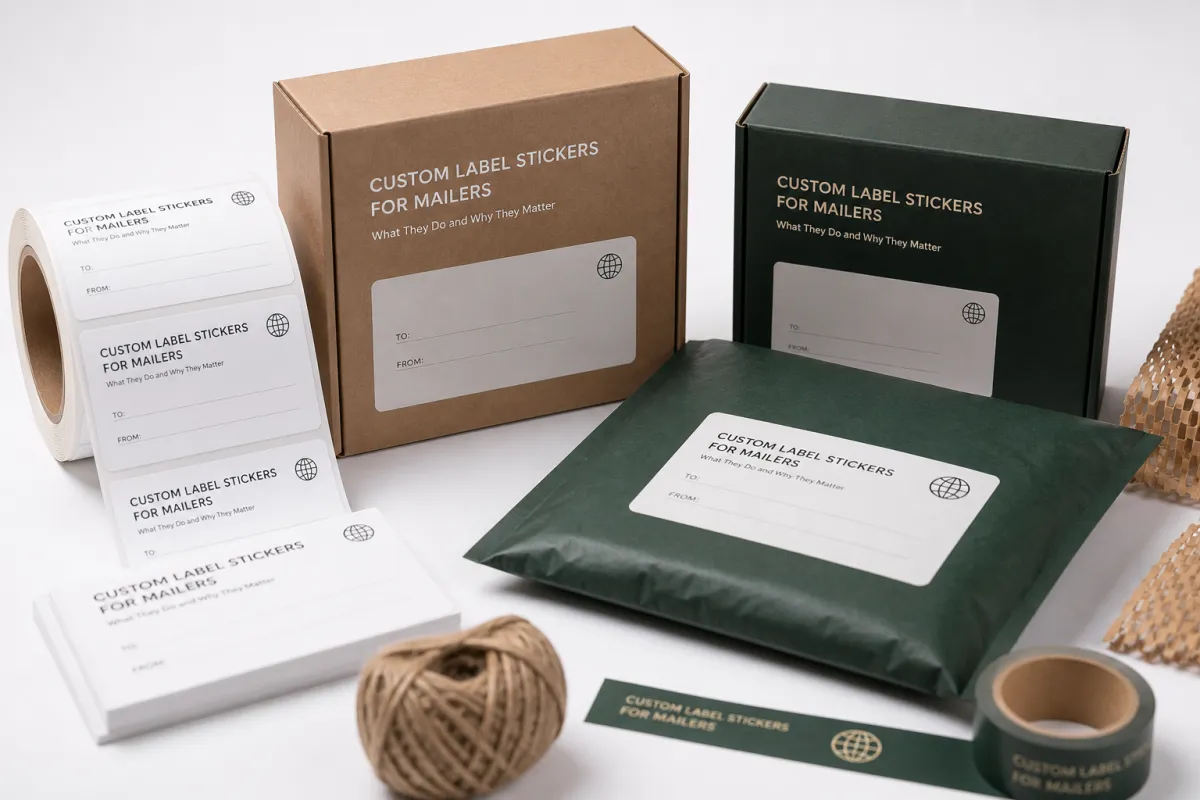
Custom label stickers for mailers are branded adhesive labels used on shipping mailers, poly mailers, corrugated mailers, and padded envelopes for identification, promotion, compliance, or handling instructions. They sit at the intersection of operations and branding, which is why they matter far more than a casual sample sheet suggests. One side helps the package move. The other side helps a customer recognize who sent it before the parcel is even open.
That dual function is where the real value lives. A mailer label can direct a picker, reassure a packer, and guide a courier in the same square inch of space. It can also turn a plain envelope into a recognizable brand touchpoint. A company already investing in branded packaging, Custom Printed Boxes, or broader package branding has a lot to gain from getting this detail right. The label is small, but the impression it leaves can linger longer than the tape or the carton.
There is a practical comparison worth making. Handwritten labels slow packing and drift in quality as order volume rises. Plain thermal stickers work well for barcodes and shipping data, yet they rarely carry much identity. Custom label stickers for mailers bridge that gap. They look polished, reduce manual errors, and keep busy shipping workflows organized. In a warehouse handling hundreds of orders a day, those tiny efficiencies compound fast. A five-second savings per order becomes real labor by the end of a shift.
"A label is not just a sticker. It is a traffic signal for the warehouse and a brand signal for the customer."
The right choice depends on the mailer material, print method, volume, durability needs, and budget. A paper label that looks perfect on kraft may fail on a glossy poly mailer. A premium soft-touch finish may be ideal for retail packaging, yet unnecessary for disposable shipping parcels. Custom label stickers for mailers work best when they are chosen for the actual workflow, not the mockup render.
For teams building a fuller packaging system, labels connect neatly to everything else in the ship-and-unbox path. A brand might ship products in Custom Poly Mailers, pair them with Custom Labels & Tags, and keep the rest of the line aligned through Custom Packaging Products. That kind of consistency matters. Customers notice whether the shipping layer feels like part of the same story as the product packaging inside.
What Are Custom Label Stickers for Mailers Used For?
Custom label stickers for mailers do more than sit on top of a parcel and look tidy. In practice, they can carry order information, support warehouse sorting, reinforce branding, and add handling instructions in one pass. That matters because shipping is rarely a single-purpose system. It is a chain of decisions, and every object in that chain either reduces friction or adds it.
For e-commerce brands, the most common use is visual identity. A label can turn a plain mailer into a recognizable piece of package branding, which matters when customers see your parcel stacked with others in a lobby, locker, or receiving room. For fulfillment teams, the same label can help organize SKUs, seasonal campaigns, or bundle orders. For regulated goods, a label may also support compliance text, batch details, or care instructions. One sticker. Several jobs.
The best labels tend to be the ones that do not force the user to think too hard. If the packer can place it quickly and the customer can recognize it instantly, the label is doing its job. That balance is why custom label stickers for mailers are often a stronger option than handwritten notes or generic stock stickers. They combine speed, clarity, and a finished look without asking the warehouse to slow down.
I have watched teams lose hours a week because a label format was "good enough" on screen but awkward on the line. The failure is usually small and boring: a label that curls on poly, a barcode that prints too close to the edge, or a finish that looks great under studio lights and muddy under fluorescent warehouse lighting. Those are not glamorous mistakes. They are the kind that quietly eat margin.
How Custom Label Stickers for Mailers Move Through Fulfillment
Custom label stickers for mailers are easy to misunderstand if you only look at the finished sheet or roll. The label has a lifecycle, and most mistakes start before printing begins. Artwork approval, proofing, production, quality checks, inventory storage, application, and final scan each create a place where a weak decision can turn into a reprint or a shipping delay. The failure may show up at the packing bench, but the cause usually lives much earlier in the process.
The typical workflow starts with design file prep. That means setting the right dimensions, bleed, safe area, barcode placement, and color profile. Once the artwork is approved, the vendor issues a proof. If the proof is clean, production begins. Depending on the substrate and finish, labels may need drying, curing, slitting, or roll conversion before they ship. After that comes receiving, staging, and application at the packing bench.
For e-commerce, custom label stickers for mailers often serve as an outer branding layer that still has to move quickly through the line. For subscription boxes, labels may need to match seasonal campaigns, influencer drops, or limited-edition product packaging. Wholesale shipments usually care more about durability and compliance. Local delivery can prioritize speed and clear identification. Different channels, different pressure points, different failure modes.
The timeline question matters more than most buyers expect. Digital proofs can move in a few hours. Production is different. A modest run might be ready in 5 to 8 business days after approval, while larger or more complex orders can take 10 to 15 business days, especially if special finishes or tighter color matching are involved. Freight time and warehouse receiving add another layer. That lag matters if you are planning a product launch, a retail packaging refresh, or a holiday shipping window with no room for surprises.
There is a real operational tradeoff between in-house printing and outsourced production. In-house systems are excellent for variable data, fast changes, and short runs. Outsourced custom label stickers for mailers tend to win on consistency, stronger material options, and better cost efficiency at scale. Many teams settle into a hybrid model: outsourced master labels for the core brand, with in-house variable labels for SKUs, promotions, or route-specific details. That approach is less glamorous than a full system overhaul, and often more useful.
For teams that ship in large volumes, standards can help frame the decision. The packaging industry often looks to ISTA transit testing guidance for distribution risk, and broader packaging resources at packaging.org for material and supply-chain context. Neither site picks your label stock, but both are useful reference points when you want packaging design to reflect actual handling conditions rather than wishful thinking.
Choosing Materials, Adhesives, and Finishes for Mailers
Material selection is where custom label stickers for mailers either become dependable or become a nuisance. The main options are paper labels, polypropylene labels, vinyl labels, and specialty stocks built for moisture resistance or premium appearance. Paper is usually the most economical and works well on flat, dry surfaces. Polypropylene tends to hold up better to scuffing, light moisture, and handling. Vinyl is durable, though it is often more label than many shipping applications truly need unless the parcel will face repeated abrasion or harsh environmental conditions.
Adhesive selection matters just as much as face stock. Smooth plastic mailers need a different tack profile than textured paper mailers. Recycled mailers can be inconsistent because the surface is not always uniform. Refrigerated or cold-chain shipments often need a higher-performance adhesive that stays bonded at lower temperatures. That is not a side detail. A label that lifts in transit can break a scan or make a parcel look sloppy before it reaches the customer.
Finish choice shapes both durability and perception. Matte gives a clean, readable look and reduces glare under warehouse lighting. Gloss can sharpen colors and make branded graphics pop, though it may show scratches more easily. Soft-touch finishes feel premium, yet they usually belong more naturally in product packaging or retail packaging than on a rough shipping lane. A protective laminate can improve moisture and scuff resistance, though it raises cost and adds thickness that may matter on tight application surfaces.
Size and shape are not decorative decisions. A 2 x 3 inch label may be perfect for a simple logo and return address, while a 4 x 6 inch label can handle branding, instructions, barcode space, and regulatory text. Leave room around seams, folds, and edges. If the label has to wrap over a crease or a curve, lift risk increases. In practical terms, the flatter the application zone, the stronger the bond usually is.
There is also a sustainability angle, and it deserves a grounded view rather than marketing fluff. Recyclable stocks, minimal-ink layouts, and right-sized labels all help reduce waste. A label that fails in transit creates more waste than it saves, so durability remains part of the sustainability conversation. If your team wants FSC-aligned sourcing or recycled-content claims, make sure the documentation is current and real. The FSC certification framework is a useful benchmark, and the EPA recycling guidance is helpful when disposal assumptions need checking. Good sustainability is specific, not vague.
For many brands, the smartest approach is to match the label to the mailer rather than forcing one stock across every shipment. If your line uses both poly and paper mailers, it may be smarter to spec two label constructions than to make one compromise choice and hope it holds up everywhere.
One more thing from the field: testing on the actual mailer is not optional. I have seen labels pass a bench test and then peel after a 48-hour stay in a warehouse that was a little too humid. That is the kind of thing that makes everyone suddenly very interested in adhesion curves, even if nobody was before.
Cost and Pricing Factors for Custom Mailer Labels
Custom label stickers for mailers are priced by more than the printed face. Size, quantity, substrate, adhesive type, color count, finishing, and whether the job is sheeted or roll-fed all shape the invoice. A simple one-color paper label in a large volume can look nothing like a full-color laminated BOPP label in a short run. The art budget may be the same. The label budget rarely is.
Scale changes the math. Small orders usually have a higher per-label cost because setup and press time are spread across fewer pieces. A run of 1,000 labels might fall in the range of $0.12 to $0.30 per unit depending on material and coverage. A 10,000-piece order can pull unit cost much lower, sometimes into the $0.04 to $0.10 range for standard constructions. Those are broad estimates, not promises, but they show how volume changes budget planning.
Hidden costs matter too. Blank stock plus in-house printing looks inexpensive at first glance, yet the real picture includes printer maintenance, ink or ribbon consumption, labor, spoilage, and reprints. If the team spends extra seconds checking alignment or replacing supply rolls, the true cost per shipped order rises. Custom label stickers for mailers can reduce that friction because the artwork arrives finished and ready to apply, which is often where the savings show up.
Below is a simple comparison buyers often find useful:
| Option | Typical Unit Cost | Best For | Main Tradeoff |
|---|---|---|---|
| Blank stock + in-house print | $0.03-$0.12 | Variable data, fast changes, low to moderate volume | Printer upkeep, labor, and reprint risk |
| Custom printed paper labels | $0.04-$0.18 | Simple branding, standard mailers, larger repeat runs | Less durability on moisture-prone surfaces |
| Custom printed BOPP or laminate labels | $0.08-$0.28 | Poly mailers, premium branding, higher handling exposure | Higher cost and sometimes longer lead time |
| Specialty cold-temp or high-tack labels | $0.10-$0.35 | Refrigerated shipping, recycled mailers, difficult surfaces | More testing needed before committing |
Some buyers overspecify because they assume stronger is always better. That is not always true. A premium laminated label on a plain document mailer may be money spent on a feature no customer notices. On the other side, under-specifying a label on a damp or recycled poly mailer can lead to scuffing, peel-back, or poor presentation. The answer usually sits in the middle: durable enough for the route, simple enough for the budget.
One more budgeting point. The cheapest label is not always the lowest-cost option. If a label slows packing by four seconds per order, or creates a 1% misread rate that requires manual intervention, the operational drag can outrun the material savings. That is why custom label stickers for mailers should be evaluated as part of packaging design and fulfillment flow, not as a line item floating by itself.
Step-by-Step Process: Design, Proof, Print, Apply
The best way to approach custom label stickers for mailers is to treat them like a repeatable system. Start with the brief. Define the mailer type, surface texture, shipment conditions, brand goals, required text, barcode needs, and target turnaround time. If the label has to do more than one job, spell that out early. A label meant for both branding and sorting is not the same as a label meant only for a logo.
Artwork setup comes next, and the details matter. Use the correct label dimensions. Keep important text away from the trim edge. Leave bleed if the artwork runs to the edge. Build strong contrast between text and background so scanners and packers can read the label without strain. For barcodes, preserve adequate quiet space around the symbol. In practical terms, the layout should be easy on both the eye and the machine.
The proofing stage is where many reprints could have been avoided. Check spelling, item codes, barcode placement, brand colors, legal text, and quantity. If the mailer is a glossy poly surface, ask how the adhesive behaves on that material. If the label is supposed to carry a sustainability claim, confirm the wording before production starts. A proof is not a checkbox. It is the last low-cost place to catch a mistake.
Here is a simple production sequence that works well for most teams:
- Finalize the brief and label dimensions.
- Approve the artwork and proof.
- Run the print job and allow curing or drying as needed.
- Finish, slit, or sheet the labels.
- Pack and ship the finished order to the warehouse.
- Receive, inspect, and store the labels in a dry staging area.
- Train packers on placement and pressure during application.
Application discipline sounds minor. It is not. Pressure, timing, and surface prep affect bond quality. If the mailer is dusty, folded, or damp, the label may not seat correctly. If the packer places it inconsistently, the outbound look becomes uneven. In a high-volume environment, custom label stickers for mailers are part of the packing standard, not just an accessory stuck on at the end.
That standard should connect to the rest of the line. A brand that invests in packaging design for boxes, tissue, inserts, and mailers should give the label the same attention. Otherwise the visual system breaks at the last step, which is exactly where the customer is most likely to notice it.
Common Mistakes with Mailer Labels and How to Avoid Them
The most common mistake with custom label stickers for mailers is choosing a label that performs well on paper but fails on plastic, recycled, or cold-temperature surfaces. That mistake usually shows up as edge lift, poor adhesion, or labels that wrinkle during transit. The fix is straightforward: test on the actual mailer, not only on a sample sheet in the office.
Another frequent issue is weak contrast. Tiny fonts, pale ink, and busy graphics can interfere with scanning and readability. A label does not need to shout, but it does need to be legible. If the mailer label carries route information or a barcode, use clean typography and leave breathing room. Warehouse lighting is often harsher than the design team expects, and glare can expose every weak decision.
Placement errors are just as damaging. Labels applied across seams, folds, or curved edges tend to lift. A label that lands too close to a flap can catch during handling. A label that wraps over a crease can wrinkle and make the package look poorly packed. Consistency matters here, because a good label applied badly still becomes a bad package.
File prep mistakes can create avoidable reprints. Mismatched color profiles, low-resolution logos, missing bleed, and incorrect dielines all slow the process. So do inconsistent brand assets across product lines. If your custom label stickers for mailers do not match the look of your custom printed boxes or other retail packaging elements, the overall brand system feels patched together instead of intentional.
Inventory planning can also trip up experienced teams. Ordering too few labels forces emergency reorders, which are expensive and stressful. Switching suppliers without testing can create unexpected changes in adhesive, finish, or color. Seasonal spikes are another trap. Holiday promotions, launch windows, and wholesale surges all increase consumption faster than a casual estimate suggests. A spreadsheet that looked fine in July can fall apart by November.
A useful preventive habit is to test in batches. Run two or three adhesive and material combinations on the exact mailers you ship most often. Then inspect them after application, after overnight dwell, and after simulated handling. If the label stays flat, reads well, and looks right after a rough pass, you have a real candidate. If not, you have saved yourself a warehouse problem.
Teams that ship high volumes often document these lessons in a basic label spec sheet: mailer type, label construction, approved artwork, storage conditions, application notes, and reorder triggers. That kind of discipline sounds simple, but it saves time every week.
One more mistake deserves a mention: confusing "premium" with "appropriate." A label can look expensive and still be wrong for the route. I have seen brands spend extra on a silky finish for a mailer that spends its life getting shoved into parcel cages. That money would have been better spent on adhesion and print clarity. Fancy is nice; reliable is nicer.
Expert Tips and Next Steps for Better Mailers
If there is one practical shift that improves custom label stickers for mailers, it is standardization. Standardize a few proven label formats by mailer size so the packing team is not making one-off decisions on every order. One label for small poly mailers. One for rigid envelopes. One for large shipping pouches. That is often enough. Complexity tends to grow on its own; standards keep it from growing faster than the business.
It also helps to document your tests. Start with two or three candidate materials, apply them to the actual mailer stock, and record what happens after handling, storage, and transit. Note the cost per shipped order, mislabel rate, pack time, and customer feedback. You do not need a complicated dashboard. A spreadsheet can reveal whether the label system is improving operational efficiency or just looking better on a render.
Another good move is to build a refresh cycle for artwork and compliance details. Brand campaigns change, return addresses move, phone numbers shift, and legal language gets updated. If the label master file is reviewed on a schedule, you avoid last-minute scrambles. That keeps custom label stickers for mailers current without interrupting the fulfillment line.
There is a bigger lesson here, too. Labels are not isolated accessories. They sit inside the broader packaging ecosystem, alongside inserts, cartons, mailers, and protective materials. If a business is serious about package branding, the label should be treated with the same respect as the outer shipper or the shelf-facing product packaging. The customer may not name the label specifically, but they absolutely register the effect.
For teams ready to make the system repeatable, the end goal is straightforward: document the spec, approve one master template, and scale from there. Keep the artwork simple enough to scan, durable enough to survive shipping, and consistent enough to support the brand. That is how custom label stickers for mailers move from a one-off supply purchase to a reliable part of the fulfillment process.
And if the operation grows, revisit the label spec the same way you would revisit mailer size, carton strength, or pack-out materials. Packaging is a system. The label sits in the final inch of that system, but the final inch is often the part customers remember most. It sounds small, but it adds up.
FAQ
Are custom label stickers for mailers better than direct printing?
Custom label stickers for mailers are usually better when you need flexibility across multiple mailer types, short runs, or frequent design changes. Direct printing can be efficient for very high volumes, but labels are easier to update, stock, and redeploy across products or campaigns. If your mailers vary by size or surface, labels often create fewer production headaches than changing print setups.
What size should custom label stickers for mailers be?
The right size depends on the mailer dimensions, required text, barcode placement, and whether the label needs to carry branding or shipping information. A good rule is to leave margin around seams, edges, and folds so the label stays flat and readable. Test a sample on the actual mailer before ordering a full run of custom label stickers for mailers.
How do I choose the best adhesive for mailer labels?
Match the adhesive to the mailer surface: smooth plastic, paper, recycled stock, and cold or humid environments all behave differently. High-tack options help on tricky surfaces, but too much adhesive can make repositioning difficult during application. Ask for material tests on the exact mailer stock you ship most often before you commit to custom label stickers for mailers.
How much do custom label stickers for mailers cost?
Pricing depends on quantity, size, material, finish, and whether the labels are printed on rolls or sheets. Smaller runs usually have a higher per-label cost, while larger orders lower unit pricing but increase storage needs. The real cost also includes labor, spoilage, reprints, and packing speed, not just the invoice price for custom label stickers for mailers.
Can I print custom label stickers for mailers in-house?
Yes, in-house printing works well for fast updates, low volumes, and variable information like SKUs or promotions. External production is often better for consistent color, stronger materials, and larger orders that need repeatable quality. Many teams use a hybrid approach: custom-printed master labels plus in-house variable labels when needed.
For brands that want the shipping side to feel as intentional as the product itself, custom label stickers for mailers are a strong place to start. Choose the Right material, test the adhesive on the actual mailer, and build the label into your packing process instead of treating it as an afterthought. Write down the spec, keep the proof tight, and verify it in real handling conditions. That is the cleanest way to turn a small sticker into a dependable part of the shipping system.

