Buyer Fit Snapshot
| Best fit | Custom Labels Affordable projects where brand print, material claims, artwork control, MOQ, and repeat-order consistency need to be specified before quoting. |
|---|---|
| Quote inputs | Share finished size, material target, print colors, finish, packing count, annual reorder estimate, ship-to region, and any compliance wording. |
| Proofing check | Approve dieline scale, logo placement, barcode or warning zones, color tolerance, closure strength, and carton packing before bulk production. |
| Main risk | Vague material claims, crowded artwork, missing packing details, or unclear freight terms can make a low unit price expensive after revisions. |
Fast answer: Custom Labels Affordable: Quote Scope, Sample Proof, MOQ, and Lead Time should be specified like a repeatable production item. The safest quote records material, print method, finish, artwork proof, packing count, and reorder notes in one written spec.
Production checks before approval
Compare the actual filled-product size with the drawing, then confirm tolerance on folds, seals, hang holes, label areas, and retail display edges. Reserve space for logos, QR codes, warning copy, and material claims before decorative graphics fill the panel.
Quote comparison points
Review material grade, print process, finish, sampling route, tooling charges, carton quantity, and freight assumptions side by side. A quote is only useful when the supplier can repeat the same color, closure quality, and packing count on the next order.
Custom Labels Affordable: Smart Options That Cut Costs
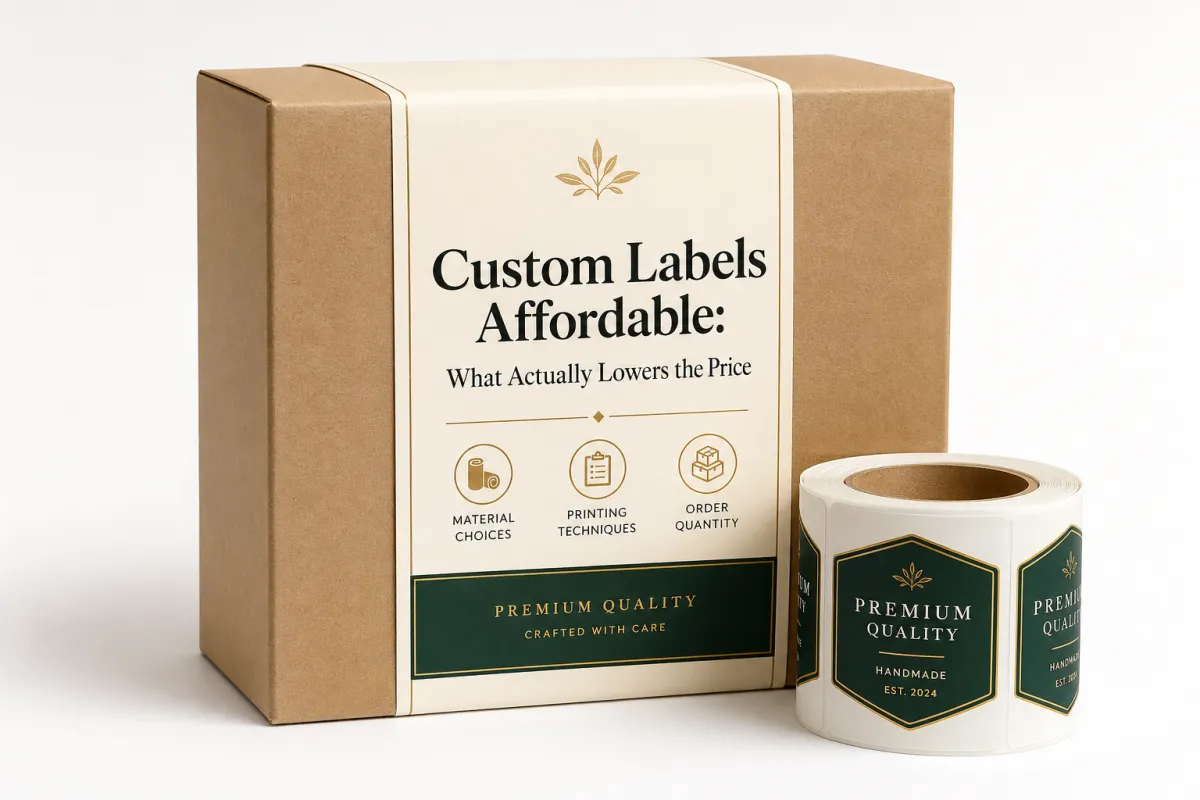
If you are trying to make custom labels affordable for the first time, the real challenge is rarely the label itself. The challenge is the chain of tiny decisions that quietly pushes the quote upward: color depth, edge shape, material chemistry, adhesive strength, and timing promises that do not match the production method. A label can look premium in a mockup and still be expensive in the pressroom. That gap is where budgets get bruised.
Factory pricing is less mysterious than most buyers think. The main levers are size, shape, material, color count, and quantity. A compact 25 mm x 12 mm rectangle can cost more per piece than a 50 mm x 30 mm label if the smaller version wastes more substrate or needs a trickier die path. The phrase custom labels affordable is not just marketing copy. It is a cost model: remove waste early, then protect print quality all the way to shipment.
Picture a startup nutrition brand ordering 5,000 labels for matte clear bottles. The design team wants rounded custom outlines, a UV spot-gloss logo, and four extra specialty colors because the mockup feels luxurious. The quote comes back steep. Then the team tests a standard die, a two-color CMYK-friendly palette, and a matte finish. The label still looks sharp. Shelf presence stays strong. The package survives distribution without drama. That is how custom labels affordable becomes practical: fewer assumptions, fewer expensive flourishes, more useful insight.
Label pricing also shifts after approval. A design can be inexpensive on paper and expensive in production if the roll orientation, storage conditions, or application method create rework. I have seen jobs look tidy in the proof stage and then slip because the real line was a little messier than the spec sheet suggested. Wet fingers, temperature swings, and manual application speed all change the equation. Most teams only discover that after the unit cost has moved.
Use the rest of this guide as a working map. It breaks down material choices, print methods, adhesion, and quote review so your team can order custom labels affordable without turning packaging into a gamble. Clean branding still matters. So does math, and more importantly, sequence.
What drives budget most in real production runs
Print coverage sits near the top. Every extra color adds setup time, ink handling, and a chance for variation. Shape matters too. A custom edge profile can increase tooling time and raise waste at die-cutting. The environment matters just as much. Labels for chilled storage, repeated handling, or wet-clean environments need different chemistry than labels that live on a dry retail shelf. Overbuild the label and you pay for durability you never use. Underbuild it and the label fails early. Keeping custom labels affordable means matching the spec to the actual product path, not to a screenshot.
Shipping belongs in the budget conversation from the beginning. Freight can add 5% to 20% in some lanes, especially with heavy cores or bulky packaging. A quote that looks lower on unit price can become more expensive once delivery is included. The custom labels affordable mindset asks a simpler question: what is the true cost of one label job from design file to warehouse handoff?
Ask the same question in every evaluation: what requirement drives each feature, and what would fail first if we remove it? Teams that ask this before design freeze usually cut surprises by more than half, even with the same artwork style and the same launch calendar.
Label Types And Materials That Keep Costs In Check
Material choice is where many budgets slip because appearance gets mistaken for performance. Paper, polypropylene, polyester, and specialty films each solve different problems. The strongest option is rarely the flashiest. It is the one that fits the product, the handling, and the budget. If your goal is custom labels affordable, start with the environment and work backward.
For low-cost branding programs, the best materials often come from mapping use-case variables instead of chasing premium labels. Think in terms of a labeling matrix: expected contact, exposure, abrasion, and storage life. That one framework turns vague conversations into measurable comparisons and helps you compare packaging labels across SKUs instead of comparing one-off art ideas.
Paper labels: usually the first cost-efficient baseline
Paper labels are a natural fit for dry, moderate-wear applications on cartons, pouches, food-safe outer packaging, and retail inserts. They look polished when printed well, and they often move quickly through digital production. For 2-color or 4-color digital runs between 1,000 and 5,000 pieces, paper usually sits at the lower end of the price range. It performs well on corrugated board, cardboard, and coated white substrates.
Moisture changes the picture quickly. Cold storage, wet handling, and oil-heavy products can break paper down earlier than expected unless the surface is protected. That is why teams chasing custom labels affordable do not force paper into conditions it cannot survive. They avoid a repeat order and avoid the kind of launch note nobody wants to write: "we'll fix it after launch." That fix is usually more expensive than choosing correctly on day one.
Polypropylene and polyester films: stronger in wet or harsh handling
Polypropylene, especially BOPP, is a strong value option for durable labels because it balances printability with resistance. It handles oils, condensation, and scuffing better than standard paper. Products that face handwashing, splash exposure, or outdoor humidity often need that extra layer of protection.
Cost shifts with thickness and finish. A 60 to 70 micron film tends to behave more predictably in abrasion-prone zones than a very thin stock. There is no free lunch; better performance comes from higher raw material cost and often tighter tolerance checks during production. So the question is still arithmetic: does this added film grade reduce risk enough to keep custom labels affordable over three quarters of shipments?
Polyester films are common for higher abrasion and longer shelf exposure, particularly where heat and mechanical stress show up together. They are durable, yet short lifecycle jobs rarely need that level of toughness. For many buyers pursuing custom labels affordable, a simpler film choice can be more intelligent than a premium one, because the package itself does not need to outlive the content. Durability should follow use condition, not habit.
Adhesive selection: one of the biggest hidden budget drivers
Adhesive choice catches people off guard. Permanent acrylic pressure-sensitive adhesives are strong for retail packaging that will be handled more than once, but they cost more and need tighter production control. Removable or repositionable adhesives are often cheaper and fit temporary packaging or short-run promotions. Freezer-grade adhesives and cryogenic formulas should be reserved for temperature swings that actually demand them. If the product lives at ambient shelf conditions between 15 and 35 C, low-temperature chemistry usually adds expense without adding value.
Liner choice deserves equal attention. Full-liner, half-liner, and no-liner formats change waste and labor, especially on application lines. A lower sticker price can come from a liner that peels cleanly and speeds application, which is why experienced teams often reduce total cost by choosing simpler adhesives that match the process.
That is one of the clearest examples of custom labels affordable becoming operationally visible instead of remaining a pitch-line. Less friction at application can reduce rejected units and line stops, and those minutes add up across a 20,000-piece run.
Finish options: gloss, matte, and soft-touch
Gloss and matte remain the simplest ways to look finished without overspending. Gloss can deepen color and sharpen contrast on dark packaging. Matte often suits healthcare, cosmetics, and nutraceutical lines because it reads controlled and deliberate. Soft-touch adds tactile appeal, but it usually carries extra lamination complexity.
Ask a blunt question: does the customer actually need the tactile feel? If the answer is no, skip it. Buyers chasing custom labels affordable usually get a stronger result from stable matte or gloss finishes and accurate print registration than from layered varnishes that complicate production and raise the risk of defects. A clean finish with low ink solids often survives better in harsh warehouse conditions too.
Digital vs flexographic: choose by run behavior
Digital printing is often the better budget path for short to mid runs, frequent artwork changes, and one-off SKU labels. It moves quickly for 250 to 5,000 pieces, handles variable data naturally, and makes QR updates and campaign text changes easy to manage. Flexographic printing becomes more economical once the design is stable and the run is larger, usually from 5,000 to 10,000-plus pieces, because plate cost is spread across volume.
Many buyers cut per-piece cost by 20% to 35% at scale when they move predictable jobs into flexo. Special effects such as foil, metallic ink, and spot varnish are not the opening move for custom labels affordable projects. They can work well for campaign peaks, yet each effect adds passes, time, and inspection points. Start with strong print fundamentals. Upgrade only after the numbers show the marketing lift exceeds the extra spend.
"If the label has to survive rain, chill, and repeated handling, pay for chemistry where it matters. If it does not, skip the features you will never use."
Print Specifications That Protect Budget And Brand Quality
Clear specs save money before a quote even leaves the inbox. That single step does more for custom labels affordable than most buyers expect. Vague instructions create back-and-forth, and every round of clarification adds cost. Strong teams give exact details from the start: finished size, bleed, shape, core size, roll orientation, and application method.
What matters here is not just whether the file is pretty, but whether the file is production-ready. Dielines and color profiles are not optional extras in label printing costs. If a dieline is underspecified, rework becomes a tax on every stakeholder in the chain: design, prepress, production, and operations.
Finished size, die lines, and bleed: precision lowers rework
When the finished size does not line up with a proper die line and usable margin, nesting gets worse and waste goes up. More waste means more recut material and a higher total bill. For labels, define the basics early:
- Trim size: exact dimensions after die-cut or kiss-cut.
- Bleed: usually 2 to 3 mm around the edge for safe trimming.
- Safe zone: the area that keeps text and logos away from the cut line.
- Corner radius: tighter corners tend to cost more than larger, simpler radii.
Small size changes can matter more than buyers think. A circular label that shifts by 1 to 2 mm can land in a different setup tier. A rectangle that moves from 63 x 38 mm to 62 x 37 mm may preserve design while fitting a more efficient cut pattern. Practical trimming choices like that keep custom labels affordable without sacrificing the artwork.
Core size, roll orientation, and application method
Roll production brings its own math. A 3-inch core is common and efficient for many smaller stock widths. A 6-inch core may be required for certain machines, though it can increase material use. Roll orientation matters too, especially where text direction has to match machine feed. State whether the labels should face up or face down relative to the core. That small note prevents costly confusion later.
Application method affects adhesive and liner recommendations. Hand-applied labels on a retail line benefit from easy release and a forgiving peel. Machine-applied labels on shrink-packaged units may need tighter curl control and a different release profile. Choosing the Right behavior keeps the project custom labels affordable because the label works the first time instead of creating returns, rejects, and line downtime.
Simplify artwork before it leaves design software
Color count still shapes cost. A full-color artwork file with gradients, shadows, and multiple spot tones can look striking, but it also raises profile complexity and ink coverage. A restrained palette often performs better at shelf distance. One accent color, strong typography, and careful spacing usually beat a crowded design. Labels are read, not framed.
Use standard color profiles, embed images at the correct resolution, and check contrast in grayscale. If the text disappears under warehouse light or loses clarity at 1.0x size, the proof stage gets longer and pricier. Keep vector text as vector, use spot channels only where they matter, and avoid decorative effects unless the design truly needs them. That discipline keeps custom labels affordable across packaging programs while preserving brand credibility.
Proofing, color matching, and preproduction testing
Proofing is not a courtesy. It is the guardrail between a clean launch and a costly correction. Ask for a digital proof or a hard proof if the run is color-sensitive. If the label has to hold under peel-adherence conditions like ASTM D3330 testing, ask for a basic adhesion check and curl test before release. For shipping-sensitive products, request a sample check that resembles the likely warehouse environment.
The same logic applies to ISTA-style handling expectations. Full destructive testing is not needed for every order, but one representative sample can prevent a reprint. Brands spend less when the first sample gets scrutiny and the final order gets approved with confidence.
For most buyers, the best practice is simple: submit one locked file, one approved proof, and one short note about the environment. That combination keeps pricing closer to the original estimate and keeps custom labels affordable from slipping into vague production language.
How Can Custom Labels Affordable Stay on Budget Without Compromising Brand Quality?
The short answer is not to cut everything to the lowest cost tier. The better question is where quality risk is highest versus where aesthetics are optional. In most label programs, the margin sits on the first 20% of decisions. If those are stable, the rest can stay lean without looking cheap.
One practical method is to run a quick dual-scenario test before the official quote. Scenario A: maximum design intent with premium finishes. Scenario B: same visual hierarchy with baseline materials and simpler finishing. If both versions hold brand clarity at the same shelf distance, B is usually the one that keeps custom labels affordable through reorder cycles.
Teams that use this method often discover an unexpected connection: clarity does not require complexity. A tighter type system and consistent color logic can outperform an extra texture when shoppers are glancing for 1.5 to 3 seconds. In that moment, contrast and spacing matter more than embellishment. That is good for margins and good for recognition.
Another rule is to separate appearance targets from performance targets. If anti-fake cues, UV sensitivity, or special tactile cues are not directly tied to consumer benefit or compliance, park them for later. That keeps custom labels affordable in the now, and lets you reserve budget for launch-critical improvements when sales data is available.
This is where cost-aware design teams become commercial winners. They are not reducing brand quality; they are prioritizing what the product actually needs to function and be recognized. That is a pretty big distinction, and it changes the whole quote conversation.
Custom Labels Affordable: Pricing, MOQ, And Unit Economics
Headline price misleads more buyers than almost any other number. Real label pricing has five parts: setup cost, material rate, print cost, finishing or lamination, and freight. A good quote shows each block clearly. If one is vague, the lowest number is usually the least reliable one. A buyer aiming for custom labels affordable needs the full cost picture, not just the first line.
For many packaging teams, the most useful metric is landed cost per piece after handling adjustments. A label with a slightly higher unit print price can still be cheaper overall if it reduces rejects, improves peel behavior, and shortens line changeover. That is why custom labels affordable has to be treated as total cost of ownership, not just sticker price.
Why setup cost matters at low quantity
Setup is where first-time orders can feel expensive. The initial run pays for file prep, press setup, die change, and machine waste. Spread across 500 pieces, that fixed cost can dominate the job. Spread across 5,000 pieces, the same cost becomes easier to absorb.
There is a useful habit here: request several quantity bands before choosing. One extra carton can lower the unit price enough to shift the decision. A directional comparison looks like this:
| Choice | Typical Cost Drivers | Approx. Cost at 1,000 pcs | Approx. Cost at 5,000 pcs | Approx. Cost at 20,000 pcs |
|---|---|---|---|---|
| Standard paper, 2-color digital | Low setup premium, basic finish, standard die | $0.22-$0.32 | $0.14-$0.20 | $0.09-$0.14 |
| PP film, 4-color digital | Higher base stock, moisture resistance | $0.30-$0.45 | $0.20-$0.28 | $0.13-$0.20 |
| Standard die + matte finish, 4-color flexo | Higher MOQ, lower unit at scale | $0.26-$0.34 | $0.16-$0.22 | $0.10-$0.16 |
| Custom shape + soft-touch + extra clearcoat | Die complexity, extra finishing labor | $0.45-$0.70 | $0.32-$0.55 | $0.22-$0.38 |
These figures are directional only. Still, the pattern is obvious. Volume helps. Low complexity helps more. That is the arithmetic behind custom labels affordable.
Across many quote sets, a clean print run with fewer artwork approvals often shows the best trajectory. That is an important but underused lever when teams chase lower budget. A delayed proof cycle can quietly erase the benefit of a lower quoted per-piece rate by pushing timeline and freight to a different tier.
MOQ strategy and when to order more
Minimum order quantities exist because printers need to recover startup labor and calibration work. A 300-piece order can be produced in some digital workflows, though the economics are rarely friendly. In many plants, moving from 1,000 to 2,500 pieces creates a meaningful unit drop. For recurring SKUs, it can make sense to buy a larger lot once and manage storage with care.
Cashflow still matters. Labels that expire in six months can become dead stock if the order is too large. A better way to think about it is to model separate demand windows. Compare one quarter of demand and the next quarter of demand, then weigh two smaller batches against one larger batch plus storage and handling. custom labels affordable is not always the cheapest single invoice. It is the lowest sensible cost over the full life of the product and campaign.
Compare apples to apples, not just lowest first number
Quote comparison works only when the specs match. Compare like with like: same material, same shape, same color count, same finish, same adhesive class. If one quote includes shipping and another excludes it, normalize that before drawing conclusions. If one includes sampling and another leaves it out, do the same. If a supplier hides a laminate fee, bring that into the open too.
Small teams get misled here all the time. One quote can look cheap because it leaves out a process that shows up later. Another can seem expensive because it includes a color-checked hard proof and a narrow correction window. Stability usually beats a low headline. Ask for a line-by-line breakdown and check where custom labels affordable is genuine and where it only appears after discounting the details.
Common pricing inflection points to request before approval
The largest price jumps usually show up when you move between:
- Custom die to standard shape: can reduce cost by 15% to 35% depending on complexity.
- Premium film to paper: can reduce base material and simplify lamination.
- Four-color + special effect to restrained color: lowers ink and setup significantly.
- Frequent proof changes to locked version: lowers correction waste and press time.
- Full-width roll layout to inefficient nesting: increases scrap and can erase expected savings.
Do not guess at these differences. Ask the production partner to show the delta. Teams buying Custom Printed Boxes or other branded packaging often benefit from the same level of transparency because it reduces surprises across the entire order. If a supplier can explain the cost impact clearly, that is a good sign they can handle repeat packaging work with the same discipline.
If your goal is controlled spend with a professional shelf result, compare at least three quantities and two substrate options side by side. That is the route most likely to keep the decision inside the custom labels affordable zone for launch and for reorders.
Ordering Process And Production Timeline
Many budget surprises happen before ink touches substrate. A clean order path protects the launch date and keeps the price from drifting. A standard production sequence for custom labels affordable runs stays predictable when inputs are complete and approvals move quickly.
One operational insight matters here: timeline and cost are rarely separate. A late approval in design or spec review is often more expensive than one extra unit of print cost, especially if it causes expedited shipping. The sequence is simple because it should be simple.
From request to shipment: the practical sequence
Step 1: submit design intent and usage scenario. Step 2: receive a material recommendation and a pre-quote range. Step 3: review proof options. Step 4: approve the final proof. Step 5: production and finishing. Step 6: shipment.
The trouble begins when a step is skipped. A common example is failing to mention whether the label will face condensation, repeated abrasion, or cold-chain handling. The production team then starts with assumptions, and each adjustment adds cost. In a custom labels affordable project, exact use conditions save time and keep the schedule intact.
Information that moves everything faster
Use a one-page checklist. Include:
- Finished label size and shape.
- Quantity by SKU and channel.
- Surface material of application (glass, PET, corrugated, aluminum, etc.).
- Environment (dry warehouse, refrigerated line, direct splash, UV window exposure).
- Required adhesives and any peel or repositioning behavior.
- Proof format preference and brand color references.
When these details arrive on day one, the proof cycle usually shortens. Simple digital jobs often move from brief to shipment in roughly 8 to 15 business days. Flexo repeat runs commonly fall into a 10 to 18 day window. Complex coating, multiple finishing stages, or international shipping can extend that timeline by several days.
Production variables that affect timeline and cost
Proof revisions cause the most delay. Two rounds is normal. Three or four usually means the artwork or manufacturing spec was underdefined. Shipping changes the clock too. Air freight is faster and more expensive. Truck or rail tends to be slower and cheaper on domestic lanes. Global orders add customs paperwork, and incomplete documents can stall a job at the worst possible moment.
If the project is urgent, say so early and freeze the artwork after the first proof. If the timeline is looser, keep the approval chain small: one reviewer, one final approver. Long comment loops create hidden costs in reprogramming and rechecking. A transparent custom labels affordable process is less about rushing and more about avoiding preventable stops.
Some buyers also ask for machine-readable quality references. If the label will be part of distribution or third-party logistics, mention any peel, humidity, or handling targets that matter. That kind of clarity lowers the chance of a quality hold later and keeps the schedule from being pulled apart by last-minute surprises.
Why Choose Us For Custom Labels Affordable Packaging
Choosing a partner matters more than choosing a sticker profile. A supplier that understands your actual workflow can usually deliver better custom labels affordable results than one that only pushes a long list of upgrades. The difference is practical advice: the right material, adhesive, and print method for the exact use case, with checks that hold the line on quality.
The right partner also understands that custom labels affordable is not a price discount strategy. It is a planning discipline. They should explain, with numbers, how each variation changes print cost, run time, and quality risk. If that conversation is available before purchase, not after, you reduce the chance of expensive escalation later.
Practical guidance instead of upsell pressure
That means recommendations based on what the product sees every day. If the label faces moisture, a moisture-resistant film comes first. If the item sits in a controlled dry environment, there is no reason to force a premium option that adds cost without adding value. Honest advice can sound plain, even a little stubborn, because it sometimes skips glossy extras. It also prevents expensive reprints and post-launch fixes.
You should expect direct guidance backed by process data: unit-cost impact from changing shape, color count, and adhesive class. Retail teams often get better package branding without pushing spend upward. Warehouse teams often get faster application and fewer line defects. That combination is the real value behind custom labels affordable.
Quality checks, consistency, and dependable lead times
Reliable production depends on repeatable checkpoints. Trim size verification, print registration, color tolerance, adhesion testing, and edge integrity all matter. That is not theater. It keeps the shipped product aligned with the approved proof. For recurring SKUs, consistency matters as much as initial cost.
A strong partner also supports both smaller brands and growing operations. Small-volume buyers need speed and flexibility for short runs. Larger teams need repeat pricing and lead times they can plan around. If your team already uses Custom Labels & Tags in one part of the catalog, a consistent workflow across the rest of the packaging stack reduces procurement noise. The same applies to broader planning with Custom Packaging Products and related packaging components.
Performance-first decisions that still support shelf appeal
There is a difference between expensive and premium. Premium usually comes from clean design, strong contrast, stable typography, and accurate registration, not from adding costly material to every layer. A matte paper label with disciplined layout can look intentional on retail packaging even beside glossy competitors. A PP film with matte lamination can be a smart base for durable products. That is why custom labels affordable is as much an engineering outcome as a design decision.
From a buyer’s side, straightforward specs and confidence in delivery matter most. If a change affects cost, you should hear about it early. If shipping will slip because a material has a longer lead time, you should know before sign-off. That kind of honesty builds trust and keeps commercial orders from becoming budget overruns.
If sustainability matters, ask about certified material paths where they fit the application. Many teams combine performance and responsibility by choosing FSC-conscious stock options and suitable print routes without moving outside budget. The smart move is to decide that early. Late shifts in sustainability, finish, or style almost always cost more than expected.
Action Steps Before You Request A Quote
Before you send a quote request for custom labels affordable, run a final check. The list looks basic, but it is the difference between a controlled order and one that keeps drifting through revisions.
Gather the essentials first
Collect these items first:
- Label dimensions, shape, and maximum allowed tolerance.
- Expected usage surface and expected environment (dry, moist, refrigerated, abrasive).
- Quantity by shipment wave and expected reorder interval.
- Finish preference and any finish exclusions.
- Artwork file format, fonts converted to outlines, and exact brand color references.
For fast-moving teams, this checklist cuts out at least one avoidable revision. For slower teams, it keeps scope from creeping in once the schedule gets tight.
Also capture secondary variables: print run objective, whether this is a one-time campaign or core SKU support, and whether barcode legibility or scanning reliability is required. These are not luxuries. They are constraints that influence cost and should be addressed before the quote is finalized.
Simplify before pricing
Ask the design team to remove nonessential decorative layers before the first quote. Every spot gloss, foil block, and textured layer can raise the price. Start with one base finish and a clean version of the artwork. If needed, request a premium alternative on a single version only. That gives you a clean comparison: base versus premium, not a blurred wishlist.
Typography often carries more visual weight than embellishment. Two clear font families, controlled spacing, and good contrast can make a label feel deliberate at shelf distance. That approach often outperforms decorative extras. It also keeps custom labels affordable without flattening the brand.
Ask for confidence checks
Before signing, request:
- Sample or approval proof.
- Material recommendation and why it matches your environment.
- Quote at multiple quantities.
- Shipping method and lead-time commitments by scenario.
Use those quotes to compare like-for-like. If one provider excludes freight and another includes it, normalize the numbers before deciding. If one offers handling reliability aligned to ASTM-style expectations and another does not, ask what testing assumptions sit behind the claim. You are buying commercial reliability, not just a visually pleasing label.
Before approval, make the request explicit: approve this version, at this quantity, with this finish, this adhesive, and this lead time. That is the moment custom labels affordable becomes a real commercial agreement instead of a vague promise that disappears between departments.
Follow that path and the result is usually stronger than expected: cleaner brand execution, practical durability, and packaging design consistency across campaigns. The actionable takeaway is simple: lock the environment, lock the spec, then compare quotes only after the material and finishing choices are narrowed to what the product actually needs. That is how you keep custom labels affordable across every batch without gambling on quality.
Frequently Asked Questions
How can I make custom labels affordable without looking cheap?
Start with the right material for the actual handling conditions, then remove unnecessary upgrades in shape and finish. Keep the design clean, use strong hierarchy, and check whether a standard shape can replace a custom die. That combination usually keeps the label polished while reducing avoidable waste. Teams that apply this approach often report better on-shelf confidence because the design stays crisp and the production path stays stable.
What affects the price of custom labels the most?
Quantity, material, size, shape, and print method remain the strongest cost drivers. Special finishes, specialty adhesives, and complex artwork add time and setup work. Shipping and repeated proof revisions also change the final invoice because they affect production confidence and schedule. In many quote reviews, label printing costs jump most when hidden specification changes are discovered mid-run.
Is there a minimum order for affordable custom labels?
Most production environments include a minimum order because setup gets built into the job. Small quantities are possible, but unit cost rises when the same setup is spread over fewer pieces. The best move is to request pricing at several quantity levels and compare unit price with total spend. A slightly larger first order can sometimes reduce total cost across two subsequent reorder windows.
Which label material is best for low-cost branding?
Paper is often the most economical choice for dry, low-abrasion packaging, and it performs well when the application stays stable. Film materials make more sense when moisture, oils, or rough handling are part of the product’s life. The right answer depends on where the product is used, stored, and shipped; this is exactly why the same design can be too expensive in one lane and sensible in another.
How long does it take to produce custom labels?
Simple digitally produced labels with clean files can move quickly, often within 5 to 12 business days after proof approval. Complex materials, custom shapes, and demanding finishing steps add time. The more complete the initial spec and environment details, the fewer delays the order carries into production, and the easier it is to keep custom labels affordable while still meeting launch dates.