Buyer Fit Snapshot
| Best fit | Custom Labels for Candle Jars Wholesale projects where brand print, material claims, artwork control, MOQ, and repeat-order consistency need to be specified before quoting. |
|---|---|
| Quote inputs | Share finished size, material target, print colors, finish, packing count, annual reorder estimate, ship-to region, and any compliance wording. |
| Proofing check | Approve dieline scale, logo placement, barcode or warning zones, color tolerance, closure strength, and carton packing before bulk production. |
| Main risk | Vague material claims, crowded artwork, missing packing details, or unclear freight terms can make a low unit price expensive after revisions. |
Fast answer: Custom Labels for Candle Jars Wholesale: Retail Fit, Compliance Space, Print, and Cost should be specified like a repeatable production item. The safest quote records material, print method, finish, artwork proof, packing count, and reorder notes in one written spec.
Production checks before approval
Compare the actual filled-product size with the drawing, then confirm tolerance on folds, seals, hang holes, label areas, and retail display edges. Reserve space for logos, QR codes, warning copy, and material claims before decorative graphics fill the panel.
Quote comparison points
Review material grade, print process, finish, sampling route, tooling charges, carton quantity, and freight assumptions side by side. A quote is only useful when the supplier can repeat the same color, closure quality, and packing count on the next order.
Custom Labels for Candle Jars wholesale are not a finishing touch. They are the part of the package that has to survive 95-degree warehouse heat, cross-country freight, and the brutally fast judgment call a shopper makes in about three seconds at the shelf. I remember a winter reorder of 12,000 jars that went sideways because the adhesive softened in a 31°C loading dock and the label slid just enough to look wrong. Half a millimeter does not sound dramatic until it repeats across every 8 oz amber jar in a shipment, and then it feels like a tiny manufacturing conspiracy.
Years on production floors taught me something plain and inconvenient: custom labels for candle jars wholesale only perform when the material, adhesive, finish, and artwork are matched to the jar and the sales channel. Pretty mockups can win a meeting. A pressure-sensitive label that stays flat on glass, keeps its color after 72 hours in a humid storeroom, and does not curl in a 40% RH packing room keeps the account. That gap between presentation and performance is where packaging either earns trust or quietly bleeds it away. Honestly, I think that gap is where a lot of brands misread the market. They think they are buying a label. They are actually buying survival.
At Custom Logo Things, I keep the discussion practical. Pick the right structure. Control the spec. Price the run against real volume, like 1,000, 5,000, and 10,000 pieces. That is how custom labels for candle jars wholesale become dependable branding instead of a monthly guessing game. And if the quote sheet gets too poetic, I usually get suspicious. Packaging is not a romance novel, and a line item should say more than "premium finish" without a size, substrate, and print method attached.
Why Custom Labels for Candle Jars Wholesale Work
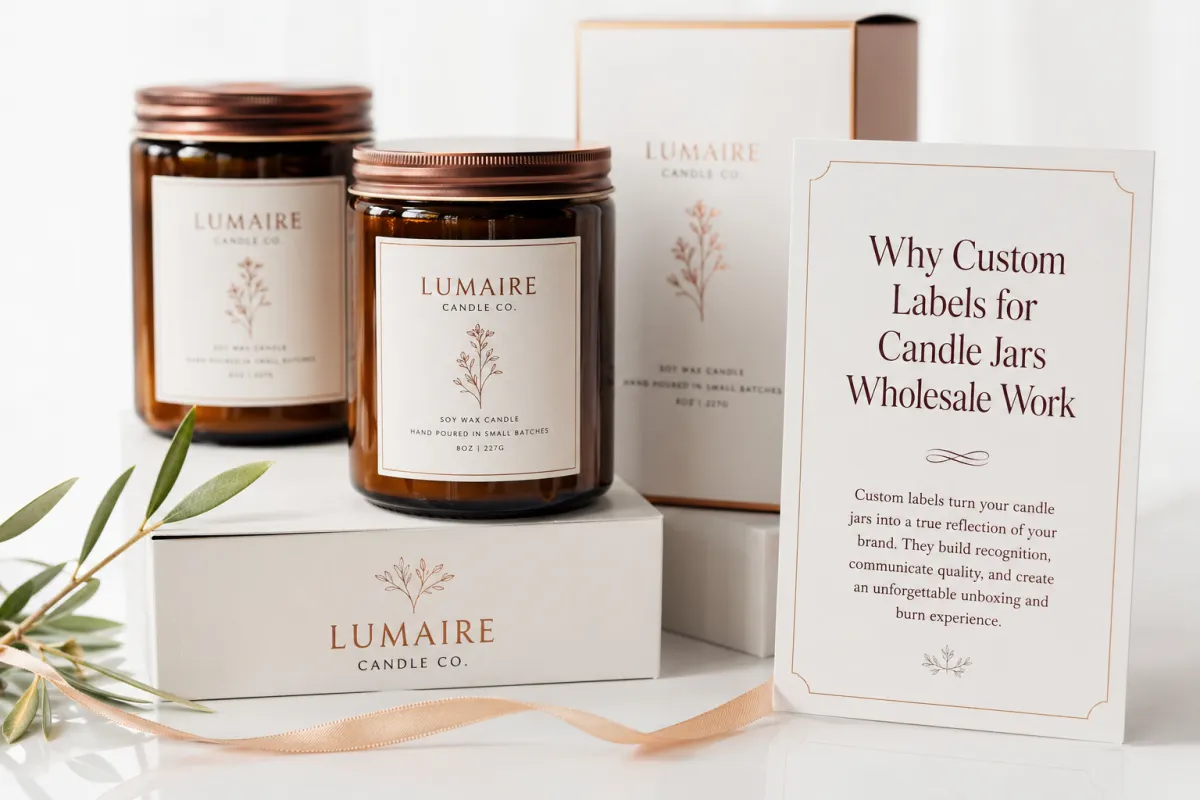
Custom labels for candle jars wholesale work because candle brands need consistency at scale. One fragrance may launch in 2 oz sample jars, move into 8 oz retail tumblers, then show up again in 16 oz gift sets and seasonal bundles. If every version looks like a distant cousin of the last one, the shelf loses its rhythm. If every jar follows the same label system, the brand looks organized. That matters more than most founders admit out loud. Packaging is arithmetic with a psychological edge. A clean repeated system tells buyers the company is paying attention before anyone reads a single line of copy.
The conditions candle jars live through are rarely gentle. They sit near warm wax at 130-160 degrees during filling. They get touched by hands that have lotion, sanitizer, or moisture on them. They ride in trucks through 88-degree summer heat and winter chill that drops below freezing in the Midwest. They sit under fluorescent retail lighting, then in back rooms, then on boutique shelves with unpredictable humidity. I once walked through a distribution warehouse in Louisville, Kentucky, where the temperature pushed into the high 80s for three straight days. The candles held up. The labels did not. The adhesive had been selected for paper gift boxes, not glass jars with fragrance oils in the picture. The client missed a holiday placement by two weeks, and the fault was visible before anyone opened the carton. That is the kind of failure that makes everyone talk quietly in the conference room.
Volume changes the math too. Once the artwork is locked, custom labels for candle jars wholesale lower unit cost, improve consistency across scent families, and remove the little packaging snags that consume time. A 10,000-piece run almost always gives a cleaner cost structure than a stack of tiny repeat orders each time a scent returns. Put the same design across multiple jar sizes and the line feels disciplined instead of improvised. One label system. One type family. Fewer surprises. Fewer opportunities for somebody to say, "It should be fine," which is a sentence I have never trusted in production.
"I do not care how elegant the mockup looks if the label cannot survive a warm shelf and a sticky hand. I care about the jar that leaves the store still looking like it was packed yesterday."
That is the actual argument for custom labels for candle jars wholesale. Not hype. Not aesthetic fluff. A label carries scent name, warning copy, barcode, and the tone of the brand. If it fails, the customer notices before they smell the candle. If it succeeds, the jar can look far more expensive than the material cost suggests. I have seen labels that cost $0.08 per unit still make a product feel like a boutique item, and I have seen $0.22-per-unit finishes fall apart because the adhesive was wrong. Price alone is a bad judge, especially when a 5,000-piece reorder can move the economics by 30%.
The buying decision is less mysterious than it sounds. For most candle brands, the right label comes down to three questions: where the candles will be sold, how the jars will be stored, and how much handling the labels need to endure. Thinking in terms of use case keeps the purchase grounded. Custom labels for candle jars wholesale should support the business, not add another layer of packaging drama. If a supplier cannot explain that in plain language, I start wondering what else they are hoping nobody notices.
Another detail gets ignored too often. Candle labels do not live alone. They are part of a full branded packaging system. When a retailer sees a clean candle label, a matching shipper, and consistent graphics on Custom Packaging Products, the line feels deliberate. That is package branding doing real work. It is also how a shelf starts to look like a story instead of a pile of objects, especially when the jar label, outer carton, and insert card all follow the same Pantone 432 C or warm kraft palette.
How Do Custom Labels for Candle Jars Wholesale Hold Up on Glass?
Custom labels for candle jars wholesale hold up on glass when the adhesive, face stock, and finish are designed for real handling, not just a proof on a screen. Glass is smooth, but it is also unforgiving. If the adhesive is too weak, the label lifts at the corners. If the adhesive is too aggressive for the application process, the label can wrinkle during placement. If the finish is wrong, fingerprints and scuffs show up fast. The best result is usually a pressure-sensitive label with a permanent acrylic adhesive, matched to the jar surface and the humidity level where the product is filled and stored.
I like to test three things before a run leaves the factory: edge lift, rub resistance, and color stability. Those checks tell me far more than a glossy mockup ever could. A label that looks beautiful on a flat proof but curls on a curved 8 oz tumbler is not ready for wholesale. The good news is that custom labels for candle jars wholesale can be dialed in quickly once the jar measurements, label size, and adhesive type are locked. The bad news is that skipping those details usually costs more later than doing the work correctly the first time.
Custom Labels for Candle Jars Wholesale: Product Options
Custom labels for candle jars wholesale begin with material choice. Paper labels remain popular because they are cost-effective and easy to print in small or mid-size runs. They can look soft, handmade, and warm, which suits soy candles, apothecary styles, and natural fragrance lines. Paper is not always the safest answer, though. If the jar gets handled often, if the environment runs humid, or if fragrance oil can creep toward the adhesive edge, film labels usually hold up better. For paper-based candle collateral, I often specify 350gsm C1S artboard for hang tags or neck cards, paired with a matte aqueous coating that resists light scuffing in a 68-72 degree retail environment.
I have watched brands fall in love with a matte paper label, then wonder why it wrinkled near the seam after a few weeks on shelf. The spec needed a sturdier foundation. For custom labels for candle jars wholesale, BOPP is often the workhorse. White BOPP gives a clean, durable surface. Clear film creates the printed-on-glass effect that premium candle lines use when they want artwork to feel lighter. Gloss film adds punch. Matte film softens glare. Soft-touch lamination adds a rich hand feel, though it pushes cost and lead time upward. I usually joke that soft-touch is the packaging version of a cashmere sweater: lovely, but do not expect it to behave like denim. A 2.4 mil white BOPP label with gloss lamination is often the sweet spot for 8 oz and 10 oz jars that move through boutique retail and online fulfillment.
Adhesive selection matters just as much. Permanent acrylic adhesive is the default for most Candle Jar Labels because it stays put on glass. Removable adhesive can work for promotional runs or test launches, but it is not always the best fit for long shelf life. I have also used freezer-grade adhesive for brands that ship through sharp temperature swings or store inventory in cold rooms before fulfillment, like the kind I saw in Toronto, Ontario, during winter shipments. Not every order needs that. Still, custom labels for candle jars wholesale should match the actual warehouse path, not the idealized one. Real life is less polite than the spec sheet.
Shape and placement change the whole design language. A front label reads clean and simple. A wrap label makes room for scent stories, ingredients, and warning copy. Bottom labels work well for batch codes, SKU numbers, or retail compliance details. Dual-label setups are common in candle packaging: one front label for brand and scent, one back or bottom label for legal copy, barcode, or burn instructions. That arrangement keeps the front panel calm while the practical text stays close at hand. It also prevents the label from becoming a crowded little shouting match.
Jar curvature can complicate everything. A straight-sided tumbler is easier than a rounded glass jar with a narrow shoulder. If the label is too tall, it fights the curve and lifts at the edges. If the label is too wide, the seam can overlap badly and look rushed. I keep telling brands the same thing: custom labels for candle jars wholesale need to fit the physical jar, not just the artboard. Measure the straight panel height, the diameter, the lid clearance, and the seam zone before design is final. A candle jar is not a flat brochure. It is a cylinder with opinions, and the difference between a 2.75-inch and 3.00-inch label can decide whether the line feels polished or cramped.
Here is a quick comparison I use with buyers who want the tradeoffs laid out plainly.
| Label Type | Typical Use | Approx. Wholesale Price | Best For | Tradeoff |
|---|---|---|---|---|
| Paper, matte | Handmade or natural candle lines | $0.06-$0.11/unit at 5,000 pcs | Soft look, lower cost | Less moisture resistance |
| White BOPP, gloss | General retail candle jars | $0.08-$0.16/unit at 5,000 pcs | Durability, clean color | Less organic feel |
| Clear film, matte or gloss | Premium glass jars | $0.10-$0.20/unit at 5,000 pcs | Invisible-edge look | Needs careful artwork prep |
| Soft-touch laminated film | High-end gifting lines | $0.14-$0.28/unit at 5,000 pcs | Luxury feel | Higher cost, longer lead time |
That table is a map, not a quote. Custom labels for candle jars wholesale can land lower or higher depending on size, color count, finish, and quantity. A 3 x 2 inch white BOPP label printed in four colors, die-cut on rolls, can sit around $0.15 per unit for 5,000 pieces, while the same design at 1,000 pieces may rise to $0.27 or more. If a supplier cannot explain why paper costs less than film, or why soft-touch costs more than gloss, I would keep looking. Straight pricing is part of good wholesale work. Vague pricing usually hides some combination of shortcuts and hope, and hope is not a production plan.
For brands building a broader line, I often recommend keeping labels in the same visual family as the shipper box and insert card. That is where Custom Labels & Tags become part of a larger retail packaging system instead of a disconnected print job. Consistency matters. A candle brand with matching labels and Wholesale Programs support looks more established on the shelf. It also feels easier to reorder because the visual system is already doing some of the work, especially when a 250-piece seasonal test becomes a 5,000-piece replenishment three months later.
Specifications That Keep Candle Jar Labels Sharp
Custom labels for candle jars wholesale only look effortless after someone has done the hard spec work. Buyers usually want a clean label. Production teams want measurable details. That means material thickness, adhesive type, print method, finish, shape, and format need to be locked before the order begins. Vague specs turn into expensive fixes later, and expensive fixes have a way of arriving right before the launch event. I have seen that movie, and it ends with frantic email chains.
My base checklist for custom labels for candle jars wholesale usually starts with 2.0-3.0 mil film for durable applications, or a quality paper stock when the environment is controlled. I also ask whether the label needs a topcoat, varnish, or laminate. Smudge resistance matters because candle jars get handled by shop staff, distributors, and end customers. Moisture resistance matters because humidity is real. Oil resistance matters because fragrance oils travel farther than most people expect. I learned that after a factory test sheet picked up faint scent residue and began losing edge grip after a week in a warm sample room in Guangzhou. It was a weirdly fragrant disaster, and the fix was a stronger permanent adhesive plus a slightly wider dead zone around the edge.
Shipping adds another layer. Candle jars are glass. Glass has no interest in optimism. It responds to impact and temperature. I think about ISTA packaging test standards here because the label has to stay readable after transit, not just look sharp in a proof. If the brand ships through distribution, the label needs to handle carton rub, warehouse stacking, and standard retail handling. That is especially true for custom labels for candle jars wholesale sold through boutiques and larger chains. A label that looks beautiful for 20 minutes on a desk is not enough, especially if it has to survive 1,200 miles by truck from Dallas to Chicago.
Label failures usually show up at the edges. A design too close to the cut line can look perfect on screen and then chip visually after trimming. A seam in the wrong place can create a wrinkle. A barcode squeezed into a tight corner may scan poorly. The remedy is not mysterious. Give the production team enough margin, enough quiet space, and enough accurate dimensions to work with. I would rather have a design that breathes than one that is packed so tightly it looks nervous. A 0.125-inch bleed and a 0.125-inch safety margin solve more problems than a dozen apologetic emails.
Compliance copy needs room too. Candle labels often need warning text, burn instructions, scent name, and sometimes batch or lot coding. I am not trying to turn a beautiful label into a legal notice, but the copy has to live somewhere. That is one reason I like dual-label layouts for many custom labels for candle jars wholesale orders. A front label can stay clean. The back or bottom label can carry the practical details without crowding the brand story. Everyone gets their lane, which is rare and refreshing, and it works especially well on a 3-inch front label with a 1 x 2 inch compliance panel tucked underneath.
Artwork quality deserves equal attention. Vector files are best because they stay crisp at any size. If the logo is trapped in a low-resolution PNG, the print can still work, but the file review gets more delicate. I ask for live text where possible, CMYK color setup, and clear notes on metallic or foil effects. If a buyer wants a metallic look, I need to know whether that means true foil, metallic ink, or a simulated effect. Those options are not interchangeable, and pretending otherwise is a fast way to wreck a quote. I have had to explain that more times than I can count, usually after someone says, "It all looks shiny on my screen." Screens are liars, especially when the mockup was exported at 72 dpi and the final label needs 300 dpi artwork.
Finish choices matter on the production line too. Gloss can make color feel brighter. Matte can make the label feel more grounded. Soft-touch can create a rich, almost suede-like surface, but it is not right for every candle brand. I have negotiated with suppliers in Shenzhen, Guangdong over a difference of $0.02 per unit just to secure a better scratch-resistant topcoat for a premium line. That tiny adjustment saved the client from replacing a whole shelf display later. Small money, big consequence. That is how custom labels for candle jars wholesale should be specified: by what prevents downstream cost, not by what sounds fancy in a sales deck.
Some brands also want FSC-certified paper or a lower-impact supply chain. That request makes sense. I do not oversell the sustainability angle, because the best material still depends on use case, but if your brand story includes responsible sourcing, ask for documentation. You can check FSC guidance and then align the paper choice with your broader packaging design. Candle labels carry part of the message, not all of it. If the rest of the packaging fights the promise, customers notice faster than marketers would like, especially when the shipper box is uncoated kraft and the label is a high-gloss metallic foil.
Pricing, MOQ, and Cost Drivers
Custom labels for candle jars wholesale are priced by a handful of concrete variables, and strong buyers know how to read them. Size comes first. Bigger labels use more material and more press time. Material comes next. Paper costs less than film. Finish follows close behind. Matte, gloss, laminate, spot varnish, and foil each change the bill. Quantity matters just as much. A 1,000-piece order usually costs more per label than a 10,000-piece order because setup is spread across fewer units. If you want straight pricing, ask for unit cost at multiple quantities and compare the breakpoints carefully. That is much more useful than asking, "Can you do better?" which is basically a financial shrug.
MOQ tends to confuse newer brands. Minimum order quantity exists because setup costs are real. Plates, digital setup, cutting dies, proofing, and press calibration all take time. That is why a small test run of custom labels for candle jars wholesale can cost more per unit even if the invoice total is lower. I have watched new brands resist that math, then return six weeks later after they realized the market response was strong and they needed a larger production run anyway. A test run makes sense when the fragrance line is unproven or the artwork is still being refined. It makes less sense when the launch window is tight and the spec is already locked.
Below is the way I break it down in real buying conversations.
| Cost Driver | How It Affects Price | What To Ask | Easy Savings |
|---|---|---|---|
| Size | Larger labels use more stock and ink | What is the exact finished size? | Trim unused white space |
| Material | Paper is lower; film is higher | Will the jar face oil, moisture, or heat? | Use paper only in dry retail settings |
| Finish | Laminate, foil, and soft-touch add cost | Is premium finish needed on every SKU? | Reserve premium finish for hero scents |
| Quantity | Higher volume lowers unit cost | What is the reprint forecast? | Consolidate SKUs into one run |
| Format | Rolls are faster for application, sheets can be flexible | How are labels applied in-house? | Match format to your workflow |
For most custom labels for candle jars wholesale orders, the cheapest quote is not the best quote. I have seen low bids hide weak adhesive, poor cut control, or a finish that scuffs in transit. The brand pays again to correct the problem. That is not savings. That is delayed pain with paperwork. I say that gently, but only because I have had to help fix it too many times, usually after a 2,500-piece run turns into a 2,500-piece reprint.
If you want a useful benchmark, here is the range I usually see in practice: paper labels at 5,000 pieces can sit near $0.06-$0.11 per unit, white BOPP often lands around $0.08-$0.16, clear film can run $0.10-$0.20, and soft-touch or specialty finishes may move into the $0.14-$0.28 range. A 2.75 x 2.75 inch white BOPP label with four-color print and gloss lamination often lands around $0.15 per unit for 5,000 pieces, while the same format at 1,000 pieces may be closer to $0.24-$0.30. Those numbers shift with size, colors, and shape. Even so, they give you a grounded way to judge custom labels for candle jars wholesale without getting lost in vague "low cost" language. Numbers calm the conversation, which is helpful when a launch calendar is breathing down everyone's neck.
A simple buying framework helps more than most sales decks do:
- Compare at least three specs, not just three prices.
- Check material, adhesive, finish, and format side by side.
- Ask whether proofing, cutting, and freight are included.
- Confirm whether the quote covers one SKU or multiple scent variants.
- Judge the supplier on clarity, not only on the number at the bottom.
That is how I recommend evaluating custom labels for candle jars wholesale. Clear spec. Clear cost. Clear expectation. Anything less usually turns into extra charges after proof approval, which is the polite version of an ambush. And yes, I have seen that ambush play out with a smiley email. The smiley email is always worse somehow, especially when the extra fee is $180 for a plate change nobody mentioned up front.
Process and Timeline for Wholesale Orders
The cleanest custom labels for candle jars wholesale orders follow a predictable path: quote, file check, proof, revision, approval, production, inspection, and shipping. I like a process that does not force anyone to play detective. If a supplier cannot tell you where the order sits, they are not managing the job. They are reacting to it. That kind of uncertainty turns a simple reorder into a scavenger hunt, and nobody needs that, especially when the product launch date is already pinned to a trade show in Atlanta or a holiday market in Vancouver.
Most delays begin with missing measurements or weak artwork files. A brand sends a logo but not the jar diameter. Or they send a diameter but not the label height that clears the shoulder. Or they approve a proof before noticing that the warning copy sits too close to the edge. Small misses. Big delays. Custom labels for candle jars wholesale depend on exact information because the label has to be cut, printed, and packed to fit a real glass vessel. The jar does not care that the PDF looked "close enough," and neither does a die line that was built for a 3-inch jar but approved for a 2.5-inch one.
In factory visits, I have watched teams lose half a day because one founder wanted to tweak the scent name after proof approval. That sounds harmless. It is not. If the file is already locked for print, that small revision can push the run back a full cycle. Timelines matter even more for seasonal launches, because candle brands do not get a second chance at a holiday window. They need the labels before the jars go into packing, not after. A missed holiday shelf is the kind of mistake that sits in your inbox all January, usually with a freight invoice attached.
For standard custom labels for candle jars wholesale orders, I usually expect proofing to take 2-3 business days, production to take typically 12-15 business days from proof approval, and shipping to depend on destination. Rush options exist, but they only make sense when the artwork is final and the structure is simple. Special finishes, foil effects, or highly custom shapes can stretch the schedule by 3-5 business days. I would rather tell a client that up front than pretend a premium finish will behave like a plain one. A 10-day promise that becomes 18 days helps no one, especially if the jars are already sitting in a warehouse in New Jersey.
Here is a practical timeline plan that helps candle brands avoid preventable drama:
- Launch stock: place label orders 4-6 weeks before jars land in your facility.
- Restock: reorder when you hit 30%-40% remaining inventory, not when you are empty.
- Seasonal drops: add extra time for proofing because scent names and artwork often change.
- Trade orders: build in buffer time if you need retail-ready cartons and display units too.
That buffer matters. I have seen brands coordinate Custom Printed Boxes, inserts, and custom labels for candle jars wholesale on different schedules, then wonder why the launch stacked in the wrong order. Product packaging works best when the label supplier and box supplier are pulling in the same direction, especially if the labels are printed in Shenzhen and the cartons are produced in Dongguan or Ningbo. Otherwise, you end up with a beautiful label and nowhere sensible to put it. Which is, frankly, a terrible kind of efficiency.
For brands that like standards and proof discipline, I point them toward industry references like the Packaging Machinery Manufacturers Institute and testing organizations such as ISTA. I am not saying every candle label needs a formal lab program. I am saying the same discipline used in larger packaging operations makes smaller runs cleaner, faster, and less expensive to fix. A little process saves a lot of apologizing, especially when the order spans 2,000 jars and three scent names.
The production part is straightforward too. We confirm the spec, run the press, inspect for color consistency and cut accuracy, then pack labels in a format that suits application. If the labels are going by roll, I care about unwind direction and core size, usually 3-inch cores for applicators and 1-inch gaps between labels. If they are going by sheet, I care about spacing and trim tolerance. Those details keep custom labels for candle jars wholesale from becoming a job that looks polished in a sample photo and frustrating in the packing room. There is nothing charming about a label roll that fights the applicator.
Why Choose Us for Custom Candle Jar Labels
I am blunt about this because the industry has enough smoke and mirrors already. If you are buying custom labels for candle jars wholesale, you need a partner who understands how labels behave on glass, how print specs shape pricing, and how to avoid expensive mistakes before the order is locked. That is the service standard I aim for at Custom Logo Things. Anything less feels like inviting trouble to move into your warehouse.
I have sat across from suppliers who tried to hide a material downgrade behind a polished quote sheet. I have also stood on the floor checking whether a white BOPP sample kept its color against a dark amber jar and whether the adhesive stayed seated after a warm storage test at 85 degrees. That work is not glamorous. It is responsible. Brands pay for consistency, not excuses wrapped in pretty language. I would rather hear a hard truth on day one than a smooth explanation after the reprint invoice shows up.
Our process is built to support custom labels for candle jars wholesale without making the buyer guess. We look at jar size, label placement, finish, and application method before anyone approves production. That saves time later. It also makes the quote more honest. If a buyer wants a premium matte film for a small batch, I will say so. If a paper label is enough for a controlled retail environment, I will say that too. I would rather lose a sale than pretend every spec is the same. That is not me being difficult. That is me trying to keep your margin intact.
What matters most to candle brands is plain enough: consistent color, reliable adhesive, sharp trimming, and clear communication. You do not need mysterious pricing games. You need a supplier who understands that a label is part of the full branded packaging story, not a random line item. When the candle jar, the shipper, and the insert feel aligned, the product looks more established and the shelf story gets stronger. Buyers may not articulate why they trust it, but they feel it, usually within the first eight seconds of holding the jar.
That is why clients often pair candle label work with our broader packaging support, including Custom Packaging Products. If the label and the box are developed together, package branding stays tighter. If you need scale support, our Wholesale Programs help keep reorder planning cleaner. For more focused label work, Custom Labels & Tags is where the conversation usually starts. I like that path because it lets the packaging logic stay connected instead of scattered across three vendors and six opinions.
Honestly, the best suppliers make the process feel boring. I mean that as praise. Boring is good in production. Boring means the colors match, the adhesive sticks, the roll winds correctly, and the cartons leave on time. Custom labels for candle jars wholesale should feel that way. Calm. Predictable. No theater. The only drama I want near a label order is the candle scent name, and even that should stay politely behaved, like a single-word label on a 4 oz amber vessel.
Next Steps for Ordering Candle Jar Labels
If you are ready to Order Custom Labels for candle jars wholesale, start with the jar. Measure the flat panel height, the visible wrap width, and the lid clearance to the nearest 1/16 inch. Photograph the jar on a white background if the shape is unusual. Then decide whether the label should be front-only, wrap-around, or split into front and bottom labels. That decision changes the spec more than most buyers realize, and it is usually the difference between a clean shelf presence and a label that looks slightly off no matter how good the art is.
Next, choose material and finish based on actual use. Paper can work for dry, handmade lines. BOPP is safer for handled retail jars. Clear film works when you want the label to disappear into the glass. Soft-touch is a premium move if the brand needs a richer feel. Custom labels for candle jars wholesale are not a one-style-fits-all category, and anyone selling that idea is skipping the hard part. The physical environment always gets a vote, especially if the products sit in a 28-degree shipping container or a warm boutique window.
To get a fast quote, send these items:
- Jar dimensions and a product photo
- Label style: front, wrap, bottom, or dual-label
- Quantity per SKU and total quantity
- Material and finish preference
- Artwork files or a working draft
- Warning copy, barcode, scent name, and any compliance notes
If you already know your retail packaging direction, include that too. I want to see whether the label needs to match Custom Printed Boxes, a gift sleeve, or a display carton. That keeps the whole product packaging system cleaner. A candle line with aligned packaging design usually sells better because the buyer feels a clear brand point of view. It looks intentional rather than assembled at the last minute, which is more common than anyone wants to say out loud, especially during a November launch season.
My last piece of advice is the simplest one. Do not wait until the jars are already on a truck to think about labels. Custom labels for candle jars wholesale should be ordered early enough to allow a proof cycle, one revision if needed, and a production window that does not depend on luck. That is how you keep the launch on schedule and keep your margins from getting eaten by avoidable reprints, whether the run is 500 units or 15,000 units.
If you want labels that stay flat, print clean, and support the candle line instead of fighting it, custom labels for candle jars wholesale are the smart path. Bring me the jar measurements, the quantity, and the artwork. I will tell you what spec makes sense, what it will cost, and where you can save money without making the label look cheap. That is the job. That is also why custom labels for candle jars wholesale keep winning for brands that care about stable quality and a clean shelf presentation.
What is the minimum order for custom labels for candle jars wholesale?
MOQ depends on material, size, and print method, but wholesale runs usually start at 1,000 pieces and become more economical around 5,000 pieces because setup costs spread better. A smaller test run is possible for new candle brands, but the per-label cost will usually be higher than a standard production order. If you are comparing vendors, ask whether the MOQ changes for paper labels, film labels, and specialty finishes. It is also fair to ask what happens if you reorder within a short window, because some shops can reduce setup pain on repeat work, especially on the second run of the same 2.75 x 3 inch die cut.
Which material is best for candle jar labels wholesale?
BOPP or another film label is usually the safest choice for glass jars that may face oil, moisture, or frequent handling. Paper labels can work well for dry, controlled environments and are often chosen for a softer, handmade look. The best material depends on your jar surface, candle formula, and where the product will be sold. I usually say: if the candle has to survive real retail life, film deserves serious attention, especially for 8 oz and 12 oz jars sold in humid coastal markets like Miami or New Orleans.
Can custom labels for candle jars be waterproof?
Yes, water-resistant or waterproof options are common, especially for jars that may be handled often or stored in humid spaces. Film materials with the right adhesive usually outperform standard paper when moisture resistance matters. If you need the label to resist oil from fragrance residue, say that upfront so the material spec matches the use case. "Waterproof" also gets used loosely in sales, so I like to ask whether the label needs splash resistance, condensation resistance, or full wash durability. A 2.4 mil BOPP label with laminate behaves very differently from a matte paper label sealed only with varnish.
How long does wholesale candle jar label production take?
Typical timing includes proof approval, production, inspection, and shipping, so the full schedule depends on how fast files are approved. Simple orders can move faster than custom finishes or complex shapes, which may add extra production time. Rush options may be available, but only if artwork is ready and the spec does not require special tooling. If a deadline is tied to a seasonal launch, build the timeline backward and leave room for one revision, because one revision is usually where time disappears. Standard production is typically 12-15 business days from proof approval, and freight from a factory in Shenzhen to Los Angeles can add another 3-5 business days by air.
What artwork do you need to start custom labels for candle jars wholesale?
Send final label dimensions, logo files, scent names, warning copy, barcode files if needed, and any finish or color notes. Vector artwork is best, but a clean high-resolution file can still work if the production team is allowed to review it first. If the jar has a curve or a seam, include a photo or measurement sketch so the label does not end up fighting the bottle. The more physical context you give, the fewer ugly surprises show up later, and that is good for everybody. I also like to see Pantone references, if you have them, because a 50% black on screen can print very differently from a true PMS 432 C or PMS 7406 C gold.

