Buyer Fit Snapshot
| Best fit | Custom Labels Pricing projects where brand print, material claims, artwork control, MOQ, and repeat-order consistency need to be specified before quoting. |
|---|---|
| Quote inputs | Share finished size, material target, print colors, finish, packing count, annual reorder estimate, ship-to region, and any compliance wording. |
| Proofing check | Approve dieline scale, logo placement, barcode or warning zones, color tolerance, closure strength, and carton packing before bulk production. |
| Main risk | Vague material claims, crowded artwork, missing packing details, or unclear freight terms can make a low unit price expensive after revisions. |
Fast answer: Custom Labels Pricing: Production Review should be specified like a repeatable production item. The safest quote records material, print method, finish, artwork proof, packing count, and reorder notes in one written spec.
Production checks before approval
Compare the actual filled-product size with the drawing, then confirm tolerance on folds, seals, hang holes, label areas, and retail display edges. Reserve space for logos, QR codes, warning copy, and material claims before decorative graphics fill the panel.
Quote comparison points
Review material grade, print process, finish, sampling route, tooling charges, carton quantity, and freight assumptions side by side. A quote is only useful when the supplier can repeat the same color, closure quality, and packing count on the next order.
Custom Labels Pricing Guide: What Drives the Cost? A custom labels pricing guide usually begins with a small shock: a 500-label order can carry almost the same setup burden as a run of 5,000, even though the invoices look nothing alike. I have sat through enough quote reviews to know that the sticker price is only half the story. The real answer sits in the mix of material, print method, finish, labor, proofing, and freight, and once you see that stack clearly, the pricing starts making sense.
From a packaging buyer's point of view, labels are not office stickers with a nicer logo. They sit inside product packaging, shape package branding, and often become the first physical detail a shopper touches before deciding whether a product feels polished or forgettable. A good custom labels pricing guide helps you compare quotes on equal ground: same size, same stock, same adhesive, same finish, same quantity, same turnaround. Anything less turns into guesswork, and guesswork is expensive.
"A label quote is really a spec quote. Change the stock, the finish, the shape, or the timing, and you are no longer comparing the same product."
That is where many brands lose money without realizing it. A label that looks simple may still need die cutting, file cleanup, color matching, press setup, slitting, rewinding, inspection, and packing. If you are also coordinating branded packaging, Custom Labels & Tags, or a broader lineup of Custom Packaging Products, the quote details matter even more because the label cost has to sit comfortably beside the rest of the package system. A quote that looks tidy on paper can get kinda messy once production starts telling the truth.
Custom Labels Pricing Guide: Why a Tiny Label Can Cost More Than the Box
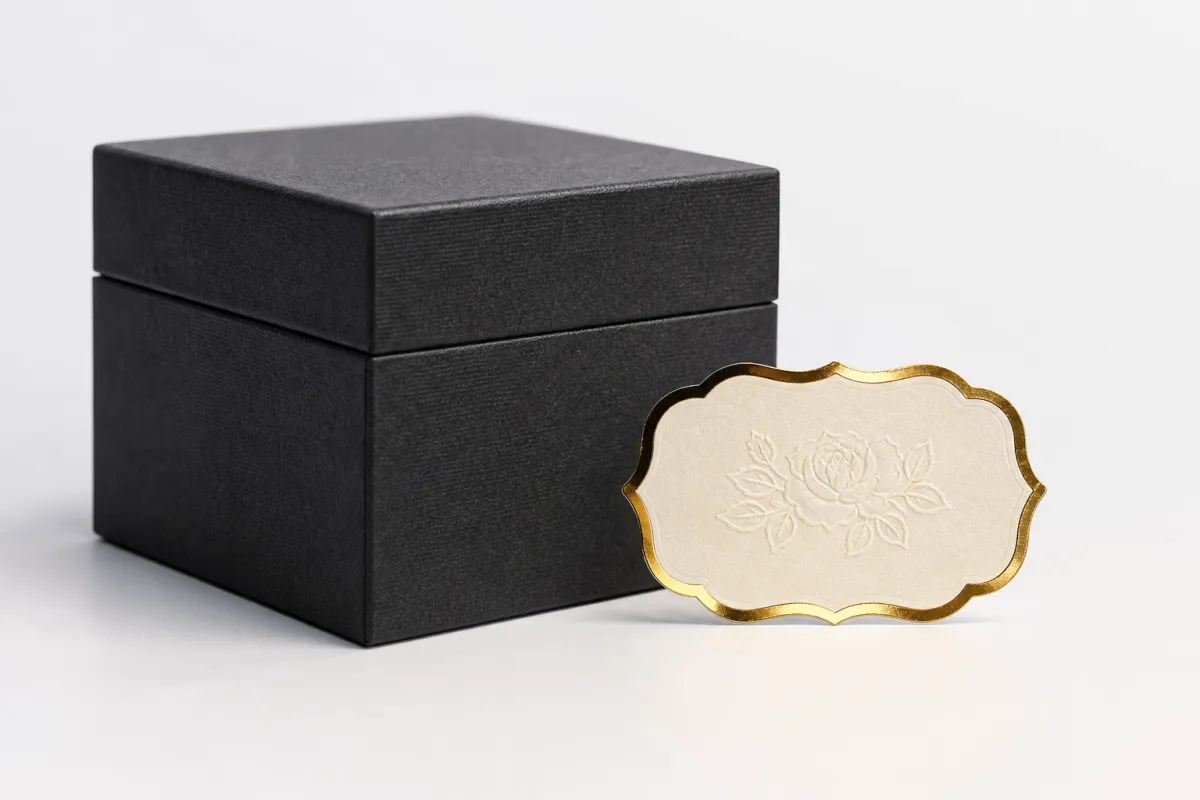
The most surprising part of a custom labels pricing guide is that size does not always match price. A compact 2" x 3" label can cost more per square inch than a larger box panel if it calls for a specialty film, a crack-and-peel liner, a waterproof adhesive, or a soft-touch finish. Labels are priced through a chain of production decisions, and each one carries cost in a different way.
Buyers are not just paying for ink on stock. They are paying for the substrate, the adhesive, the color count, the cutting method, the quantity, and the risk a supplier takes on a short run. In practice, a custom labels pricing guide is a cost map for pressure-sensitive materials, not a generic sticker chart. That is why a paper label for a dry carton and a BOPP label for a chilled bottle do not belong in the same pricing bucket.
The simplest way to think about it is this: labels usually include a few fixed costs and a few variable costs. Fixed costs show up even on a tiny order - proofing, setup, die lines, tooling, file checks, and sometimes plate charges. Variable costs rise with quantity, coverage, special finishes, and packing requirements. A small run can therefore look expensive because the fixed costs are spread across very few pieces.
A practical custom labels pricing guide also has to separate the label itself from the use case. A label for retail packaging on a shelf-facing jar faces different demands than a logistics label on a shipping carton. One may need rich color and scuff resistance. The other may need barcode clarity and adhesive performance through transit. The price follows the job, not just the graphic.
That is where brands often spend more than they need to. Labels get treated like a commodity, then specified like a premium component. The quote comes back higher than expected, yet the supplier is simply pricing the spec that was requested. A better custom labels pricing guide asks a more direct question: what level of performance does this label actually need to deliver?
That question matters because labels sit close to the customer experience. If the label rubs off, wrinkles in cold storage, or lifts at the edges during shipping, the brand damage can easily exceed the savings from a cheaper stock. The right answer is not always premium, but the right answer should be deliberate. That is the real purpose of a custom labels pricing guide.
How the Custom Labels Pricing Guide Breaks Down Quotes
Suppliers do not build quotes from a single universal label price. A serious custom labels pricing guide starts with a spec sheet, because two Labels That Look similar on a PDF can cost very different amounts once size tolerance, material, and finish are locked in. If a quote leaves out those details, it is not truly comparable.
A typical quote has four parts. First is the one-time setup, which can include file prep, proofing, plates, dies, and color matching. Second is the per-unit cost, which depends on quantity and material. Third are add-ons such as lamination, special adhesives, variable data, or custom packing. Fourth is freight, which can swing a small order by a meaningful percentage if the cartons are heavy or the timeline is tight. A good custom labels pricing guide makes each line visible.
- Setup and prepress: file correction, proof generation, die or plate preparation.
- Unit production: substrate, ink, finishing, converting, and inspection.
- Extras: rush fees, split shipments, roll orientation, numbering, or variable text.
- Delivery: freight, fuel surcharge, residential delivery, or special packaging.
Artwork readiness can change the quote more than many buyers expect. If your logo file needs cleanup, spot-color conversion, bleed adjustments, or a low-resolution fix, the supplier may add labor. That is not padding; it is prepress time. In a clean custom labels pricing guide, the cost of production stays separate from the cost of rescuing a file.
Print method matters too. Digital printing often supports smaller minimums and faster proof cycles, which can help a launch or pilot run. Flexographic printing usually brings better economics at higher quantities, but it may involve plates or more setup. A buyer comparing a digital quote with a flexo quote should never skip the question of volume threshold. The cheapest unit price at 10,000 pieces can be the wrong answer at 1,000.
Sample proofs can also appear as a line item. Some suppliers include digital proofs at no charge, while printed samples, press proofs, or color-accurate mockups may cost extra. Plate charges or tool charges are another place where the numbers shift. A paper roll label might not need the same setup as a custom die-cut shape on film, and the difference can easily show up as a $75 to $250 line item depending on method, size, and supplier policy.
That is why a custom labels pricing guide only works when the comparison is apples to apples. Same dimensions. Same adhesive. Same finish. Same roll count. Same application method. If one quote is for sheet labels and another is for roll labels, or one includes matte lamination and another does not, the lower number is not automatically the better buy. It is just a different job.
Custom Labels Pricing Guide: Cost, MOQ, and Unit Price
The relationship between quantity and unit price is where a custom labels pricing guide becomes genuinely useful. MOQ, or minimum order quantity, is not an arbitrary hurdle. It is how suppliers spread fixed production costs across a run. The smaller the run, the more each label has to carry in setup burden.
As a rule of thumb, digital label suppliers may offer lower minimums, sometimes starting around 250 to 500 labels for simple work, while flexo jobs may begin at 2,500 or 5,000 because plate economics need volume to make sense. That is not always the case, but it is a useful starting point when you build a custom labels pricing guide.
| Order size | Typical unit price range | What usually happens to setup cost | Best fit |
|---|---|---|---|
| 500 labels | $0.25-$0.90 | High per-piece impact from setup and proofing | Pilot programs, local launches, short-term promotions |
| 2,500 labels | $0.10-$0.28 | Setup begins to spread out more efficiently | Growing SKUs, seasonal items, moderate reorder cycles |
| 10,000 labels | $0.04-$0.14 | Fixed costs are diluted across volume | Stable products, multi-channel retail packaging, ongoing production |
Those ranges are illustrative, not universal. I am using them as a planning yardstick because label pricing shifts by region, supplier, stock availability, and finishing method. A 2" x 3" paper label with a simple black logo will not cost the same as a waterproof polypropylene label with a white underprint and soft-touch lamination. Still, the shape of the pricing curve is predictable enough to matter in a custom labels pricing guide: once setup costs are absorbed, the unit price usually falls quickly, then flattens as volume rises.
Material type is one of the strongest cost drivers. Paper stocks are often the least expensive and work well for dry, indoor applications. BOPP and PET cost more, but they hold up better against moisture, oils, and abrasion. Adhesive choice matters too. A removable adhesive, a freezer adhesive, or a high-tack permanent adhesive can each change the quote. If the application is food, beverage, cosmetic, or cold-chain, that choice is functional, not decorative.
Finish changes the economics as well. Gloss varnish may be cheaper than a laminate. Matte laminate can add durability and a more premium look. Soft-touch lamination can signal a high-end line, but it also raises cost and may slow production. In a disciplined custom labels pricing guide, finish should follow the product experience, not the mood board.
Shape complexity is another silent price driver. A standard rectangle can be cheaper than a highly irregular contour because die cutting becomes simpler and waste drops. Number of colors matters too, especially on analog processes. If a design uses five spot colors, metallic ink, or white ink on a clear film, the quote can move quickly. That is one reason custom shapes and rich print effects belong near the top of any custom labels pricing guide checklist.
There are also hidden add-ons that can surprise a buyer who only looks at unit price. Rush production may add 10% to 25% depending on schedule pressure. Split shipments can bring extra packing or freight. Variable data, serialized labels, or multiple SKUs in one run can require special handling. Roll direction, core size, and unwind orientation matter if the labels need to feed an applicator line. Those details sound small until they slow a packing floor.
When a premium label earns its keep, the math usually comes down to visibility or performance. If the label is the first thing a shopper sees on shelf, the print quality and finish may justify a higher cost. If the label has to survive refrigeration, condensation, shipping abrasion, or repeated handling, a better substrate can prevent returns and relabeling. If none of that applies, a standard stock label is often enough. The smartest custom labels pricing guide is the one that shows where premium really pays back.
Process and Timeline: How Custom Labels Move From Proof to Ship
Most buyers think about price first, but the timeline can shape the final number just as much. A reliable custom labels pricing guide should map the path from brief to proof approval to production to inspection to packing to freight. Every step has a chance to add cost if the schedule is compressed or the artwork is not ready.
The process often starts with a brief that includes size, shape, substrate, adhesive, finish, quantity, and application method. Then the supplier issues a proof, which may be a PDF mockup or a printed sample depending on the job. Once the proof is approved, production begins. After printing and converting, the labels are checked, packed, and shipped. If the order is tied to a launch date, there is usually little tolerance for delay, which is why a custom labels pricing guide should always include lead time.
Where do delays happen most often? Slow artwork feedback. Missing die-line confirmation. Unclear color expectations. Material shortages. Custom finishing. A short-run job can sit for days if the buyer takes too long to approve the proof, and a fast rush can become expensive if the supplier has to reshuffle the production schedule. That is not a scare tactic. It is how manufacturing calendars work.
Simple paper labels can often move faster than specialty films, high-adhesion freezer stocks, or jobs that require variable data. A typical simple run may land in the 10 to 15 business day range after proof approval, while more complex work can stretch beyond that, especially if it needs custom finishing or nonstandard packing. If a supplier promises a very fast turnaround, the custom labels pricing guide question becomes, "What had to change to make that speed possible?"
There is a direct relationship between schedule pressure and cost. Faster work can reduce the range of material choices, require overtime, or force a supplier to prioritize your job over another one. In some cases, the rush premium is modest. In others, it is the price of reclaiming a missed launch window. Either way, the custom labels pricing guide should treat time as a cost input, not an afterthought.
For products that move through transit, testing and durability checks matter too. Packaging teams often refer to ISTA procedures for transport performance, especially when labels live on cartons or shipper packs that face vibration, compression, or temperature swings. You can read more at ISTA. For paper sourcing on label stock, FSC certification can matter in broader sustainability claims, and the standard reference is FSC. A strong custom labels pricing guide does not replace these standards, but it should sit beside them.
Planning ahead helps more than most teams expect. If labels support a seasonal launch, order before the packaging schedule gets crowded. If the product has multiple SKUs, lock the common base label early and save variable details for the final layer. If the label is part of a larger branded packaging refresh, make sure the artwork team, procurement team, and production team are looking at the same proof. That coordination can save both days and dollars, and it keeps everyone from arguing over a file that was never the real problem.
Step-by-Step Estimate: Building Your Own Custom Labels Pricing Guide
If you want to build a practical custom labels pricing guide for your own team, start with a simple estimate worksheet. The goal is not to become a printer. The goal is to compare offers on equal terms so the cheapest quote is actually the cheapest, not just the least complete.
-
Write down the exact spec. Size, shape, quantity, application method, stock, adhesive, finish, and whether the labels will ship on rolls or sheets. A 2" x 3" roll label is not the same as a die-cut sheet label, and the custom labels pricing guide comparison falls apart if you mix them.
-
Choose the Right print method. Digital is often better for short runs, quick revisions, and multiple SKUs. Flexo can be more economical at higher quantities. Your custom labels pricing guide should reflect the actual order pattern, not the most attractive quote on paper.
-
Request identical quotes. Ask at least three vendors to quote the same materials, same finish, same quantity tiers, same proof policy, and same delivery location. If one quote includes freight and another does not, the custom labels pricing guide is not fair yet.
-
Separate setup from unit cost. Write down proof charges, plate charges, die charges, and freight on their own lines. That way, you can see whether a low per-label price is being offset by a heavy setup fee. A clean custom labels pricing guide makes the full picture visible.
-
Calculate landed cost. Add production, freight, and any rush or split-ship fees, then divide by usable labels. That gives you the real per-label cost. The custom labels pricing guide should help you compare the full landed number against the value of stronger branding, better durability, or faster launch timing.
One practical habit pays off quickly: build a comparison sheet before you contact suppliers. Put columns for size, stock, adhesive, finish, print method, quantity, setup cost, unit cost, freight, lead time, and proof policy. After a few rounds, the custom labels pricing guide stops feeling like research and starts working like a repeatable procurement tool.
It also helps to think in packaging systems rather than isolated labels. If the SKU also needs sleeves, cartons, inserts, or shipping shippers, the label choice should fit the broader package architecture. That is where labels connect with custom printed boxes, secondary packaging, and the visual logic of packaging design. If the label and box fight each other visually, the brand pays twice.
From a budget standpoint, ask what happens when the quantity changes. If 500 pieces cost $0.42 each and 2,500 pieces cost $0.17 each, the larger run may make sense if demand is stable. If the product is unproven, the smaller run may protect cash. A useful custom labels pricing guide does not force volume; it clarifies volume.
Common Pricing Mistakes That Inflate Custom Label Quotes
The most common mistake is comparing quotes that are not actually the same job. One vendor quotes 3" x 4" paper labels on rolls, another quotes 2.5" x 3.5" BOPP labels on sheets, and the buyer assumes the lowest line item wins. That is not a custom labels pricing guide; that is a comparison of different products.
Another frequent error is ignoring setup and freight until the final invoice. The unit price looks attractive, then proofing, packing, and shipping show up later and blow up the budget. A better custom labels pricing guide surfaces those charges early so the procurement team can see the real landed cost.
Premature premium finishing is another budget leak. Matte lamination, foil accents, embossed effects, and unusual varnishes can be excellent choices for premium brands, but they are not free, and they do not always improve the buyer experience. If the label will be tucked behind a sleeve, inside a kit, or used on a short-lived promotion, the finish may be overkill. A disciplined custom labels pricing guide asks whether the finish is serving the product or just the mood board.
Ordering too few labels can also be expensive in the long run. Brands sometimes save a small amount by minimizing the first order, then end up paying a higher unit cost across repeated reorders. If the product has stable demand, a slightly larger run can spread setup cost more efficiently. That does not mean overbuying inventory blindly. It means using the custom labels pricing guide to find the order size where waste and unit cost balance each other.
File problems are a hidden cost that gets overlooked. Low-resolution artwork, missing bleed, unconverted fonts, or unclear dielines can lead to revision fees. If the supplier has to clean up the file or rebuild the layout, you will likely pay for that time. The same is true for proof revisions. Three rounds of changes on a simple label can cost more than many buyers expect, which is why the custom labels pricing guide should include a production-ready art checklist.
Another common mistake is forgetting about reprint policy. If the first run is wrong because of supplier error, ask how a reprint is handled. If the error comes from approved artwork, understand where responsibility shifts. A trustworthy custom labels pricing guide should help you ask those questions before the order is placed, not after a pallet arrives.
Finally, brands sometimes over-specify labels because they are thinking like designers instead of operators. A beautiful label that jams an applicator line, peels in cold storage, or cannot be applied by hand at speed is not actually cost-effective. Packaging is not only visual. It is mechanical. That is why the best custom labels pricing guide keeps one eye on aesthetics and the other on how the label will run on the floor.
Expert Tips and Next Steps for Smarter Label Buying
If you want a better price without hurting performance, start with the end use. Cold storage, moisture, abrasion, and hand application all change the economics. A label for a freezer case has a different adhesive problem than a label for a dry retail shelf. A custom labels pricing guide that ignores use conditions will often push you toward the wrong stock.
Standard sizes can save real money. Custom shapes may look distinctive, but they can also create die costs, slower converting, and more waste. If a standard rectangle or square does the job, use it. The same logic applies to finish. A clean gloss or matte varnish may deliver enough brand lift without the extra cost of heavier lamination. The smartest custom labels pricing guide looks for the smallest change that creates the biggest benefit.
SKU consolidation is another underrated tactic. Instead of creating five different label families, consider one base design with variable text or serialized fields. That can reduce inventory complexity and improve reorder economics. In packaging operations, fewer versions often mean fewer mistakes. A leaner custom labels pricing guide should reward that simplicity.
If sustainability matters to your buyers, be specific. Ask whether the paper stock is FSC certified, whether the adhesive complicates recycling in your category, and whether the label sits on a package that already has a recycling claim. The EPA has useful resources on recycling language and material sorting at epa.gov/recycle. That does not mean every label must be recyclable in the same way, but the claim should match the material reality. A credible custom labels pricing guide treats sustainability as a spec, not a slogan.
For teams that also buy cartons, inserts, and shipping components, keep the label conversation tied to the rest of the package. Sometimes a label can do the job of a more expensive print process on a box. Sometimes the opposite is true. If the label is part of a package refresh, compare it against the visual and cost impact of upgrading custom printed boxes or reworking the broader packaging design. The answer is rarely isolated.
Before you go to market, assemble a request-for-quote packet with a clean spec sheet, art files, target timeline, and an internal budget ceiling. Then ask vendors to quote the same assumptions. That is the fastest way to get a useful custom labels pricing guide instead of a pile of mismatched numbers. If the product is strategic, ask for tiered pricing at 500, 2,500, and 10,000 pieces so you can see how the curve behaves.
The best label buyers do not chase the lowest number first. They define the job, then price the job. That is how the custom labels pricing guide becomes a decision tool instead of a spreadsheet exercise. It keeps branding, durability, lead time, and landed cost in the same frame, which is exactly where packaging decisions belong.
Frequently Asked Questions
What affects custom labels pricing the most?
Material choice and finish usually move the price first, because paper, BOPP, PET, gloss, matte, and lamination all behave differently in production. Order quantity matters next, since setup gets spread across more labels as volume rises. Special shapes, extra colors, and rush timing can add meaningful cost, so a solid custom labels pricing guide should rank those variables before anything else.
Why does a small custom labels order cost more per label?
Fixed setup and proofing costs are divided across fewer pieces, which makes each label carry more of the overhead. Short runs also trigger higher minimum pricing from some suppliers because the production schedule and changeover time stay about the same whether the order is 500 labels or 5,000. If you need fast turnaround, a custom labels pricing guide should also account for the labor premium that can come with it.
How can I lower custom labels pricing without hurting quality?
Choose a standard size or shape instead of a fully custom die line if the design allows it. Simplify the finish if a premium coating is not needed for the use case, and ask for price breaks at higher quantities so you can see where the curve improves. The smartest custom labels pricing guide compares total landed cost, not just the lowest unit number.
How long does custom label production usually take?
It depends on proof approval speed, material availability, and finishing complexity. Simple labels can move faster than specialty stocks, laminates, or variable data jobs, and shipping time should be included if the labels are tied to a launch date. A realistic custom labels pricing guide should treat lead time as part of the cost structure, not as a separate issue.
What should I ask for in a custom labels quote?
Ask for an itemized quote that separates setup, unit price, freight, and rush fees. Confirm the exact size, stock, adhesive, finish, and quantity tiers being priced, then request lead time, proof policy, and reprint terms so the comparison is truly apples to apples. If the supplier cannot itemize the job, your custom labels pricing guide comparison will not be reliable.
If you are building a quote right now, start with one clean spec sheet, ask for identical pricing tiers, and compare landed cost instead of chasing the cheapest unit number. That simple habit turns a custom labels pricing guide into a practical buying tool, and it usually saves more than one round of back-and-forth with suppliers.

