Buyer Fit Snapshot
| Best fit | Wholesale Packaging for Subscription Boxes Made Simple projects where brand print, material claims, artwork control, MOQ, and repeat-order consistency need to be specified before quoting. |
|---|---|
| Quote inputs | Share finished size, material target, print colors, finish, packing count, annual reorder estimate, ship-to region, and any compliance wording. |
| Proofing check | Approve dieline scale, logo placement, barcode or warning zones, color tolerance, closure strength, and carton packing before bulk production. |
| Main risk | Vague material claims, crowded artwork, missing packing details, or unclear freight terms can make a low unit price expensive after revisions. |
Fast answer: Wholesale Packaging for Subscription Boxes Made Simple should be specified like a repeatable production item. The safest quote records material, print method, finish, artwork proof, packing count, and reorder notes in one written spec.
Production checks before approval
Compare the actual filled-product size with the drawing, then confirm tolerance on folds, seals, hang holes, label areas, and retail display edges. Reserve space for logos, QR codes, warning copy, and material claims before decorative graphics fill the panel.
Quote comparison points
Review material grade, print process, finish, sampling route, tooling charges, carton quantity, and freight assumptions side by side. A quote is only useful when the supplier can repeat the same color, closure quality, and packing count on the next order.
Wholesale Packaging for Subscription Boxes Made Simple
Wholesale packaging for subscription boxes can look pretty straightforward on a spreadsheet, and then the first pallet goes through parcel handling and the weak spots show up fast: corners crush, inserts drift, closures bow, and the whole presentation loses its polish before the customer even lifts the lid. I’ve seen that happen enough times to know the problem usually starts earlier, during the packaging decision itself. The brands that stay ahead treat wholesale packaging for subscription boxes as a production choice, not an impulse buy, because the right structure has to protect the contents, support a repeatable brand experience, and keep unit cost in a sane range month after month.
A practical buying process starts with the structure, the product mix, and the shipping path all at once. That is why a lot of teams pair Custom Packaging Products with a broader Wholesale Programs plan instead of piecing together retail-priced cartons every time a new box cycle begins. Wholesale packaging for subscription boxes gives you room to standardize sizes, coordinate print, and keep inventory ready for recurring launches without scrambling to rebuild the package each quarter.
Wholesale Packaging for Subscription Boxes: What Bulk Buying Solves
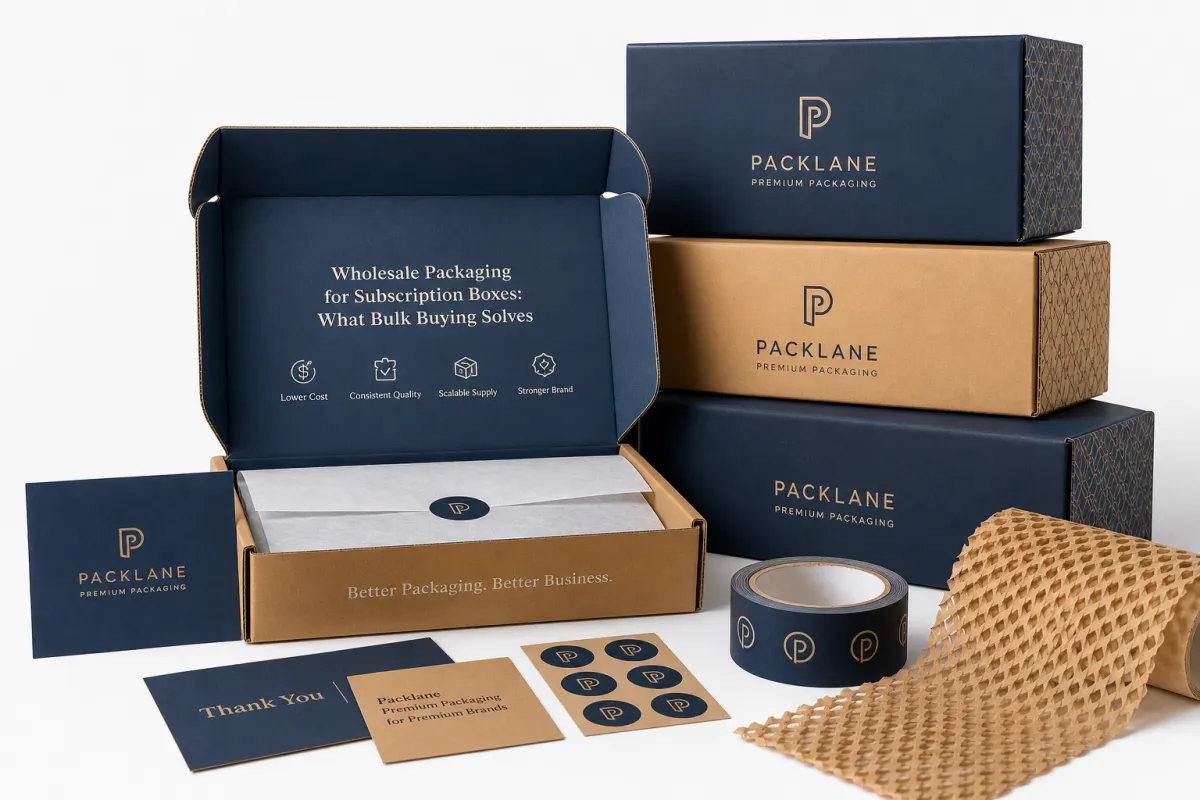
Wholesale packaging for subscription boxes solves a very specific tension: the box has to look good on the table and still survive the trip to the front door. If a box is chosen only for shelf appeal, it can fail in transit because the board is too light, the closure is too loose, or the internal fit leaves too much movement. That’s why wholesale packaging for subscription boxes should start with the shipping environment first, then move to the visual details after the structure is right.
Bulk buying keeps cost per unit steadier, which matters a lot once subscriber counts start moving around. A program that ships 2,000 boxes one quarter and 5,500 the next needs packaging that can scale without forcing a redesign every time the numbers shift. Wholesale packaging for subscription boxes gives that continuity, and it also keeps the brand from paying retail margins on cartons, inserts, sleeves, and labels that are consumed on a repeat schedule. That part seems boring until the invoice lands, and then it becomes very interesting very quickly.
There is also a timing advantage that buyers sometimes underestimate. When a seasonal drop or new theme lands late, packaging can become the bottleneck. Wholesale packaging for subscription boxes reduces that risk because the materials are already planned, quoted, and ordered in production quantities that make sense for recurring use. In practice, that means fewer emergency reorders, fewer mismatched cartons in the fulfillment area, and fewer delays caused by sourcing five different pieces from five different vendors.
From a packaging buyer’s point of view, wholesale packaging for subscription boxes is not just about getting a lower price. It is about building a packaging system that supports the kitting line, protects margins, and gives the customer the same opening experience every month. A clean program usually includes a primary box, any required internal support, and a reorder plan that is clear enough for operations to follow without guessing.
Honestly, the strongest subscription programs are the ones that pick the structure based on the product first. A beauty set with glass serum bottles needs a different answer than an apparel box, and an all-food kit needs different moisture and crush protection again. Wholesale packaging for subscription boxes works best when the spec matches the real contents, the carrier path, and the presentation goals from the start.
- Cost control: wholesale packaging for subscription boxes lowers unit cost as volume rises.
- Consistency: repeat orders help keep branding, print color, and fit steady across launches.
- Transit protection: the structure can be tuned for parcel handling, stacking, and vibration.
- Pack-out speed: a well-planned box system reduces the time spent fitting and adjusting product inside the carton.
A subscription box should not be judged by the mockup alone. If the corners crush, the insert shifts, or the lid bows after shipping, the packaging was chosen for appearance instead of performance.
Wholesale Packaging for Subscription Boxes: Product Options and Materials
Wholesale packaging for subscription boxes usually starts with four main structure families: Corrugated Mailer Boxes, folding cartons, rigid boxes, and branded sleeves. Each one has a different job, and the material choice should follow the contents rather than a generic idea of “premium” packaging. Corrugated is the workhorse for strength, paperboard fits lighter retail-style presentations, and rigid board supports higher perceived value when the unboxing moment matters as much as the shipping protection.
Corrugated Mailer Boxes are the most common answer for wholesale packaging for subscription boxes because they balance crush resistance and printability. A typical single-wall board can be specified around 32 ECT or equivalent performance, depending on the design and the load. Folding cartons, usually made from paperboard in the 18 pt to 24 pt range, work well for smaller components, skincare items, accessories, or secondary packaging inside a larger shipper. Rigid boxes, by contrast, use thicker chipboard wrapped with printed paper and are often reserved for premium kits where structure and presentation carry real weight.
Branding options matter, but they should always support the material. Full-color litho print, spot colors, foil, embossing, debossing, and soft-touch or aqueous coatings can all improve the look of wholesale packaging for subscription boxes, yet every finish adds cost and, in some cases, production time. A coated mailer can resist scuffing better than an uncoated one, while a soft-touch surface feels premium but can show wear if the box is handled roughly in fulfillment. The finish has to fit the route the box will actually travel.
Inserts are a major part of the design conversation. Paperboard inserts are useful for separating light products, while corrugated inserts can brace heavier or more fragile items. Die-cut partitions, product trays, and folded retention structures can keep glass, metal tins, vials, or sample jars from rattling during transit. That internal control is often what turns wholesale packaging for subscription boxes from a plain shipper into a system that feels deliberate and well built.
The product mix should decide the construction. Beauty kits often need a tight insert and clean graphics. Apparel boxes need a structure that opens neatly but does not waste material on unnecessary internal complexity. Food and supplement programs care more about fit, tamper awareness, and storage stability. Promotional kits may need a lower-cost structure with strong print branding to carry the message. Wholesale packaging for subscription boxes has room for all of those, but the material has to be chosen with a clear job in mind.
| Packaging Type | Typical Use | Approx. Wholesale Price Range | Strength / Presentation Balance |
|---|---|---|---|
| Corrugated mailer box | Parcel shipping, mixed-product kits, recurring subscriptions | $0.55-$1.40 per unit at 5,000 pcs | Strong protection with solid print options |
| Folding carton | Lighter goods, retail-style inner packs, secondary packaging | $0.18-$0.45 per unit at 10,000 pcs | Clean presentation, lighter protection |
| Rigid box | Premium kits, gift-style subscription presentations | $1.80-$4.50+ per unit depending on finish | High perceived value, less efficient shipping profile |
| Printed sleeve | Brand layer over a standard box or tray | $0.10-$0.30 per unit | Good branding at a controlled cost |
Those ranges are illustrative, not fixed, because wholesale packaging for subscription boxes shifts with board grade, print coverage, glue coverage, tooling, and the amount of hand assembly required. Even so, the table shows the general tradeoff that matters most: corrugated usually wins on transit performance, folding cartons keep costs lower for lighter contents, and rigid boxes create the strongest premium signal but also carry the highest production and freight burden.
For packaging design teams that want to test options, it helps to look at shipping standards before approving a structure. The ISTA shipping test standards are useful because they reflect real distribution stress, not just how the carton looks on a desk. FSC-certified paper can also be a smart fit for brands that want clearer sourcing language and a more responsible material story, which is why many teams review FSC-certified paper options during the quoting stage.
Wholesale packaging for subscription boxes can also include custom printed boxes with inside print, tear strips, tuck locks, dust flaps, or a sleeve-plus-tray combination. Each addition should earn its place. If an add-on improves protection or makes pack-out faster, it has value. If it only adds complexity without improving the product packaging, it should be reconsidered. That is the practical filter I use: every feature should either protect the contents, strengthen package branding, or make fulfillment easier.
Specifications That Make Wholesale Packaging Work in Transit
Wholesale packaging for subscription boxes cannot be quoted well without a complete spec sheet. The first items a buyer should lock down are the finished dimensions, target weight, number of items inside, closure style, print coverage, and whether the carton ships as a mailer or sits inside an outer shipper. Those details may sound basic, but they drive the real cost more than any single decoration choice. A one-inch change in size can alter board usage, packing density, freight, and how neatly the product sits inside the box.
Tolerances matter more than many teams expect. If the cavity is too loose, the contents migrate during transit and create rub marks, corner dents, or broken seals. If the fit is too tight, packers fight the box and risk scuffing the print or deforming the closure. Wholesale packaging for subscription boxes should allow enough clearance for the actual product, any protective tissue or filler, and the natural variation that comes from a production run. In practice, that means the dieline should be reviewed with the real sample, not just a CAD concept.
Shipping conditions also shape the spec. Parcel carriers stack cartons, drop them at angles, and expose them to vibration that a retail shelf never sees. Humidity, temperature change, and storage time can also affect board performance, especially for coated paperboard or lightly specified corrugated. If the box is going to sit in a warehouse before fulfillment, wholesale packaging for subscription boxes needs a construction that can tolerate that staging period without warping or weakening at the score lines.
Insert design deserves the same attention. Clearance around fragile items should be measured in real dimensions, not guesswork. A glass jar may need a snug cavity with enough release space to avoid forcing the panel walls. A bottle with a pump may need an internal height that prevents cap compression. A multi-item kit may need a partition grid so that products do not strike one another during movement. Wholesale packaging for subscription boxes gets much easier to assemble when the insert is set up to guide pack-out instead of fighting it.
Here is a simple working rule: if the packer has to twist, bend, or compress a product to make the box close, the specification is off. Wholesale packaging for subscription boxes should close cleanly with consistent hand pressure. That is what produces repeatable results on the line and consistent appearance after the customer opens the carton. The packaging should support the contents, not force them into a shape they were never meant to take.
Another detail that gets overlooked is how the package behaves after it leaves the design table. A glossy surface can show scuffs from conveyor belts and warehouse stacking. A deep black print can reveal dust and abrasion more clearly than a lighter tone. Even the style of the tuck flap can influence how the box holds up after repeated handling. These are small choices, but wholesale packaging for subscription boxes lives or dies on small choices because the customer sees every one of them at the moment of opening.
Common items to confirm before requesting quotes:
- Finished size: exact internal and external dimensions, including any required tolerance window.
- Product load: item count, total weight, and fragile components.
- Print plan: number of colors, inside print, foil, coating, or special varnish.
- Shipping profile: mailer only, master shipper, or a two-box system.
- Assembly method: hand pack, semi-automated pack-out, or full fulfillment line.
- Performance target: retail presentation, transit durability, or both.
That checklist is one reason wholesale packaging for subscription boxes is best handled early in the planning cycle. Once the box size, product mix, and shipping method are fixed, the artwork and structural details can move with fewer revisions. A clean spec also prevents the common quoting problem where one side assumes a mailer box and the other side assumes a rigid presentation box. Those are very different cost structures, and the difference shows up quickly in the final quote.
Pricing, MOQ, and What Changes the Quote
Wholesale packaging for subscription boxes is priced from a mix of material, labor, tooling, and production efficiency. The biggest cost drivers are size, board type, print method, coatings, insert complexity, and total quantity. A larger box uses more board and usually more freight. A more complex print layout may need additional setup. A custom insert can add dieline work, cutting time, and assembly cost. Those are the real levers, and they matter more than simple color count alone.
Minimum order quantity changes with the structure. A straightforward corrugated mailer may run at a lower MOQ than a premium rigid box because the converting process is simpler and the material sheets can be used more efficiently. A tightly engineered insert or specialty finish can raise the minimum because more setup is required before production becomes cost-effective. Wholesale packaging for subscription boxes usually becomes more economical as the order scales because press setup, tooling, and finishing costs spread across a larger count.
For planning purposes, many buyers look at three volume bands. A small pilot run might carry the highest unit cost but the lowest inventory commitment. A mid-size recurring program often gives the best balance of price and flexibility. A larger annual buy can lower unit cost further, but only if the brand has the storage space and forecast discipline to support it. Wholesale packaging for subscription boxes should be compared on landed cost, not just carton price, because freight, warehousing, and reorders all matter.
There are sensible ways to lower the quote without hurting the result. Standardizing dimensions can reduce waste and simplify production. Simplifying finish choices can save both money and time if the extra feature does not improve durability or brand impact. Combining the box and insert into one coordinated order may reduce handoff issues and avoid mismatched components. Forecasting also matters, because a brand that can place a cleaner annual or semiannual plan often avoids rush fees and repeated small runs that break the unit-cost benefit of wholesale packaging for subscription boxes.
From experience, the cheapest headline price is not always the best buy. If a lower-cost box arrives with crushed edges, slow pack-out, or higher damage rates, the true cost rises fast. Wholesale packaging for subscription boxes should be priced with the damage rate, rework time, and shipping performance in mind. That is the part buyers sometimes miss when they focus only on the printed carton number.
There is another pricing trap worth calling out honestly: some quotes look low because the spec quietly changed. The board may be thinner, the coating may have been removed, the insert may have gone from die-cut to loose fill, or the box size may have been reduced in a way that no longer fits the actual contents. Those changes do not always show up in a neat line item. They show up later in the warehouse, where somebody is trying to make the package work and muttering that it was “good enough on paper.”
Here is a practical comparison that shows why pricing decisions should follow the full use case:
| Buying Choice | Upfront Cost | Operational Impact | Best Fit |
|---|---|---|---|
| Very small run, highly customized | Highest unit cost | More setup per box, limited inventory risk | Launch tests, short campaigns, proof-of-concept kits |
| Standardized wholesale run | Balanced unit cost | Efficient pack-out, stable reorders, predictable supply | Recurring subscription programs and seasonal drops |
| Large annual buy | Lowest unit cost in many cases | Needs stronger forecasting and storage planning | Established brands with repeatable volume |
If a quote looks unusually low, I would ask what was removed to get there. Was the board downgraded, was the insert simplified, was the coating dropped, or was the quote based on a size that will not actually fit the product? Wholesale packaging for subscription boxes can be optimized, but it should not be stripped down so far that the package fails in the field. A tight quote is useful only if the box still protects the contents and holds the brand image together.
Process and Timeline for Wholesale Packaging Orders
Wholesale packaging for subscription boxes usually follows a predictable workflow: brief intake, structural recommendation, dieline or spec confirmation, artwork prep, proofing, sampling if needed, production, and freight coordination. The cleaner the brief, the smoother each step moves. A packaging team can build a good box from a rough idea, but the job goes faster and with fewer revisions when the product dimensions, target quantity, and finish requirements are already organized before the quote is requested.
Timeline depends on complexity. A repeat order on an existing structure with approved artwork can move quickly, often in about 12-15 business days after proof approval, depending on the production slot and freight plan. New custom packaging programs take longer because the structure may need revised tooling, the artwork may need multiple checks, and samples may be required before full production. Wholesale packaging for subscription boxes with custom inserts or specialty finishes often needs extra calendar room so the team can verify fit and print quality before the launch date is locked in.
Delays usually come from three places: incomplete artwork, dimension changes after quoting, and late approvals on proofs or samples. If a subscription box is still changing after the quote, every change can ripple through the schedule. That is why the packaging schedule should be tied to the billing and fulfillment calendar early. Wholesale packaging for subscription boxes works best when the proof window, the kitting window, and the ship date are all mapped together instead of handled in separate silos.
Sampling is not always required, but it is often worth the time on a new structure. A printed sample can reveal whether the finish is too glossy, whether the closure feels loose, or whether the insert needs one more millimeter of clearance. For wholesale packaging for subscription boxes, that small amount of validation can prevent a costly reprint. In practice, a short sampling step is usually cheaper than correcting a full run after the packaging has already been approved on paper.
Freight planning also deserves attention. Boxes that are taking up pallet space for a recurring subscription program should be packed and labeled in a way that fits the receiving workflow. If the destination is a fulfillment center, the cartons may need pallet count, lot identification, and clear reference to the approved order. Wholesale packaging for subscription boxes is easier to manage when the receiving team knows exactly what structure, quantity, and artwork version is on the dock.
A simple planning sequence usually works best:
- Confirm the ship date and back into the artwork deadline.
- Approve the structure and fit before decorating the package heavily.
- Request a sample if the box is new or includes a custom insert.
- Lock the production quantity and reserve a reorder window.
- Coordinate freight so inventory lands before the subscription pack-out begins.
That sequence keeps wholesale packaging for subscription boxes tied to the real business schedule instead of the other way around. A good box that arrives after the fulfillment window is still a problem. A practical process protects the launch by treating packaging as a scheduled input, not an afterthought.
I also tell buyers to leave a little breathing room between approval and ship date, even if everybody feels rushed. Someone always wants one more proof tweak, and if there is no buffer, the whole schedule starts wobbling. A couple of extra days can save a lot of expensive scrambling later. That is not a fancy recommendation, just a hard-earned one.
Why Choose Us for Wholesale Packaging for Subscription Boxes
What buyers usually want from a packaging partner is not hype. They want someone who can read a spec, understand the product, and recommend a structure that will actually ship well. That is the right mindset for wholesale packaging for subscription boxes. The goal is to match the board, the print, and the internal support to the contents so the finished box does the work it is supposed to do without adding unnecessary cost.
Our approach starts with the practical details. If the package needs corrugated strength, we steer toward a structure that protects the product and keeps the score lines stable. If the program is lighter and presentation-led, we can look at paperboard or sleeve options that keep the look polished without overbuilding the carton. Wholesale packaging for subscription boxes should not be overdesigned just to look complicated. It should be designed to perform, fit the pack-out flow, and still present the brand in a strong way when the lid opens.
We also pay close attention to the numbers that matter. That means realistic unit pricing, sensible MOQ planning, and honest discussion about where a premium finish helps and where it only adds expense. A foil stamp can be useful on a gift-driven subscription box, but it may not make sense on a high-volume replenishment kit. Wholesale packaging for subscription boxes should be guided by the actual order pattern, not by a wish list of features that never earn their keep.
Recurring programs are where this kind of planning really pays off. Once a structure is set, the reorder cycle gets easier, inventory is easier to forecast, and the pack-out team does not have to relearn the build every month. Wholesale packaging for subscription boxes should support that repeatability. A stable packaging system reduces surprises, protects margins, and keeps the customer experience steady from the first shipment to the fiftieth.
We also understand that product packaging is not just about shipping safety. It is part of package branding, and it is one of the few touchpoints a subscriber actually handles before opening the contents. That is why the print, closure, insert, and finish all need to work together. A clean, well-spec’d box tells the customer the brand pays attention to details. Wholesale packaging for subscription boxes can do that without pushing the budget into a place the business cannot sustain.
For buyers comparing options, the real test is simple: does the packaging protect the goods, support the unboxing, and keep the cost in line with the subscription model? If the answer is yes, the box is doing its job. If the answer is no, the design still needs work. Wholesale packaging for subscription boxes should make the program easier to run, not harder.
There is also a trust piece here that matters more than people admit. Packaging teams hear a lot of broad promises, and most of them sound great until the first shipment gets dinged in transit. A good partner should be willing to say when a flashy finish is probably not worth the extra cost, or when a smaller box would save money but squeeze the product too tightly. That kind of honest pushback is part of the service.
Next Steps to Order Wholesale Packaging for Subscription Boxes
If you are ready to price wholesale packaging for subscription boxes, the fastest path is to send a quote-ready checklist. Include the finished dimensions, product list, item weights, shipping method, target quantity, print goals, and any insert or coating requirements. The more complete the spec, the less back-and-forth you will need before the first proof. A clean brief also makes it easier to compare options fairly, because every quote is built from the same assumptions.
It helps to share reference images or competitor examples if you are trying to match a certain retail packaging style or branded packaging look. That does not mean copying another box; it means giving the packaging team a clear visual target so the structure and finish can be aligned with the intended market position. Wholesale packaging for subscription boxes moves faster when the design direction is clear from the start.
Set the launch date first, then work backward. That gives you a realistic schedule for artwork, proofing, sampling, production, and freight. If the box needs a custom insert, add time. If the finish is complex, add time. If the subscription program is seasonal, add time again, because every missing day gets more expensive near the shipping window. Wholesale packaging for subscription boxes should be planned against the calendar the same way the product and fulfillment work are planned.
It also helps to decide whether the project needs one box, a box plus insert, or a full packaging set with sleeves, labels, and protective components. Some programs do better with one strong outer mailer and a well-cut insert. Others need a two-piece presentation box with a shipper around it. Wholesale packaging for subscription boxes is not a one-size-fits-all category, and the right answer depends on how the product is packed, stored, and delivered.
One last practical tip: ask for the quote based on the actual pack-out sequence, not just the artwork concept. If the fulfillment team has to add tissue, seal a sleeve, place a product card, and then close the box, that needs to be part of the spec. Otherwise, wholesale packaging for subscription boxes can look perfect on paper and still slow the line down in real life.
Here is the short version: fit first, cost second, presentation third, and transit performance always. That order keeps wholesale packaging for subscription boxes focused on the things that protect revenue and keep subscribers happy. If you have a spec sheet ready, the next step is simple: send the dimensions, the product details, and the launch timeline so the quote can be built around your actual run, not a guess.
Frequently Asked Questions
What should I know before ordering wholesale packaging for subscription boxes?
Have the finished dimensions, product count, and target weight ready before you request pricing. Decide whether the package needs to look premium on arrival, survive parcel shipping, or do both. Share your launch date early so wholesale packaging for subscription boxes can be planned around your fulfillment schedule instead of forcing a rush later.
Which materials work best for wholesale packaging for subscription boxes?
Corrugated board is usually the best choice when shipping strength and crush resistance matter most. Paperboard works well for lighter product sets and a cleaner retail-style presentation. Rigid board is a strong fit for premium kits where structure and perceived value are key. The right choice for wholesale packaging for subscription boxes depends on the product weight, the carrier path, and the brand position you want the customer to feel.
How do I lower costs without hurting the box quality?
Use standard dimensions when possible, because custom sizing usually increases waste and setup cost. Simplify finishes and avoid features that do not improve protection or brand impact. Order at a volume that matches your real reorder pattern so you get better unit pricing. Those are the practical ways to keep wholesale packaging for subscription boxes efficient without weakening the package.
What is a typical MOQ for wholesale packaging for subscription boxes?
MOQ depends on structure, print method, and how efficiently the design fits production sheets. More complex packaging and premium finishes usually require higher minimums than simple mailers. A quote should be built around your expected run size and reorder frequency, not guesswork, because wholesale packaging for subscription boxes changes quickly once the board grade, insert design, and finishing steps are known.
How long does wholesale packaging for subscription boxes usually take?
Timing depends on artwork readiness, structure complexity, and whether samples are needed. Simple repeat orders move faster than new custom builds with inserts or specialty finishes. The safest plan is to build production around your subscription ship date and approval window, then leave enough room for one revision cycle if the first proof needs cleanup. That keeps wholesale packaging for subscription boxes on schedule and avoids last-minute compromises.
Can wholesale packaging for subscription boxes still feel premium on a controlled budget?
Yes, if the structure is clean, the print is handled well, and the box fit is tight. A smart subscription box often gets more value from crisp graphics, accurate die-cutting, and a well-planned insert than from expensive finishes that do not change the customer experience. For many brands, wholesale packaging for subscription boxes works best as a fit-and-finish exercise first, then a decoration exercise second. That is the path that keeps the package honest, protective, and ready for repeat orders.


