Buyer Fit Snapshot
| Best fit | Custom Logo Boxes with Tissue Paper projects where brand print, material claims, artwork control, MOQ, and repeat-order consistency need to be specified before quoting. |
|---|---|
| Quote inputs | Share finished size, material target, print colors, finish, packing count, annual reorder estimate, ship-to region, and any compliance wording. |
| Proofing check | Approve dieline scale, logo placement, barcode or warning zones, color tolerance, closure strength, and carton packing before bulk production. |
| Main risk | Vague material claims, crowded artwork, missing packing details, or unclear freight terms can make a low unit price expensive after revisions. |
Fast answer: Custom Logo Boxes with Tissue Paper: Board, Finish, Dieline, and Unit Cost should be specified like a repeatable production item. The safest quote records material, print method, finish, artwork proof, packing count, and reorder notes in one written spec.
Production checks before approval
Compare the actual filled-product size with the drawing, then confirm tolerance on folds, seals, hang holes, label areas, and retail display edges. Reserve space for logos, QR codes, warning copy, and material claims before decorative graphics fill the panel.
Quote comparison points
Review material grade, print process, finish, sampling route, tooling charges, carton quantity, and freight assumptions side by side. A quote is only useful when the supplier can repeat the same color, closure quality, and packing count on the next order.
Custom Logo Boxes with tissue paper do not shout for attention. They do something more effective: they make a customer pause. The box carries the brand, the tissue slows the reveal, and the product feels considered before it is even touched. That small pause is not decoration. It is perception, and perception changes how people judge value. A plain carton can move an item from point A to point B. Custom logo boxes with tissue paper can make the same item feel like it belongs in a higher tier.
Packaging buyers usually focus on the outer shell first: print quality, board strength, finish, price. Those matter. The inner layer is where a lot of the actual performance happens. Tissue paper can reduce scuffs, keep contents centered, and stop the unboxing from feeling empty. If you compare branded packaging options side by side, Custom Logo Boxes with tissue paper often deliver more visible value per dollar than a louder box with no inner structure and a lot of wasted air.
The better question is not whether custom logo boxes with tissue paper look polished. They usually do. The real question is whether the box dimensions, board grade, tissue weight, fold style, and closure method work together. That combination decides whether the package survives shipping, packs consistently, and still looks sharp after a long ride through a sorting network that was never designed with brand storytelling in mind. The difference between clever packaging and expensive clutter is often just fit.
Apparel brands, cosmetics companies, gift sellers, subscription kits, and boutique retail labels use this pairing for a reason. It gives them two jobs in one structure: branding on the outside and controlled presentation on the inside. It also brings a practical advantage that tends to get ignored during mockup reviews. Tissue reduces friction. Friction is what leaves marks on folded garments, satin finishes, foil labels, and coated surfaces. Custom logo boxes with tissue paper are strongest when they are treated as one packaging system, not as two attractive pieces assembled because the render looked tidy.
I have watched sample packs look perfect on a studio table and then come back from transit with scuffed corners, lifted tissue, or a lid that would not sit square. That is usually where teams learn that presentation and protection are not separate goals. They are tied together. If the box looks beautiful but the tissue does not protect the product, the customer notices the flaw in about two seconds. That is not gonna help the brand.
Custom Logo Boxes with Tissue Paper: Why the Combo Works
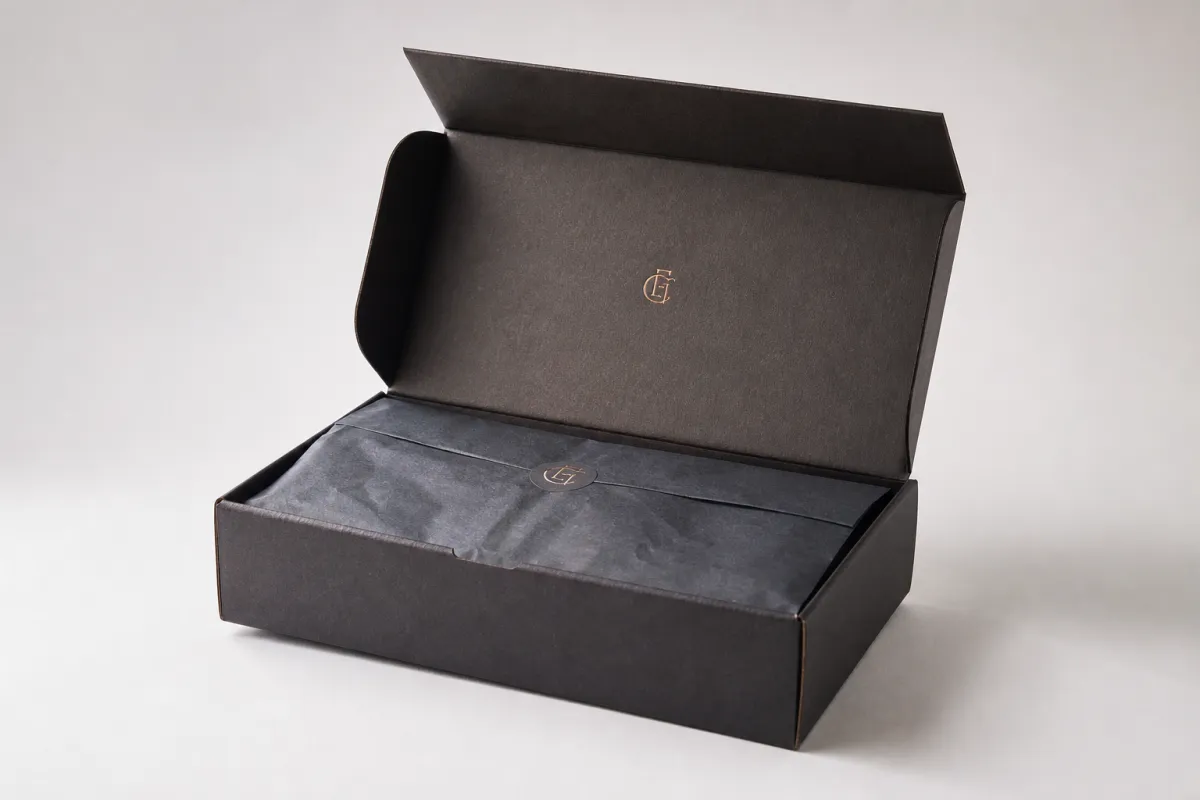
The outer box is structure and identity. The tissue is pacing and protection. They sound similar only if you have never watched someone open a well-packed order. A brand mark on the lid tells the customer what they bought. Tissue Makes Them Work to uncover it. That tiny bit of resistance changes the rhythm of the moment. Research on consumer behavior has long shown that people form fast judgments from small sensory cues, and packaging is full of those cues. Custom logo boxes with tissue paper create layers, and layers imply care.
That effect matters more than many teams expect. A package with visible layers feels intentional. A package with one thin shell and a product rattling inside feels improvised. The gap between the two is not subtle. It can decide whether the customer thinks they received a premium order or a basic shipment dressed up for a photo. Custom logo boxes with tissue paper work because they add a visual sequence: logo, fold, reveal, product. People trust sequences. They distrust chaos.
The tissue also carries a job that is easy to underestimate. It softens contact between the product and the carton walls, especially when the item has a printed, coated, embroidered, glossy, or polished surface. A folded shirt can handle more than a ceramic mug. A candle label with a coated finish can handle more than a raw paper wrap. A cosmetic kit with delicate print behaves differently than a stack of notebooks. In those cases, custom logo boxes with tissue paper protect the surface without demanding foam corners, rigid trays, or an oversized insert system that can quickly push costs upward.
There is a comparison worth making. A loud box with heavy print can impress for a moment, but if it arrives dented or scuffed, the impression collapses. A quieter box with thoughtful tissue often holds its value better because the whole package feels controlled. Customers do not separate the pieces in their heads. They judge the shipment as one object. That is why custom logo boxes with tissue paper are often the smarter choice for brands that care about both presentation and consistency.
Tissue is not magic, and it should never be treated like a substitute for fit. If the box is too large, the tissue becomes filler and the product still shifts. If the box is too tight, the folds buckle and the lid looks strained. The right answer is boring in the best possible way: size the box correctly, choose tissue that suits the product, and confirm that the closure can survive real handling. Boring specifications are what keep damage claims and rework from eating into margin.
"The strongest packaging usually feels calm. Nothing is fighting for attention, but nothing is accidental either. That balance is what customers read as quality."
How Custom Logo Boxes with Tissue Paper Work in the Shipping Flow
The packing sequence affects everything from labor time to the final reveal. A typical flow starts with the product centered in the box, followed by the tissue wrap or fold, then a seal, sticker, or tuck, then the lid closure. After that comes labeling and, in many cases, placement into a corrugated shipper. Custom logo boxes with tissue paper make that sequence feel smooth when the proportions are right. When they are not, every step starts to feel slightly awkward, and awkwardness shows up in labor costs before it shows up on the customer’s doorstep.
Tissue adds a buffer against friction. That matters for printed surfaces, embroidery, coated paper, gloss finishes, and other materials that can pick up marks during motion. Parcel shipping introduces vibration, compression, and small shifts that most product designers never see in a meeting room. The problem is not movement itself. The problem is uncontrolled rubbing. Custom logo boxes with tissue paper reduce that contact when the tissue is folded to keep the item from pressing hard into the board.
There is a difference between a package that looks full and one that actually holds the product in place. Visual fill is about appearance. Protective fill is about function. Tissue can help with both, but only up to a point. Heavy objects, brittle items, and products with sharp corners still need inserts or trays. Expecting tissue alone to manage impact is a fast way to create breakage and then spend a week comparing claim photos. Custom logo boxes with tissue paper should support protection, not pretend to replace it.
The opening experience gets better when the little things are planned. A branded sticker can hold the tissue in place. A card can sit on top with product information or a thank-you note. A tear strip can create a clean opening point. These details do more than decorate the box. They help custom logo boxes with tissue paper open in a sequence that feels deliberate instead of improvised. Nobody wants to dig through a crumpled nest of paper just to reach a folded shirt or a gift set.
Transit conditions change how tissue behaves. Humidity softens thinner sheets. Compression from stacked cartons can flatten folds. Long shipping lanes can turn a neat wrap into something more wrinkled than planned. Heavier tissue holds shape better, yet it also adds cost and can make the package bulkier than necessary. For that reason, custom logo boxes with tissue paper should be tested under the same conditions they will face in the real world. For transportation testing, ISTA is a useful reference point for parcel and package validation: ISTA.
Custom Logo Boxes with Tissue Paper Cost and Pricing Factors
Cost starts with structure, not branding. A stronger board, a specialty finish, or a custom cut can move the unit price faster than a logo ever will. Tissue adds another layer of spending, and it is easy to underestimate because the material looks light in the hand. Custom logo boxes with tissue paper are rarely expensive for one dramatic reason. They become expensive because several small decisions push the total upward at the same time.
The main cost drivers are straightforward: board grade, print coverage, tissue sheet count, tissue color, custom sizing, insert type, and whether the tissue carries print. Add a logo to the tissue and setup fees rise. Choose a dyed tissue that matches a brand color and the cost rises again. Push for a lower MOQ and the per-unit price usually climbs because setup is spread across fewer pieces. Packaging economics is rarely romantic. It is mostly arithmetic with a nicer finish.
MOQ deserves attention because it changes the shape of the budget. Small runs usually carry higher unit pricing since the factory has to cover die setup, print setup, and waste. With custom logo boxes with tissue paper, the box MOQ and the tissue MOQ may not line up neatly. A supplier may be able to produce one component at a different quantity than the other. That can help with flexibility, but it can also leave you with a pile of boxes and not enough tissue, or the reverse, if planning is sloppy.
A practical rule saves money: keep the outer structure simple if the product margin is thin, then use tissue to create the feeling of value. The box does not need to be loud. It needs to be clean, fit properly, and carry the brand in a way that does not look cheap. A one-color logo, a well-sized carton, and neat tissue inside can do more for perception than elaborate coverage. Custom logo boxes with tissue paper do not have to be visually aggressive to feel premium. Often the opposite is true.
Hidden costs usually arrive through freight, sampling, and labor. Freight can jump quickly when the box footprint is large, even if the item inside is light. Sample fees show up during proofing. Rush charges appear when a launch date gets tightened because a team waited too long to lock decisions. Hand-folding tissue, adding stickers, or assembling inserts also consumes labor in ways that are easy to ignore on a quote sheet. If you are comparing options, ask for all-in pricing. Custom logo boxes with tissue paper should be evaluated as a complete package, not as a collection of independent line items.
| Option | Typical Use | Approx. Cost Impact | Notes |
|---|---|---|---|
| Plain white tissue + one-color logo box | Apparel, gifts, entry-level retail packaging | Lowest | Best when you want branded packaging without much setup complexity. |
| Colored tissue + printed logo box | Premium product packaging, gift sets | Moderate | Improves presentation, but color matching and print setup add cost. |
| Custom-printed tissue + specialty-finish box | High-visibility launches, luxury kits | Highest | Strong package branding, but also the most setup, proofing, and waste. |
| Simple box + insert + plain tissue | Fragile or shift-prone items | Moderate to high | Often the best balance when protection matters more than heavy decoration. |
For paper sourcing, FSC certification is worth asking about if your brand claims responsible sourcing or if retail buyers expect traceable materials. It will not make the packaging prettier. It does make procurement conversations easier and gives marketing teams a cleaner basis for claims. More information on that standard is available here: FSC.
If you want a practical place to compare structural choices, inserts, and related components, start with Custom Packaging Products. Clear specs make budgets behave. Custom logo boxes with tissue paper tend to cost less, not more, once the build is defined instead of guessed.
One more thing from the buying side: ask whether the tissue is quoted by sheet count, by ream, or by finished pack-out. That sounds minor, but it changes how you compare suppliers. I have seen two quotes look close on paper and then diverge hard once one includes folding labor and the other assumes loose tissue only. The spec has to say exactly what "done" means, or the pricing gets fuzzy fast.
Production Process, Timeline, and Lead Time for Custom Logo Boxes with Tissue Paper
The production path is fairly predictable, which is one reason packaging teams like it. You submit dimensions, board preference, print requirements, and the tissue spec. The supplier confirms the dieline or structure. Artwork and proofing follow. Samples get reviewed. Production begins. Packing and shipment close the loop. Custom logo boxes with tissue paper move through that sequence faster when the dimensions are locked early and no one decides to revise the fold after approvals have already started.
Delays usually come from the same few places: artwork revisions, color approval, structural changes, and late decisions about tissue color or print. A box may be ready while tissue is still waiting for sign-off. An insert may need to change because the product team discovered the item is three millimeters taller than the previous sample. Those are small numbers with real consequences. Custom logo boxes with tissue paper reward disciplined project management because packaging work has very little patience for last-minute inspiration.
The timeline changes with complexity. Simple jobs can move quickly once proofs are approved. Specialty coatings, custom structures, printed tissue, and elaborate inserts add steps, and each step adds time. That is before freight enters the picture. Freight is a separate clock. A carton that leaves the factory on schedule can still miss a launch if ocean or air transit was never planned honestly. Comparing production time with shipping time is one of those simple habits that saves people from embarrassment later.
One of the best ways to protect a launch date is to lock dimensions early, approve a physical sample or pre-production proof, and avoid midstream changes. Revisions are possible, but they always cost time. Custom logo boxes with tissue paper are easiest to produce when the box size, tissue quantity, and closure method are all settled before mass production starts. Waiting until the last minute to decide how the tissue folds is not a strategy. It is a bill.
For product launches, buffer time matters. Leave a gap between production completion and the public launch. That margin covers freight delays, customs hold-ups, and the ordinary chaos that appears when cartons, tissue, and shipping schedules all collide. If the shipment crosses borders, add more time. If it stays domestic, add some anyway. Custom logo boxes with tissue paper do not care about your launch calendar. They only care whether the box has been built, packed, and moved on time.
A simple workflow note keeps teams aligned:
- Confirm product dimensions and weight.
- Choose the box structure and board grade.
- Approve the tissue color, size, and fold method.
- Review one physical sample or pre-production proof.
- Lock the pack-out method before production begins.
That list sounds basic because it is. Basic is good in packaging. Most avoidable mistakes come from people trying to skip one of those steps and hoping the final result will still behave. It usually does not. The order of operations matters more than the mood board.
Choosing the Right Box, Tissue, and Insert Specs
Box sizing comes first. A box that is too large invites movement, wastes material, and makes the presentation feel loose. A box that is too tight crushes the fold and can bow the lid. For custom logo boxes with tissue paper, the ideal fit leaves just enough room for the product and the tissue to sit naturally without creating a cavern or a clamp. The sweet spot is narrower than many people assume.
Tissue weight should match the product. Lighter tissue works well for apparel, gifts, and presentation-first packaging. Heavier tissue brings more body and better abrasion resistance. If the tissue tears the moment it is folded, the weight is too low for the application. If it fights the closure or bulks up the box, it is too heavy. Custom logo boxes with tissue paper need tissue that opens nicely, packs consistently, and still behaves after repeated handling.
Color changes the feel of the whole package. White and soft neutrals read clean and pair with almost any brand palette. Darker or dyed tissue can create a richer appearance, but it also shows creases and fold lines more readily. High contrast can be useful for package branding, yet too much contrast can make a small box feel cluttered. In many retail packaging contexts, muted brand colors tend to read as more expensive than loud full-coverage interiors. That is especially true when the product should remain the star.
Inserts are where protection becomes non-negotiable. Paperboard inserts work well for lightweight items and simple positioning. Molded pulp makes sense when you want a more responsible fitment and the product shape supports it. Folded cradles and tucked supports can be enough for soft goods. Fragile items need more than tissue. Custom logo boxes with tissue paper should include inserts whenever the product can shift, dent, or break under normal parcel handling.
Five questions help teams avoid guesswork:
- How heavy is the product?
- Does the surface scratch, scuff, or transfer color?
- How much movement can the product tolerate?
- Is the goal more protection or more presentation?
- What cost range can the margin actually support?
Answer those honestly and the spec becomes easier to solve. The right combination should open neatly, keep the product centered, and avoid overstuffing. That sounds obvious, yet plenty of custom logo boxes with tissue paper end up overdesigned because someone keeps adding decorative pieces after the practical spec is already settled. Extra embellishment rarely fixes a bad fit.
One practical field trick: test the package with gloved hands, not just careful hands. Packing line workers move differently than designers do, and the tissue has to behave in a real assembly rhythm. If a fold only works when one person handles it slowly and perfectly, the spec is probably too fragile for production. That is the kind of detail a mockup hides and a factory exposes.
Common Mistakes With Custom Logo Boxes with Tissue Paper
Overpacking is the first mistake. Too much tissue makes the box bulge, distorts the closure, and turns a clean reveal into a cramped mess. It also slows packers down because the fold stops behaving the same way from unit to unit. Custom logo boxes with tissue paper are supposed to look neat. When the lid has to fight its way shut, the entire package feels slightly off, even if the logo print is perfect.
Mismatch is the second problem. A beautiful logo box paired with flimsy tissue looks cheap immediately. The opposite is true as well: strong tissue inside a weak box that dents under stacking pressure creates a package that fails on contact. The customer does not separate the pieces in their mind. They judge the package as a whole. That is why custom logo boxes with tissue paper need matched material quality. The weak link is the one people remember.
Color transfer is another issue that often stays hidden until samples arrive marked or stained. Highly dyed tissue and some printed coatings can transfer onto light fabrics, uncoated paper, or porous finishes if contact testing is skipped. The real test is the actual product, not a swatch in a folder. Custom logo boxes with tissue paper deserve that extra check because any ink transfer quickly erases the savings from choosing a cheaper tissue spec.
Freight surprises show up more often than people admit. Tissue is light, but volume still matters. Oversized cartons take up more room in shipping, and dimensional weight pricing can make a "light" package cost more than expected. Packaging teams sometimes focus only on manufacturing cost and ignore how the finished goods will move through the freight network. Custom logo boxes with tissue paper can quietly increase shipping costs if the carton footprint is larger than it needs to be.
Skipping samples is probably the most expensive mistake in the whole process. A single prototype usually exposes the issues that the spec sheet hides: the fold is awkward, the logo sits too high, the tissue tears, the lid catches, or the insert leaves the product rattling inside the box. Catching that before a full run is the difference between a manageable correction and a warehouse full of almost-right packaging. Custom logo boxes with tissue paper are not difficult to execute, but they are very easy to get slightly wrong in ways that pile up.
Labor gets ignored too often. A polished tissue presentation may require more hand work than a simple insert-and-close pack-out. That labor should be counted in the real cost, not buried under a vague "presentation" line. Multiply an extra five seconds per box across 5,000 units and you have almost seven extra hours of work. Multiply that by a larger run and the number becomes impossible to ignore. The math is plain, even if the packaging looks elegant.
Another mistake is confusing decoration with structure. A metallic sticker, a custom printed sheet, or a fancy color palette will not fix a carton that is undersized or an insert that lets the product shift. I have seen teams spend extra on finishing effects and then lose the win because the box opened with a crooked crease. The customer does not grade packaging on effort. They grade it on how the package behaves in their hands.
Expert Tips and Next Steps for Custom Logo Boxes with Tissue Paper
Start with the product. Measure it carefully, not approximately. Note the weight, finish, and any fragile points. Then define the unboxing order: what the customer sees first, second, and third. After that, choose the box structure, then the tissue fold, then the color. That order saves time and removes guesswork. Custom logo boxes with tissue paper become much easier to manage when the package is treated like a sequence instead of a pile of attractive parts.
A one-page packaging spec is one of the most useful tools a team can create. Include dimensions, product weight, board grade, print area, tissue quantity, closure method, insert type, acceptable color range, and target cost range. If several teams touch the project, that sheet keeps people from drifting into different versions of reality. Custom logo boxes with tissue paper are simpler to source when everyone is looking at the same document instead of three different opinions and one vague mockup.
Order a sample run or at least a pre-production proof. Test the fit, the fold, the closure, and the way the package looks under real handling. If the product has a coating, print, embroidery, foil, or any surface that rubs easily, check for abrasion. If the package will ship through parcel networks, treat the sample as if it will be dropped, compressed, and handled by someone with no attachment to the brand. That is the real test. Custom logo boxes with tissue paper need to survive ordinary shipping conditions, not just a presentation table.
Approval workflow matters as much as the materials. Decide who signs off on design, who signs off on cost, and who signs off on operations. If those roles are unclear, every small change becomes a loop of internal debate. That delay usually costs more than the change itself. Teams that move efficiently on custom logo boxes with tissue paper tend to decide early and stay disciplined once the spec is set.
For retail packaging or subscription packaging at scale, the best version is the one you can repeat without drama. It should pack the same way every time, ship safely, and look consistent from run to run. That is the real standard. If you are still comparing options, review the structural choices in Custom Packaging Products and build from the product outward. Custom logo boxes with tissue paper are strongest when the spec is precise, practical, and repeatable.
The finish still matters, even after all the math is done. A clear logo, board that holds its shape, a tissue fold that does not bulge, and an insert that keeps the product centered all work together. None of that is mystical. It is simply packaging done with discipline. That discipline is usually enough. In the final count, custom logo boxes with tissue paper earn their place because they protect the product, support the brand, and make the unboxing feel like somebody paid attention.
If you are defining this packaging for the first time, the most reliable starting point is not the print file. It is the pack-out test. Lock the product dimensions, choose the lightest tissue that still protects the surface, and test one full sample through the same shipping path the order will actually follow. If the box closes cleanly, the product stays centered, and the tissue still looks composed after transit, you have the right base. From there, the branding is the easy part.
How many sheets of tissue do I need for custom logo boxes with tissue paper?
Most light products need 1 to 3 sheets, depending on size and how much visual fill you want. Use more sheets only when the tissue is doing real work, such as reducing scuffs or keeping the product centered. If the box begins to bulge or the lid resists closure, too much tissue is the likely culprit. That stays true for custom logo boxes with tissue paper no matter how polished the mockup appears.
Are custom logo boxes with tissue paper enough protection for fragile items?
Not by themselves if the item can break, dent, or shift hard during transit. Pair tissue with an insert, rigid inner tray, cushioning, or another fitment when the product needs impact control. Tissue is best for surface protection and presentation, not as the only shock absorber. For fragile shipments, custom logo boxes with tissue paper should be part of a system, not the whole system.
What affects the MOQ for custom logo boxes with tissue paper?
MOQ usually depends on box size, print complexity, tissue customization, and whether the supplier is running a standard or fully custom job. Custom-printed tissue often raises MOQ because it adds setup and manufacturing waste. If you need a lower MOQ, simplify the box print and keep the tissue unprinted or single-color. That keeps custom logo boxes with tissue paper more practical for smaller launches.
How long does production usually take for custom logo boxes with tissue paper?
Simple packaging jobs move faster than fully custom structures with specialty finishes or printed tissue. Most delays come from artwork revisions, sample approvals, and late changes to dimensions or fold style. Production time and shipping time are separate, so plan both before setting a launch date. With custom logo boxes with tissue paper, the calendar matters almost as much as the spec.
What tissue paper weight works best for custom logo boxes with tissue paper?
Lighter tissue works well for clothing, gifts, and premium presentation. Heavier tissue is better when you need more structure, less tearing, or a neater fold around irregular items. Test the weight against your product surface so the finish does not rub, crease, or transfer color. The right weight makes custom logo boxes with tissue paper feel intentional instead of overstuffed.
Should the tissue match the box color exactly?
Not always. Exact matching can look elegant, but it can also make the package feel flat if the tones are too close. A deliberate contrast often creates more depth, especially with a restrained logo and a clean fold. The safer move is to test one neutral option and one brand color side by side, then decide which version still looks good after handling. That is a practical way to keep custom logo boxes with tissue paper from looking overdesigned.

